Checked on 14 November 2026 against official pages from the Deposit Insurance Corporation of Japan (DICJ), the Financial Services Agency, Japan Post Bank, the Agricultural and Fishery Co-operative Savings Insurance Corporation and the Japan Investor Protection Fund (JIPF), and the text of the Deposit Insurance Act, the Financial Instruments and Exchange Act and the Banking Act enforcement rules (e-Gov). This guide does not recommend any bank or securities firm.
The short answer
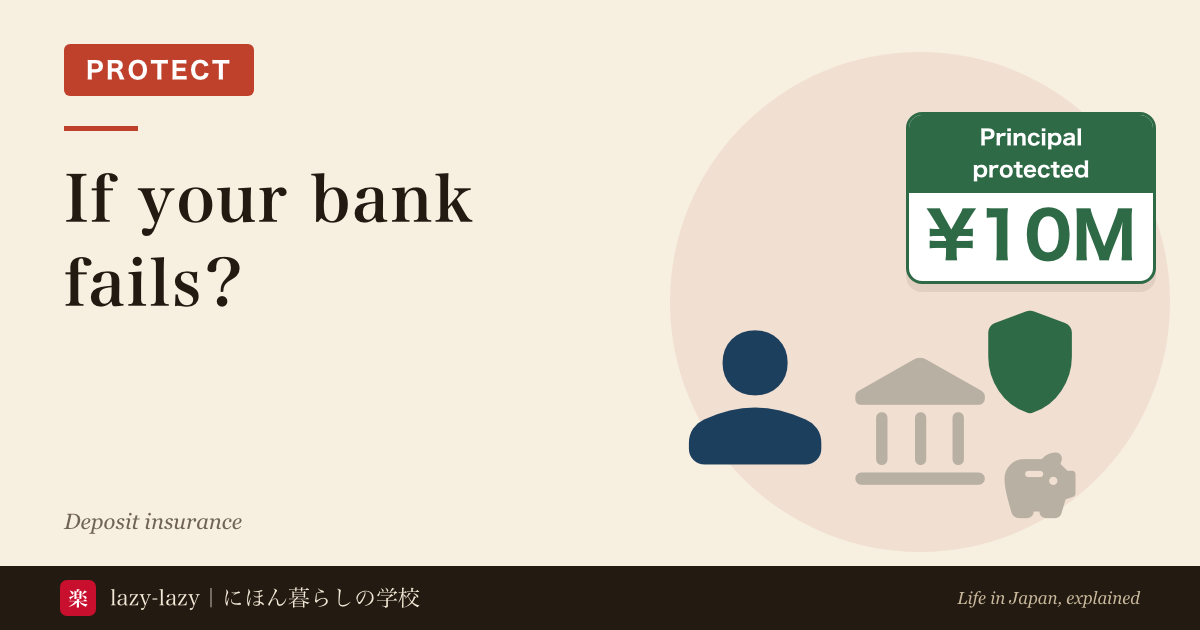
- Deposit insurance protects your deposits up to a set amount if a bank fails. Interest-bearing ordinary and time deposits are protected up to 10 million yen of principal plus interest to the date of failure, per institution. Settlement deposits, which pay no interest, are protected in full.
- Neither the Deposit Insurance Act nor the DICJ sets any nationality or residence-status condition. What matters is whether the institution has its head office in Japan, the type of deposit, and whether the account is in your own name. There is nothing to sign up for and nothing to pay.
- Foreign-currency deposits and Japan branches of foreign banks are not covered. Investment funds and government bonds bought at a bank counter are not covered by deposit insurance either.
- If a securities firm fails, your shares and funds come back as a rule. Firms must keep customer assets apart from their own. Only if something cannot be returned does the Japan Investor Protection Fund pay, up to 10 million yen per person.
- There is no need to rush to the bank when you hear bad news. Keeping your name and address up to date with the bank, and never using someone else’s name, is what you can do now.
Knowing this, you can say exactly which part of your money is protected and which part is not. You can decide where to keep it yourself, instead of reacting to headlines.
The bank your salary goes into is in the news. The report says it is struggling. Your account holds next year’s tuition and the money for your flight home. You also have a fund you have been building up bit by bit in a brokerage account. A Japanese friend says, “Up to 10 million yen is safe, I think.” But your friend does not know whether that applies to foreign residents, or what happens to foreign-currency deposits and brokerage accounts.
- What is the deposit insurance limit in Japan? 10 million yen plus interest per bank
- Are foreign residents covered by deposit insurance? It depends on where, what and whose name
- How is the 10 million yen counted? Everything at one institution is added up
- Are foreign-currency deposits, funds and bonds protected? None are covered by deposit insurance
- Japan Post Bank, online banks, shinkin banks, foreign bank branches? It depends on the head office
- What happens to shares, funds and NISA if a broker fails? Segregation and the Japan Investor Protection Fund
- What should you do if a bank or broker fails? Do not rush, and watch for the announcement and deadline
- Does it cost anything, and what can you do now? Nothing to pay; keep records and placement in order
- Which one are you?
- FAQ
- Bottom line
- Related reading
What is the deposit insurance limit in Japan? 10 million yen plus interest per bank
If a bank fails, your deposits do not drop to zero. According to the Deposit Insurance Corporation of Japan (Japanese), how much is protected depends on the type of deposit. The 10 million yen figure people talk about, sometimes called the “payoff” limit, is the cap for general deposits.
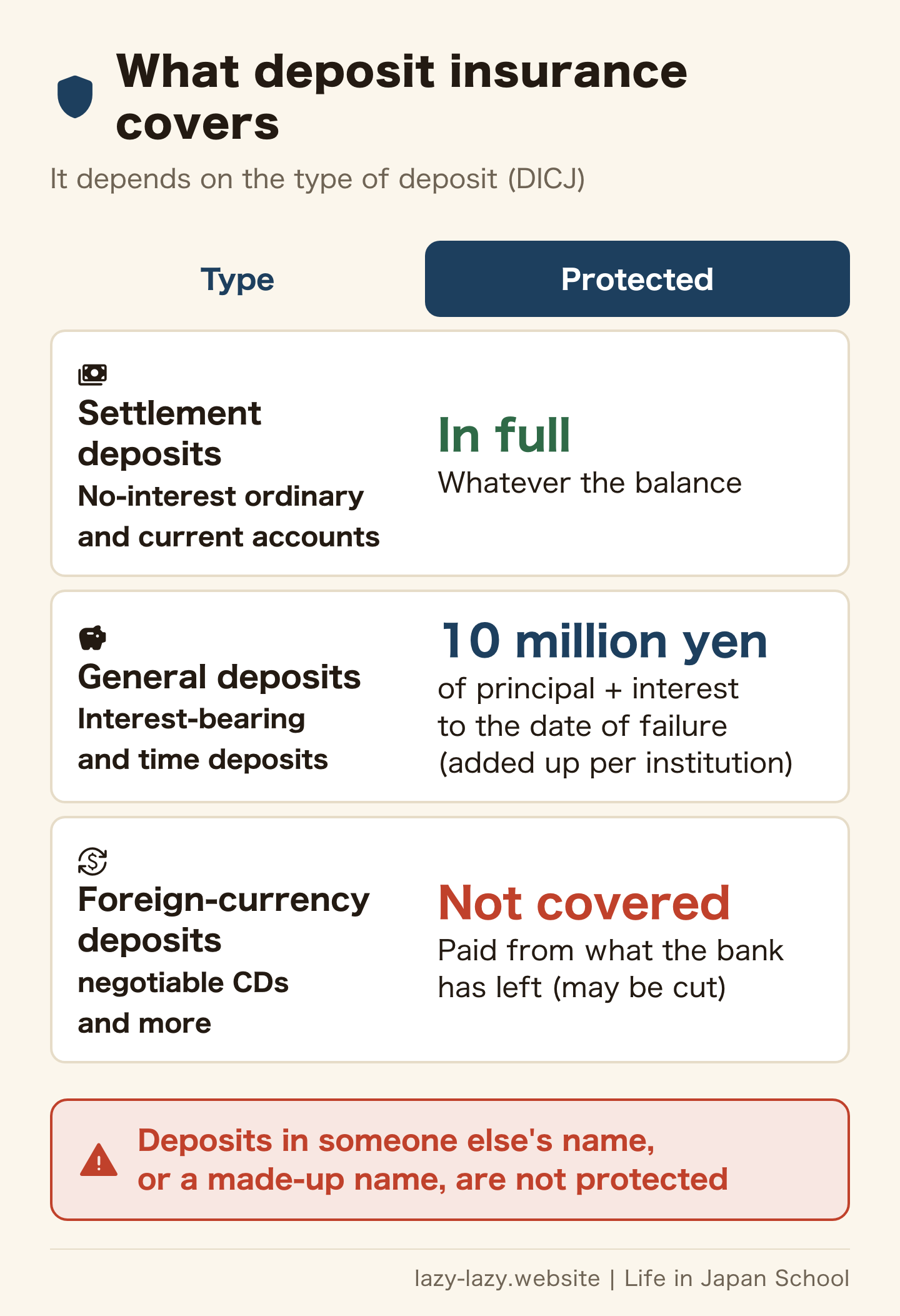
A settlement deposit meets three conditions: it pays no interest, you can withdraw it at any time, and it can be used for direct debits or receiving pay. The DICJ (Japanese) says what counts is whether the product can be used that way, not whether you actually use it for debits. Individuals who do not run a business can open one too (Japanese). Names and procedures differ by institution, so ask your bank.
Anything above 10 million yen does not simply vanish. It is paid later, depending on what the failed bank has left. Part of it may be cut.
Are foreign residents covered by deposit insurance? It depends on where, what and whose name
The Deposit Insurance Act says that when a covered institution takes deposits, an insurance relationship forms for each depositor (Article 49, Japanese). What falls outside protection is things like deposits held in someone else’s name. Neither the Act nor the DICJ’s explanation sets any condition about nationality or residence status.
You do not have to do anything. According to the DICJ (Japanese), the insurance relationship forms automatically when you deposit money at a covered institution. The premiums are paid by the institutions, not by depositors.
The thing to watch is the name on the account. Deposits in someone else’s name, or a made-up name, are not protected. Keeping money in a friend’s account, or letting someone use yours, takes you outside protection. Handing over your passbook or cash card for someone else to use is prohibited under the Act on Prevention of Transfer of Criminal Proceeds (Japanese). The risks of handing over an account you no longer use are covered in tidying up your bank accounts. Deposits in a family member’s name count as that person’s own. If you only borrowed their name, it counts as someone else’s name.
How is the 10 million yen counted? Everything at one institution is added up
The 10 million yen limit is not per account. If you have several accounts at the same institution, everything in your name is added together. This is called name aggregation (nayose, Japanese). Different branches of the same institution are still added together.
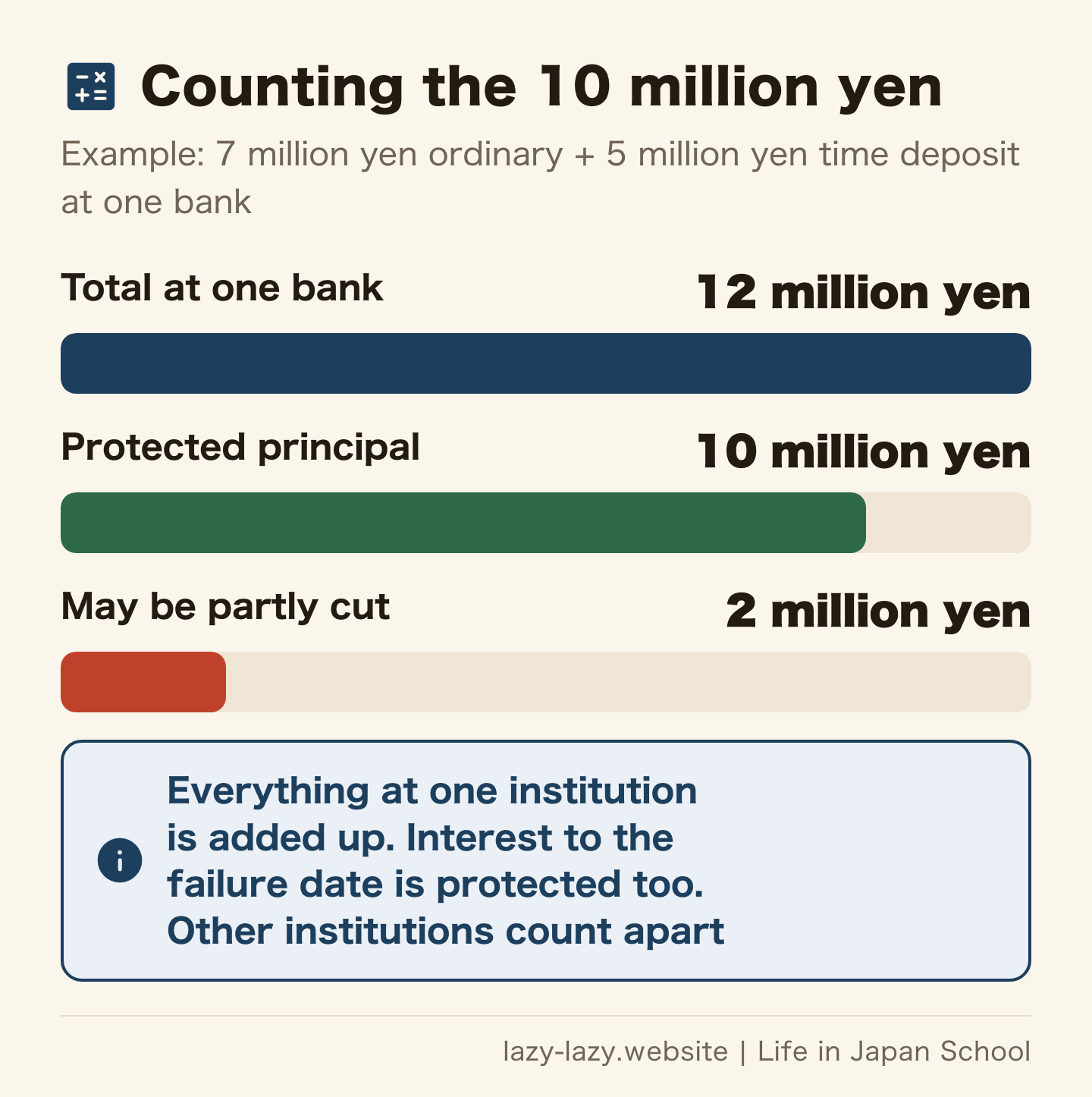
Say you have 7 million yen in an interest-bearing ordinary account and 5 million yen in a time deposit at the same bank. That makes 12 million yen. The protected amount is 10 million yen of principal plus interest to the date of failure. The other 2 million yen may be partly cut. Deposits at a different institution are counted separately.
Aggregation uses the name, date of birth, address and other details the bank has on file. The DICJ asks depositors to update their bank promptly when they move or change their name. Out-of-date records can slow down repayment. Do it for each bank where you hold an account.
There is a special rule for mergers. For one year after institutions merge, the cap is 10 million yen times the number of institutions involved. A merger of two banks means 20 million yen.
Are foreign-currency deposits, funds and bonds protected? None are covered by deposit insurance
Some people think moving into a higher-interest dollar deposit is the safe choice. Where you come from, holding US dollars rather than your own currency may be seen as the safe option. In Japan, foreign-currency deposits at a bank are not covered by deposit insurance.
According to the DICJ (Japanese), foreign-currency deposits are paid depending on what the failed bank has left, and part may be cut. They are eligible for “estimated payment”, where the DICJ pays out early at an estimated rate. Their value in yen also moves with exchange rates, unlike a yen deposit. Why foreign-currency deposits do not suit living-cost money is also covered in where to keep an emergency fund.
Investment funds and government bonds bought at a bank counter are not covered by deposit insurance (Japanese). They are protected in other ways. Government bonds are issued by the state, so even if the bank that sold them fails, the state pays the principal and interest. A fund’s assets are held by the trustee (such as a trust bank), kept apart from the trustee’s own assets. That does not change if the bank you bought the fund from fails. Funds are paid out according to the value of those assets, though, so price falls are not protected. When banks sell funds and similar products, they must explain (Japanese) that they are not deposits, not covered by deposit insurance, and that the principal is not guaranteed (Banking Act enforcement rules, Article 13-5). So even at one bank counter, deposits are protected by deposit insurance, government bonds by the state’s payment, and funds by the trustee keeping assets separate.
Japan Post Bank, online banks, shinkin banks, foreign bank branches? It depends on the head office
Whether you are covered does not depend on a bank’s size or reputation. According to the DICJ (Japanese), banks, shinkin banks, credit cooperatives, labour banks and similar institutions with a head office in Japan are covered. Their overseas branches are not, and nor are the Japan branches of foreign banks.
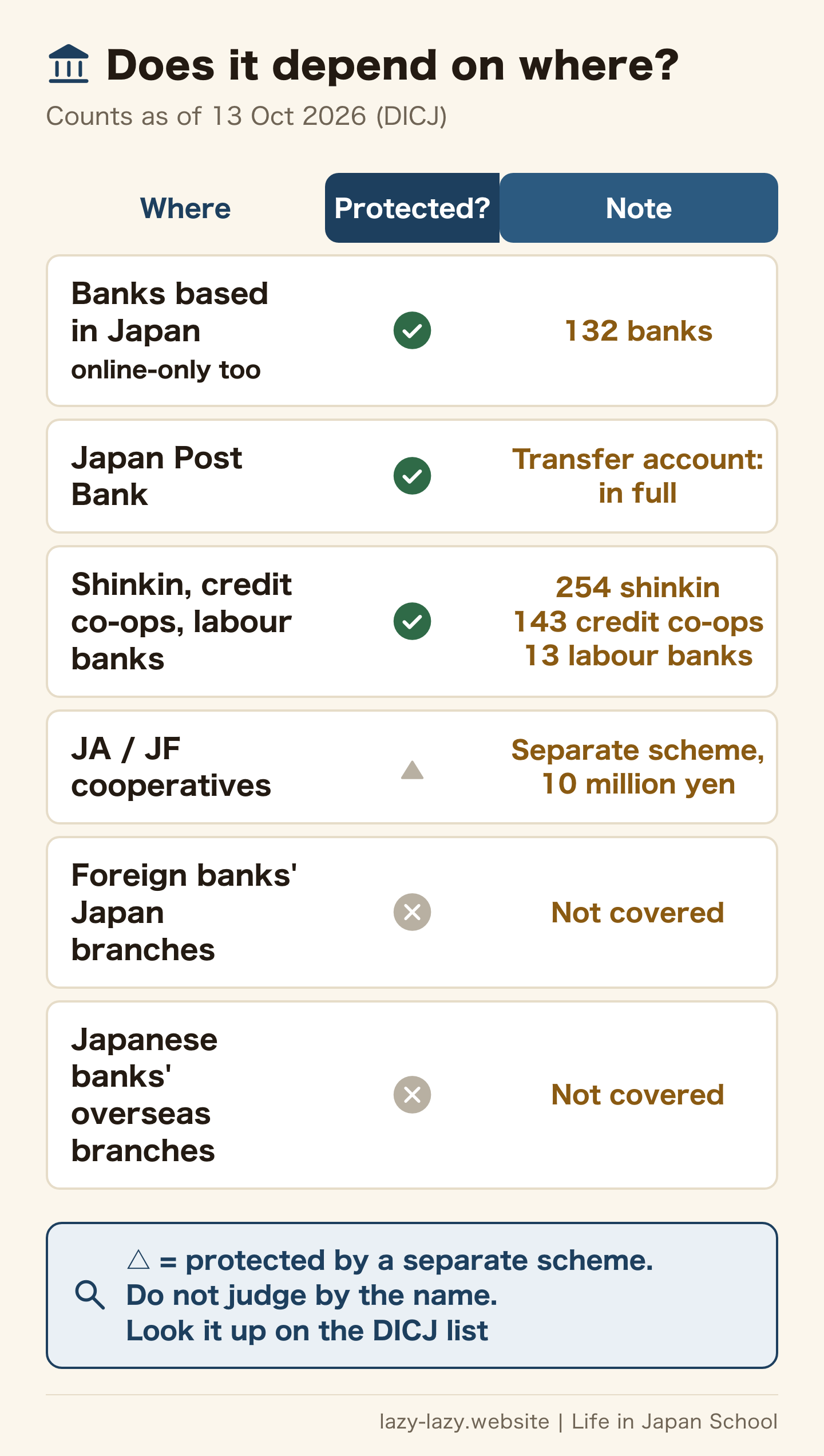
- Online-only banks: covered if they are banks with a head office in Japan. They appear on the DICJ list of covered institutions (Japanese; 132 banks as of 13 October 2026).
- Japan Post Bank: its savings are covered by deposit insurance (Japanese), up to 10 million yen of principal plus interest. Money in its no-interest transfer account is protected in full. Fixed-amount postal savings placed before privatisation in October 2007 still carry a separate government guarantee.
- Shinkin banks, credit cooperatives and labour banks: covered. The list shows 254 shinkin banks, 143 credit cooperatives and 13 labour banks.
- JA and JF cooperatives: protected by a separate savings insurance scheme (Japanese). Ordinary and time savings are protected up to 10 million yen of principal plus interest per cooperative.
- Japan branches of foreign banks: not covered. If you keep money at the Japan branch of a bank from your home country, ask that bank how it is protected.
Japan Post Bank also has deposit limits: 13 million yen for ordinary savings and 13 million yen for fixed-term savings (postal savings placed before privatisation count towards this). Note that the deposit limit is higher than what deposit insurance protects, which is 10 million yen of principal. Do not judge by a bank’s name. Looking it up on the DICJ list is the sure way.
What happens to shares, funds and NISA if a broker fails? Segregation and the Japan Investor Protection Fund
Brokerage accounts are protected by two systems that are separate from deposit insurance. The first is segregation: securities firms must keep the shares, funds and cash they hold for customers apart from their own assets (Financial Instruments and Exchange Act, Article 43-2, Japanese).
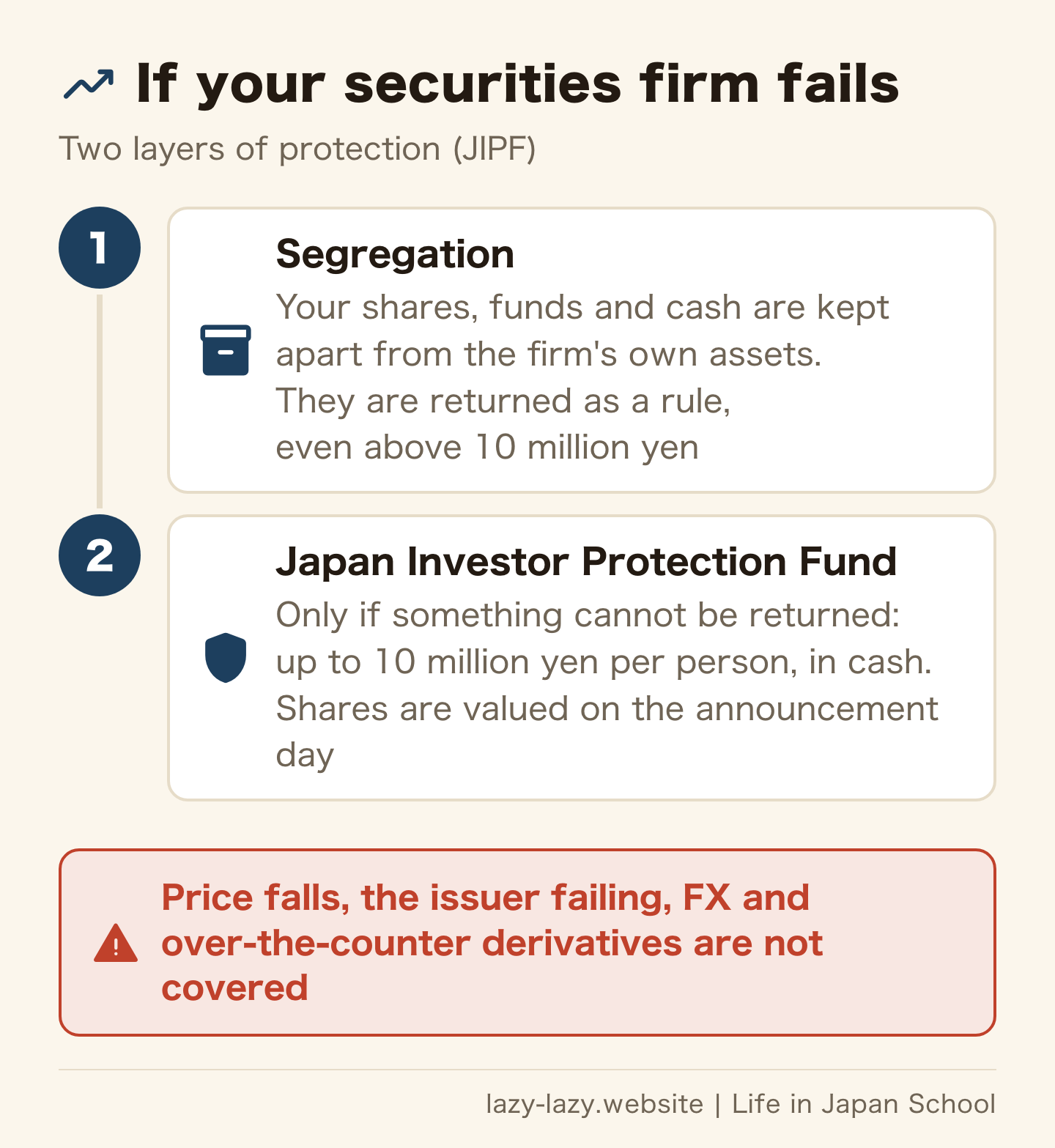
According to the Japan Investor Protection Fund (English), if assets are properly segregated, they are returned to customers as a rule even when the firm fails. That holds even if you have more than 10 million yen there. The second system is the fund’s compensation. Only if segregation has failed and something cannot be returned does the fund pay, up to 10 million yen per person, in cash. Securities are valued at market price on the day the fund announces compensation.
This is not insurance against losses. The fund does not cover (English) falls in price, the failure of the company that issued a share or bond, or damage from poor explanations at the time of sale. FX, over-the-counter derivatives and derivatives on foreign exchanges are not covered either. Do not assume a product you were told “can only go up” is protected. How to spot that kind of pitch is in our guide to MLM and get-rich offers.
Online-only securities firms are legally required to join the fund too. Investment funds bought at a bank or other non-securities firm are not covered by the fund, although banks must also segregate customer assets. According to the fund’s explanation (English), compensation is for general customers, excluding professional investors such as financial institutions, and the national and local governments. It does not mention nationality.
NISA is a type of tax-free account. We found no separate rule for NISA accounts in the Financial Instruments and Exchange Act or in the fund’s explanation. The shares and funds inside follow the same segregation and fund rules as any other account. How foreign residents open a NISA, and what happens when you leave Japan, is in NISA for foreigners in Japan.
What should you do if a bank or broker fails? Do not rush, and watch for the announcement and deadline
You hear a bank is in trouble and you go straight to the counter to queue. Where you come from, that may be normal. In Japan, the DICJ advises (Japanese) that there is no need to rush to withdraw deposits that are protected. Payment of the unprotected part is settled fairly with a court involved. Getting there first does not get you more.
- When repayment starts: under the method the DICJ prefers, where a rescuing institution takes over the failed bank’s business (financial assistance), if a bank fails on a Friday, the aim is to start repayment the following Monday. Interest is calculated daily up to the date of failure.
- Transfers you requested before the failure: protected in full as settlement obligations, and carried out.
- Money you have borrowed from the bank: you still have to repay it after a failure. If you have borrowed from the failed bank, you may be able to offset the loan against your deposits. Using the part above 10 million yen, which might be partly cut, for the offset has the same effect as avoiding the cut. Offsetting is not automatic (Japanese): you apply yourself after the failure. Deposits bought through estimated payment can no longer be offset, so offset before that.
- Securities firms: once the fund announces compensation, you claim within the set filing period. After that, you cannot claim (Financial Instruments and Exchange Act, Article 79-56, Japanese), unless the fund accepts a disaster or other unavoidable reason. If the fund has made no announcement, you cannot ask for compensation.
A failure can also become an excuse for scams. DICJ staff will never (Japanese) phone or visit to ask for your account number, or take your card, passbook or cash. The JIPF and securities firms will never (Japanese) ask you to deposit money, such as a guarantee, to receive compensation. If you get a call like that, do not pay, and call the police consultation line #9110. Common tricks are listed in scams targeting foreigners in Japan.
Does it cost anything, and what can you do now? Nothing to pay; keep records and placement in order
You pay nothing for deposit insurance or the investor protection fund. Banks and securities firms pay the premiums. What you can do is keep your records up to date and decide where your money sits.
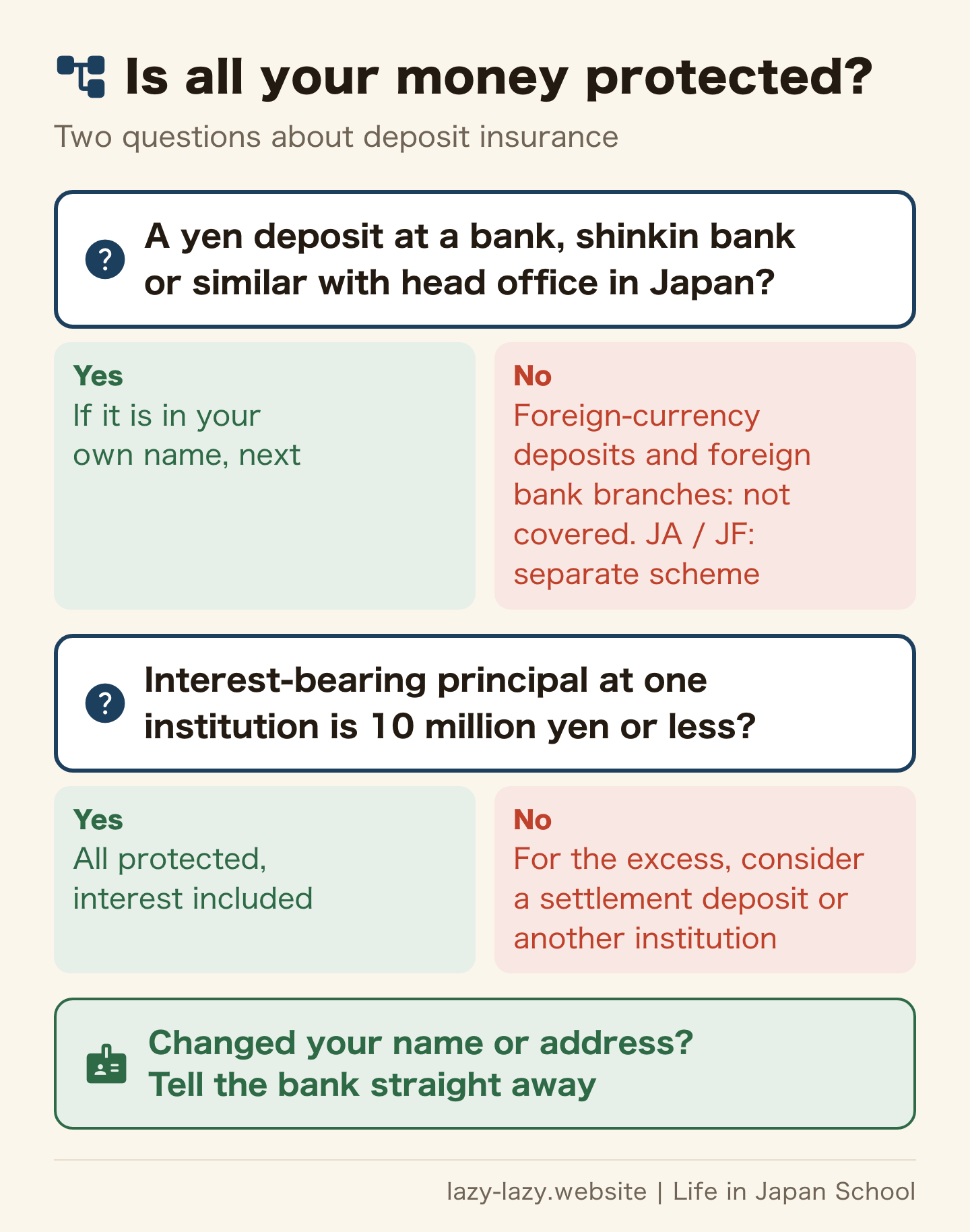
- Check your institution is covered: look up each bank where you hold an account on the DICJ list (Japanese).
- Add up each institution: if interest-bearing principal at one institution is above 10 million yen, decide where the excess should go, either a settlement deposit or another institution.
- Keep your name and address current: when you move, tell every bank and securities firm where you hold an account.
- Use only your own name: deposits in someone else’s name are not protected. Do not borrow anyone’s account, and do not lend yours.
- Check your broker’s segregation: firms are audited on segregation every year, and the results are published on their websites and elsewhere.
Which one are you?
- You only have yen deposits, and less than 10 million yen at any one bank: today, just check that each bank you use is on the DICJ list.
- You have more than 10 million yen of principal at one bank: today, add up your interest-bearing deposits there and set a date to ask the bank about where the excess could go.
- You have foreign-currency deposits, or money at a foreign bank’s Japan branch: today, knowing it is outside deposit insurance, decide whether to keep your living-cost money in a yen deposit instead.
- You hold shares or funds in a brokerage account: today, find where your broker publishes its segregation audit results.
- You recently moved or changed your name: today, count the banks and securities firms where you hold accounts, and update any you have not told.
FAQ
Q. Are foreign residents’ deposits protected by deposit insurance in Japan?
The Deposit Insurance Act and the DICJ set no condition about nationality or residence status. A yen deposit in your own name at an institution with a head office in Japan is protected up to 10 million yen of principal plus interest to the date of failure, per institution. There is nothing to sign up for and nothing to pay.
Q. What happens to deposits above 10 million yen if a Japanese bank fails?
They do not simply vanish. They are paid later, depending on what the failed bank has left, and part may be cut. Settlement deposits that pay no interest are protected in full, whatever the amount.
Q. Are foreign-currency deposits covered by deposit insurance?
No. Foreign-currency deposits are outside deposit insurance. They are paid depending on what the failed bank has left, and part may be cut. Investment funds and government bonds bought at a bank counter are not covered either.
Q. What happens to my shares, funds and NISA if my broker fails?
Securities firms must keep customer assets apart from their own, so they are returned as a rule. Only if something cannot be returned does the Japan Investor Protection Fund pay, up to 10 million yen per person. We found no separate rule for NISA accounts, so the same rules apply. Losses from price falls are not covered.
Q. Are Japan Post Bank and online banks covered?
Yes. Japan Post Bank savings are protected up to 10 million yen of principal plus interest, and its transfer account is protected in full. Online-only banks are covered if they are banks with a head office in Japan. You can check on the DICJ list of covered institutions.
Q. Is money at a foreign bank’s Japan branch protected?
Japan branches of foreign banks are outside deposit insurance. Overseas branches of Japanese banks are outside it too. If you keep money at the Japan branch of a bank from your home country, ask that bank how it is protected.
Bottom line
If a Japanese bank fails, interest-bearing deposits are protected up to 10 million yen of principal plus interest per institution, and settlement deposits in full. Neither the Deposit Insurance Act nor the DICJ sets any nationality or residence-status condition: what counts is where the money is, what type of deposit it is, and whose name it is in. Foreign-currency deposits, Japan branches of foreign banks, and funds bought at a bank counter sit outside deposit insurance.
Shares and funds in a brokerage account come back as a rule through segregation. The Japan Investor Protection Fund covers only what cannot be returned, up to 10 million yen per person. There is no need to panic at a headline. Today’s task: look up your banks on the DICJ list, and check that your name and address are up to date with each one.
Sources (official, Japanese unless noted): DICJ, scope of protection / DICJ, basics of deposit insurance / DICJ, if an institution fails / DICJ, name aggregation / DICJ, covered institutions / DICJ, FAQ / DICJ, scams using its name / Financial Services Agency, deposit insurance / Japan Post Bank, basic terms / Agricultural and Fishery Co-operative Savings Insurance Corporation, scope of protection / JIPF, what it protects (English) / JIPF, Q&A (English) / JIPF, warning about fake contacts / Deposit Insurance Act / Financial Instruments and Exchange Act / Ordinance for Enforcement of the Banking Act (all checked 14 November 2026)
Related reading
WHO WROTE THIS

mori
Japanese. I read the ministries’ own notices, orders and Q&As in the original, and I start from what my Nepalese and Sri Lankan friends in Japan actually ran into. I do not write about what I have not checked or been told.
What this site can and cannot do →Looking for something else?
You may use the figures in this article, including commercially, if you credit this site with a link. How to use our figures