This article was checked on 5 November 2026 against the e-Gov law texts, Immigration Services Agency guidance, official pages from MUFG Bank, Zengin-Net, Japan Post Bank and Japan Post, and notices from Nagoya, Nishinomiya, Kyoto and other municipalities. On that date we could not find the 2026-27 notices for post offices or Japan Post Bank.
In short
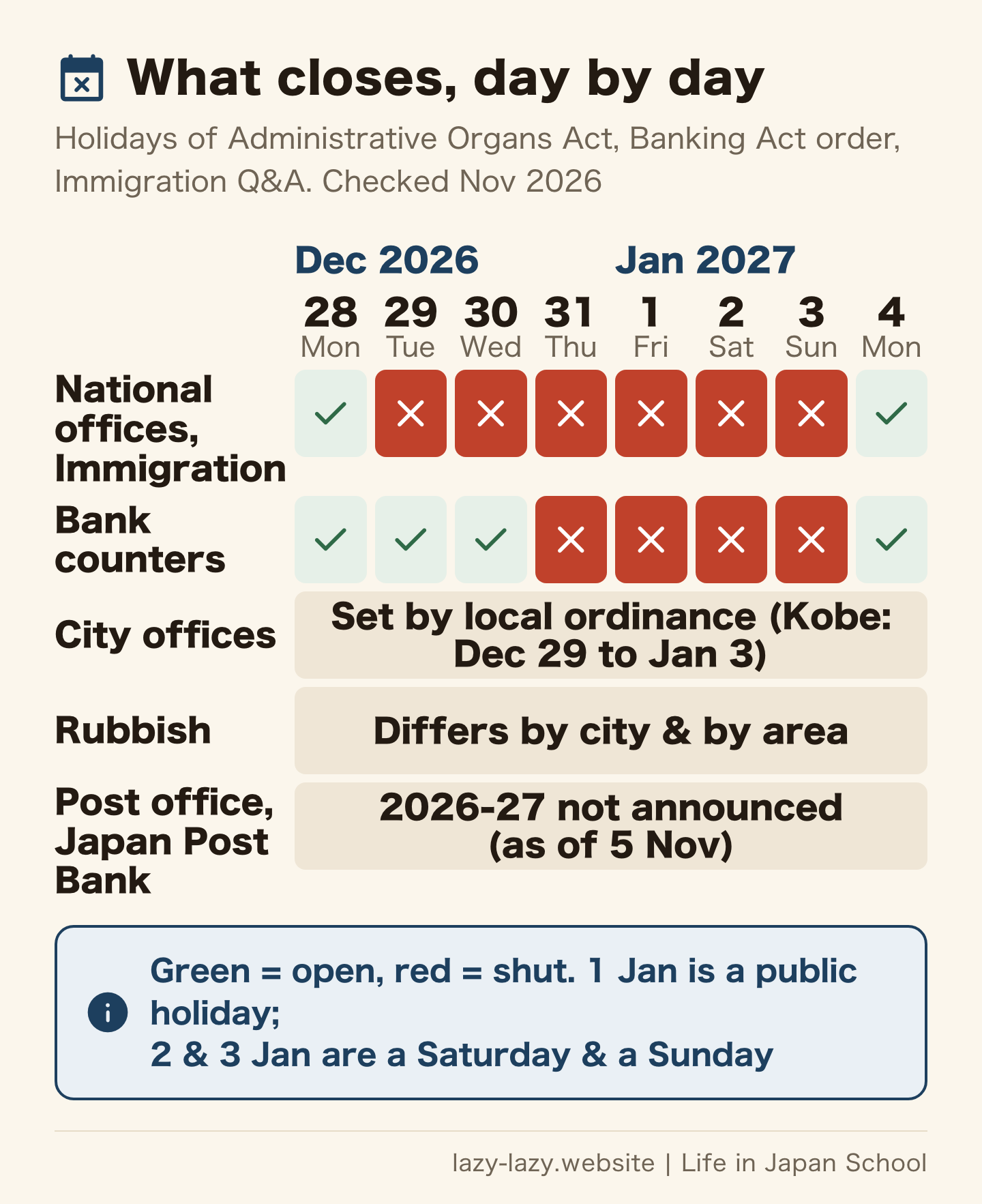
- The New Year holidays set by law are December 29 to January 3 for national government offices and December 31 to January 3 for bank counters. In 2026-27, both reopen on Monday January 4.
- The last Immigration counter day of the year is Monday December 28. If your period of stay ends over New Year, the safe move is to apply by that day. Online filing does not work on the expiry date itself.
- City offices and rubbish have no single national schedule. They differ by ordinance and by area, so check your own municipality.
- For a transfer to another bank, finishing by midday on Wednesday December 30 leaves a safe margin. At MUFG Bank ATMs the line is 15:00 on weekdays, and times differ by bank. From December 31 to January 3, it may be handled as January 4, the next weekday.
- Post office and Japan Post Bank hours for 2026-27 were not announced as of November 5. Do not apply last year’s hours to this year.
Knowing this, you can decide today which day in December clears your visa deadline, rent and moving notice. You will not be rushing to a counter on January 4.
It is early December. You look at your residence card and the expiry date is January 2. A month away, so the renewal can wait until the new year. That is the thought. But the Immigration counters close from December 29. Online filing does not work on the expiry date itself either. Your Japanese friends may not have an answer. People without a period of stay have never needed to look up Immigration’s New Year hours. Banks, rubbish and clinics all stop on different days too.
- When do Japan’s New Year holidays start in 2026-27?
- What is closed in Japan during New Year? City offices depend on your municipality
- Is the immigration office open over New Year? Count back from December 28
- Are banks and ATMs open at New Year? Counters run to December 30
- When do New Year bank transfers arrive? Midday on December 30 is the safe line
- Japan Post office and Japan Post Bank New Year hours: not announced yet
- New Year garbage collection: it depends on your city and area
- Are clinics open at New Year? Find what is open first
- Student part-time work in winter break: 8 hours a day only in a school-rule long vacation
- What if you miss a deadline? Move on the morning of January 4
- Which one are you?
- Frequently asked questions
- Q. When are city offices closed over New Year in Japan?
- Q. Can I apply online to Immigration over New Year?
- Q. My period of stay ends on January 2. Is it fine to go to Immigration on January 4?
- Q. When do bank transfers arrive over New Year in Japan?
- Q. What are the Japan Post and Japan Post Bank New Year hours?
- Q. Until when can I put out garbage over New Year?
- Summary
- Related guides
When do Japan’s New Year holidays start in 2026-27?
National government offices are closed from December 29 to January 3. That comes from Article 1 of the Act on Holidays of Administrative Organs (in Japanese). In 2026 the last open day is Monday December 28, and offices reopen on Monday January 4, 2027.
Banks follow a separate rule. Article 5 of the Order for Enforcement of the Banking Act (in Japanese) makes December 31 to January 3 bank holidays. So Tuesday December 29 and Wednesday December 30 are days when banks open even though government offices are shut.
What is closed in Japan during New Year? City offices depend on your municipality
Municipal holidays are set by each local ordinance, under Article 4-2 of the Local Autonomy Act (in Japanese). That includes which New Year days are holidays. So there is no single national schedule.
- Kobe’s ward offices, branch offices and sub-branches close from December 29 to January 3 (in Japanese).
- Yokohama’s administrative service corners are also closed from December 29 to January 3 (in Japanese).
Search your municipality’s website for its New Year counter hours (年末年始 窓口). Look for the closing days, and also whether hours are shorter on the last day of the year.
Getting a certificate at a convenience store may stop too. In Sagamihara, the service is suspended from December 29 to January 3 (in Japanese). Fukuoka Prefecture’s guide (in Japanese) also excludes December 29 to January 3 and maintenance days. Check whether it stops in your municipality.
Your 14-day moving notice may fall over New Year. Yokohama says that when the 14th day is a closed day, the next open day becomes the last day (in Japanese). The rule behind it is Article 4-2, paragraph 4 of the Local Autonomy Act (in Japanese), and it does not apply where a law or order says otherwise. If you can, finish your 14-day residence registration within the year.
Marriage registration works a little differently. In Yokohama, family register notices are held at the night and holiday desk on closed days (in Japanese). Osaka also takes them through its duty staff on holidays, then reviews them and decides on an open day (in Japanese). But Osaka says address changes cannot be left at the night and holiday desk. Check the place and hours with your own municipality.
Is the immigration office open over New Year? Count back from December 28
If a deadline falls on a holiday, you can just go after the holiday. Where you come from, that may be normal. In Japan, do not rely on that for your period of stay.
Immigration offices are closed on weekends, public holidays and December 29 to January 3 (Q20, in Japanese). The counter for renewals takes applications on weekdays from 9:00 to 12:00 and 13:00 to 16:00 (in Japanese). So the last counter time of the year is 16:00 on Monday December 28. Days and hours can differ by procedure and office, so check your own office first.
There is a law that moves an application deadline set as a “period” by law or order to the day after a holiday (in Japanese) (Article 2, unless another rule applies). But we could not find how a closed-day expiry is handled in Immigration’s Q&A, renewal page or online guidance. Do not count on an extension. Apply before the closed days. If you are unsure, call the Immigration Information Center at 0570-013904 (in Japanese). It answers on weekdays from 8:30 to 17:15, and it is closed from December 29 to January 3.
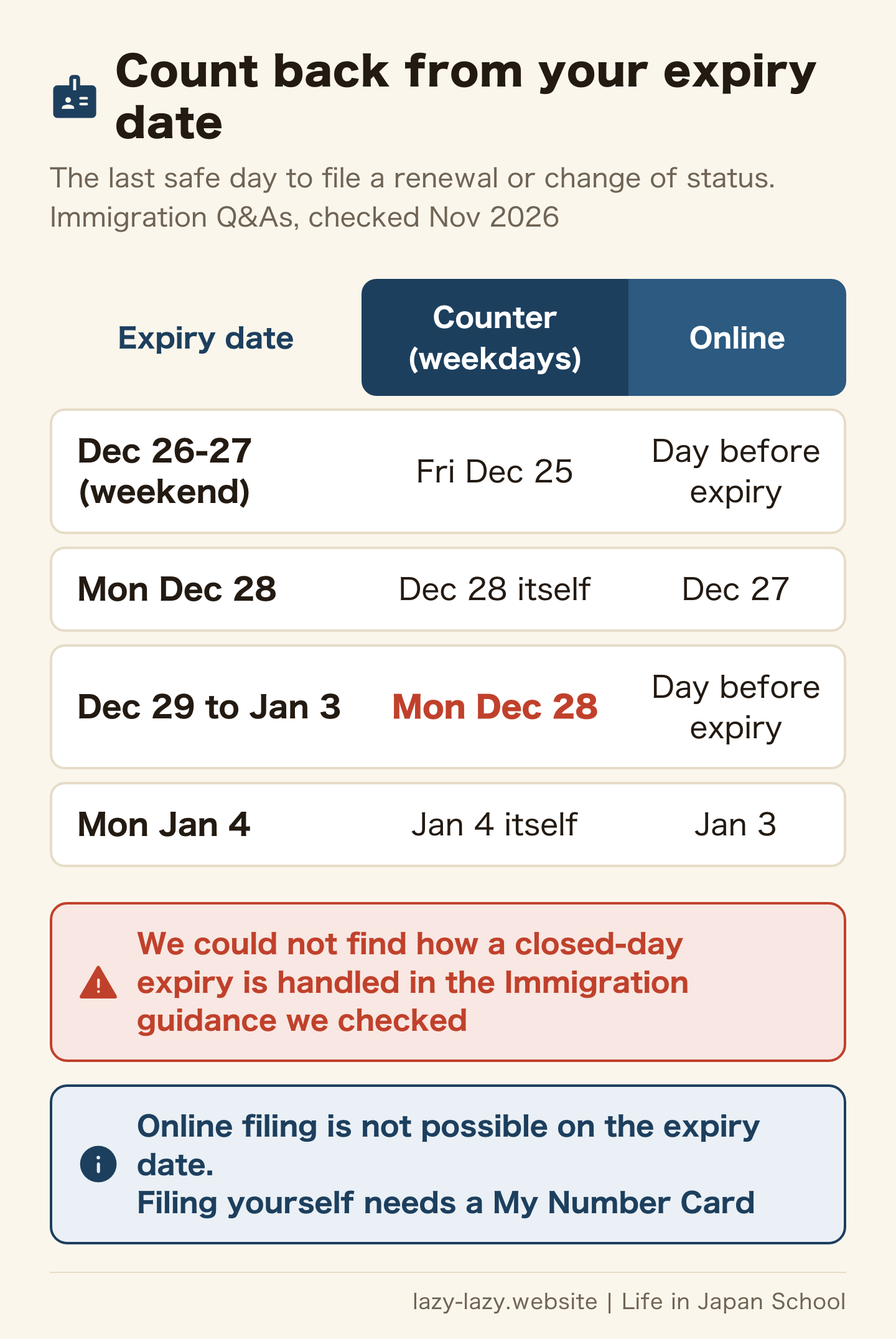
Online filing does not close. The online residence application system takes applications 24 hours a day, 365 days a year (in Japanese). Your acceptance date is the day you apply online. There are conditions.
- You cannot use it during system maintenance.
- You cannot use it on the last day of your period of stay. You must go to the counter.
- You cannot use it after the period has ended.
- You cannot use it on the day you filed a moving-in notice. Apply from the next day.
- If you apply yourself, you register with your My Number Card and a smartphone with the My Number Portal app.
If your period ends after New Year, you can still apply now. With a period of stay of 6 months or longer, you can apply from 3 months before it ends (in Japanese). For example, if yours ends by March 28, you can apply at the counter on December 28. With a period of 3 months or less, you can apply after at least half of it has passed (in Japanese). If you want the decision within your period of stay, Immigration asks you to apply between 3 months and 45 days before it ends (in Japanese). Setting up online renewal takes time the first time, so start early if you plan to use it.
If you apply by the expiry date, a special period applies. If you hold a residence card, apply for a renewal or change, and no decision comes by the expiry date (in Japanese), you can stay until the decision or until the end of the day two months after the expiry date, whichever comes first. Check documents and fees in our visa renewal guide.
If you hold Student or many work statuses, notices for leaving a school or changing a company are due within 14 days of the event (in Japanese). Who must file, and the type of notice, depend on your status. The electronic notification system takes them 24 hours a day, 365 days a year (in Japanese), but first-time users must register. You can also post them. If your 14 days end during the break, use these instead of waiting for a counter.
Are banks and ATMs open at New Year? Counters run to December 30
You go to the bank counter at midday on New Year’s Eve. Where you come from, that may be normal. In Japan, counters are closed from December 31 to January 3.
Not every branch is the same on December 29 and 30. The Banking Act enforcement order (in Japanese) also allows holidays for individual branches. MUFG Bank’s counters are open on weekdays from 9:00 to 15:00 in principle (in Japanese). If you need a counter, check your branch hours first.
ATMs differ by bank and by location. Seven Bank’s guide for overseas-issued cards says its ATMs work in principle 365 days (in Japanese). With a Japanese bank card, also check your bank’s hours. MUFG Bank says ATM hours differ by location (in Japanese). SMBC also sets separate New Year hours for other banks’ cards (in Japanese). If you take out a little extra cash by December 30, you will not need to look up hours.
Fees can change too. At MUFG Bank, ATM fees from December 31 to January 3 are the same as on a public holiday (in Japanese). Amounts differ by bank and card type, so check your own bank’s table. What stays open on January 1 is also listed in our New Year and osechi guide.
When do New Year bank transfers arrive? Midday on December 30 is the safe line
A transfer to another bank can arrive on a holiday. But not always. Zengin-Net’s 2018 explanation (in Japanese) says joining the 24-hour, 365-day transfer system is each bank’s choice, and hours and methods differ by bank and account.
Take an MUFG Bank ATM used with an MUFG card as an example. For a transfer to another bank accepted after 15:00 on a weekday, on a weekend or holiday, or from December 31 to January 3 (in Japanese), you choose same-day handling or next-weekday handling. Depending on the receiving bank or account, same-day may not be offered (in Japanese). For 2026-27, next-weekday handling means Monday January 4.
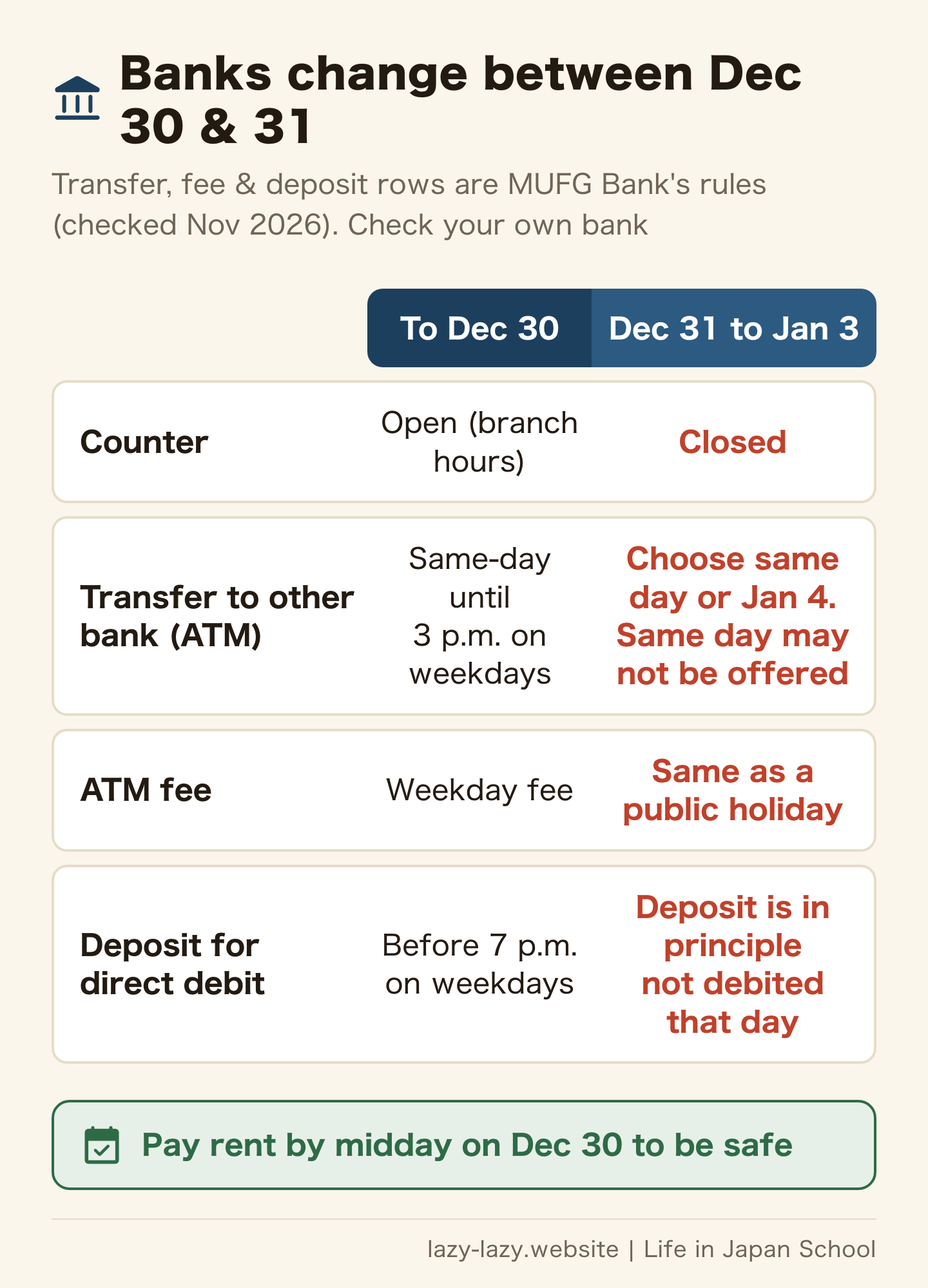
If your contract says rent is due by the end of December, check your bank’s cut-off and leave a margin by finishing by midday on December 30.
For direct debits, watch when your money goes in. At MUFG Bank, a deposit made after 19:00 on a weekday, on a weekend or holiday, or from December 31 to January 3 is in principle not used for that day’s debit (in Japanese). If you have a debit, put the balance in by the business day before it. For a debit after December 30, midday on December 30 is a safe guide.
If you send money home at a bank counter, December 30 is your last day of the year too. Our guide to sending money home compares the other ways.
Japan Post office and Japan Post Bank New Year hours: not announced yet
As of November 5, 2026, we could not find the 2026-27 notices. Japan Post Bank’s notice list for FY2026 (in Japanese) has no New Year notice yet. Its notice for 2025-26 (in Japanese) came out on November 20, 2025. This year’s hours may not be the same, so we do not list them here.
Counter hours can differ by post office. The New Year table for FY2022 (in Japanese) shows different hours by office. When the notice is out, check your own office with the post office and ATM search (in Japanese). Since August 24, 2026, more offices have a midday counter break (in Japanese). ATMs still work during that time.
New Year’s cards are already decided. Japan Post aims to deliver cards posted by Sunday December 27, 2026 on New Year’s Day (in Japanese). In the first three days, cards are delivered on January 1 and Sunday January 3, and regular mail is also delivered on January 3.
New Year garbage collection: it depends on your city and area
There is no national schedule for rubbish (garbage). Like everyday sorting, it is set by each municipality. Three cities have 2026-27 notices out, as below.
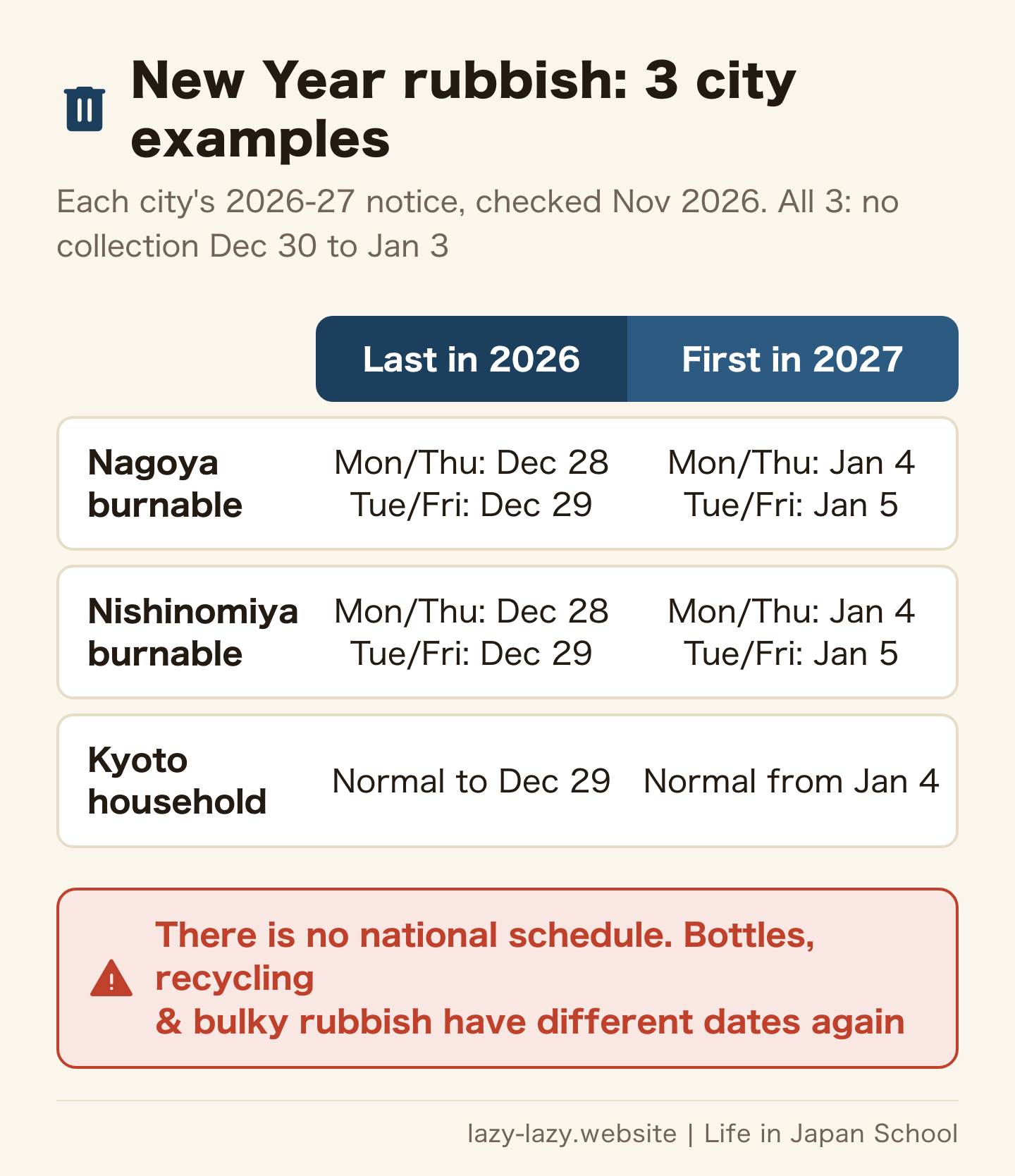
- Nagoya (in Japanese): no collection from December 30 to January 3. In areas with non-burnable and bulky rubbish on Fridays, January collection days shift back one week. In areas collected January 6 to 8, the bulky rubbish application deadline is 5 p.m. on December 28.
- Nishinomiya (in Japanese): no collection from December 30 to January 3. Friday bottles and recycling restart on January 8 in first/third-Friday areas and January 15 in second/fourth-Friday areas.
- Kyoto (in Japanese): no collection from December 30 to January 3. There is no mixed paper collection on December 29.
Burnable days may look alike, but other types shift. All three start on December 30, but that is not a national rule. Fukuoka City’s page, updated December 10, 2025 (in Japanese), gives the break as December 31 to January 3 and says substitute days may be set. We could not confirm Fukuoka’s 2026-27 dates.
Some municipalities have not published yet. Search your city’s name with 年末年始 ごみ, and check the December city newsletter. Put out New Year cleaning rubbish before the last collection day.
Are clinics open at New Year? Find what is open first
Clinic closing days differ by clinic. If you take regular medicine, ask your clinic about its closed days at your next visit.
If you get sick, go to a holiday and night emergency clinic or the on-duty doctor. How to find them and which number to call are in our urgent care guide. For example, the Nishinomiya emergency clinic (in Japanese) opens from 9:00 to 14:00 and 17:00 to 23:30 over New Year. Reception closes at 13:45 and 23:15. You do not need a reservation. Medicine is one day’s worth in principle, but the doctor decides during long holidays. In infection season you may wait a long time, or not be seen.
The cost can go up. A national notice (in Japanese) treats December 29 to 31 and January 2 and 3 as holidays. January 1 is a public holiday. The holiday add-on for a first visit is 250 points (in Japanese), so an adult paying 30% pays 750 yen more. It applies to visits such as those to places treating holiday emergencies. It does not apply during the normal hours of a place that regularly opens on holidays.
Student part-time work in winter break: 8 hours a day only in a school-rule long vacation
Winter break does not always mean longer hours. The exception in Article 19, paragraph 5 of the Immigration Act Enforcement Regulations (in Japanese) applies only to people with Student status, during a long vacation set in their school’s rules. In that period the limit is 8 hours a day. Kyoto University’s guide (in Japanese) gives up to 40 hours a week.
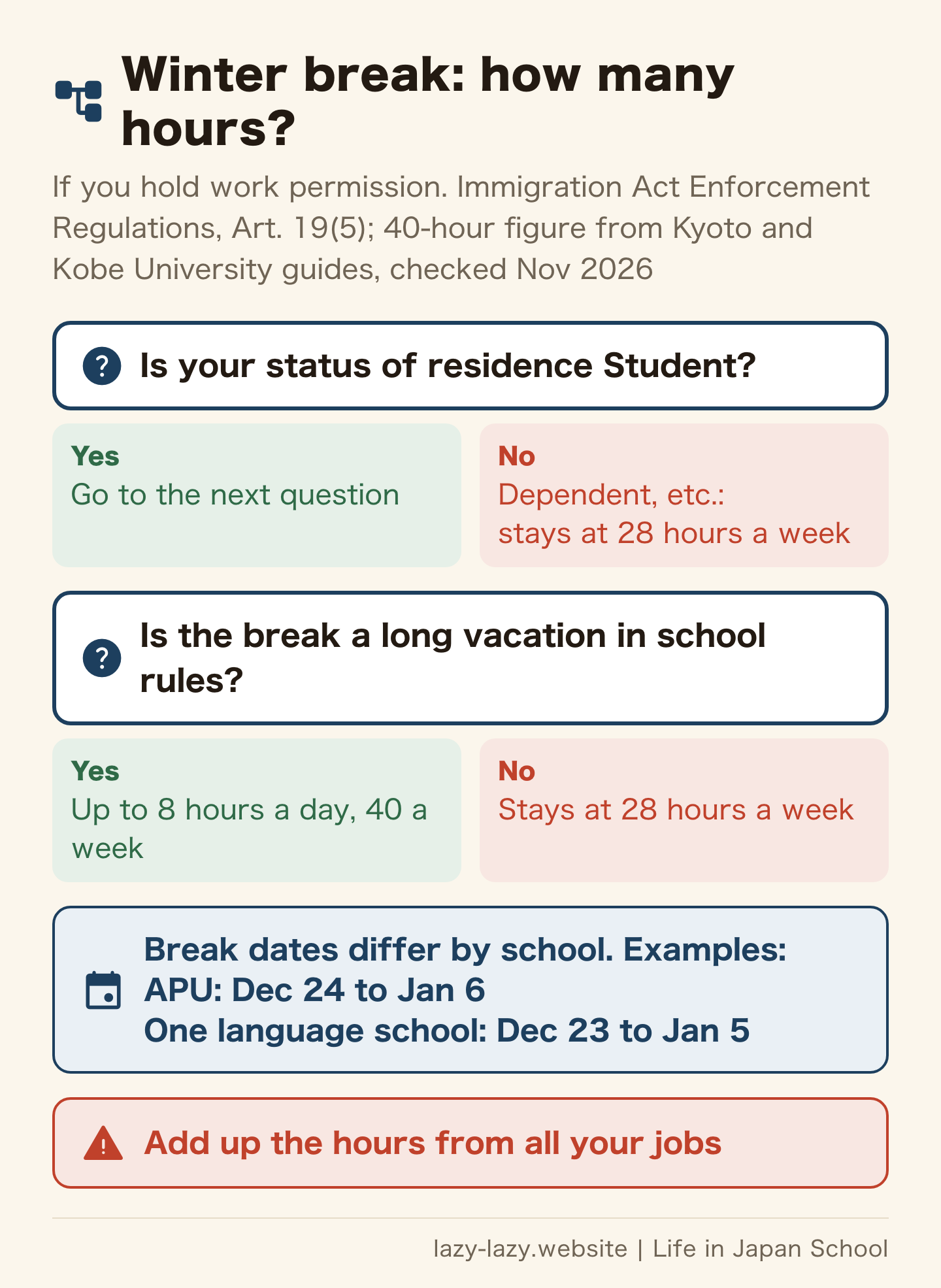
Kobe University’s guide includes winter in its long vacations (in Japanese). Break dates differ by school. Ritsumeikan Asia Pacific University’s FY2026 winter break is December 24 to January 6 (in Japanese). One Japanese language school’s is December 23 to January 5 (in Japanese). Check the dates in your school calendar, and ask your school whether it counts as a long vacation.
People with work permission limited to 28 hours a week under a status other than Student, such as Dependent, do not get this exception. They stay at 28 hours a week. When the break ends, students go back to 28 hours a week too. Check how the week is counted, and what happens if you go over, in our part-time job guide.
What if you miss a deadline? Move on the morning of January 4
- Your period of stay has passed: you cannot apply online (in Japanese). Immigration tells you to come to the counter promptly and ask. It opens on Monday January 4, so go during reception hours that day.
- Your moving notice is late: file it anyway. Our residence registration guide covers what happens when you are late.
- Your rent transfer became January 4: contact your landlord or management company within the year.
- Your balance was short for a debit: follow the biller’s instructions. Do not leave it alone.
Which one are you?
- Your period of stay ends by March 28, 2027 — check whether you can renew yet. Today, ask your school or company for the documents you need.
- You move in December, or your job or school changes — count to your 14th day. Today, look up your city office’s year-end counter hours.
- You have rent or a debit from late December to early January — list every payment date. Today, put each transfer and deposit on your calendar before its payment date, by midday on December 30 at the latest.
- You are a student who wants longer hours in winter break — confirm your school’s long vacation dates. Today, open your school calendar and keep your shifts inside those dates.
- None of these — check your last rubbish day and your usual clinic’s closed days. Today, read your municipality’s notice and write it on your calendar.
Frequently asked questions
Q. When are city offices closed over New Year in Japan?
National government offices are closed by law from December 29 to January 3. City offices follow local ordinances, so there is no single national schedule. For example, Kobe ward offices close from December 29 to January 3. Check your own municipality.
Q. Can I apply online to Immigration over New Year?
The online system takes applications 24 hours a day, 365 days a year. It can stop for system maintenance. You cannot apply online on the last day of your period of stay, or after it has passed. Using it yourself requires a My Number Card and a smartphone with the My Number Portal app.
Q. My period of stay ends on January 2. Is it fine to go to Immigration on January 4?
We could not confirm that it is. The Immigration Q&A, renewal page and online guidance do not say what happens when an expiry date falls on a closed day. At the counter, apply by December 28. If you can use the online system, you can apply up to the day before your expiry date.
Q. When do bank transfers arrive over New Year in Japan?
It depends on the bank and the time. At an MUFG Bank ATM, a transfer to another bank accepted from December 31 to January 3 is handled as either same-day or next weekday, and you choose. Same-day may not be offered. The next weekday is January 4 in 2027. To leave a safe margin, finish by midday on December 30.
Q. What are the Japan Post and Japan Post Bank New Year hours?
As of November 5, 2026, we could not find the 2026-27 notices. Japan Post Bank published its previous notice on November 20, 2025. Once a notice is out, check your own post office on the Japan Post office search page.
Q. Until when can I put out garbage over New Year?
There is no national schedule. It differs by municipality and by area. Nagoya, Nishinomiya and Kyoto have no collection from December 30 to January 3 in their 2026-27 notices. The last and first days differ by area and by rubbish type, so check your own municipality.
Summary
The dates fixed by law are December 29 to January 3 for national offices and Immigration, and December 31 to January 3 for bank counters. If your period of stay ends in that window, apply by December 28 at the counter. Make transfers and deposits in time for each payment date, by midday on December 30 at the latest to be safe.
For city offices and rubbish, only your own municipality’s notice will do. For post offices and Japan Post Bank, check once the notices are out. What to do today is write down your own deadlines and payment dates.
Official sources: e-Gov: Act on Holidays of Administrative Organs (Japanese) / e-Gov: Local Autonomy Act (Japanese) / e-Gov: Order for Enforcement of the Banking Act (Japanese) / e-Gov: Immigration Act Enforcement Regulations (Japanese) / Immigration Services Agency: Q&A (Japanese) / Online application Q&A (Japanese) / Renewal of period of stay (Japanese) / What is the special period? (Japanese) / Consultation desks (Japanese) / MUFG Bank: ATMs (Japanese) / Zengin-Net: extended operating hours (Japanese) / Japan Post Bank: notices (Japanese) / Japan Post, 31 August 2026 (Japanese) / Nagoya (Japanese) / Nishinomiya (Japanese) / Kyoto (Japanese) / Ministry of Health: medical fee schedule (Japanese) (all checked 5 November 2026). Schedules can change. Check with your own counter before you act.
Related guides
Found this useful? Share it
Send it to a friend who lives in Japan.
WHO WROTE THIS

mori
Japanese. I read the ministries’ own notices, orders and Q&As in the original, and I start from what my Nepalese and Sri Lankan friends in Japan actually ran into. I do not write about what I have not checked or been told.
What this site can and cannot do →Looking for something else?
You may use the figures in this article, including commercially, if you credit this site with a link. How to use our figures