Checked on 23 September 2026 against the Income Tax Act (e-Gov), the National Tax Agency’s Tax Answers No. 7411, 2668, 1900 and 2030, its procedure for reporting a slip that was never issued, its box-by-box guide to the withholding slip, and the Immigration Services Agency’s renewal document list.
The short answer
- The gensen choshu hyo (withholding slip) is the paper your employer gives you showing a year’s pay and the income tax taken from it. Employers must give one to foreign employees too.
- You get it by 31 January of the next year, or within one month of the day you leave the job (Income Tax Act, article 226).
- Four boxes matter: total pay, employment income, total deductions and tax withheld. If the middle two are blank, you had no year-end adjustment, and a tax return may get some tax back.
- You use it for your next employer’s year-end adjustment and for a tax return. For a work-visa renewal, the official list asks for city tax certificates, not the withholding slip.
- If it never arrives, you can report it to the tax office for your address with a “notification of non-issuance”. If you lost it, ask your employer to issue it again.
Knowing this, you can tell from one sheet of paper whether you are due a refund, and you know what to do if your employer never hands it over.
You left your part-time job a month ago. Your new employer asks for “the gensen choshu hyo from your last job”. You would rather not call your old manager. You are not even sure which piece of paper that is. A Japanese friend says, “It’s the thing the company gives you at the end of the year,” and that is all they know. For people who get it every January without thinking, quitting mid-year, working two jobs or leaving Japan is simply not something they have dealt with.
- What is a gensen choshu hyo?
- When do you get a withholding slip?
- How to read a gensen choshu hyo: four boxes
- What does the 外国人 box on the withholding slip mean?
- Where do you use the withholding slip?
- Do you need the gensen choshu hyo for a visa renewal?
- Withholding slip or tax certificate: what is the difference?
- What if your employer does not give you a gensen choshu hyo?
- Lost your withholding slip? Ask your employer again
- Two part-time jobs? One withholding slip from each
- Leaving Japan? Sort out the slip before you fly
- How much does it cost?
- Which one are you?
- FAQ
- Summary
- Related reading
What is a gensen choshu hyo?
Income tax is taken out of every paycheck. That is withholding, gensen choshu. The withholding slip, gensen choshu hyo, adds it up: what one employer paid you for the calendar year (1 January to 31 December) and how much income tax it withheld. The employer makes two copies, one for the tax office and one for you (Income Tax Act, article 226).
Nationality does not matter. Tax Answer No. 7411 tells employers that “all recipients” includes foreign employees who are residents, meaning they have an address in Japan or have lived here for a year or more, and that they “must” be given the slip. Part-timers too.
Your copy does not show your My Number. If you have agreed to it, the employer can send it electronically, for example as a PDF. Even then, if you ask for paper, they have to give you paper.
If you received a retirement payment, there is a separate slip for it, also due within one month of leaving.
When do you get a withholding slip?
The deadlines are in the law (article 226).
- Still employed in December: by 31 January of the next year. For 2025, 31 January was a Saturday, so the National Tax Agency’s guide gave 2 February 2026
- Left during the year: within one month of the day you left
If you worked through December, the slip usually comes after the year-end adjustment. The exact day is up to the company, so if it has not come by January payday, ask the office.
If you left, the month counts from your last day of work, not your last payday. Leave on 20 May, and expect it by around 20 June.
Freelance or contract fees are not salary, so no withholding slip is issued for them (National Tax Agency). Check first that you were actually employed.
How to read a gensen choshu hyo: four boxes
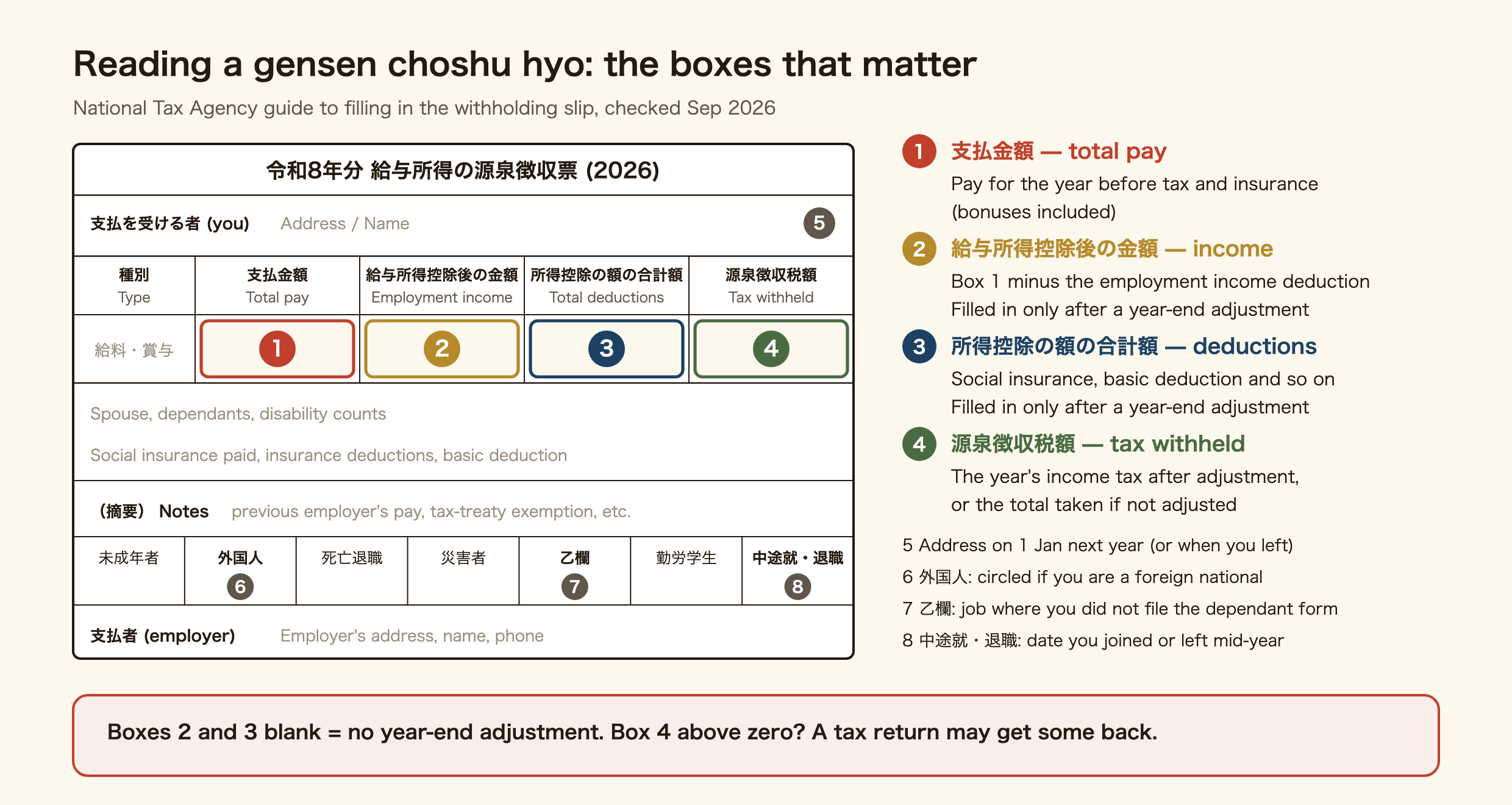
The slip is crowded, and it is only in Japanese. Start with the four amounts in the top row (National Tax Agency guide, box-by-box instructions).
| Box on the slip | Reading | What it means |
|---|---|---|
| 1. 支払金額 | shiharai kingaku | Total pay for the year before tax and social insurance, bonuses included |
| 2. 給与所得控除後の金額 | kyuyo shotoku kojo-go no kingaku | Box 1 minus the employment income deduction. This is your “income” for tax |
| 3. 所得控除の額の合計額 | shotoku kojo no gaku no gokei-gaku | Total deductions: social insurance, the basic deduction, dependants and so on |
| 4. 源泉徴収税額 | gensen choshu zeigaku | Income tax withheld (including the reconstruction surtax) |
The rule that matters is how boxes 2 and 3 are filled. The National Tax Agency’s guide says they are written only on the slips of people who had a year-end adjustment. If they are blank, that employer did not adjust your tax.
That changes what box 4 means. After an adjustment, box 4 is your settled income tax for the year. Without one, it is just the monthly deductions added up. Monthly withholding is a provisional amount and can run high. If box 4 is above zero, a refund return may get the over-withheld tax back. You can file one for five years from 1 January of the next year (No. 2030).
Three more places are worth a look.
- Address — your address on 1 January of the next year, or when you left. If you moved and did not tell the company, it will be the old one
- 中途就・退職 — the date you joined or left during the year
- 摘要 (notes) — if your pay from a previous job was included in the adjustment, that employer and amount appear here. If a tax treaty exempts you from income tax, the exempt amount and the treaty article are written here
What does the 外国人 box on the withholding slip mean?
Near the bottom is a row of small boxes: 未成年者 (minor), 外国人 (foreign national), 死亡退職, 災害者, 乙欄, 勤労学生 (working student) and others. The National Tax Agency’s guide tells employers to put a circle in the ones that apply. If you are not Japanese, 外国人 is circled.
Nationality is not what decides your tax. The agency’s leaflet for foreign employees explains that the tax depends on whether you are a resident or a non-resident. A resident has an address in Japan, or has lived here for a year or more. If you live and work in Japan, you are normally a resident and taxed the same way as a Japanese employee.
The other box people with two jobs should know is 乙欄. It comes up below.
Where do you use the withholding slip?
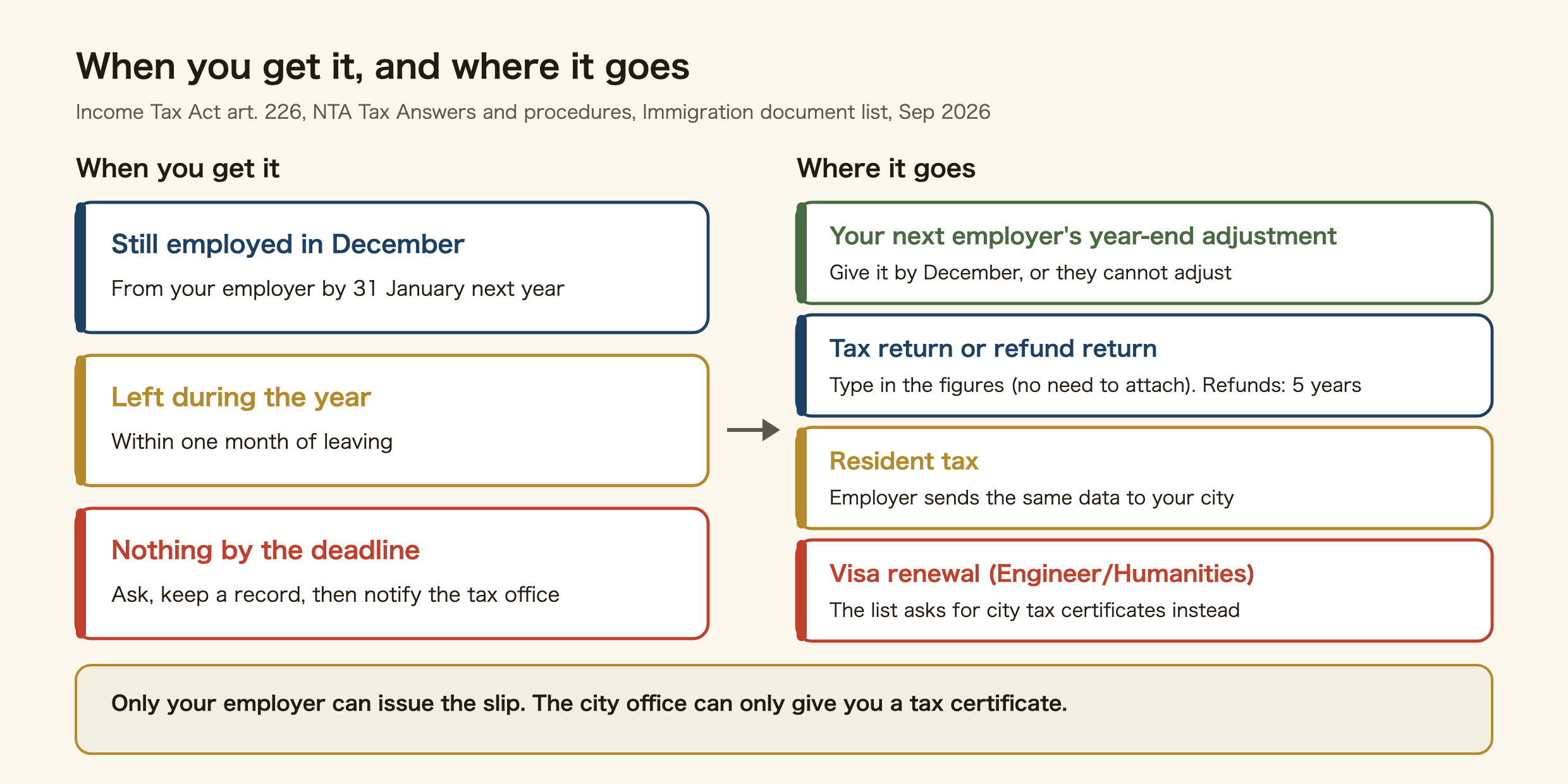
First, your next employer. If you join mid-year, the new company includes your earlier pay in its year-end adjustment. Tax Answer No. 2668 says that if it cannot confirm that pay from your previous withholding slip, it cannot do the adjustment. Hand it over by December for the year-end adjustment.
Second, a tax return. Under the National Tax Agency’s filing guide, you do not attach or show the slip with the return. But every figure you type comes from it, and if you prepare the return at a tax office, bring it.
Third, resident tax, and here you do nothing. Your employer sends the same pay data to the city where you live on 1 January, as a “salary payment report”, by 31 January (No. 7411). The agency’s own form puts the report and your copy of the slip on a single template. Resident tax on that previous year’s income starts in June.
Do you need the gensen choshu hyo for a visa renewal?
Many people search for this. Open Immigration’s document list for renewing Engineer/Specialist in Humanities/International Services (applications from 15 April 2026) and your own withholding slip is not on it. See visa renewal in Japan for the whole process.
- If your employer is in category 3 or 4, you submit a resident tax assessment (or non-assessment) certificate and a tax payment certificate, from the city where you lived on 1 January. One certificate showing both your total income for the year and your payment status is enough
- The “法定調書合計表” (summary of statutory statements, including withholding slips) on the list is a copy of a document your employer files with the tax office. It is not your slip
Your slip can still end up at Immigration. In one of Immigration’s published refusal cases, the address on a withholding slip submitted with a renewal did not match the address the person had registered. It turned out the application was false, and the renewal was refused. When you move, tell your employer your new address as well as notifying Immigration.
Withholding slip or tax certificate: what is the difference?
| Withholding slip (gensen choshu hyo) | Resident tax certificate (kazei shomeisho) | |
|---|---|---|
| Issued by | Your employer (company or part-time job) | The city where you lived on 1 January |
| Covers | That one employer’s pay and income tax for the year | All your income for the year and the resident tax on it |
| When | By 31 January, or within one month of leaving | Yokohama: the 2026 fiscal-year certificate from 18 May (for payroll-deducted taxpayers and others) |
| Cost | Your employer is legally required to issue it | A fee (Yokohama: 300 yen per copy) |
The amounts often look different, for two reasons. With two jobs you get one slip from each, while the certificate adds everything together. And certificates are named by fiscal year. As Yokohama explains, the Reiwa 8 (2026) certificate shows your income for Reiwa 7 (2025).
City offices cannot issue a withholding slip. Osaka’s Q&A says it is a document from your employer and the city cannot produce it. If you only need proof of income, Osaka suggests an income certificate from the city instead.
What if your employer does not give you a gensen choshu hyo?
Once the deadline has passed, go in order.
- Ask your employer again, clearly. In person, by phone or in writing, any is fine. The National Tax Agency asks you to note when, where, who you spoke to, how you asked and what they said
- If it still does not come, file a “notification of non-issuance of a withholding slip” (源泉徴収票不交付の届出書) with the tax office for your address. You can use e-Tax, or bring or post a paper form
- Attach copies of your payslips if you kept them, and the record showing you asked
The tax office then gives your employer administrative guidance to issue the slip. The agency is open that this guidance has no legal force. Keep asking the employer yourself after you file.
The employer does face a penalty. Not issuing the slip by the deadline, or issuing a false one, can mean up to one year’s imprisonment or a fine of up to 500,000 yen (Income Tax Act, article 242). “We don’t give slips to people who quit” is not a choice the employer gets to make.
Lost your withholding slip? Ask your employer again
The tax office notification does not cover reissues. The National Tax Agency tells you to ask your employer to reissue it yourself. If phoning is hard, a letter or an email works.
The city office cannot help with the slip itself. If you only need proof of income, for a flat or a loan, ask whether a city tax certificate will do instead, as Osaka suggests. If you need the figures for a tax return, getting the slip again from your employer is the sure way.
Two part-time jobs? One withholding slip from each
Each employer issues its own slip. Two jobs, two slips.
Only one of them can do your year-end adjustment. The law says that when you are paid by two or more employers, you file the dependant form with your “main” one only (article 194). The other job calculates your tax from the 乙欄 (otsu) column of the tax tables (No. 2511). Its slip will have the 乙欄 box circled or “乙欄適用者” in the notes, and boxes 2 and 3 will be blank.
If the pay that was not adjusted plus any other income comes to more than 200,000 yen, you must file a tax return (No. 1900), by 15 March. Students can check how this fits with the income limits in income tax for part-timers.
Leaving Japan? Sort out the slip before you fly
The one-month deadline does not wait for your flight. If you quit and leave straight away, the slip may be issued after you are gone.
- Tell your employer your departure date early. If you leave Japan mid-year and stop living here, the company does a year-end adjustment when you leave (No. 2665), and boxes 2 and 3 on that slip are filled in
- If you cannot collect it before you go, agree where it should be sent. If you need to file a return or claim a refund, you can register a tax representative with the tax office before departure and have them receive it
- Pay made after you leave is paid to a non-resident. It goes on a different statement, not the withholding slip (No. 7411), and is taxed at a flat 20.42% as a rule (the agency’s leaflet for foreign employees)
For the order to close resident tax, pension and insurance, use the leaving-Japan checklist.
How much does it cost?
The withholding slip is a document your employer is required by law to issue. The National Tax Agency’s procedure page for the non-issuance notification lists no fee. You pay only if you get a city tax certificate instead. Fees are set by each city; Yokohama charges 300 yen per copy.
Which one are you?
- Same employer through December — when the slip arrives in January, check that boxes 2 and 3 are filled in. If they are and you have no other income, you are done. Today: put January payday in your calendar.
- Left a job during the year — collect the slip within one month of leaving. If you join a new employer by December, give it to them; if not, see whether a refund return gets money back. Today: write down the date one month after your last day.
- Working two jobs — collect a slip from every employer. If the unadjusted pay plus other income tops 200,000 yen, file a tax return by 15 March. Today: list every job you had this year.
- Nothing by the deadline — ask your employer in writing and keep a record. If nothing comes, file the notification with the tax office. Today: find your payslips and keep them.
- Leaving Japan soon — tell your employer your departure date and agree on the departure adjustment and how you will receive the slip. Today: tell the office your flight date.
FAQ
Q. When do I get my gensen choshu hyo?
By 31 January of the next year if you worked through December, or within one month of the day you left if you quit during the year. Article 226 of the Income Tax Act requires this of employers.
Q. How do I read a Japanese withholding slip?
Look at the four amounts in the top row: total pay, employment income, total deductions and tax withheld. The middle two are filled in only after a year-end adjustment, so if they are blank, a tax return may get some tax back.
Q. My employer will not give me a withholding slip. What can I do?
Ask again and record when, to whom and how you asked. If it has not come by the deadline, file a notification of non-issuance with the tax office for your address, with copies of your payslips and the record of your request.
Q. I lost my gensen choshu hyo. Can I get another one?
Ask your employer to reissue it. The tax office notification does not cover reissues, and city offices cannot issue the slip. If you only need proof of income, ask whether a city tax certificate is acceptable.
Q. Do I need my withholding slip to renew my visa?
The renewal list for Engineer/Specialist in Humanities/International Services asks for a resident tax assessment certificate and a tax payment certificate from your city, not your withholding slip. Check the list for your own status on the Immigration website.
Q. Why is the 外国人 box circled on my withholding slip?
Because you are a foreign national. The National Tax Agency’s guide tells employers to circle the boxes in that row that apply. What decides your income tax is whether you are a resident or a non-resident, not your nationality.
Summary
The gensen choshu hyo is the record of a year’s pay and the income tax withheld from it. Employers must give it to foreign employees and part-timers alike: by 31 January, or within one month of leaving. Read the four boxes in the top row. If the middle two are blank, a tax return may get you money back.
You use it for your next employer’s year-end adjustment and for tax returns. A work-visa renewal asks for city tax certificates instead. If it does not come, ask in writing and then notify the tax office. If you lost it, ask your employer to reissue it. And if you are leaving Japan, decide how you will receive it before you fly.
Official sources: Income Tax Act (e-Gov, Japanese) / National Tax Agency, Tax Answer No. 7411 (Japanese) / NTA guide to the withholding slip, 2025 edition (Japanese) / NTA procedure F5-4, notification of non-issuance (Japanese) / NTA Tax Answer No. 2668 (Japanese) / NTA Tax Answer No. 1900 (Japanese) / Immigration Services Agency, Engineer/Specialist in Humanities/International Services (Japanese) / Osaka City, certificate Q&A (Japanese). Checked on 23 September 2026.
Related reading
Found this useful? Share it
Send it to a friend who lives in Japan.
WHO WROTE THIS

mori
Japanese. I read the ministries’ own notices, orders and Q&As in the original, and I start from what my Nepalese and Sri Lankan friends in Japan actually ran into. I do not write about what I have not checked or been told.
What this site can and cannot do →Looking for something else?