Checked on 23 September 2026 against the Immigration Services Agency’s page and guideline for Designated Activities (graduates of Japanese universities, revised April 2026), the Designated Activities public notice, the Immigration Control Act on e-Gov, and the Ministry of Education’s pages.
The short answer
- Designated Activities No. 46 is a status of residence for people who graduated from a Japanese university (or similar) and have N1-level Japanese, so they can take a wide range of jobs that involve communicating in Japanese.
- Customer service and factory line work — hard to get on the Engineer/Humanities visa — are allowed if the job includes real two-way communication in Japanese. Jobs that are only dishwashing, cleaning or following instructions are not.
- It covers graduates of Japanese universities and graduate schools, and “kodo senmonshi” graduates of vocational school courses certified by the Ministry of Education, among others. A foreign degree alone, or an ordinary senmonshi diploma, does not qualify.
- Japanese: JLPT N1 or BJT 480 or above. A university degree majoring in Japanese counts as N1.
- If you change employer, you must apply to change your status. The first period of stay is normally one year. Dispatch and part-time work are not allowed.
Knowing this, when your future employer says “you’ll also work in the store” or “on the factory floor”, you can check whether No. 46 fits before giving up on the job. You also know in advance what a job change will involve.
At the offer meeting, HR says: “For the first period you’ll be in the store, dealing with customers.” A senior student has already told you the Engineer/Humanities visa does not allow a job that is just customer service. You ask a Japanese friend. “Designated Activities? Number 46? Never heard of it.” Japanese graduates do not need a status of residence to take a job, so they never meet the name. But if you graduated in Japan and hold N1, there is a status made for exactly this.
- What is the Designated Activities 46 visa in Japan?
- Designated Activities 46 requirements: education, Japanese, the job, the contract
- Can vocational school (senmon gakko) graduates get No. 46?
- What jobs can you do on Designated Activities 46?
- Designated Activities 46 vs the Engineer/Humanities visa
- How long can you stay, and how do renewals work?
- Can you bring your family? Spouse and children get No. 47
- Designated Activities 46 application: the documents
- How much does it cost? The fee depends on the period granted
- Changing jobs on Designated Activities 46
- What if you break the rules? Three months and cancellation
- No N1 in time, or no job offer yet?
- Which one are you?
- FAQ
- Summary
- Related reading
What is the Designated Activities 46 visa in Japan?
Its official name is Designated Activities (graduates of Japanese universities, honpo daigaku-to sotsugyosha). It is called No. 46 because it is item 46 in the Ministry of Justice public notice that lists designated activities. Search for tokutei katsudo 46 in Japanese and you will find the same thing.
The Immigration guideline sums it up in one line: on top of what you studied, it allows a wide range of work on condition that you use the high level of Japanese you gained as an international student. On the Engineer/Humanities visa, jobs centred on general service or manufacturing work are not allowed. On No. 46, they can be.
It is not only for students. People who graduated in Japan and went home, and people already working in Japan on another work status, can also apply if they meet the conditions (Immigration guideline).
Designated Activities 46 requirements: education, Japanese, the job, the contract
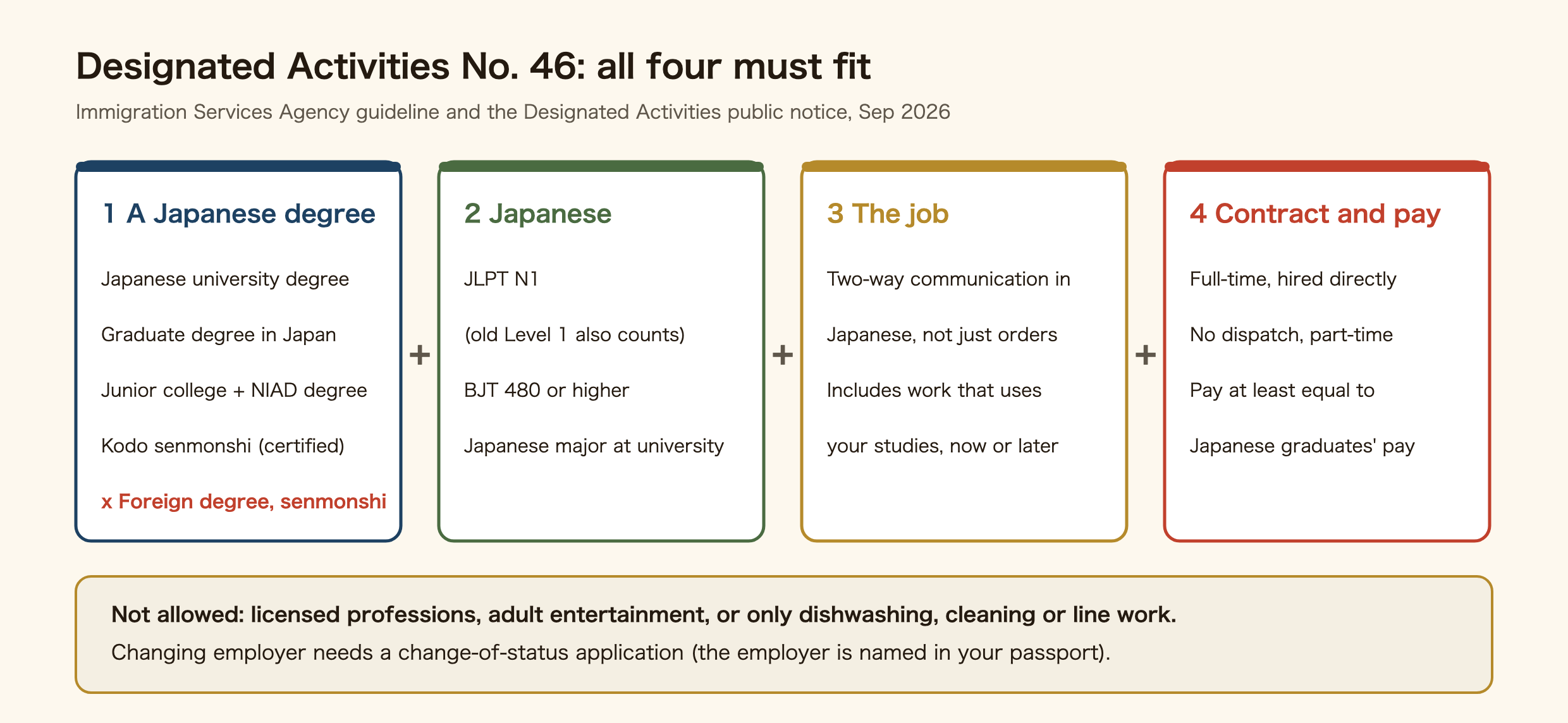
You need all four. Missing any one of them means you cannot apply for No. 46.
1. Education in Japan
- A bachelor’s degree from a Japanese university (not a junior college)
- A master’s or doctoral degree from a Japanese graduate school
- A Japanese junior college (including the first stage of a professional university) or KOSEN diploma, followed by a bachelor’s degree awarded by the National Institution for Academic Degrees and Quality Enhancement of Higher Education (NIAD-QE)
- The kodo senmonshi title from a vocational school course certified by the Minister of Education as a “career development programme for international students”
A degree from a university or graduate school outside Japan does not qualify on its own. You need one of the Japanese routes above.
2. Japanese: N1 or BJT 480
You need JLPT N1 (the old Level 1 also counts) or 480 or more on the BJT Business Japanese Proficiency Test. You submit a copy of the certificate of results.
If you majored in Japanese at a university or graduate school, that is treated as meeting the N1 condition. “Majored” here means you studied in a faculty or department of Japanese linguistics, Japanese language education or a similar field. A Japanese major from a university abroad is treated the same way, but you still need the Japanese education in point 1.
No N1 yet? Check the test calendar first. The JLPT in Japan runs twice a year, in July and December, and costs 7,500 yen. Applications for December 2026 have already closed. Dates and how to apply are in our JLPT registration guide.
3. The job: two-way communication in Japanese
Immigration’s phrase is “work requiring smooth communication in Japanese”. It does not mean understanding instructions and doing your own task. It means work with an element of translation or interpreting, work where you approach customers or other people yourself, and work that needs two-way communication.
The job must also include work that uses what you studied — planning products, technical development, sales, management, PR, teaching and so on. If you are expected to move into that kind of work later, that counts too.
4. Contract and pay: full-time, direct, equal to Japanese graduates
You must be a full-time employee under contract with the company. Short-hours part-time work does not count. You cannot be a dispatched worker placed at another company.
Pay must be at least what a Japanese person would get for the same work. There is no fixed yen figure. Immigration looks at the region, the company’s pay scale and what Japanese staff doing the same job earn. For No. 46, the guideline says it compares with Japanese university and graduate school graduates, including pay rises.
Can vocational school (senmon gakko) graduates get No. 46?
Some can. A change to the public notice took effect on 29 February 2024 and added certain vocational school graduates. It is already in force.
You qualify only if both of these apply:
- You completed a course certified by the Minister of Education as a “career development programme for international students”
- You received the kodo senmonshi title (given for courses of four years or more, among other conditions)
The senmonshi title from a two-year course does not qualify, and neither does a course without the certification (Immigration guideline). The Ministry of Education publishes the list of certified courses. The quickest way to know whether yours is on it is to ask your school’s international or careers office. If you have not chosen a school yet, start with senmonshi vs kodo senmonshi and the Japanese needed to get in.
What jobs can you do on Designated Activities 46?
These are the examples in the Immigration guideline. If a job becomes only what is in the right-hand column, it is not allowed.
| Workplace | Can be allowed | Not allowed on its own |
|---|---|---|
| Restaurant | Store management, serving customers while interpreting (Japanese customers too) | Dishwashing or cleaning in the kitchen |
| Factory | Passing on and explaining Japanese staff’s instructions to technical interns in their language, while working on the line yourself | Line work on instructions |
| Retail | Buying, product planning, sales and service while interpreting | Stocking shelves or cleaning the store |
| Hotel or inn | Running the foreign-language website, bell staff or door staff who also interpret | Cleaning guest rooms |
| Taxi company | Planning tours and guiding tourists while interpreting (normal driving too) | Vehicle maintenance or cleaning |
| Care home | Care work in Japanese while supervising foreign staff and interns | Cleaning the facility or doing laundry |
| Food manufacturing | Planning and developing products in Japanese with colleagues, while working on the line | Line work on instructions |
Work that only licensed professionals may do, and adult entertainment, are excluded. A taxi driver’s second-class licence does not count as such a licence, the guideline says.
Designated Activities 46 vs the Engineer/Humanities visa
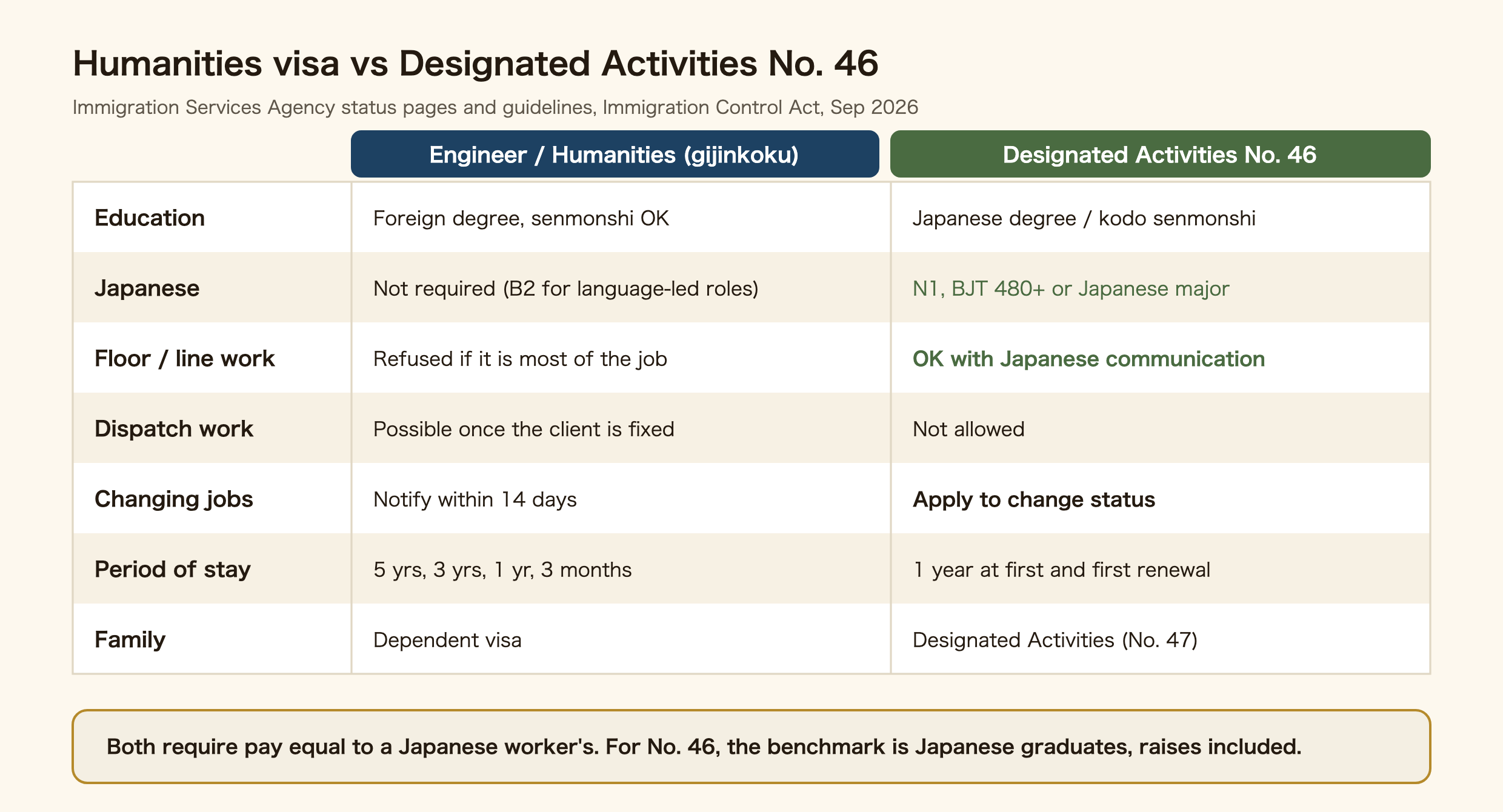
The Engineer/Humanities visa assumes the job is mainly work that uses what you studied. If tills, serving or line work become most of it, the application fails. Where exactly that line fell is in the jobs Immigration approved and refused on the Humanities visa.
No. 46 allows that floor work, as long as it comes with communication in Japanese. The price is more conditions: a Japanese degree and N1, and no dispatch work.
The difference people miss is job changes. On the Engineer/Humanities visa, moving to a job in the same field only needs a notification to Immigration within 14 days. On No. 46, the company’s name is written on the “designation” sticker in your passport, so a new employer means an application to change status.
Which one to apply for depends on the job itself. If your offer fits the Engineer/Humanities visa, that visa has no Japanese requirement and a job change only needs a notification. Timing and documents for switching from a student visa are in student visa to work visa in Japan.
How long can you stay, and how do renewals work?
The period of stay is 5 years, 3 years, 1 year, 6 months or 3 months. But the guideline says the change from a student visa and the first renewal are normally granted for one year. Plan on renewing every year for about the first two years.
If your period of stay is six months or longer, you can apply to renew from three months before it ends. Immigration’s standard processing time for a renewal is two weeks to one month. For a renewal you bring the application form, a photo, the declaration about the company’s representative, and your resident tax certificates (tax assessment and tax payment).
Your behaviour as a student is also checked when you change or renew. The guideline says that someone who regularly worked more than 28 hours a week in breach of their work permit “is not regarded as being of good conduct”.
Can you bring your family? Spouse and children get No. 47
A spouse and children you support can live in Japan on Designated Activities (spouse or child of a graduate of a Japanese university). It is item 47 in the notice, so it is called No. 47. It is a different status from the Dependent visa that Engineer/Humanities holders’ families use.
If your family member wants to work, they need permission to engage in an activity other than that permitted. Immigration says family members on this Designated Activities status are, in principle, treated like Dependent visa holders. With comprehensive permission, the limit is 28 hours a week, counted the same way as in the Dependent visa work rules.
Designated Activities 46 application: the documents
A change of status from inside Japan and a Certificate of Eligibility (COE) from abroad use almost the same documents.
- Application form (the “N” versions for graduates of Japanese universities) and a photo
- A copy of the document showing your working conditions, such as the notice of employment terms
- A statement of reasons for employment, written by the company (not needed if the working conditions already show the job uses Japanese)
- Proof of education: graduation certificate, degree certificate, proof of the kodo senmonshi title
- A copy of your N1 or BJT 480+ results (for a Japanese major, the graduation certificate)
- One document about the company’s business: brochure, a printout of its website or its certificate of registered matters
- A declaration about the company’s representative (for applications from 15 April 2026)
Ask the company to state clearly, in the statement of reasons, which tasks use Japanese and which use what you studied. Immigration warns that incomplete applications can be delayed badly or end in a negative decision.
How much does it cost? The fee depends on the period granted
| Application accepted | At the counter | Online |
|---|---|---|
| By 30 September 2026 | 6,000 yen | 5,500 yen |
| From 1 October, 1-year permission | 33,000 yen | 27,000 yen |
| From 1 October, 6-month permission | 18,000 yen | 15,000 yen |
| From 1 October, 3-year permission | 64,000 yen | 56,000 yen |
| From 1 October, 5-year permission | 75,000 yen | 65,000 yen |
You pay when permission is granted. Because No. 46 is normally one year at the change and at the first renewal, budget for the one-year fee twice. A COE application from abroad has no fee. Every bracket is in the 2026 visa fee increase.
Changing jobs on Designated Activities 46
A new employer means a different designated activity, so every job change needs an application to change status. Immigration’s standard processing time for a change is one to two months.
For a change caused by a new job, you do not need to submit your education and N1 proof again. Instead you add your resident tax assessment and payment certificates.
Moving within the same company (the same corporate number), such as a transfer or new posting, does not need an application. Unlike the Engineer/Humanities visa, No. 46 is not on the Immigration Control Act’s list for the 14-day notification about your employer. The procedure for a new employer is the change-of-status application.
What if you break the rules? Three months and cancellation
If you stay in Japan for three months or more without doing the No. 46 activity, your status can be cancelled, unless there is a justifiable reason. The same applies if you are doing something else instead of the No. 46 activity (Immigration Control Act, Article 22-4).
The riskiest time is after you leave a job and before the next one is settled. How cancellation works and how long you then have to leave are in what really gets a visa cancelled in Japan.
Working for a company that is not on your designation is outside your designated activity. Start at the new company after the change is approved.
No N1 in time, or no job offer yet?
If your N1 result will not arrive before graduation, first check whether your offer fits the Engineer/Humanities visa, which has no Japanese requirement. If the job is mainly language-led customer work such as interpreting or a hotel front desk, applications from 15 April 2026 may need B2-level proof such as N2, depending on the company’s category.
If you have no offer by graduation, your school’s recommendation lets you stay up to a year on Designated Activities for continued job hunting. Conditions and timing are in the job-hunting visa after graduation.
Thinking about permanent residence? Immigration’s guideline asks, in principle, for 10 years in Japan including 5 years on a work or residence-based status. It does not say whether time on No. 46 counts as a “work status” for this. Ask Immigration before you apply. The general rules are in permanent residency in Japan.
Which one are you?
- Your offer includes store, factory or hotel floor work — compare the job with the Humanities visa’s limits and with the No. 46 examples. Today, ask HR whether you can get the job description in writing.
- You graduated in Japan but do not have N1 yet — check the next JLPT or BJT date and consider the Humanities visa alongside. Today, put the application window in your calendar.
- You are in your final year at a vocational school — find out whether your course is certified and gives the kodo senmonshi title. Today, ask your school’s careers office.
- You are on No. 46 and thinking of changing jobs — the new employer needs a change application that takes one to two months, so set your last day with that in mind. Today, check whether the new company will write the statement of reasons.
FAQ
Q. What is the Designated Activities 46 visa?
A status of residence for people who graduated from a Japanese university or similar and hold N1 or BJT 480+, allowing a wide range of jobs that involve communicating in Japanese. The official name is Designated Activities (graduates of Japanese universities).
Q. How is No. 46 different from the Engineer/Humanities visa?
No. 46 allows customer service and factory line work if it comes with communication in Japanese. In return it needs a Japanese degree and N1 or equivalent, does not allow dispatch work, and needs a change-of-status application each time you change employer.
Q. Can vocational school graduates get Designated Activities 46?
Yes, if they completed a course certified by the Minister of Education as a career development programme for international students and received the kodo senmonshi title. This was added by a change that took effect on 29 February 2024. An ordinary senmonshi diploma does not qualify.
Q. How long is the period of stay on No. 46?
5 years, 3 years, 1 year, 6 months or 3 months. The change from a student visa and the first renewal are normally granted for one year.
Q. Can I change jobs on Designated Activities 46?
Yes, but a new employer means you must apply to change your status. A transfer within the same company does not need an application.
Q. Can I bring my family on No. 46?
A spouse and children you support can stay on Designated Activities No. 47. To work, they need permission for activities outside their status, up to 28 hours a week with comprehensive permission.
Summary
Designated Activities No. 46 is for people who graduated in Japan and hold N1. Customer service and factory work that the Engineer/Humanities visa rarely allows are possible, as long as the job includes real communication in Japanese. Among vocational school graduates, only kodo senmonshi from certified courses qualify.
The trade-off: every new employer needs a change-of-status application, dispatch work is out, and the first two grants are normally one year. If your offer includes floor work, compare the actual tasks with both statuses before you apply.
Official sources: Immigration Services Agency, Designated Activities (graduates of Japanese universities and their spouses) / ISA, guideline on Designated Activities for graduates of Japanese universities / ISA, Designated Activities public notice / ISA, work permission for Dependent and family Designated Activities / ISA, fee revision from 1 October 2026 / e-Gov, Immigration Control and Refugee Recognition Act / MEXT, career development programme for international students. Checked on 23 September 2026. Before applying, confirm with the Immigration Services Agency’s information centre (0570-013904) or your regional immigration bureau.
Related reading
Found this useful? Share it
Send it to a friend who lives in Japan.
WHO WROTE THIS

mori
Japanese. I read the ministries’ own notices, orders and Q&As in the original, and I start from what my Nepalese and Sri Lankan friends in Japan actually ran into. I do not write about what I have not checked or been told.
What this site can and cannot do →Looking for something else?