Checked on 23 September 2026 against the National Tax Agency’s 2026 withholding tax tables and its April 2026 revision summary, Kyokai Kenpo’s FY2026 premium tables for all 47 prefectures, the Japan Pension Service, the Ministry of Health, Labour and Welfare’s FY2026 employment insurance rates, the Children and Families Agency’s guide to the new support contribution, and the Income Tax, Health Insurance, Employees’ Pension Insurance, Employment Insurance and Labour Standards Acts (e-Gov).
The short answer
- A Japanese payslip (kyuyo meisai) has three parts: pay (shikyu), deductions (kojo) and take-home pay (sashihiki shikyugaku). Your employer is legally required to give you one (Income Tax Act, Article 231).
- There are five main deductions: health insurance, employees’ pension, employment insurance, income tax and residence tax. Every rate comes from an official table, not from your employer.
- FY2026 rates: health insurance 9.85% in Tokyo (you pay half), pension 18.3% (you pay 9.15%), employment insurance 0.5%. From the May 2026 paycheck, a new child and childcare support contribution of 0.23% (half each) was added.
- Income tax depends on the kou or otsu column. Only the one employer you gave your dependants declaration to uses kou; any other job uses the higher otsu column.
- Students working part-time normally pay no health insurance, pension or employment insurance. Residence tax starts in June of your second year in Japan.
Knowing this, you can check each line of your payslip against the official rate and see for yourself whether your take-home pay is right. You will also know which procedure gets back any income tax that was over-withheld.
Your first payday. The amount in your account is almost 40,000 yen less than the monthly salary you were offered. The payslip has more than ten lines of kanji, and the only thing you can read is the numbers. You ask a Japanese colleague whether it looks right. “That’s just how much they take.” They have never recalculated their own payslip either. Whether the numbers are right is something you can check yourself, with the National Tax Agency’s and Kyokai Kenpo’s tables.
- How do I read a Japanese payslip?
- What is on the pay side? Base pay, overtime and commuting allowance
- What are the deductions on a Japanese payslip, and where do the rates come from?
- How much is my take-home pay? A worked example on 245,000 yen
- What is deducted from a student’s part-time pay? Kou, otsu and employment insurance
- Is it illegal not to give me a payslip?
- What if a deduction looks wrong? Ask your employer, then the Labour Standards Office
- Which one are you?
- FAQ
- Summary
- Related reading
How do I read a Japanese payslip?
Read a Japanese payslip as three blocks, from top to bottom.
- Shikyu (支給, pay): everything your employer pays you. Base pay and allowances such as overtime and commuting
- Kojo (控除, deductions): what is taken out. Insurance premiums and taxes
- Sashihiki shikyugaku (差引支給額, net pay): pay minus deductions, the amount paid into your account. This is your take-home pay
Many payslips also have an attendance block (kintai, 勤怠) at the top: days worked, hours worked and overtime hours. Your pay is calculated from these, so first check that the hours match your own record.
The law only requires two things on the payslip: the amount of pay and the income tax withheld (Income Tax Act Enforcement Regulations, Article 100). Line names and layout vary between employers. Kojo-kei, kojo gokei and sokojo-gaku all mean “total deductions”.
What is on the pay side? Base pay, overtime and commuting allowance
Base pay (kihonkyu) is the monthly salary or hourly wage promised in your written working conditions. Hourly workers see “hourly wage x hours worked”. If it does not match what you were promised, compare it line by line with your employment contract.
Overtime pay (jikangai teate) is paid at least 25% extra for hours beyond 8 a day or 40 a week. The late-night premium for 10pm to 5am sometimes appears in the same block. You can check both the hours and the rates with the overtime pay calculation.
Commuting allowance (tsukin teate) covers your train or bus pass. It behaves differently for tax and for insurance.
- No income tax: for people who commute by public transport, up to 150,000 yen a month is tax-free (Income Tax Act Article 9; Order Article 20-2)
- Insurance premiums do apply: it counts as “remuneration” for health insurance and pension, and as “wages” for employment insurance (Japan Pension Service; labour bureau wage table)
So a large commuting allowance leaves your tax unchanged but raises your premiums a little. If your own calculation is slightly off, this is the first place to look.
What are the deductions on a Japanese payslip, and where do the rates come from?
Deductions are money your employer takes from your pay and hands to the government or your city on your behalf. There are five main lines.
| Deduction | FY2026 rate | Who sets it |
|---|---|---|
| Health insurance (健康保険料) | Differs by prefecture: Tokyo 9.85%, Osaka 10.13%. You pay half | Kyokai Kenpo (or your company’s own health insurance society) |
| Long-term care insurance (介護保険料, age 40-64) | 1.62%. You pay half | Kyokai Kenpo |
| Child and childcare support contribution (子ども・子育て支援金) | 0.23%. You pay half | Children and Families Agency / Kyokai Kenpo |
| Employees’ pension (厚生年金保険料) | 18.3%. You pay 9.15% | Employees’ Pension Insurance Act Art. 81 (fixed since September 2017) |
| Employment insurance (雇用保険料) | 0.5% (0.6% in agriculture, sake brewing and construction) | Ministry of Health, Labour and Welfare (each fiscal year) |
| Income tax (所得税) | Not a rate: a table | National Tax Agency withholding tax table |
| Residence tax (住民税) | Basically 10% of last year’s income plus 5,000 yen | Your city or ward |
Health insurance and pension use “standard monthly remuneration”
Health insurance and pension are not charged on this month’s pay. The rate is applied to a band called standard monthly remuneration (hyojun hoshu getsugaku). Your average pay for April, May and June, including overtime and commuting allowance, is placed in a band that is used from September for a year (Japan Pension Service).
That is why deductions often jump in September. Heavy overtime in spring raises your premiums for the following year. A pay change of two bands or more, such as a raise, triggers a mid-year revision.
Kyokai Kenpo’s health insurance rate is set by prefecture from the March 2026 premium. The lowest is Niigata at 9.21% and the highest Saga at 10.55%. Large companies with their own health insurance society use that society’s rate (Health Insurance Act, Article 160).
Since the April 2026 premium, the child and childcare support contribution of 0.23% has been collected together with health insurance. The Children and Families Agency’s guide says it is deducted from May pay. The agency also says showing it as a separate line is not a legal requirement. So even without a “support contribution” line, it may be inside your health insurance figure.
Pension is 18.3%, split with your employer. Whether it is money lost, and whether you get it back when you leave Japan, is covered in Japan’s pension for foreigners.
Why were there no premiums on my first payslip, and two months on my last?
The law lets employers deduct last month’s premiums from this month’s pay (Health Insurance Act Art. 167; Employees’ Pension Insurance Act Art. 84). So your first payslip may show no insurance at all, with premiums starting on the second. When you leave, the employer may deduct both the previous month and the final month, so your last payslip can show two months of premiums.
Employment insurance: 0.5% of this month’s pay
Employment insurance uses no bands. The rate is applied to this month’s total pay, commuting allowance included. From April 2026 the worker’s share is 5 per 1,000, down from 5.5 in FY2025 (Ministry of Health, Labour and Welfare). On 245,000 yen, that is 1,225 yen.
Income tax comes from a table, after social insurance is taken off
Income tax is read straight off the National Tax Agency’s withholding tax table. The amount you look up is your pay minus the tax-free commuting allowance and minus social insurance premiums.
In the 2026 monthly table, the kou column with no dependants shows zero tax on any month where that amount is under 105,000 yen. The 2025 table drew the line at 88,000 yen. If you have heard “tax starts above 88,000 yen”, that figure is out of date.
The amount withheld each month is provisional. Your real tax for the year is recalculated in December’s year-end adjustment, and the difference comes back. For 2026, the basic deduction rises to 1.04 million yen from December, so income tax starts only above 1.78 million yen of salary. How the refund works is in the year-end tax adjustment.
Residence tax starts in June of your second year
Residence tax is charged on last year’s income by the city where you lived on 1 January (Local Tax Act, Article 318). In the year you arrive, you had no Japanese income the year before, so the line is zero or blank. A missing residence tax line is not a mistake.
From the following June, one twelfth of the annual amount is deducted every month (Article 321-5). What it will cost, and what happens when you leave Japan, is in residence tax in Japan.
How much is my take-home pay? A worked example on 245,000 yen
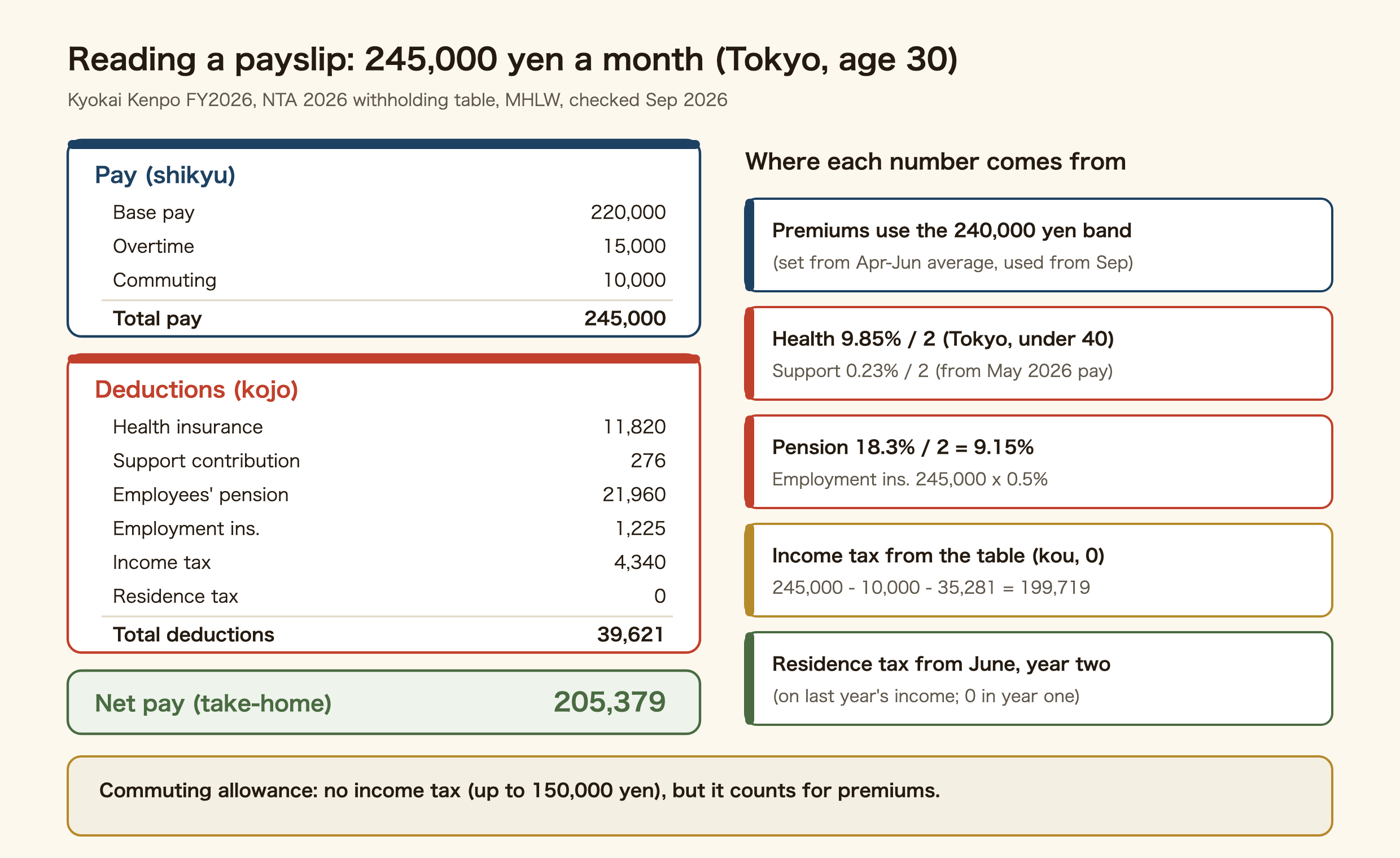
Here is the payslip in the figure, step by step. A 30-year-old working for a company in Tokyo: base pay 220,000 yen, overtime 15,000 yen and commuting allowance 10,000 yen, so total pay is 245,000 yen. If April to June were about the same, the standard monthly remuneration is 240,000 yen (the band for 230,000 to under 250,000).
- Health insurance: 240,000 x 9.85% / 2 = 11,820 yen
- Support contribution: 240,000 x 0.23% / 2 = 276 yen
- Employees’ pension: 240,000 x 18.3% / 2 = 21,960 yen
- Employment insurance: 245,000 x 0.5% = 1,225 yen
- Income tax: 245,000 – 10,000 – 35,281 (items 1-4) = 199,719 yen. In the monthly table’s row for 199,000 to under 201,000, the kou column with no dependants gives 4,340 yen
- Residence tax: 0 yen in the first year
Total deductions are 39,621 yen, so take-home pay is 205,379 yen, about 84% of total pay. From age 40, long-term care insurance is added and the health line becomes 13,764 yen (half of 11.47%). From June of the second year, residence tax joins the list.
If your own calculation is off by a few hundred yen or more, first check the standard monthly remuneration band and which prefecture’s rate is used. If your company belongs to a health insurance society, the rate is that society’s.
What is deducted from a student’s part-time pay? Kou, otsu and employment insurance
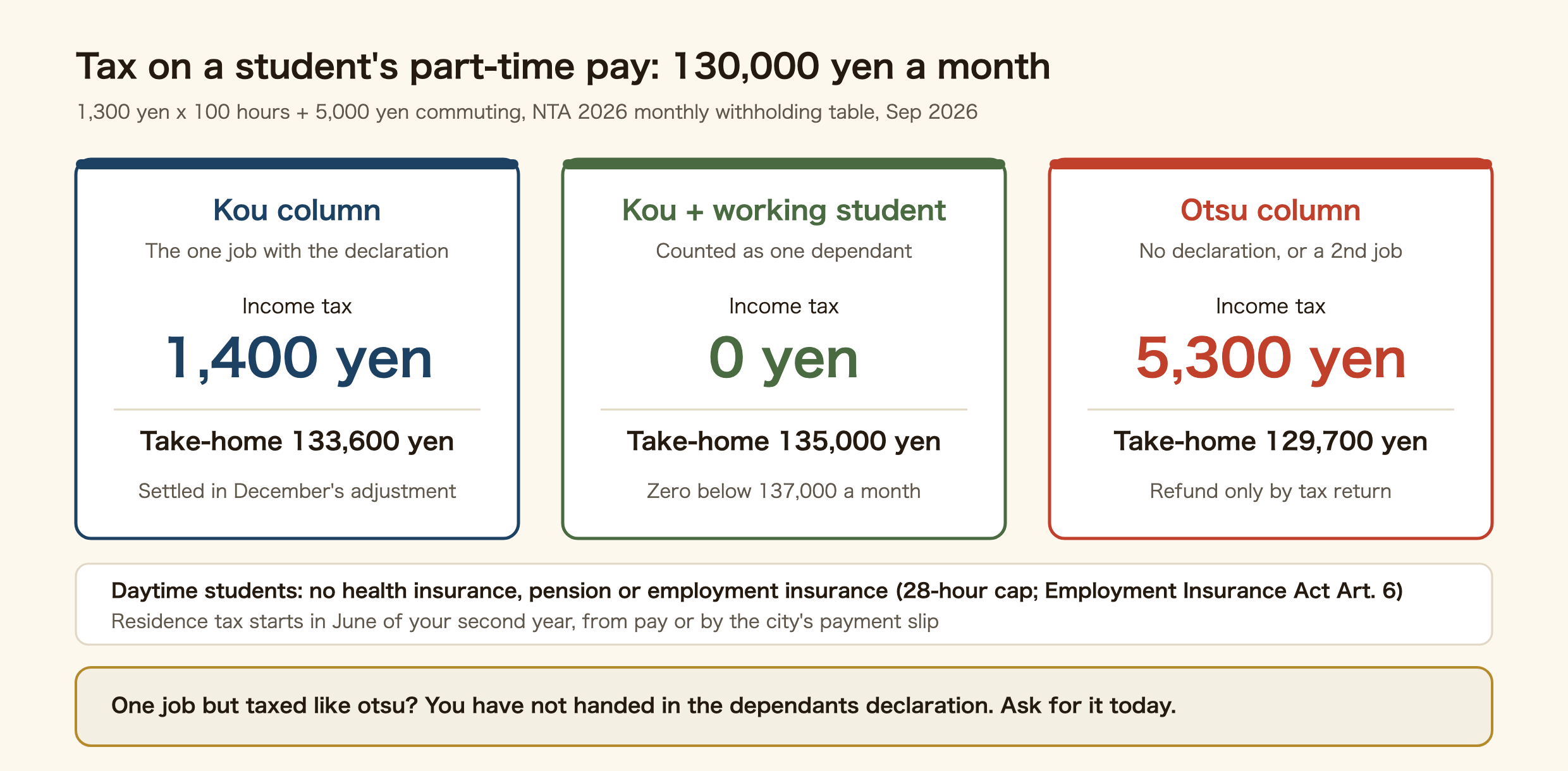
A student’s part-time payslip has mostly empty deduction lines. For a student, that is how the system is meant to work.
- Health insurance and pension: students are excluded from the 20-hours-a-week route for part-timers, and the 28-hour limit keeps them below the other 30-hour route. The details are in why social insurance does not apply to students
- Employment insurance: daytime students are not covered in principle (Employment Insurance Act, Article 6(4)). The Tokyo Labour Bureau confirms that international students working on a work permit are, in principle, not covered if they are daytime students. Exceptions include students on a leave of absence, part-time (evening) courses, and those staying on with the same employer after graduating
- Income tax: may be withheld, and the amount depends on the kou or otsu column
- Residence tax: from June of your second year. Students with only part-time income may receive a payment slip from the city instead
For Japanese language school students, employment insurance depends on whether the school is a recognised “miscellaneous school” or similar. The Tokyo Labour Bureau says to ask your school if you are not sure.
What is the difference between the kou and otsu columns?
An employer that has your dependants declaration (kyuyo shotokusha no fuyo kojo-to shinkokusho) withholds tax using the kou (甲) column. Any employer without it uses the otsu (乙) column (Income Tax Act, Article 185). You can give the declaration to only one employer (Article 194). If you have two jobs, the second one is always otsu.
The difference is large. Take a month of 130,000 yen (1,300 yen an hour for 100 hours, commuting allowance paid separately).
- Kou, no dependants: 1,400 yen
- Kou with “working student” (kinro gakusei) ticked on the declaration: counted as one dependant, so 0 yen (zero below 137,000 yen a month)
- Otsu: 5,300 yen. Even below 105,000 yen, 3.063% is withheld
Students at universities, junior colleges and colleges of technology qualify as working students. Students at vocational and miscellaneous schools qualify only on course conditions, with a certificate from the school. For 2026, the condition is salary of 1.63 million yen a year or less (National Tax Agency).
Tax withheld under otsu is not refunded in the year-end adjustment. You get it back by filing a tax return yourself in February or March. If you only have one job and it uses otsu, you have not handed in the declaration. Ask your employer for the form today. How to count multiple jobs and claim a refund is in income tax in Japan for foreigners.
The 130,000-yen month above, repeated for twelve months, comes to 1.56 million yen. That is below 2026’s 1.78 million line, so the tax withheld comes back through the year-end adjustment or a tax return.
Is it illegal not to give me a payslip?
Yes. An employer paying salary must give you a payslip (Income Tax Act, Article 231(1)). Not giving one, or writing false amounts, can be punished by up to one year’s imprisonment or a fine of up to 500,000 yen (Article 242(7)). Part-time jobs are no exception.
Payslips on a website or app are allowed, but only with your consent, and if you ask for paper the employer must give you paper (Article 231(2)). If access ends when you leave, save your payslips as paper or PDF before your last day.
Employers must also tell you how much insurance they deducted (Health Insurance Act Art. 167(3); Employees’ Pension Insurance Act Art. 84(3)).
What if a deduction looks wrong? Ask your employer, then the Labour Standards Office
An employer may only deduct what the law requires (taxes and social insurance) and what a written agreement with a majority representative of the workers allows (Labour Standards Act, Article 24). If dormitory, meal or uniform costs are taken from your pay, you can ask whether such an agreement exists. Deducting without one is a violation, punishable by a fine of up to 300,000 yen (Article 120).
Go in this order.
- Ask your employer about the line and its basis: “What is this line? What rate is used?” Do it in writing, such as by email, so there is a record
- If you get no answer or no basis, report it to the Labour Standards Inspection Office for your workplace (Labour Standards Act, Article 104). Your employer may not dismiss you or treat you worse because you reported it
- If you are not confident in Japanese, call the free Working Conditions Hotline. English 0120-531-401 and Chinese 0120-531-402 run every day; Vietnamese 0120-531-406 and Nepali 0120-531-408 on set days. Weekdays 5pm-10pm, weekends and holidays 9am-9pm
For unpaid overtime, harassment and other problems, where to report problems at work lists every free line. Your payslip is the best evidence of what you were short-paid, so keep every one.
Which one are you?
- An employee whose take-home pay seems low: recalculate the five deduction lines with the rates in this article. Check your standard monthly remuneration band and which prefecture’s health insurance rate applies.
- One part-time job, but the tax matches the otsu column: ask your employer for the dependants declaration and hand it in. If you are a student, tick “working student” too.
- Two or more part-time jobs: give the declaration to your main job only. Plan to reclaim the second job’s otsu tax in a tax return next February or March, and collect a withholding slip from both employers.
- A line you still cannot understand after asking: photograph your payslip and your employment contract, and call the Working Conditions Hotline.
FAQ
Q. How do I read a Japanese payslip?
Split it into pay (total earnings), deductions (what is taken out) and net pay (what reaches your account). The main deductions are health insurance, employees’ pension, employment insurance, income tax and residence tax, and every rate comes from an official table.
Q. What is the difference between the kou and otsu columns?
The employer that has your dependants declaration withholds tax under kou; any other employer uses otsu. You can give the declaration to only one employer. Otsu takes more, and it is not refunded in the year-end adjustment.
Q. What is deducted from an international student’s part-time pay?
Usually only income tax. Students are not in health insurance or employees’ pension, and daytime students are not in employment insurance in principle. Residence tax starts in June of the second year, either from pay or by payment slip.
Q. What is the child and childcare support contribution on my payslip?
A contribution collected with health insurance since the April 2026 premium, at 0.23% split with your employer. The Children and Families Agency’s guide says it is deducted from May pay. A separate line is not required, so it may be included in the health insurance figure.
Q. Is it illegal for my employer not to give me a payslip?
Yes. Article 231 of the Income Tax Act requires employers to give you one, and not doing so can be punished by up to one year’s imprisonment or a 500,000 yen fine. Even with online payslips, you can ask for paper.
Q. Why is no residence tax deducted from my pay?
Residence tax is charged on the previous year’s income, so it is zero in the year you arrive. From the following June, one twelfth of the annual amount is deducted every month.
Summary
A Japanese payslip reads easily once you split it into pay, deductions and net pay. The deductions are health insurance (half of 9.85% in Tokyo), the support contribution added from May 2026 (half of 0.23%), pension (9.15%), employment insurance (0.5%), income tax (from the withholding table) and residence tax (from June of your second year). Every one of them can be calculated from an official table, so you can check your take-home pay yourself.
On a student’s part-time payslip, income tax is usually the only deduction. If your only job uses the otsu column, hand in the dependants declaration. No payslip, or a deduction nobody can explain: ask your employer first, and go to the Labour Standards Inspection Office if you get no answer. Keep every payslip; it is your evidence.
Official sources: National Tax Agency, 2026 withholding tax tables (Japanese) / NTA, April 2026 withholding tax revision summary (Japanese) / Kyokai Kenpo, FY2026 premium tables (Japanese) / Japan Pension Service, employees’ pension premiums (Japanese) / MHLW, FY2026 employment insurance rates (Japanese) / Children and Families Agency, support contribution (Japanese) / Tokyo Labour Bureau, employment insurance Q&A (Japanese) / Income Tax Act (e-Gov) / MHLW, consultation for foreign workers. Checked on 23 September 2026. If your company has its own health insurance society, check that society’s rate.
Related reading
Found this useful? Share it
Send it to a friend who lives in Japan.
WHO WROTE THIS

mori
Japanese. I read the ministries’ own notices, orders and Q&As in the original, and I start from what my Nepalese and Sri Lankan friends in Japan actually ran into. I do not write about what I have not checked or been told.
What this site can and cannot do →Looking for something else?