Figures, prices and terms were checked against the MHLW page on National Health Insurance premiums, the Tokyo Metropolitan Government standard rates and NTA Taxanswer No.1410 on 9 October 2026. They change — check the current terms yourself before you sign up or file anything.
Last updated: 9 October 2026
Summary
- Japan reduces the flat part of your National Health Insurance bill by 70%, 50% or 20% if your household income last year was low. There is no nationality condition.
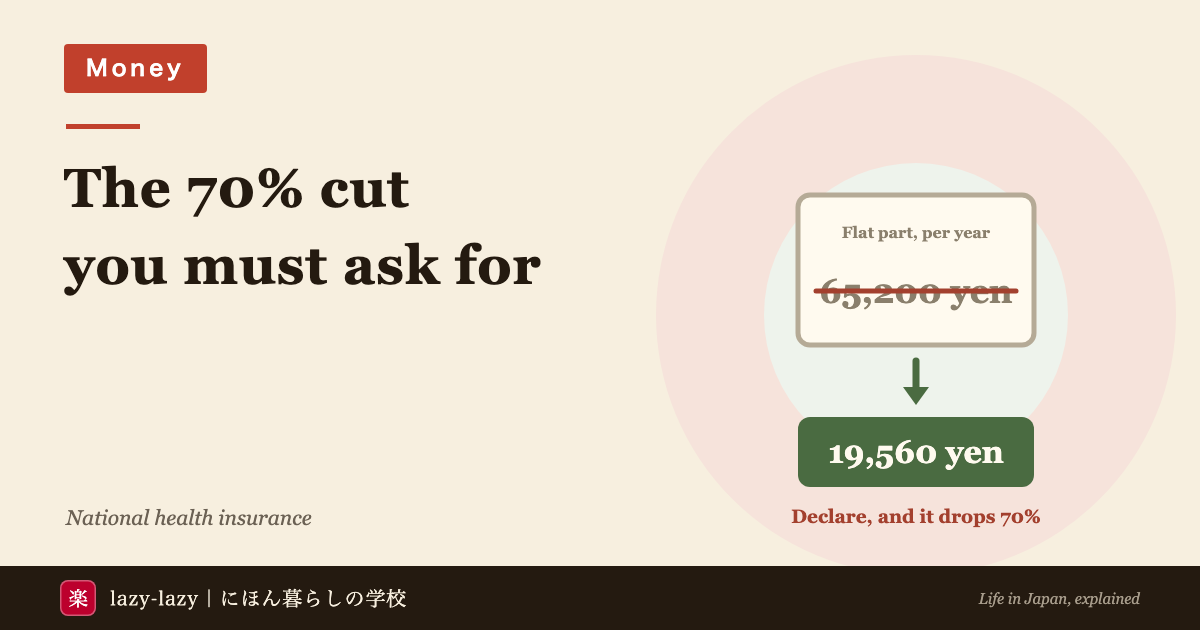
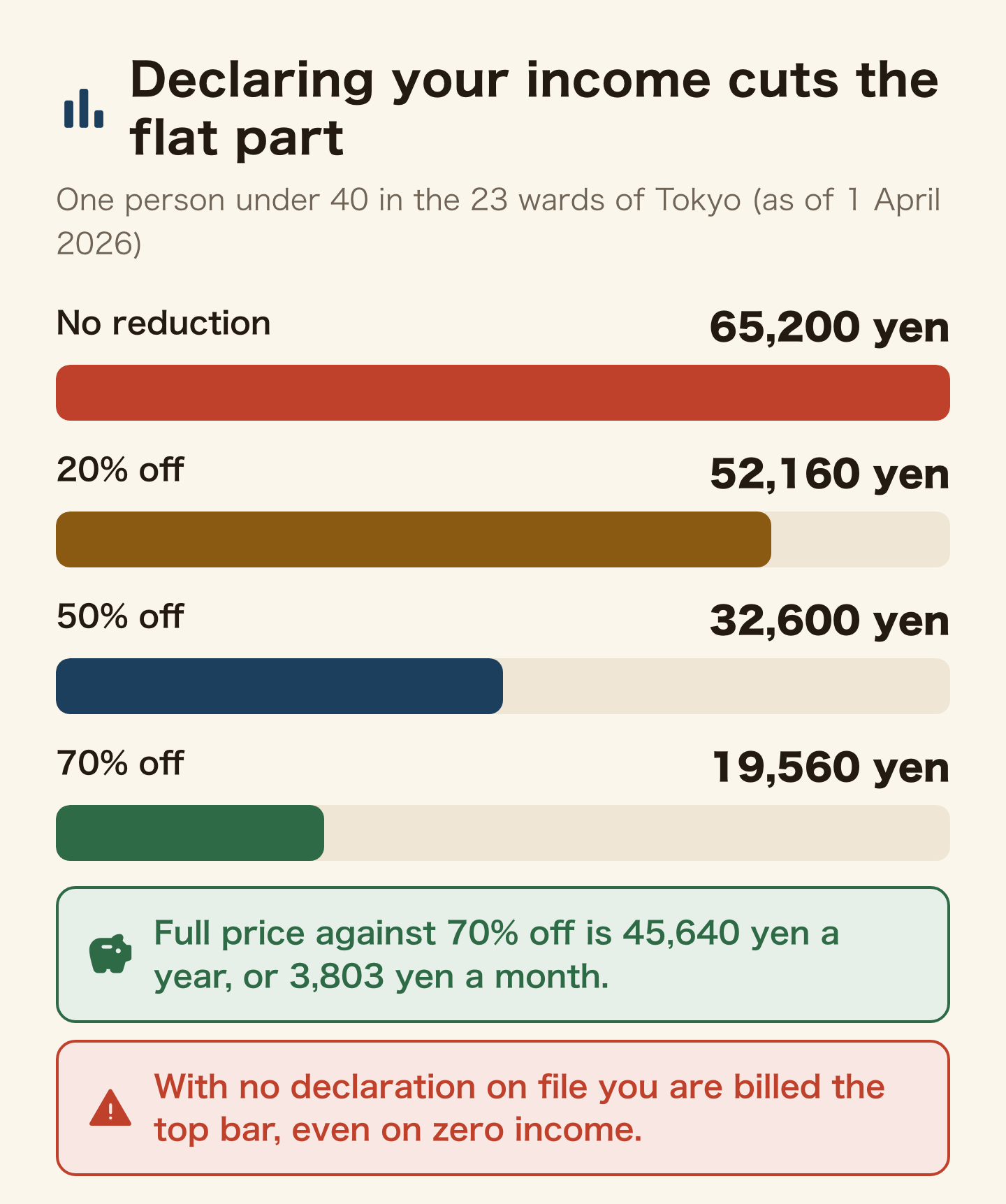
- In the 23 wards of Tokyo the flat part is 65,200 yen a year if you are under 40. With the 70% reduction it becomes 19,560 yen. The gap is 45,640 yen a year.
- In your first year in Japan you had no Japanese income the year before. So almost every student qualifies for the 70% reduction.
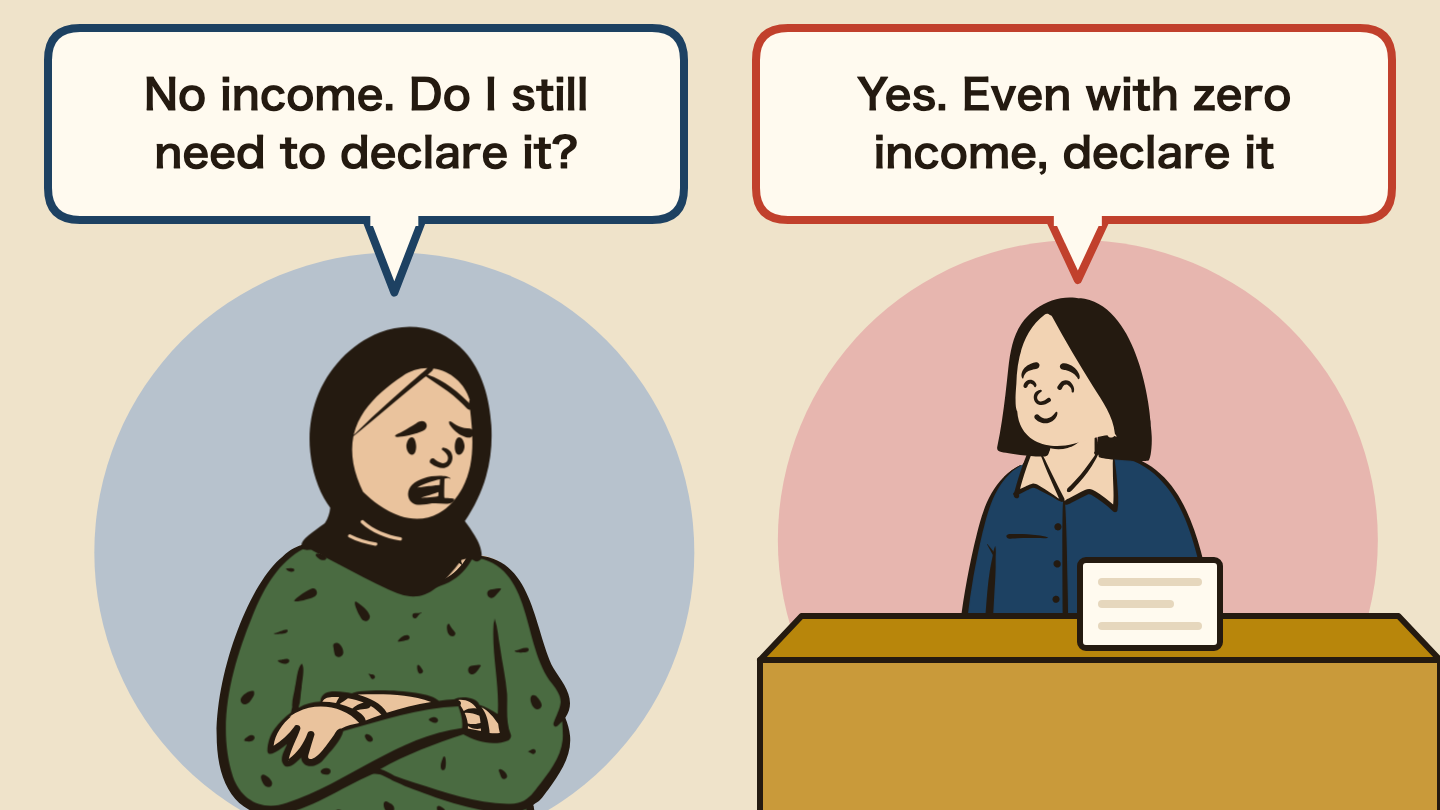
- But the reduction does not arrive unless the city office knows your income. Even with zero income, you have to declare it.
- Living alone on wages only: 70% up to 1.08 million yen a year, 50% up to 1.39 million, 20% up to 1.65 million.
- Working the full 28 hours a week in Tokyo is about 1.72 million yen a year. That is past the 20% line, so the reduction disappears.
- You can only correct the last two years. Anything older stays paid, even if it was wrong.
Once you know this, 45,640 yen a year stops being something that “never came” and becomes something you go and claim – one zero-income filing, that is all.
The insurance card arrived, and then the payment slips came. You have barely worked, and the amount still looks like a phone bill. Most of these slips land in the autumn of the year you arrive.
This article is how to check whether that amount is right, and how to bring it down if it is not.
- What the National Health Insurance reduction is
- Zero income still has to be declared
- What it is worth: 45,640 yen a year in Tokyo
- Which tier you land in: 1.08 million yen is the 70% line
- What to do: three things at the city office
- If you cannot pay, do not go quiet
- When to stop: you can only go back two years
- FAQ
- Summary
What the National Health Insurance reduction is
Your National Health Insurance premium has two parts.
- The income part. Proportional to last year’s income. Zero income means zero here.
- The flat part. Charged per insured person. It does not care whether you earned anything.
The second one is the problem. Even with no income at all, the flat part is billed in full. In the 23 wards of Tokyo that is 65,200 yen a year for one person under 40 (47,600 yen medical plus 17,600 yen elderly support, as of 1 April 2026). That is 5,433 yen a month.
The reduction cuts that flat part by 70%, 50% or 20%. The Ministry of Health, Labour and Welfare describes it as a rule set in law, so every city and ward in Japan has it. Your nationality and your residence status are not part of the test.
Zero income still has to be declared
This is the part worth reading twice. The reduction looks automatic, and it is, but only on one condition.
If your income is known, the reduction is applied automatically. (…) The reduction cannot be applied unless the income of the head of household and of every insured member has been confirmed, so please declare your income to the tax section of your city office or to the tax office, whether or not you had any.
Itabashi Ward, “Reduction and exemption of National Health Insurance premiums” (translated)
Note the phrase “whether or not you had any.” People with no income are being asked to declare it. Without a declaration, your cap on a big hospital bill is also set at the highest high-cost medical expense band.
A Japanese employee never has to think about this: their employer files a wage report and the city office learns the income by itself. A student who does not work, or someone who arrived last year with no Japanese income at all, is outside that pipe. From the office’s side your income is not zero. It is unknown. Unknown means the test cannot be run, so you are billed the full amount.
The same delay happens if you moved from another city during the year. Itabashi Ward flags that case too.
What it is worth: 45,640 yen a year in Tokyo
| Reduction | Flat part per year | Per month |
|---|---|---|
| None | 65,200 yen | 5,433 yen |
| 20% | 52,160 yen | 4,346 yen |
| 50% | 32,600 yen | 2,716 yen |
| 70% | 19,560 yen | 1,630 yen |
Full price against the 70% reduction is 45,640 yen a year. Over two years it passes 90,000 yen. Set against the 199,000 yen a month it costs to live in Tokyo, the 3,800 yen you save each month is not nothing.
The amounts differ by city. Check yours at your own office. The three tiers and the need to declare are the same everywhere.
Which tier you land in: 1.08 million yen is the 70% line
The test uses income from January to December of last year, added up across the head of household and everyone on the policy. For fiscal 2026 the thresholds are these.
- 70% … 430,000 yen, plus 100,000 yen for each wage earner in the household beyond the first
- 50% … that figure, plus 310,000 yen per insured person
- 20% … that figure, plus 570,000 yen per insured person
“Income” here is not your salary and not your take-home pay. For someone living on wages it is the salary minus the employment income deduction. The National Tax Agency sets that deduction at 650,000 yen for anyone earning up to 1.9 million yen, from the 2025 tax year onward. So if you live alone, subtract 650,000 yen from your annual pay and compare.
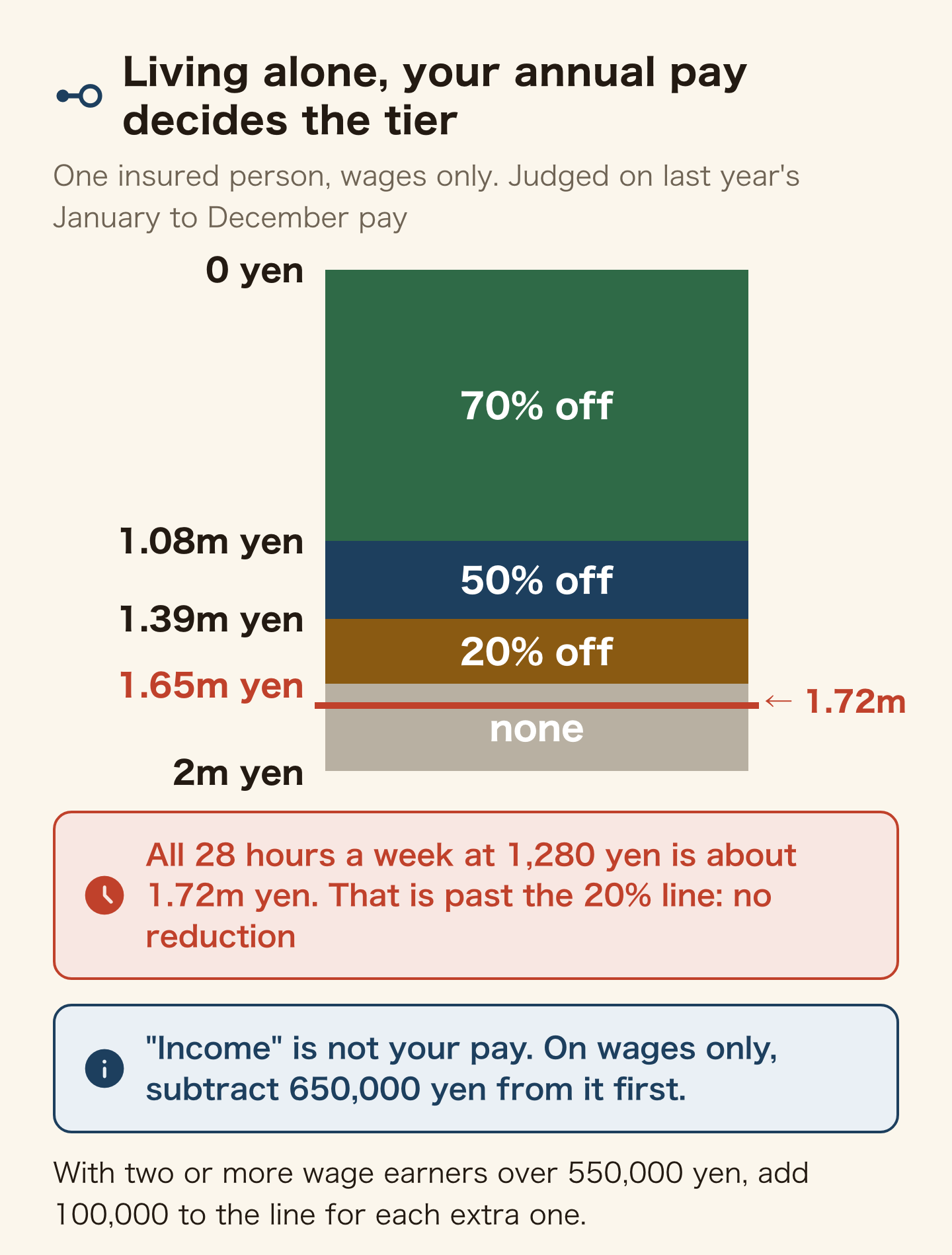
There is a line here that only students hit. Use all 28 hours a week at the Tokyo minimum wage of 1,280 yen and you earn 143,360 yen a month (112 hours, counting four weeks), about 1.72 million yen a year. The 20% line is 1.65 million, so you are about 70,000 yen over it.
Check it: 1,720,320 yen minus the 650,000 yen deduction leaves an income of 1,070,320 yen. The 20% test for one person living alone is 430,000 + 570,000 = 1,000,000 yen. You are above it. Working the full 28 hours a week takes you out of the 20% reduction too. Counted over 52 weeks it is about 1.86 million yen, further over still.
The boundary at 1,280 yen an hour is about 1,289 hours a year (1.65 million divided by 1,280), or roughly 25 hours a week. Put the other way, at 28 hours a week the boundary is an hourly rate of about 1,227 yen (four-week count), and the minimum wage is now above that.
One more thing: from the 2026 tax year the employment income deduction at this level rises from 650,000 to 740,000 yen (National Tax Agency). The line may move for next year’s test, but the reduction thresholds for fiscal 2027 have not been published. This article uses the fiscal 2026 rules, which judge last year’s income with the 650,000 yen deduction. Confirm your own year at the city office.
This is not an argument for working less. It is an argument for raising your rate and cutting your hours. The same income keeps the same tier, but when your income does grow, some of the increase leaves again as premium.
What to do: three things at the city office
There is only one task, and it happens at the tax counter, not the insurance counter.
- Go to the tax section of your city or ward office and say you want to file a resident tax declaration
- If you had no income last year, write that you had none. There is a form for zero
- If you did work, write the amount. Bring the withholding slip if you have one
Take your residence card, something showing your My Number, a personal seal, and the withholding slip if you have one. Requirements vary a little by city, so a phone call first is worth it.
If you already filed a tax return, that information reaches the office and you do not need to file again. The same is true if you had one job and your employer did the year-end adjustment.
Show this at the counter
Show this to the staff at the tax section (zeikaika / tax section) of your city or ward office. It is the tax counter, not the insurance counter.
What to say (with reading aids)
「住民税の申告をしたいです。収入がなかった場合の書き方も教えてください」
“I want to file a resident tax declaration. Please also tell me how to write it if I had no income.”
For the staff member(職員の方へ)
国民健康保険料の軽減判定のため、住民税の申告をしたいと考えています。前年の収入がなかった場合も申告が必要か、必要な書類(在留カード・マイナンバーが分かるもの・印鑑・源泉徴収票)と、申告用紙の場所を教えていただけますか。
Documents and counter names differ a little by municipality. Calling ahead is the safest.
If you cannot pay, do not go quiet
Even after the reduction the bill can be more than you have. Two routes exist.
- Payment consultation. Ask to split it. You can do this at the counter on the day. Late charges keep running on an instalment plan, so check how a formal deferral cuts the late charge before you go
- Exemption. For disasters or a sudden drop in income. This is a separate scheme from the reduction, and nothing happens until you apply
The worst option is to leave it unpaid and say nothing. Unpaid National Health Insurance counts as unpaid public dues under the permanent residence revocation rules starting April 2027. Being unable to pay is not itself a reason for revocation. Being on an agreed instalment or deferral plan is listed as a case that does not apply. The dividing line is whether you filed something. If it is not just the premium but rent and food you cannot cover, check whether you can get welfare, and the rent support that comes before it.
When to stop: you can only go back two years
There is a clock on this. Itabashi Ward cites Article 110-2 of the National Health Insurance Act: a premium cannot be set or changed more than two years after the day following the first payment deadline of that fiscal year, normally 30 June.
So last year may still be fixable along with this year. Three years ago is closed, even if the amount was wrong.
Which makes the decision simple. If the amount on your slip does not match your life, phone the office this week. Two questions: has my income been declared, and is a reduction applied. If it is, you are done. If it is not, pick a day to go in.
And from next year, declare every year between February and March whether or not you earned anything. The full-price slip will not come again.
FAQ
Q. I heard international students are exempt from National Health Insurance. Is that true?
No exemption for students exists. What exists is the reduction (70%, 50% or 20% off the flat part for low-income households) and a separate exemption you apply for after a disaster or a sudden loss of income. Being a student or a foreign resident does not remove you from the system.
Q. I was not in Japan last year. Do I still have to declare?
Yes. The declaration is how the office learns that your Japanese income was zero. Without it your income stays “unknown” rather than zero, and the test cannot be run.
Q. My employer withholds tax. Do I still need to declare?
If you have one job and received the year-end adjustment, the information reaches the office and you do not. If you work two or more jobs, or did not get the year-end adjustment, declare. You may also get overpaid income tax back.
Q. How can I tell whether a reduction has been applied?
The payment slip or decision notice shows wording such as “reduction” or “70%”. If you cannot find it, call the insurance section and give the number on your insurance card.
Q. Is this the same as the student pension exemption?
Different scheme. The student pension exemption defers National Pension contributions and you apply for it yourself. This reduction is on health insurance and applies automatically once your income is known. Many people qualify for both, so do both.
Q. I live with family. How is the test done?
The incomes of the head of household and of everyone on the policy are added together. The head of household counts even if they are not on National Health Insurance themselves. So one member who has not declared can hold up the reduction for the whole household.
Summary
- The National Health Insurance reduction cuts the flat part of your premium by 70%, 50% or 20% for low-income households, with no nationality condition
- In the 23 wards of Tokyo the flat part is 65,200 yen a year under 40; the 70% reduction brings it to 19,560, a gap of 45,640 yen
- The reduction does not arrive until the office knows your income. Zero income still has to be declared
- Living alone on wages: 70% up to 1.08 million yen, 50% up to 1.39 million, 20% up to 1.65 million
- Working the full 28 hours a week at the Tokyo minimum wage is about 1.72 million yen a year: past the 20% line, so no reduction. The boundary is about 1,289 hours a year at 1,280 yen
- If you cannot pay, ask for instalments or apply for the exemption. Silence is the worst choice
- Corrections stop two years after the first payment deadline. If in doubt, phone the office this week
Sources: Itabashi Ward, reduction and exemption of National Health Insurance premiums / Ministry of Health, Labour and Welfare, on National Health Insurance premiums / Tokyo Metropolitan Government, standard premium rates / National Tax Agency, No.1410 employment income deduction
Found this useful? Share it
Send it to a friend who lives in Japan.
WHO WROTE THIS

mori
Japanese. I read the ministries’ own notices, orders and Q&As in the original, and I start from what my Nepalese and Sri Lankan friends in Japan actually ran into. I do not write about what I have not checked or been told.
What this site can and cannot do →Looking for something else?
You may use the figures in this article, including commercially, if you credit this site with a link. How to use our figures