Last updated: 2 October 2026
Summary
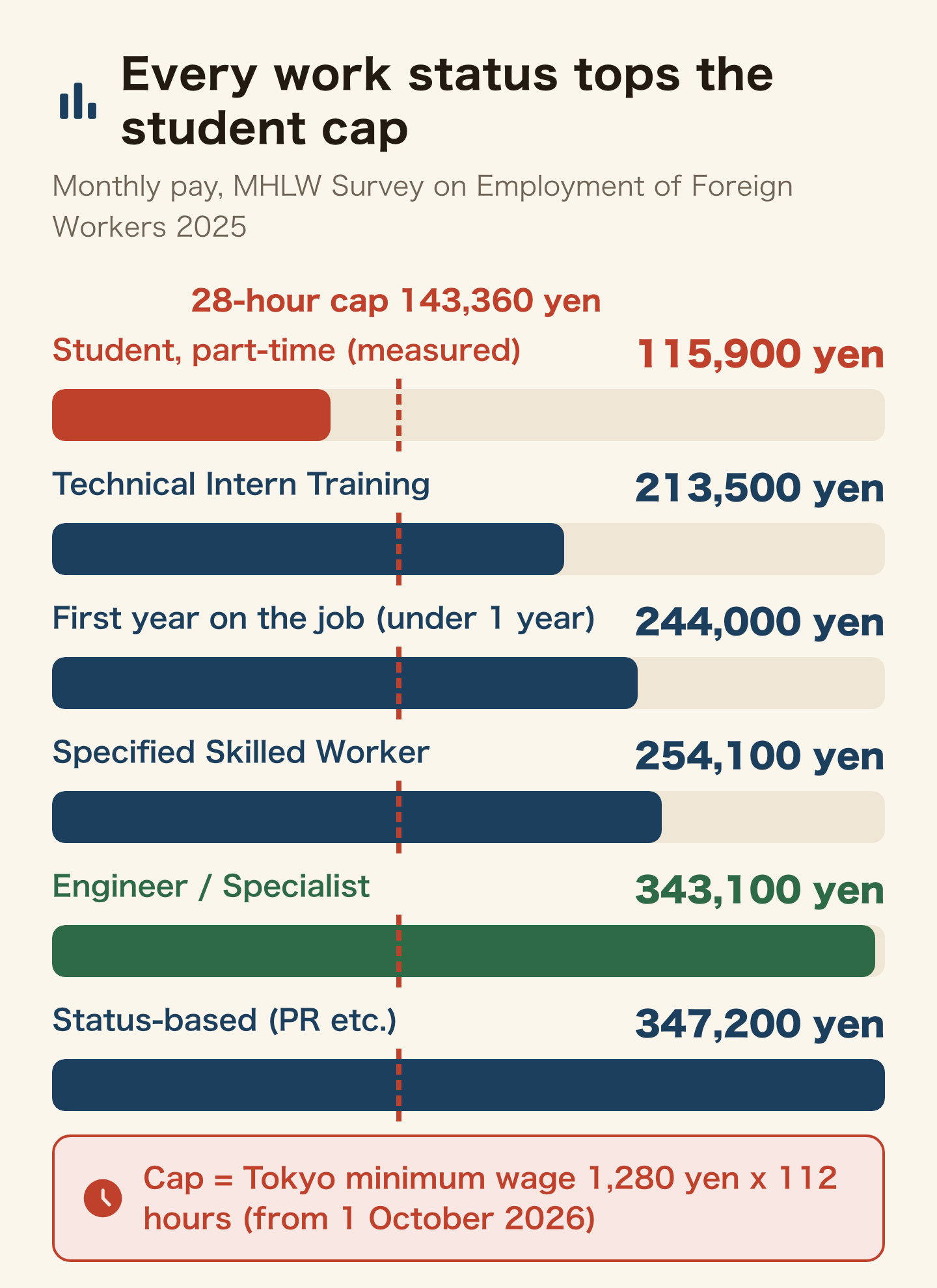
- Government data: every work visa category out-earns the student part-time ceiling of 143,360 yen a month – even Technical Intern Training at 213,500 yen. The Engineer/Specialist visa averages 343,100 yen. Students actually earn 115,900 yen (MHLW survey).
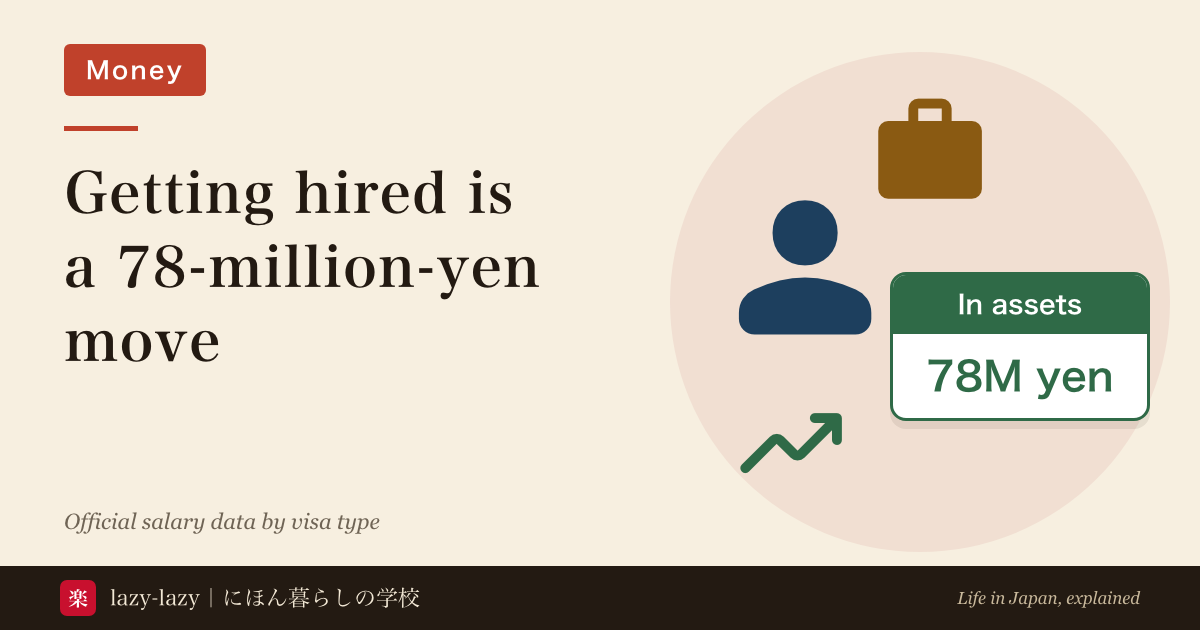
- By the 4 percent rule – the idea that assets worth 25 years of spending can sustain you – getting hired is financially equivalent to about 78 million yen in assets. Even first-year pay works out at about 39 million.
- “Equal to or above what a Japanese worker earns” is a legal requirement of the work visa. A cheap job offer is not just unfair. It is a published reason for visa refusal.
- A student who worked 200 hours a month part-time was refused a work visa. Overworking now can destroy the single biggest financial move you have.
Knowing this, you see that a job is worth about 78 million yen of assets – and you put your effort into changing your visa, not raising your hourly wage.
If you spend every week negotiating a 50-yen raise or squeezing two more hours into your shift, this page is for you – because the numbers here are in a different digit.
Everything below comes from the Ministry of Health, Labour and Welfare wage survey and from refusal cases published by the Immigration Services Agency. No motivation, just the material for a decision.
Salary by visa type: the official numbers
The 2025 Survey on Employment of Foreign Workers, published by the labour ministry on 31 August 2026, gives pay by residence status. It also records what students actually earn, so both sides can be measured on the same ruler.
| Residence status | Monthly pay | Bonus last year |
|---|---|---|
| Status-based (permanent residents, spouses of Japanese etc.) | 347,200 yen | 450,600 yen |
| Engineer / Specialist in Humanities / International Services | 343,100 yen | 412,900 yen |
| Specified Skilled Worker | 254,100 yen | 174,900 yen |
| First year on the job (under 1 year of service) | 244,000 yen | 14,900 yen |
| Technical Intern Training | 213,500 yen | 63,600 yen |
| (Comparison) students working part time – measured | 115,900 yen | 1,800 yen |
| (Reference) the legal 28-hour maximum for students (Tokyo minimum wage 1,280 yen x 112 hours, from 1 October 2026) | 143,360 yen | – |
Compare everything to the bottom two rows. Every work status pays more than the maximum you can earn on 28 hours a week. Even the lowest clears it by more than 70,000 yen a month.
The row that matters most is the second from the bottom. Students working part time average 115,900 yen (MHLW survey), which is below even the legal ceiling of 143,360 yen. Their scheduled hours come to 79.0 a month, about 18 hours a week. Most students are nowhere near the 28-hour limit.
Two honest notes. The “first year on the job” row is not a residence status but a length-of-service band across all foreign workers, so a new graduate does not jump straight to 343,100 yen. And only the student row is part-time; the rest are full-time workers. The comparison is between the job you have now and the job you would have after hiring, which is exactly what this article is about.
Getting hired is worth about 78 million yen in assets
People chasing financial independence use the 4 percent rule: with assets worth 25 times your annual spending, you can live off withdrawals. The ruler works in reverse too – an increase in income is equivalent to a certain amount of assets.
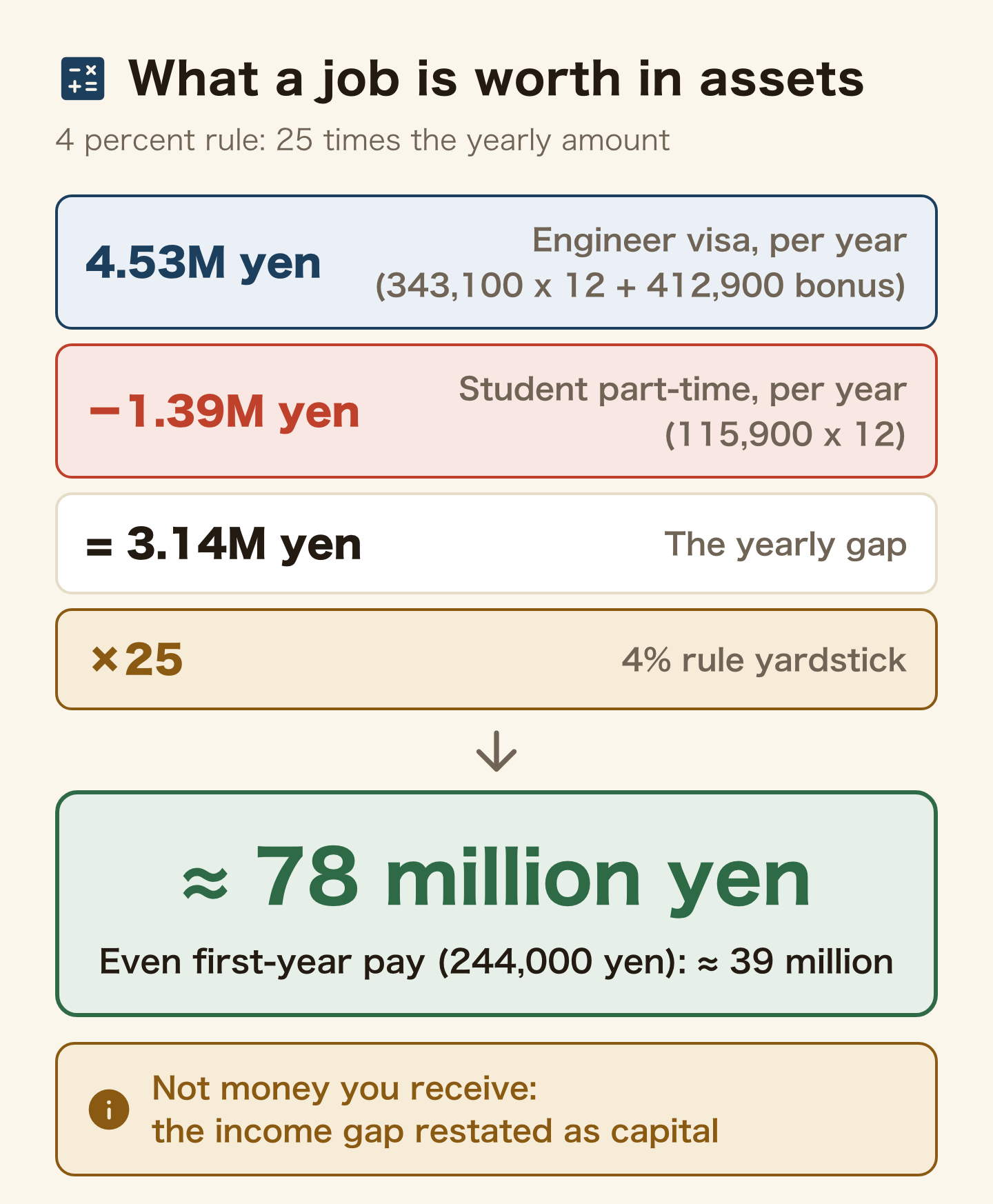
- Engineer visa: about 4.53 million yen a year (343,100 yen a month x 12, plus a 412,900 yen bonus)
- Student part-time work: about 1.39 million yen a year (115,900 yen a month x 12)
- The gap is about 3.14 million yen a year. To generate that from assets, times 25 = about 78 million yen
Moving from a student status to a work status changes your income as much as owning 78 million yen would. You do not land on the average immediately, so recomputing with first-year pay of 244,000 yen still gives about 39 million yen. No amount of frugality, wage negotiation or double shifts reaches that digit.
One honest note. The 4 percent rule is a yardstick for assets, not a promise that a job hands you 78 million yen. It restates a change in income as the amount of capital that would produce it.
Which sets the order of operations: today’s savings and the scholarship are the bridge to this one move. Do not burn out on the bridge. That is this whole site in one sentence.
“Equal pay or above” – a cheap offer is a refusal reason
It is your first job, so you are ready to take whatever salary gets you in the door. Where you come from, starting low and earning your way up may be the normal route. For a Japanese work visa, a salary below what a Japanese hire gets for the same job can mean the visa itself is refused.
The Engineer/Specialist work visa carries a legal compensation requirement: pay equal to or above what a Japanese worker would receive for the same work. From the officially published refusal cases:
An application was filed for engineering work at a monthly salary of 135,000 yen. It came to light that a Japanese new graduate hired at the same time for the same work was paid 180,000 yen a month, so the compensation was not recognised as equal to or above that of a Japanese worker, and the application was refused.
Immigration Services Agency, published permission/refusal cases – translated from the Japanese original
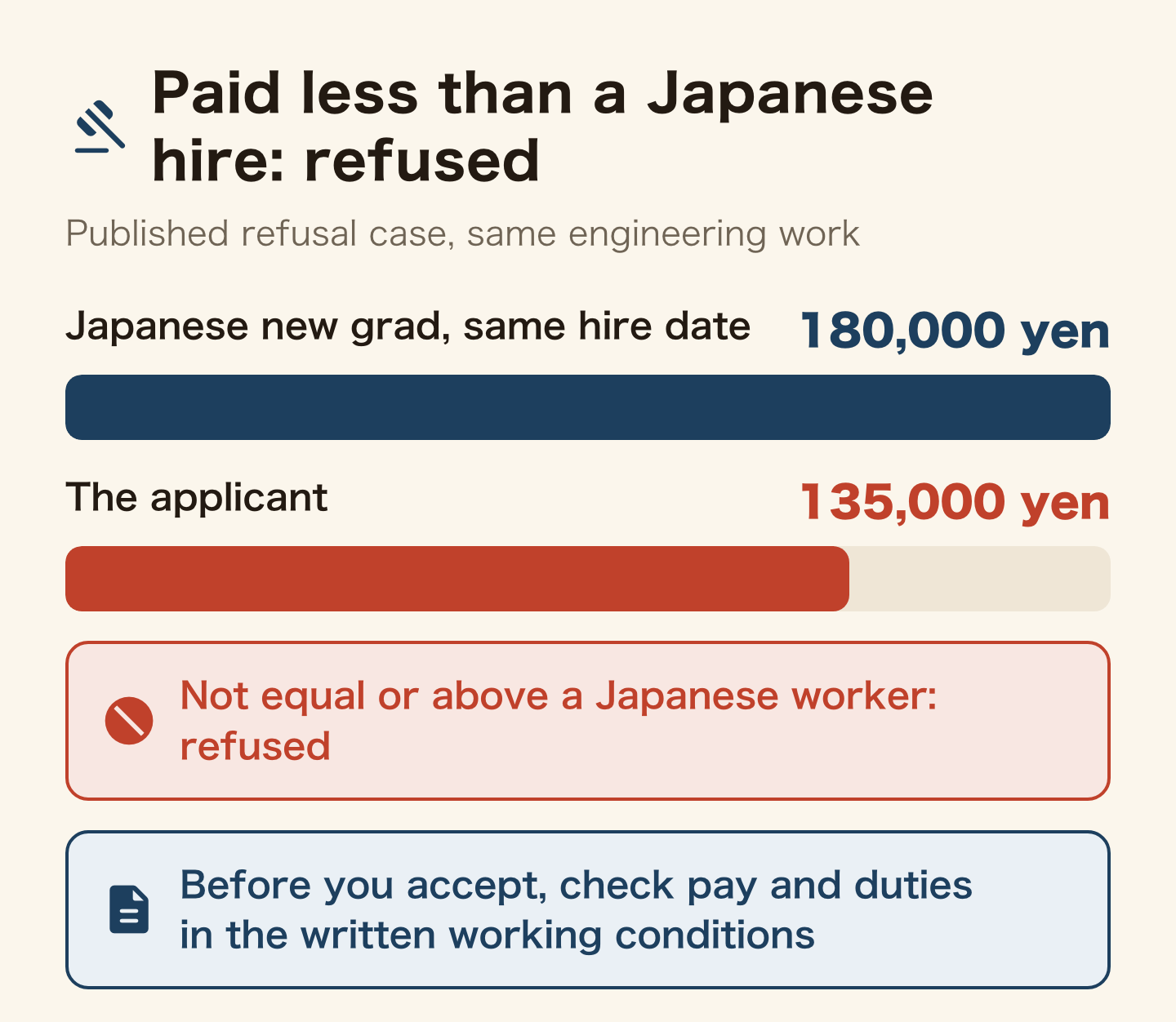
This means two things.
First: never accept an offer priced on “foreigners work cheap.” You lose money, and the visa itself may be refused at that salary. Some HR departments genuinely do not know this rule. Before you accept, get the salary and duties in the written statement of working conditions and check them.
Second: the rule is your negotiating backbone. “Pay me what you pay the Japanese hire in this role” is not a request. It is an immigration-law requirement. The law does the awkward negotiating for you.
The published case where overworking destroyed the move
The same document contains a case aimed directly at readers of this site.
It came to light in the application that the applicant, while residing on a Student visa, had worked part-time more than 200 hours a month continuously for over a year, far exceeding the scope of the work permit. The residence record was therefore not recognised as good, and the application was refused.
Immigration Services Agency, published permission/refusal cases – translated from the Japanese original
Two hundred hours is roughly double the 28-hour cap (112 hours a month). That student was almost certainly working to survive. And the overwork, recorded in the paper trail, refused the very move worth 78 million yen.
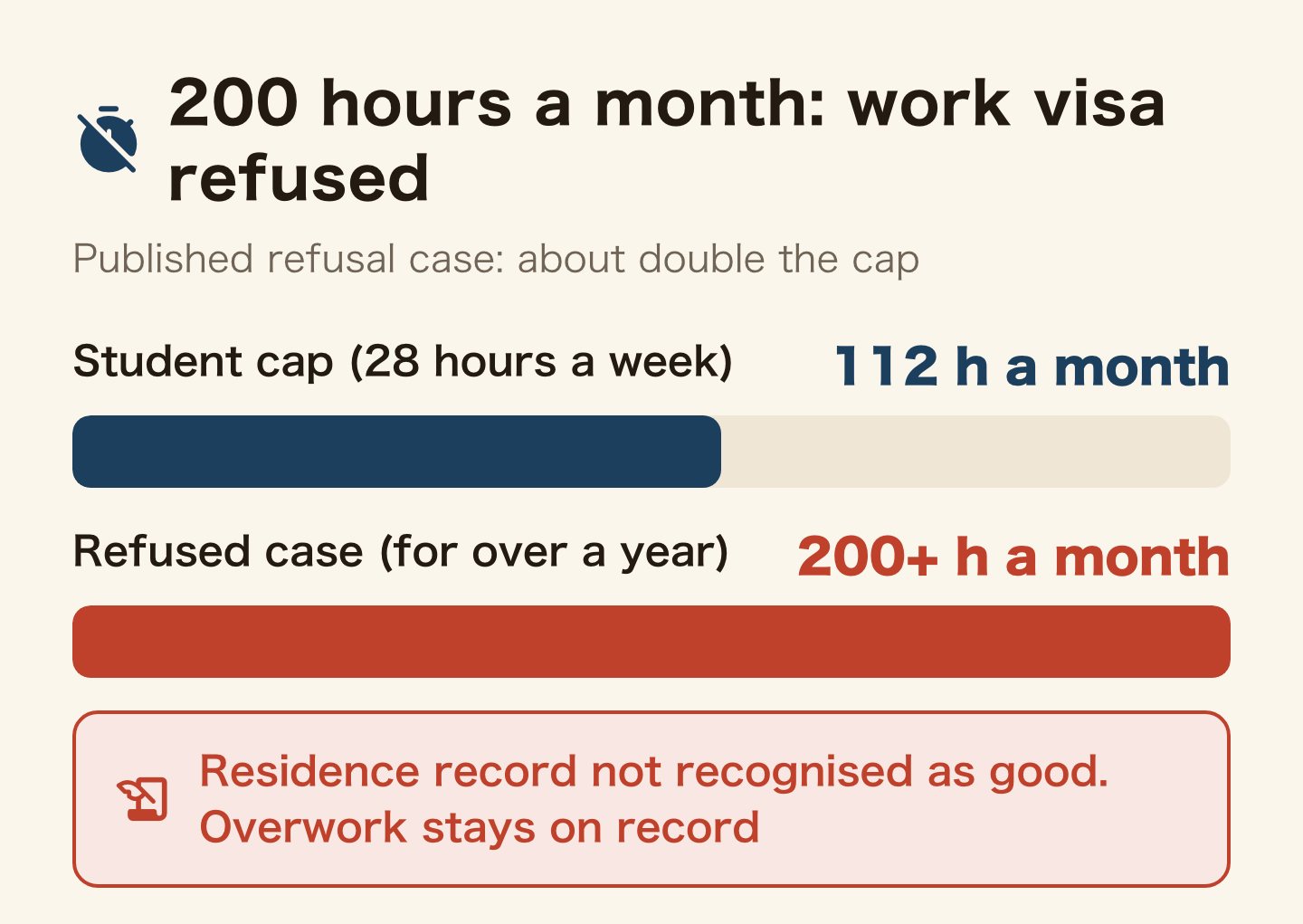
We wrote elsewhere that adding shifts can cost you the 30,000-yen scholarship when grades slip. This is bigger: staying over the cap can cost you the job itself. It is the most expensive overtime available.
What to do with these numbers while you are still a student
- Stay under 28 hours. Not out of obedience – you are protecting a 78-million-yen move
- Protect your grades. The scholarship nomination (2.30) and the school’s job recommendations come from the same place
- Put hours into Japanese. Keigo and kanji are the highest-hourly-rate skills you can build for interviews and the workplace. If an interview is close, start with onsha vs kisha and how to fix doubled keigo — you can use them that day
- The procedure, and why people fail despite a 97 percent approval rate, is in student visa to work visa
No degree? The Specified Skilled Worker route averages 254,100 yen (same survey) – still about 110,000 yen a month above the student ceiling of 143,360 yen. Fields and conditions are in working in Japan without a degree.
One more gap that never shows on the payslip: on a work visa your employer also pays half of your Employees’ Pension, on top of the salary.
Frequently asked questions
Q. How much do foreigners earn in Japan?
The 2025 Survey on Employment of Foreign Workers puts the full-time average at 292,400 yen a month. The highest category is Highly Skilled Professional at 477,600 yen, with Engineer/Specialist in Humanities at 343,100 yen.
Q. What is the work visa japan salary compared to student part-time work?
Students working part time actually average 115,900 yen a month, about 1.39 million yen a year (MHLW survey). The Engineer visa averages 343,100 yen plus a 412,900 yen bonus, about 4.53 million yen a year. The gap of about 3.14 million yen a year is equivalent to roughly 78 million yen in assets under the 4 percent rule.
Q. Is it legal to pay foreigners less in Japan?
Not on the Engineer/Specialist visa. The law requires compensation equal to or above a Japanese worker doing the same work, and a published case shows a visa refused because the applicant was offered 135,000 yen while the Japanese hire got 180,000.
Q. Do these wage figures include bonuses?
No. They are the pay fixed to be paid every month, which includes overtime pay (at least 25% extra for hours beyond 8 a day) but excludes bonuses, so real annual income at bonus-paying companies is higher than twelve times these figures.
Q. Can working too much part-time hurt my job application?
Yes. A published case shows a work visa refused because the applicant had worked over 200 hours a month for more than a year as a student, far over the permitted cap, so their residence record was not considered good.
Q. What is the SSW salary in Japan?
Specified Skilled Workers average 254,100 yen a month in the same survey – about 110,000 yen above the student part-time ceiling of 143,360 yen.
Summary
- Official data: every work status out-earns the student ceiling of 143,360 yen. The Engineer visa averages 343,100 yen; students actually earn 115,900 yen
- Under the 4 percent rule, getting hired equals about 78 million yen in assets (about 39 million using first-year pay)
- Equal-pay-or-above is a legal requirement. A cheap offer is a refusal risk – and your negotiating backbone
- 200 hours a month of part-time work refused someone’s work visa. Staying under 28 hours protects the biggest move you have
- Savings and the scholarship are the bridge. Do not burn out on the bridge
Official sources: MHLW, Survey on Employment of Foreign Workers 2025 (published 31 August 2026) / Immigration Services Agency, permission/refusal cases (PDF) / the Engineer/Specialist status
Statistics and cases were checked on 8 October 2026. Wages vary widely by employer, region and experience. The 4 percent rule is a yardstick for thinking, not a guarantee of investment results. For your own visa case, consult a regional immigration bureau or an immigration lawyer.
Found this useful? Share it
Send it to a friend who lives in Japan.
WHO WROTE THIS

mori
Japanese. I read the ministries’ own notices, orders and Q&As in the original, and I start from what my Nepalese and Sri Lankan friends in Japan actually ran into. I do not write about what I have not checked or been told.
What this site can and cannot do →Looking for something else?
You may use the figures in this article, including commercially, if you credit this site with a link. How to use our figures