Checked on 23 September 2026 against the Immigration Services Agency’s pages on the points-based system, its official Q&A (as of April 2026) and points table, the Permanent Residence Guidelines (revised 24 February 2026), the J-Skip page, and the Ministry of Justice ordinance on e-Gov.
The short answer
- The Highly Skilled Professional (HSP) visa is a status for people who score 70 points or more on education, career, salary, age, Japanese and a few bonus items. Most company employees fall under type (i)(b).
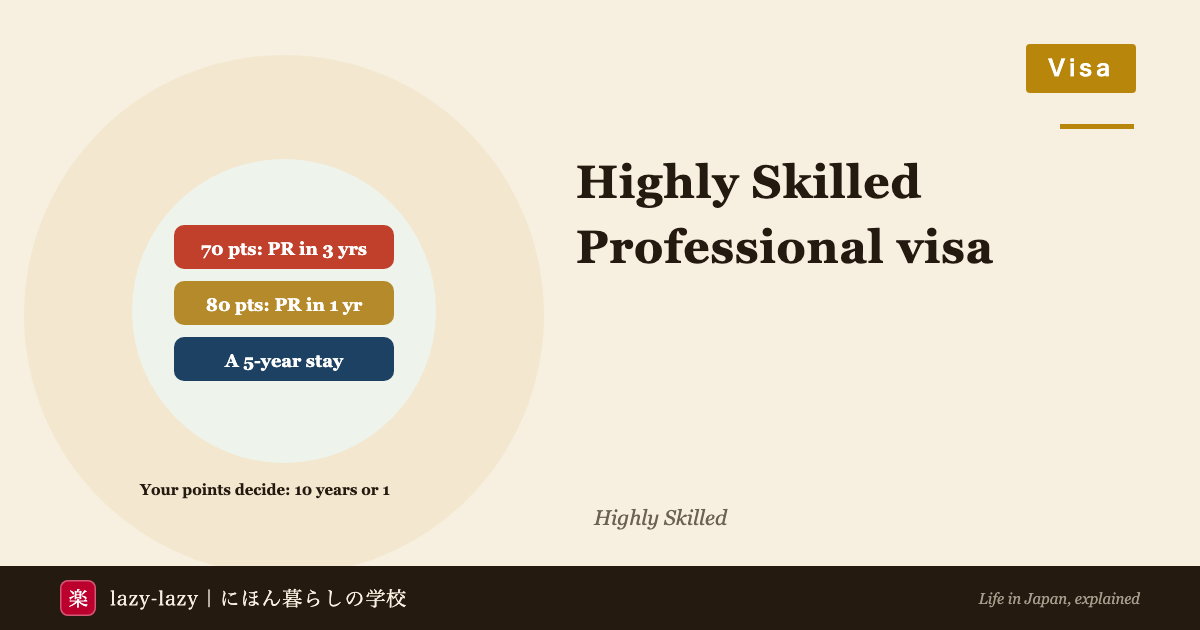
- With 70 points you can apply for permanent residency after 3 years; with 80, after 1 year. The normal rule is 10.
- You get a 5-year period of stay from the start, and, if you meet the conditions, a spouse who can work full-time, your parents, and a domestic worker.
- You score yourself on the official points table (an Excel file) and send only the documents that prove 70 points.
- With a salary of 20 million yen or more plus a master’s degree or 10 years’ experience, you can skip the points entirely: that is J-Skip.
Knowing this, you can see your score today and what would lift it to 70 or 80, so you can decide whether to chase a raise, a job change or JLPT N1 first. It also tells you whether planning for a ten-year wait is the right assumption.
You are gathering papers for your visa renewal when someone in HR asks, “Couldn’t you apply as a highly skilled professional?” You ask your Japanese colleagues how many points that takes. None of them know. Japanese nationals never get scored for a visa. When you look it up, you find a system where two people doing the same job at the same company can wait anywhere from ten years to one for permanent residency, depending on their points.
- What is the Highly Skilled Professional visa in Japan?
- What are HSP (i)(a), (b) and (c)?
- How are Highly Skilled Professional points calculated?
- How do you count salary, age and experience?
- What are the benefits of the HSP visa?
- How fast can a Highly Skilled Professional get permanent residency?
- What is HSP (ii)?
- What are the J-Skip requirements?
- Where do I get the points table, and what documents do I need?
- How much does it cost?
- What if I change jobs or break the rules?
- What if I fall short of 70 points?
- Is Japan raising the HSP salary requirement?
- Which one are you?
- FAQ
- Summary
- Related reading
What is the Highly Skilled Professional visa in Japan?
It is the residence status “Highly Skilled Professional” (kodo senmonshoku), granted to people recognised as scoring 70 points or more under the points-based system that started in May 2012.
It sits on top of an ordinary work visa. The official Q&A says that if your job, education or pay would not qualify for any work status in the first place, you are not eligible. Think of it as a layer above Engineer/Specialist in Humanities/International Services: the same kind of job, plus enough points.
At the end of 2024 there were 26,960 people on HSP (i), of whom 21,094 were in type (b), and 1,748 on HSP (ii) (Immigration Policy Council report).
What are HSP (i)(a), (b) and (c)?
The type depends on the work. Points are counted slightly differently for each.
| Type | Work | Examples |
|---|---|---|
| (i)(a) Advanced academic research | Research, research guidance or teaching under a contract with a Japanese organisation | University faculty, researchers |
| (i)(b) Advanced specialised/technical | Work needing knowledge or skills in the natural sciences or humanities, under a contract with a Japanese organisation | Engineers, planners, international lawyers |
| (i)(c) Advanced business management | Running or managing a business in Japan | Executives, managers |
Types (b) and (c) have a floor: a salary of at least 3 million yen a year. Below that you are not eligible, however many points you have. Type (a) has no such floor.
How are Highly Skilled Professional points calculated?
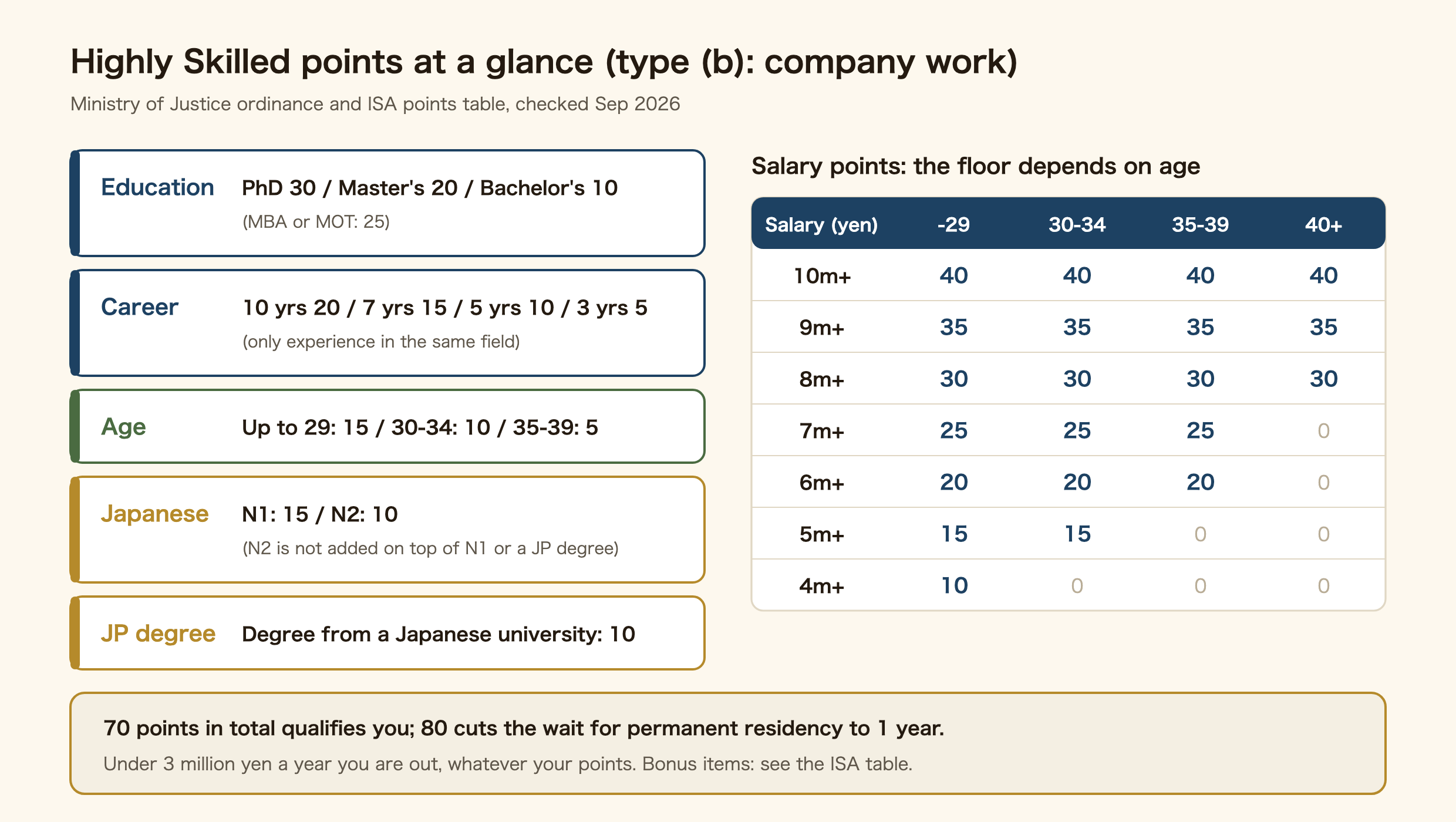
For type (b), you add up these items (the Ministry of Justice ordinance and the ISA points table).
- Education: PhD 30, a professional degree in business management (MBA, MOT) 25, master’s 20, bachelor’s 10. Plus 5 for degrees in more than one field
- Career, counting only experience related to the job: 10 years 20, 7 years 15, 5 years 10, 3 years 5
- Salary: from 40 points at 10 million yen down to 10 points at 4 million — but which bands count depends on your age (right side of the chart)
- Age: up to 29 gets 15, 30–34 gets 10, 35–39 gets 5, 40 and over 0
- Japanese: N1 (or BJT 480+, or a Japanese major at a foreign university) 15; N2 (or BJT 400+) 10
- A degree from a Japanese university or graduate school: 10
- Other items: research record 15, related Japanese national qualifications or IT exams (5 for one, 10 for two or more), and more
The salary bands are where people miscount. Five million yen is 15 points if you are 34 or younger, and zero from 35. At 40 and over, points start at 8 million.
Two worked examples. A 28-year-old with a master’s from a Japanese graduate school, three years in the same field, an expected salary of 5 million yen and N1: 20 + 5 + 15 + 15 + 10 + 15 = 80.
A 32-year-old with a bachelor’s from home, five years’ experience, 6 million yen and N2: 10 + 10 + 20 + 10 + 10 = 60. Moving from N2 to N1 adds 5. A raise to 7 million adds another 5. That makes exactly 70.
How do you count salary, age and experience?
The Q&A and the ordinance count them this way.
- Salary means the salary you are going to receive, not last year’s tax slip. Bonuses count
- Overtime pay does not count, because no one knows how much overtime there will be. Commuting, family and housing allowances that cover expenses do not count either
- If you are transferred from an overseas office and paid by that company, its pay counts
- Age is taken when you apply. If you meet the criteria when you apply, the ordinance treats you as meeting them when permission is granted
- Experience counts only if it is related to the work you will do
- “University graduate” includes junior colleges, colleges of technology and vocational schools that award the kodo senmonshi title. The ordinary senmonshi title does not count
Once you have the status, you do not have to hold 70 points every day. Turning 30 and losing 5 age points does not end your status. But at renewal, if you are below 70, you cannot renew as an HSP.
What are the benefits of the HSP visa?
HSP (i) comes with these benefits, according to the ISA.
- Activities across more than one status (for example, doing research and running a related business)
- A period of stay of 5 years for everyone, which can be renewed
- A shorter residence requirement for permanent residency (next section)
- Your spouse can work full-time in research, teaching, Engineer/Specialist or entertainment work without meeting the usual education or career rules — if you live together and the pay is at least what a Japanese worker would get
- Your parents can come, to look after a child under 7 or to help during pregnancy, if household income is 8 million yen or more, they live with you, and they are the parents of only one of you
- You can employ a foreign domestic worker: household income of 10 million yen or more, one worker, paid 200,000 yen a month or more
- Priority processing, with targets of 10 days for a Certificate of Eligibility and 5 days for applications in Japan
Number 5 is the big one. Ordinary work visas have no status for parents at all; bringing family to Japan normally means a spouse and children only. HSP makes a conditional exception. When the child turns 7, the parent’s stay cannot be renewed.
Treat number 7 as a target, not a promise. The Immigration Policy Council’s December 2025 report says processing times for HSP have become much longer.
How fast can a Highly Skilled Professional get permanent residency?
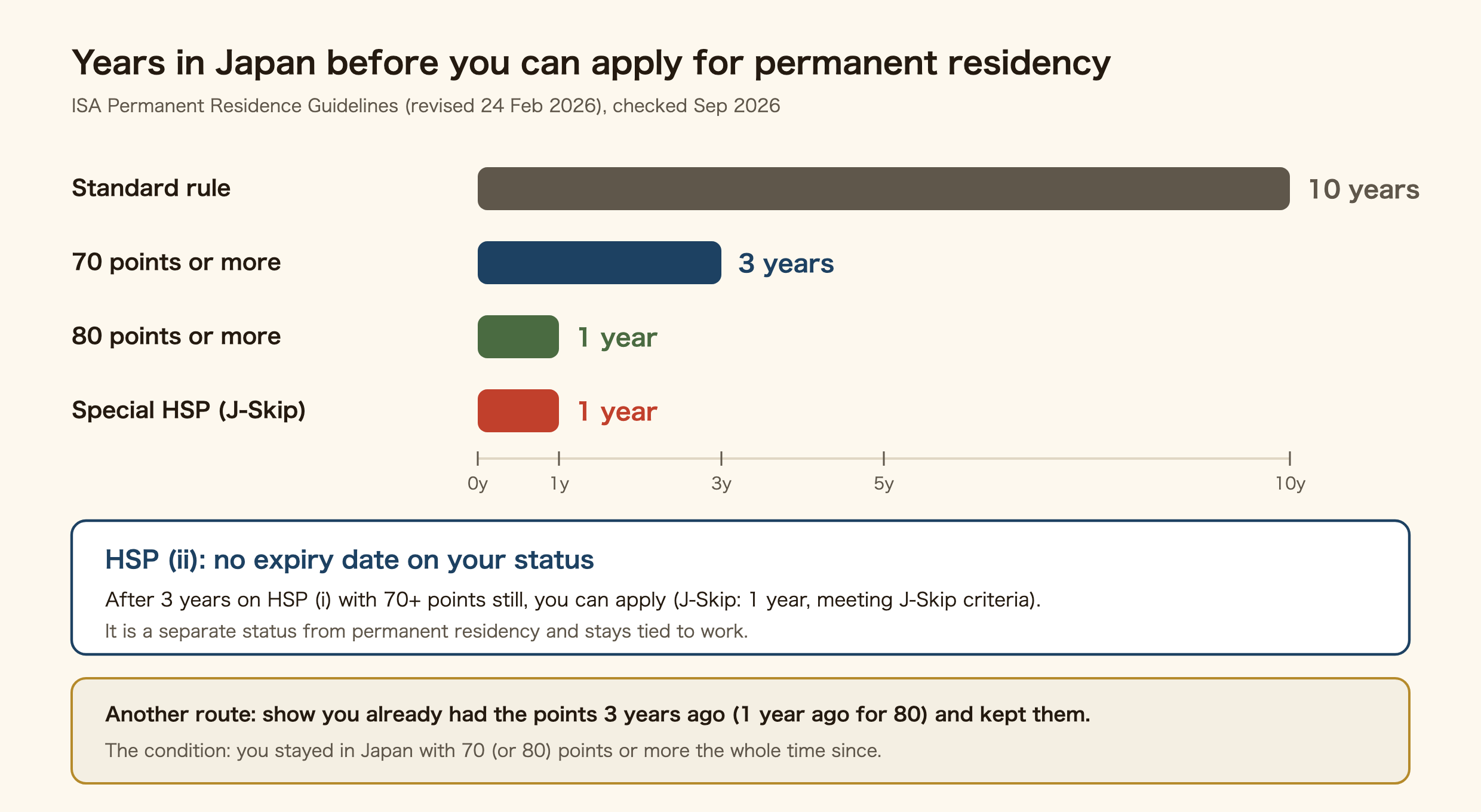
The Permanent Residence Guidelines (revised 24 February 2026) shorten the usual 10 years like this.
- 70 points or more: 3 continuous years in Japan as a highly skilled professional — or 3 continuous years with 70 points or more, counting from a calculation dated 3 years before you apply
- 80 points or more: the same, with 1 year
- Special Highly Skilled Professional (J-Skip): 1 year
Look at the second half of the first line. Even without having switched to HSP status, you may qualify if you can show you already had the points three years ago. If you are working on an Engineer/Specialist visa now, it is worth scoring your past self.
Only the years get shorter. The other requirements — good conduct, a stable livelihood, taxes and pension paid on time — stay the same. And the one-year route applies to you alone: the Q&A says your spouse and children do not get it. The rest of the requirements, and what changes from April 2027, are in our permanent residency guide.
What is HSP (ii)?
HSP (ii) is the status you can move to after 3 years on HSP (i) (1 year for J-Skip). You still need 70 points at that point, and good conduct.
Its period of stay has no end date. On top of HSP (i) work, you can do almost any other work status’s activities, such as Engineer/Specialist, Instructor, Medical Services or Legal/Accounting. The family and domestic-worker benefits continue.
It is not permanent residency. It remains a status tied to highly skilled work. If you are thinking about citizenship instead, naturalization now expects 10 years in Japan in principle, since April 2026.
What are the J-Skip requirements?
The Special Highly Skilled Professional system (J-Skip), in place since 21 April 2023, has no points. It looks only at education or experience, and salary.
- Types (a) and (b): a master’s degree or higher and 20 million yen a year or more, or 10 years’ related experience and 20 million yen or more
- Type (c): 5 years’ experience in business management and 40 million yen a year or more
You receive a certificate attached to your passport, the usual HSP benefits, and access to priority lanes at major airports. You can move to HSP (ii) after 1 year, and apply for permanent residency after 1 year. If you are already on HSP (i) through points, you can ask to be recognised as J-Skip at renewal.
Where do I get the points table, and what documents do I need?
The points table is on the ISA page “How does the point evaluation work?” as an Excel file (pointo keisan-hyo), in Japanese and English. Fill in the column for your type and score yourself.
You submit three things.
- The application form: a Certificate of Eligibility if you are coming from abroad, or a change or renewal of status if you are in Japan
- Your self-scored points table
- Proof for the points you claim: degree certificates, a record of your work history from past employers, a document showing the salary you will receive, a JLPT certificate, and so on
You also need the company documents that any work visa needs. For the points, prove only enough to reach 70. You do not need proof for every item that applies. The quickest route is to lock in 70 points from the items that are easiest to document.
If you are graduating from a Japanese university and going straight into HSP, watch the order. The ISA’s procedure page says people on Student or Dependent status should first obtain a Certificate of Eligibility and then apply for the change. That differs from the usual student-to-work visa change, so check the steps with HR early.
How much does it cost?
| What | Cost |
|---|---|
| Certificate of Eligibility (coming from abroad) | Free |
| Change or renewal, 5-year permission, received by 30 Sep 2026 | 6,000 yen at the counter / 5,500 yen online |
| Change or renewal, 5-year permission, received from 1 Oct 2026 | 75,000 yen at the counter / 65,000 yen online |
| Permanent residency (from 1 Oct 2026) | 200,000 yen |
HSP (i) is always granted for 5 years, so from October it falls in the highest fee band. Applications received by 30 September pay the old fee even if permission comes later. The full table and the reduction rules are in the fee increase guide.
What if I change jobs or break the rules?
HSP (i) names the organisation you work for. If you change jobs, you must apply for a change of status, even to stay on HSP. A 14-day notification alone, as on an ordinary work visa, is not enough; you file the notification as well. The steps around leaving a job are in leaving a job in Japan.
The family benefits have their own conditions.
- If your working spouse moves out, that work is no longer allowed. Continuing would be unauthorised activity and can lead to penalties or deportation (ISA Q&A)
- If your parent moves out, or the child turns 7, the parent’s stay cannot be renewed
- If you stop being an HSP, your domestic worker in principle can no longer stay
What if I fall short of 70 points?
Your current work visa still works. The ISA’s procedure page says that if a change is refused, you can stay on your current status while it is valid. If you drop below 70 at renewal, you change to another work status such as Engineer/Specialist.
To raise your score, look at the chart. In your early thirties, moving from N2 to N1 adds 5; the JLPT registration dates decide how soon you can do it. Each salary band adds 5, and salary data by visa type gives a sense of whether a job change could get you there.
Is Japan raising the HSP salary requirement?
In its December 2025 report, the Immigration Policy Council said the minimum salary and the salary bands for HSP “should be reviewed”, given how wages have risen since the system began. It also said the bonus items should be reorganised.
That is a recommendation. As of 23 September 2026, the ISA points table and the ordinance on e-Gov still show the current criteria, and no new amount or start date has been published. Nobody knows yet what the new criteria will be. If you already have 70 or 80 points, there is no reason to wait.
Which one are you?
- You scored 80 or more — the one-year route to permanent residency is open. Today, fill in the ISA points table and start collecting proof for 80 points.
- You scored in the 70s — switching to HSP gives you a 5-year stay and permanent residency after 3 years. Today, pick one item that could add 5 more (N1 or the next salary band).
- You scored in the 60s — stay on your current work visa. Today, write down your N1 test date or your next salary target.
- You earn 20 million yen or more and have a master’s or 10 years’ experience — apply through J-Skip instead of points. Today, gather your degree and salary documents.
FAQ
Q. What is the Highly Skilled Professional visa in Japan?
It is a residence status for people who score 70 points or more under the points-based system for education, career, salary, age, Japanese and bonus items. It has three types: academic research (a), specialised or technical work (b) and business management (c).
Q. How many points do I need?
70 points or more. Types (b) and (c) also need a salary of at least 3 million yen a year. With 80 points or more, the residence needed for permanent residency drops to one year.
Q. How soon can a highly skilled professional get permanent residency?
After 3 years with 70 points or more, after 1 year with 80 or more, and after 1 year under J-Skip. You can also qualify if you can show you had the points 3 years ago (1 year ago for 80) and kept them since.
Q. Does overtime pay count toward the salary points?
No. What counts is the salary you are going to receive, including bonuses. Overtime pay and expense allowances such as commuting or housing do not count.
Q. Can I bring my parents on an HSP visa?
Yes, to look after a child under 7 or to help during pregnancy, if household income is 8 million yen or more, they live with you, and they are the parents of only one of you. When the child turns 7, the parent’s stay cannot be renewed.
Q. What do I do if I change jobs on HSP (i)?
Because your employer is named in your status, you must apply for a change of status. You also file the notification about your organisation.
Summary
The Highly Skilled Professional visa is a work status for people who reach 70 points. It gives you a 5-year stay, and cuts the wait for permanent residency to 3 years at 70 points and 1 year at 80. Salary points depend on your age, so read the column for your age.
You score yourself on the ISA’s Excel table and send proof for 70 points. After approval, a job change still needs a change of status, and the family benefits keep their conditions. The salary criteria may be reviewed, but no new criteria exist yet. If you already qualify, apply under the rules you can see today.
Official sources: Immigration Services Agency, Points-based System for Highly Skilled Foreign Professionals / ISA, point evaluation and points table / ISA, points-based system Q&A / ISA, Permanent Residence Guidelines / ISA, J-Skip / ISA, fee revision from 1 October 2026 / e-Gov, HSP criteria ordinance. Checked on 23 September 2026. Check the latest ISA points table before you apply.
Related reading
Found this useful? Share it
Send it to a friend who lives in Japan.
WHO WROTE THIS

mori
Japanese. I read the ministries’ own notices, orders and Q&As in the original, and I start from what my Nepalese and Sri Lankan friends in Japan actually ran into. I do not write about what I have not checked or been told.
What this site can and cannot do →Looking for something else?