Last updated: 8 October 2026
Summary
- Japan has no birthright citizenship. Nationality follows the parents, not the place of birth. If both parents are foreign nationals, the baby is a foreign national too.
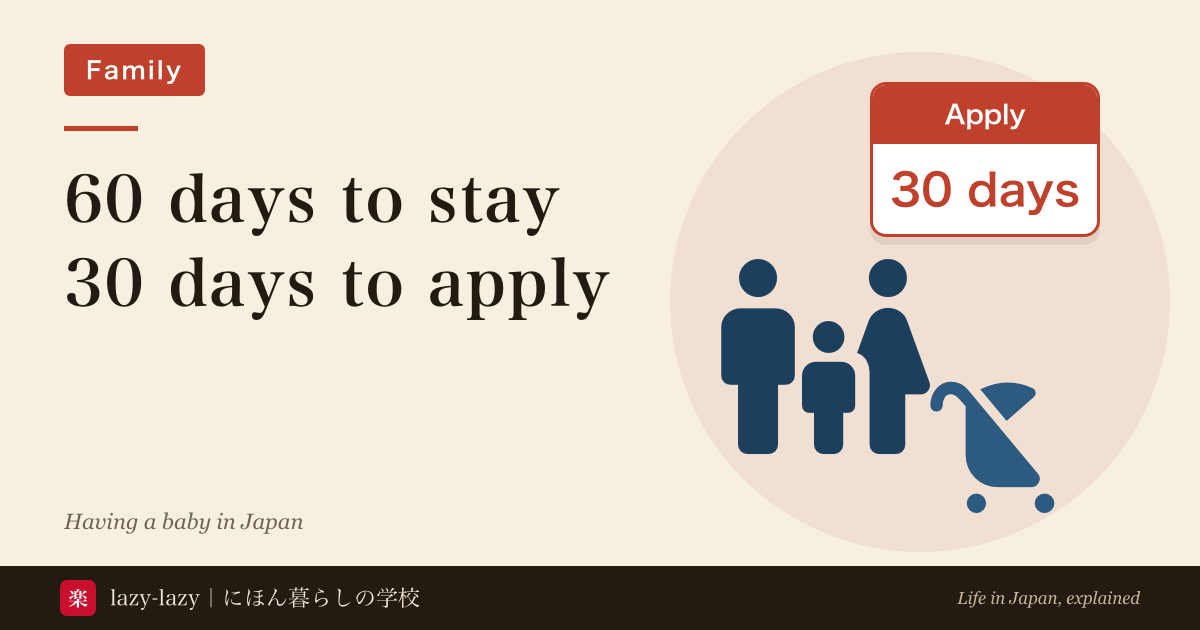
- The baby may stay 60 days without a status of residence. But the application deadline is 30 days. Remembering only the 60 is the most common way people get caught out.
- The birth registration goes to the city office within 14 days. The status of residence application goes to immigration within 30 days. Different deadlines, different counters.
- The childbirth lump sum is 500,000 yen per child from your health insurance. Twins means twice.
- The lump sum is paid when someone enrolled in health insurance, or their dependent, gives birth. Employer scheme or National Health Insurance alike.
Knowing this, you never confuse ’60 days allowed’ with ’30 days to apply’ – the single most common mistake – and the 500,000 yen grant comes in on time.
A birth in Japan arrives with paperwork attached, and there are three deadlines with different lengths and different offices. Miss one and your baby can end up without the right to stay.
This guide sets out what to file, by when, and where, plus the money you can claim – based on the Nationality Act, the Family Register Act, the Immigration Control Act, and the Japan Health Insurance Association.
Does a baby born in Japan get Japanese citizenship?
No. Japanese nationality follows the parents, not the soil.
A child shall be a Japanese national in the following cases:
(i) When, at the time of birth, the father or the mother is a Japanese national.Nationality Act, Article 2 – translated from the Japanese original
Unlike the United States or Canada, being born on Japanese ground grants nothing. If both parents hold foreign nationality, a baby born in Tokyo holds that foreign nationality too.
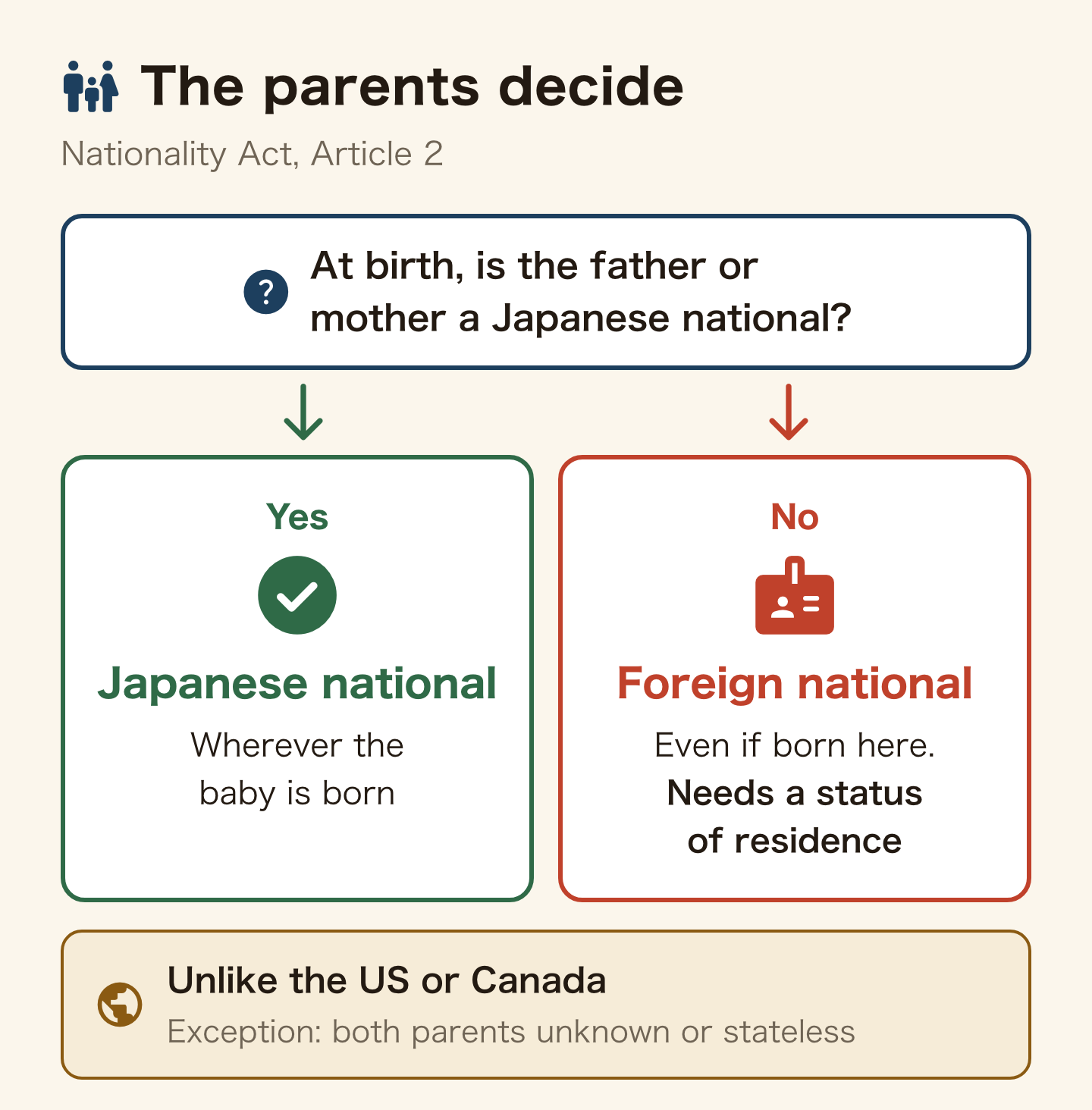
The one exception sits in the same article: where both parents are unknown, or both are stateless. It exists to prevent stateless children, and it does not apply to ordinary families.
Which means your baby needs a status of residence. That is where the real deadline lives.
60 days to stay. 30 days to apply.
This is the part to remember. The Immigration Control Act says:
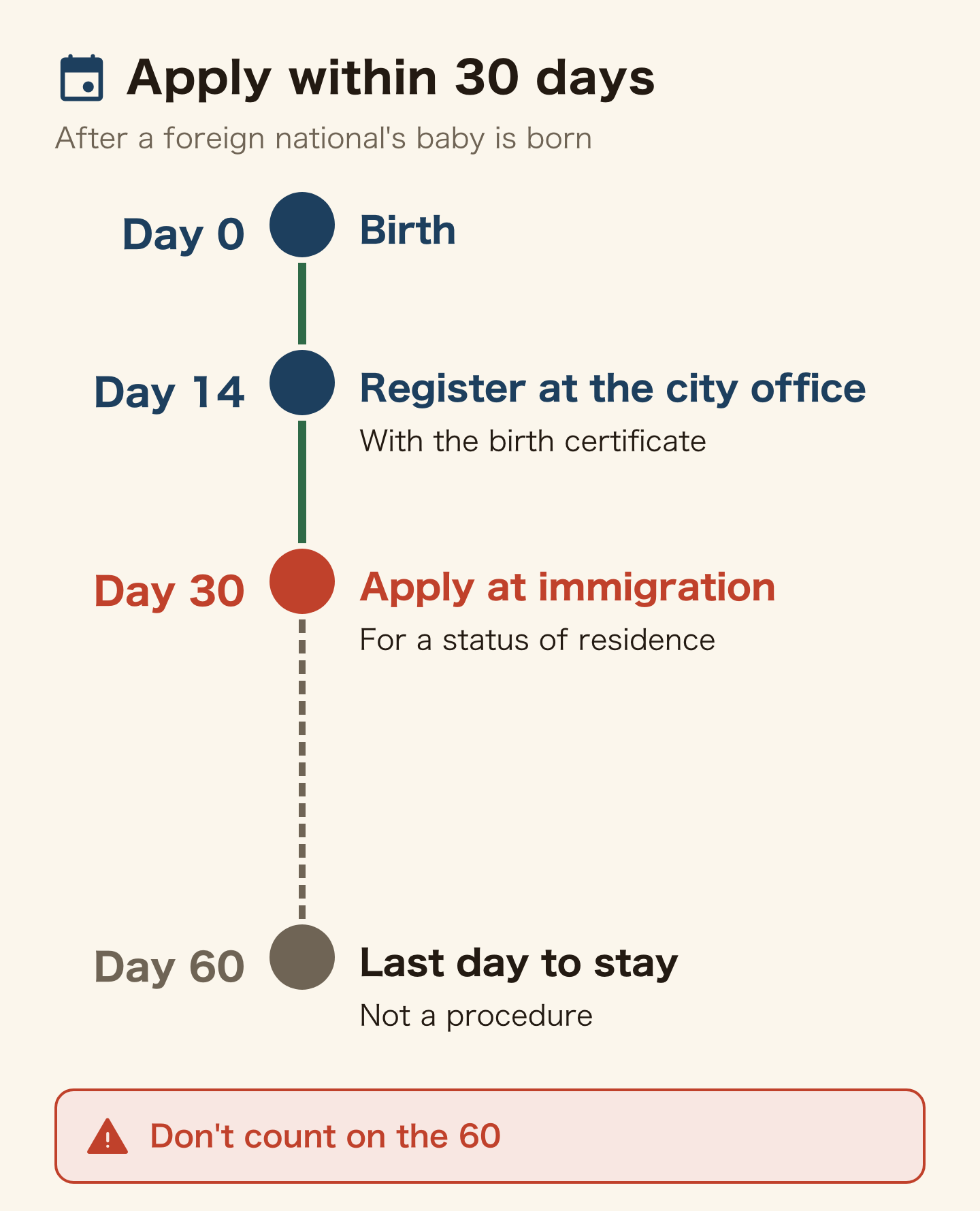
A foreign national who comes to reside in Japan by reason of birth … may continue to reside in Japan without a status of residence for a period of up to 60 days from the date of birth.
(2) A foreign national under the preceding paragraph who intends to reside beyond that period shall apply for acquisition of a status of residence within 30 days from the date of birth.Immigration Control Act, Article 22-2 – translated from the Japanese original
Sixty is how long you may stay. Thirty is how long you have to apply. They are different numbers.
“We still have 60 days” is the trap
Hold only the number 60 in your head and you will not notice the deadline passing on day 31. The weeks after a birth are not when anyone thinks clearly. Decide before the birth who is going to immigration. If the parent cannot go, a relative living in the same household can file.
If you are leaving Japan within 60 days, no application is needed. But plans to leave slip all the time. When in doubt, file.
Three deadlines, three different counters
You file the birth registration on the form the hospital gave you, and it feels like the paperwork is done. Where you come from, registering a birth once may carry through to every office. In Japan, your baby’s status of residence is a separate application at immigration, not at the city office, and the 30 days can run out before you notice.
In order. They are not the same office.
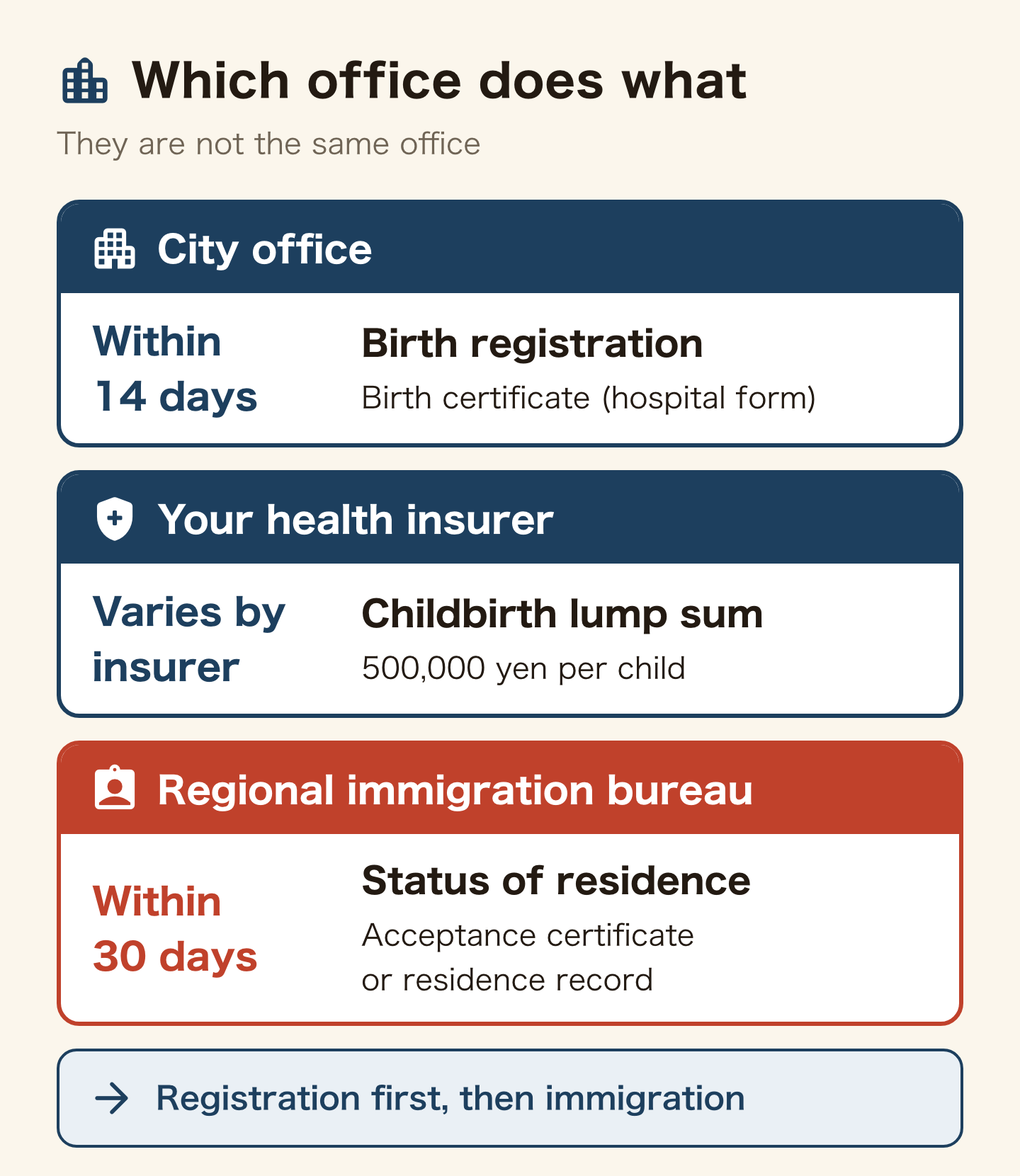
1. Birth registration – within 14 days, at the city office
Family Register Act, Article 49. Three months if the birth was outside Japan. A birth certificate written by the doctor or midwife is attached to the form. Hospitals normally hand you both on one sheet.
2. Application for a status of residence – within 30 days, at the regional immigration bureau
Immigration Control Act, Article 22-2. Not the city office. File the birth registration first and bring the acceptance certificate or the residence record with you.
3. Childbirth lump sum – at your health insurer
Either your employer’s scheme or National Health Insurance. Deadlines vary by insurer, so ask when you collect your Maternal and Child Health Handbook.
Your baby appears on the residence record automatically once the birth is registered. No separate filing.
The childbirth lump sum: 500,000 yen per child
Health insurance pays 500,000 yen per child. That is the figure the Japan Health Insurance Association publishes for a birth at 22 weeks or later at an institution enrolled in the obstetric compensation scheme.
A birth before 22 weeks, or a birth at an institution not enrolled in the obstetric compensation scheme, is 488,000 yen per child.
It covers births from 85 days (four months) of pregnancy onward, and that includes premature birth, stillbirth, miscarriage and induced abortion. If the outcome was a sad one, you can still claim.
Twins mean 1,000,000 yen. Triplets, 1,500,000. The payment is made per foetus.
If you are enrolled, National Health Insurance pays too
The Japan Health Insurance Association pays it when an insured person or their dependent gives birth. National Health Insurance works the same way: Shinjuku City, for example, pays it when someone enrolled in its National Health Insurance gives birth. If you joined National Health Insurance less than six months ago and were in another health insurance scheme for a year or more before that, the earlier scheme may pay instead. A birth to a dependent is treated the same way, as a family childbirth lump sum.
The usual way to receive it is the direct payment system, where the hospital bills your insurer. You then pay only what exceeds 500,000 yen at the counter, and claim the difference back if the birth cost less. Ask the hospital whether they use it.
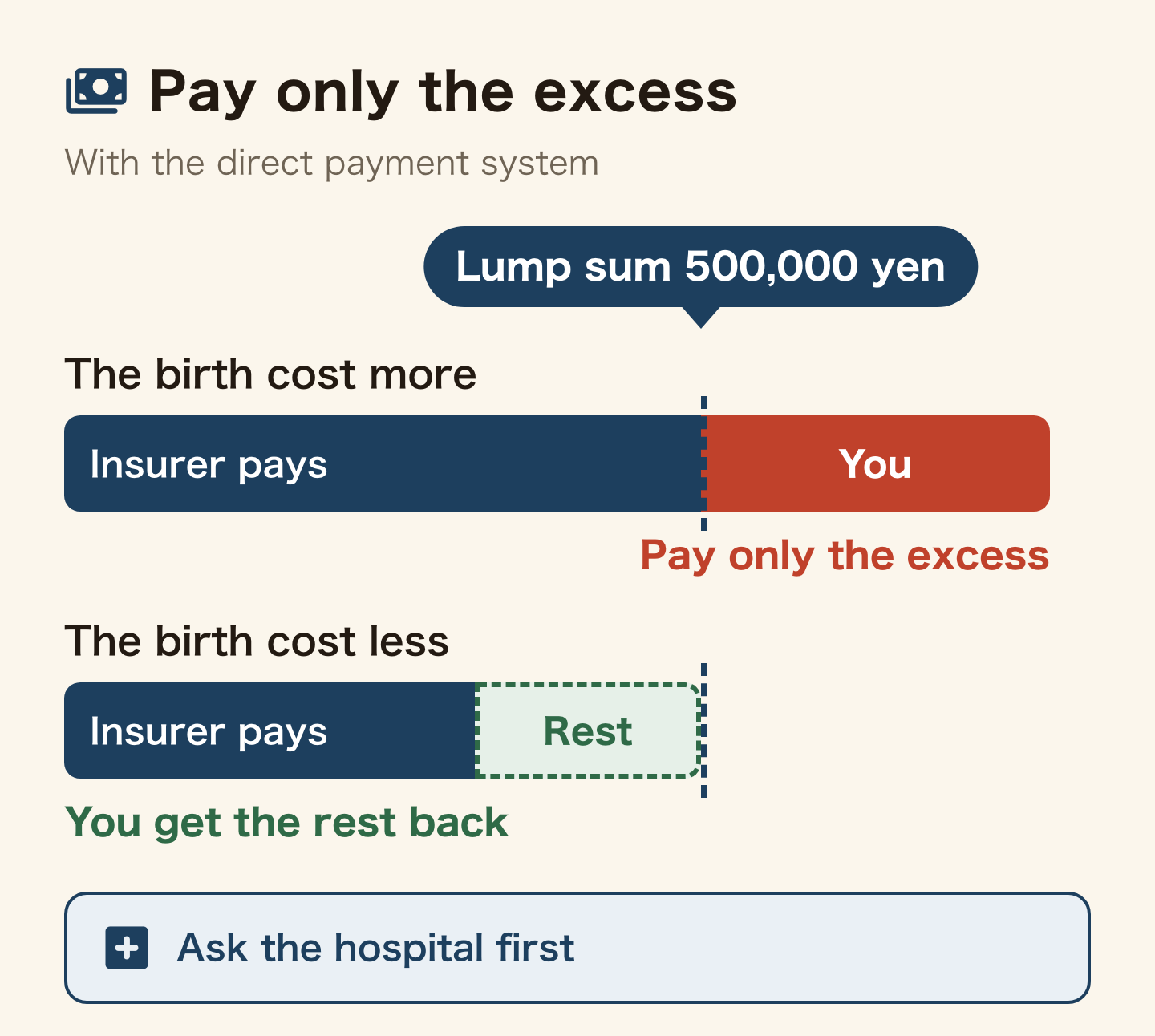
Health insurance does not cover the birth itself
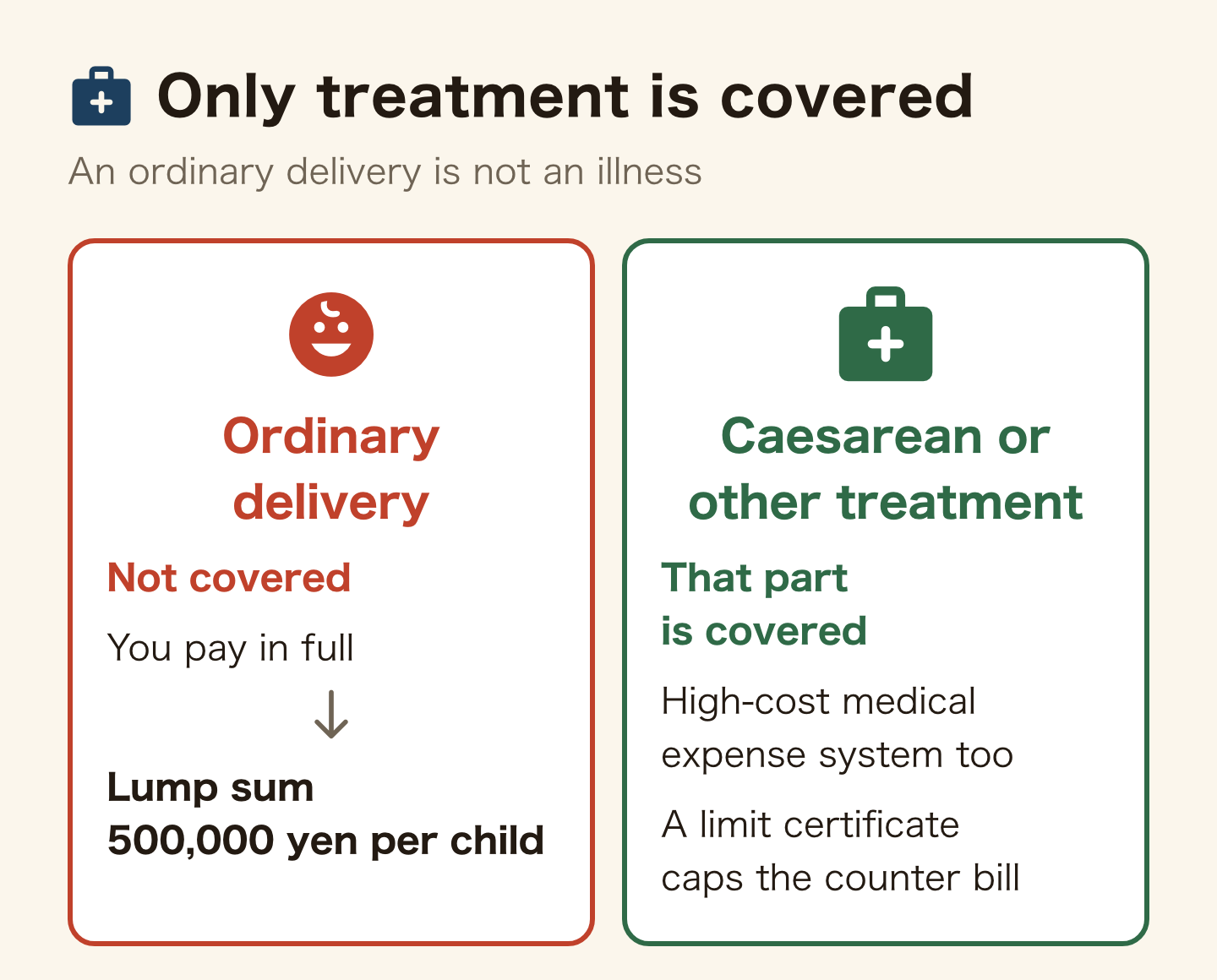
This surprises people: an ordinary delivery is not an illness, so the 30 percent co-payment does not apply. You pay the full amount, which is exactly why the lump sum exists.
But a caesarean section, or treatment for something like threatened premature labour, is covered. If the bill climbs, the high-cost medical expense system applies as well. Getting a limit-application certificate in advance caps what you pay at the counter.
Once the pregnancy is confirmed, collect your Maternal and Child Health Handbook from the city office. Vouchers subsidising checkups come with it. How to register the pregnancy, the 14+ checkup vouchers and the 100,000 yen pregnancy support payment are all things to sort out before the birth. Child allowance (15,000 yen a month under age 3 for a first or second child, the same for foreigners, apply within 15 days of the birth: Children and Families Agency, child allowance (Japanese)) is a national scheme, but children’s medical subsidies differ by municipality – ask about both while you are there.
Decide these before the birth
- Decide who goes to immigration. Thirty days is shorter than it sounds. A relative in the same household can file if the parent cannot
- Ask whether the hospital uses the direct payment system. If it does, you will not need 500,000 yen in hand at discharge
- Ask about child allowance and medical subsidies when you collect the handbook. Child allowance must be applied for within 15 days of the birth; children’s medical subsidies vary by city, so ask in person
- Plan the passport. Your baby’s own country’s embassy or consulate handles the birth registration and passport application
Which status your baby receives – Dependent, or Spouse or Child of a Japanese National – depends on the parents’ status. If you are living here on a dependent visa, read that guide alongside this one.
If you are employed, the grant is separate from the maternity allowance and the childcare leave benefit that replace your salary while you are off.
Frequently asked questions
Q. Does a baby born in Japan get Japanese citizenship?
No. Japan follows descent, not place of birth. A child is Japanese where the father or mother is a Japanese national at the time of birth. If both parents are foreign nationals, the baby is a foreign national. The only exception is where both parents are unknown or both are stateless.
Q. How do I apply for a newborn’s visa in Japan, and by when?
Within 30 days of birth, at the regional immigration bureau. The baby may remain in Japan without a status of residence for up to 60 days, but the application deadline is 30 – do not confuse the two.
Q. How much is the childbirth lump sum in Japan?
500,000 yen per child, for a birth at 22 weeks or later at an institution in the obstetric compensation scheme. A birth before 22 weeks, or at an institution outside the scheme, is 488,000 yen. Twins are paid twice.
Q. Can foreigners claim the childbirth lump sum in Japan?
Yes, if you are enrolled in health insurance. The Japan Health Insurance Association pays it when an insured person or their dependent gives birth, and National Health Insurance pays it when an enrolled member gives birth.
Q. Is giving birth in Japan free?
No. An ordinary delivery is not treated as an illness, so health insurance does not reduce it to 30 percent – you pay in full, and the lump sum offsets it. A caesarean or medically necessary treatment is covered by insurance.
Q. Are the birth registration and the visa application at the same place?
No. The birth registration goes to the city office within 14 days; the status of residence application goes to the regional immigration bureau within 30 days. File the birth registration first and take the paperwork with you.
Summary
- No birthright citizenship (Nationality Act, Article 2). Your baby needs a status of residence
- 60 days to stay, 30 days to apply (Article 22-2). Remembering only the 60 is the trap
- Three deadlines, three counters: birth registration, 14 days, city office / status of residence, 30 days, immigration / lump sum, your insurer
- 500,000 yen per child (488,000 before 22 weeks or at an institution outside the obstetric compensation scheme). Paid per foetus, and from 85 days of pregnancy stillbirth, miscarriage and induced abortion qualify
- The lump sum is paid when an enrolled person or their dependent gives birth – employer scheme or National Health Insurance alike
Official sources: e-Gov, Nationality Act / Family Register Act / Immigration Control and Refugee Recognition Act / Japan Health Insurance Association, childbirth lump sum amounts / Shinjuku City, childbirth lump sum (National Health Insurance example, Japanese)
Provisions and amounts were checked on 28 August 2026; the childbirth lump-sum conditions were rechecked on 8 October 2026. Children’s medical subsidies differ by municipality. The status your baby receives and the documents required vary by family, so confirm with a regional immigration bureau or an immigration lawyer.
Found this useful? Share it
Send it to a friend who lives in Japan.
WHO WROTE THIS

mori
Japanese. I read the ministries’ own notices, orders and Q&As in the original, and I start from what my Nepalese and Sri Lankan friends in Japan actually ran into. I do not write about what I have not checked or been told.
What this site can and cannot do →Looking for something else?
You may use the figures in this article, including commercially, if you credit this site with a link. How to use our figures