Checked on 23 September 2026 against the Children and Families Agency’s national survey of children’s medical subsidies, the National Health Insurance Act and Health Insurance Act, the Ministry of Health, and the official pages of the Tokyo Metropolitan Government, Shinjuku City, Osaka City and Yokohama City.
The short answer
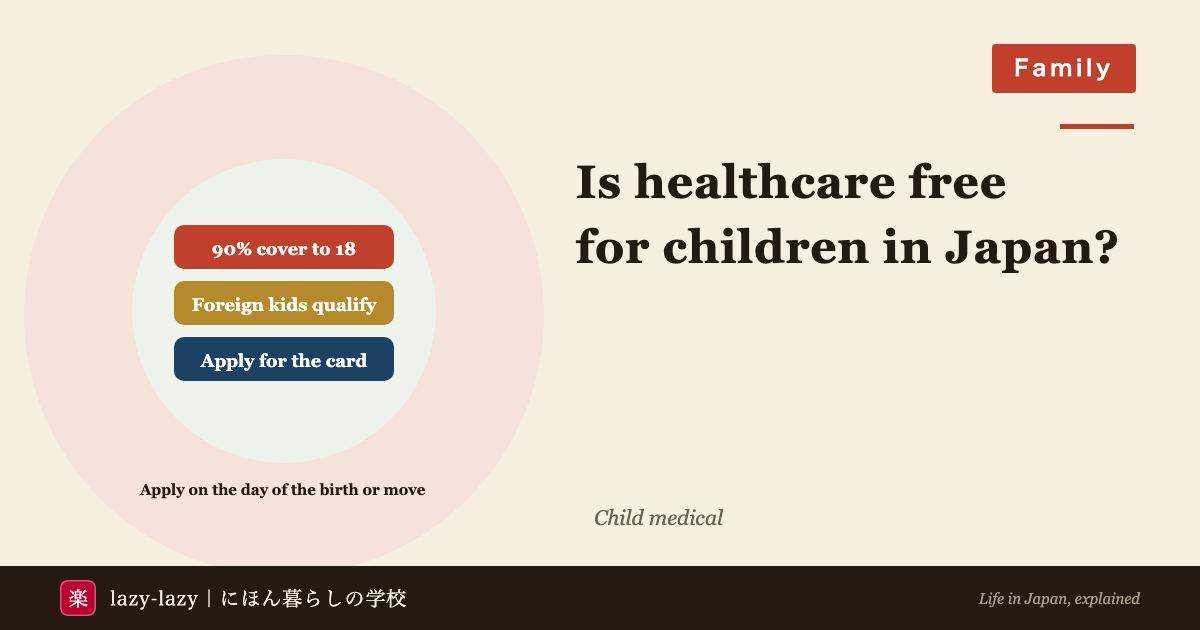
- Often, yes — but it is your city that makes it free, not the national system. National health insurance leaves you 20% of the bill for a child before primary school and 30% after that. Every city then pays some or all of that share through a children’s medical subsidy.
- All 1,741 municipalities in Japan run one, and 1,576 of them (about 90%) cover clinic visits until the end of the school year in which the child turns 18 (as of 1 April 2025).
- Foreign children qualify on the same terms. What counts is a resident record in that city and Japanese health insurance, not nationality.
- Nothing happens until you apply for the medical card (iryosho). Do it right after the birth or the move. In Shinjuku, miss three months and the lost weeks are not covered.
- At the clinic, show your insurance proof and the medical card. Outside your prefecture, or on a day you forgot the card, you pay first and claim the money back with the receipt.
Knowing this, you can apply for the card on the day of the birth or the move, and stop paying bills your city would have paid. Money you have already paid can come back too, as long as you kept the receipts.
Your child has a fever at night, so you take them to the clinic round the corner. At the counter you pay 500 yen. Next day a Japanese colleague says, “Isn’t it free for kids?” Your colleague lives in Yokohama. You live in Osaka. You are both right. Children’s medical costs depend on the city you live in, and most Japanese people only know the rules of their own city, so asking around gives you different answers.
- Is healthcare free for children in Japan?
- Until what age? About 90% of cities cover children to 18
- What do you pay at the counter in Tokyo, Osaka and Yokohama?
- Can foreign children get the children’s medical subsidy?
- How do you apply for the medical card after a birth or a move?
- How do you use the medical card?
- Treated outside your prefecture, or forgot the card? Pay, then claim it back
- What does the subsidy not cover?
- What happens when you move or leave Japan?
- Which one are you?
- FAQ
- Summary
- Related reading
Is healthcare free for children in Japan?
Under Japan’s public health insurance, you pay part of every bill at the counter. For a child up to the first 31 March after their sixth birthday — that is, before primary school — you pay 20%. After that, 30%. This is set by national law and is the same everywhere (National Health Insurance Act Article 42, Health Insurance Act Article 110).
The children’s medical subsidy is what cuts that 20% or 30% further. It is paid for by the municipality, with help from the prefecture (Children and Families Agency). That is why every city names it differently: Tokyo has maru-nyu, maru-ko and maru-ao, Osaka City has the kodomo iryohi josei, Yokohama the shoni iryohi josei. The card you get is called a medical card (iryosho) or a recipient certificate (jukyusha-sho).
Child allowance is a national payment and the same amount everywhere. Children’s medical costs are not.
Until what age? About 90% of cities cover children to 18
The Children and Families Agency surveyed every municipality as of 1 April 2025. All 1,741 of them subsidise children’s medical costs. The age limit for clinic visits looks like this.
| Clinic visits covered until | Municipalities |
|---|---|
| End of the school year in which the child turns 18 (high school) | 1,576 |
| End of the school year in which the child turns 15 (junior high) | 145 |
| Age 20 or 22 (end of school year) | 10 |
| Before primary school, or age 12 | 10 |
“The end of the school year at 18” means the first 31 March after the 18th birthday. Whether the child is actually in high school does not matter (Tokyo’s maru-ao).
Covered does not always mean free. For clinic visits, 422 municipalities still charge a small amount at the counter and 1,319 charge nothing. Only 49 have an income limit; 1,692 have none.
What do you pay at the counter in Tokyo, Osaka and Yokohama?
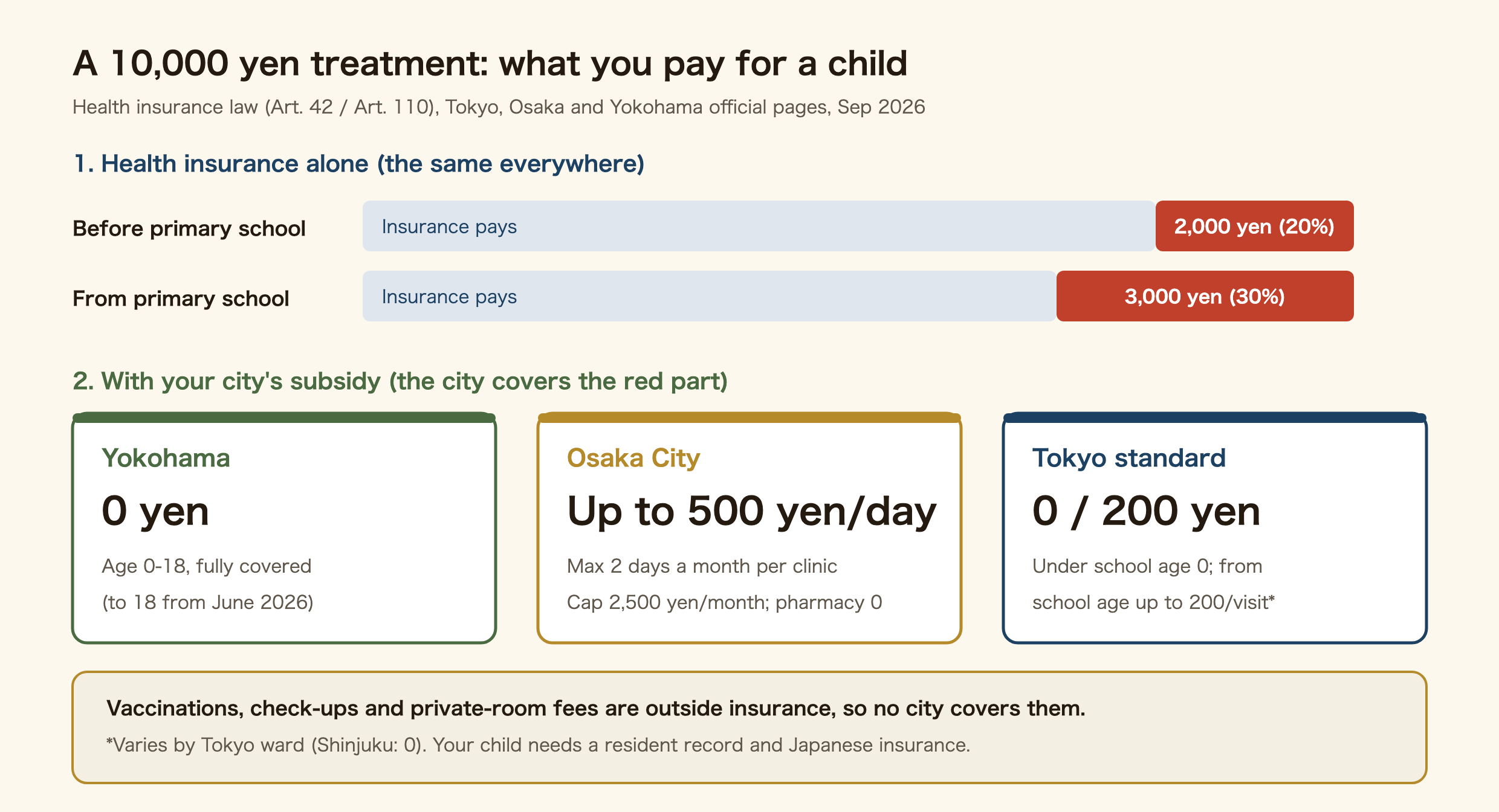
Here are three big cities side by side, all checked on their official pages on 23 September 2026.
| Tokyo (metropolitan standard) | Osaka City | Yokohama | |
|---|---|---|---|
| Ages | To 18 (end of school year) | To 18 (end of school year) | To 18 (end of school year), since June 2026 |
| You pay | 0 yen before school age. From primary school to 18: up to 200 yen per clinic visit (some wards charge nothing) | Up to 500 yen a day per clinic, at most 2 days a month per clinic. Monthly cap 2,500 yen. Pharmacy 0 | 0 yen (fully covered) |
| Income limit | Depends on the ward or city (none in Shinjuku) | None (since April 2024) | No income condition in the eligibility rules |
| Card works at | Clinics in Tokyo | Clinics in Osaka Prefecture | Clinics in Kanagawa |
In Tokyo, the metropolitan government sets a baseline and each ward or city can add to it. Shinjuku, for example, also covers hospital meals, so you pay nothing at the counter at all. If you live in Tokyo, check your own ward’s page.
Osaka’s 500 yen stops on the third day at the same clinic. However many clinics you visit, the most you pay in a month is 2,500 yen. Anything above that can be claimed back.
Can foreign children get the children’s medical subsidy?
Yes. Every city’s rules come down to two conditions, and nationality is not one of them.
- The child has an address in that municipality (a resident record)
- The child is on Japanese health insurance: National Health Insurance, or a parent’s employer plan
Some cities say it in so many words. Kariya: foreign nationals with a resident record and health insurance are eligible. Ichinomiya: children of foreign residents who live in the city with a resident record get the card. Shinjuku publishes a guide for foreign residents in English, Chinese, Korean, Nepali and Vietnamese.
The usual stumbling block is insurance. Tokyo, Osaka, Yokohama and Shinjuku all exclude children who are not on a health insurance plan. Put a newborn on a parent’s employer plan or on National Health Insurance (register within 14 days).
If the parent does not live in Japan, the rules may be different. Shinjuku’s English guide asks parents who live abroad, such as when the child’s guardian is an international student, to contact the office.
How do you apply for the medical card after a birth or a move?
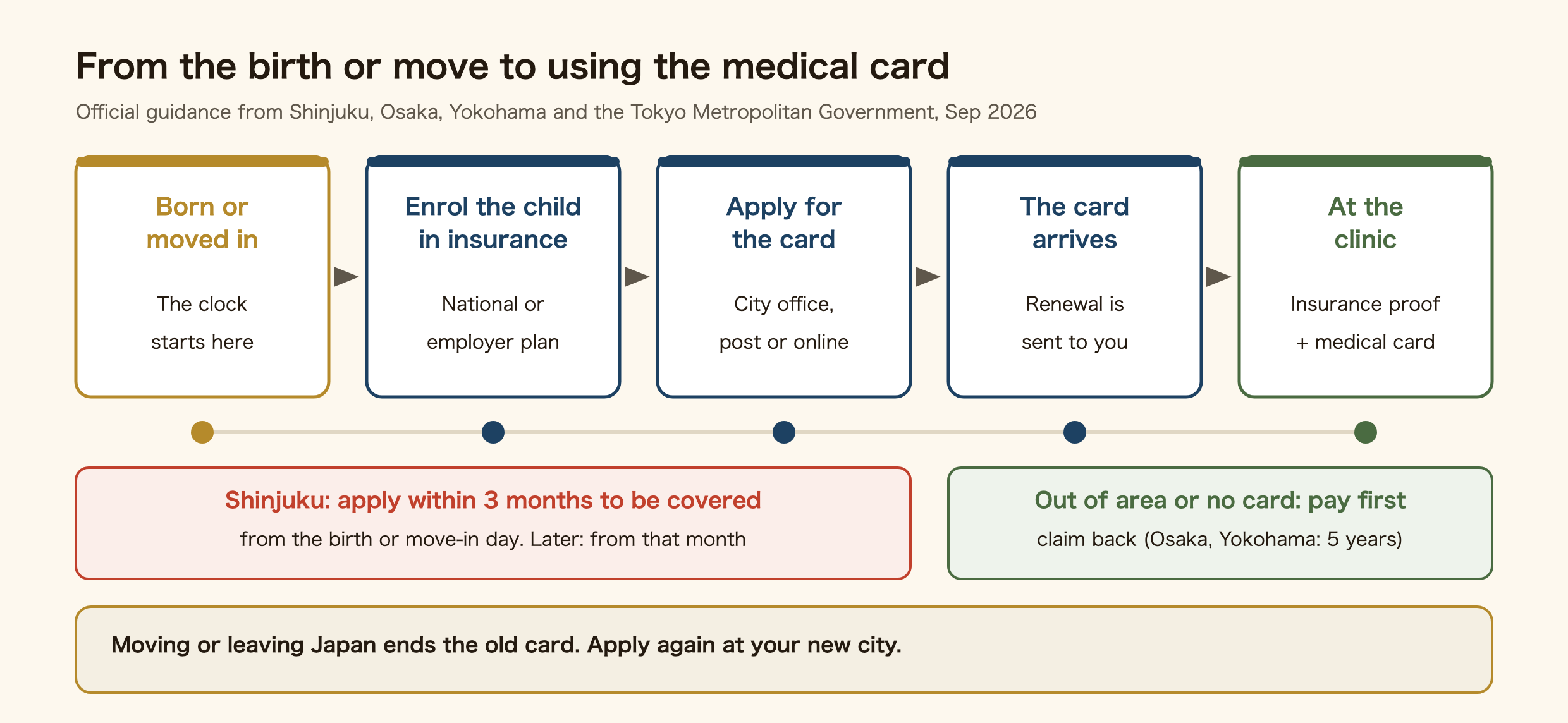
The card does not come by itself. When a child is born, or when you move in from another municipality, you apply to the city or ward where you now live.
How fast you apply decides when the cover starts. In Shinjuku, applying within three months of the day after the birth or move-in means cover from the day of the birth or move. After three months, cover starts only from the first day of the month you apply, and it cannot be backdated. Osaka’s booklet gives the start as the birth date or the move-in date. The window is different in each city, so apply on the same day as the birth or moving-in registration.
In Shinjuku you need:
- The application form for the medical card (available at the counter)
- Proof of the child’s health insurance (the eligibility certificate, the eligibility notice, or a printout of the Myna Portal screen). If enrolment is still in progress, proof of the plan the child will join is accepted
- Something showing the child’s My Number
- ID for the person at the counter (My Number Card, residence card and so on)
Shinjuku also accepts documents after the application. Do not wait for the insurance paperwork; file the application first. Osaka, Yokohama and Shinjuku all take applications by post, and there are online options too (in Osaka only for births). After a birth, doing this on the same day as the birth registration and your baby’s status of residence, and the child allowance application (15 days), saves trips.
If you are late, apply anyway. In Shinjuku, late applications are still covered from the first of the month you apply. Once the card arrives, the counter payment changes. What you pay between applying and receiving the card can be claimed back (Osaka).
How do you use the medical card?
At the clinic or pharmacy reception, show your insurance proof (the My Number health insurance card, or the eligibility certificate) together with the medical card. The bill then drops to whatever your city charges.
In some areas the My Number insurance card alone works as the medical card, if the city and the clinic are connected to a system called PMH (Tokyo). Shinjuku still asks you to bring the medical card even when you use the My Number card. Keeping it with you is the safe choice.
The card has an expiry date and is replaced on a set day. In Tokyo that is 1 October every year; the card valid from 1 October 2026 is pale green. Yokohama renews on 1 October of even-numbered years for children over one. Osaka’s cards run to 31 October of the school year in which the child turns 3, 6, 9, 12 or 15. Everywhere, the new card is posted to you without an application. If it does not arrive, contact the city.
Treated outside your prefecture, or forgot the card? Pay, then claim it back
The card normally works only inside your prefecture: Tokyo within Tokyo, Osaka City within Osaka Prefecture, Yokohama within Kanagawa. If your child sees a doctor while you are travelling, you pay the normal insurance share (20% or 30%) at the counter.
That money comes back. You send the receipt to your own city and apply for a refund. Osaka also refunds, for example:
- Days you forgot the card, or could not show it in an emergency
- Visits between applying and receiving the card
- Clinics outside the prefecture, or clinics that do not accept the card
Send the original receipt. Shinjuku wants a receipt showing the patient’s name, the amount, the date and the insurance points; a till receipt with only the amount is not accepted. If you lost it, the clinic can issue a receipt certificate (Osaka; you pay the clinic’s fee for it).
The deadline is five years in both Osaka (from the day after payment) and Yokohama (from the first day of the month after the visit). Yokohama says the money takes about three months to arrive.
If you paid 100% because you had no insurance proof at all, there is an extra step. First claim the insurance share (ryoyohi) from your health insurer, then claim the rest from the city. The deadline for the insurance claim is two years (Osaka).
What does the subsidy not cover?
The subsidy only covers your share of treatment that health insurance covers. Anything outside insurance you pay yourself, wherever you live. Tokyo and Osaka list:
- Vaccinations and health check-ups
- Private-room fees in hospital, and charges for medicine containers
- The extra fee for going to a large hospital without a referral letter
- The extra fee for asking for a brand-name drug when a generic exists
- Hospital meals (under Tokyo’s standard and in Osaka; some wards such as Shinjuku cover them)
A large hospital without a referral can add 7,000 yen or more. For a child’s fever or cough, a local clinic is cheaper. At night or on a holiday, instead of a big hospital, check how to find a night clinic or paediatric duty doctor, and when #8000 answers. How a visit works, step by step, is in seeing a doctor in Japan.
Injuries at daycare or school may be covered by a separate scheme (the Japan Sport Council’s disaster mutual aid). Tokyo excludes those cases from the medical card. Tell the daycare or school.
What happens when you move or leave Japan?
The card works only while you live in that municipality. Shinjuku’s form lists “no longer has an address in Japan” and “moved to another municipality” among the reasons eligibility ends.
Using an old card after eligibility has ended can mean paying the subsidy back (Osaka). After a move, apply again at your new city; some, like Shinjuku with its three months, count from the move-in day. If you are leaving Japan, sort out the card at the same time as your moving-out notice.
Which one are you?
- Your baby was, or will be, born in Japan — on the day you register the birth, enrol the baby in health insurance and apply for the medical card. If the insurance papers are not ready, file the application first.
- You have just moved in with your child — at the moving-in counter, ask where to apply for the medical card and do it the same day. Stop using the old city’s card.
- You never got a card, or applied late — apply today. Keep every receipt until the card arrives.
- You paid at a clinic outside your prefecture, or without the card — keep the original receipt and claim the refund from your city.
FAQ
Q. Is healthcare free for children in Japan?
National health insurance leaves you 20% of the bill before primary school and 30% after. On top of that, every municipality subsidises children’s medical costs, and 1,319 of them charge nothing at the counter for clinic visits (as of 1 April 2025). Whether it is free depends on where you live.
Q. Until what age are children’s medical costs covered?
It depends on the city. Of 1,741 municipalities, 1,576 cover clinic visits until the first 31 March after the child’s 18th birthday. Tokyo, Osaka City and Yokohama all do.
Q. Can foreign children get the children’s medical subsidy?
Yes. The conditions are a resident record in that municipality and Japanese health insurance. Kariya and Ichinomiya, for example, state on their official sites that foreign children are eligible.
Q. When do I have to apply for the medical card?
Each city sets its own window. In Shinjuku, applying within three months of the birth or move-in gives cover from that day; later, cover starts from the month you apply. The safest is the same day as the birth or moving-in registration.
Q. Do I get the money back if my child sees a doctor outside my prefecture?
Yes. Pay the insurance share at the counter, then send the original receipt to your city and apply for a refund. The deadline is five years in Osaka (from the day after payment) and Yokohama (from the month after the visit).
Q. What if I forget the medical card?
Pay the insurance share that day. Send the original receipt to your city afterwards and the subsidy is refunded. Osaka also refunds cases where you could not show the card because of a sudden illness or while travelling.
Summary
The 20% and 30% are national insurance rules and the same everywhere. How much of that your child still pays is decided by your city. About 90% of municipalities cover children to 18, and foreign children qualify with a resident record and health insurance.
The card only comes if you apply. Deal with the insurance and the medical card on the day of the birth or the move. And if you paid somewhere the card did not work, the receipt gets the money back.
Sources (official): Children and Families Agency, FY2025 survey of children’s medical subsidies / National Health Insurance Act, Article 42 / Health Insurance Act, Article 110 / Tokyo Metropolitan Government, maru-ao (maru-ko, maru-nyu) / Shinjuku City, children’s medical subsidy (with an English guide) / Osaka City, children’s medical subsidy / Yokohama City, pediatric medical subsidy / Kariya City FAQ on foreign children. Checked on 23 September 2026. Ages, counter payments and application windows differ by city — always check your own city’s page.
Related reading
Found this useful? Share it
Send it to a friend who lives in Japan.
WHO WROTE THIS

mori
Japanese. I read the ministries’ own notices, orders and Q&As in the original, and I start from what my Nepalese and Sri Lankan friends in Japan actually ran into. I do not write about what I have not checked or been told.
What this site can and cannot do →Looking for something else?