Last updated: 11 October 2026
Summary
- A dependent visa lets you earn nothing at all on its own. You need a work permit first. Only then can you work up to 28 hours a week.
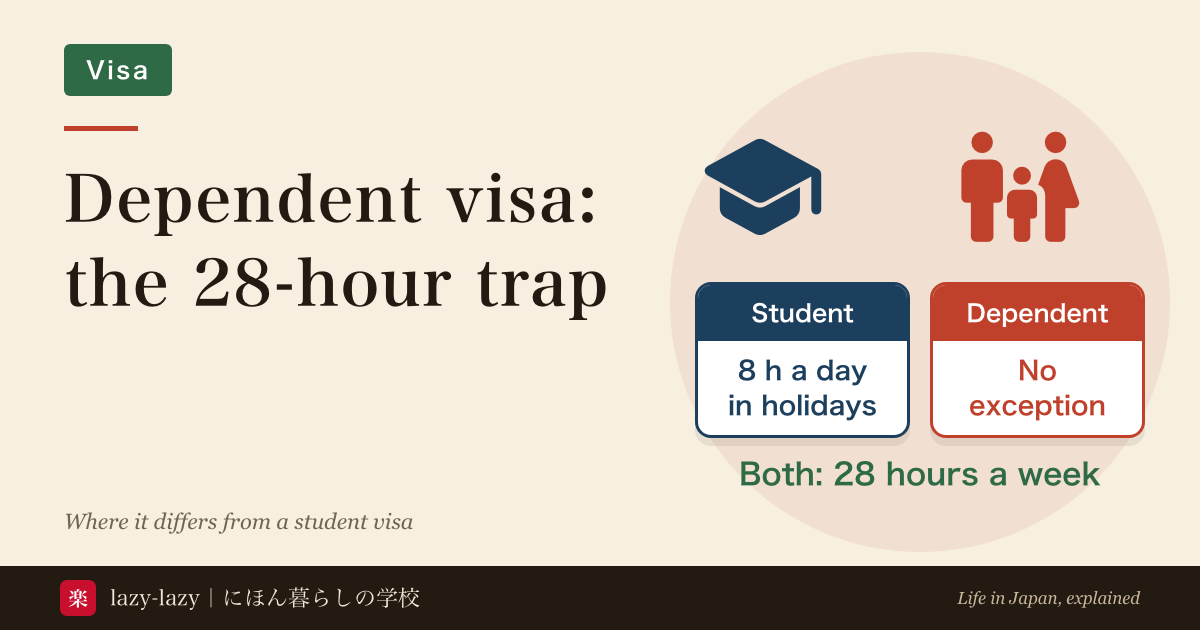
- The 8-hours-a-day allowance students get during school holidays does not exist for dependents. Work the same shifts as your student friends in August and you alone are over the limit.
- If you do go over, everything turns on one word: “solely.” A few hours over and a working life that has become your main activity are treated very differently in law.
- Delivery work is fine on the ordinary permit as long as your hours are objectively verifiable.
- The 28-hour rule and “coming off your spouse’s dependent status” are two different systems. You can stay under 28 hours and still come off it.
What changes: you know that working the same summer shifts as a student friend puts only you over the line – and you stay under it.
“I am only here as my husband’s dependent, so a few hours of work cannot hurt.” That belief is the dangerous one. On a dependent visa, working at all is prohibited until you hold a permit.
This guide covers how the 28 hours are counted, where the dependent rules differ from the student rules, and what actually happens if you exceed them – based on Immigration Services Agency pages and the text of the Immigration Control Act.
- A dependent visa does not include permission to work
- Dependent visa working hours are not the same as a student’s
- What happens if you exceed 28 hours
- Delivery work, freelancing, and which permit you need
- Some jobs stay closed even with the permit
- Coming off dependent status is a separate question
- Three things to do today
- Frequently asked questions
- Summary
A dependent visa does not include permission to work
A friend’s shop is busy, you help out for the day, and they hand you some cash on the way out. Where you come from, nobody may think twice about a family member picking up a little work. In Japan, before you hold the permit, that single paid day is already a breach.
Article 19(1) of the Immigration Control Act prohibits earning income through activities outside the ones your status of residence covers. The activity a dependent visa covers is daily life as the supported spouse or child. Work is not in it.
To work you need a work permit (資格外活動許可 / shikakugai katsudo kyoka) – permission to engage in activities outside your status. It is recorded on the back of your residence card, and the front stops saying “Not permitted to work.”
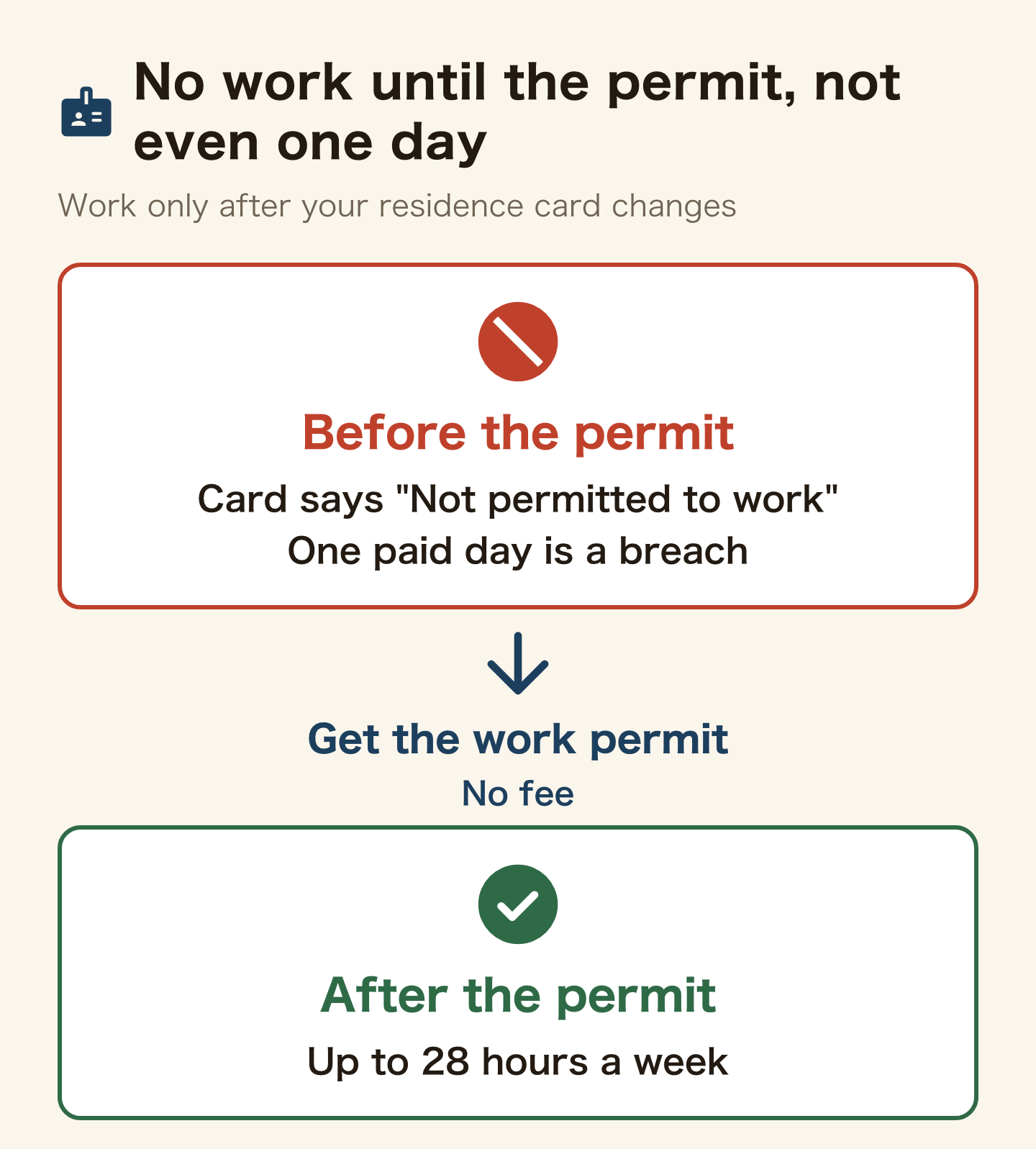
Does your residence card say “Not permitted to work”?
Before you hold the permit, it does. Working in that state is a breach regardless of how much you earned. One day of helping out counts if you were paid for it. Apply for the permit first – there is no fee. If you plan to put a child in daycare and work, the daycare application will check for this permit too.
Getting the permit is a short form, not a long wait for a sponsor. The Immigration Services Agency sets it out like this:
- Where: the regional immigration bureau that covers your address. You can go yourself, or have an approved agent or a notified lawyer or gyoseishoshi file it for you
- What to bring: for the ordinary (comprehensive) permit, the application form only. Show your residence card and passport at the counter
- Fee: none
- How long: the standard processing time is 2 weeks to 2 months. Do not start working until the permit is granted
- When: weekdays, 9:00-12:00 and 13:00-16:00. Online filing is possible only together with a change or extension of your status of residence
If you hold a Designated Activities status as a supported spouse or child, the same treatment applies in principle. This guide covers you too.
Dependent visa working hours are not the same as a student’s
With the permit you may work up to 28 hours a week. So far, identical to a student.
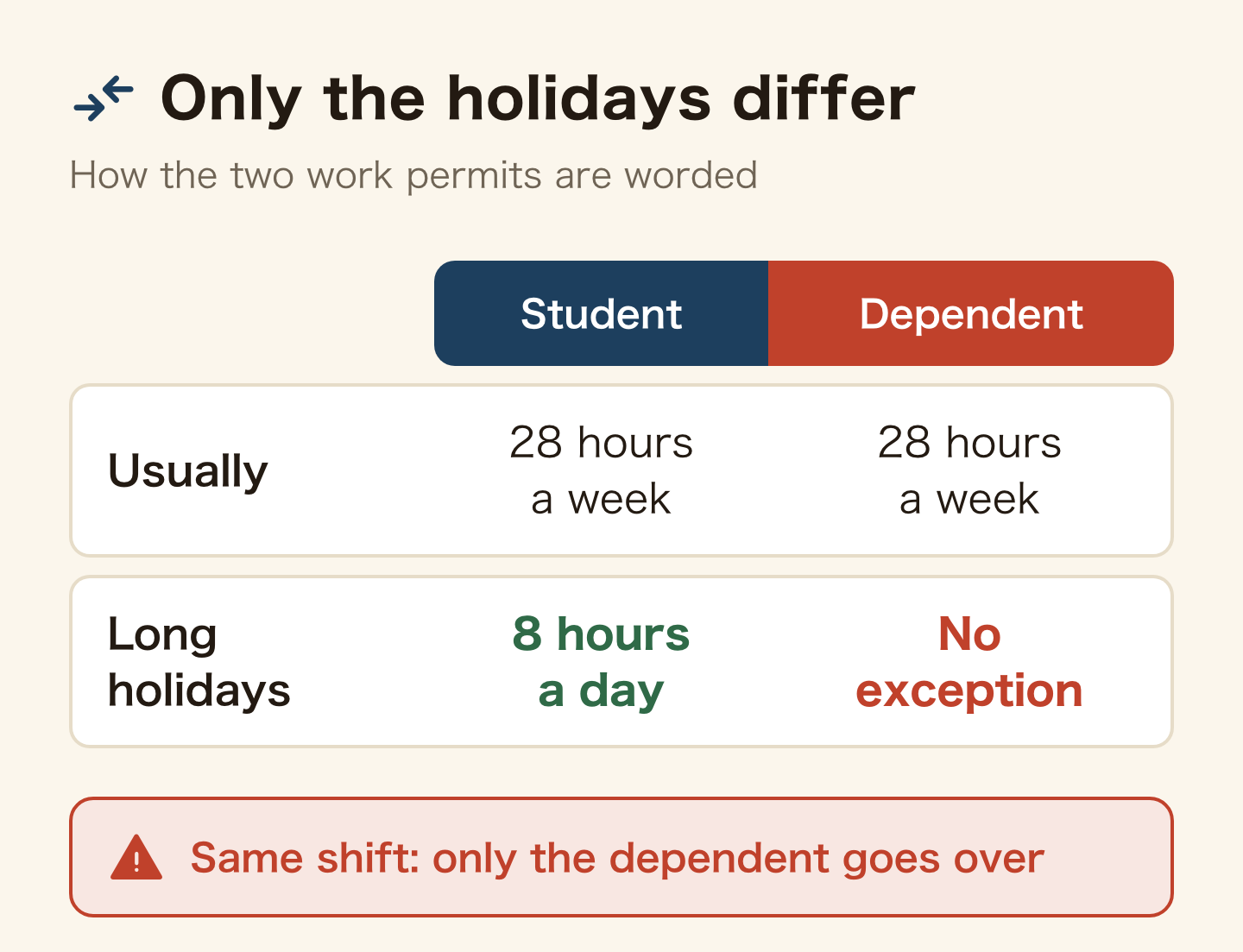
The difference appears during long school holidays.
The student version of the permit reads:
Within 28 hours per week (during long holiday periods of the educational institution, within 8 hours per day)
Immigration Services Agency, work permit for the “Student” status – translated from the Japanese original
On the dependent page, that bracket is absent. Twenty-eight hours a week, and nothing else.
Which means this: in August, when your student friends move to 8-hour days, doing the same puts you over. Same workplace, same shift, and only one of you is in breach. Very few people know this.
On counting a “week”: the total must stay under 28 hours no matter which day you start counting from. Monday-to-Sunday can look fine while Wednesday-to-Tuesday is over, and that still counts as a breach. Our guide to the 28-hour rule for part-time work works through the counting in detail.
What happens if you exceed 28 hours
This is the part people are frightened of. A few hours over and a life where work has become the main activity are, in law, two entirely different things.
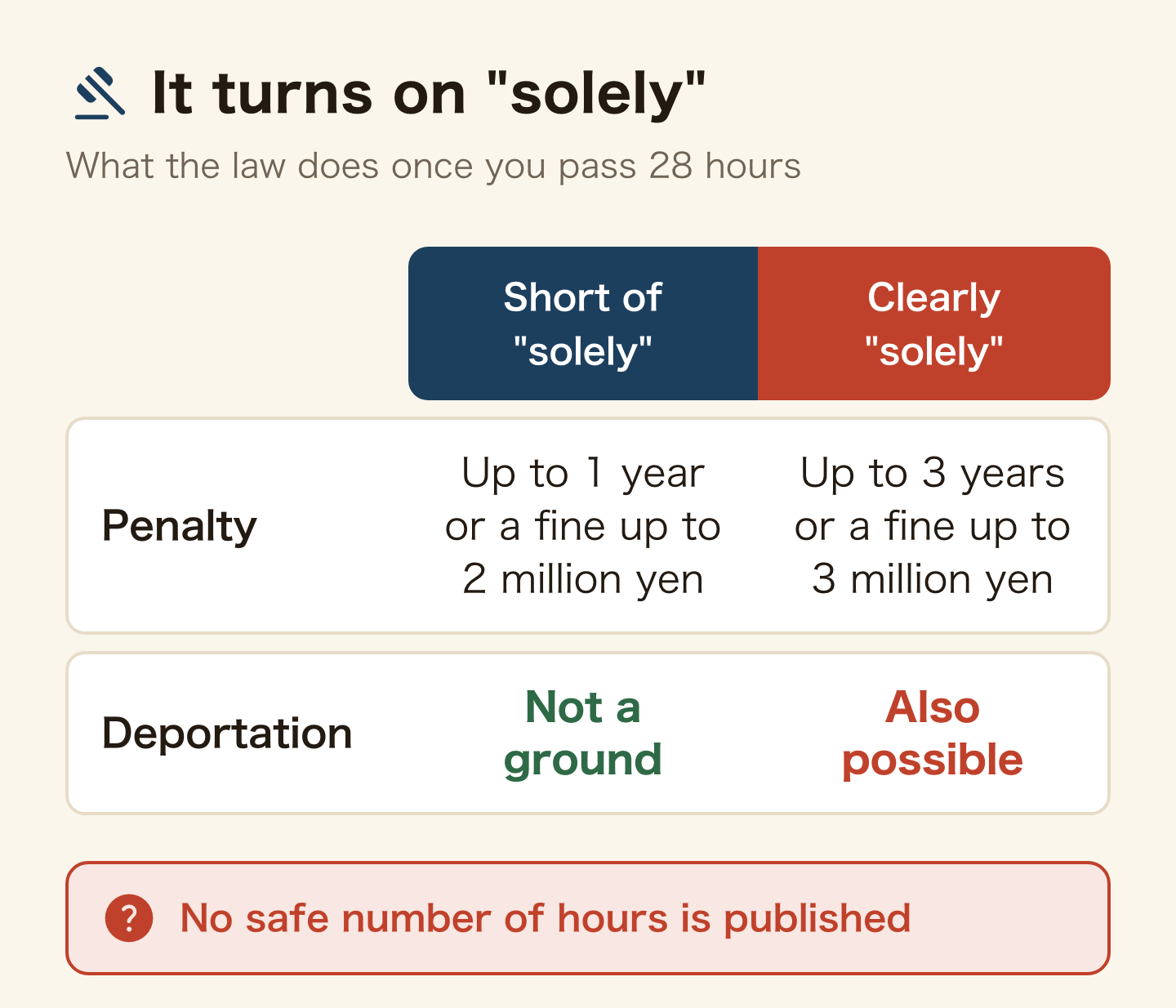
Where it falls short of “solely,” Article 73 applies: up to one year of imprisonment or a fine of up to 2 million yen, or both.
Where a person is clearly found to be working solely, Article 70(1)(iv) applies instead: up to three years of imprisonment or a fine of up to 3 million yen, or both.
And here is the weight of it. The deportation ground, Article 24(4)(a), also uses the words “clearly found to be engaging solely.” The statute repeats the same term.
Everything turns on “solely”
Being a few hours over does not translate into deportation. The deportation provision carries the word “solely.” But no published line tells you how many hours falls short of it. There is no safe number, so the only real answer is to stay under 28.
If you know you are over right now, cut your shifts first. Your working pattern is examined when you next renew your period of stay. Arriving with a record of having cut back is a different conversation from arriving still over.
Delivery work, freelancing, and which permit you need
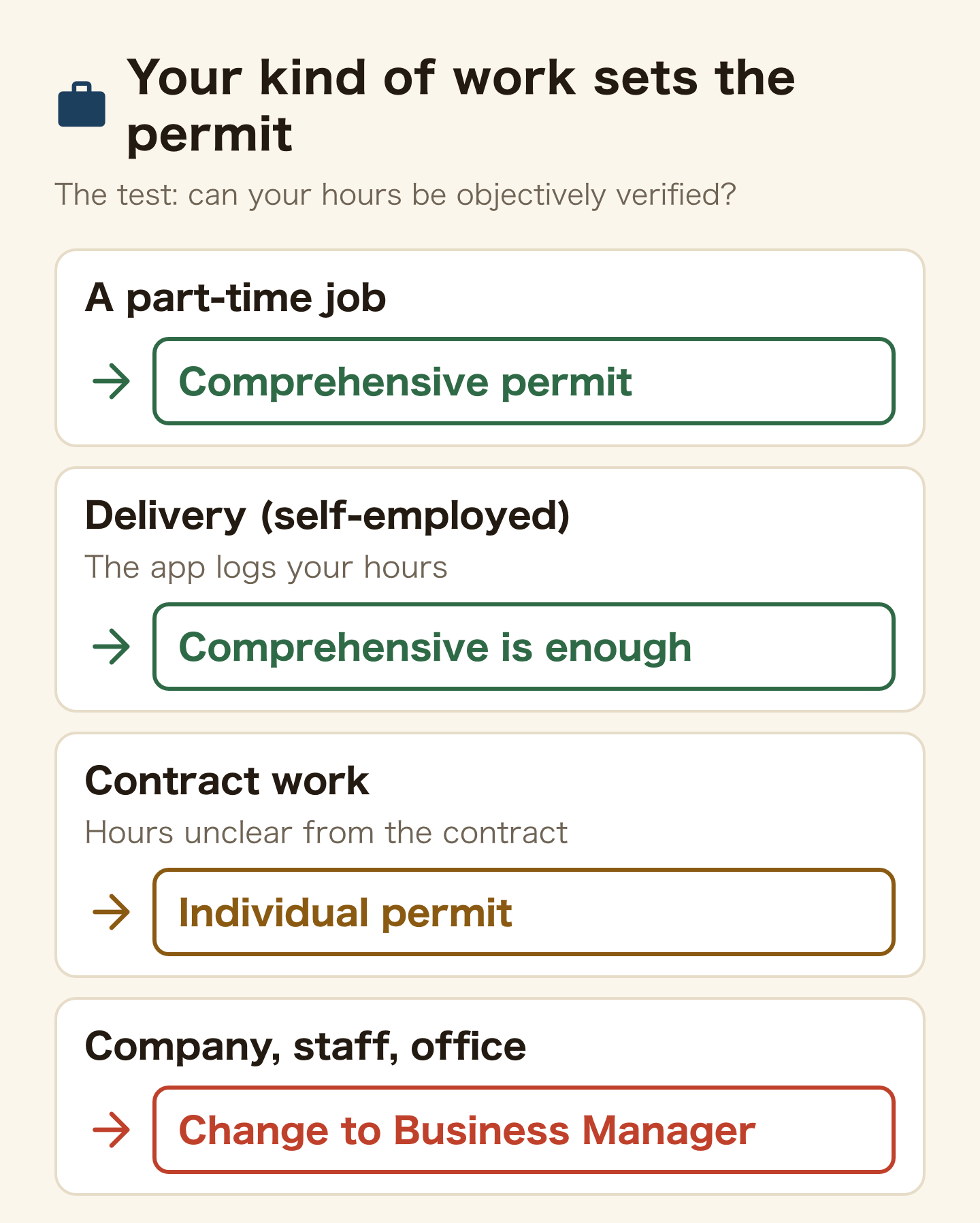
There are two kinds of work permit: the comprehensive permit and the individual permit. An ordinary part-time job uses the comprehensive one.
Delivery work is covered by the comprehensive permit. The Immigration Services Agency includes it explicitly:
Activities where a sole proprietor accepts delivery and similar assignments and receives payment according to results, and where working hours can be objectively verified
Immigration Services Agency, work permit for the “Dependent” status – translated from the Japanese original
The condition is that your hours can be objectively verified. If the app keeps a record of your working time, that is satisfied.
The individual permit is for work that leaves no record of hours – a contracting or subcontracting arrangement where the contract itself does not make the standard hours clear.
One boundary worth knowing: setting up a company, hiring staff, or taking an office goes beyond what a work permit covers. That requires changing to the Business Manager status of residence.
Some jobs stay closed even with the permit
A work permit does not open adult-entertainment businesses. Those are prohibited outright.
The prohibition covers work at premises operating as an adult entertainment business, a store-based sex-related business or a designated entertainment restaurant, and work with non-store-based sex-related businesses. At a hostess club or a pachinko parlour you cannot work even washing dishes or cleaning. Inside those premises, the job title makes no difference.
The pay is often quoted as the reason to try. There is no exception here.
If your family is still at home, start with who you are allowed to bring, and who you are not.
Coming off dependent status is a separate question
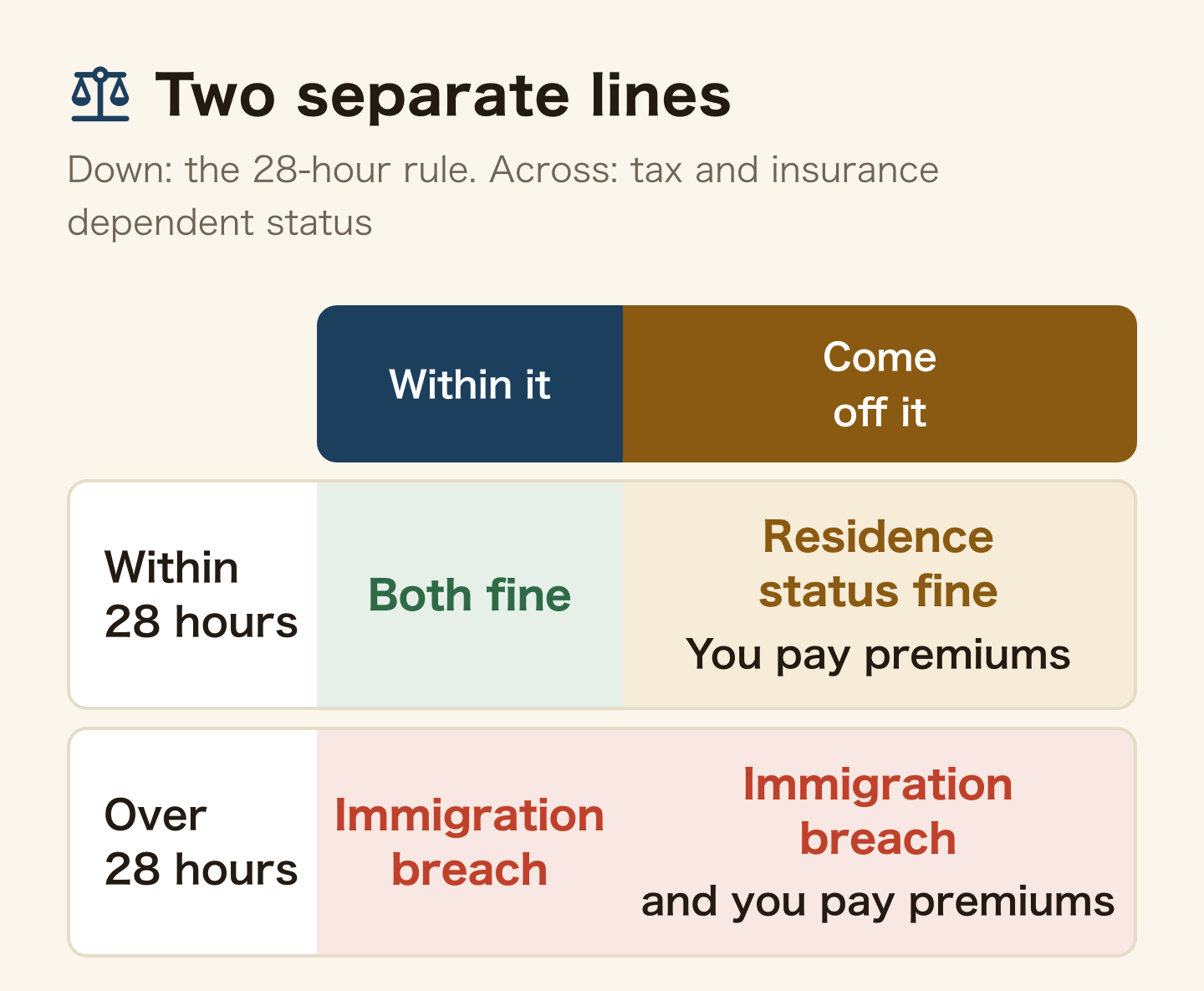
The 28-hour rule and tax or health-insurance “dependent status” are different systems. Mixing them produces wrong answers.
Twenty-eight hours is an immigration rule; breaking it is a residence-status problem. Dependent status is a tax and social-insurance rule; coming off it means paying premiums yourself.
You can stay under 28 hours and still come off dependent status, depending on what you earn. And you can be within the dependent threshold while over 28 hours, which is an immigration breach. Watch the two lines separately.
The threshold itself depends on which health insurance the person supporting you belongs to. Ask their company health insurance society, or the national association. The official lines (under 1.3 million yen a year, among others) and what 28 hours a week adds up to are worked through in dependent health insurance in Japan.
Once you come off it, you either join National Health Insurance yourself or enrol in your employer’s scheme, and your income tax position changes too.
Three things to do today
- Turn your residence card over. No work-permit entry means you cannot work yet. Apply at immigration – there is no fee
- Check last month’s shifts from every starting day, not just Monday. That is where the overage hides
- Redo your plan for the next long holiday now. Dependents have no 8-hour-a-day allowance
If the answer is that you want to work properly rather than around a cap, changing to a work visa removes the 28-hour ceiling entirely.
A Dependent spouse working under the permission and enrolled in employment insurance may qualify for maternity and childcare leave benefits (20+ hours a week, 12 months).
Frequently asked questions
Q. Can a spouse work on a dependent visa in Japan without a permit?
No. While your residence card says “Not permitted to work,” accepting payment breaches Article 19(1) of the Immigration Control Act regardless of the amount or the number of days. Applying for the permit costs nothing.
Q. How do I get a work permit on a dependent visa, and how long does it take?
Apply at the regional immigration bureau for your address. For the comprehensive permit you submit the application form only and show your residence card and passport. There is no fee, and the standard processing time is 2 weeks to 2 months. You cannot start working until it is granted.
Q. Can dependents work 8 hours a day during school holidays?
No. The 8-hour-a-day allowance appears only in the work permit for the Student status. The dependent page has no such provision, so the limit stays at 28 hours a week all year.
Q. I went over 28 hours. Will I be deported?
The deportation ground, Article 24(4)(a), applies to a person “clearly found to be engaging solely” in the work. A few hours over does not automatically meet that. No published line says how many hours is safe, so cut your shifts now.
Q. Can I do delivery work like Uber Eats on a dependent visa?
Yes, on the ordinary comprehensive permit, provided your working hours can be objectively verified. The Immigration Services Agency lists this explicitly. Work that leaves no record of hours needs the individual permit instead.
Q. If I stay under 28 hours, do I keep my dependent status for insurance?
Not necessarily – they are separate systems. Twenty-eight hours is an immigration rule; dependent status is a tax and social-insurance rule. Check the threshold with the health insurance the person supporting you belongs to.
Q. Can I join social insurance on a dependent visa?
Yes, if you meet your employer’s enrolment conditions. Those turn on working hours and pay, not on your status of residence. Enrolling takes you off dependent status.
Summary
- A dependent visa permits no work until you hold a work permit. The permit is free
- With it, 28 hours a week. The student 8-hours-a-day holiday allowance does not apply to you
- A “week” must stay under 28 hours counted from any starting day
- Going over turns on “solely”: Article 73 (1 year / 2 million yen) versus Article 70(1)(iv) plus deportation (3 years / 3 million yen)
- Delivery is fine on the ordinary permit where hours are verifiable. Adult-entertainment work is prohibited outright
- 28 hours and dependent status are separate lines. Watch both
Official sources: Immigration Services Agency, work permit for the “Dependent” status / work permit for the “Student” status / Application for permission to engage in activity other than that permitted / e-Gov, Immigration Control and Refugee Recognition Act
Provisions and conditions were checked against Immigration Services Agency pages and e-Gov on 11 October 2026. Rules change, so confirm the current position before you file anything. For a judgement on your own circumstances, ask a regional immigration bureau or an immigration lawyer.
Found this useful? Share it
Send it to a friend who lives in Japan.
WHO WROTE THIS

mori
Japanese. I read the ministries’ own notices, orders and Q&As in the original, and I start from what my Nepalese and Sri Lankan friends in Japan actually ran into. I do not write about what I have not checked or been told.
What this site can and cannot do →Looking for something else?
You may use the figures in this article, including commercially, if you credit this site with a link. How to use our figures