This article contains affiliate links.
Last updated: July 2026 (prices are 2026 market rates)
In short
- Moving cost is decided by when you move, more than by distance. A single person pays about 142,000 yen in March and 60,000 to 70,000 yen from May onward.
- Students and new graduates are forced into March by the academic year, which is exactly why shifting your date by one or two weeks is worth so much.
- Same boxes, same day, different companies quote tens of thousands of yen apart. Asking only one company is the most expensive way to move.
- Worse than the money is the order of the paperwork. Your move-in notice is due within 14 days, and large rubbish needs a booking weeks ahead.
- Quote comparison sites do lower the price, but several companies will call you in Japanese right after you register. Plan for that before you sign up.
Moving in Japan is not expensive because of distance. It is expensive because of timing, and because a few pieces of paperwork have deadlines that nobody tells you about. This guide covers both, in the order you will actually need them.
The number that decides everything: March costs double
For a single person, the average moving cost is about 142,000 yen in March and 60,000 to 70,000 yen from May onward. That is the same boxes and the same distance, at more than twice the price, purely because of the calendar.
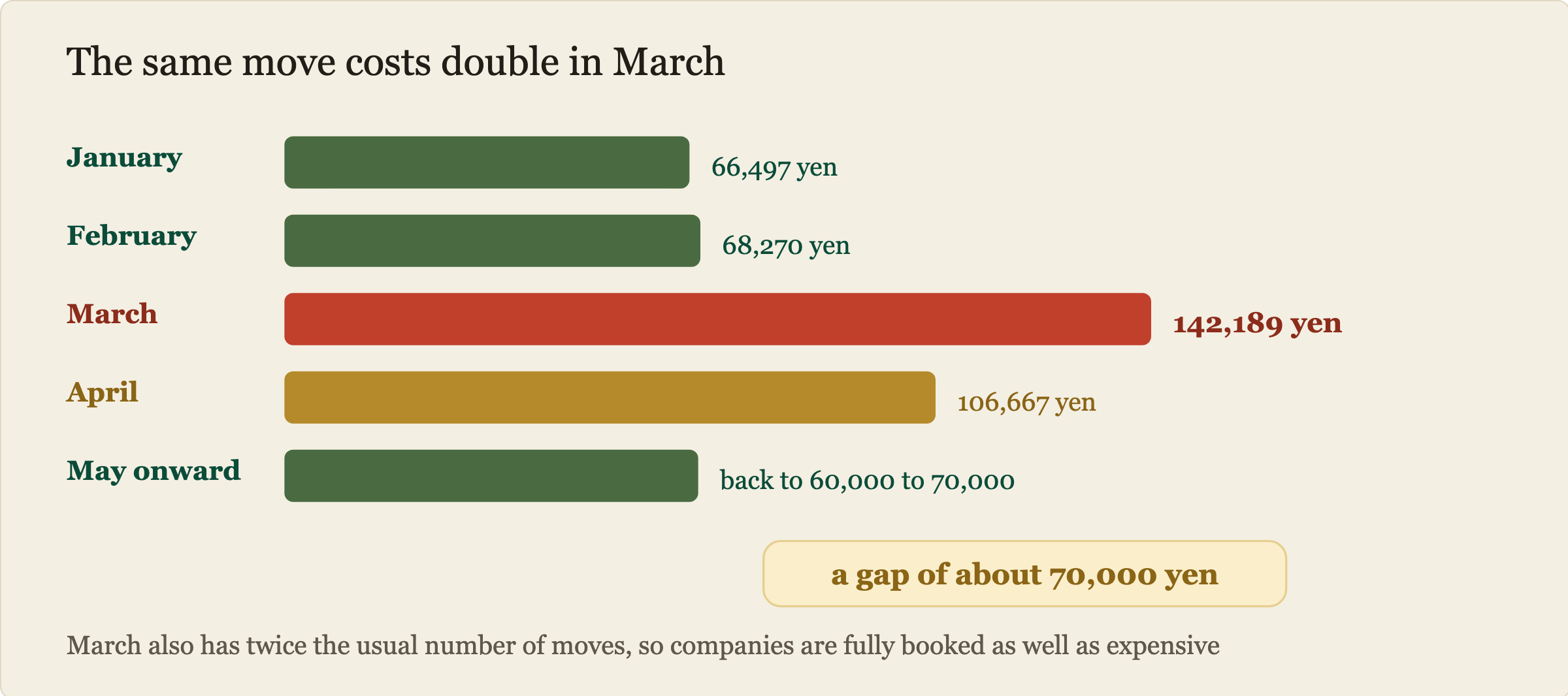
The reason is the Japanese calendar. April is when the school year and the corporate year both start, so students, new graduates, and transferred employees all move in the same few weeks. Foreign students get caught in it too, because language school ends and university or work begins on exactly that schedule.
Which makes the first question worth asking: can you shift by one or two weeks? Avoiding late March, or pushing your move-in date into May, keeps tens of thousands of yen in your pocket. Bridging the gap with a month in a share house can be cheaper than moving on the worst possible date.
If you cannot move the date, make companies compete
There is no fixed price list for moving in Japan. The same job on the same day gets quoted tens of thousands of yen apart by different companies, because each one is looking at a different truck schedule.
A company with an empty truck that day will discount hard to fill it. A company already booked will quote high. That is the entire mechanism, and it is why asking a single company is the most expensive thing you can do.
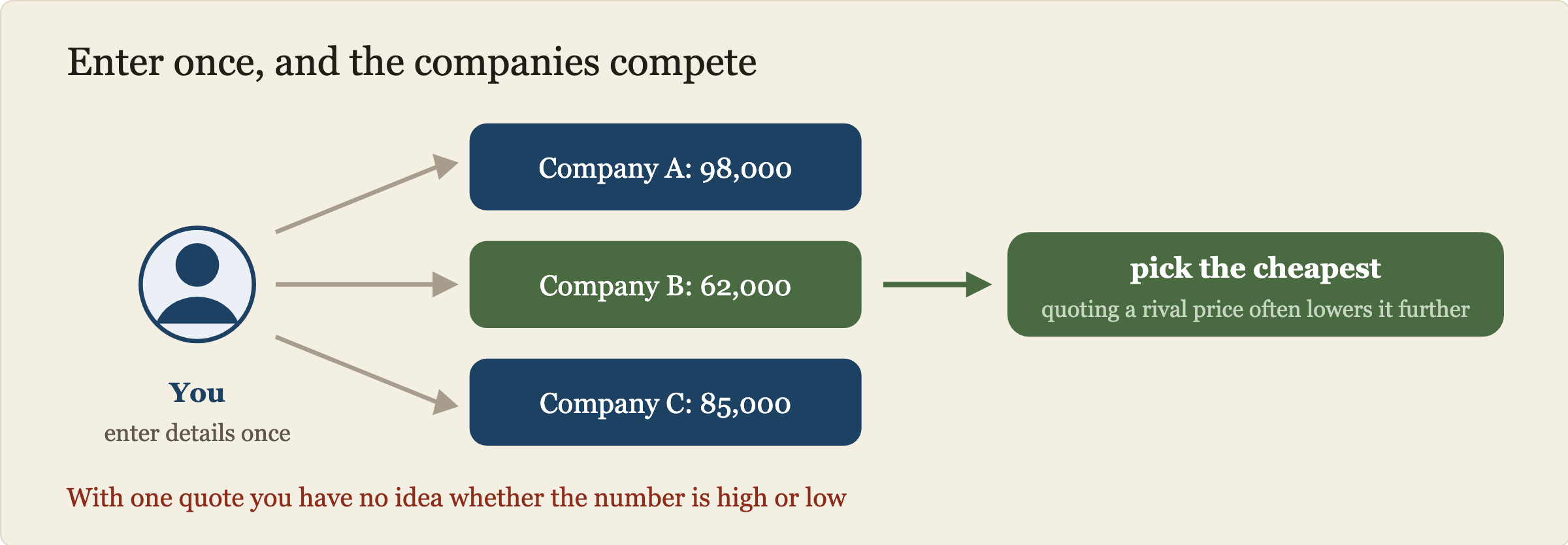
Phoning three to five companies yourself and repeating the same details in Japanese each time is a real barrier if Japanese is not your first language. A comparison site exists to collapse that into one form.
The honest problem with comparison sites
Read this before you register anywhere. The moment you submit the form, your phone number and email go to multiple moving companies, and they start calling. In Japanese. Within minutes.
This is not a flaw in one particular service – it is how the model works. For our readers it is the single biggest obstacle, so decide how you will handle it first.
- Register at a time you can actually answer the phone. Not during class or a shift. The calls come almost immediately
- Choose email contact if the form offers it. Written Japanese can go through a translation app, and you keep a record
- They all ask the same six things. Moving date, current address, new address, size of your place, big items, and whether there is a lift. Write that on one sheet of paper and you are just reading it out each time
- Have a Japanese-speaking friend on standby for the hour after you register, if you can. One hour of their time is worth tens of thousands of yen
- Say no clearly once you decide. “Hoka no kaisha ni kimemashita” (I chose another company) ends the call
If you have no Japanese at all and nobody who can help, this route is not for you. Look for a mover that advertises English support and book directly instead – you will pay somewhat more, but a move you can actually communicate about is worth more than the discount.
Comparing many companies at once: Hikkoshi Zamurai
A free moving quote comparison service run by Ateam Inc. It works with around 390 moving companies (as of February 2026), which is one of the largest networks in the industry.
- One form gets you quotes from several companies to compare side by side
- Over 46,000 user reviews on the site, so you can weigh reputation and not only price
- Free to use – you only pay the company you actually book
- The site and the phone calls are in Japanese. Read the section above and prepare before you register
The part that actually goes wrong: the order of the paperwork
Money is the easy problem. The expensive mistakes are procedural: telling your landlord late means paying rent on a place you left, missing the rubbish booking means leaving furniture behind, and a late move-in notice touches your residence card.
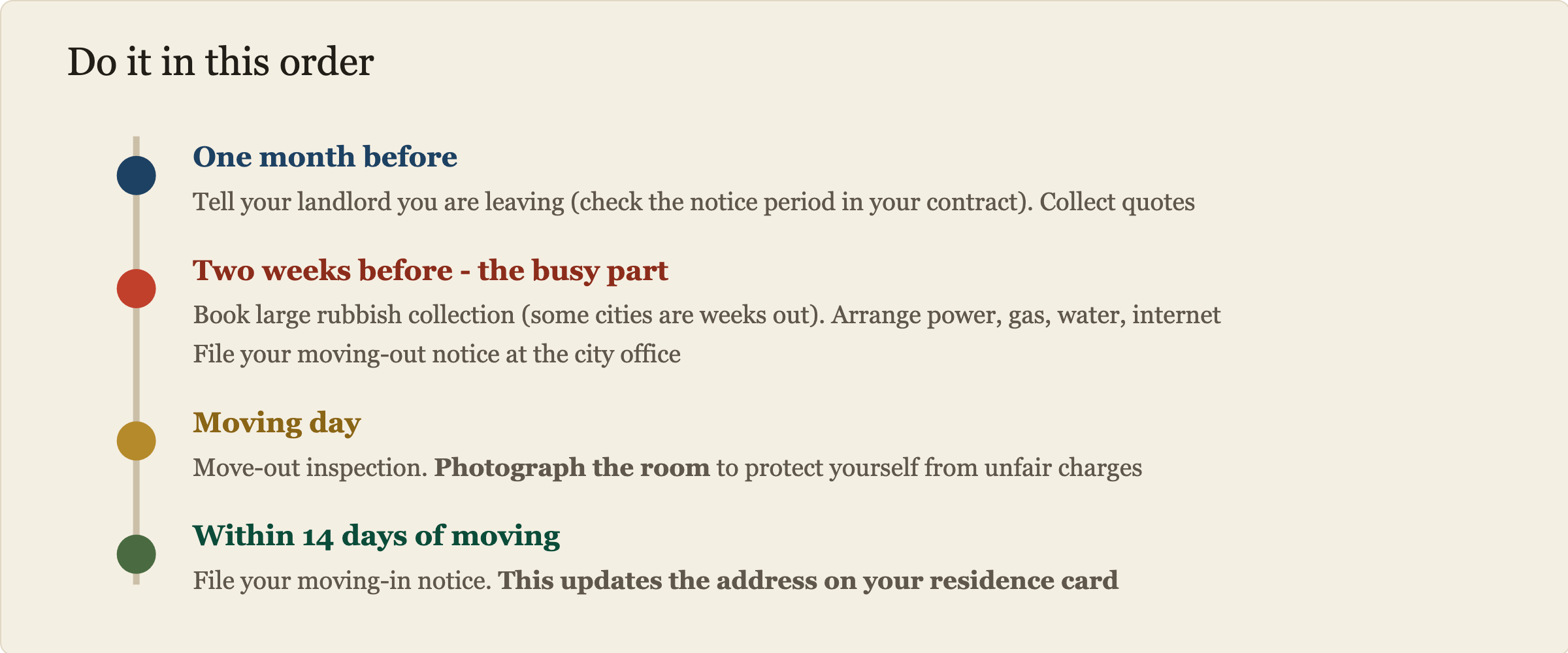
Three of these catch foreign residents out repeatedly:
- Large rubbish (sodai gomi): beds, desks, and bicycles cannot go out with normal rubbish. You book a collection with your city, buy a sticker at a convenience store, and put the item out on the assigned morning. Some cities are booked weeks ahead, so realising this a few days before your move means you physically cannot dispose of it – and furniture left behind gets billed to you
- The move-out inspection: this is where repair charges get decided. If you are asked to sign and you do not agree, you are allowed to say you need time. See how not to overpay move-out costs
- The 14-day move-in notice: your address is tied to your residence card. Filing late creates extra procedures and can count against you at your next visa renewal. See residence registration explained
If you are leaving Japan rather than moving within it, the sequence is completely different – see the leaving Japan checklist instead.
What to prepare before you ask for quotes
Every company asks the same things, so writing them down once turns five phone calls into five short ones.
| What they ask | Example answer | Effect on price |
|---|---|---|
| Moving date | March 28 (flexible by one week) | Largest |
| Current and new address | City A to City B | Large (distance) |
| Size of your place | One room / 1K | Medium |
| Large items | Fridge, washing machine, bed, desk | Large |
| Lift in the building | No lift, 3rd floor | Medium (no lift costs more) |
| Packing service | I will pack myself | Large (adds 10,000 to 50,000) |
Saying “my date is flexible by about a week” is the strongest card you hold. It lets the company slot you into a truck that would otherwise run half empty, and the discount comes back to you.
Reference (official): Ministry of Internal Affairs and Communications, Basic Resident Registration
Frequently asked questions
Q. When is the cheapest time to move in Japan?
May through January. A single person averages 60,000 to 70,000 yen, less than half the roughly 142,000 yen average in March. Avoid March and April, and late March above all.
Q. Are quote comparison services really free?
Yes. Getting quotes costs nothing and you only pay the company you actually book. The trade-off is that several companies will contact you soon after you register, so choose a time when you can answer.
Q. Can I book a mover if my Japanese is weak?
Yes, because the questions are fixed and predictable. Prepare a single sheet with your date, addresses, room size, and large items, and you can work through the calls. If you have no Japanese at all and no one to help, book an English-supporting mover directly instead.
Q. How far ahead do I need to book large rubbish collection?
At least two weeks, and a month during the March and April rush. Some cities are booked weeks out, and anything you cannot dispose of gets left in the flat and charged to you as a move-out cost.
Q. What happens if I do not file the move-in notice?
Your address is linked to your residence card, so filing late means extra procedures and can count against you when you renew your residence status. File within 14 days at your new city office.
Summary
- Timing decides the price: about 142,000 yen in March, 60,000 to 70,000 from May
- If you can shift the date by one or two weeks, that is the biggest saving available
- If you cannot, make companies compete – one quote is the expensive option
- Comparison sites work, but the calls come in Japanese, immediately. Prepare first
- Book rubbish collection two weeks ahead and file the move-in notice within 14 days
Related guides
Found this useful? Share it
Send it to a friend who lives in Japan.
Internet at the new place: the no-installation options work from day one.
Home Internet in Japan →WHO WROTE THIS

mori
Japanese. I read the ministries’ own notices, orders and Q&As in the original, and I start from what my Nepalese and Sri Lankan friends in Japan actually ran into. I do not write about what I have not checked or been told.
What this site can and cannot do →Looking for something else?