Checked on 25 September 2026 against Articles 19-16, 71-2, 71-5 and 22-4 of the Immigration Control Act (e-Gov), the Immigration Services Agency’s pages on the notification of the contracting organization and of the organization of affiliation, its notification Q&A, its sample forms and e-notification user manual, and the Ministry of Health, Labour and Welfare’s page on employers’ foreign employment reports.
In short
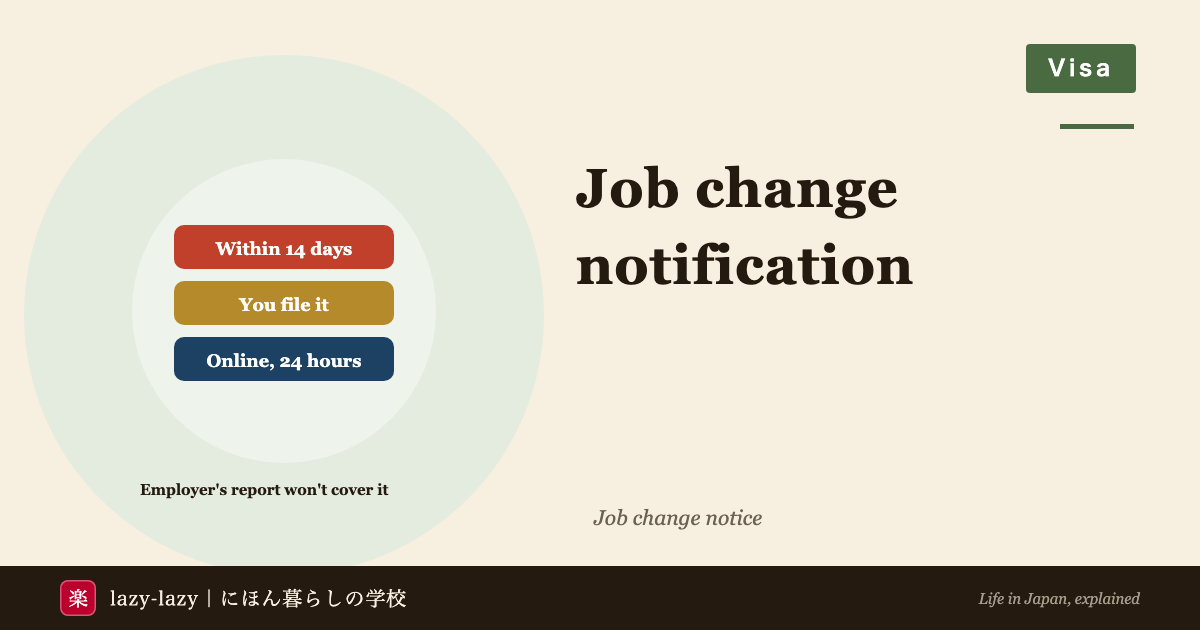
- The job change notification tells Immigration, within 14 days, that you left a company or joined a new one. You file it yourself (Immigration Control Act, Article 19-16).
- It applies to Engineer/Specialist in Humanities/International Services, Specified Skilled Worker, Skilled Labor, Nursing Care, Business Manager, Intra-company Transferee, Student and similar statuses. Permanent residents, long-term residents and spouses of Japanese nationals do not file it when they change jobs.
- The 14 days run from the day you quit and the day you join. You cannot file before either happens.
- File online (the e-notification system, 24 hours), at an immigration office, or by post. No employment contract or other documents are needed.
- Your employer’s report to Hello Work does not replace it. Not filing can mean a fine of up to 200,000 yen, and it is checked at visa renewal and permanent residence. If you are past 14 days, file on the day you notice.
Knowing this, you can file the right form once, in the week you quit or join, instead of hearing at a renewal two years later that the notification is missing. If you have no next job yet, you will also know what to file now and what to file later.
First day at the new company. HR says they will handle your health insurance and pension, and takes a copy of your residence card. It feels finished. You ask a Japanese colleague whether you need to tell Immigration anything, and they have no idea. Japanese workers never report a job change to Immigration, so nobody around you has done it. You have to. And it is your filing, not the company’s.
- What is the job change notification to Japan Immigration?
- Who has to file it? Contracting organization or organization of affiliation
- How are the 14 days counted?
- How do I file the notification: online, at a counter, or by post?
- What documents do I need?
- How much does it cost?
- How is it different from the notice my employer files?
- What happens if I do not file it?
- What if I missed the 14 days?
- Is the notification enough if my job changes?
- Which one are you?
- FAQ
- Summary
- Related reading
What is the job change notification to Japan Immigration?
It is the notification you send the Immigration Services Agency when your relationship with the company or school you belong to changes. Article 19-16 of the Immigration Control Act requires it “within 14 days from the day on which the event occurred”.
The agency uses two names, depending on your status:
- Notification of the contracting organization — for statuses based on a contract with a company. File “termination of the contract” when you quit and “conclusion of a new contract” when you sign with a new employer
- Notification of the organization of affiliation — for statuses based on where you carry out your activity. File “leaving” when you quit or graduate and “transfer” when you move to a new company or school
For both, the agency’s pages name the filer as the mid- to long-term resident themselves.
Who has to file it? Contracting organization or organization of affiliation
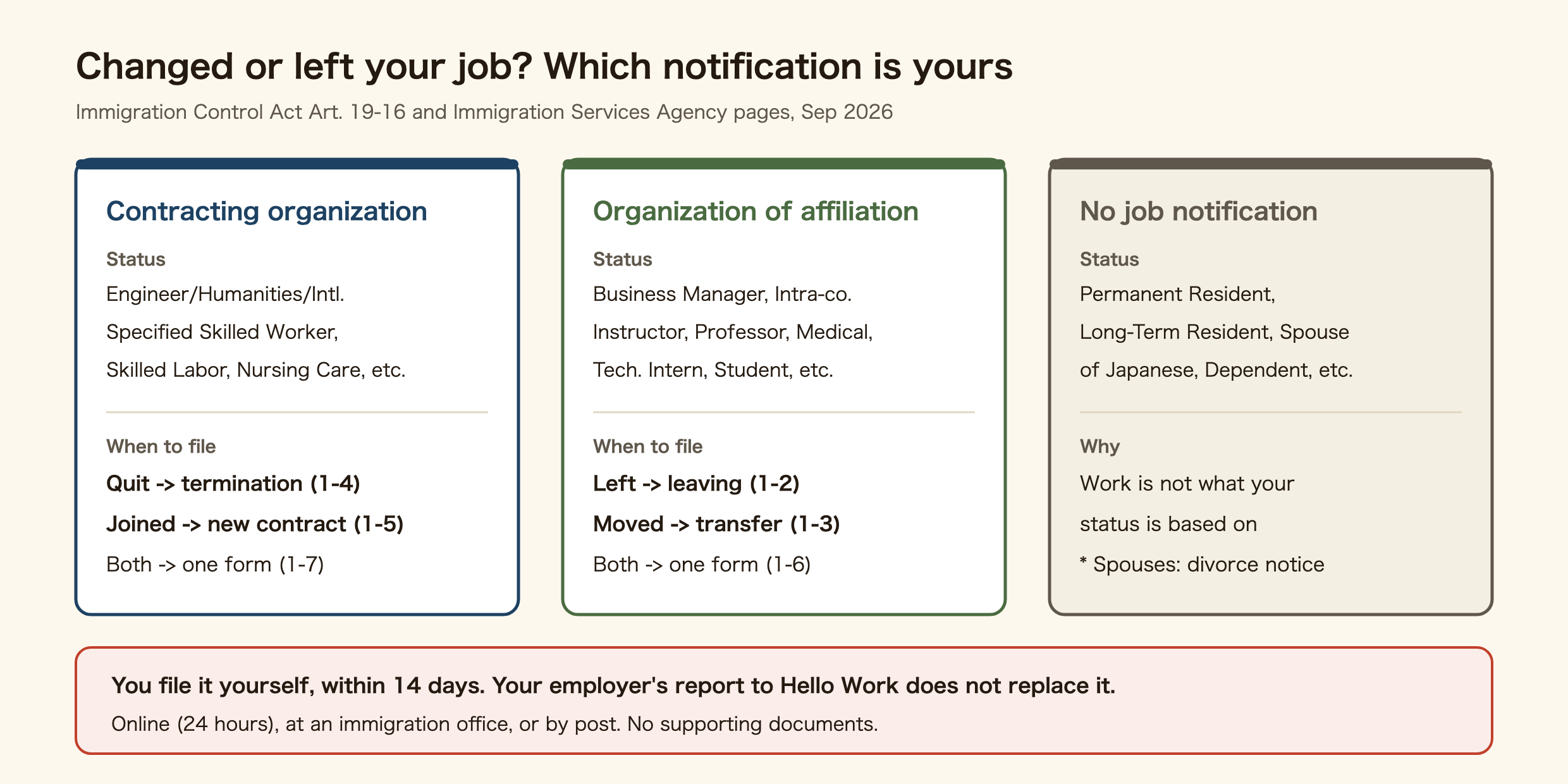
The “status of residence” line on your residence card decides which one is yours. Engineer/Specialist in Humanities/International Services, Specified Skilled Worker, Skilled Labor, Nursing Care, Researcher, Entertainer and Highly Skilled Professional (i)(a)/(b) file the contracting organization notification. Business Manager, Intra-company Transferee, Instructor, Professor, Medical Services, Legal/Accounting Services, Technical Intern Training, Student, Trainee and Highly Skilled Professional (i)(c) file the organization of affiliation notification.
Permanent residents, long-term residents, spouses of Japanese nationals, dependents and Designated Activities holders have no notification when they change jobs, because work is not the activity their status is based on. Those who stay as a spouse have a separate notification on divorce or bereavement.
The agency’s Q&A settles the common grey areas:
- Moved to another branch of the same company — no notification for contracting-organization statuses
- Same staffing company, new client site (dispatch work) — no notification for contracting-organization statuses. Organization-of-affiliation statuses file leaving the old site and transfer to the new one
- Also working long term for a second company — notify it, and write “(dual contract)” after your current company’s name. A three-day side job needs nothing
- Seconded to another company — contracting-organization statuses file a new contract with the company you are seconded to
How are the 14 days counted?
The agency’s sample forms say exactly which dates to use:
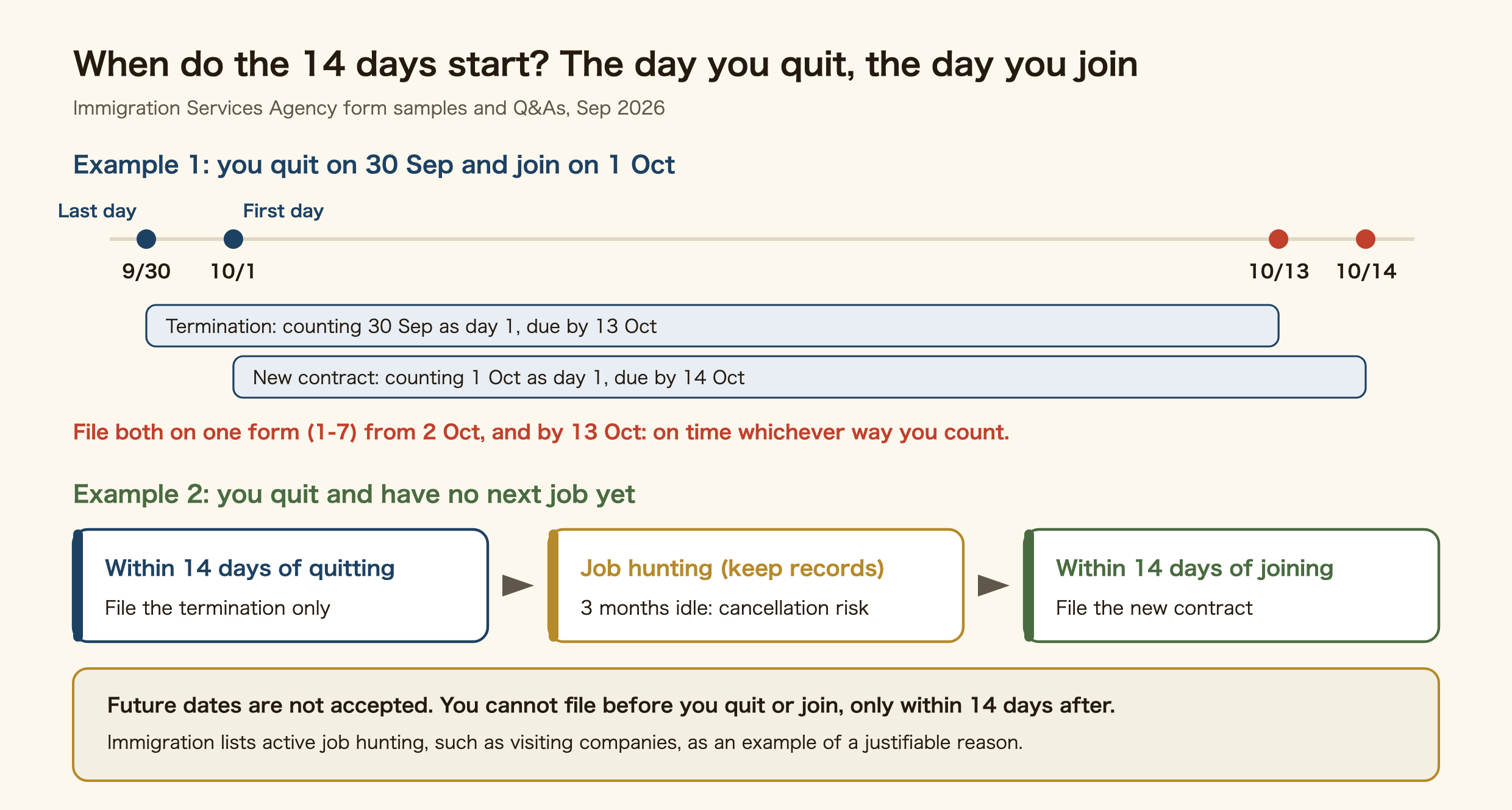
- Termination (leaving): the day the contract ended — the day you quit
- New contract (transfer): the day the contract took effect — your first day at the new company
It is not the day you signed the job offer. If you quit on 30 September and join on 1 October, you can file both on one form (1-7 for contracting-organization statuses) from 2 October, exactly as in the agency’s sample.
The agency does not say whether the first day counts. Count the day you quit as day 1 and file by day 14, and you are on time either way. In the example, that is 13 October.
You cannot file in advance. The Q&A says a notification with a future date is not accepted. If you are leaving next month, file after you leave.
With no next job yet, file in two steps: the termination within 14 days of quitting, then the new contract within 14 days of joining. Between the two, a different clock runs. Three months or more without the activity of your status makes it liable to cancellation (Article 22-4). The agency’s Q&A gives active job hunting, such as visiting companies, as an example of a justifiable reason. Keep a record of where you applied, when, and your interviews. How the three months lead to cancellation is set out in what really triggers a visa cancellation.
How do I file the notification: online, at a counter, or by post?
The agency’s own advice is that online filing is the convenient one.
Online (the e-notification system) — open 24 hours a day, 365 days a year, and you can see your filing history and status afterwards. The steps, from the user manual for residents:
- Register your email address and get a user ID through the link you receive (valid for 24 hours)
- Log in and submit the “application for use” (once only)
- Choose the notification for the organization or spouse, pick your status and the event (termination and so on), and fill it in
- Emails arrive for receipt, the receipt number and completion. If something is wrong, you get a registration error email; correct it and file again
The screens switch to eight languages, including English, Chinese, Vietnamese and Tagalog. The supported environment is a Windows or macOS computer. You do not need a My Number Card just to file notifications. The card is needed only for the separate online residence application system used for renewals and changes. If you get stuck, the help desk takes calls in Japanese or English on weekdays, 9:00 to 17:00 (050-3786-3053).
At a counter — hand the form in at your nearest regional immigration office and show your residence card. Some offices take notifications only on certain days or hours, so check with the Immigration Services Agency’s information centre (0570-013904) first.
By post — put the form and a copy of your residence card in an envelope, write “NOTIFICATION ENCLOSED” (or 届出書在中) in red on the front, and send it to:
〒160-0004 東京都新宿区四谷1丁目6番1号 四谷タワー14階 東京出入国在留管理局 在留調査部門 届出受付担当
(Tokyo Regional Immigration Services Bureau, Residence Investigation Division, Notification Reception, Yotsuya Tower 14F, 1-6-1 Yotsuya, Shinjuku-ku, Tokyo 160-0004)
This one address is used wherever you live, and you cannot drop the form off in person. No receipt is sent, so the agency recommends a mail service with tracking.
What documents do I need?
None besides the form. The Q&A says no supporting documents are required: no employment contract, no certificate of leaving. By post, add a copy of your residence card.
On paper, use the agency’s reference forms:
- Contracting organization: termination (1-4), new contract (1-5), both (1-7)
- Organization of affiliation: leaving (1-2), transfer (1-3), both (1-6)
You write your name, date of birth, nationality, address and residence card number exactly as on the card, plus the date you quit or joined, and the company’s name, address and 13-digit corporate number. For a new employer, add what you will do there. A job title such as “systems engineer” is fine.
Three things to watch. Write in Japanese or English. Give the name of the company you have the contract with, meaning the head office, not the branch (if you work for a sole proprietor, their personal name). And the signature must be your own, handwritten. The form has a “submitter” box, so someone such as your employer can hand it in for you, but it is still your notification.
How much does it cost?
Neither of the agency’s two procedure pages nor its Q&A lists any fee. If you post it, you pay for the tracked mail. Online, there is not even that.
How is it different from the notice my employer files?
Your employer has three reports of its own:
- Foreign employment report (employer to Hello Work) — required of every employer when they hire or lose a foreign worker. For workers in employment insurance, the insurance enrolment and loss forms double as this report. Failing to file can mean a fine of up to 300,000 yen (Ministry of Health, Labour and Welfare)
- Report on accepting mid- to long-term residents (employer to Immigration) — a duty to make efforts, with no penalty. Employers who file the Hello Work report do not need to file it (Article 19-17)
- Specified Skilled Worker employer’s notification (employer to Immigration) — an employer of Specified Skilled Workers must report a contract ending or starting within 14 days, with a fine of up to 300,000 yen for not doing so (Articles 19-18 and 71-4)
All three are the employer’s duties. Yours sits in a different article and names a different filer, and nothing the company files cancels it. If HR says “we will take care of it”, ask whether that includes your own notification to Immigration. Specified Skilled Workers also need a change-of-status permission; the order is in how to change jobs on a Specified Skilled Worker visa.
What happens if I do not file it?
The Act sets two penalties:
- Not filing: a fine of up to 200,000 yen (Article 71-5)
- Filing something false: imprisonment of up to one year or a fine of up to 200,000 yen (Article 71-2). A mid- to long-term resident sentenced to imprisonment for this also becomes subject to deportation (Article 24, item 4-4)
Cancellation of status is a separate question. The list of grounds for cancellation in Article 22-4(1) does not include failing to file this notification. On the other hand, filing does not protect you if you stop working: the agency’s filling guide says your status can still be cancelled if you do not carry out your activity for a certain period after filing. The notification is not a shield against cancellation.
What lasts longer than a fine is the next review. The agency’s Q&A warns that not filing “may work against you” in later applications.
- The renewal and change-of-status guidelines list “meeting the notification duties under the Immigration Control Act” as item 8
- Whether you get a five-year period of stay takes into account how you have met your notification duties
- The permanent residence guidelines count notification duties under the Act among the public duties you must have met
What if I missed the 14 days?
Asked whether someone well past 14 days can skip it, the agency answers: please file promptly. Not filing because you are late is the worst choice. Even for a job change years ago, file online on the day you notice, using the real dates you quit and joined.
Some people do not need to file. If you handed in your residence card and left Japan, so you are no longer a mid- to long-term resident, no notification is needed. A technical intern who leaves the training company and goes home within 14 days is not in breach either.
Is the notification enough if my job changes?
The notification only reports that you left and joined. It does not check whether the new job fits your status, and the agency says filing does not mean the activity has been approved.
- If the new job fits your current status — the notification is all you need, and you can stay (Q&A Q11). Check what fits in jobs allowed on the Engineer/Humanities visa
- If you are unsure — the Certificate of Authorized Employment lets Immigration confirm it first. Applying for it does not count as the notification
- If the job is outside your status, or you change company on Specified Skilled Worker or Highly Skilled Professional (i) — you need a change-of-status permission. If you receive it, no job change notification is needed (Q&A Q10), including when you leave the old company after the permission
- If you renewed your visa around the time you changed jobs — you still need the notification (Q&A Q9)
Which one are you?
- Already at the new company — within 14 days of joining, file the termination and the new contract together on one form (1-7 or 1-6). Today, register your email on the e-notification system.
- Quit with no next job yet — within 14 days of quitting, file only the termination (leaving). Today, start a note of every company you apply to and the date.
- About to quit — you cannot file early, so put day 14 after your last day in your calendar. Before you quit, check that the new job fits your current status.
- Not sure you filed for a past job change — look at your e-notification history or your own copies. If you cannot find it, file today with the real dates.
FAQ
Q. Who files the job change notification to Japan Immigration?
You do. The agency’s pages name the resident as the filer. Your employer’s foreign employment report to Hello Work is the employer’s own duty and does not replace it.
Q. What is the deadline for the job change notification?
Within 14 days of the day you quit and the day you join. You cannot file before either happens. Count the day you quit as day 1 and file by day 14, and you are on time whichever way it is counted.
Q. Can I file the job change notification online?
Yes. The Immigration Services Agency’s e-notification system accepts it 24 hours a day, 365 days a year. Register with your email and submit the application for use first. No documents need to be attached.
Q. I forgot the notification and the 14 days have passed. What do I do?
File it on the day you notice. The agency asks people who find they have not filed to do so promptly. Use the real dates you quit and joined.
Q. Will my visa be cancelled if I do not file the job change notification?
Failing to file is not one of the grounds for cancellation in the Immigration Control Act. But it can mean a fine of up to 200,000 yen, and renewals and permanent residence check whether you met your notification duties. Separately, three months without working can put your status at risk of cancellation.
Q. Where do I post the notification of the contracting organization?
Tokyo Regional Immigration Services Bureau, Residence Investigation Division, Notification Reception, Yotsuya Tower 14F, 1-6-1 Yotsuya, Shinjuku-ku, Tokyo 160-0004 (in Japanese: 東京都新宿区四谷1丁目6番1号 四谷タワー14階 東京出入国在留管理局 在留調査部門 届出受付担当). Enclose the form and a copy of your residence card, and write “NOTIFICATION ENCLOSED” in red on the envelope. No receipt is sent, so use tracked mail.
Summary
The job change notification is how you tell Immigration yourself that you left or joined a company. You file it within 14 days of quitting and of joining, online from home if you like, with no documents. When the company’s paperwork is all done, this one is still yours to do.
Not filing can mean a fine of up to 200,000 yen, and it surfaces at renewals and permanent residence years later. If you are late, file the day you notice. If you have no next job, file the termination now and keep a record of your job hunting through the three months. That is all it takes to never have a problem with this notification.
Official sources: Immigration Services Agency, Notification of the contracting organization / ISA, Notification of the organization of affiliation / ISA notification Q&A / ISA e-notification system portal / ISA, Report on accepting mid- to long-term residents / ISA immigration and residence Q&A / ISA guidelines for change of status and extension of period of stay / Ministry of Health, Labour and Welfare, Foreign employment report / Immigration Control Act, Articles 19-16 to 19-18, 22-4, 24, 71-2, 71-4 and 71-5 (e-Gov). Checked on 25 September 2026.
Related reading
Found this useful? Share it
Send it to a friend who lives in Japan.
WHO WROTE THIS

mori
Japanese. I read the ministries’ own notices, orders and Q&As in the original, and I start from what my Nepalese and Sri Lankan friends in Japan actually ran into. I do not write about what I have not checked or been told.
What this site can and cannot do →Looking for something else?