Checked on 23 September 2026 against the Immigration Services Agency’s page for this status, its guideline on the status (revised April 2026) and published approval and refusal cases, its employer Q&A (July 2026), the procedure pages for the work qualification certificate and the 14-day notification, and the landing standards ordinance and Immigration Control Act on e-Gov.
The short answer
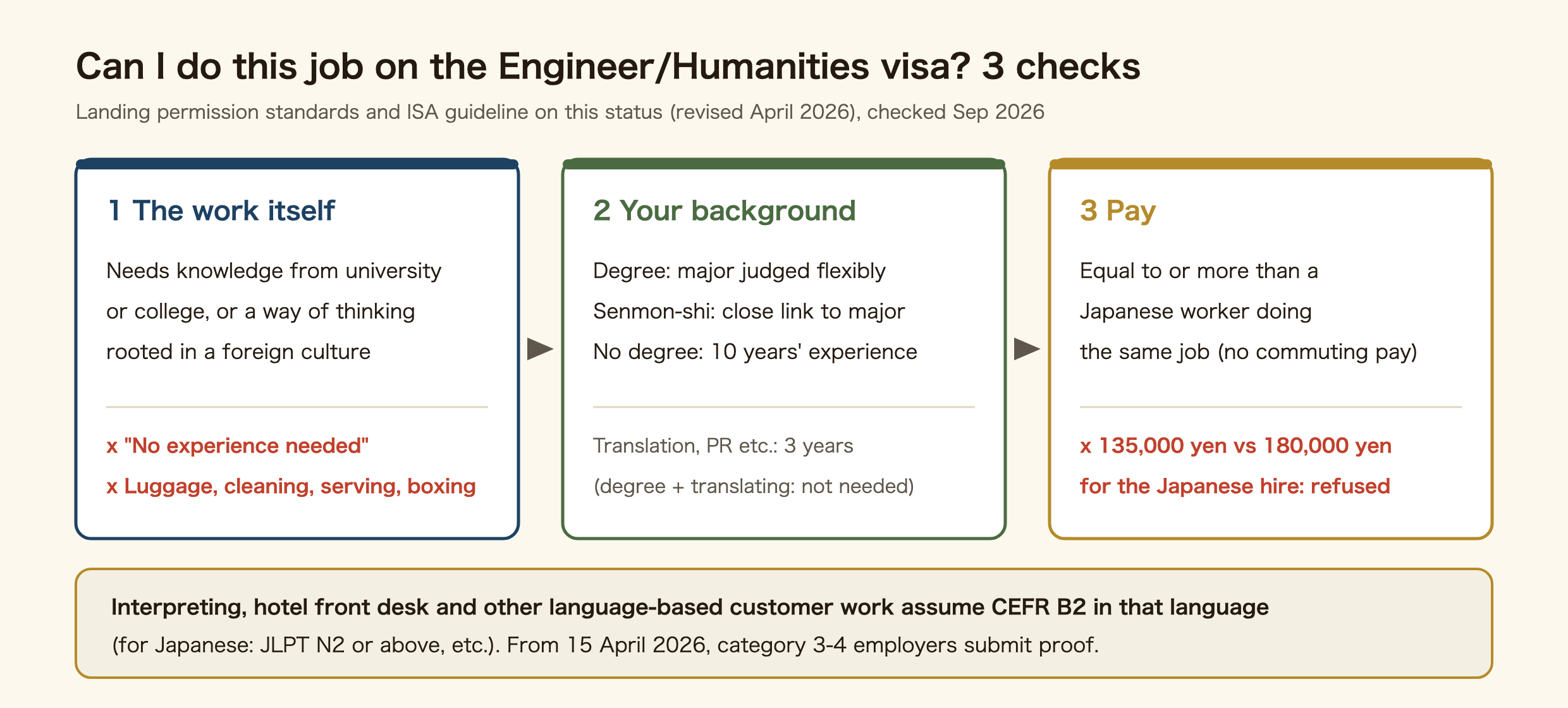
- The Engineer/Specialist in Humanities/International Services status (“gijinkoku”) covers work that uses what you studied, or a way of thinking rooted in a foreign culture. Engineers, interpreters, designers, language teachers and marketing staff are the examples Immigration gives.
- It does not cover work that needs no such knowledge. Immigration says jobs advertised as “no experience needed, you’ll pick it up fast” are outside it. Carrying luggage, cleaning, serving or packing as your main work has been refused.
- Shop-floor or factory work can be accepted as training, if Japanese graduate hires do the same training and it is not most of your time on this status.
- You need one of three: a degree, a senmon-shi diploma from a Japanese vocational school, or 10 years’ experience (3 years for translation, PR and similar). Pay must equal what a Japanese worker gets for the same job.
- If you change jobs, notify Immigration within 14 days. If you are unsure the new job fits, a work qualification certificate (2,000 yen) lets you check first.
Knowing this, when a new employer or your manager says “start on the floor”, you can check that work against Immigration’s own published cases and judge whether your next renewal is at risk. You can decide to push back, get it in writing or look elsewhere before the renewal, not after.
At the offer meeting, HR says: “For the first two years you’ll work in our stores, serving customers. Everyone goes through it.” Your Japanese colleagues starting with you are not worried at all. You are wondering what those two years do to your visa. A Japanese friend says, “It’s training, that’s normal.” They have never had to ask whether a job is allowed. You do.
- What jobs can you do on the Engineer/Humanities visa in Japan?
- Which jobs are not allowed? “No experience needed” and simple labour
- Where did approved and refused cases split?
- Is training on the shop floor or factory line allowed?
- Engineer/Humanities visa requirements: degree, senmon-shi or 10 years
- How closely must your major match the job?
- Do interpreting and hotel front desk jobs need N2? The 15 April 2026 change
- How much must you be paid? Equal to a Japanese worker
- How long is the period of stay: 5 years, 3 years, 1 year or 3 months?
- Documents and costs
- Changing jobs on the Engineer/Humanities visa: 14 days and the certificate
- What if you do work outside the status?
- Which one are you?
- FAQ
- Summary
- Related reading
What jobs can you do on the Engineer/Humanities visa in Japan?
“Work visa” is the everyday word. The legal term is status of residence, and most international students who get hired in Japan switch to this one: Engineer/Specialist in Humanities/International Services. In Japanese it is shortened to gijinkoku. As the name says, it has three parts.
- Engineer — work that uses natural sciences such as science, engineering or agriculture: mechanical engineers, systems engineers, programmers
- Specialist in Humanities — work that uses law, economics, business, sociology and other humanities: planning, marketing, accounting, trade administration
- International Services — work that needs a way of thinking or sensitivity rooted in a foreign culture: translation, interpreting, language teaching, PR, advertising, overseas trade, fashion or interior design, product development
The examples on Immigration’s own page are engineers in fields like mechanical engineering, interpreters, designers, language teachers at private companies and marketing staff. The education and experience rules differ between the three parts.
Immigration does not publish a list of job titles. Among “hotel staff” there are people who were approved and people who were refused. What decides it is not the title but what you actually do all day.
Which jobs are not allowed? “No experience needed” and simple labour
Immigration’s guideline describes the jobs that do not qualify in two ways.
- Jobs whose hiring criteria say something like “no experience needed, you’ll get used to it quickly”
- Jobs that Japanese employees without the required education or experience normally do
The guideline never uses the phrase “simple labour”. It says work that “requires no particular skill or knowledge” or that “can be done after repeated practice”. Site work, customer service that is only tills or serving, and factory line work fall here most easily.
Immigration looks at your activity over your whole stay. If the qualifying work is a small part and most of your time goes on work that needs no knowledge, the job as a whole does not qualify. A contract that says “interpreter” does not help if the job is really serving customers.
At a hotel, a front-desk worker carrying bags when a tour group arrives is not a problem in itself, says Immigration. It becomes one when that is your main work.
Where did approved and refused cases split?
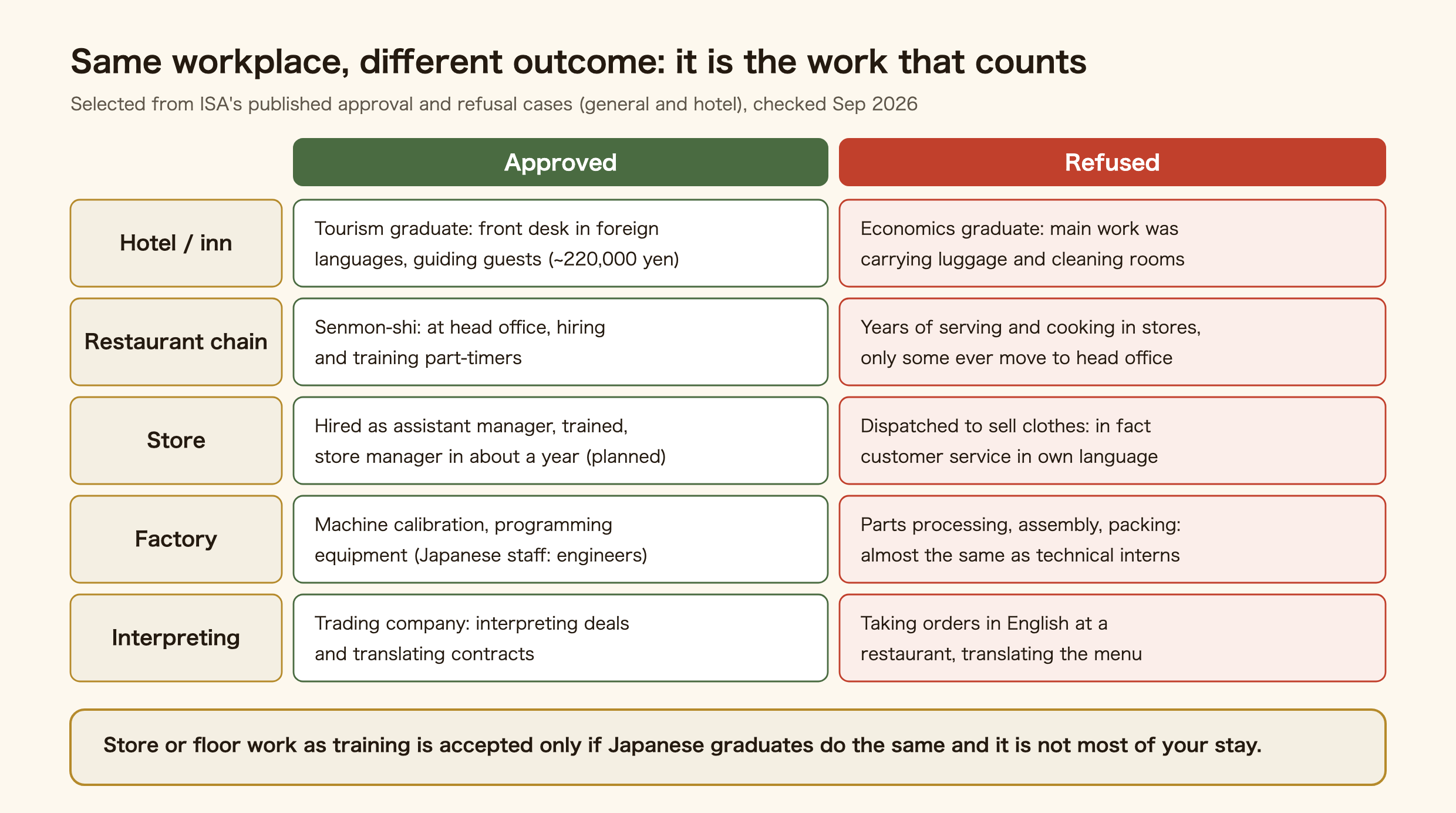
Put Immigration’s published cases side by side by workplace, and the line is not the type of workplace. It is the work.
| Workplace | Approved | Refused |
|---|---|---|
| Hotel or inn | Front desk in foreign languages, guiding foreign guests, planning stay packages | Main work was carrying luggage and cleaning rooms / parking guidance and serving and clearing tables |
| Restaurant | At head office: hiring and training part-timers, preparing induction materials | Hired at head office, but years of serving and cooking in stores with no set end, and only selected staff ever move to head-office work |
| Convenience store or supermarket | Assistant manager trained on the job, becoming store manager in about a year to handle marketing and store operations (written plan) | Dispatched to sell clothes, described as translation and interpreting, in fact customer service in their own language |
| Factory | Machine calibration and programming equipment; Japanese staff in the same role are science and engineering graduates on the same pay | Parts processing, assembly, inspection and packing, almost the same as the technical interns at the same plant / packing lunch boxes |
| Interpreting and translation | Interpreting business talks and translating contracts in a trading company’s overseas division | Taking orders in English and translating the menu at a restaurant (not enough work) |
For interpreting, the amount of work matters too. A cleaning company that wanted an interpreter for student part-timers who already spoke Japanese was refused: there was no real need.
Is training on the shop floor or factory line allowed?
Immigration can accept on-the-job training right after hiring, even serving in a restaurant, selling in a shop or working a factory line. Three conditions apply.
- Japanese graduate hires and others go through the same training
- After training, you move to work that qualifies, and that is planned
- The training is not most of your total time in Japan on this status
A literature graduate hired as a career-track employee spent two years stocking shelves and working the till in a supermarket, and was approved. Japanese graduates did the same two years before moving to head office. The restaurant chain in the table was refused because neither the store period nor the move to head office was fixed. Training only for foreign staff is not accepted, unless there is a reason such as Japanese language training.
If training runs longer than a year, the company is asked for a training plan. If training runs past the plan without a good reason, the renewal is refused. When you hear “training”, get the length and what comes after it in your contract or a written training plan. “Everyone goes through it” said out loud will not protect your renewal.
Engineer/Humanities visa requirements: degree, senmon-shi or 10 years
The education and experience rules come from the landing standards ordinance. For engineering and humanities work, you need one of these.
- A university degree with a major related to the job (foreign universities count)
- Graduation from a Japanese vocational school (senmon gakko) with a related major and the title senmon-shi or kodo senmon-shi
- At least 10 years of experience
The 10 years include time spent studying related subjects at university, technical college, high school or vocational school, and time in related work. IT engineers who passed an information technology exam or hold a qualification designated by the Minister of Justice can use that instead of the education rule.
International services work (translation, interpreting, language teaching, PR, advertising, overseas trade, design, product development and similar) needs at least three years of related experience. A university graduate who will translate, interpret or teach a language needs no experience at all.
If none of these fit you, you need a different status. Compare the three visa routes for people without a degree.
How closely must your major match the job?
For university graduates, Immigration says it judges the link between major and job flexibly, because universities give broad knowledge. An economics graduate working as a systems engineer was approved. Foreign universities are treated the same way.
Vocational schools are different. They train for specific jobs, so as a rule the job must be closely related to what you studied. A voice-acting graduate interpreting at a hotel, and a jewellery-design graduate handling foreign customers at an IT firm, were both refused for that reason.
Vocational graduates have two exceptions.
- If you completed a course certified by the Minister of Education under the career development programme for international students, the link is judged flexibly
- After about three years in a job that was accepted as related, the link to your next job is judged flexibly
Basic Japanese classes taken only by international students do not count as studying translation or interpreting. The timing and paperwork for switching from Student are in the student-to-work-visa article.
Do interpreting and hotel front desk jobs need N2? The 15 April 2026 change
Immigration revised its guideline on 15 April 2026. For jobs centred on using a language with people, such as translation, interpreting or hotel front desk work, CEFR B2 in that language is now the starting point. Without it, the job is not treated as work at the required level. For Japanese, any of these counts as B2.
- JLPT N2 or above
- 400 points or more on the BJT Business Japanese Proficiency Test
- 20 years or more living in Japan as a mid- to long-term resident
- Graduating from a Japanese university, or finishing a Japanese technical college or vocational school (if the major relates to the job)
- Finishing compulsory education in Japan and graduating from high school
For other languages, it counts if the language is your native or official language, or if a test with a CEFR level on it shows B2 or higher.
For applications from 15 April 2026, employers in category 3 or 4 submit this proof. The category is the employer’s size class: listed companies and similar are 1, employers with at least 10 million yen of income tax withheld the previous year are 2, others that filed the annual withholding summary are 3, and the rest are 4. Categories 1 and 2 can also be asked for it during review.
If you already work on this status and a job change moves you into this kind of work, you submit it at your next renewal. If you keep doing the same work, you do not. If you still need N2, check JLPT registration dates and the fee.
How much must you be paid? Equal to a Japanese worker
The third condition is pay equal to or above what a Japanese worker would receive for the same job. The published refusals repeat the same pattern.
- Engineer: 135,000 yen a month, while a Japanese new graduate hired at the same time got 180,000 yen
- Translation and interpreting: 170,000 yen, against 200,000 yen for the Japanese new graduate
- Inn front desk: about 150,000 yen, against about 200,000 yen for Japanese staff, with no reasonable explanation for the gap
Commuting, family and housing allowances that simply cover costs are not counted as pay (unless they are taxed). Real monthly pay by status is compared in salary data by visa type.
How long is the period of stay: 5 years, 3 years, 1 year or 3 months?
This status is granted for five years, three years, one year or three months (Immigration Control Act enforcement regulations). Immigration decides by looking at how long you are expected to work, your track record, whether you meet public obligations such as taxes, and the size and record of the employer (ISA Q&A). There is no published rule for which length you will get.
Two things are fixed. People in on-the-job training get one year as a rule. Dispatched workers get a period that matches the dispatch contract.
Documents and costs
There are three routes: a Certificate of Eligibility (COE) if you are coming from abroad, a change of status if you are switching from Student or another status, and an extension if you stay on this status. Category 3 and 4 employers submit more.
- You: application form, photo, graduation certificate (senmon-shi certificate for vocational graduates), and B2 proof if the job is mainly language-based customer work
- Employer (categories 3 and 4): written working conditions, company registration certificate, business description, financial statements, and a declaration about the company’s representative
- Dispatch work: pledges and the individual dispatch contract. If the client company is not fixed, the application is not approved as a rule
| Item | Cost |
|---|---|
| Change of status or extension (applications from 1 October 2026) | Set by the period granted: 1 year 33,000 yen at the counter / 27,000 yen online; 3 years 64,000 / 56,000 yen; 5 years 75,000 / 65,000 yen |
| Same (applications received by 30 September 2026) | 6,000 yen at the counter / 5,500 yen online |
| Work qualification certificate | 2,000 yen (1,600 yen online) |
Standard processing times are one to two months for a change of status, two weeks to a month for an extension, and one to three months for a COE. Every fee band and the reduction rules are in the October fee increase.
Changing jobs on the Engineer/Humanities visa: 14 days and the certificate
When your contract with an employer ends, or you sign with a new one, you must notify Immigration within 14 days with the “notification regarding the contracting organisation”. The 14 days run from the day the contract ended and from the day you signed the new one. If you move straight across, you file both, and there is a form that covers both at once. You file it, not the company.
If the new job is also inside this status, you do not need a change of status. The risk is reaching your next renewal without anyone having checked that it is.
That is what the work qualification certificate is for. Apply at the immigration office for where you live, and Immigration certifies whether the new job is work your status allows. It costs 2,000 yen, or 1,600 yen online, and after a job change the review takes one to three months. Applying is your choice. The Immigration Control Act bans treating someone unfavourably for not showing the certificate when the work they can do is already clear.
If your new employer is category 3 or 4, your first renewal after the move asks for more company documents, and your job is looked at then. Finding out right after the move leaves you more room than finding out at renewal.
If you realise the 14 days have passed, file the same day. Failing to notify can bring a fine of up to 200,000 yen, and Immigration’s guideline says it checks whether you met your notification duties when reviewing changes and extensions. Health insurance and pension after leaving a job are covered step by step in leaving a job in Japan.
What if you do work outside the status?
To be paid for work outside this status, you need permission for activity outside your status (Immigration Control Act, Article 19). A weekend job at a convenience store is outside it. Working without permission can bring up to one year of imprisonment or a fine of up to 2 million yen. If you are working mainly outside the status, it is up to three years or up to 3 million yen. The employer can also be punished for facilitating illegal work. What each status lets you earn on the side is in side income by visa type.
If your main job has drifted outside the status, that is dangerous too. Not doing the status’s activity while doing something else is a ground for cancellation (Article 22-4, paragraph 1, item 5). So is not doing it for three months or more (item 6). Real numbers and the process are in what gets a visa cancelled in Japan.
It can also surface at renewal. At one hotel, foreign staff hired earlier on the same terms had kept serving tables and cleaning rooms long past the planned training. When that came out, the next applicant was refused. How a company uses its staff affects the people it hires after you.
Which one are you?
- Your offer says “start on the floor” — ask for the length of training, whether Japanese graduates do the same, and what job follows, in writing. Email HR today.
- Your job has slowly become mostly floor work — write down how your time splits between qualifying work and the rest, and ask your manager whether it can go back. Start a daily log of your tasks today.
- You are moving into interpreting, front desk or similar work — check you have B2 proof such as JLPT N2 or BJT 400. Find your certificate today, or look up the next test date.
- You have a new job lined up — count 14 days from the day your old contract ended and the day you signed the new one, and file online. If you are unsure about the work, download the work qualification certificate form today.
FAQ
Q. What jobs can I do on the Engineer/Humanities visa in Japan?
Work that uses specialist knowledge from university or vocational school, or a way of thinking rooted in a foreign culture. Immigration’s examples are engineers in fields like mechanical engineering, interpreters, designers, language teachers at companies and marketing staff.
Q. Can I work at a convenience store or restaurant on this visa?
Not if the job is only tills, serving or similar customer service. Hiring and training part-timers at a restaurant company’s head office, and an assistant manager plan leading to store manager in about a year, have been approved.
Q. Is training on a factory line or in a store a violation?
It can be accepted if Japanese graduate hires do the same training and it is not most of your time on this status. Open-ended store work with no fixed move to qualifying work has been refused.
Q. What counts toward the 10 years of experience?
Time in related work, plus time spent studying related subjects at university, technical college, high school or vocational school. International services work needs 3 years, and a university graduate who translates, interprets or teaches a language needs none.
Q. Do I need JLPT N2 for this visa?
If the job is mainly language-based work with people, such as interpreting or hotel front desk, CEFR B2 in that language is expected, and N2 is one way to show it for Japanese. From 15 April 2026, category 3 and 4 employers submit the proof with the application.
Q. What do I do when I change jobs?
Notify Immigration within 14 days of the old contract ending and the new one starting. If you are unsure the new job fits, a work qualification certificate (2,000 yen, 1,600 yen online) lets you check.
Summary
Whether a job fits this status depends on the work, not the job title. Work that uses what you studied, or a foreign-culture perspective, fits. A job that is mostly “no experience needed” does not. Floor work as training can be accepted if Japanese graduates do the same and it does not take up most of your stay.
On top of that: a degree, senmon-shi or 10 years (3 for international services), and pay equal to a Japanese worker. For language-based customer work, B2 in that language as well. When you change jobs, notify within 14 days, and if you are unsure, check with a work qualification certificate first.
Official sources: Immigration Services Agency, status of residence “Engineer/Specialist in Humanities/International Services” (Japanese) / ISA guideline clarifying this status, with annexes (Japanese) / ISA Q&A on work-status applications (Japanese) / ISA work qualification certificate (Japanese) / ISA notification regarding the contracting organisation (Japanese) / ISA fee revision from 1 October 2026 (Japanese) / Landing standards ordinance (e-Gov) / Immigration Control and Refugee Recognition Act (e-Gov). Checked on 23 September 2026. For whether a specific job fits, ask your regional immigration office or the Immigration Services Information Center (0570-013904).
Related reading
Found this useful? Share it
Send it to a friend who lives in Japan.
WHO WROTE THIS

mori
Japanese. I read the ministries’ own notices, orders and Q&As in the original, and I start from what my Nepalese and Sri Lankan friends in Japan actually ran into. I do not write about what I have not checked or been told.
What this site can and cannot do →Looking for something else?