Checked on 23 September 2026 against the Immigration Services Agency’s pages on cancellation of status and its official Q&A, and the official guidance for international students at the University of Tokyo, Kyoto, Osaka, Kobe, Tohoku, Keio and Meiji.
The short answer
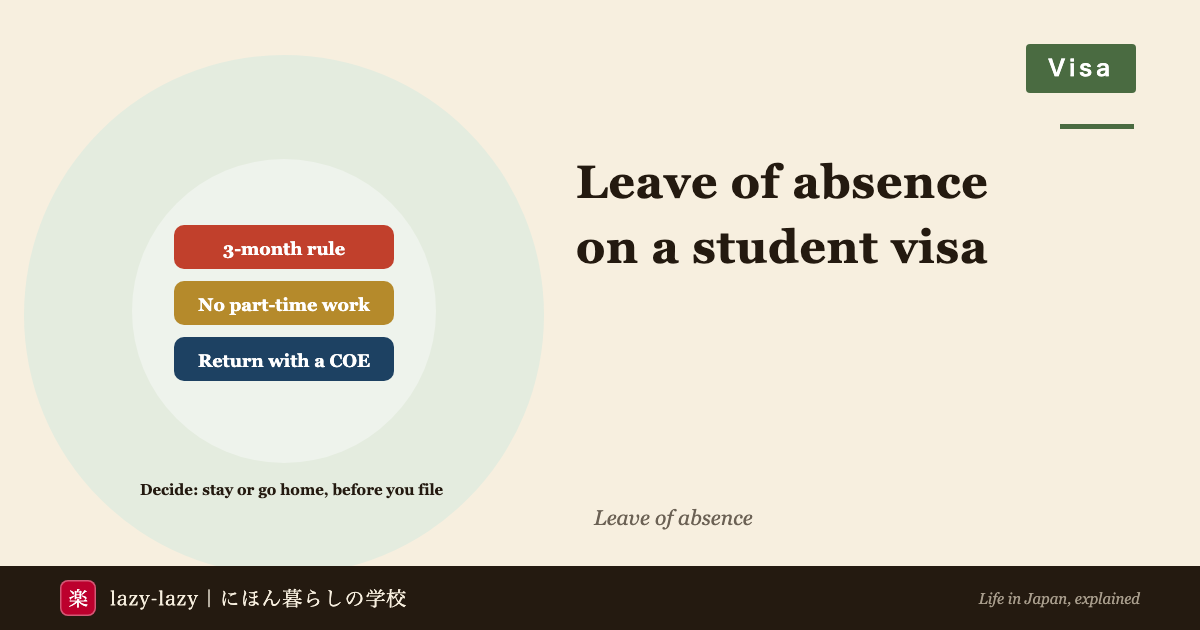
- Taking a leave of absence does not end your Student status on the day you file it. But three months without studying makes your status liable to cancellation.
- The exception is a “justifiable reason”. The example Immigration gives is a student in long-term hospital treatment who has to suspend studies and intends to return after discharge. Do not judge it yourself — ask Immigration and your school.
- You cannot do part-time work during a leave of absence, even if you hold a work permit for students.
- If you go home during the leave, universities tell you to hand in your residence card at the airport. To come back, your school applies for a new Certificate of Eligibility (COE). Contact your school at least four months before you return.
- Nationals of Nepal, the Philippines and Vietnam also need a TB clearance certificate for the new COE.
Knowing this, you can decide “stay or go home” before you sign the leave form, instead of finding out three months later that your status is at risk. If you go home, you can also count back from your return date to know when to contact your school.
You cannot pay next term’s fees. A parent is ill and you have to fly home. Or you are the one who is ill and cannot sit in class. The leave-of-absence form is on the desk, and you ask a Japanese friend what happens to your visa. They do not know. For a Japanese student, a leave of absence is between them and the school. For you, Immigration is part of it too.
- What happens to my student visa if I take a leave of absence?
- What counts as a “justifiable reason”?
- Can I work part-time during a leave of absence?
- Going home during the leave: hand in your residence card
- Coming back: tell your school four months ahead and start from a new COE
- How much does it cost?
- Do I have to notify Immigration about a leave of absence?
- What if I break the rule?
- Which one are you?
- FAQ
- Summary
- Related reading
What happens to my student visa if I take a leave of absence?
The Student status (ryugaku) is for receiving education at a school in Japan. A leave of absence stops that activity.
Under the Immigration Control Act, a person on a status like Student who has not carried out that activity for three months or more in a row can have the status cancelled (Article 22-4, paragraph 1, item 6). A leave of absence counts. It does not matter how much time is left on your residence card.
This happens in practice. In 2025, 1,446 statuses were cancelled in Japan, 343 of them Student. The most common reason was exactly this: three months of doing nothing. The numbers and the process are in what really gets a visa cancelled in Japan.
Language school, vocational school or university — the status is the same Student status, so the same rule applies.
What counts as a “justifiable reason”?
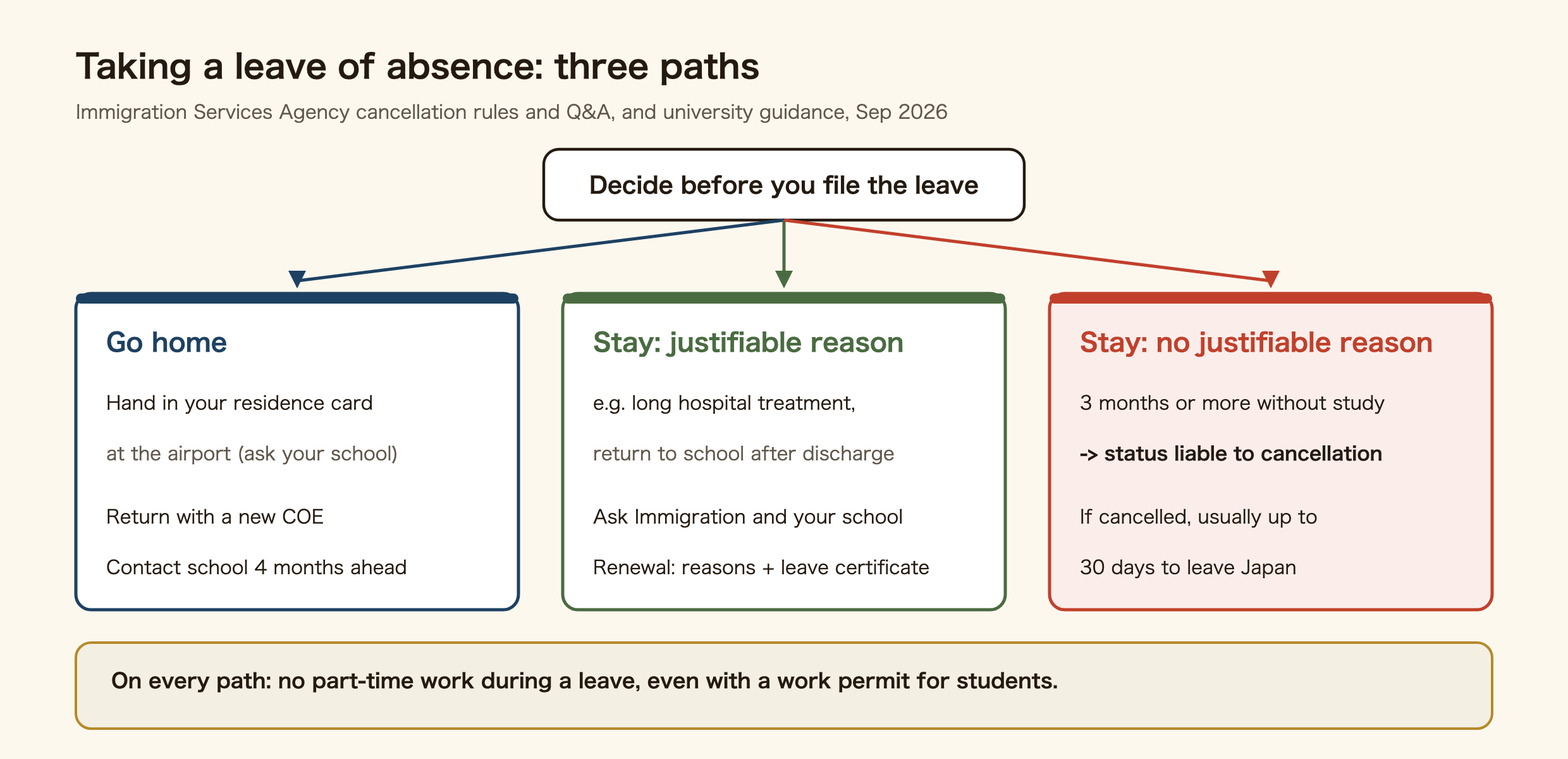
The three-month rule has an exception: “unless there is a justifiable reason”. The Immigration Services Agency’s Q&A gives these examples.
- You need long-term hospital treatment, have had to suspend your studies, and intend to return to school after discharge
- Your school closed and you are going through the procedure to enter another school
- You graduated from a vocational school and have been accepted by a Japanese university
Only the first one is about a leave of absence. Immigration says each case is judged individually, and it does not say that everyone outside these examples will be cancelled. But nothing official says whether money or family reasons count.
That is why universities are careful. Keio tells students who want to stay in Japan during a leave not to decide for themselves whether their situation is a justifiable reason, but to ask Immigration. Tohoku and Keio both say that during a leave you cannot keep staying on Student status: leave Japan, or change to a status that fits.
If you do stay, the next renewal will ask. The University of Tokyo tells students who took a leave to submit a statement of reasons and a certificate of the leave period with their renewal. If you were in hospital, keep the medical certificate and admission records.
Can I work part-time during a leave of absence?
No. The permission to work part-time is, in the words of the Immigration Q&A, “valid only while enrolled at an educational institution”. And university guidance on leave is the same everywhere we checked.
- University of Tokyo: part-time work is not permitted during a leave of absence
- Kyoto University: no part-time work while you are not studying at the university — before enrolment, after graduation, during a leave
- Osaka University and Kobe University: work is not allowed (prohibited) during a leave
So the plan “take a year off and save money from part-time work” does not work. If money is the reason, talk to your school’s international office before you file the leave: payment by instalments, fee reductions, or a scholarship for international students. There may be a step you can take before a leave.
Working without permission is illegal work, and a reason for cancellation or deportation. The full rules are in the 28-hour rule for student jobs.
Going home during the leave: hand in your residence card
Most students on leave go home. Kyoto, Tohoku and Keio all say the same thing: when you leave Japan for a leave of absence, return your residence card at the airport. Kyoto puts it plainly: students leaving because of a leave “in principle return the residence card at the port of departure and give up their status”.
There is a system that lets you leave with your card and come back within a year, the special (deemed) re-entry permit. But during a leave you are not doing Student activity, so holding on to the status can still run into the three-month rule. That is why schools tell you to return it. Follow your own school’s instructions.
Returning the card also closes your life as a resident here: moving your resident record out, health insurance, pension and resident tax. The order matters for money, so use the leaving-Japan checklist. Whether to give up your flat depends on how long the leave is.
Coming back: tell your school four months ahead and start from a new COE
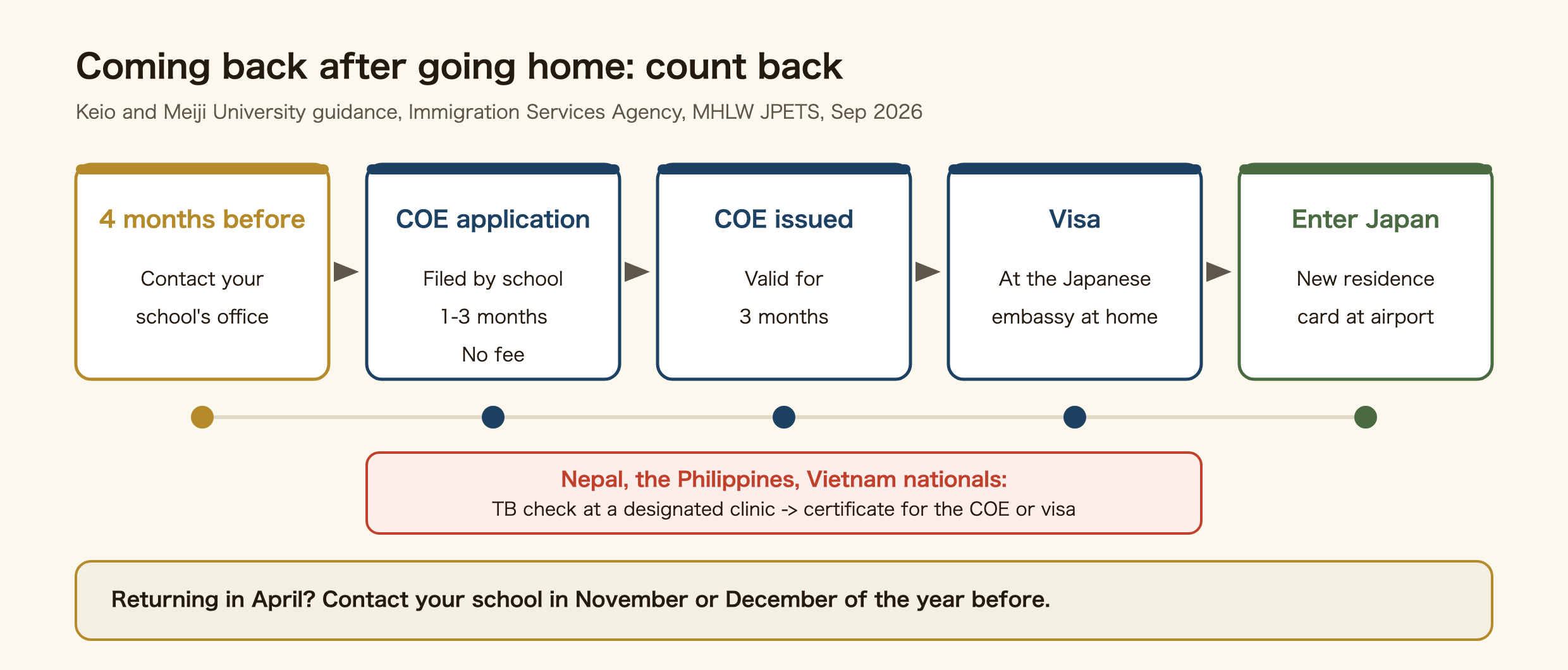
If you returned your card and went home, coming back means repeating what you did when you first enrolled. Your school applies for a Certificate of Eligibility (COE) on your behalf. Once it is issued, you get a visa at the Japanese embassy at home and enter Japan (Meiji University and others).
It takes time. Immigration’s COE review takes one to three months, and Keio asks students to contact the international office at least four months before returning. To come back in April, that means contacting the school in November or December of the year before.
Your nationality can add one more document. Nationals of Nepal, the Philippines and Vietnam must submit a TB clearance certificate with the COE or visa application (the Philippines and Nepal since 23 June 2025, Vietnam since 1 September 2025). You get it from a designated clinic at home after a chest X-ray and check-up (Ministry of Health, Labour and Welfare). People re-entering with a re-entry permit are exempt, but if you handed in your card you are entering as new, so it applies to you. Indonesia, Myanmar and China have no start date yet.
How much does it cost?
| Item | Cost |
|---|---|
| COE application | Free (the school applies) |
| Visa at the Japanese embassy | Depends on your country |
| TB check (Nepal, Philippines, Vietnam) | Depends on the designated clinic |
| Return flights | Depends on the season |
| (If you stay in Japan) status renewal | From 1 October 2026, set by the length of stay granted |
If you go home and come back, you pay Immigration almost nothing. The heavy costs are flights and the bills that keep running during the leave. How fees work during a leave depends on the school, so ask the office for the amount when you file. If you stay in Japan, the new renewal fees by length are in the October fee rise.
Do I have to notify Immigration about a leave of absence?
The notification you must make yourself within 14 days, the “notification regarding the organisation”, is for when you leave a school (graduation, withdrawal and so on) or move to another. Immigration’s procedure page does not list a leave of absence among its examples.
Some schools, such as Tohoku University, still ask you to file within 14 days of starting a leave. When you decide on a leave, ask your international office one question: “Do I need to notify Immigration?” If you withdraw, every school will tell you the 14-day notification is required.
What if I break the rule?
Staying in Japan on leave for three months or more without a justifiable reason can start cancellation proceedings. Before cancelling, Immigration holds a hearing where you can explain and present evidence. If the status is cancelled on this ground, you are usually given up to 30 days to leave on your own. If you do not leave within that time, you face deportation.
Working during a leave is a separate violation of the work-permission rules. For example, the job-hunting visa after graduation requires that there be no problem with how you have stayed in Japan.
Which one are you?
- Going home during the leave — ask your school about the residence card and any notification, and hand the card in at the airport. Work through the leaving-Japan checklist for your resident record, insurance and pension. Put the date “four months before return: contact school” in your calendar.
- In hospital and continuing treatment in Japan — keep your hospital and treatment records and talk to your school and Immigration. Prepare a statement of reasons and a leave-period certificate for your next renewal.
- Thinking of a leave because of money — before filing, ask the international office about instalments, reductions and scholarships. You cannot work during a leave, so a leave will not earn you money.
- Planning to stay in Japan on leave — do not wait three months. Talk to your school and Immigration now. If there is no reason you can stay, decide between going home and changing status.
FAQ
Q. Does my student visa end as soon as I take a leave of absence?
No, not immediately. But if you do not carry out Student activity (studying at school) for three months or more, your status becomes liable to cancellation, unless there is a justifiable reason.
Q. What is a “justifiable reason” for a leave of absence?
Immigration’s example is a student who needs long-term hospital treatment, has had to suspend studies, and intends to return after discharge. Each case is judged individually, so ask Immigration and your school rather than deciding yourself.
Q. Can I work part-time during a leave of absence?
No. The work permission is for students who are enrolled and studying, and official guidance from the University of Tokyo, Kyoto, Osaka and Kobe says part-time work is not permitted during a leave.
Q. What do I do with my residence card if I go home during a leave?
University guidance says to hand it in at the airport. Kyoto, Tohoku, Keio and others tell students leaving Japan for a leave of absence to return the card. Check your own school’s instructions.
Q. How do I come back to Japan after a leave?
Your school applies for a new Certificate of Eligibility (COE), then you get a visa at the Japanese embassy at home and enter Japan. The COE review takes one to three months, so contact your school at least four months before you return.
Q. Do I have to notify Immigration about a leave of absence?
Immigration’s procedure page requires a 14-day notification when you leave a school (graduation, withdrawal) or move to another. Some schools also ask you to file for a leave, so check with your international office.
Summary
A leave of absence does not end your visa on the day you take it. But three months without studying makes it liable to cancellation, and the only exception Immigration spells out is something like long hospital treatment. You cannot work during a leave, either.
That is why universities agree: go home, return your card, and come back through a new COE. Contact your school four months before you return. Add a TB certificate if you are from Nepal, the Philippines or Vietnam. If you have to stay in Japan, talk to your school and Immigration before the three months are up.
Official sources: Immigration Services Agency, Cancellation of status (Article 22-4) / ISA immigration and residence Q&A / ISA notification regarding the organisation / University of Tokyo, leave of absence and withdrawal / Kyoto University, status procedures (Japanese) / Keio University, leave of absence, return and withdrawal / MHLW Japan Pre-Entry Tuberculosis Screening. Checked on 23 September 2026. Always confirm with your own school’s international office before filing a leave.
Related reading
Found this useful? Share it
Send it to a friend who lives in Japan.
WHO WROTE THIS

mori
Japanese. I read the ministries’ own notices, orders and Q&As in the original, and I start from what my Nepalese and Sri Lankan friends in Japan actually ran into. I do not write about what I have not checked or been told.
What this site can and cannot do →Looking for something else?