Checked on 17 September 2026 against the Immigration Services Agency’s notification pages, the Immigration Control Act (e-Gov), Hello Work’s employment-insurance guidance, Kyokai Kenpo’s “When you leave your company” and a municipal National Pension page.
In short
- When you leave a job, three offices need to hear from you, and you do it yourself: immigration, Hello Work and the city office. Your employer’s part ends with the withholding slip and the separation notice.
- Immigration: within 14 days of leaving. The “notification of the contracting (or affiliated) organization”, online is fine. Skipping it is a fine of up to 200,000 yen and a mark against your next renewal.
- Get the rishokuhyo from your employer. It unlocks unemployment benefit and the National Health Insurance reduction. If they will not issue it, go to Hello Work.
- Health insurance: three options (voluntary continuation within 20 days). Pension: switch to the National Pension within 14 days at the city office. Do nothing and you are uninsured.
- Going home? Add the year-end adjustment or tax return, resident tax, the pension lump-sum and the moving-out notice. Tell your employer you are leaving Japan before your last day.
You decided to leave. You told your manager. The last day is set. Up to here it is the same as for a Japanese colleague. What comes after is different. The colleague says “the company handles the rest.” The company handles its own filings. The filing about your residence status is yours to make. And from the day after you leave, health insurance and pension go blank unless you act.
- First, immigration: notify within 14 days of leaving
- What to get from your employer: the rishokuhyo and the withholding slip
- Health insurance: from the day after you leave, pick one of three
- Pension: switch to the National Pension within 14 days
- Your status: the three-month clock starts today
- Leaving Japan? Five more
- The decision: which case are you?
- FAQ
- Summary
First, immigration: notify within 14 days of leaving
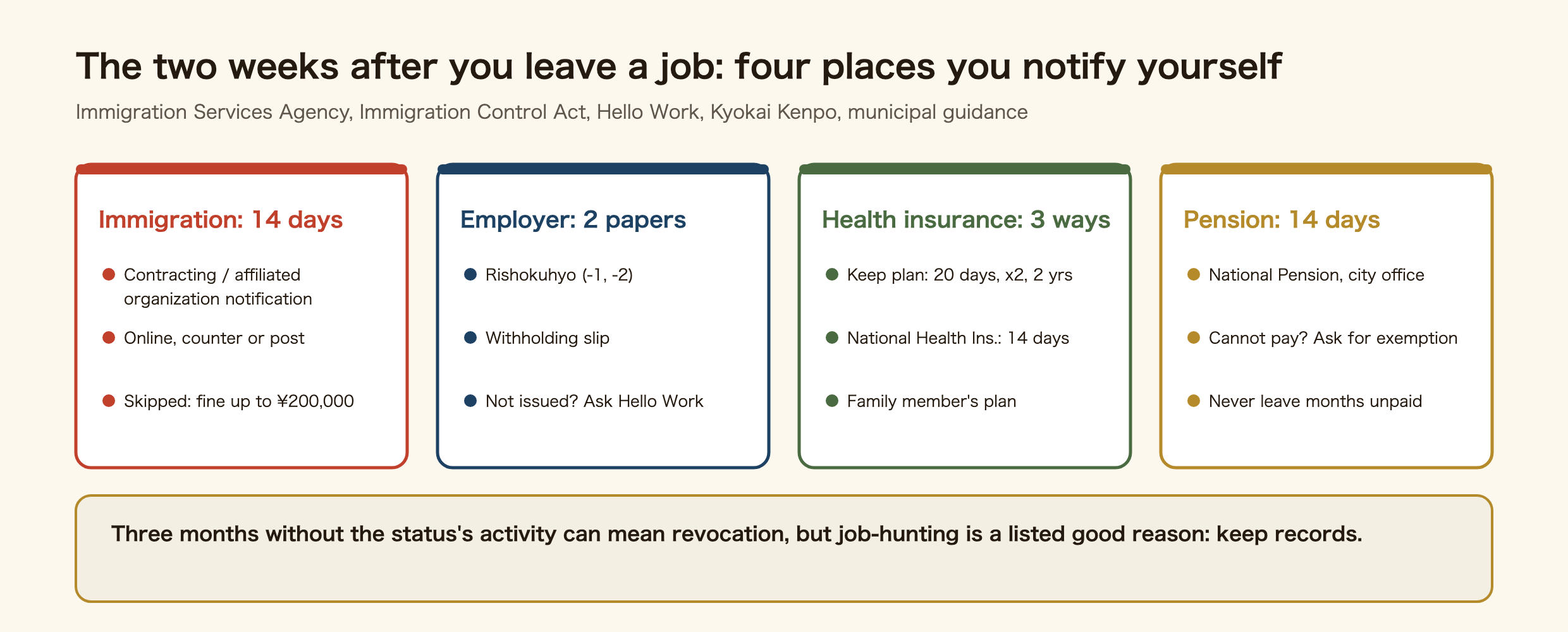
If you hold a work-based status of residence, you must notify the Immigration Services Agency within 14 days of the day your contract ended (Immigration Control Act, Art. 19-16). There are two names for the form, and your status decides which one.
- Notification of the contracting organization – Engineer/Specialist in Humanities/International Services, Specified Skilled Worker, Skilled Labor, Nursing Care, Researcher, Entertainer, Highly Skilled Professional 1(a)(b) and 2(a)(b). File it when “the contract ended” and when “a new contract was concluded”.
- Notification of the organization of affiliation – Business Manager, Intra-company Transferee, Instructor, Professor, Medical Services, Legal/Accounting Services, Technical Intern Training, Student, Trainee, Highly Skilled Professional 1(c) and 2(c). File it when you “leave” (resignation, graduation) or “transfer”.
Three ways to file: the e-notification system (online, 24 hours), the counter of a regional immigration office (show your residence card), or post (the form plus a copy of your residence card). If you already have a new job, file both “ended” and “new contract”. If not, file “ended” now and “new contract” when you sign.
What if you do not? Failing to notify is a fine of up to 200,000 yen (Art. 71-5); a false notification is imprisonment of up to one year or a fine of up to 200,000 yen (Art. 71-2). The part that bites harder is that at your next extension of stay the examiner looks at whether you filed. Fourteen days is short. Do it online in the week you leave.
Note that Dependent, Permanent Resident, Spouse of Japanese National and Long-Term Resident holders have no such notification. It applies only where work is the “activity” of your status.
What to get from your employer: the rishokuhyo and the withholding slip
Ask for two documents before your last day.
- Rishokuhyo (employment-insurance separation notice, forms -1 and -2) – issued after the company files a separation certificate with Hello Work. Before you leave, you are supposed to write your name on that certificate and check the stated reason for leaving (Hello Work). “Personal reasons” versus “company reasons” changes when unemployment benefit starts, so read it. The rishokuhyo is posted to you after you leave (sometimes you collect it). If the company will not issue it, the Hello Work covering your address can help.
- Gensen choshu hyo (withholding slip) – proof of the year’s pay and tax withheld. Your next employer uses it for the year-end adjustment, or you use it for your own tax return (refund return). If you left mid-year with no next job, this is how your tax comes back.
The rishokuhyo matters even if you never claim benefit: it is the proof for the National Health Insurance reduction after a company-initiated separation. Take it.
Health insurance: from the day after you leave, pick one of three
Your company health insurance ends the day after your last day. From that day you are uninsured unless you are in one of these (Kyokai Kenpo, “When you leave your company”).
- Voluntary continuation (nin’i keizoku) – keep the current plan for up to two years. Conditions: at least two continuous months insured up to your last day, and apply within 20 days of the day after leaving. The employer’s half disappears, so the premium is roughly double what you paid (with a cap), fixed for the two years.
- National Health Insurance – at the city office, within 14 days. The premium depends on household size and last year’s income. A reduction exists for company-initiated separations.
- Dependant on a family member’s plan – if your spouse is in company health insurance and you meet the dependant rules. No premium. Filed through the spouse’s employer.
Which is cheaper depends on last year’s income. The voluntary-continuation premium is “the health-insurance line on your payslip times two”, so you know it now. The city office will estimate the NHI premium for you. Put the two numbers side by side. Miss the 20-day window and NHI is the only option left.
Pension: switch to the National Pension within 14 days
Employees’ Pension cover also ends the day after you leave. If you are 20 to 59, go to the National Pension counter of your city office within 14 days of the day after leaving and register as a category-1 insured person (municipal guidance). Bring ID, a document showing your last day (a certificate of separation or of loss of insurance), and something with your basic pension number.
If you cannot pay, enrol anyway and apply for exemption or deferment. Unpaid months and exempted months are treated differently for your future pension (the difference between arrears and an exemption). Going back to school? That is the student special payment system.
Your status: the three-month clock starts today
On a work status, three months or more without the status’s activity, with no good reason, makes you a candidate for revocation. But immigration lists job-hunting as an example of a good reason. Keep your Hello Work registration, your applications and interview dates. The revocation article shows what actually gets revoked.
When you find the next job, check that it falls inside your current status. If not, apply for a change of status. Specified Skilled Workers have their own steps and timelines in the job-change article.
Leaving Japan? Five more
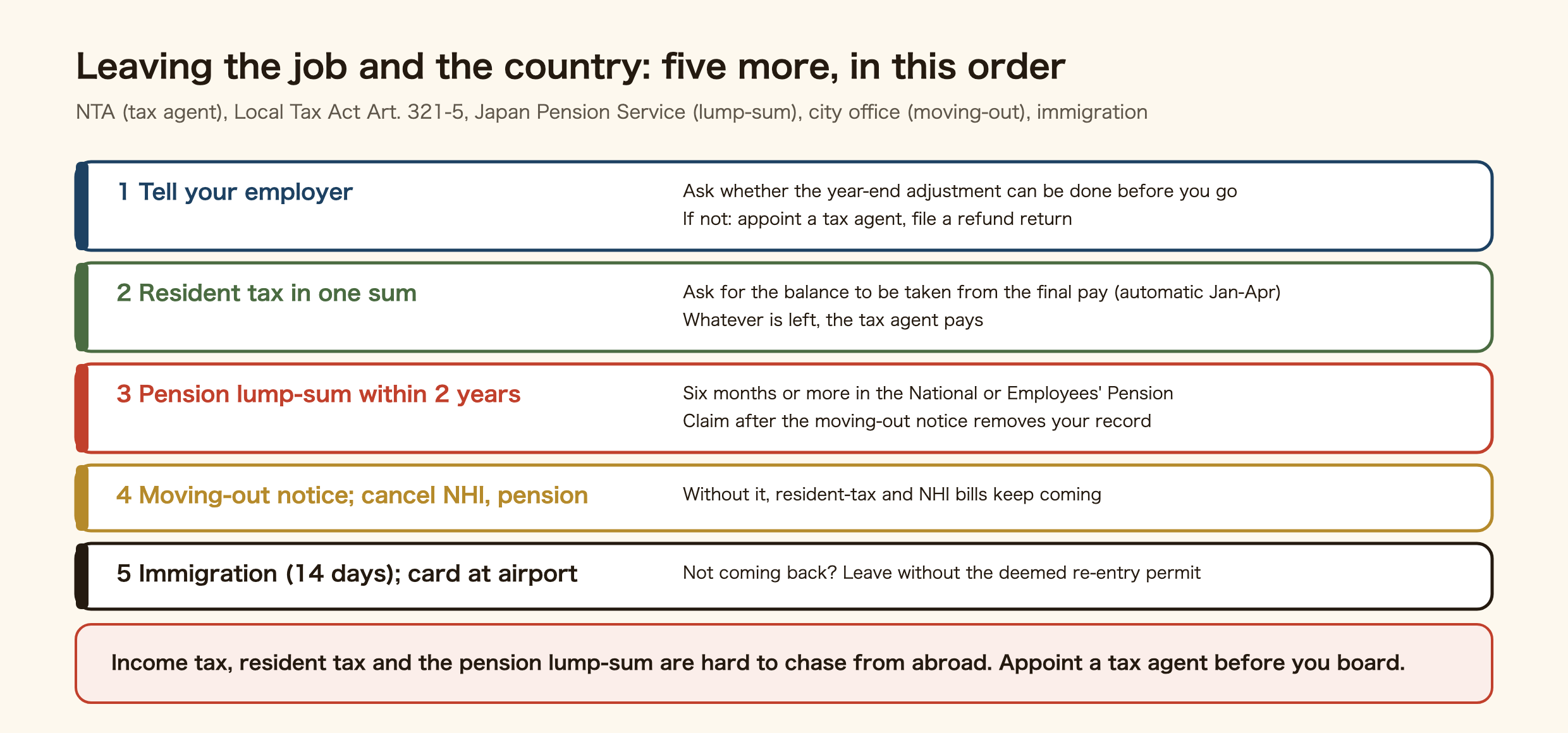
If you leave the job and the country, add three procedures that bring money back and two that close things down. Get the order wrong and the money does not come back.
- Tell your employer you are leaving Japan and ask whether they can do the year-end adjustment before you go. If not, appoint a tax agent before departure and file a refund return for the over-withheld income tax.
- Resident tax: have the balance deducted from your final pay in one sum. The company does it if you ask (automatic for January-April leavers). Anything left is paid by your tax agent.
- Pension lump-sum withdrawal: claim within two years of leaving Japan. For people with six months or more in the National or Employees’ Pension. You must have filed the moving-out notice first.
- Moving-out notice at the city office, and cancel National Health Insurance and National Pension at the same time. Without it, resident-tax and NHI bills keep coming.
- Immigration notification of contract end (14 days), and hand in your residence card at the airport. If you are not coming back, leave without using the deemed re-entry permit.
The full order and what to bring is in the leaving-Japan checklist.
The decision: which case are you?
Next job already lined up: file both “ended” and “new contract” with immigration within 14 days. The new employer takes over health insurance and pension; with no gap at all, you skip the NHI and National Pension steps. With a gap, you join both for exactly those days.
No job yet: file “ended”, register at Hello Work, choose one of the three health-insurance options, switch to the National Pension. All four in the month you leave. The job-search record is your “good reason”.
Leaving Japan: employer, then immigration, then insurance and pension, then taxes, then the moving-out notice, then the flight. The money-back procedures – income tax, resident tax, the pension lump-sum – are hard to move from abroad. Appointing a tax agent before departure is the best insurance you can buy.
FAQ
Q. I left my job. What do I file with immigration?
The notification of the contracting organization (Engineer/Humanities, Specified Skilled Worker and others) or of the organization of affiliation (Business Manager, Intra-company Transferee, Technical Intern, Student and others), within 14 days. Online through the e-notification system. Skipping it is a fine of up to 200,000 yen.
Q. My employer will not give me the rishokuhyo.
Ask the Hello Work covering your address. You need it for unemployment benefit and the NHI reduction.
Q. What happens to my health insurance after I leave?
It ends the day after your last day. Three options: voluntary continuation (20 days, roughly double premium, up to two years), National Health Insurance (14 days), or a family member’s plan.
Q. What about my pension?
Register for the National Pension at the city office within 14 days of the day after leaving. If you cannot pay, apply for exemption or deferment rather than leaving months unpaid.
Q. Can my status be revoked while I look for work?
Immigration lists job-hunting as an example of a good reason, so your search records protect you. Keep the Hello Work registration, applications and interview dates.
Q. I am leaving Japan. Do I get tax back?
If you left mid-year, the year-end adjustment or a refund return usually returns income tax. Ask the employer to do the adjustment before departure, or appoint a tax agent and file. For pension, claim the lump-sum withdrawal within two years of leaving.
Summary
When a foreign resident leaves a job, three offices need to hear from you: immigration (14 days), Hello Work (rishokuhyo, job search) and the city office (health insurance, pension). The employer’s part ends with the withholding slip and the rishokuhyo. Health insurance is a three-way choice, voluntary continuation within 20 days. Pension within 14 days.
Leaving Japan: employer, immigration, insurance and pension, taxes, moving-out notice, flight. Income tax, resident tax and the pension lump-sum all come back if you keep that order. Appoint a tax agent before you board.
Sources (official): Immigration Services Agency, notification of the contracting organization / notification of the organization of affiliation / Immigration Control and Refugee Recognition Act, Art. 19-16, 71-2, 71-5 (e-Gov) / Hello Work, employment insurance procedures / Japan Health Insurance Association, when you leave your company / Chofu City, National Pension enrolment and category change (all checked 17 September 2026)
Found this useful? Share it
Send it to a friend who lives in Japan.
WHO WROTE THIS

mori
Japanese. I read the ministries’ own notices, orders and Q&As in the original, and I start from what my Nepalese and Sri Lankan friends in Japan actually ran into. I do not write about what I have not checked or been told.
What this site can and cannot do →Looking for something else?