Checked on 17 September 2026 against the seal-registration pages of Yokohama, Shinjuku, Kitakyushu, Kawaguchi and Nakano, the MLIT vehicle registration portal and the Cabinet Office’s seal-reform page. The fine print and the fees are set by each city or ward. Check your own municipality’s page last.
In short
- Foreign residents can register a seal. Age 15 or over, with a resident record. The seal can be in roman letters, katakana or kanji.
- Only a name that is on your resident record can be registered. For katakana, first have a katakana reading added to the record. A seal that mixes your legal name and an alias is refused.
- Few people need a registered seal right away. You need it when someone asks for a seal certificate: registering a car, buying property, a loan. National procedures dropped ordinary seals almost entirely.
- Rubber stamps and self-inking “shachihata” cannot be registered. The impression must be larger than 8 mm square and fit inside 25 mm square.
- Bring the seal and your residence card (or My Number Card). With photo ID it is done the same day. Registration costs from a few tens of yen; a certificate is usually 300 yen.
In your first month in Japan the ward office, the bank and the estate agent all ask “Do you have a hanko?” You say no, and most of the time a signature is accepted. So when is a seal actually required? If you make one, which one? Can it carry a name in roman letters? Ask a Japanese colleague and you get “Hmm, my registered seal… I think my parents had it made.” They do not remember, because they never had to.
- There are three kinds of hanko, and you probably need none of them yet
- When do you need a registered seal? When someone asks for the certificate
- Roman letters, katakana or kanji: which name can you use?
- Want a katakana seal? Add the katakana reading to your record first
- How to register, and what to bring
- The decision: should you make one?
- FAQ
- Summary
There are three kinds of hanko, and you probably need none of them yet
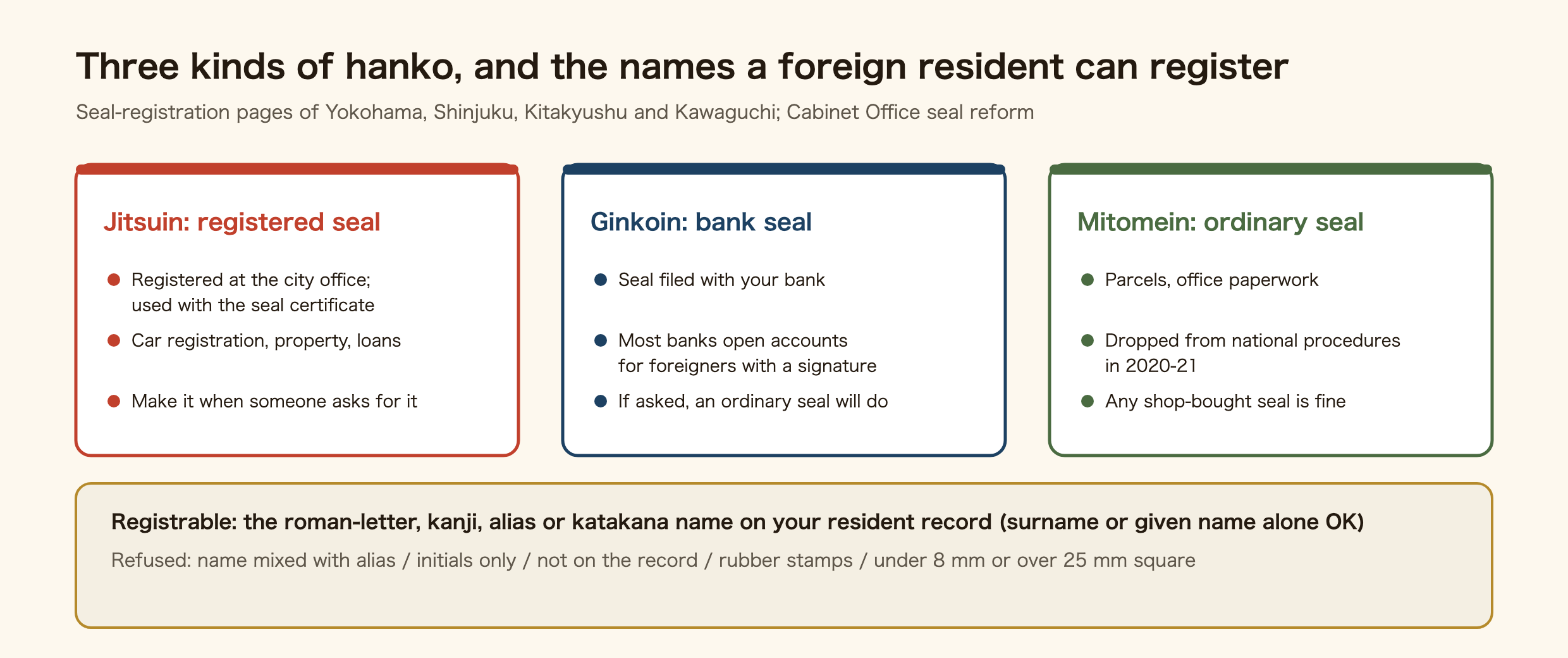
What Japanese calls a hanko or inkan splits into three by how it is used.
- Jitsuin, the registered seal – registered at your city or ward office. It is used together with an official paper called the seal registration certificate (inkan toroku shomeisho), and the pair proves that you personally agreed to a contract. Asked for when registering a car, buying property, taking a loan or signing a notarised deed.
- Ginkoin, the bank seal – a seal filed with your bank and matched at the counter. Most banks open accounts for foreign residents with a signature; if one insists on a seal, an unregistered seal is enough.
- Mitomein, the ordinary seal – any seal that is not registered. Used for parcel deliveries, office paperwork and corrections. In national administrative procedures the ordinary seal was almost entirely abolished in 2020-21 (Cabinet Office regulatory reform). What survived are the procedures that demand a registered seal with its certificate.
So there is no reason to rush out and buy one. You need a registered seal when a situation that requires one arrives, and with photo ID most municipalities register it the same day.
When do you need a registered seal? When someone asks for the certificate
The test is simple. If the other party says “please attach a seal certificate”, you need a registered seal, because the certificate is issued only for a registered one. If nobody asks for the certificate, an ordinary seal or a signature will do.
- Buying or receiving a car (a registered vehicle, not a kei car or motorcycle) – the transfer of ownership needs the new owner’s seal certificate issued within the last three months, and the registered seal on the application (MLIT vehicle registration portal). Light and small motorcycles do not need it.
- Buying property – the registration procedure asks for the seal certificate.
- A mortgage, a business loan, a notarised contract – lenders and notary offices normally ask for the certificate.
On the other side: renting a flat, signing up for a phone, starting a part-time job, getting a copy of your resident record – none of these normally asks for a seal certificate. You may be asked for an ordinary seal, so owning one makes life easier, but if you do not have one, ask “Is a signature all right?” It depends on the counter, and it usually is.
Roman letters, katakana or kanji: which name can you use?
This is the part that matters most to a foreign resident. Only a name that appears on your resident record (juminhyo) can be registered – Yokohama, Kitakyushu and Kawaguchi all start from that rule. If your residence card carries your name in roman letters, so does your resident record. That leaves these options.
- The roman-letter name on the record – full name, surname only, or given name only. Kawaguchi also accepts surname plus the initials of given or middle names
- A kanji name – for people from China, Taiwan, Korea and other kanji countries. The kanji name must be shown on the residence card and on the resident record. If your card only has roman letters, apply at immigration first to have the kanji name added (Kitakyushu, Nakano)
- An alias (tsusho) – a Japanese-style name you use in daily life, if it is registered on your resident record as an alias
- A katakana “concurrent name” – for people from non-kanji countries who have had the katakana reading of their name recorded in the remarks column of the resident record. This is the usual route to the “katakana registered seal” foreigners ask about
The municipalities also agree on what is refused: mixing your legal name and your alias (Kawaguchi’s example: record “KAWAGUCHI DAVID JAMES”, alias “Saitama Jiro” – a seal reading “Saitama James” is refused), initials only (K.D.J.), a spelling that differs from the record, a name not on the record at all. People do have a seal carved first and then get turned away, so the order is: check the name on your record, then carve, then register.
Want a katakana seal? Add the katakana reading to your record first
If your resident record only has your name in roman letters, registering a katakana seal starts with a request at the city or ward counter to add the katakana reading of your name (the concurrent name) to your resident record (Yokohama: “recorded in the remarks column”; Nakano: “concurrent name registration”). Nakano explains that registering the full name on your residence card, in residence-card order, lets you register a seal in that katakana.
The request is free and normally done on the spot. Then have the seal carved exactly as the katakana appears on the record. If the record says “ジョーン フラント スミス”, a seal reading only “スミス” or only “ジョーン” is fine. Not one character may differ from the record.
How to register, and what to bring
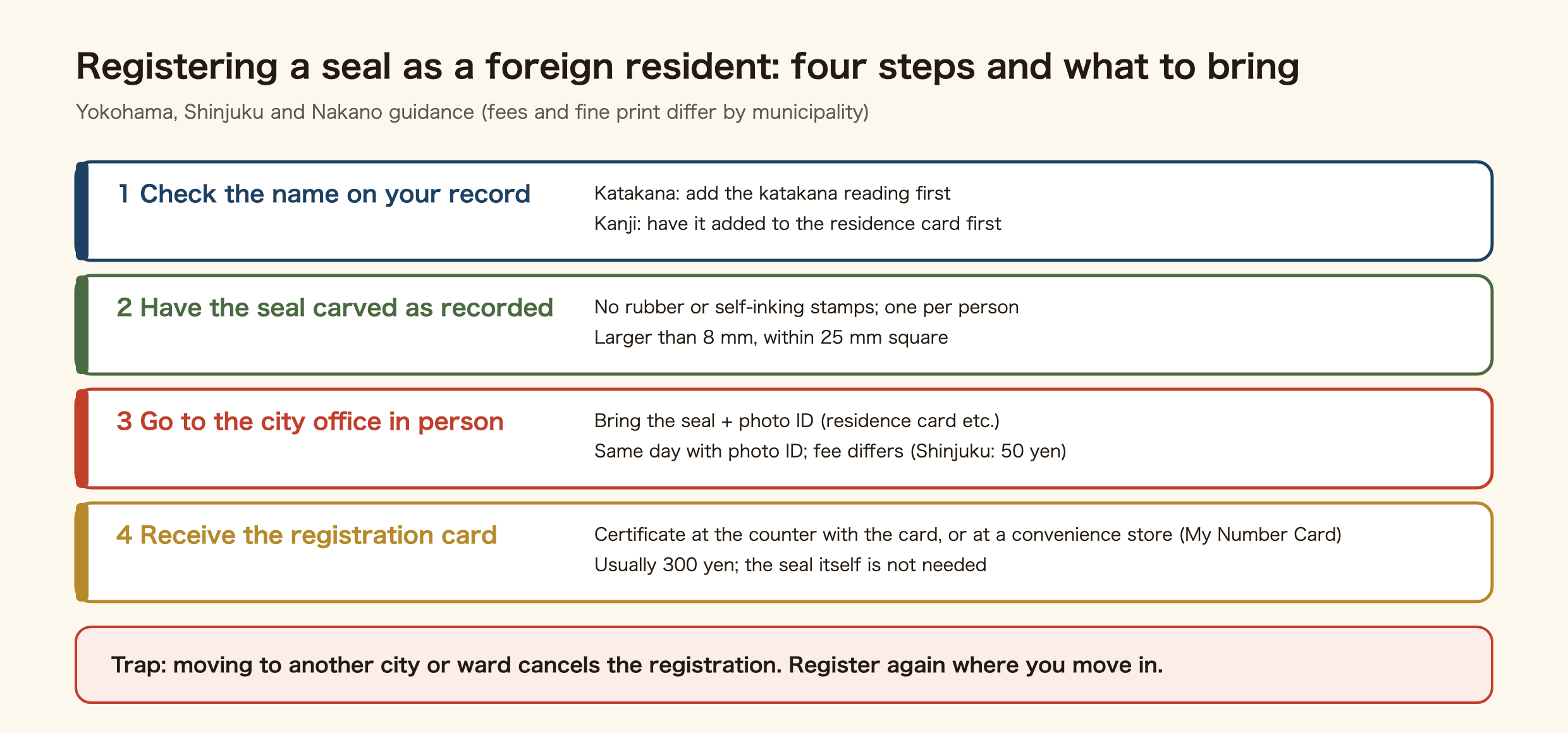
- Check the name on your resident record. Katakana needs the concurrent-name request, kanji needs the kanji added to your residence card (previous section).
- Have the seal carved exactly as the record shows. Rubber, self-inking and other deformable stamps are refused. The impression must be larger than 8 mm square and fit inside 25 mm square (Yokohama, Shinjuku). Shinjuku also refuses mass-produced seals. At a seal shop, say “inkan toroku yo” – for seal registration – and they will know.
- Go in person to the office of the city or ward where you live. Bring the seal and photo ID issued by a public office: residence card, My Number Card, driving licence. With photo ID the registration is completed the same day (Yokohama’s “licence method”). Without it the office posts a confirmation letter to your address and registration completes a few days later. Fees differ by municipality (Shinjuku: 50 yen).
- Receive the seal registration card. To get a seal certificate, take this card to the counter, or use your My Number Card at a convenience store. Usually 300 yen a copy (Yokohama, Shinjuku). You do not need the seal itself to get the certificate.
One trap: moving to a different city or ward cancels your seal registration. Register again where you move in. A move within the same municipality keeps it.
The decision: should you make one?
No car, no property, no loan on the horizon: you do not need a registered seal. One ordinary seal for parcels and paperwork is enough. Any shop-bought seal will do, and it needs no registration.
Buying a registered car, buying a home, taking a loan: register before the contract. Check the name on the record, add the katakana reading if you want katakana, have the seal carved, register, then get the certificate. Certificates are usually required to be less than three months old, so count back from the contract date.
Still unsure: make one when someone asks for the certificate. With a residence card in hand it is done the same day.
FAQ
Q. Can a foreign resident register a seal?
Yes. Anyone aged 15 or over with a resident record in that municipality (Yokohama, Shinjuku). With a residence card it is usually done the same day.
Q. Can the seal carry my name in roman letters?
Yes. If your resident record has your name in roman letters, you can register the full name, the surname only or the given name only (Kitakyushu, Kawaguchi). Initials alone are refused.
Q. I want a katakana seal.
First ask your city or ward office to add the katakana reading of your name to your resident record. A seal carved exactly as recorded can then be registered.
Q. Can I register a shachihata (self-inking stamp)?
No. Rubber and other deformable stamps are refused everywhere. They are fine as an ordinary seal for deliveries.
Q. How much is a seal certificate, and where do I get it?
Usually 300 yen a copy, at the counter with your seal registration card or at a convenience store with a My Number Card. You do not need the seal itself.
Q. What happens to the registration when I move?
Moving to another municipality cancels it. Register again after you move in.
Summary
Foreign residents can register a seal in roman letters, kanji or katakana – but only a name that is on the resident record. Katakana needs the reading added first; kanji needs the residence card updated first. Mixed names, initials only and rubber stamps are refused.
Few people need a registered seal right away. Make one when someone asks for the certificate: a car, property, a loan. Bring the seal and your residence card, usually same day, certificates about 300 yen. Register again after moving to another city.
Sources (official): Yokohama City, seal registration / Shinjuku Ward, seal registration and certificates / Kitakyushu City, seal registration for foreign residents / Kawaguchi City, seal registration for foreign residents / Nakano Ward, registrable seals for foreign residents / MLIT vehicle registration portal, documents for transfer of ownership / Cabinet Office, review of paper, seal and in-person requirements (all checked 17 September 2026)
Found this useful? Share it
Send it to a friend who lives in Japan.
WHO WROTE THIS

mori
Japanese. I read the ministries’ own notices, orders and Q&As in the original, and I start from what my Nepalese and Sri Lankan friends in Japan actually ran into. I do not write about what I have not checked or been told.
What this site can and cannot do →Looking for something else?