Figures and terms were checked on 8 October 2026 against the Immigration Services Agency pages on the Engineer/Specialist visa and on 2024 student hiring, the Ministry of Education pages on the senmonshi title and practical vocational courses, and the Osaka Employment Service Center for Foreigners. They change — check the current terms yourself before you sign up or file anything.
Last updated: 8 October 2026
Summary
- After language school there are four roads: vocational school, university, a route that ignores your education, or going home.
- A Japanese language school has no pipeline to jobs. High schools and universities do. That absence is normal, not a failure. Even the job-hunting visa after graduation that university and vocational graduates can use is closed to language-school-only graduates.
- The reason is legal. Finishing language school alone does not qualify you for the engineer or specialist in humanities visa.
- For vocational school, everything turns on whether the course carries the “senmonshi” title. Some do not.
- If it does, it also qualifies you to transfer into a university. Choosing vocational school does not close the university door.
- Graduating from a Japanese university or specialist course waives the Japanese language proof on the work visa.
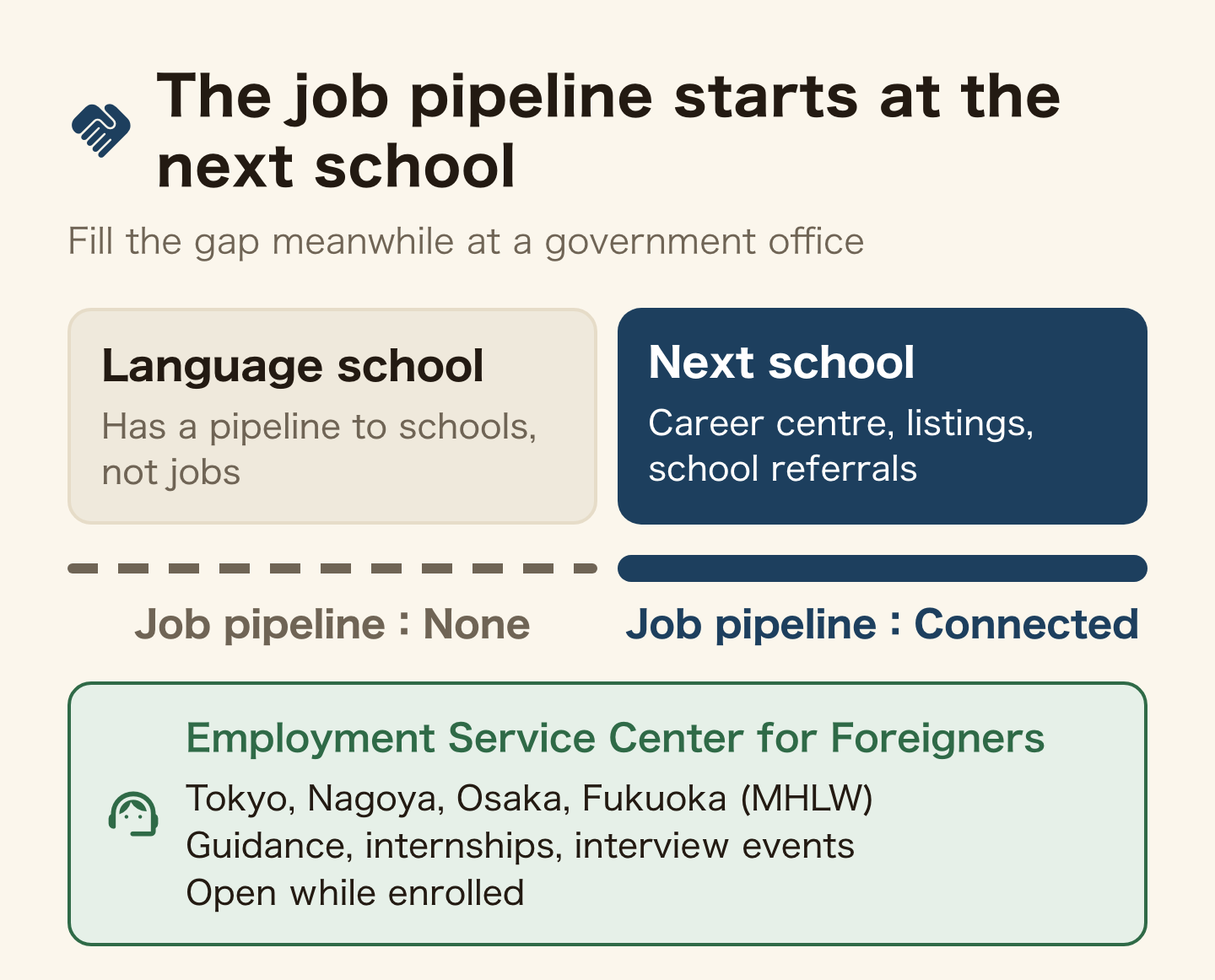
- The gap where you have no pipeline can be filled at a government office. It is open to you while enrolled.
What changes: you know the missing job pipeline is the system, not you – and you pick a vocational course that carries the Senmonshi title.
Nothing is pinned to the language school noticeboard for jobs. Teachers only talk about further study. Meanwhile classmates are deciding to go home, and you are the one who cannot see what comes next.
You cannot see it because of how the system is built, not because you looked in the wrong places.
- Four roads out of language school
- Language schools have no job pipeline, and that is normal
- Road 1: vocational school, where one in four hires comes from
- Choosing vocational school does not close the university door
- Road 2: university, the widest road at 44.7%
- Road 3: the route that ignores your education
- Three things to ask a school
- Filling the gap while you have no pipeline
- What to do this week
- FAQ
- Summary
Four roads out of language school
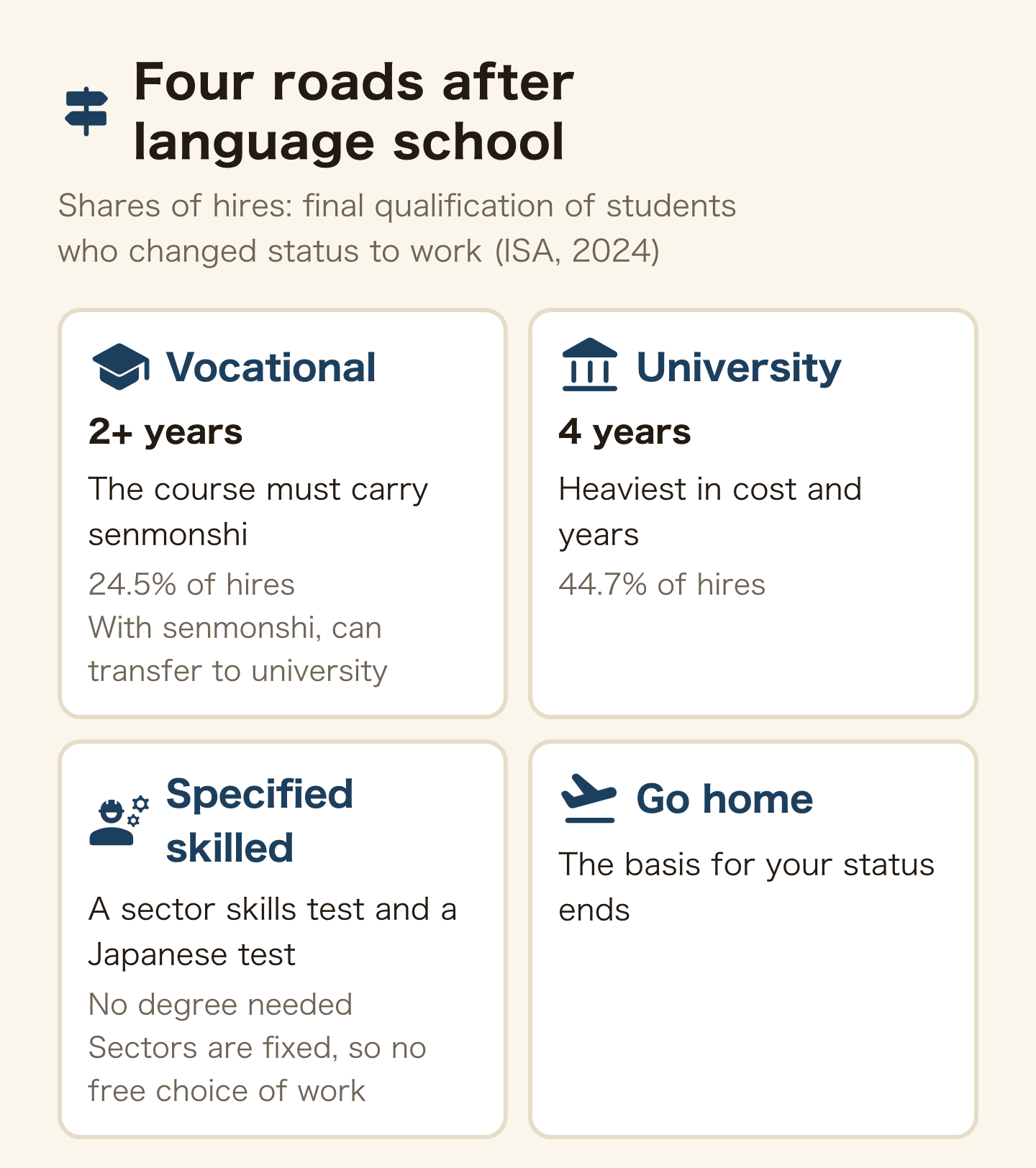
When your language school course ends, staying in Japan means changing or renewing your residence status. There are four options.
- A vocational school (senmon gakko; status stays “Student”)
- A university or graduate school (also “Student”)
- A route that does not ask about your education, such as specified skilled worker
- Going home
Each one changes what you can do afterwards. Start with the part people misread most.
Language schools have no job pipeline, and that is normal
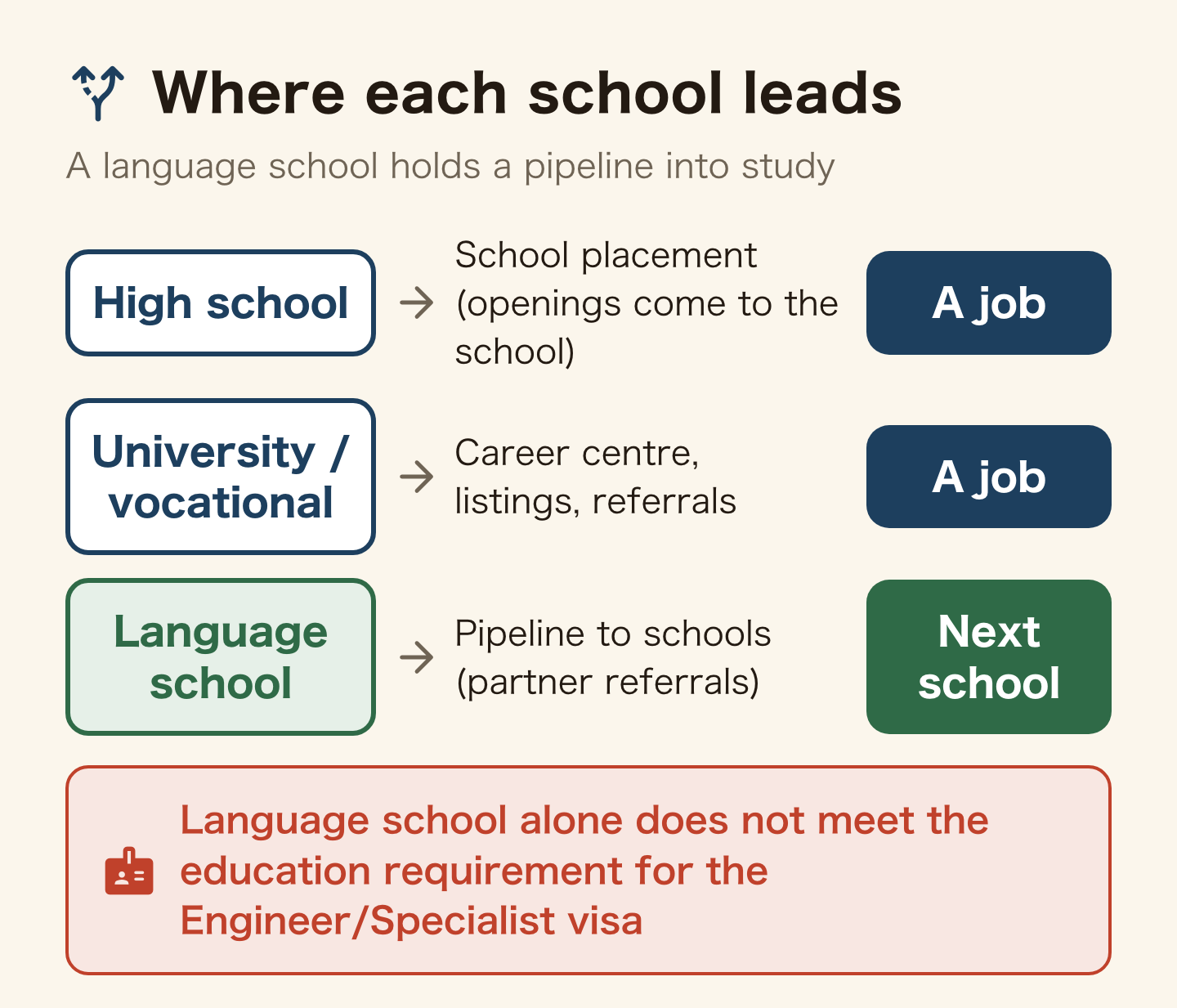
High schools in Japan place students directly. Job openings arrive at the school and teachers allocate them. It is an unusually strong arrangement by world standards.
Universities and vocational schools have career centres: listings, school recommendations, interview practice. International students can use them.
Japanese language schools hold a different pipeline, the one into further study. Recommendations to partner schools, help with application forms, interview practice. That is their job.
There is a legal reason too. The engineer or specialist in humanities visa needs a university degree, or a vocational school qualification carrying the “senmonshi” title. A language school is not a vocational school, so no senmonshi comes with it.
Which means that if a language school introduced you to an employer, you could not get the visa anyway. The introduction would not lead anywhere, so the openings never arrive.
If it feels like everyone else has a plan and you do not, you are not behind. The pipeline connects once you are inside the next school.
Road 1: vocational school, where one in four hires comes from
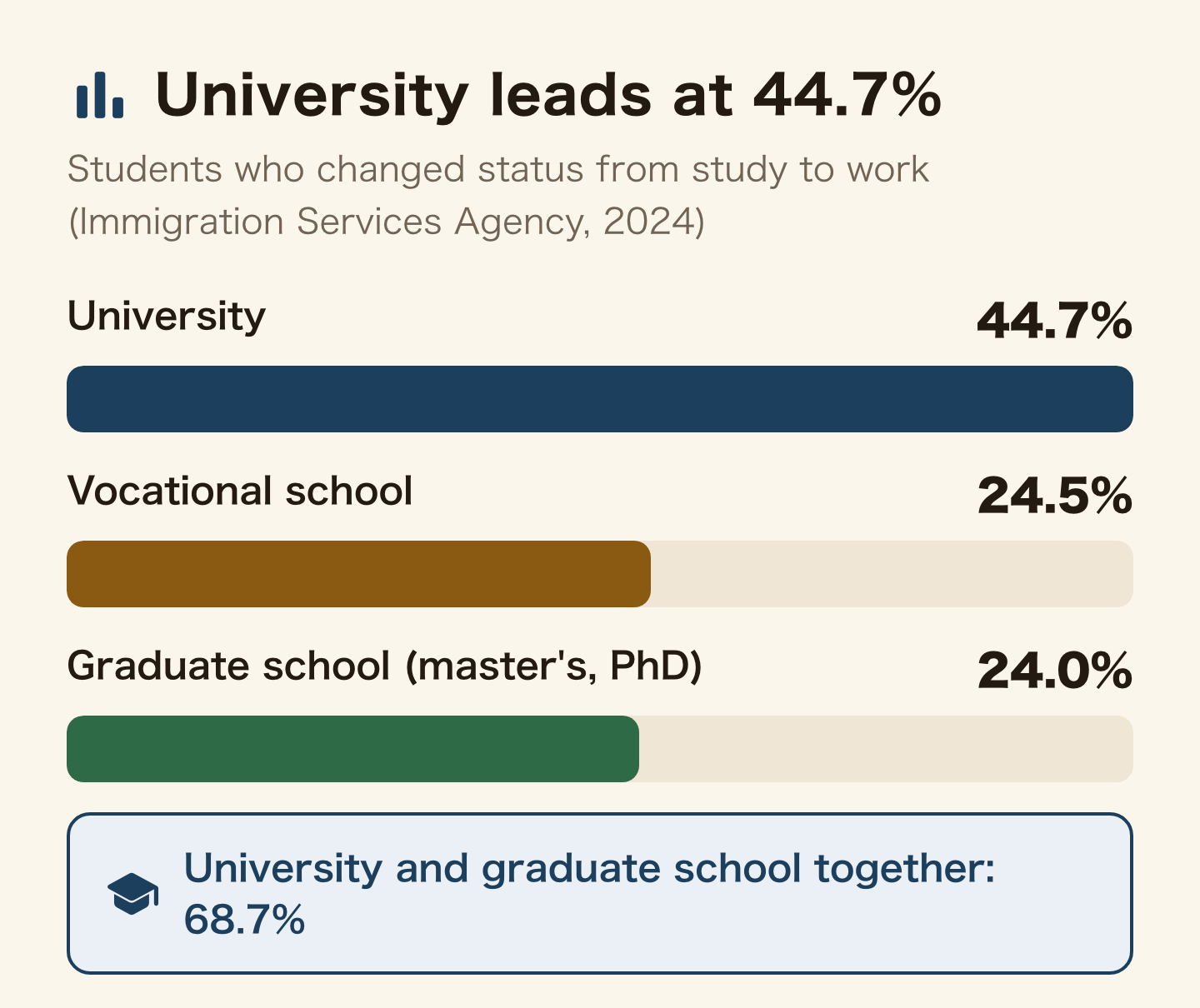
In the Immigration Services Agency data for 2024, students who moved into work had these final qualifications: university 44.7%, vocational school 24.5%, graduate school 24.0%. The vocational route is real.
It has one condition: does the course carry senmonshi?
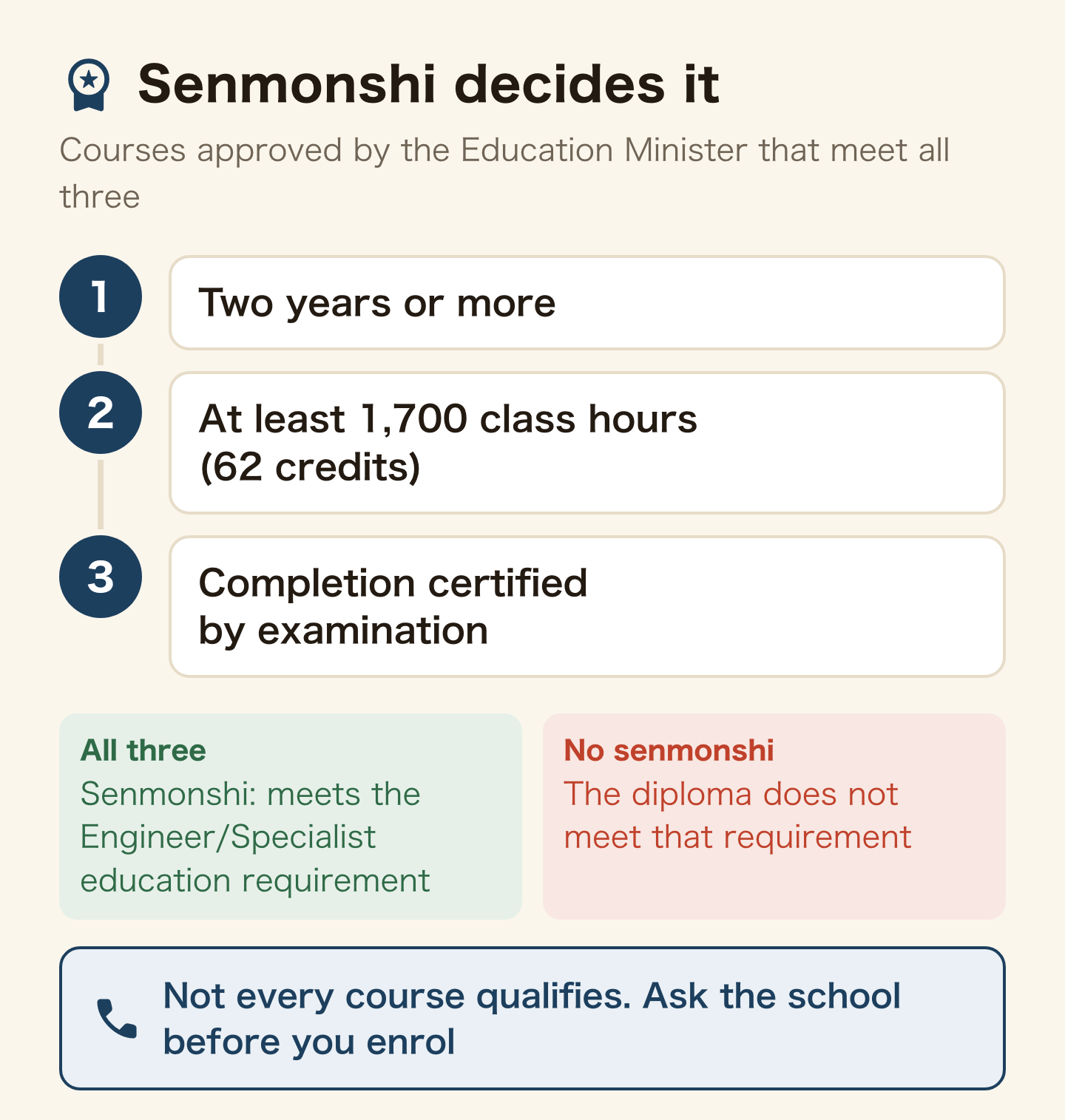
The Ministry of Education grants the title to graduates of courses it has approved, which must meet requirements including:
- A course length of two years or more
- At least 1,700 class hours (62 credits) in total
- Assessment by examination, with completion certified on that basis
Not every vocational course qualifies. Ask the school before you enrol. Finish a course without it and you will not meet the education requirement for the Engineer/Specialist in Humanities/International Services visa. Getting in has its own rule too, one year at language school or N2 and similar, so also check the Japanese-language requirement for entering vocational school.
Choosing vocational school does not close the university door
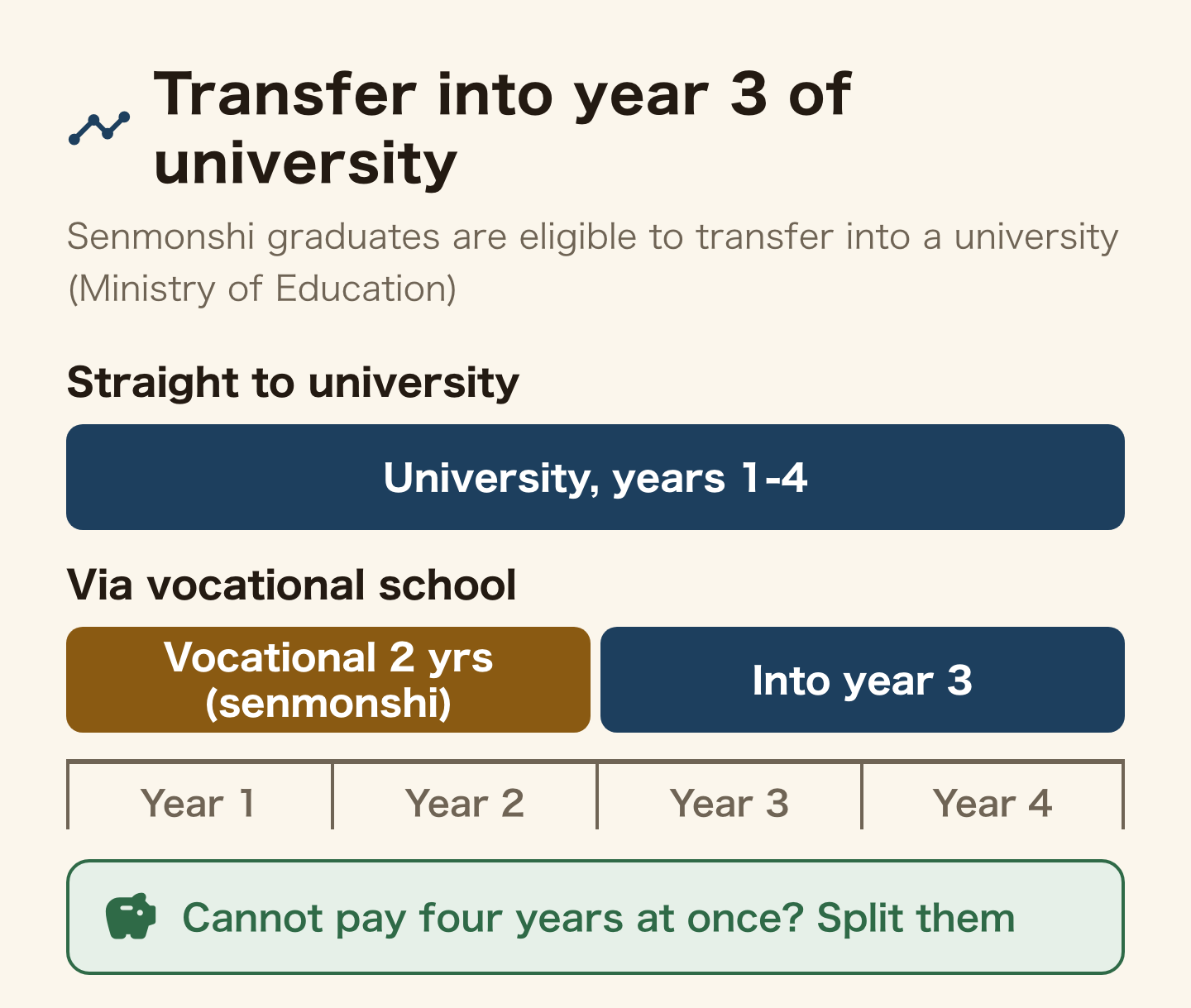
This part is not widely known. The Ministry of Education states that the requirements for a senmonshi course broadly match those for courses that qualify a graduate to transfer into a university, and that senmonshi holders are recognised as eligible to transfer into a university.
Two years of vocational school, then entry into the third year of a university. Choosing vocational school now is not giving up on a degree. If you cannot pay for four years at once, this is how you split it.
Road 2: university, the widest road at 44.7%
University graduates are 44.7% of those who moved into work, and 68.7% once graduate degrees are counted. By volume this is the main road. Some universities select international students on EJU scores and name the subjects and sessions they accept, so check your target school’s rules before you register. Some people enter graduate school as a research student first, but that gives no degree and lasts two years at most on Student status, so check how a research student differs from a master’s student before you apply.
University and specialist courses share another advantage. The Immigration Services Agency asks for proof of Japanese ability when your work is mainly language-based, but treats you as having it if you graduated from a Japanese university, or completed a specialist course or advanced course at a specialised training college.
Your graduation certificate does the job, with no need to sit JLPT N2 for the paperwork. Studying Japanese is not wasted, but you will not have to prove it twice.
The cost and the years are heavier. Remember that one year of language school ran to about 2 million yen: language-school students spend 169,000 yen a month on average, tuition included, which is about 2.03 million over 12 months (JASSO FY2023 student living survey, in Japanese). Four years is a multiple of that. Look into scholarships and tuition reductions at the same time as you apply, not after.
Road 3: the route that ignores your education
You can also skip both. Specified skilled worker asks nothing about your education. You pass a skills test for a sector and a Japanese test, and that is the requirement. For most sectors the Japanese test is JLPT N4 or above or the JFT-Basic.
In 2024, 2,517 students moved from student status into specified skilled worker, 169 of them Nepalese. A small number, but the road is open.
The catch is that the sectors are fixed. It ignores your education, and in exchange you do not choose your line of work. That belongs in the same paragraph as the good news.
Three things to ask a school
Do not choose on tuition and location alone. Ask the school directly, not the brochure.
- Does this course carry senmonshi? Without it, the Engineer/Specialist in Humanities/International Services visa is out of reach after you graduate
- Is it certified as a “practical vocational course”? This is a Ministry of Education certification for courses run in close partnership with employers, and carrying out an evaluation with outside stakeholders and publishing information, together with employers, are among the conditions for it (in Japanese). Published numbers can be compared
- Show me your employment record for international students. How many, into which industries. A school that cannot answer has no pipeline there
The second one does the work. Because publication is a condition of the certification, schools split into those that can show you numbers and those that cannot.
Filling the gap while you have no pipeline
Until you are inside the next school, there is no job pipeline. A government office covers that stretch.
The Ministry of Health, Labour and Welfare runs Employment Service Centers for Foreigners in Tokyo, Nagoya, Osaka and Fukuoka: information for international students, job-hunting guidance, internships and interview events.
Osaka Employment Service Center for Foreigners
16F Hankyu Grand Building, 8-47 Kakuda-cho, Kita-ku, Osaka 530-0017 (5 minutes from JR Osaka station and the Umeda stations)
You can use it while enrolled. First year of language school is not too early for a guidance session. Seeing what the jobs actually are, before you choose a school, changes how you choose it.
What to do this week
- Ask your current school by when you must decide. Application timing differs from school to school. Ask yours, not a friend
- Phone the vocational schools on your list and ask two questions: does the course carry senmonshi, and is it a certified practical vocational course. Two questions will shorten the list
- Call the Osaka centre and ask when the next guidance session runs
- Keep your attendance up. It is checked for school admission and again for the work visa
The first two are one phone call each. You can finish them today.
FAQ
Q. Why are there no job listings at my Japanese language school?
Because finishing language school alone does not qualify you for the engineer or specialist in humanities visa. That visa needs a university degree or a vocational qualification with the senmonshi title, and a language school is not a vocational school. An introduction would not lead to a visa, so the listings never come. The pipeline starts at your next school.
Q. Vocational school or university, which is better?
Both lead to jobs. Among students who moved into work in 2024, 44.7% held a university degree and 24.5% came from vocational schools. Vocational school is shorter and cheaper; university tends to open more job types. If the course carries senmonshi you can also transfer into the third year of a university afterwards.
Q. What is “senmonshi”?
A title given to graduates of specialist courses at specialised training colleges. The Ministry of Education grants it for courses it has approved, which must run two years or more, total at least 1,700 class hours, and certify completion through examination. You need it to meet the education requirement for the Engineer/Specialist in Humanities/International Services visa.
Q. Can I transfer to a university after vocational school?
Yes. The Ministry of Education states that the requirements for senmonshi courses broadly match those for university transfer eligibility, and that senmonshi holders are recognised as eligible to transfer. Two years of vocational school followed by third-year entry to a university is a real route.
Q. Is there a way to work without going on to another school?
Specified skilled worker asks nothing about your education. You pass a sector skills test and a Japanese test. In 2024, 2,517 students moved into it, including 169 Nepalese. The sectors are fixed, so you cannot choose your line of work freely.
Q. What happens if I finish language school without deciding?
The basis for your residence status disappears, so you cannot stay as you are. Deadlines differ by school, so ask your own school what has to be submitted and by when.
Summary
- Four roads: vocational school, university, specified skilled worker, or home
- Language schools have no job pipeline because their graduates do not meet the education requirement for the Engineer/Specialist in Humanities/International Services visa
- The job pipeline starts at the career centre of your next school
- For vocational school, everything depends on whether the course carries senmonshi
- A senmonshi course also makes you eligible to transfer into a university
- Graduating from a Japanese university or specialist course waives the Japanese language proof for the work visa
- Ask schools three things: senmonshi, practical vocational course certification, and the employment record
- The Osaka Employment Service Center is open to you while you are still enrolled
Sources: Immigration Services Agency, engineer / specialist in humanities / international services / same, employment of international students by Japanese companies, 2024 / Ministry of Education, on the senmonshi and kodo senmonshi titles / same, certification of practical vocational courses / Osaka Employment Service Center for Foreigners
Found this useful? Share it
Send it to a friend who lives in Japan.
WHO WROTE THIS

mori
Japanese. I read the ministries’ own notices, orders and Q&As in the original, and I start from what my Nepalese and Sri Lankan friends in Japan actually ran into. I do not write about what I have not checked or been told.
What this site can and cannot do →Looking for something else?
You may use the figures in this article, including commercially, if you credit this site with a link. How to use our figures