Checked on 24 September 2026 against the Immigration Services Agency’s Student status page and landing criteria, the education ministry’s fees ordinance and guideline, JASSO’s Study in Japan site, and official guidance for international students at the University of Tokyo, the University of Electro-Communications and three other universities.
The short answer
- A research student (kenkyusei) is a non-degree student who is enrolled and doing research at a university or graduate school. Staying as a research student never turns into a master’s or a doctorate. To get a degree, you pass the graduate school’s entrance exam.
- The status of residence is the same Student status as degree students, but you can hold it as a research student for two years at most — and time as a research student at another university counts (University of Tokyo, UEC and others).
- Studying mainly Japanese as a research student or auditor no longer qualifies in principle. Under rules in force since 26 April 2024, study that is mainly Japanese has to be at an approved Japanese language institution.
- Part-time work is the same as for degree students: 28 hours a week with permission.
- Finishing as a research student does not open the job-hunting visa after graduation. To go on to a job in Japan, you need to complete a degree course.
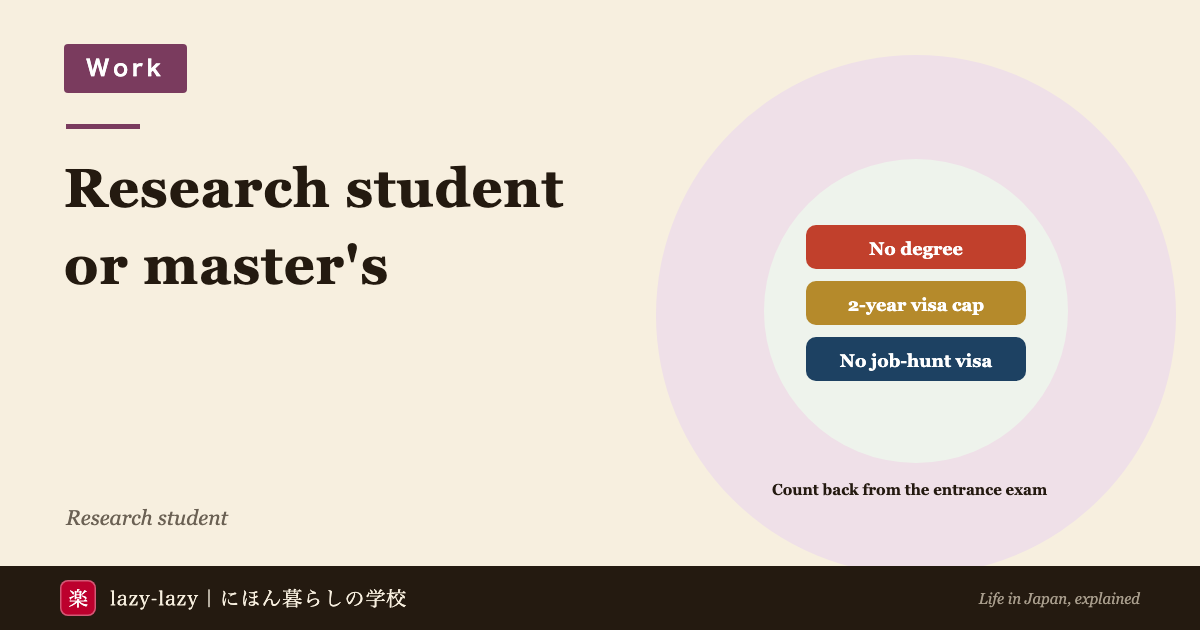
Knowing this, you can plan your two research-student years backwards from the entrance exam, instead of reaching the end of your stay with no degree and no job-hunting visa. You can also decide whether to skip the research-student stage and apply to a degree course directly.
A senior from home told you: “In Japan, you start graduate school as a research student.” You have even found a professor who might take you. But how long can you stay as a research student? Do you get a degree? What happens to your visa? You ask a Japanese friend, and they ask back: “What is a research student?” Most Japanese students sit the graduate entrance exam directly, so they never pass through it. The word itself trips people up too. In Chinese, 研究生 means a regular graduate student. In Japanese, a kenkyusei is not a regular student at all (University of Electro-Communications).
- What is a research student in Japan, and how is it different from a master’s student?
- Research student visa in Japan: Student status, two years at most
- Can I be a research student just to study Japanese?
- Can research students work part-time?
- Research student visa renewal: what you need
- When are graduate school entrance exams in Japan?
- How much does graduate school in Japan cost?
- Scholarships for graduate school: research students can qualify
- What happens after two years as a research student?
- Jobs after graduate school: the job-hunting visa is for degree graduates
- Which one are you?
- FAQ
- Summary
- Related reading
What is a research student in Japan, and how is it different from a master’s student?
JASSO’s Study in Japan site describes a research student as a status given to non-regular students. Its three examples are:
- People enrolled for short-term research without aiming for a degree (mainly graduate level)
- Short-term exchange students under agreements between universities
- People enrolled to prepare for a regular graduate programme (mainly those who finished a bachelor’s)
If you are heading for a master’s, you are the third case. Research-student time does not become year one of the master’s. UEC states plainly that research students cannot earn credits or a degree. To get the degree, you pass the entrance exam while you are a research student and enrol again as a degree student.
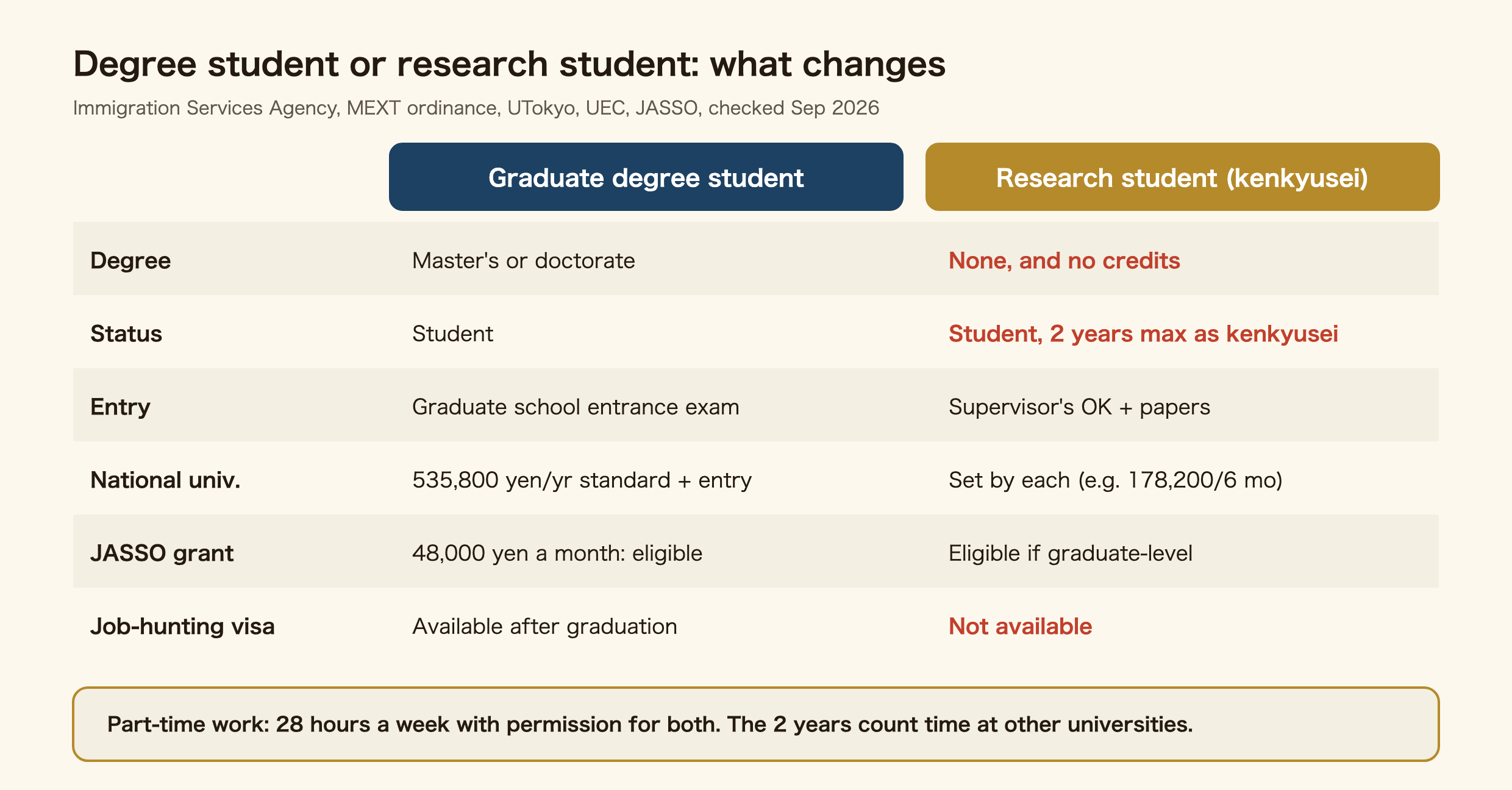
Getting in works differently too. Research students are selected mainly on documents (JASSO). UEC does not accept an application unless a supervisor has already agreed to take you.
And you do not have to go through the research-student stage. JASSO notes that some graduate schools let you sit the degree exam directly, while others prefer you to come as a research student first. Check the application guidelines of the school you want.
Research student visa in Japan: Student status, two years at most
A research student holds the same Student status as a degree student. Immigration grants the Student status for an individually set period of up to four years and three months.
What differs is how long you can stay as a research student. The University of Tokyo says research students (undergraduate or graduate level) can stay on Student status for up to two years, including time as a research student at other universities, unless there are special circumstances. Waseda (two years in principle), UEC (two years in total) and SOKENDAI (two years at most) say the same. One year at university A plus one year at university B, and you are at two.
Auditors and credited auditors, who only attend classes, get one year in principle (SOKENDAI). They also need at least ten hours of classes a week.
Waseda and SOKENDAI both warn that if the status is refused, fees already paid are in principle not refunded. If you were a research student somewhere else, count your total time before you apply.
Can I be a research student just to study Japanese?
Not in principle, since an amendment to the landing criteria ordinance took effect on 26 April 2024.
Under the ordinance now, if you study mainly Japanese at a university or similar school, that school must be a Japanese language institution designated by public notice, or one accredited by the education minister (on its course for international students). The conditions for research students and auditors who study by attending classes also exclude study that is mainly Japanese.
What counts as “mainly” is set out in a guideline from the education ministry and Immigration dated 30 September 2024. If your Japanese on entry is below N2 level and roughly 70% or more of your class hours are basic Japanese, that is, in principle, mainly Japanese study.
Universities that took such students in the year before the change have a transition period until 31 March 2029. If your Japanese is not there yet, the road is a Japanese language school first. The route from there into graduate school is compared with three others in what comes after Japanese language school.
Can research students work part-time?
Yes, with permission to work, up to 28 hours a week. The Immigration rules set 28 hours a week for Student status (eight hours a day during the long vacations fixed in the school’s rules) and do not separate research students from degree students. Yokohama City University says the same limit applies without distinction to regular, exchange and research students.
Long vacations are defined by each school’s rules, so check with your university before you use the eight-hour days. And from the day you stop being a research student, you cannot work even with the permission. How to count the hours is in the 28-hour rule for student jobs.
Research student visa renewal: what you need
If your period of stay ends while you are a research student, you renew it. Applications open three months before the expiry date. The University of Tokyo lists these for a research student’s renewal:
- Application for extension of period of stay (the school’s section is issued by your faculty office)
- Photo (4 cm x 3 cm), passport and residence card
- The document checklist and confirmation forms
- A certificate of your research (research period, content, and your supervisor’s name and title)
- Certificate of enrolment and transcript
From 1 October 2026 the fee depends on the length of stay granted. For one year it is 33,000 yen at the counter (27,000 yen online). All the bands are in the October fee rise.
If you change schools, for example to a graduate school at another university, you must notify Immigration yourself within 14 days.
When are graduate school entrance exams in Japan?
Timing and method differ by university and by graduate school, and JASSO tells applicants to check each school’s website. Many combine documents, written tests, interviews and oral exams, and JASSO says many graduate schools also take students in autumn (September or October).
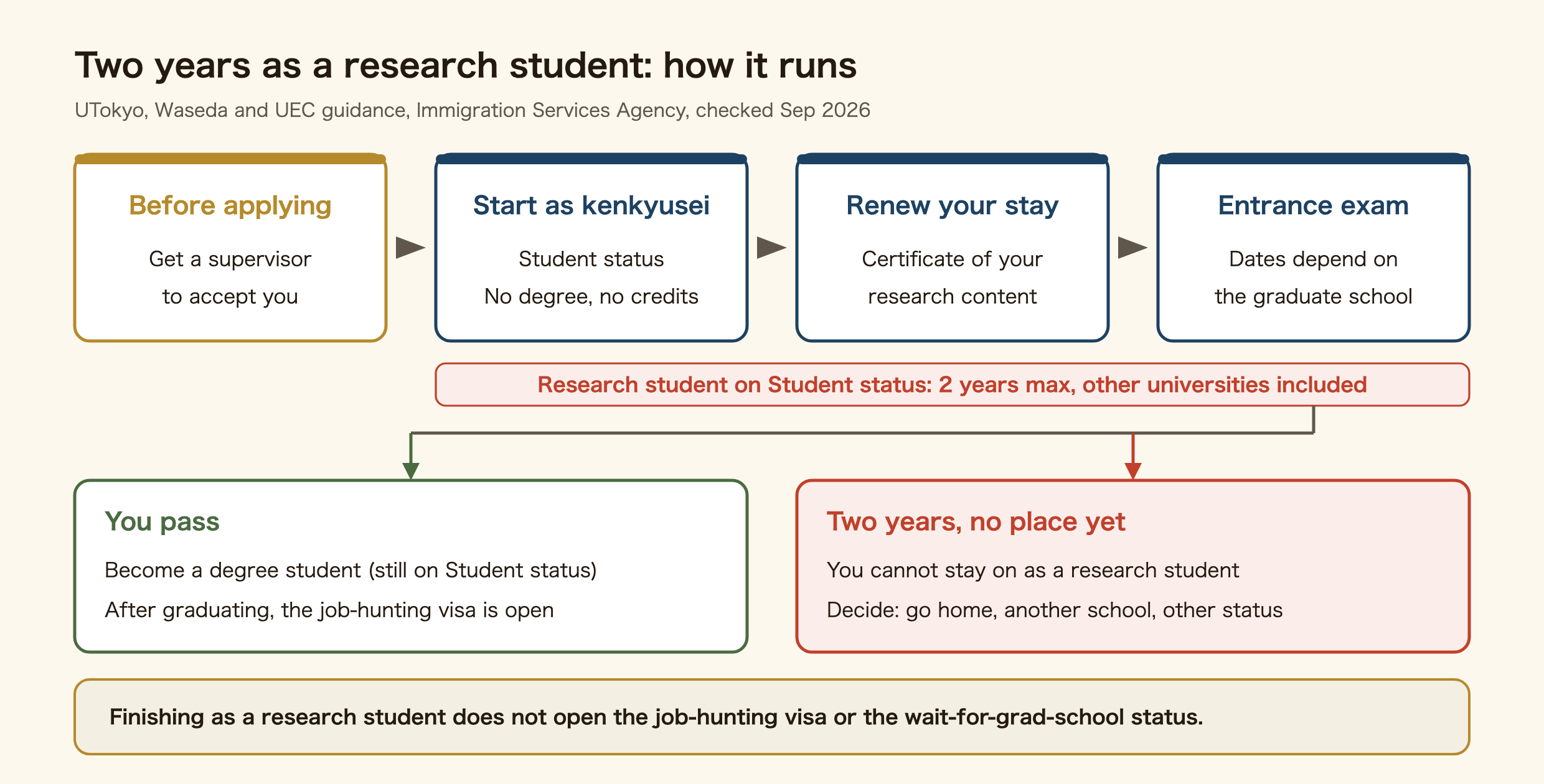
Research-student applications have deadlines too. For October 2026 entry, UEC took applications from abroad on 1–14 May and from inside Japan on 27 July – 14 August.
Check eligibility early. A master’s course requires a university degree, or 16 years of schooling completed abroad, among other routes (JASSO). If your country’s system adds up to fewer than 16 years, you go through the graduate school’s individual eligibility screening.
Japanese matters as well. UEC runs its master’s entrance exam and classes basically in Japanese and asks applicants to aim for at least N2 by the exam. Some programmes award a degree entirely in English (JASSO), so look for those if Japanese is your weak point. If you need an N2 certificate, work back from the application date using the JLPT registration dates.
How much does graduate school in Japan cost?
| Item | National university standard (graduate school) |
|---|---|
| Tuition (per year) | 535,800 yen |
| Entrance fee | 282,000 yen |
| Application fee | 30,000 yen |
A ministry ordinance sets these standard amounts for national universities. They are not a ceiling. With special reasons a university can go up to 120% of the standard. And since 1 April 2024, national universities may set tuition, entrance and application fees for international students separately from the standard. Always look up the international-student amount at the school you want.
According to JASSO, the first-year entrance fee plus tuition for graduate school averages about 820,000 yen at national, 900,000 yen at public and 1.1 million yen at private universities.
Research-student fees are set by each university (the ordinance leaves fees for non-students to them). At UEC, for October 2026 entry, a research student paid a 9,800 yen application fee, an 84,600 yen entrance fee and 178,200 yen tuition for six months. That is on top of the two years of the master’s itself.
If you are struggling to pay, ask your university about fee exemption or deferral. The ordinance requires national universities to offer exemption or deferral to students who cannot pay for financial reasons.
Scholarships for graduate school: research students can qualify
The government-funded JASSO Honors Scholarship pays 48,000 yen a month at graduate level. It covers regular graduate students and research students who hold a bachelor’s or higher and do graduate-level research. Being a research student does not rule you out.
The conditions include a grade point of 2.30 or higher in the previous year; one of JLPT N2 or higher, 200 or more in the EJU Japanese section, or English at CEFR B2 or higher; and an allowance from home averaging 90,000 yen a month or less. You cannot apply yourself — your school nominates you, and each school has a set number of places. How it works, and what to say at the office, is in the JASSO scholarship guide.
What happens after two years as a research student?
If you have not passed an entrance exam within two years, you no longer have a basis to stay on Student status as a research student. UEC says that once you lose research-student status you cannot stay on Student status, unless you enter another school. Decide before the deadline: go home, enter another school, or change to another status.
Even with time left on your residence card, three months or more without Student activity makes your status liable to cancellation. When you stop being a research student, notify Immigration within 14 days.
There is a Designated Activities status for university graduates waiting to start graduate school, but Immigration excludes research students from it. Plan your research-student period so that it runs up to the graduate school’s start date.
Jobs after graduate school: the job-hunting visa is for degree graduates
Graduates without a job offer can stay on Designated Activities for up to a year to keep job hunting. Immigration excludes non-degree students — auditors, credited auditors, research students and preparatory-course students — from it. Graduates of a degree course at graduate school do qualify. Who qualifies and when to apply is in the job-hunting visa after graduation.
In Immigration’s 2024 data, 24.0% of students who switched from Student status to a work status were graduate-school graduates. Which companies hire them is broken down in where international students actually get hired.
Which one are you?
- At a Japanese language school, aiming for graduate school — check whether your target graduate schools prefer research students first or accept direct applicants. Today, write down three graduate schools to check.
- Holding a degree from home and planning to come as a research student — find a supervisor who will accept you and check the application deadline. Today, count whether your schooling adds up to 16 years.
- A research student in your first year — count how many exam rounds fit inside your two years, working back from the exam dates. Today, put the next application window in your calendar.
- A research student near the end of year two — decide your plan if you do not pass: go home, another school, or another status. Today, ask the international office about your expiry date and next step.
FAQ
Q. What is a research student in Japan, and how is it different from a graduate student?
A research student (kenkyusei) is a non-degree student enrolled to do research at a university or graduate school. It never leads to a master’s or doctorate on its own, and some universities give no credits. To get a degree, you pass the graduate entrance exam and become a degree student.
Q. What visa does a research student in Japan hold?
The same Student status as degree students. But according to the University of Tokyo and others, you can hold it as a research student for two years at most, including time as a research student at other universities.
Q. Can research students work part-time in Japan?
Yes, up to 28 hours a week with permission to work. Immigration’s rules do not separate research students from degree students. The eight-hour days during long vacations depend on your school’s rules, so check with your university.
Q. Can I become a research student at a university just to study Japanese?
In principle, study that is mainly Japanese does not qualify for Student status as a university research student. Since the ordinance change of 26 April 2024, it has to be at a designated or accredited Japanese language institution. Some universities have a transition period until 31 March 2029.
Q. How much is tuition at a national university graduate school?
The standard is 535,800 yen a year, with a 282,000 yen entrance fee and a 30,000 yen application fee. Since 1 April 2024, national universities may set international students’ fees separately, so check the school you want.
Q. Can I use the job-hunting visa after finishing as a research student?
No. Immigration excludes research students from the job-hunting visa after graduation. Graduates of a degree course at graduate school do qualify.
Summary
A research student is a preparation stage before graduate school. You are on Student status, but there is no degree. You can be a research student for two years at most, other universities included, and finishing does not open the job-hunting visa. Use those two years to pass the entrance exam.
If you only want to study Japanese, the road is a Japanese language school, not a research-student place. National graduate schools have a standard tuition of 535,800 yen a year, but check each school’s rate for international students. Research students can qualify for the JASSO grant, so ask your office to nominate you.
Official sources: Immigration Services Agency, Student status (Japanese) / Landing criteria ordinance (e-Gov, Japanese) / MEXT and ISA guideline on “mainly Japanese language education” (Japanese) / ISA, job hunting after graduating from a Japanese university (Japanese) / Ordinance on national university fees (e-Gov, Japanese) / JASSO Study in Japan, graduate schools / University of Tokyo, extension of period of stay / UEC, research students (international). Checked on 24 September 2026. Always confirm with the international office and application guidelines of the school you want before applying.
Related reading
Found this useful? Share it
Send it to a friend who lives in Japan.
READ THIS NEXT
Student Visa to Work Visa in Japan →In 2024, 96.7% of applications to change from a student visa to a work visa were approved.WHO WROTE THIS

mori
Japanese. I read the ministries’ own notices, orders and Q&As in the original, and I start from what my Nepalese and Sri Lankan friends in Japan actually ran into. I do not write about what I have not checked or been told.
What this site can and cannot do →Looking for something else?