Last updated: 26 August 2026
Summary
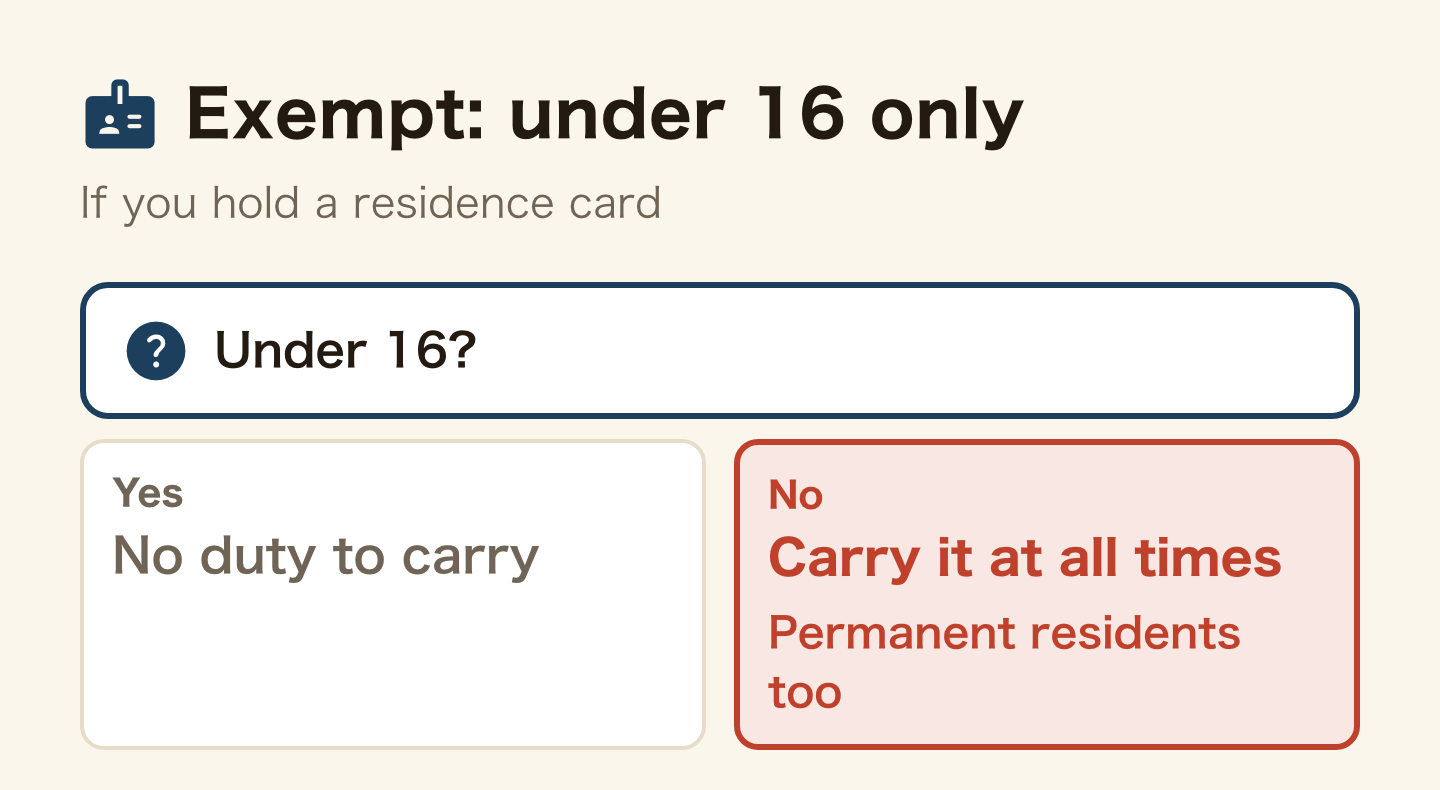
- You must carry your residence card at all times. The only exemption is for people under 16. Permanent residents are not exempt.
- Not carrying it is a fine of up to 200,000 yen. Refusing to show it is up to one year of imprisonment or a fine of up to 200,000 yen.
- If you carry your residence card, you do not have to carry your passport. The Immigration Services Agency states this directly. Leave the passport at home.
- Renewing your visa and renewing your residence card are two different procedures. This is the single most common confusion.
- Renewing the card’s validity is free. So is replacing a lost one – but you must apply within 14 days of noticing it is gone.
What changes: you know one card in your pocket is enough – no passport every day – and that the 200,000 yen fine only exists on the day you forget it.
You leave your residence card at home one morning. A police officer stops you that afternoon. That alone is a criminal offence in Japan. “I forgot” is not a defence in law.
This guide covers how far the carrying obligation goes, what happens if you break it, and how the renewal and replacement procedures work – based on what the Immigration Services Agency actually publishes. It also covers the new card format introduced in June 2026.
- Do I really have to carry my zairyu card every day?
- What happens if I forget it?
- Do I have to carry my passport as well?
- Zairyu card renewal is not the same as visa renewal
- Residence card renewal: when to apply, and the price
- Lost your residence card? You have 14 days
- The card changed in June 2026, and so did the photo rule
- From April 2027, breaking these duties costs more
- Three things to do today
- Frequently asked questions
- Summary
Do I really have to carry my zairyu card every day?
You pop out to the corner shop with just your phone. Where you come from, leaving your ID at home may be perfectly ordinary. In Japan, the moment you leave the house without your residence card, you are no longer meeting a legal duty.
Yes. Mid-to-long-term residents must carry the residence card at all times. The basis is Article 23 of the Immigration Control Act.
A “mid-to-long-term resident” (中長期在留者 / chuchoki zairyusha) is anyone with a status of residence longer than three months. Student, Engineer/Specialist in Humanities/International Services, Specified Skilled Worker, Permanent Resident, Dependent – almost everyone. If you hold a residence card, you are one.
There is exactly one exemption
People under 16 are not required to carry the card. There is no other exemption. Permanent residents carry it too, and so does someone who has lived here twenty years. Length of residence changes nothing.
There is no rule about how you carry it. A wallet is the reliable answer. A photocopy does not satisfy the obligation – carry the actual card.
What happens if I forget it?
Breaching the obligation is a criminal matter, under the Immigration Control Act: Article 75-3 for not carrying the card, Article 75-2 for refusing to show it. This is a penalty, not an administrative warning.
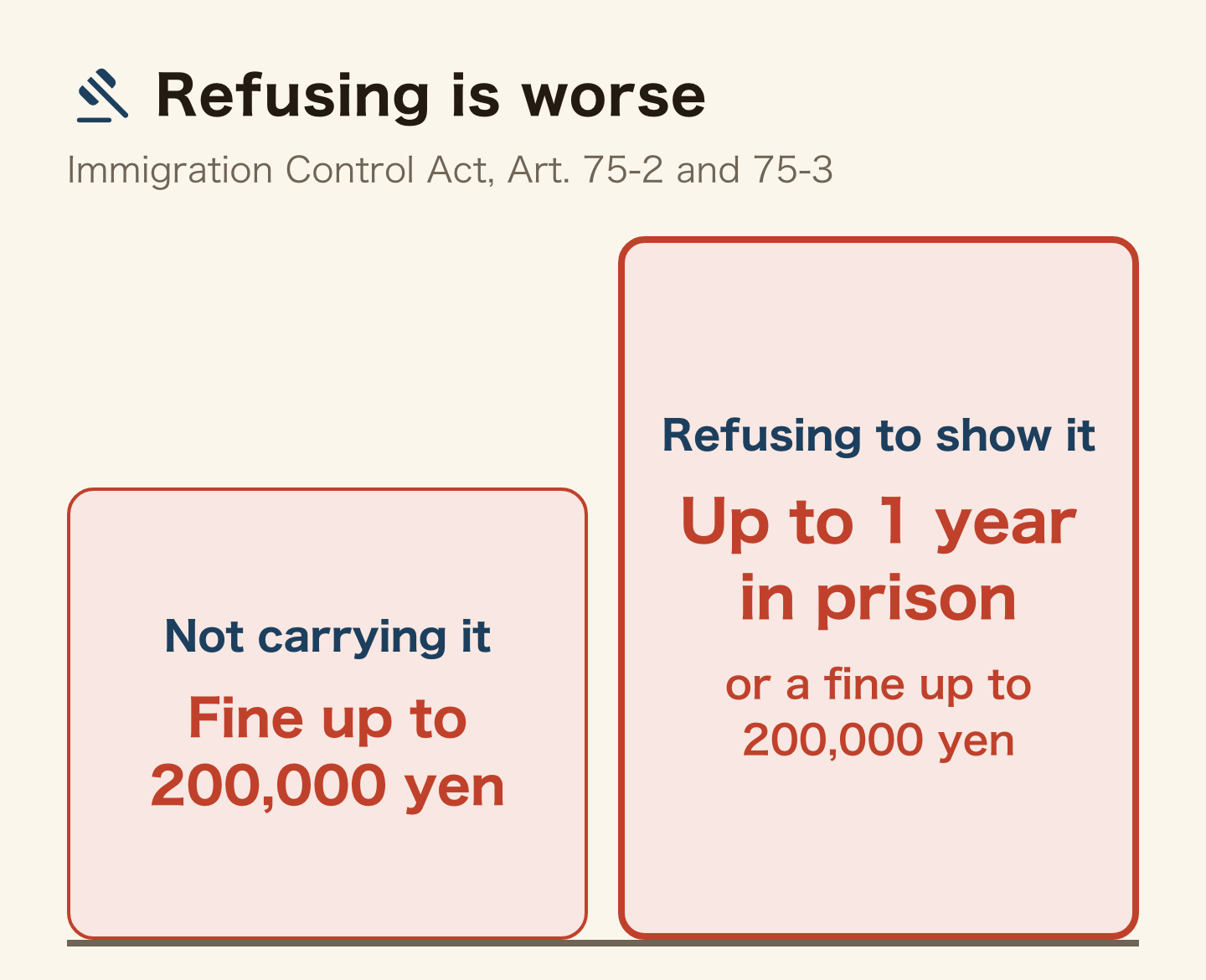
Not carrying it: a fine of up to 200,000 yen. Your reason for not having it is not part of the test.
Refusing to show it is treated more seriously: up to one year of imprisonment, or a fine of up to 200,000 yen. Having the card and declining to produce it is the worst position to be in. If you are asked, hand it over.
The people entitled to ask are immigration inspectors, immigration control officers and police officers. Your landlord, your employer and a shop assistant have no such right. The duty runs to public officials.
Do I have to carry my passport as well?
No. If you are carrying your residence card, you are not required to carry your passport.
The Immigration Services Agency puts it plainly:
Mid-to-long-term residents are required to receive and carry a residence card, and where a mid-to-long-term resident carries the residence card, the obligation to carry a passport does not apply.
Immigration Services Agency, “Carrying a passport etc. (Article 23)” – translated from the Japanese original
Plenty of people carry a passport daily without knowing this. All that does is raise the odds of losing it. If it does go missing, file a report at a police box first, then go to your embassy. Leave the passport at home and carry the card. Keep the passport with your earthquake grab bag, so you are not hunting for it when you have to leave in a hurry.
Special Permanent Residents are also exempt from carrying a passport, under Article 17(4) of the Special Act.
Zairyu card renewal is not the same as visa renewal
They are separate procedures, and confusing them is common.
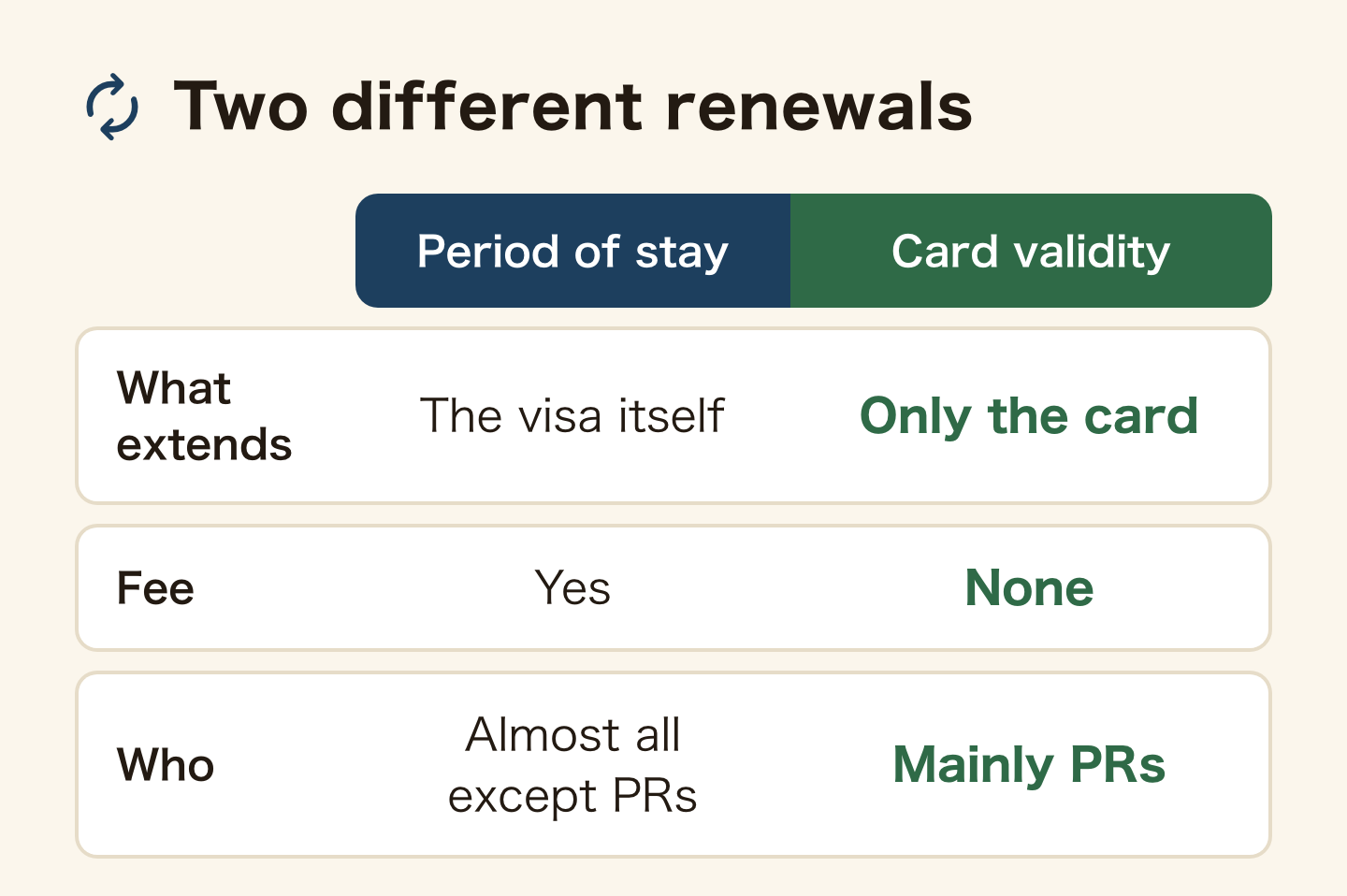
Renewing your period of stay extends the visa itself – the one year on a Student visa, the three years on an Engineer visa. It costs a fee. The paperwork is in our guide to visa renewal in Japan.
Renewing the residence card’s validity remakes the card itself. It is free.
Most people never file this separately. When your period of stay is renewed you are handed a new card on the spot, and the card’s expiry matches your visa’s.
The people who do need it are mainly permanent residents. A permanent resident has no period of stay, so the card is the only thing with an expiry date. Nobody sends you a reminder. Missing the card’s expiry without noticing is the single most common failure here.
Residence card renewal: when to apply, and the price
Permanent residents aged 16 or over apply from three months before the card’s expiry date, up to the expiry date itself. There is no fee.
If your card’s expiry is set to your 16th birthday or the day before (for cards issued up to 13 June 2026), you can apply from six months before. Parents, this is the date to watch.
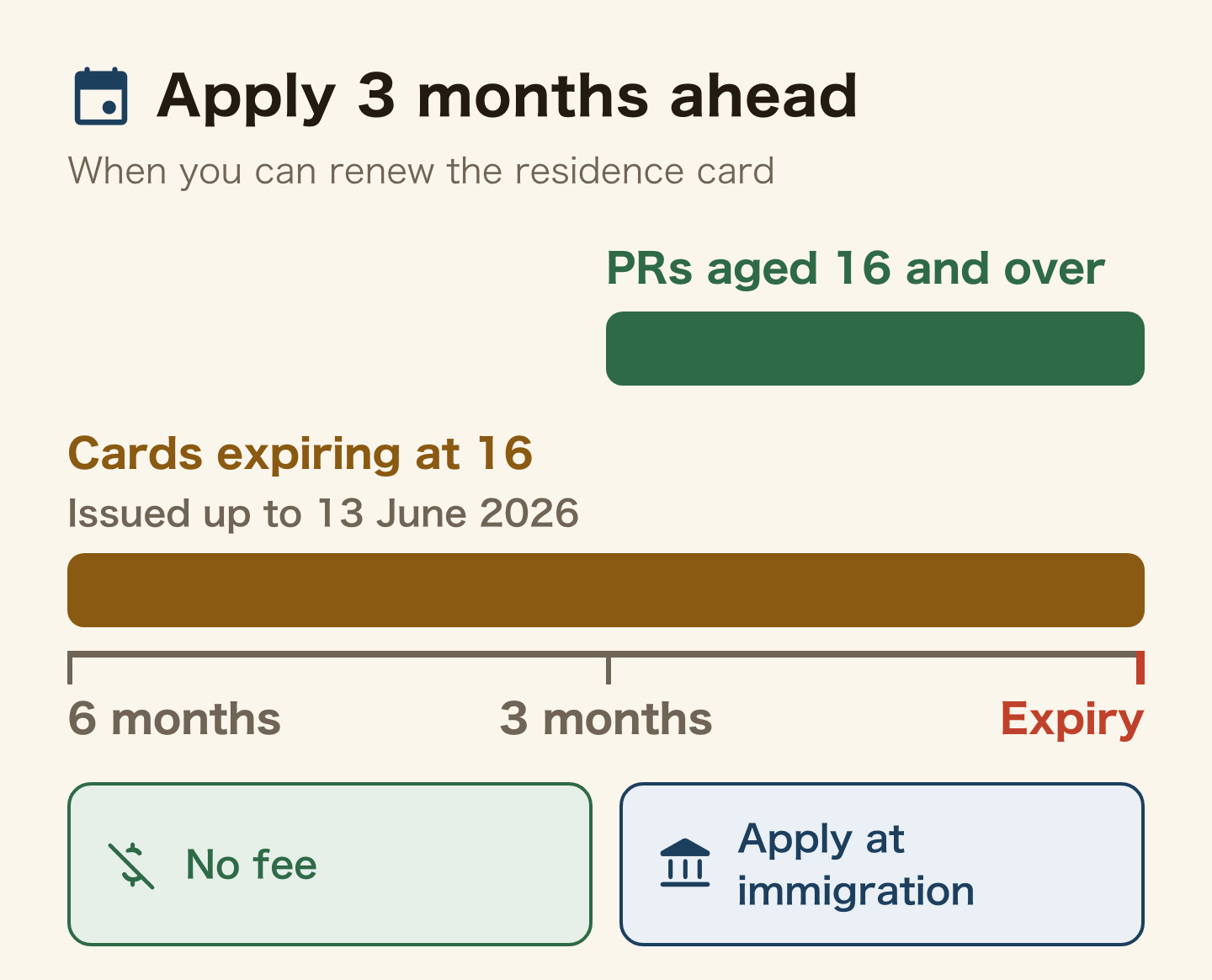
If you will be abroad for work or study and know you cannot file in time, you may apply before the window opens. Contact your regional immigration bureau first.
What to bring
The application form, one photograph, your passport and your residence card. File at the regional immigration bureau for the area where you live – not at the city office.
The residence card photo size is 4cm tall by 3cm wide. Head uncovered and facing forward, no background and no shadow, sharp, and taken within 6 months of the day you file. A photo outside the specification is sent back. At a photo booth, choose the “zairyu shikaku” (在留資格) setting and you will get this size.
Lost your residence card? You have 14 days
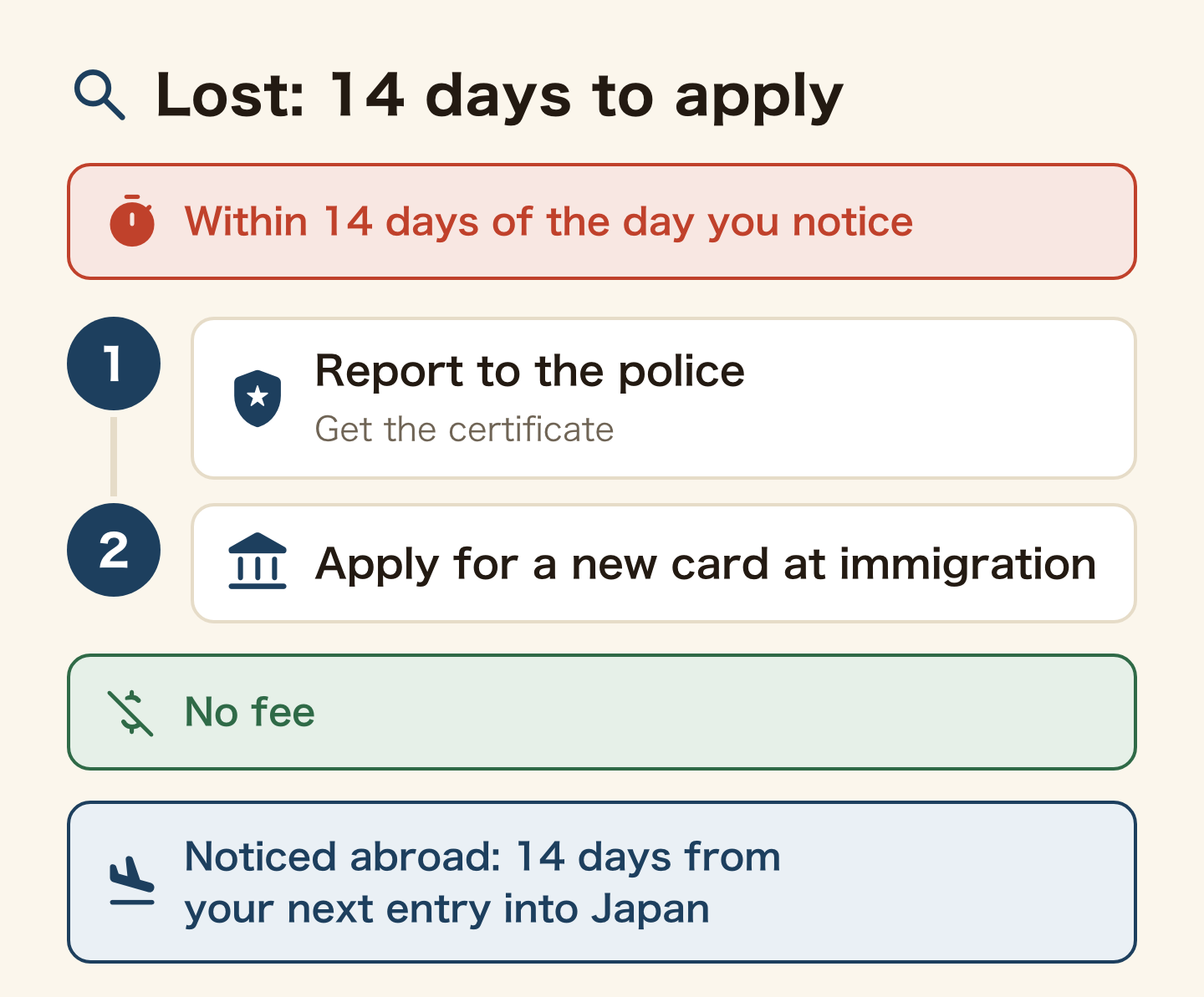
Apply for a replacement within 14 days of noticing it is missing. There is no fee.
If you realise it while outside Japan, the 14 days run from the day you next enter Japan.
Go to the police first. You need a certificate acknowledging your report of loss, or of theft. At a police box, say “ishitsu-todoke wo dashitai” (遺失届を出したい). Take that certificate to the regional immigration bureau.
The carrying obligation does not pause while you wait. Keep the document showing you have applied so you can explain yourself if you are stopped.
For a card that is badly damaged or defaced there is no deadline – unless immigration orders you to apply, in which case it is 14 days from the order. This is free too.
The card changed in June 2026, and so did the photo rule
A new residence card format took effect on 14 June 2026, along with the Specified Residence Card – a residence card carrying My Number card functions.
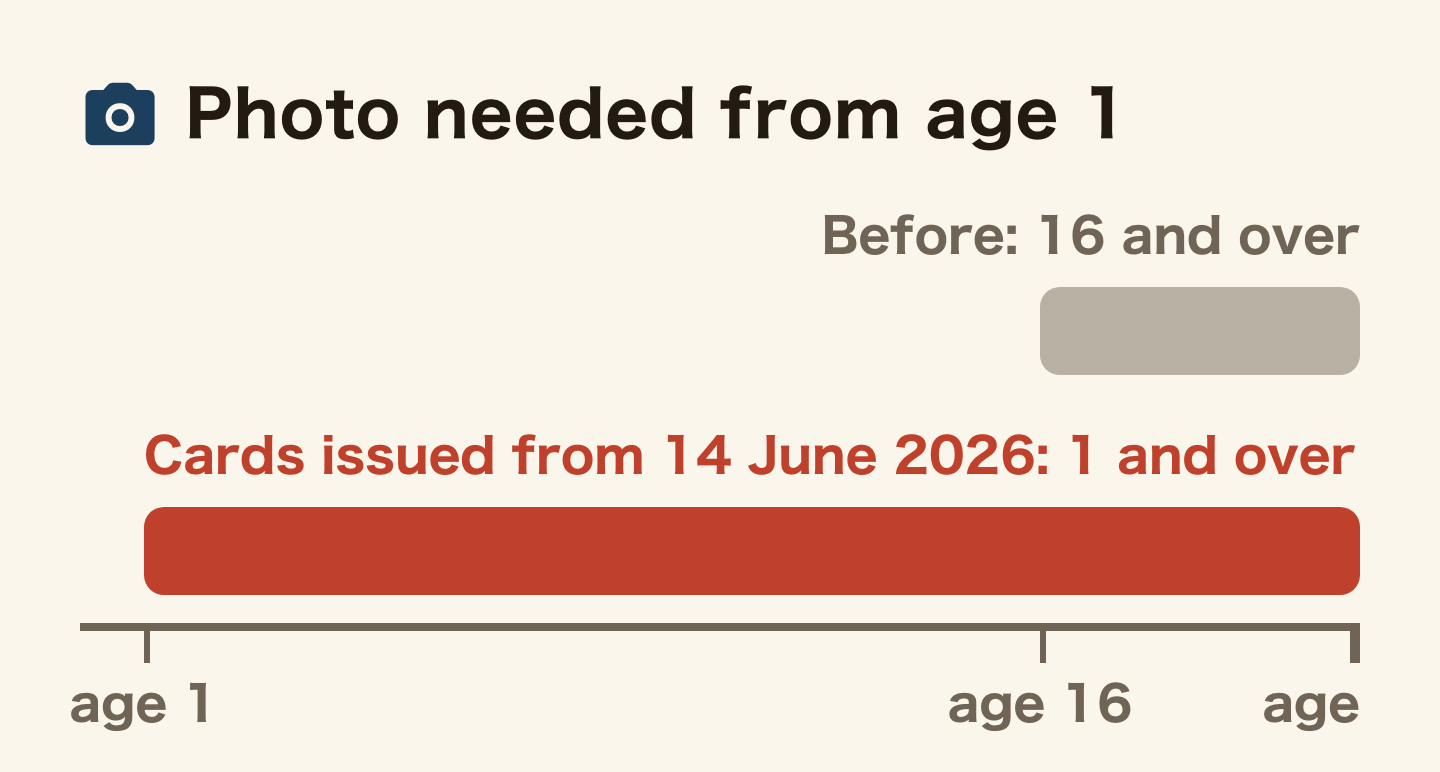
The change that affects daily life is the photograph. For cards issued from 14 June 2026, a photo is required for everyone aged 1 and over. Previously the threshold was 16. If you are handling paperwork for a small child, do not turn up without a photo.
An older-format card stays valid until its expiry date. There is no need to rush out and replace it.
From April 2027, breaking these duties costs more
Everything above – carrying the card, keeping its validity current – is a duty under the Immigration Control Act.
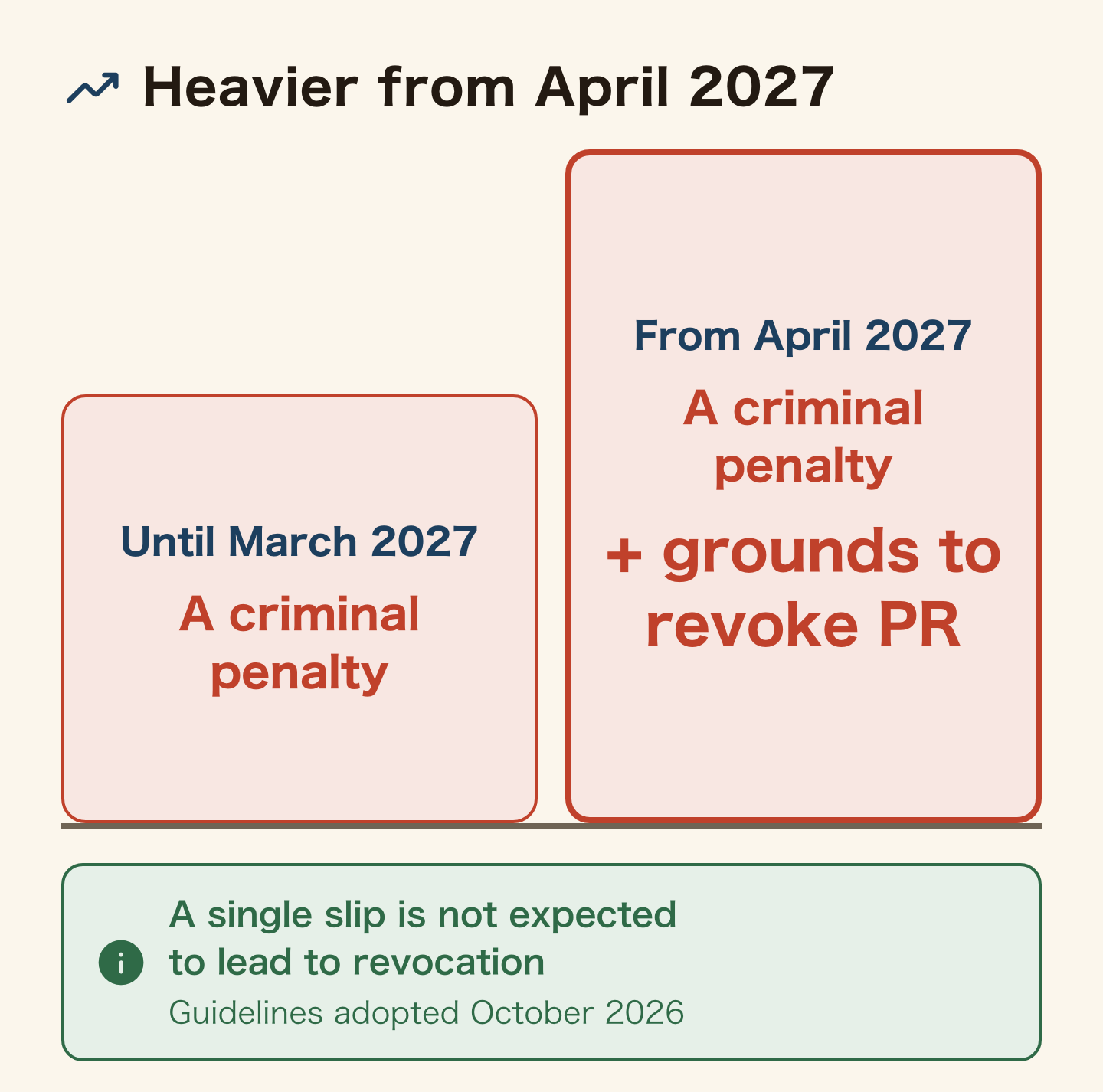
From April 2027, breaching those duties becomes one of the grounds for revoking a permanent resident’s status. The stakes stop being just a fine.
That said, the guidelines adopted on 1 October 2026 state that revocation “is not envisaged on the basis of a single failure to perform a duty.” Forgetting your card once will not cost you permanent residence. The detail is in can permanent residency be revoked in Japan.
Three things to do today
- Check your wallet right now. If the card is not in it, put it in. That is the carrying obligation dealt with
- Find the expiry date on the card and mark your calendar three months earlier. For permanent residents this is the one that matters
- Leave your passport at home. You are not required to carry it
When you move, report the change of address at the city office within 14 days – see residence registration in Japan – and they will write your new address on the back of the card. Doing it alongside the rest of your moving paperwork saves a trip.
Before you travel abroad, check whether you need a re-entry permit. You do not, if you leave with a valid passport and your residence card, tell the immigration officer at departure that you are leaving on a “special re-entry permit” (tick the box on the re-entry ED card), and come back within one year of leaving – or by the end of your period of stay, if that comes sooner (Immigration Services Agency, special re-entry permit, in Japanese).
Frequently asked questions
Q. Are there any exceptions to the residence card carrying requirement?
Only for people under 16. Permanent residents are included. Length of residence in Japan is not a ground for exemption, and there is no published exception for situations like swimming or bathing.
Q. Is a photocopy or a photo on my phone enough?
No. Carry the physical card. A copy does not satisfy the obligation.
Q. What do I carry while my card is being renewed?
Your old card if you still have it. If you do not, carry the paperwork showing that you have applied.
Q. What is the residence card renewal price?
There is no charge. Renewing the validity period is free, and so is replacing a lost or damaged card. The procedure that costs money is renewal of your period of stay.
Q. Can I do the residence card renewal online?
No. Renewal of the card’s validity is handled at the regional immigration bureau counter for your area. The Online Residence Application System covers seven procedures, such as extending your period of stay and the re-entry permit, and card validity renewal is not one of them (as of 8 October 2026). What can be filed online changes over time, so check the Immigration Services Agency pages before you travel there.
Q. I noticed my card was missing more than 14 days ago. What now?
Late is far better than not at all. You may be asked for a written explanation, so be ready to say when you noticed, and apply as soon as you can.
Summary
- Carrying your residence card is a legal obligation. The only exemption is under 16, and permanent residents are not exempt
- Not carrying it: up to 200,000 yen. Refusing to present it: up to one year imprisonment or 200,000 yen
- Carrying the card removes the obligation to carry a passport. Leave it at home
- Visa renewal and card renewal are different. Card renewal is mainly for permanent residents and it is free
- Lost card: apply within 14 days of noticing. Get the police certificate first
Official sources: Immigration Services Agency, “Carrying a passport etc. (Article 23)” / “What is the residence card?” / “Application for renewal of the residence card validity period” / “Application for reissuance due to loss” / “Photograph specification” / Online residence applications / Special re-entry permit / e-Gov: Immigration Control and Refugee Recognition Act
Amounts, deadlines and conditions were checked against Immigration Services Agency pages on 26 August 2026. Rules change, so confirm the current position yourself before you file anything.
Found this useful? Share it
Send it to a friend who lives in Japan.
WHO WROTE THIS

mori
Japanese. I read the ministries’ own notices, orders and Q&As in the original, and I start from what my Nepalese and Sri Lankan friends in Japan actually ran into. I do not write about what I have not checked or been told.
What this site can and cannot do →Looking for something else?
You may use the figures in this article, including commercially, if you credit this site with a link. How to use our figures