Last updated: 24 August 2026
Summary
- If you are 20 or over and registered as a resident, you must join the National Pension – students included. The premium is 17,920 yen a month (FY2026).
- If you cannot pay it, apply for the student payment special provision. Most people call it an exemption; it is technically a deferral.
- Unpaid and deferred are completely different things. Unpaid leads to demands and asset seizure, and it reaches your visa renewal. Deferred does not.
- Japanese language school students can usually apply. It depends on the school, and this page explains how to check.
- One honest cost: deferred months do not count toward the lump-sum withdrawal payment you claim when leaving Japan.
- Repayment is not compulsory, and if you are going home you are better off not repaying – 215,040 yen buys back only 107,520 yen. Staying in Japan flips that.
What changes: you know unpaid and deferred are different things – and you choose the one that does not touch your visa renewal.
The National Pension (kokumin nenkin) is Japan’s public pension for everyone aged 20 to 59 living here. It is not only for Japanese nationals. Foreign residents with a resident registration are covered once they turn 20. It is separate from National Health Insurance, and billed separately.
- Do students really have to pay the pension?
- How much is the premium?
- It is a deferral, not an exemption
- What happens if you leave it unpaid?
- Can Japanese language school students apply?
- How to apply
- Do I have to pay it back eventually?
- Is repaying worth it? Not if you are going home
- Does deferring reduce my lump-sum withdrawal payment?
- Still short? Cut fixed costs in this order
- Frequently asked questions
- Q. Do international students have to pay the National Pension?
- Q. How much is the National Pension premium?
- Q. Is the student provision an exemption?
- Q. Can students at Japanese language schools apply?
- Q. What happens if I just do not pay?
- Q. Does deferring reduce my lump-sum withdrawal payment?
- Q. Do I have to pay the deferred months back?
- Q. Is repaying worth it?
- Q. Do I only apply once?
- In short
- Related guides
Do students really have to pay the pension?
You cannot work more hours, and the envelopes arrive anyway. Inside a 28-hour weekly cap you cover rent and food, and then 17,920 yen a month lands on top. Of course it does not fit.
And the obligation itself does not go away. At 20 or over with a resident registration, you are covered. Neither “I did not know” nor “I am only here temporarily” removes it.
What does exist is a route for people who cannot pay. That is the student payment special provision.
How much is the premium?
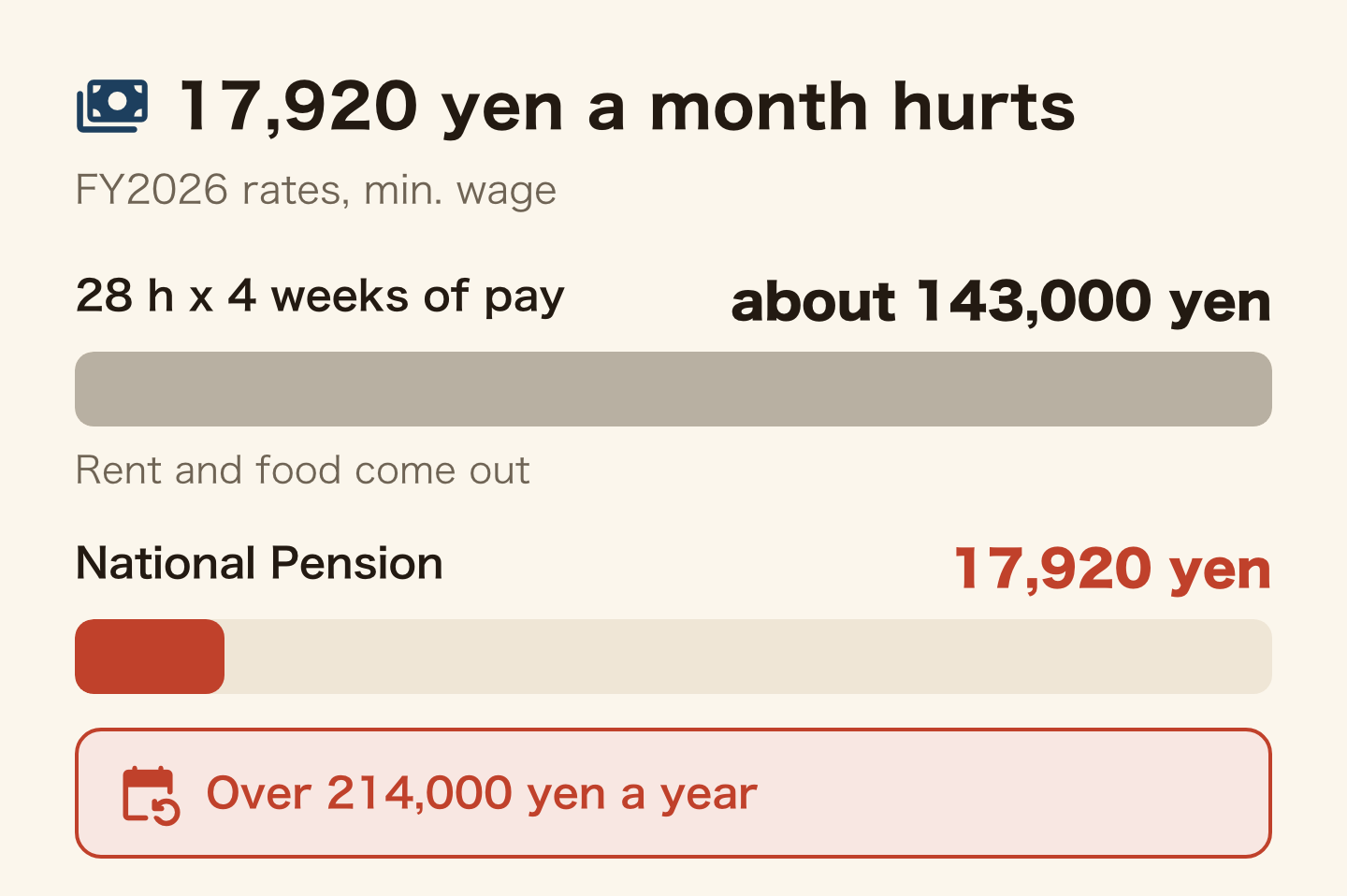
For FY2026 the National Pension premium is 17,920 yen a month, which comes to over 214,000 yen across the year (Japan Pension Service, National Pension premiums (Japanese)).
Set that against a 28-hour cap. Tokyo’s minimum wage is 1,280 yen an hour (in force since 1 October 2026), so 28 hours across four weeks is 112 hours, and 1,280 yen x 112 hours is 143,360 yen: about 143,000 yen a month. (Tokyo Labour Bureau, Tokyo minimum wage raised to 1,280 yen (Japanese)) Take out rent and food, then find 17,920 yen. The arithmetic does not work, and that is not your fault.
It is a deferral, not an exemption
Search in English and you will find this called a student pension exemption. That is what people call it, so this page has too. The scheme’s actual name is the student payment special provision, and what it grants is a deferral.
The difference matters. A deferral means “you may pay later”, not “you never have to pay”. Approved months count toward your qualifying period, but they are not reflected in the pension amount. Pay them back later and that changes.
It is still worth applying, because of how far it sits from the alternative.
What happens if you leave it unpaid?
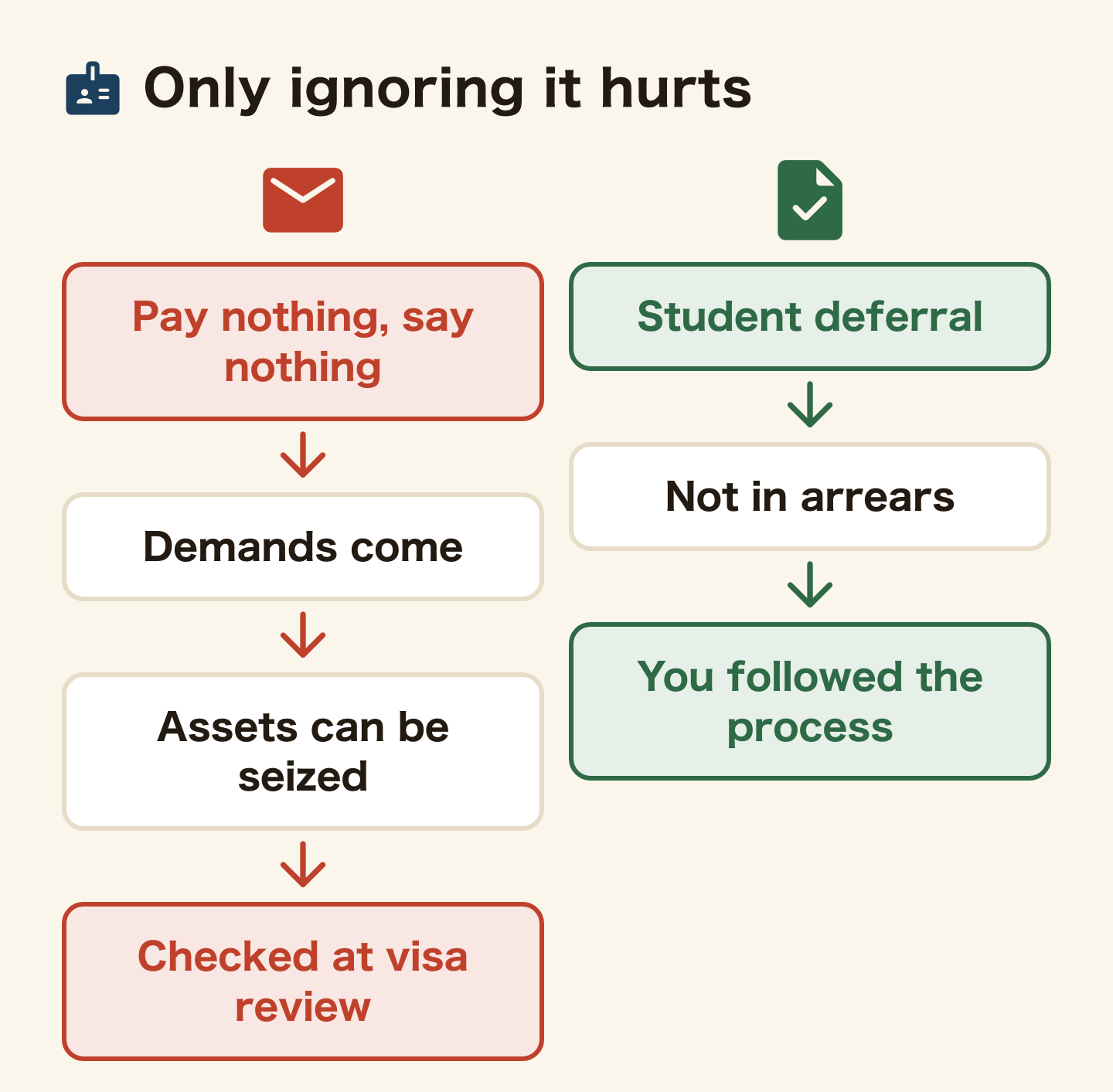
The pension envelope arrives, and it goes into a drawer unopened. Where you come from, nothing may ever come of that. In Japan the pension does not fade away because you stayed quiet, and the months you left alone are looked at later, when your visa comes up for review.
Say nothing and pay nothing, and demands come first. Keep ignoring those and your assets can be seized. (Japan Pension Service, enforced collection of National Pension premiums (Japanese))
For foreign residents there is a second weight. Applications to extend your period of stay, and applications for permanent residence, are assessed partly on whether you meet your public obligations. Pension and health insurance premiums are among those obligations (Immigration Services Agency, guidelines for permission for permanent residence (Japanese)). The renewal counter also asks to see your health insurance card.
Which brings the point of this page. Holding an approved deferral means you are not in arrears. You have not paid, but you have followed the process. What reaches your visa is ignoring it, not deferring it.
Asking for help also protects permanent residence (guidelines adopted 1 October 2026)
Operational guidelines were adopted on 1 October 2026, unchanged from the draft, for the revocation system starting in April 2027. The ground “wilfully failing to pay public dues” includes public health insurance and pension premiums.
The guidelines also spell out what does not count: “illness, disaster, unemployment and other unavoidable circumstances”, and “responding to demands, showing willingness to pay, and being granted instalments or a deferral”. Being unable to pay is not itself the problem. A record of going to the counter and arranging instalments is what protects your status. (They apply from April 2027.)
Can Japanese language school students apply?
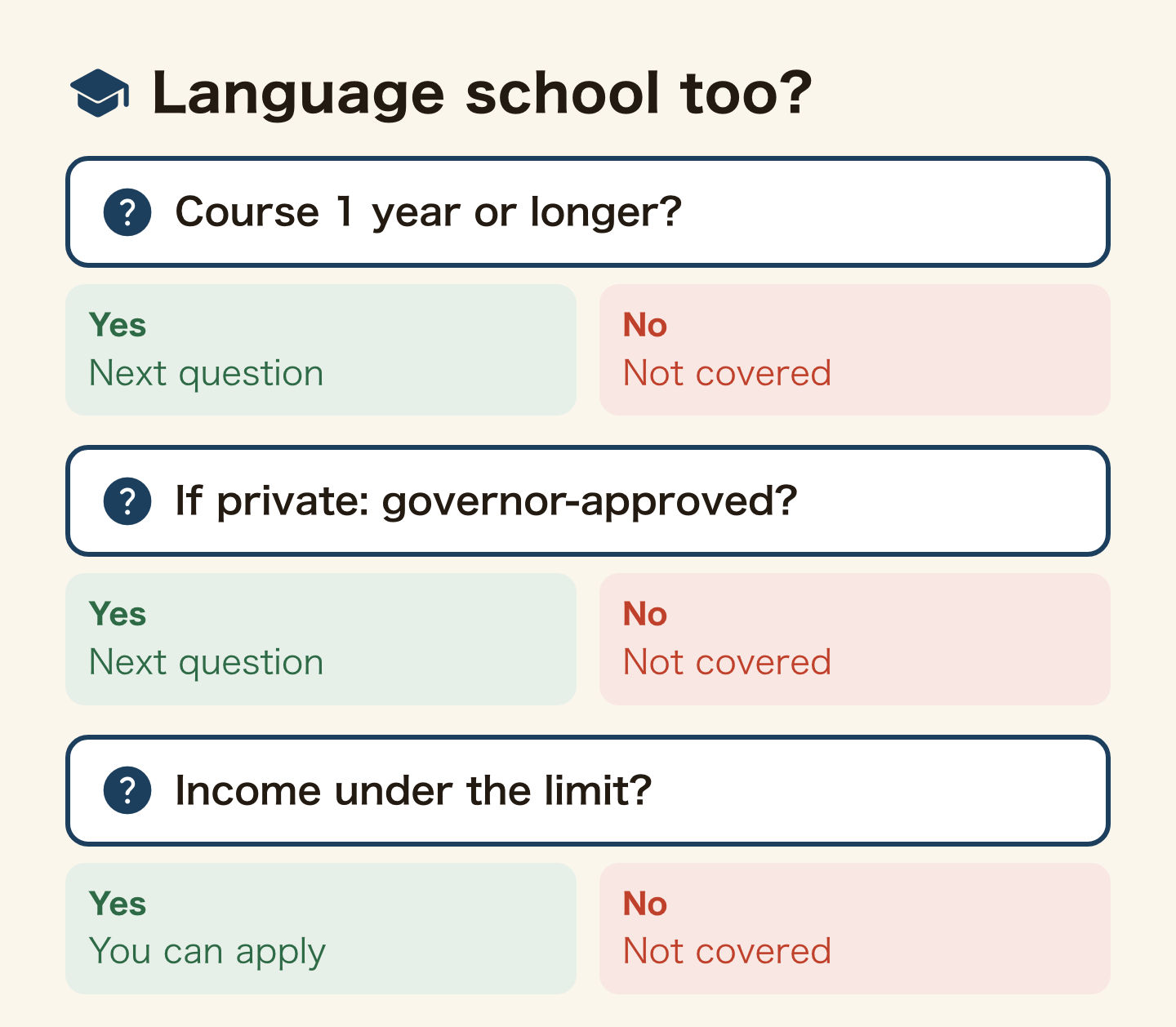
The scheme covers students at universities and graduate schools, junior colleges, high schools, colleges of technology, special needs schools, and specialised training colleges and miscellaneous schools – evening, part-time and correspondence courses included (Japan Pension Service, student payment special provision (Japanese)).
Most Japanese language schools fall under “miscellaneous schools”, so they are usually covered. There are conditions, though. A miscellaneous school must run a course of one year or longer, and private ones need prefectural governor approval. So it varies school to school.
Two ways to check.
- Ask your school office. Fastest by a distance, and an approved school may hand you the application form on the spot
- Look up the Japan Pension Service list of eligible schools, published on their site (Japan Pension Service, list of eligible schools (Japanese))
There is an income condition as well. Your income for the previous year must be at or below 1,280,000 yen plus 380,000 yen per dependent, plus social insurance deductions. Most students working within the 28-hour cap sit inside that.
How to apply
Three places accept the application, and any of them is fine.
- The National Pension desk at the city or ward office where you are registered
- A pension office
- Your school, if it holds the relevant approval
Bring your student ID or a certificate of enrolment, and something showing your basic pension number. Take your residence card too.
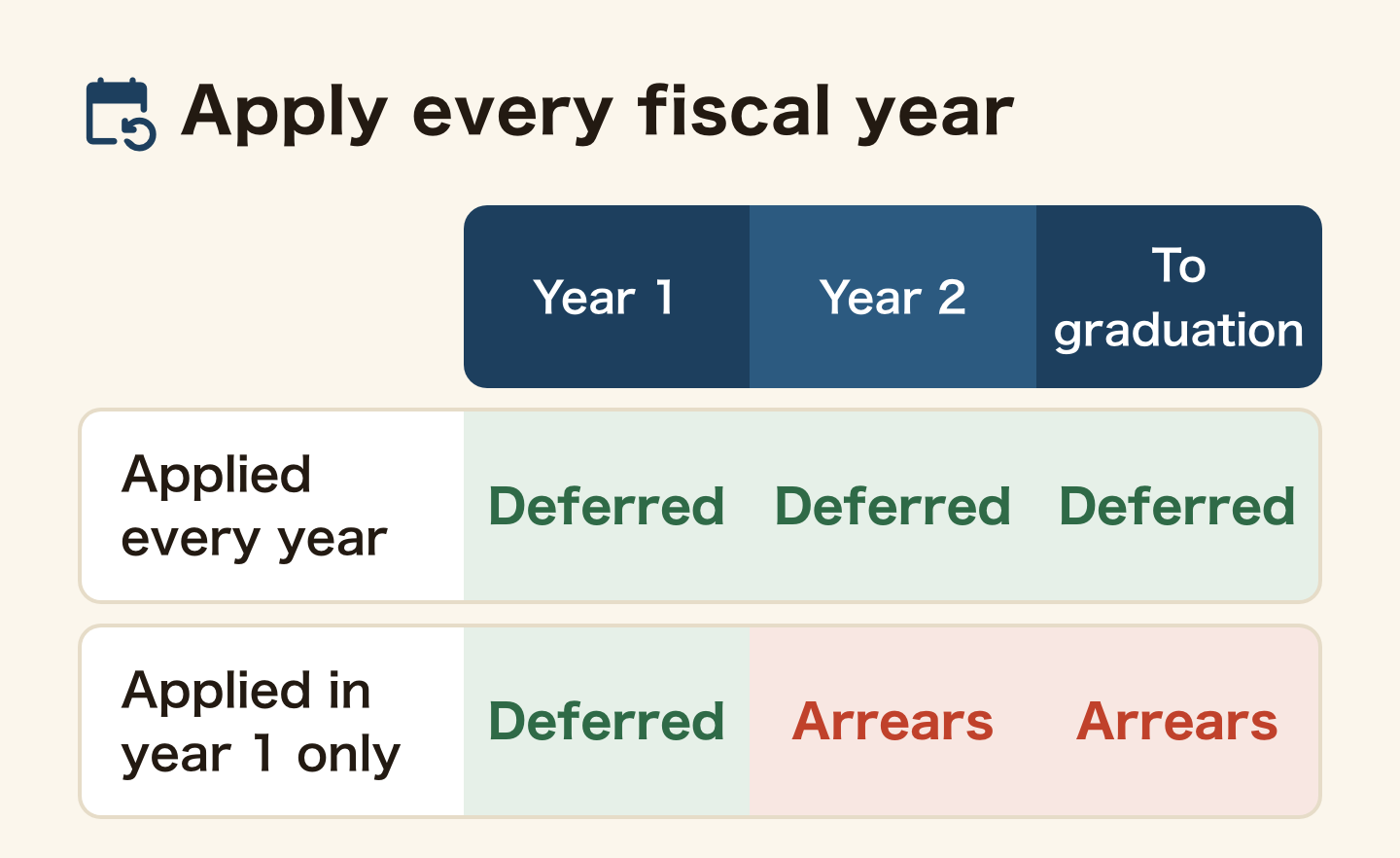
The application runs by fiscal year. Filing once does not cover you until graduation. Apply again when the new school year starts. Forgetting this is how people end up in arrears from year two.
Do I have to pay it back eventually?
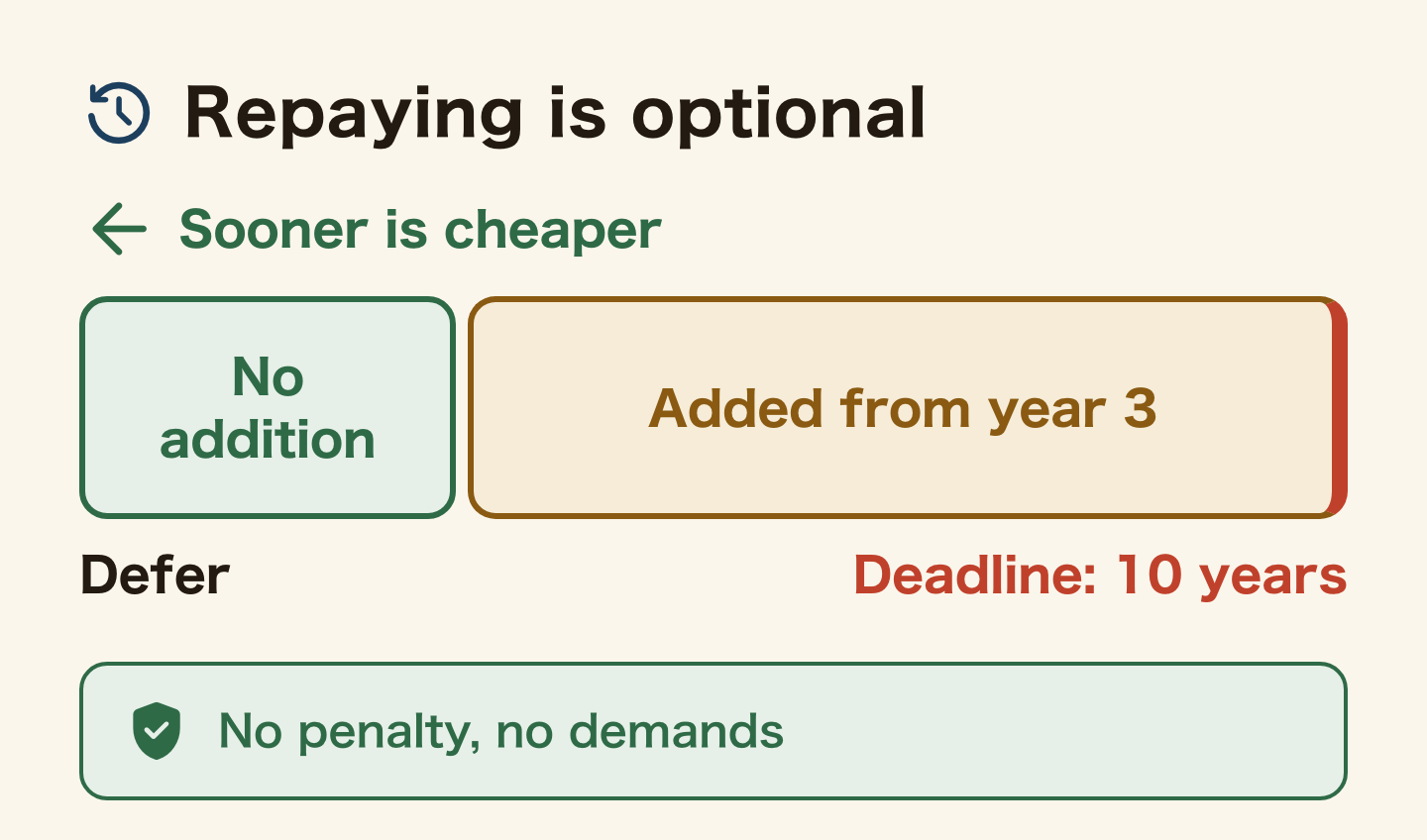
No. Back-payment is not compulsory. There is no penalty for never paying, and no demands arrive. Deferred months still count toward the 10-year qualifying period, so your right to receive a pension at all is untouched.
What changes is the amount only. Two years deferred and never repaid means an old-age basic pension roughly 40,000 yen a year below the full rate: the FY2026 full rate is 847,300 yen a year, and 24 of 480 months missing takes off about 42,000 yen (Japan Pension Service, old-age basic pension (Japanese)).
If you do want to repay, you have 10 years. Note that back-payments from the third fiscal year onward carry an added amount, so sooner is cheaper.
Is repaying worth it? Not if you are going home
This is where the answer differs from almost everything written in Japanese. Those articles say repay, and they assume you stay in Japan.
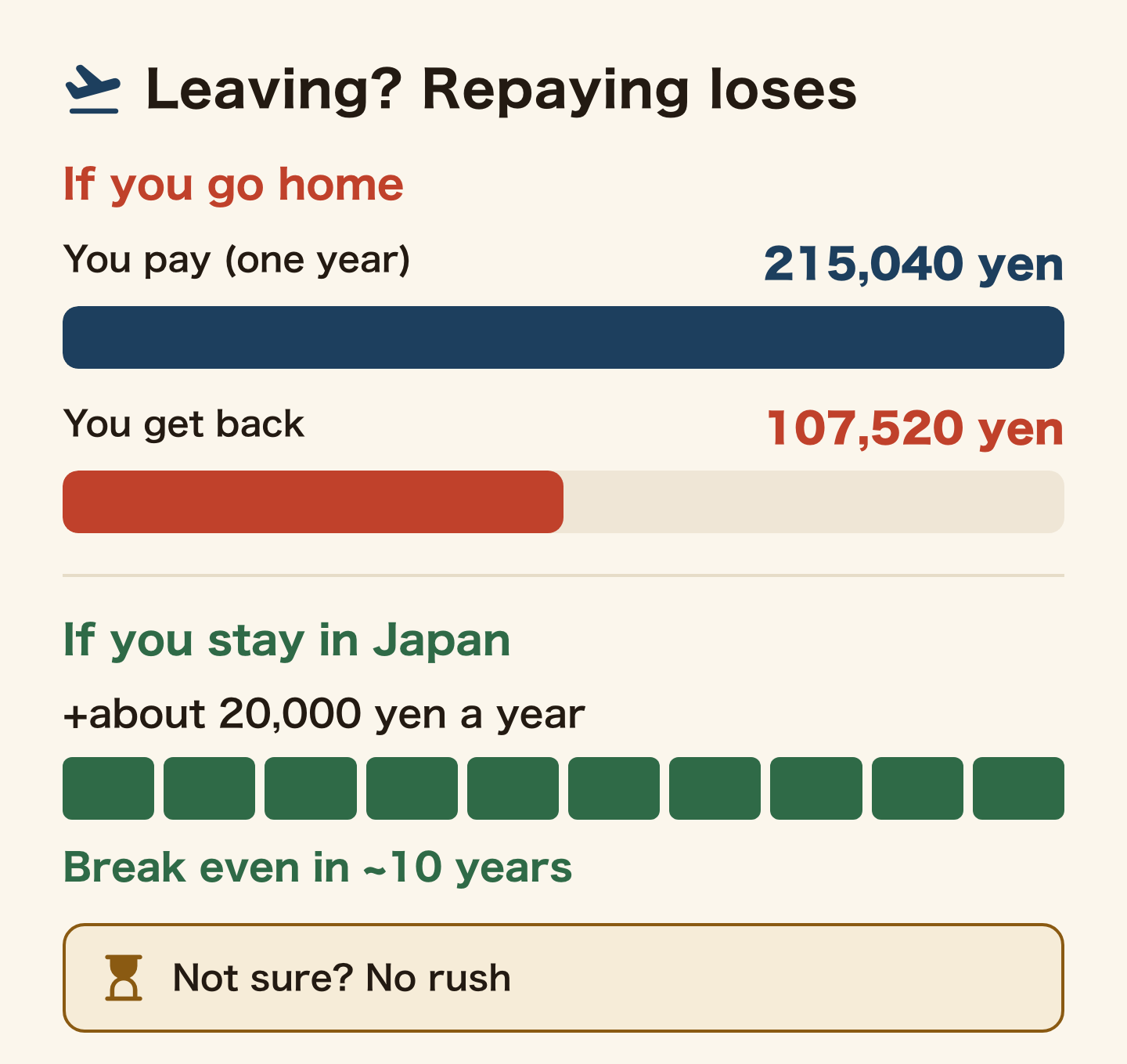
Run the numbers. One year of back-payment is 17,920 yen times 12, or 215,040 yen.
| If you return home | If you stay in Japan | |
|---|---|---|
| What you pay (one year) | 215,040 yen | 215,040 yen |
| What comes back | Lump-sum payment rises by 107,520 yen | Pension rises by roughly 20,000 yen a year (847,300 × 12/480 = 21,182 yen) |
| Verdict | You lose about 100,000 yen | Breaks even in about 10 years |
If you leave Japan, the only thing repayment buys back is the lump-sum withdrawal payment. And that payment is designed to be exactly half of what you contributed – 53,760 yen per six months in FY2026, so 107,520 yen for a year (Japan Pension Service, lump-sum withdrawal payment (Japanese)).
So you pay 215,040 yen to get 107,520 yen back. If you already know you are leaving, keeping the money is the better move.
One more thing that saves people money. The lump-sum payment is capped. Sixty months of contributions reaches the maximum of 537,600 yen and nothing beyond that counts. If you already have five years of paid months, repaying adds nothing at all.
So the decision splits cleanly.
- Staying in Japan to work? Repaying is worth it. A pension pays out for as long as you live, so breaking even at ten years means everything after that is gain
- Going home after graduation? Do not repay. Keep the 215,040 yen and claim the lump-sum payment when you leave
- Not sure yet? Nothing is urgent. You have ten years, and deciding once your path is settled is still in time
Does deferring reduce my lump-sum withdrawal payment?
This part has to be said plainly. Yes, it does.
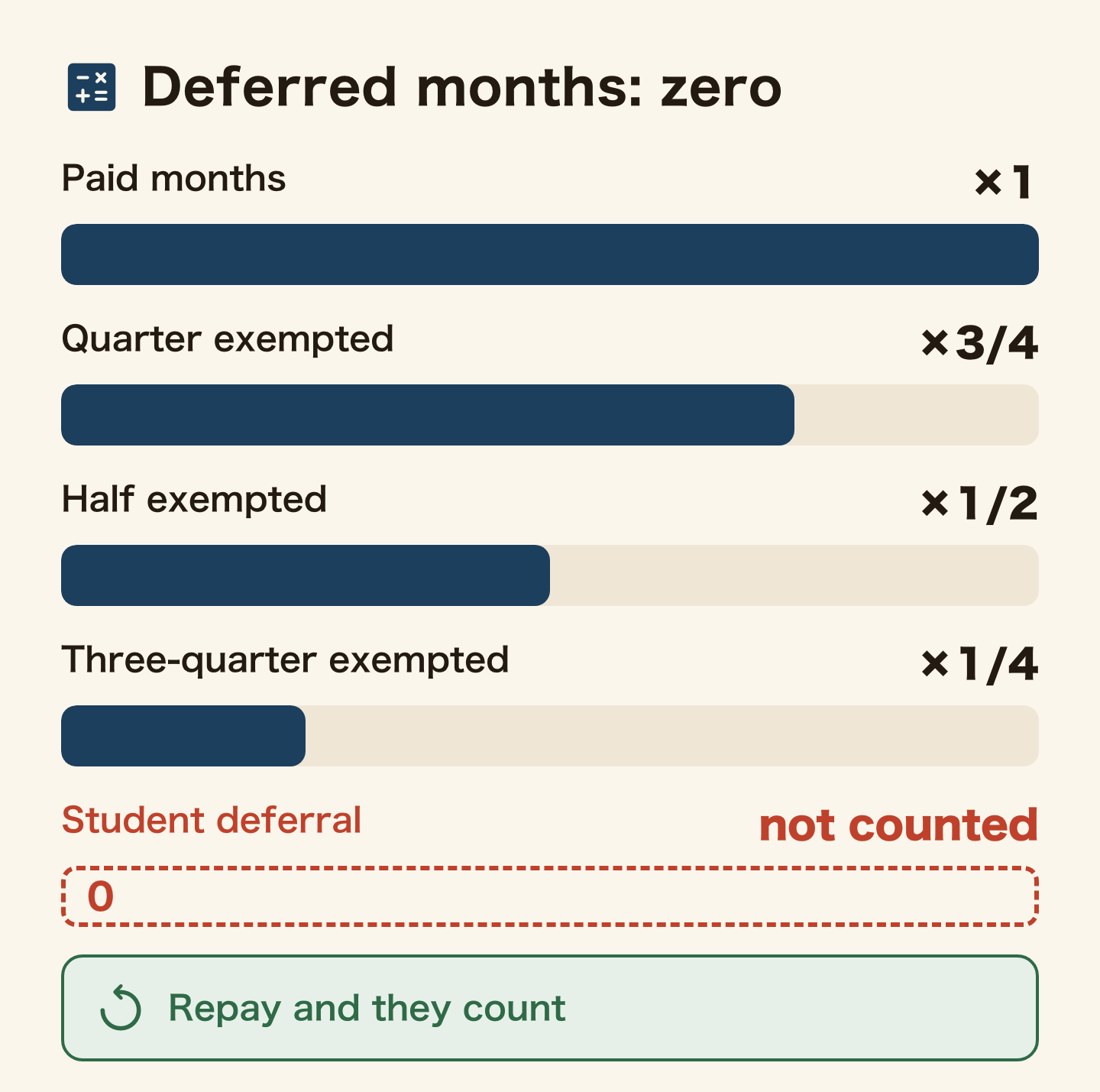
The lump-sum withdrawal payment you can claim on leaving Japan is calculated from a defined set of months: months of paid premiums, quarter-exempted months times three quarters, half-exempted months times one half, and three-quarter-exempted months times one quarter. Student deferral months are not on that list.
So months you deferred do not count, and the payment is smaller by exactly that much.
The order is still clear.
- Pay if you can. It builds both your pension and your lump-sum payment
- If you cannot, defer. Your visa stays clean and you can pay it back later
- Never simply leave it unpaid. No money either way, plus seizure and a visa problem
Back-payment turns those months into paid months. Pay them back once you are working and the lump-sum payment comes back too. Deferring is the recoverable choice.
Amounts and conditions were checked on the Japan Pension Service website on 24 August 2026 (the minimum wage against the Tokyo Labour Bureau on 1 October 2026). Rules change – confirm on the official site or at a counter before you apply. Official sources: Japan Pension Service, student payment special provision / the same body’s list of eligible schools / Japan Pension Service, National Pension premiums (Japanese) / Japan Pension Service, enforced collection of National Pension premiums (Japanese) / Japan Pension Service, lump-sum withdrawal payment (Japanese) / Tokyo Labour Bureau, Tokyo minimum wage raised to 1,280 yen (Japanese) / Immigration Services Agency, guidelines for permission for permanent residence (Japanese) (checked 26 September 2026)
Still short? Cut fixed costs in this order
Deferring the pension may not close the gap on its own. The chart below is ordered by size, but size is not the only thing that decides the order. Whether you can act on it today matters just as much.
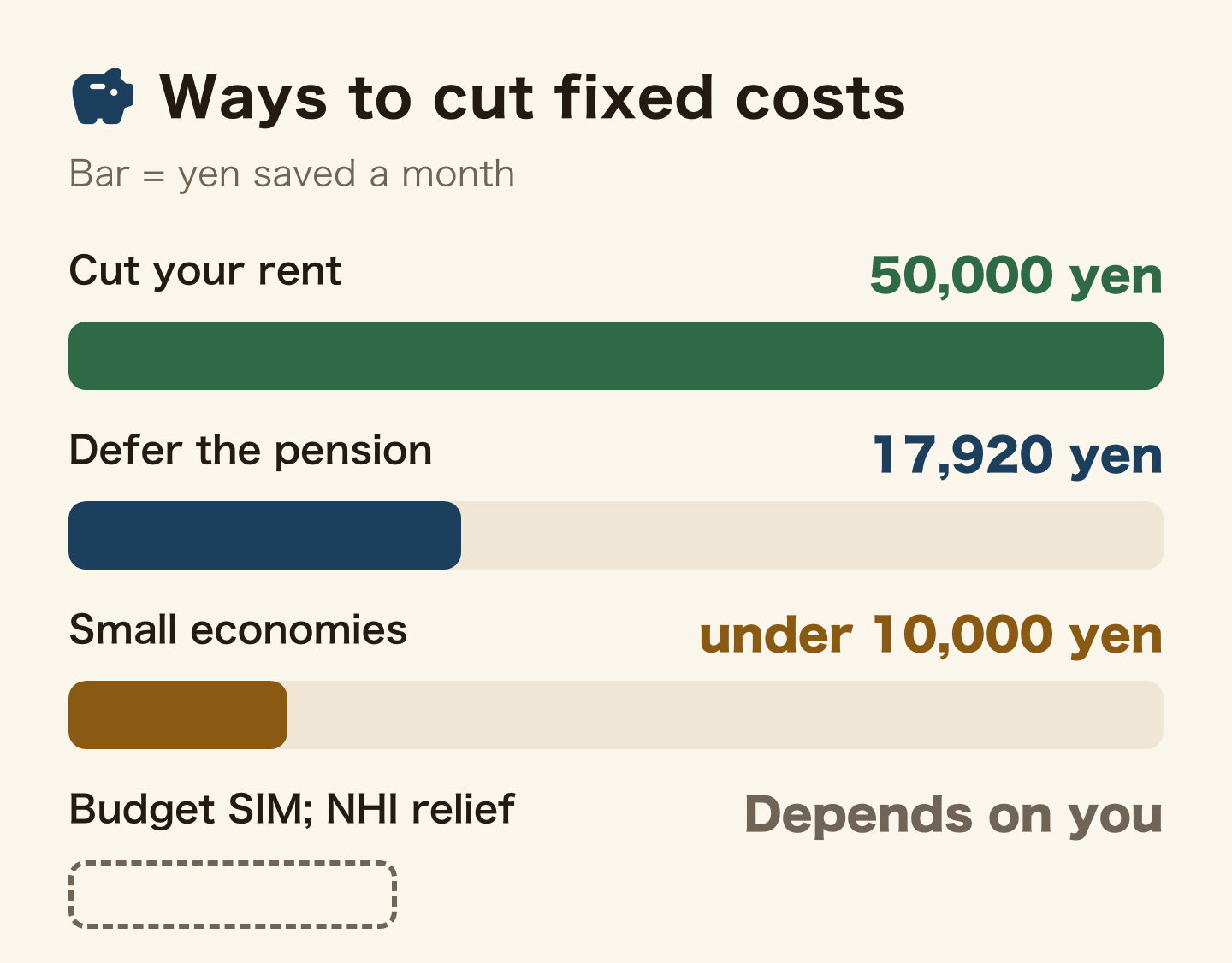
Rent is the big one. Moving from an 80,000 yen one-room flat into a share house at 30,000 yen frees up 50,000 yen a month.
Weigh that properly. 28 hours a week is 112 hours a month, so 50,000 yen divided by 112 is 446 yen an hour. Someone on 1,280 yen would have to find a job paying 1,726 yen (1,280 + 446) to match it. Nobody negotiates a 446 yen raise. You can move house this month.
Then the pension at 17,920 yen, then a budget SIM, where the saving depends on the plan you are on now. National Health Insurance has a reduction scheme as well.
Water-saving shower heads, electric blankets, cheaper supermarkets – together a little under 10,000 yen a month. Not the 50,000 yen that rent moves.
Calling that small would be wrong, though. On an income of 143,000 yen a month, 10,000 yen is 7 percent of everything you have. And the three options differ in a way the numbers hide.
| Option | Saves | What it takes to start |
|---|---|---|
| Cut your rent | 50,000 yen/mo | Moving house – deposits, a guarantor, and you cannot move mid-contract |
| Defer the pension | 17,920 yen/mo | An application at your school or city office, every fiscal year |
| Small economies | under 10,000 yen/mo | Nothing. You can start today |
Some people cannot move mid-contract, and some cannot leave the area around their school. For them the small economies are not the last resort – they are the only thing available right now.
So the real order is this. Take the big moves when you can. Take the small ones today. It was never a choice between them.
Health insurance has a step you have to take yourself as well. The National Health Insurance reduction does not arrive until you declare your income, even when it was zero. File for both and the whole thing comes to 1,630 yen a month.
Once you take a full-time job, you move from the National Pension to the Employees’ Pension, and the employer pays half.
Frequently asked questions
Q. Do international students have to pay the National Pension?
Yes. At 20 or over with a resident registration you are covered regardless of nationality. If you cannot pay, apply for the student payment special provision to have the premiums deferred.
Q. How much is the National Pension premium?
17,920 yen a month for FY2026, which is over 214,000 yen across the year.
Q. Is the student provision an exemption?
Strictly it is a deferral rather than an exemption. Approved months count toward your qualifying period but not toward the pension amount. You can pay them back within 10 years, and doing so does count them.
Q. Can students at Japanese language schools apply?
Usually yes. Miscellaneous schools are covered, provided the course runs a year or longer and, for private schools, the prefectural governor has approved it. Ask your school office or check the Japan Pension Service list of eligible schools.
Q. What happens if I just do not pay?
Demands come first, then your assets can be seized. Extensions of stay and permanent residence applications also assess whether you meet public obligations, which include pension and health insurance premiums. An approved deferral does not count against you.
Q. Does deferring reduce my lump-sum withdrawal payment?
Yes. The payment is calculated from paid and partially exempted months, and student deferral months are not included. Paying them back within 10 years turns them into paid months and restores it.
Q. Do I have to pay the deferred months back?
No. Repayment is not compulsory and there is no penalty for skipping it. Deferred months still count toward the qualifying period, so your right to a pension is unaffected. Only the amount changes: two deferred years never repaid means roughly 40,000 yen a year below the full pension (847,300 yen x 24/480 months, about 42,000 yen: Japan Pension Service (Japanese)).
Q. Is repaying worth it?
Not if you are going home. A year of repayment costs 215,040 yen and raises the lump-sum withdrawal payment by only 107,520 yen. If you stay in Japan it reverses: the old-age pension rises by about 20,000 yen a year (847,300 yen x 12/480 months is 21,182 yen: Japan Pension Service (Japanese)), so the 215,040 yen comes back in roughly ten years. You have ten years to decide, so waiting until your path is settled is fine.
Q. Do I only apply once?
No, it runs by fiscal year. Apply again at the start of each school year, or you fall into arrears from year two.
In short
- Residents aged 20 and over are covered, students included. The premium is 17,920 yen a month
- Cannot pay? Apply for the student payment special provision – a deferral, not an exemption
- Unpaid and deferred are not the same. Unpaid brings seizure and reaches your visa; deferred does not
- Japanese language school students can usually apply (one-year course, governor approval for private schools)
- Apply every fiscal year. People fall into arrears in year two by forgetting
- Deferred months do not count toward the lump-sum payment, and repayment is not compulsory
- Going home? Do not repay (215,040 yen buys back 107,520 yen). Staying in Japan flips it
- Still short? Start with rent. Cutting 50,000 yen equals a 446 yen hourly raise
Related guides
Found this useful? Share it
Send it to a friend who lives in Japan.
WHO WROTE THIS

mori
Japanese. I read the ministries’ own notices, orders and Q&As in the original, and I start from what my Nepalese and Sri Lankan friends in Japan actually ran into. I do not write about what I have not checked or been told.
What this site can and cannot do →Looking for something else?
You may use the figures in this article, including commercially, if you credit this site with a link. How to use our figures