Checked on 23 October 2026 against Japan Post’s official pages: the rate tables, the rate and delivery-day calculator, the availability table by country (as of 15 October 2026), the country conditions, the list of items that cannot be mailed, and the notice of new rates from 1 February 2027. Which countries are served and what it costs can change, so check Japan Post’s pages on the day you send.
The short answer
- To send a package home from Japan, the usual choices are Japan Post’s EMS and international parcels (airmail or sea mail). EMS is Japan Post’s international express mail, the fastest service in international mail. All of them go up to 30 kg, but some countries set a lower limit.
- For 10 kg to Asia (except China, Korea and Taiwan), EMS costs 13,350 yen, airmail 13,300 yen and sea mail 6,600 yen. At 10 kg, EMS costs only 50 yen more than airmail.
- SAL is suspended to every country. Sea mail is also suspended to Nepal and Sri Lanka (as of 15 October 2026). Before you send, look up your country in Japan Post’s availability table.
- Handwritten labels are not accepted. Make the label on International Mail My Page (on a phone you can use it without registering), then take the box to a post office.
- Perfume, spray cans, nail polish, power banks and e-cigarettes cannot be sent to any country. Prices go up on 1 February 2027, so 31 January is the last day at today’s rates.
Knowing this, you can decide before you go to the post office which service to use, what it will cost, how long it takes and what must not go in the box, and you will not get stuck at the counter.
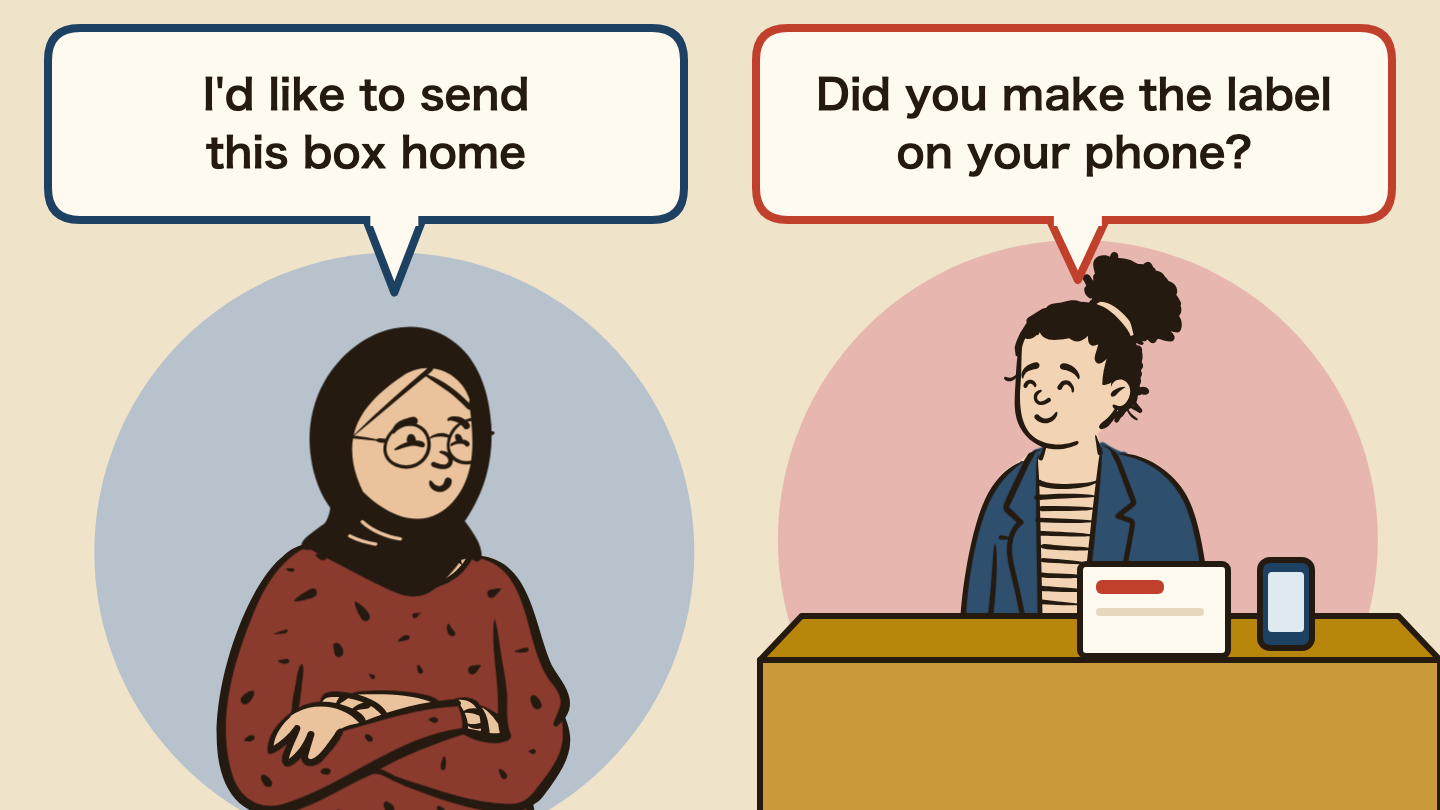
Early December. A friend flying home for the winter holidays has a full suitcase and cannot take your presents for the family. You pack clothes and snacks into a cardboard box and carry it to the post office. At the counter you are asked, “Have you made the label?” Your Japanese friend says, “Can’t you just fill in a slip?” Your friend has never sent anything abroad. International mail has its own rules, separate from domestic delivery.
- How do you send a package home from Japan? EMS, airmail and sea mail
- How much do EMS, airmail and sea mail cost? 5 kg and 10 kg compared
- How many days does EMS take? 3 days to Vietnam, about 2 months by sea
- Can you use sea mail or SAL now? Suspended to some countries
- Which service should you use? Decide by speed, cost and weight
- How do you send a package home? Pack, make the label, go to the post office
- What can’t you send? Perfume, sprays, power banks, and each country’s bans
- What if it is damaged or lost? EMS covers 20,000 yen for free
- Sending your things when you leave Japan, or a box worth over 200,000 yen
- How to pay less: compare shipping with taking it or letting it go
- Which one are you?
- FAQ
- Summary
- Related reading
How do you send a package home from Japan? EMS, airmail and sea mail
Japan Post has four main ways to send goods abroad (Japan Post service list and comparison).
- EMS (international express mail): up to 30 kg. It gets top priority in international mail and arrives fastest. It is tracked.
- International parcel: up to 30 kg. You choose airmail, SAL or sea mail. It is tracked.
- International Air Packet: small items up to 2 kg. It goes by air, is tracked, and is delivered to the recipient’s mailbox.
- Small packet: up to 2 kg. It is not tracked.
EMS goes to more than 120 countries and regions (Japan Post, EMS). The size limit is 1.5 m on the longest side and 3 m for length plus girth. You can compare the limits of each service in Japan Post’s service list and comparison. The limits differ by country, though. Parcels to Nepal, for example, may weigh up to 20 kg and measure up to 1.05 m long, with length plus girth up to 2 m (Japan Post country conditions, Nepal).
How much do EMS, airmail and sea mail cost? 5 kg and 10 kg compared
The price depends on the destination’s “zone” and the weight. China, Korea and Taiwan are Zone 1, and the rest of Asia is Zone 2 (Japan Post rate tables). Hong Kong and Macau are in Zone 2 too. Nepal, Sri Lanka, Vietnam, the Philippines, Indonesia and Myanmar are all in Zone 2, so they share the same prices.
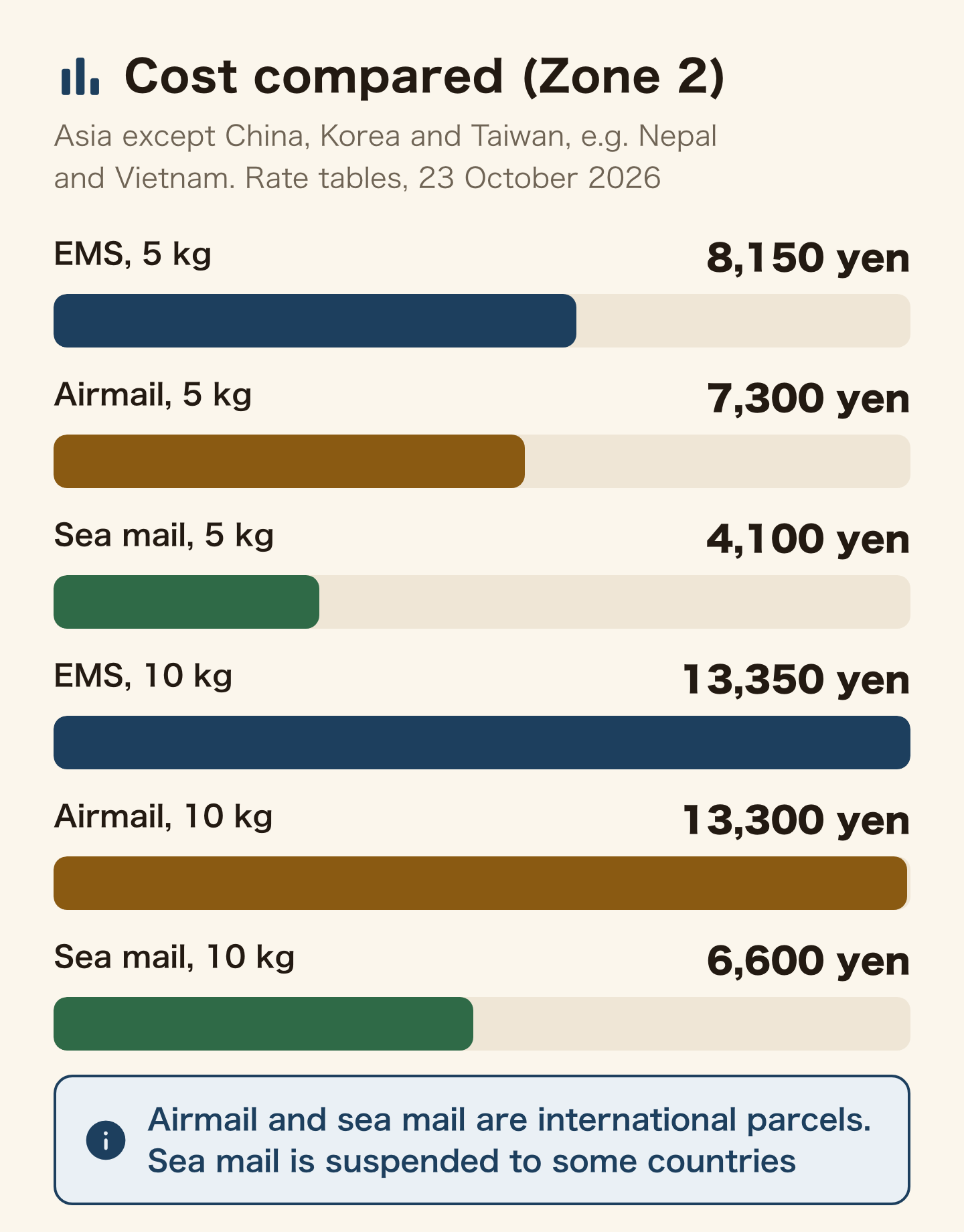
Prices to Zone 2 are as follows (rate table, EMS and rate table, international parcels, Zone 2).
| Weight | EMS | Airmail | Sea mail |
|---|---|---|---|
| Up to 5 kg | 8,150 yen | 7,300 yen | 4,100 yen |
| Up to 10 kg | 13,350 yen | 13,300 yen | 6,600 yen |
| Up to 30 kg | 33,350 yen | 26,300 yen | 14,600 yen |
To China (Zone 1), 10 kg costs 10,600 yen by EMS, 8,350 yen by airmail and 5,400 yen by sea mail (rate table, international parcels, Zone 1).
At 10 kg to Zone 2, EMS costs only 50 yen more than airmail. EMS is faster and better covered, so for a 10 kg box when sea mail is not available, EMS is the better deal. At 5 kg the gap is 850 yen (8,150 − 7,300).
For 2 kg or less, the International Air Packet is cheaper. To Zone 2 it costs 1,830 yen up to 1 kg and 3,030 yen up to 2 kg (Japan Post, International Air Packet). The same 2 kg by EMS costs 4,550 yen.
How many days does EMS take? 3 days to Vietnam, about 2 months by sea
Put 5 kg from Tokyo to Vietnam into Japan Post’s calculator and it shows 3 days for EMS, 6 days for airmail and “about 2 months” for sea mail (Japan Post rate and delivery-day calculator, 23 October 2026). To Sri Lanka, EMS takes 14 days and airmail 17 days. For Nepal, no number of days is shown.
These are “standard days” and do not include customs clearance. Japan Post says weekends, public holidays and flight delays can add more. If the box must arrive for a birthday or a festival, send it with extra time on top of the days shown.
Can you use sea mail or SAL now? Suspended to some countries
SAL is cheaper than airmail and faster than sea mail. Right now, though, Japan Post’s country conditions state that it has completely stopped accepting SAL items. Its notice of the February 2027 rate change also says the date for restarting SAL is “undecided” (Japan Post notice of international rate changes).
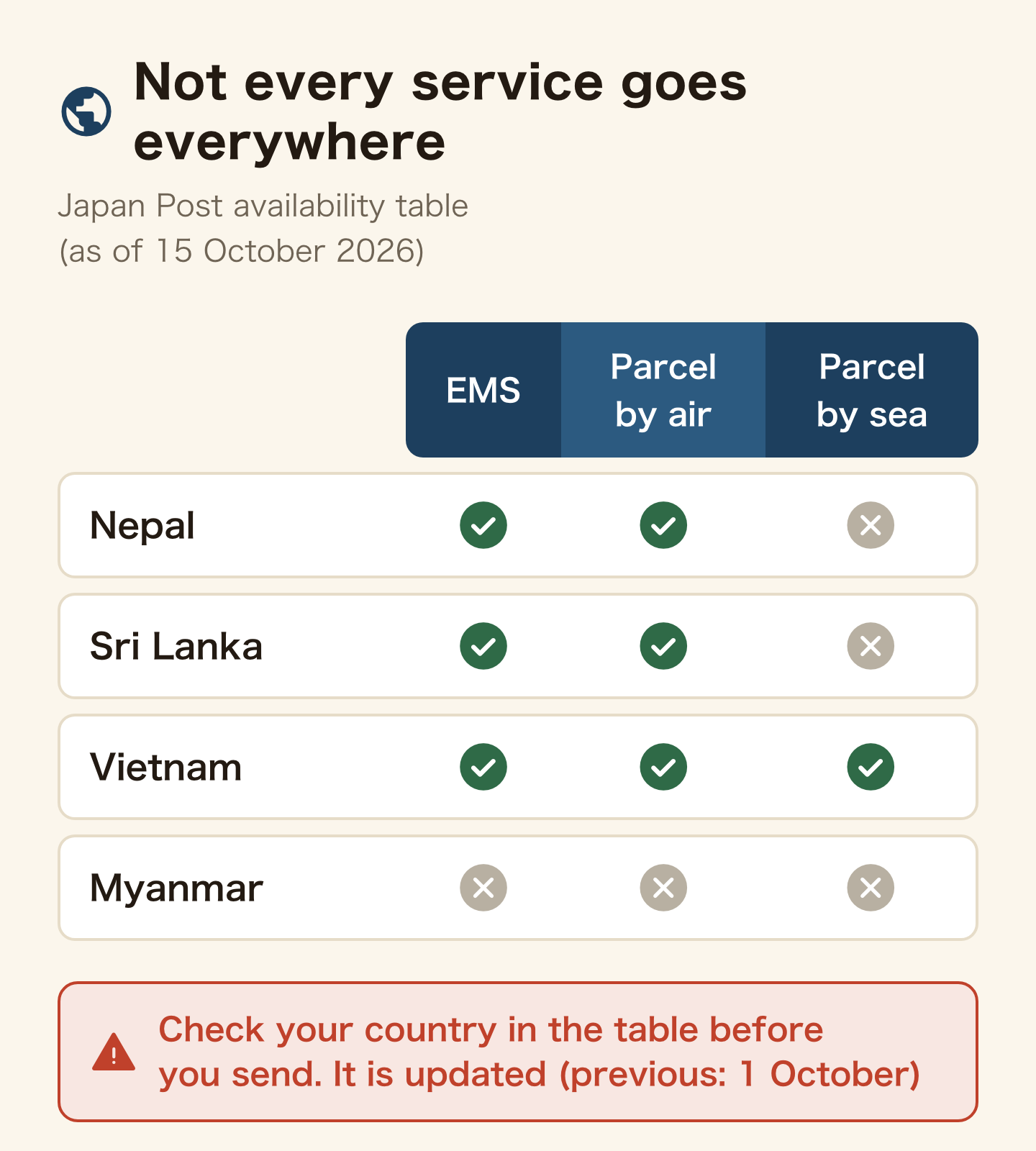
Sea mail is suspended to some countries too. In the table as of 15 October 2026, parcels to Nepal and Sri Lanka can go by airmail only (Japan Post availability by country). To Vietnam, China, the Philippines and Indonesia, sea mail is available. To Myanmar, neither EMS nor international parcels are accepted. Letters and International Air Packets up to 2 kg can still go by air.
The table is updated from time to time. The edition before this one was as of 1 October. Before the day you send, check your country’s row.
Which service should you use? Decide by speed, cost and weight
If you are unsure, answer in this order: the weight, whether you are in a hurry, and whether sea mail is available.
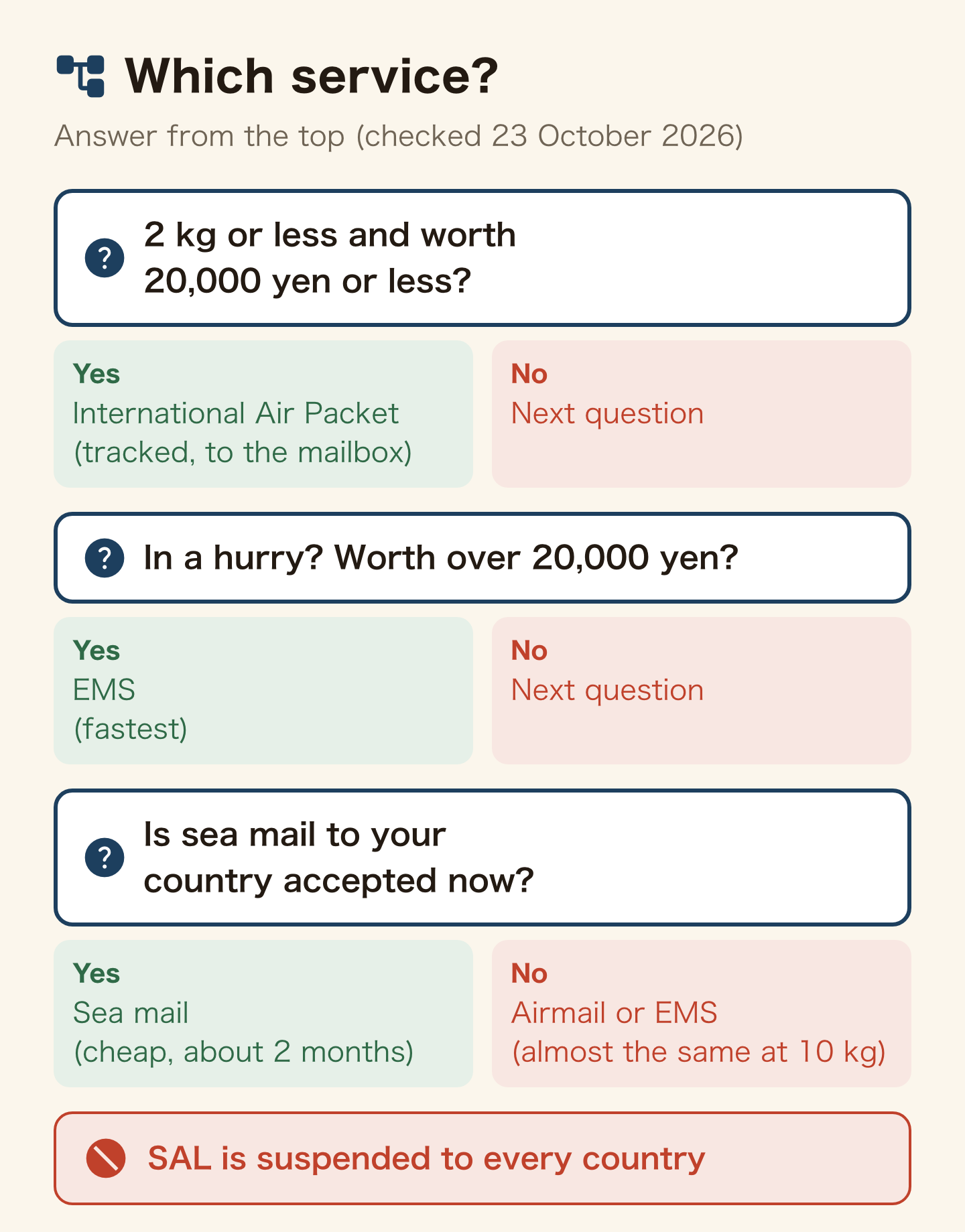
- A small item of 2 kg or less, worth 20,000 yen or less: International Air Packet.
- Something urgent, or worth over 20,000 yen: EMS. It is covered up to 20,000 yen without doing anything.
- A heavy box that is not urgent, where sea mail is accepted: sea mail. 10 kg to Vietnam costs 6,600 yen.
- A country where sea mail is suspended: airmail or EMS. At 10 kg to Zone 2 the gap is 50 yen, so choose EMS.
International parcels to Nepal are not delivered to the door. In the country conditions, “delivery to the address” is marked ×, and the recipient collects the parcel at a post office counter. EMS is delivered to the address, in Nepal too. If it is hard for your family to get to the post office, choose EMS.
How do you send a package home? Pack, make the label, go to the post office
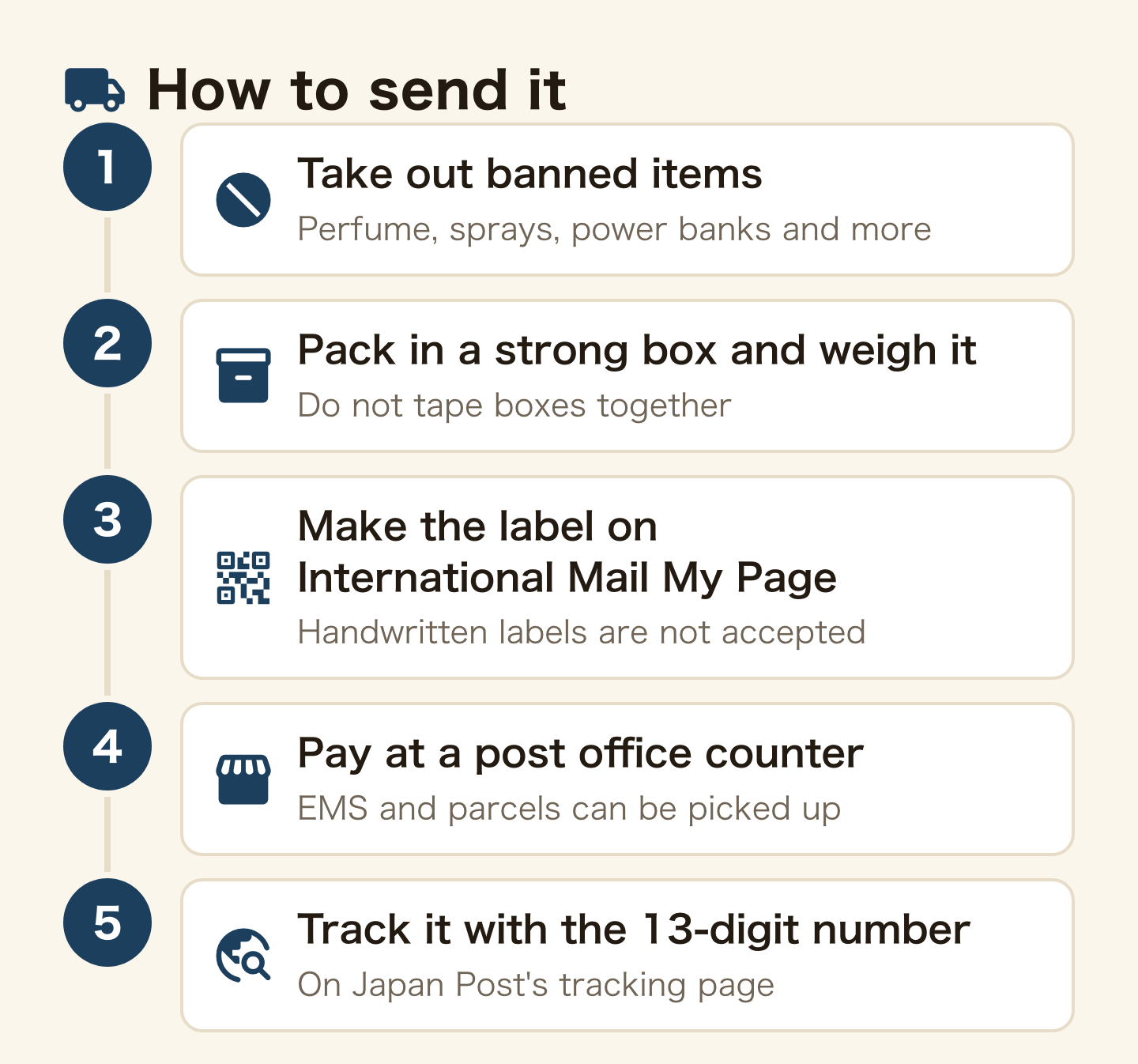
Filling in a paper slip by hand at the post office: where you come from, that may be normal. In Japan, handwritten labels are not accepted for international mail. You have to make the label on International Mail My Page (Japan Post, how to make a label).
- Take out anything that cannot be sent. See the list in the next section.
- Pack a strong cardboard box, fill the gaps with cushioning, and weigh it. International mail has no “fragile” or “this side up” handling. Do not tape two or more boxes together either (Japan Post guide to sending international mail). A box printed with pictures of meat, vegetables or fruit may be refused.
- On International Mail My Page, enter the sender, the recipient and the contents. Name each item specifically, such as “Stuffed Doll” rather than “Toy”. What you enter is sent ahead to the destination country as customs electronic data. EMS, international parcels, small packets and International Air Packets cannot be sent without this data (Japan Post on sending HS codes and customs data).
- On the phone version, hold the QR code you receive by email over the Yu-Print Touch machine at the post office to print the label. On the PC version, print it yourself on A4 paper and put it in the pouch you get at the post office.
- Pay at the post office counter. At a post office, postage can be paid by credit card, debit card, e-money or smartphone payment as well as cash (Japan Post, cashless payment at post office counters). At a small contracted post office (kan’i yubinkyoku), postage cannot be paid cashless. EMS and international parcels can also be picked up from your home.
- Use the 13-digit number on your receipt to follow the delivery on Japan Post’s tracking service.
Enter the address in the Roman alphabet, the way the destination country writes it. For Vietnam, an address without the new address and postcode system that started on 1 July 2025 cannot be delivered and is returned (Japan Post country conditions, Vietnam). For goods, also enter the recipient’s 12-digit personal ID or Vietnamese tax number in the customs data (‘TAX code / VAT number’ field). How to write your own Japanese address in English is in how to write a Japanese address in English.
What can’t you send? Perfume, sprays, power banks, and each country’s bans
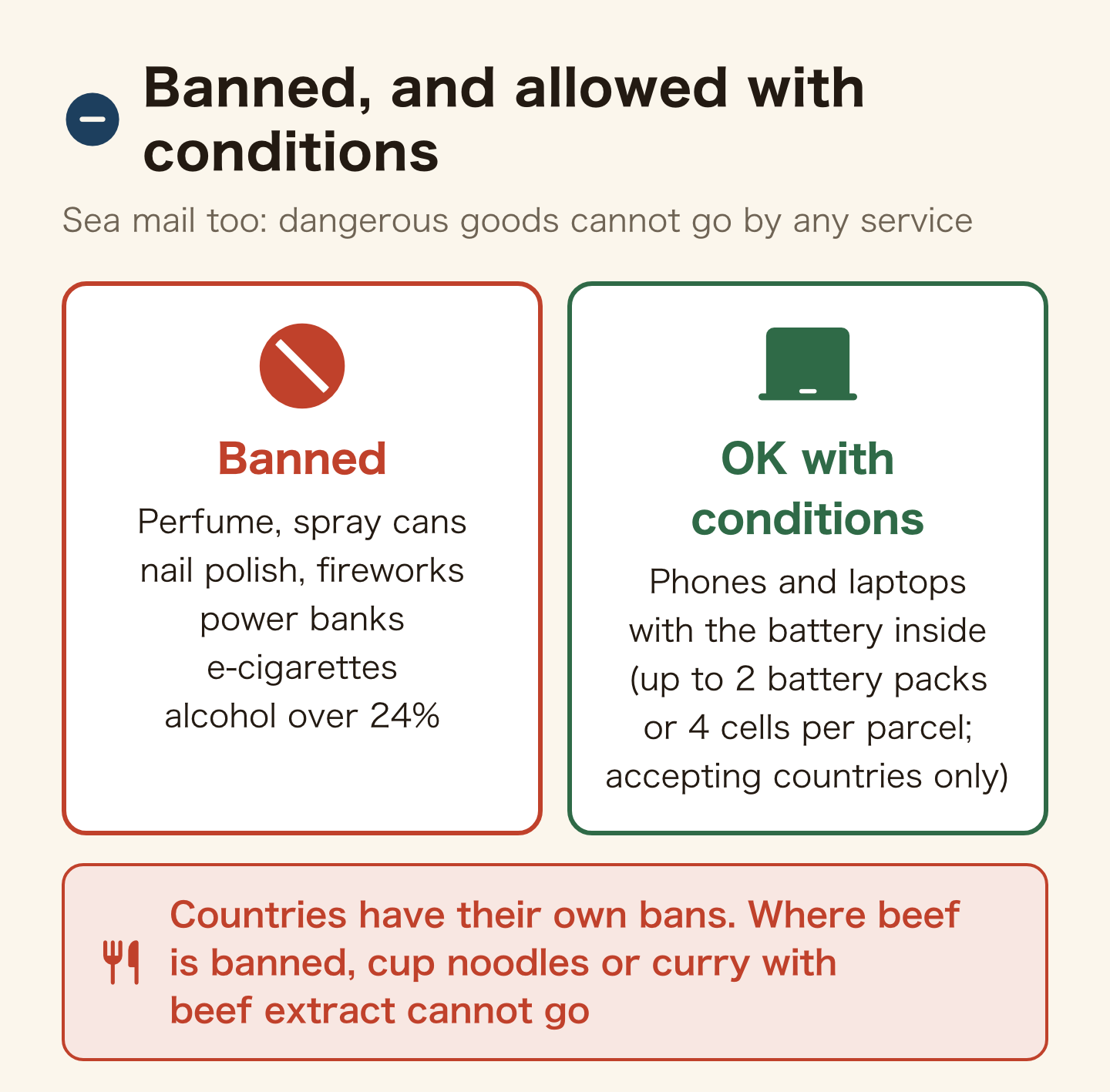
Typical items that cannot be sent to any country are spray cans, perfume, fireworks, nail polish, e-cigarettes, power banks and alcoholic drinks above 24% alcohol (Japan Post, items that cannot be sent internationally). Sunscreen and hair tonic with more than 24% alcohol are on the list too. These are dangerous goods for air transport, so sending them by sea mail does not help.
Phones and laptops can be sent with the battery inside. The conditions are up to 4 battery cells or 2 battery packs per parcel, sent to a country that accepts them (Japan Post conditions for lithium batteries). A spare battery that has been taken out, or a battery packed loose next to the device, cannot be sent.
The destination country has its own bans as well. Japan Post lists alcohol, tobacco, meat, vegetables and fruit as items people often send by mistake. To a country that bans beef, you also cannot send cup noodles, curry or consommé that contain beef extract. Check each country’s bans under “prohibited items” in the country conditions.
Do not put cash in either. Coins and banknotes cannot be sent by EMS. If you want to get money to your family, it is safer to compare the fees in sending money home from Japan and send it that way.
What if it is damaged or lost? EMS covers 20,000 yen for free
EMS is covered up to 20,000 yen without asking. If the contents are worth more than 20,000 yen, declare the value when you send it. For 50 yen (60 yen from 1 February 2027) per extra 20,000 yen you can raise the cover up to 2 million yen (Japan Post, EMS compensation).
For international parcels without insurance, the maximum compensation depends on the weight: 11,160 yen up to 5 kg, 15,170 yen up to 10 kg and 31,230 yen up to 30 kg (Japan Post, compensation for international mail). Insurance cannot be added to parcels to Nepal, Sri Lanka or Vietnam. Small packets are not covered (registered mail for small packets ended on 31 December 2025: Japan Post service list, in Japanese). If you are sending something valuable, use EMS, where you can set the amount of cover.
Sending your things when you leave Japan, or a box worth over 200,000 yen
When you send your things home before leaving Japan, the steps are the same. The difference comes when the contents add up to more than 200,000 yen. You then need an export declaration to customs and export permission (Japan Post, sending items worth over 200,000 yen abroad). Japan Post can file the declaration for you for a fee of 2,800 yen per case (until 31 January 2027; 3,200 yen from 1 February 2027) (new rate table). You prepare an invoice in English and a customs power of attorney. If you send several boxes to the same person at the same time, the contents of all the boxes are added together.
The destination country’s customs may charge tax. How it treats the belongings of people moving home also differs by country. Before you send, check your home country’s customs website. The order of everything else to do before you leave is in the leaving Japan checklist.
How to pay less: compare shipping with taking it or letting it go
The heavier the box, the less you pay per kilogram. By airmail to Zone 2, 5 kg works out at 1,460 yen per kg (7,300 ÷ 5) and 30 kg at about 877 yen per kg (26,300 ÷ 30) (rate table, international parcels, Zone 2). Parcels to Nepal, however, are limited to 20 kg.
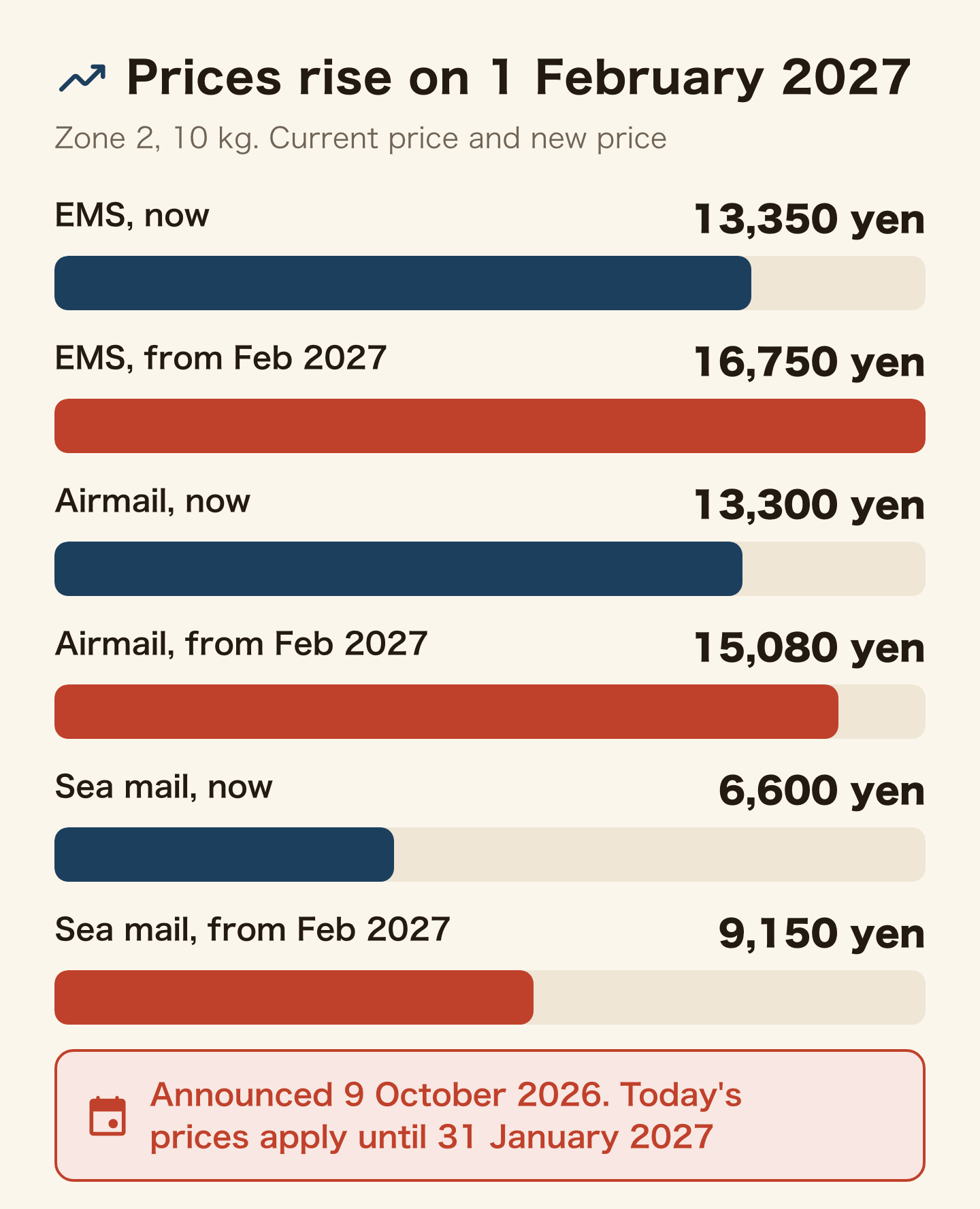
International postage goes up on 1 February 2027. For 10 kg to Zone 2, EMS rises from 13,350 yen to 16,750 yen, airmail from 13,300 yen to 15,080 yen, and sea mail from 6,600 yen to 9,150 yen (Japan Post new rate table from 1 February 2027). If you plan to send something over the New Year holidays, posting it by 31 January keeps today’s price.
Before you send, also ask whether the item is worth the postage. There are three ways to look at it.
- Things worth less than the postage (old clothes, cheap everyday items): do not send them. Give them away or let them go in Japan, and buy again at home. How to throw things out is in garbage disposal in Japan.
- Things you cannot get at home, or things with memories: worth sending. If there is no hurry and sea mail goes to your country, use sea mail.
- If you are flying home: check on your airline’s website how much checked baggage you can take and what extra weight costs. Compare that with the postage before you decide.
Which one are you?
- Sending a small item of 2 kg or less: use the International Air Packet. Today, weigh it and make the label on International Mail My Page.
- Sending something urgent or worth over 20,000 yen: use EMS, and declare the value if the contents are worth more than 20,000 yen. Today, check the price and days in the calculator.
- Sending a heavy box that is not urgent: look up sea mail to your country in the availability table. Today, use sea mail if it is accepted; if not, compare EMS and airmail in the calculator.
- Sending your things before leaving Japan: sort them into “send”, “take with me” and “let go”, and add up whether the contents exceed 200,000 yen. Today, decide how many boxes and the day you will post them, by 31 January 2027.
Once the box is posted, send the 13-digit number to your family too. When tracking shows “delivered”, this box is no longer something to worry about.
FAQ
Q. What is the cheapest way to send a package home from Japan?
For a heavy box, sea mail, if it goes to your country. 10 kg to Zone 2 costs 6,600 yen. For a small item up to 1 kg, the International Air Packet (1,830 yen) can be cheaper. Sea mail to Nepal and Sri Lanka is suspended, so there it is airmail or EMS. SAL is suspended to every country (as of October 2026).
Q. What is the difference between EMS and an international parcel by airmail?
EMS is faster and is covered up to 20,000 yen without asking. An international parcel without insurance is covered up to 15,170 yen for 10 kg. For 10 kg to Zone 2, the price difference is 50 yen.
Q. How many days does EMS take?
Japan Post’s calculator shows 3 days from Tokyo to Vietnam and 14 days to Sri Lanka (23 October 2026). Customs clearance is not included and can add more time.
Q. Can I use a handwritten slip?
No. You make the label on International Mail My Page. The phone version can be used without registering, and you print the label on the Yu-Print Touch machine at the post office.
Q. Can I send cosmetics or food?
Perfume, nail polish and spray cans cannot be sent to any country. Food depends on the destination country’s bans. To a country that bans beef, you cannot send cup noodles or curry with beef extract either. Check “prohibited items” in Japan Post’s country conditions.
Q. How do I send my things home when I leave Japan?
The steps are the same. If the contents add up to more than 200,000 yen you need an export declaration, and Japan Post charges 2,800 yen (3,200 yen from 1 February 2027) per case to file it. Prices go up on 1 February 2027, so posting by 31 January keeps today’s price. Check tax at home with your home country’s customs.
Summary
To send a package home from Japan, choose from Japan Post’s EMS, international parcels and International Air Packet. The price depends on the zone and the weight: for 10 kg to Asia (except China, Korea and Taiwan) it is 13,350 yen by EMS, 13,300 yen by airmail and 6,600 yen by sea mail. Handwritten labels are not accepted; you make the label on International Mail My Page.
SAL is suspended worldwide, and sea mail is suspended to Nepal and Sri Lanka. Before you send, look up your country in the availability table. If sea mail is not available, compare airmail and EMS in the calculator. At 10 kg to Zone 2 the gap is 50 yen, so choose EMS, which is faster. Leave out perfume, sprays and power banks, and check the destination’s bans on food. Prices go up on 1 February 2027, so post anything for the New Year holidays by 31 January.
Official sources: Japan Post service list and comparison / EMS / rate tables: EMS, parcels Zone 1, Zone 2 / International Air Packet / rate and delivery-day calculator / availability by country and table (as of 15 October 2026) / country conditions: Nepal, Sri Lanka, Vietnam, Myanmar / notice of rate changes from 1 February 2027 and new rate table / items that cannot be sent and lithium battery conditions / guide to sending international mail / how to make a label / HS codes and customs data / items worth over 200,000 yen / compensation and EMS / cashless payment at post offices / tracking (all checked 23 October 2026). Countries served, prices and delivery days change, so check Japan Post’s pages on the day you send.
Related reading
Found this useful? Share it
Send it to a friend who lives in Japan.
WHO WROTE THIS

mori
Japanese. I read the ministries’ own notices, orders and Q&As in the original, and I start from what my Nepalese and Sri Lankan friends in Japan actually ran into. I do not write about what I have not checked or been told.
What this site can and cannot do →Looking for something else?
You may use the figures in this article, including commercially, if you credit this site with a link. How to use our figures