The Japanese-system parts of this article were checked on 9 October 2026 against pages from the Immigration Services Agency and the Financial Services Agency. The book parts are my own summary.
The short answer
- The four quadrants are four ways money comes in, as laid out in a book by Robert Kiyosaki. E (employee), S (self-employed), B (business owner) and I (investor). The book is divisive, and it is not evidence about Japanese rules or statistics.
- In Japan, your residence status sets the activities you may do. You may not be free to choose any of the four.
- This article does not claim which status allows which quadrant. It only reports what the Immigration Services Agency pages say. Where they do not say, the answer is: it depends on your status, so check the scope of your permission first.
- In the 5 Skills, E, S and B sit in Earn and I sits in Grow. The order is Protect, Save, Earn, Grow, Spend well.
- This is not an article telling you to change jobs or start a business.
Once you see this, you can turn the four famous quadrants into an order for checking your own status. The order is: check the scope of your permission first, then think about the type.
You may have read about the four quadrants and wondered which of them applies to you in Japan. The book’s diagram makes it look as if anyone can move to any of the four. Residence statuses in Japan limit the range in advance. This article is a map that puts the book’s four types next to what the Immigration Services Agency pages say.
- What are the four quadrants? Four ways money comes in, per Kiyosaki
- Mapping the four types onto the 5 Skills
- In Japan, your residence status decides the activities first
- E (employee): many statuses are based on a contract
- S (self-employed): running a business is also named in the permission page
- B (business owner): there is a status called Business Manager
- I (investor): Grow. Not a type of work, but there are points to check
- Checking which type you are in now: start with the residence card
- When to stop: which one are you?
- FAQ
- Summary
- Read next
What are the four quadrants? Four ways money comes in, per Kiyosaki
Robert Kiyosaki is best known for Rich Dad Poor Dad. The four-quadrant framework is explained in a sequel in the same series, Rich Dad’s CASHFLOW Quadrant.
The book sorts the ways money comes in into four. E (employee) is someone employed by a company and paid a salary. S (self-employed) is someone who does the work themselves and runs a small business. B (business owner) owns a business whose system runs on other people. I (investor) lets money do the work. In outline, E and S earn by their own effort, while B and I earn from systems and assets.
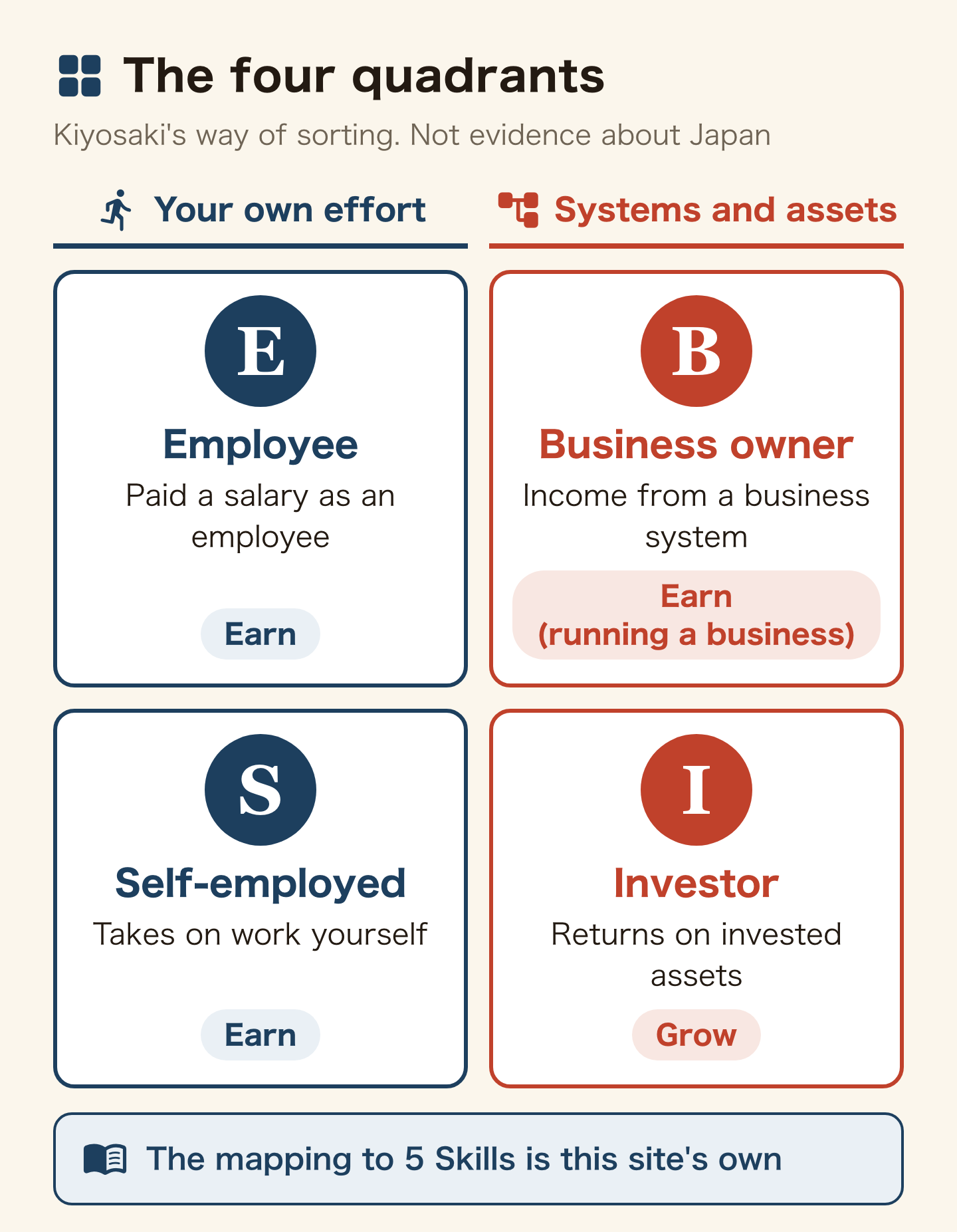
Keep in mind that the book divides readers. What it claims is separate from statistics and institutional facts. This article uses the book only as a framework. It does not say which type pays better or suits whom, and it does not state the book’s anecdotes or figures as fact.
Mapping the four types onto the 5 Skills
This site organizes money and life in Japan into five skills: Protect, Save, Earn, Grow, Spend well, stacked from the bottom (the 5 Skills). The four types map as follows.
| Book type | How money comes in | 5 Skills |
|---|---|---|
| E Employee | Paid a salary as an employee | Earn |
| S Self-employed | Takes on work yourself | Earn |
| B Business owner | Income from a business system | Earn (running a business) |
| I Investor | Returns on invested assets | Grow |
This mapping is this site’s own, made to fit life in Japan. The book does not assign the 5 Skills. Notice that none of the four types contains Protect or Save. Before choosing a type, protecting your residence status and contracts and setting money aside come first. That is the order of the 5 Skills (the Earn page).
In Japan, your residence status decides the activities first
The Immigration Services Agency’s table of statuses groups them. The statuses in the first and second tables, plus technical intern training, are classed as work statuses. Cultural activities and temporary visitor (third table) and student, trainee and dependent (fourth table) are classed as non-work statuses. Designated activities are those the Minister of Justice designates for each person. Permanent resident, spouse of a Japanese national, spouse of a permanent resident and long-term resident are described not by an activity but by a status or position held in Japan.
Your residence card shows your status and whether you may work (Immigration Services Agency, “What is a residence card?”). In your country, whether to take a side job or start a business may be your own decision. In Japan, your status first sets what you may do.
The entry point for adding another type next to your main one is permission to engage in activity outside your status. According to the Agency’s page on that application, it is for when you wish to run a business that earns income, or to receive pay, in an activity that is not part of your current status. There is no fee. One of the requirements is that you are actually carrying out the activity of your current status. So adding a type is not a free choice. It comes after checking the scope of your permission.
E (employee): many statuses are based on a contract
In the second table of the status list, Engineer/Specialist in Humanities/International Services, Researcher, Instructor, Nursing Care and Skilled Labor are described as activities carried out under a contract with a public or private organization in Japan. In other words, employed work starts from the activity at the organization you contracted with.
If you wonder whether your job falls within the permitted range, the humanities visa jobs article shows where the line is drawn and what gets refused. For checking that a new job is within scope after you change jobs, the certificate of authorized employment article is the place. The Agency’s page of that name describes the certificate as a document proving the business or paid activity your status allows. For the notification after you change employers, the job change notification article explains the 14 days and how to file.
S (self-employed): running a business is also named in the permission page
The Agency’s page on permission for activity outside status lists “running a business that earns income” alongside “receiving pay”. So it is not only employment. Running your own business can also require permission if it lies outside your current status.
The Agency’s page for the student status goes into more detail. For activities such as individual business operation where working hours are hard to verify objectively, individual permission is needed. And if you set up a new corporation, hire employees or work from an office, the page says a change to the Business Manager status is required. That is an explanation for students and does not necessarily apply to other statuses. It depends on your status, so check the scope of your permission first.
For a broader look at how far you can earn from your own position, the article on making money in Japan compares what a work visa, a Japanese spouse and a student status allow. For how student work hours are counted, the part-time job article is where to check.
B (business owner): there is a status called Business Manager
The Agency’s page on the Business Manager status describes its activity as running a trade or other business in Japan, or engaging in the management of that business. Its examples include executives and managers of companies.
In the book, B is someone who owns a system that runs on other people. The status wording centers on engaging in the running or management of a business rather than on owning one. Whether holding a stake in a business and engaging in its management are treated the same depends on the status. The wording of this page alone cannot settle it.
The same page lists required documents by the category of the organization, and says further materials may be requested during review. The criteria can be amended, so open the latest page before applying.
I (investor): Grow. Not a type of work, but there are points to check
In the book, I is the type where money works for you. On the Japanese side, the Financial Services Agency’s NISA page explains NISA as a tax-exempt investment scheme. It lists these points: gains from selling and dividends or distributions are tax-free, and the tax-free holding period has no limit. Investments can fall in value, and you can lose principal. This article only introduces the scheme and does not say whether to start.
The Immigration page on permission for activity outside status deals with running a business and receiving pay. It does not mention investing through a brokerage account as such. We have not confirmed how each status treats it, so if you are unsure, ask the Immigration Services Agency.
In the order of the 5 Skills, this sits near the end. For opening an account and what happens when you leave Japan, see the NISA article. To ask whether savings alone are enough, the article on whether foreigners should invest sets out the order for people who will leave. For a scheme you cannot withdraw from until 60, the iDeCo article lets you read the exit first.
Checking which type you are in now: start with the residence card
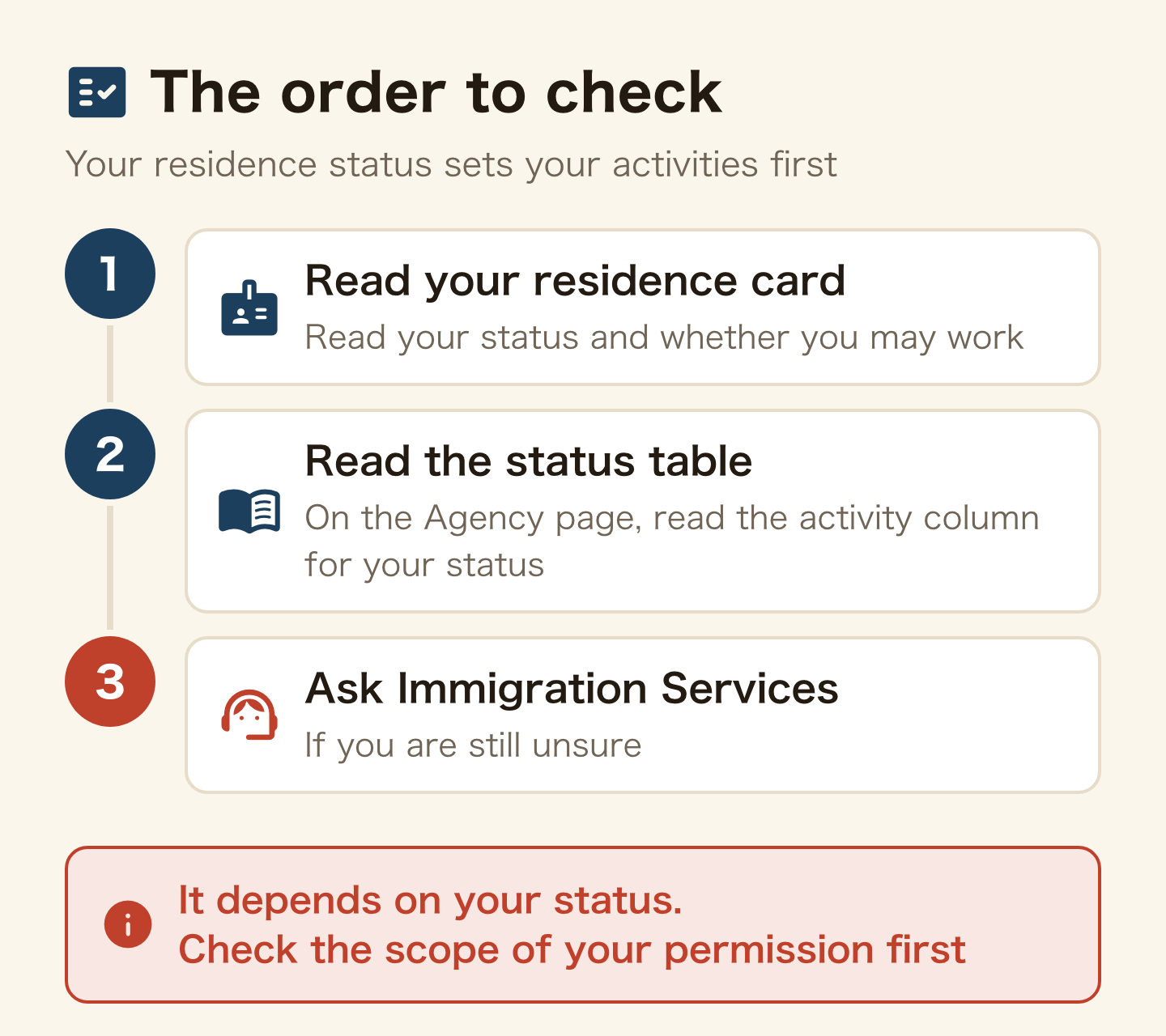
There are three steps. First, read your status and whether you may work on your residence card. Second, read the activity column for that status in the Agency’s status table. Third, if you are still unsure, ask the Immigration Services Agency.
How to read the card and the duty to carry it are in the residence card article. Before adding a type, protecting your current status comes first. The renewal timing and fees are in the visa renewal article, and the situations that lead to cancellation are in the visa cancelled article. To go back to the base of the 5 Skills, read the section on protecting your status on the Protect page.
When to stop: which one are you?
- You are employed now (E): read whether you may work on your residence card. If your employer or the content of your job is about to change, ask the Immigration Services Agency first. You can stop reading here.
- You are a student thinking about an income-earning activity: open the Agency’s page on permission for activity outside status for students, and check only whether your activity falls within the range. If it does not, do not start.
- You are thinking about your own business (S or B): open the Business Manager page and confirm with the Agency which treatment your case falls under. Until that is confirmed, do not sign contracts or set anything up.
- You are thinking about growing your money (I): check Protect and Save first. Read the NISA article, understand the scheme, and stop there for today.
FAQ
Q. What are the four quadrants?
A way of sorting how money comes in, set out in a book by Robert Kiyosaki. The four are E (employee), S (self-employed), B (business owner) and I (investor). This article reads them against the 5 Skills.
Q. Is the content of the four quadrants fact?
The book is divisive, and its claims are separate from statistics and institutional facts. This article uses it as a framework and does not say which type is better.
Q. Can foreigners freely choose any of the four types in Japan?
Not necessarily. In Japan, each residence status sets the activities you may do. Check the work permission shown on your residence card and the Immigration Services Agency’s status table.
Q. Which status lets me be self-employed or a business owner?
This article does not say. The Agency’s pages describe the Business Manager activity and the running of a business as a subject of permission for activity outside status. It depends on your status, so check the scope of your permission first.
Q. Does investing (I) have anything to do with my residence status?
The Agency’s page on permission for activity outside status does not mention investing through a brokerage account as such. How each status treats it is not confirmed, so if you are unsure, ask the Immigration Services Agency.
Summary
The four quadrants are a sorting of how money comes in: E (employee), S (self-employed), B (business owner) and I (investor). E, S and B sit in Earn, and I sits in Grow. The book is divisive and is not backing for Japanese rules.
In Japan, your residence status sets your activities first. Before choosing a type, read the work permission on your card and check the scope of your permission on the Agency’s pages. Where it cannot be confirmed, the answer is: it depends on your status, so check the scope of your permission first. The order is Protect, Save, Earn, Grow.
Sources (official and primary): Immigration Services Agency, table of statuses of residence / Immigration Services Agency, Business Manager / Immigration Services Agency, permission to engage in activity outside the status / Immigration Services Agency, permission for activity outside status under the Student status / Immigration Services Agency, certificate of authorized employment / Immigration Services Agency, What is a residence card? / Financial Services Agency, NISA. Checked on 9 October 2026. Rules and pages can change. The book content is a summary of Robert Kiyosaki’s Rich Dad’s CASHFLOW Quadrant and is not a source for Japanese rules.
Read next
Found this useful? Share it
Send it to a friend who lives in Japan.
WHO WROTE THIS

mori
Japanese. I read the ministries’ own notices, orders and Q&As in the original, and I start from what my Nepalese and Sri Lankan friends in Japan actually ran into. I do not write about what I have not checked or been told.
What this site can and cannot do →Looking for something else?
You may use the figures in this article, including commercially, if you credit this site with a link. How to use our figures