Checked on 7 October 2026 against the Japan Health Insurance Association (Kyokai Kenpo), the Health Insurance Act, National Health Insurance Act and Employment Insurance Act on e-Gov, Hello Work and the Japan Pension Service.
The short answer
- The injury and sickness allowance is money from employee health insurance when an illness or injury outside work stops you working and you are not being paid. There is no nationality condition.
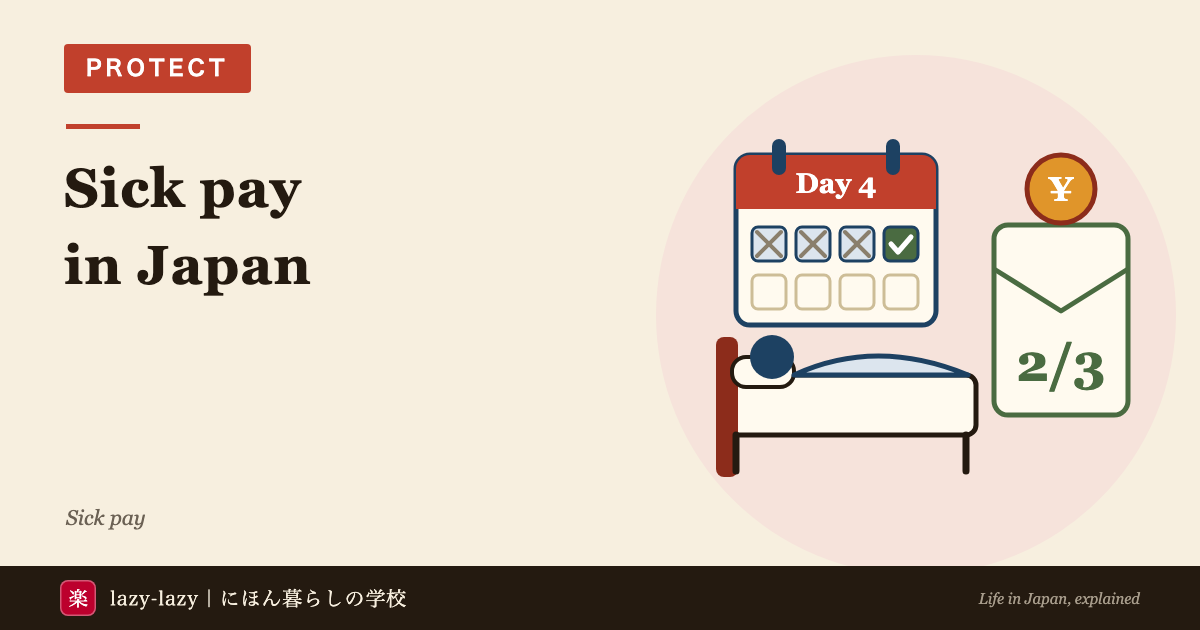
- After three days off in a row, it starts on day 4. The daily amount is your average standard monthly pay over the last 12 months, divided by 30, times two-thirds. It lasts up to 1 year 6 months in total.
- National Health Insurance pays it only if your city’s bylaws say so. If you are on NHI, ask your city office.
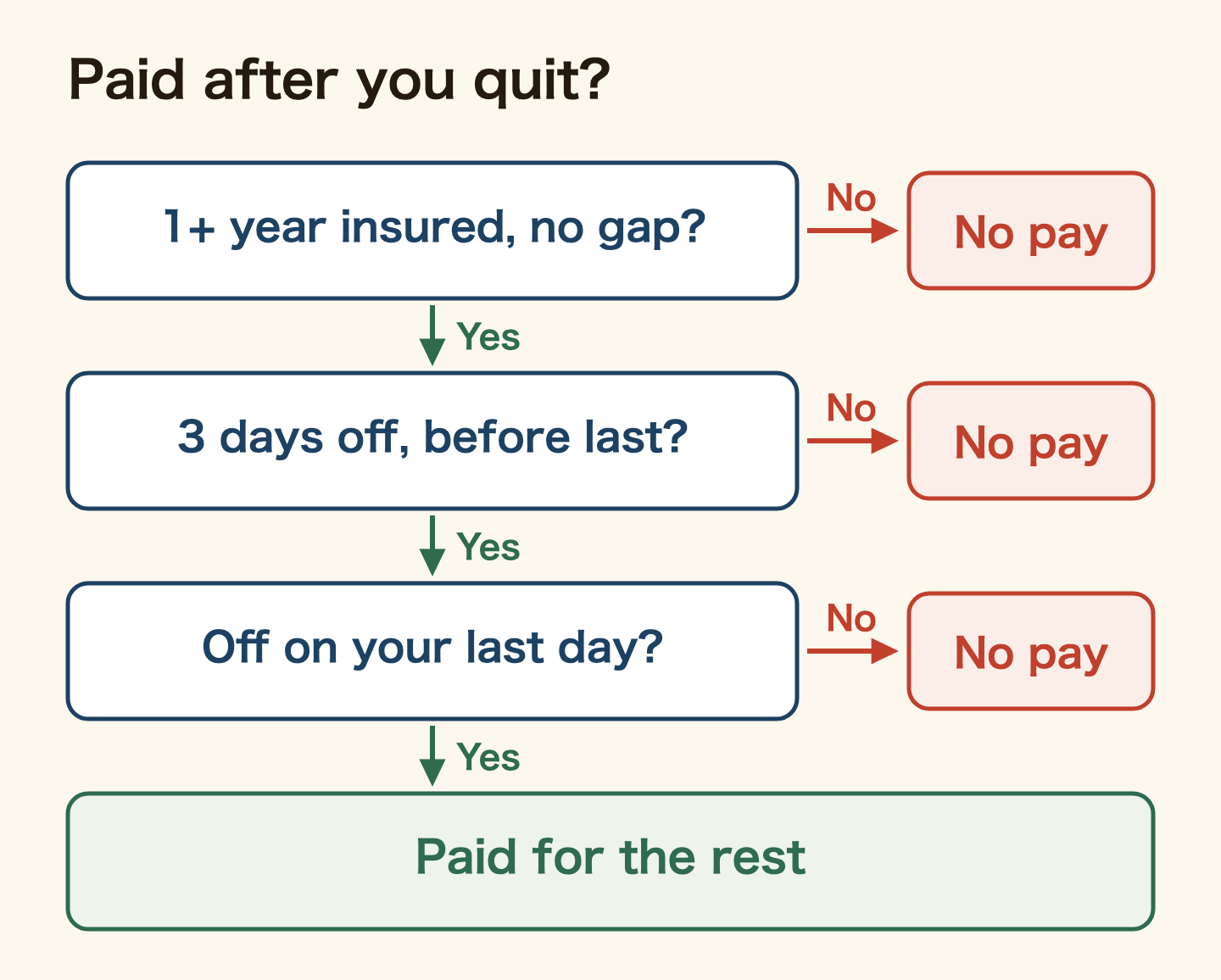
- If you leave your job while ill, do not go to work on your last day. With at least a year of continuous cover, the rest of the allowance can keep coming after you leave.
- Unemployment benefit is for people who can start work right away. You cannot get it while you are unable to work — ask Hello Work to extend the period instead.
Knowing this, you can count from your first day off how much will come in and when, and plan your leaving date or your flight home around it. And you will not lose the rest of your allowance by going in on your last day.
The fever will not go away, and the doctor says to stay home for two weeks. Your manager says that is fine, but you will not be paid for those days. A Japanese colleague shrugs: “You’ll get shobyo teatekin.” But what is it? Are you even covered? Where is the form? Nobody explains, because your colleague takes employee health insurance for granted. The answer depends on which insurance you are actually in.
- Who is eligible for the injury and sickness allowance in Japan?
- How much is the injury and sickness allowance, and from when?
- Can you get sick pay on National Health Insurance?
- How do you apply, and when does the money arrive?
- Can you get the allowance after leaving your job?
- Can you keep getting it if you leave Japan?
- Can you get it together with paid leave, rosai, unemployment benefit or a disability pension?
- Which one are you?
- Frequently asked questions
- Summary
- Related reading
Who is eligible for the injury and sickness allowance in Japan?
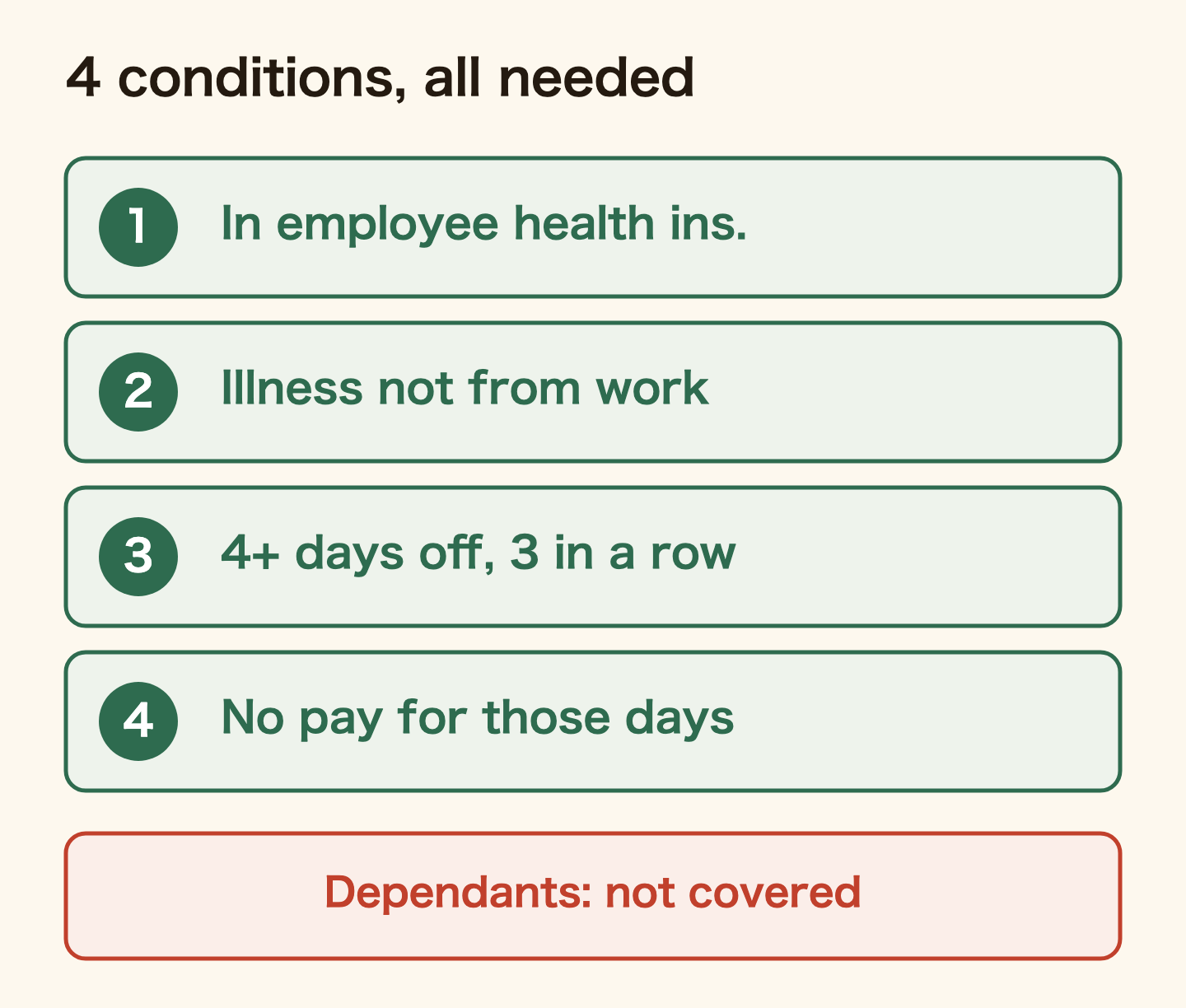
Kyokai Kenpo pays it when all four of these are true (Kyokai Kenpo, injury and sickness allowance, in Japanese):
- You are off work to recover from an illness or injury that did not come from your job. Treatment you paid for yourself, and recovering at home, both count.
- You cannot do your work. This is judged from the doctor’s opinion and the kind of work you do.
- You have been unable to work for at least 4 days, including 3 days in a row.
- You are not being paid for those days.
Nationality is not one of the conditions. The Health Insurance Act simply says the allowance is paid to the “insured person” (Health Insurance Act, Article 99). If you are in your employer’s health insurance and paying premiums, the rules are the same for you as for a Japanese colleague.
Only the insured person qualifies. Kyokai Kenpo’s FAQ says it is “for insured persons only” (Kyokai Kenpo FAQ). If you are on your spouse’s company plan as a dependant, you get nothing from this allowance even when you cannot work.
Illness or injury from work or the commute is not covered here. That goes to rosai insurance, which also pays from day 4 off (MHLW, in Japanese).
What about students working part-time?
Students at universities, vocational schools and Japanese language schools with courses of a year or more are, as a rule, outside company social insurance even if they work 20 hours a week or more (30 hours and 15 days a month would bring them in, but student visas cap work at 28 hours). A student who is not in company health insurance is on National Health Insurance, so the company allowance does not apply. The exceptions are students on leave of absence, in night or correspondence courses, or who will stay with the same employer after graduating (Japan Pension Service, who counts as a student). A student who is in employee health insurance is eligible. Our guide to students and social insurance shows which side you are on.
Not sure which insurance you have? Look at the “notice of eligibility information” that replaced the insurance card, or the health insurance screen on Mynaportal. Kyokai Kenpo tells members to find their branch there (Kyokai Kenpo claim form page).
How much is the injury and sickness allowance, and from when?
You fall ill, and your employer keeps paying you while you recover. Where you come from, that may be normal. In Japan, whether you are paid for sick days is up to your employer’s rules. What covers the unpaid days is the sickness allowance from health insurance.
When it starts: counting the 3 waiting days
The first 3 days in a row are the waiting period, and nothing is paid for them. The allowance is paid for each day from day 4 on which you cannot work. Paid leave and days off such as weekends and holidays count towards the 3 days, and it does not matter whether you were paid (Kyokai Kenpo).
The 3 days must be in a row. Two days off and then a day at work does not complete the waiting period. If you fall ill during working hours and have to stop, that day counts as day 1.
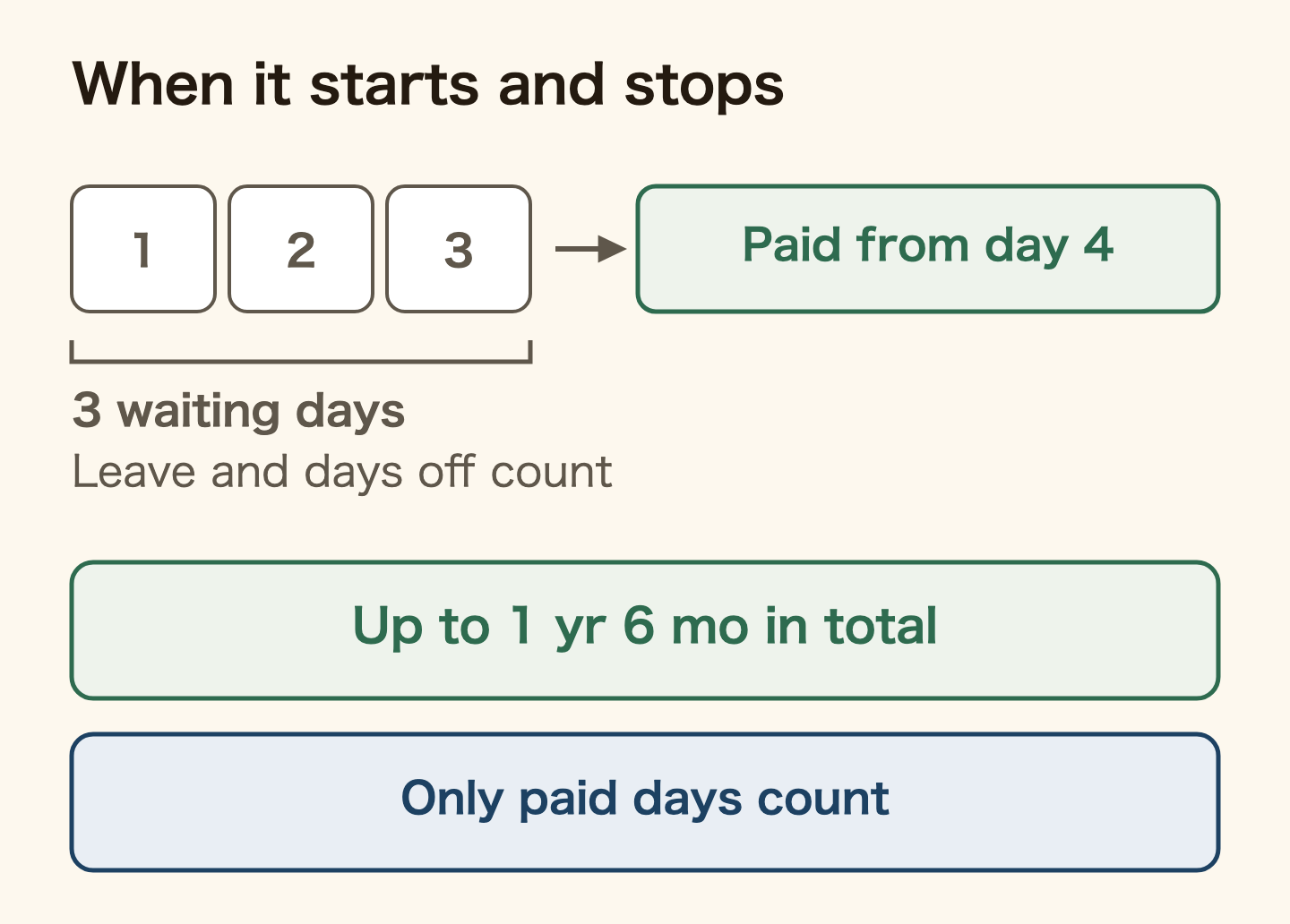
It lasts up to 1 year 6 months in total from the first day it is paid. “In total” means periods when you went back to work and were not paid are not counted. If the same illness keeps you off again, the remaining time carries on (Health Insurance Act, Article 99(4)).
How much: a three-step calculator
Work out the daily amount in this order:
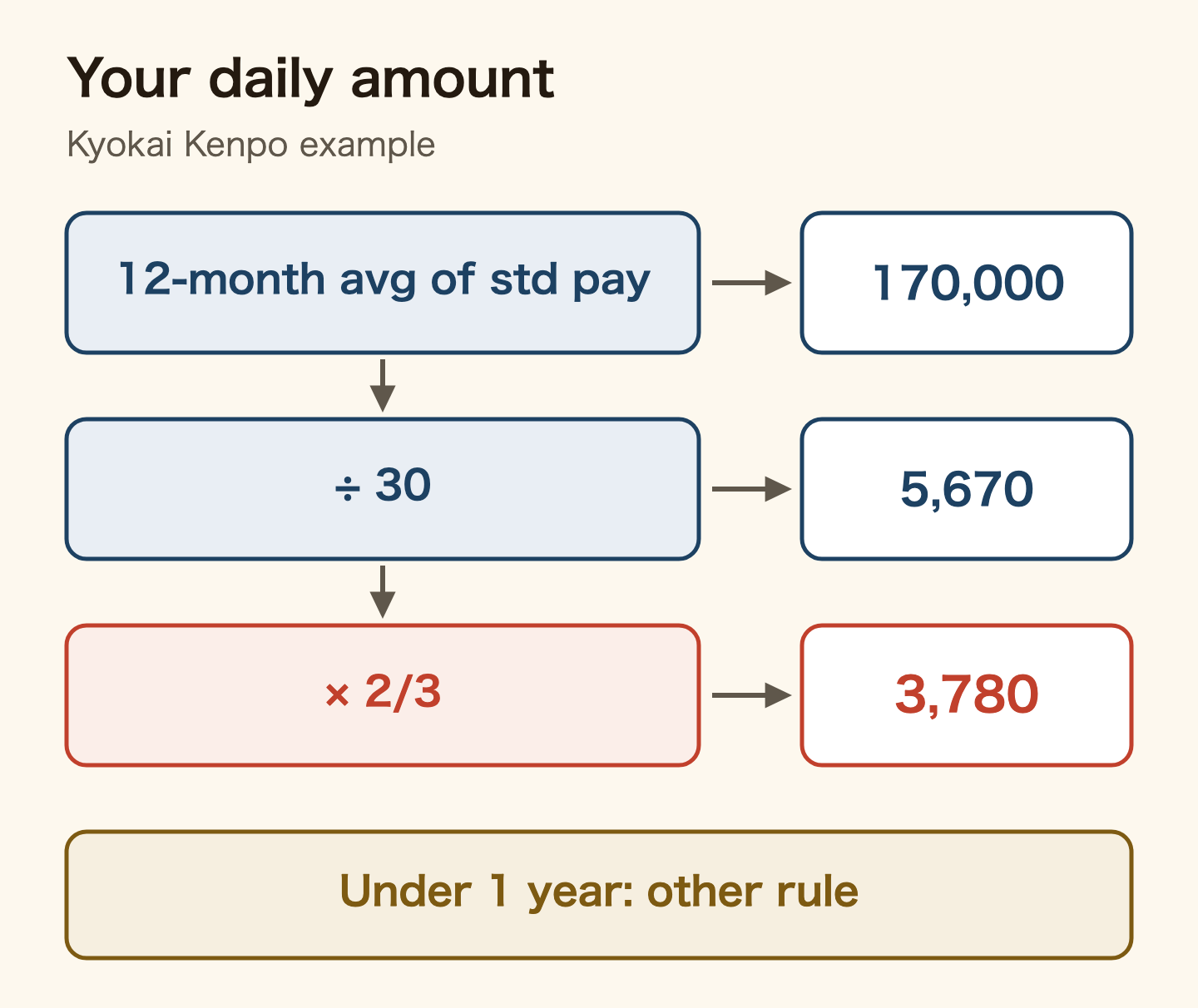
- Average your standard monthly remuneration (the pay band your health insurance premium is based on) over the 12 months up to the month the allowance starts.
- Divide that average by 30 (rounded to the nearest 10 yen).
- Two-thirds of that is your daily amount.
Kyokai Kenpo’s own example: with an average of 170,000 yen, 170,000 ÷ 30 = 5,670 yen, and 5,670 × 2/3 = 3,780 yen a day. For 30 days that is 3,780 × 30 = 113,400 yen.
If you are paid a little for a day off, you get the allowance minus that pay (Health Insurance Act, Article 108(1)).
Insured for less than a year?
If you started work in Japan recently and have fewer than 12 months of cover, the lower of these two is used:
- the average of your standard monthly remuneration for the continuous months since you joined
- the average across all Kyokai Kenpo members — 320,000 yen for allowances starting on or after 1 April 2025, according to Kyokai Kenpo (checked 7 October 2026)
On 320,000 yen, 320,000 ÷ 30 = 10,670 yen (to the nearest 10), and 10,670 × 2/3 = 7,113 yen. With less than a year of cover, your daily amount will not go above 7,113 yen. The all-member average is reset each fiscal year (Kyokai Kenpo FAQ), so check the figure with Kyokai Kenpo when your allowance starts.
Treat two-thirds as the floor
The amounts above are Kyokai Kenpo’s. A health insurance society — the kind many large companies run — can add extra benefits on top of the legal ones if its rules say so (Health Insurance Act, Article 53). If your eligibility notice names a health insurance society, check its guide for a top-up. If medical bills pile up while you are off, the monthly cap on what you pay for treatment applies as well.
Can you get sick pay on National Health Insurance?
Under employee health insurance, the allowance is required by law. National Health Insurance is different. The National Health Insurance Act says cities “may, as set out in their bylaws, provide an injury and sickness allowance and other insurance benefits” (National Health Insurance Act, Article 58(2)).
“May” means each city decides. Some cities’ lists of NHI benefits do not include it at all.
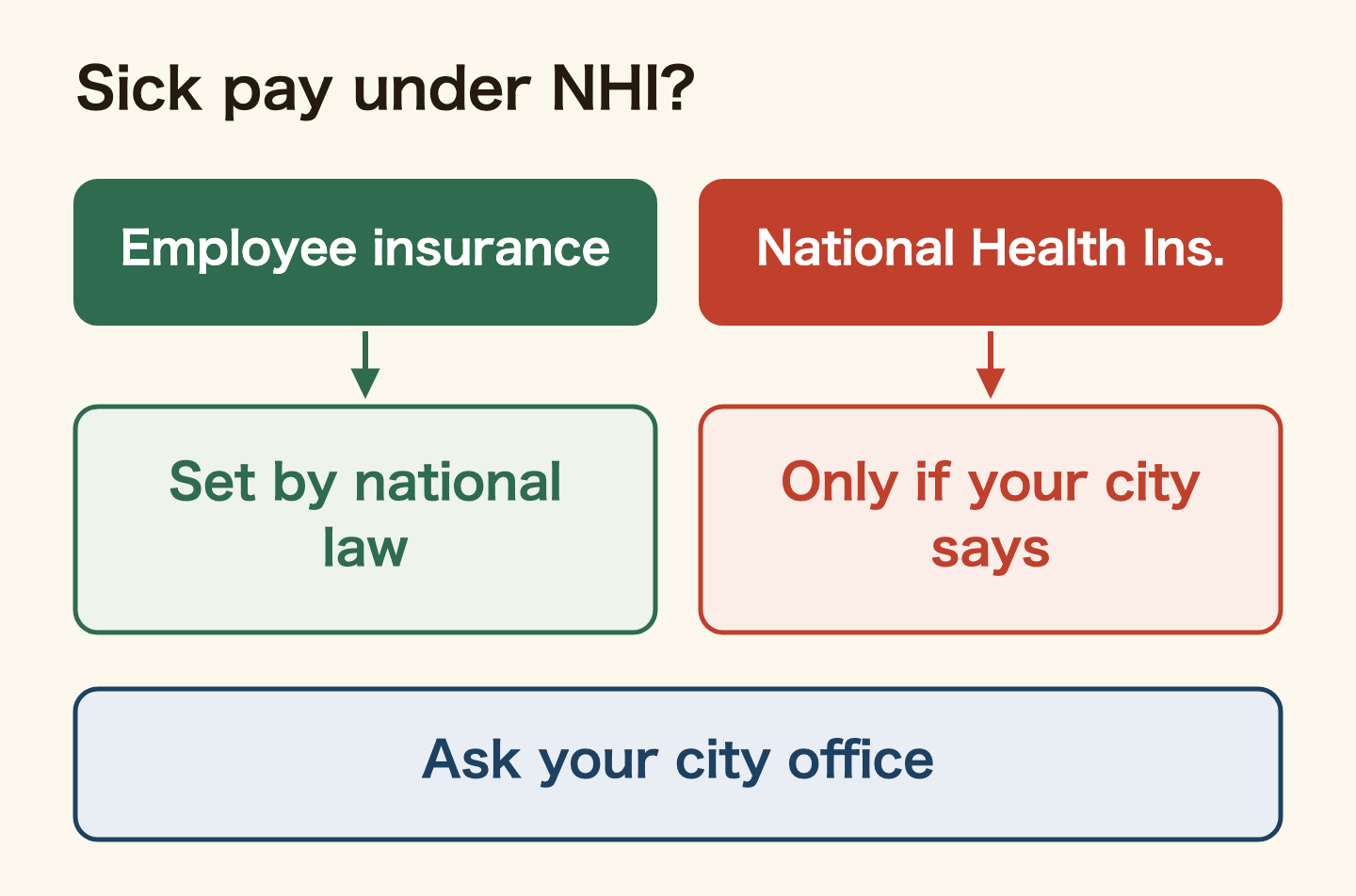
If you are on NHI, ask the National Health Insurance counter at your city office: “Is there an injury and sickness allowance (shobyo teatekin)? If so, what are the conditions?” Our National Health Insurance guide shows where that counter is.
If there is no allowance and your savings run out, public assistance is open to some visa types. Whether to insure lost income privately is easier to decide once you have counted the public benefits you already have.
How do you apply, and when does the money arrive?
The form is the “Health Insurance Injury and Sickness Allowance Application” (kenko hoken shobyo teatekin shikyu shinseisho). You can print it from Kyokai Kenpo’s website. It has four pages, filled in by three people (Kyokai Kenpo application form, PDF):
- Pages 1–2: you. Bank account, the days you were off, the illness, your job, whether you were paid, and whether you receive rosai or a disability pension.
- Page 3: your employer. The days you came in and the pay given for the period.
- Page 4: your doctor. The period you could not work, and your symptoms.
For payment, either choose your registered public benefit account on Mynaportal or give an account in your own name. A Kyokai Kenpo branch notes that foreign residents whose account name differs from their insurance name should attach a copy of the bankbook (Kyokai Kenpo Hokkaido branch slides, in Japanese).
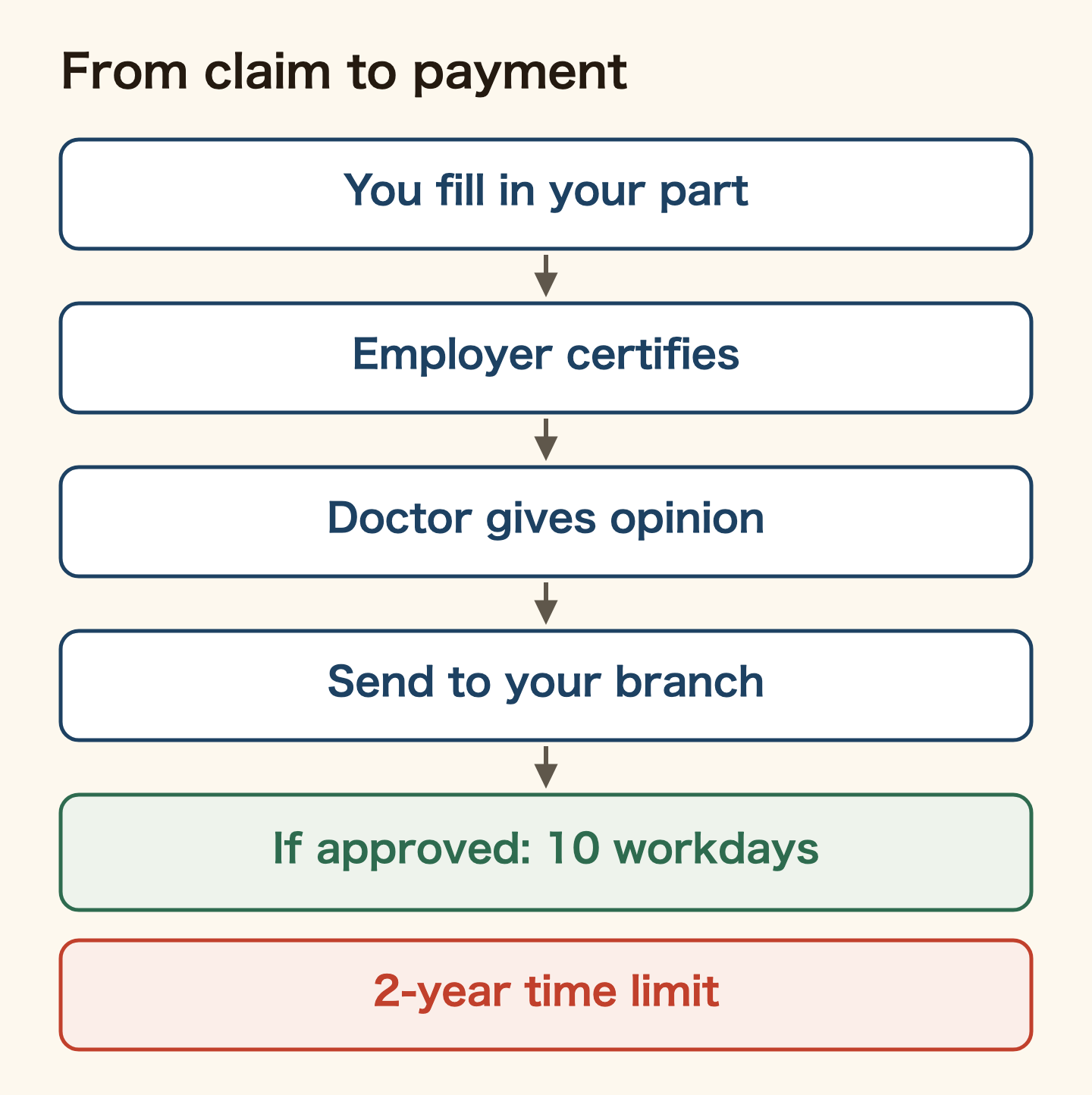
Send it to your Kyokai Kenpo branch by post, or apply online. Because your employer has to certify each period, Kyokai Kenpo recommends claiming one month at a time, in line with your payroll cut-off date (Kyokai Kenpo FAQ).
When does it arrive? After the claim is checked, if it can be paid, it goes into your account within 10 working days of receipt (Kyokai Kenpo claim form page). Gaps on the form send it back to you and add delay. If your first claim covers a whole month, nothing arrives until after you file it, so keep money aside for that first month.
There is a deadline. The right to an insurance benefit expires 2 years after it could first be exercised (Health Insurance Act, Article 193). Days more than 2 years back are lost, so do not put the claim off. The form and address here are Kyokai Kenpo’s; if you are in a health insurance society, ask it how to claim.
Can you get the allowance after leaving your job?
Yes, if you qualify, the rest of the allowance can keep coming after you leave a job while ill. This is called continued payment after loss of insured status. Kyokai Kenpo’s FAQ sets out two conditions (Kyokai Kenpo FAQ):
- By your last day, you have been insured continuously for at least 1 year. Time on voluntary continued coverage, in a mutual aid association, or on National Health Insurance does not count.
- When you leave, you are receiving the allowance or meet the conditions to receive it.
The same answer adds: if you go to work on your last day, you no longer meet the conditions for continued payment, and nothing is paid from the day after you leave. Coming in just for goodbyes or a handover can cancel everything after your leaving date, even if all else was in place. Take your last day as paid leave or an unpaid absence.
A Kyokai Kenpo branch explains that you need to have been off at least 3 days in a row before your last day, and off on your last day as well (Kyokai Kenpo Hokkaido branch slides). In other words, the 3 waiting days must be done before you leave.
Three more things to watch after you leave:
- Once you are able to work again, the allowance does not restart if you later become unable to work (Kyokai Kenpo).
- If you keep your health insurance through voluntary continued coverage, an illness or injury that begins during that time is not covered.
- If you start receiving an old-age pension after leaving, the allowance stops (if 1/360 of the pension is lower than your daily amount, you get the difference).
For periods entirely after your leaving date, the employer page is not needed (Kyokai Kenpo Hokkaido branch). You fill in your part, your doctor fills in theirs, and you send it to the branch. Periods up to your last day still need the employer’s part, so ask before you go.
Apart from the allowance, your health insurance and pension need switching from the day after you leave, and Immigration needs a notice within 14 days. Our guide to leaving a job in Japan puts them in order. If your income stops and you cannot pay National Pension premiums, you can apply for an exemption on the grounds of losing your job.
Can you keep getting it if you leave Japan?
Should you stay in Japan until you recover, or go home to your family to rest? What you want to know is whether the allowance follows you. But neither Kyokai Kenpo’s allowance page, its FAQ nor the claim form says anything about claiming after leaving Japan or being paid into a foreign account (checked 7 October 2026). They do not say you can, and they do not say you cannot.
Here is what can be confirmed:
- Payment goes to your registered public benefit account or an account in your own name. The bank section of the form is laid out for Japanese banks, credit unions and Japan Post Bank (Kyokai Kenpo application form, PDF).
- Every claim form has a section where a doctor states the period you could not work.
- For a different benefit — reimbursement of medical costs abroad — Kyokai Kenpo states that it “cannot send money directly overseas” and asks you to authorise your employer or family living in Japan to receive it (Kyokai Kenpo, overseas medical expenses). Whether the same applies to the sickness allowance is not stated.
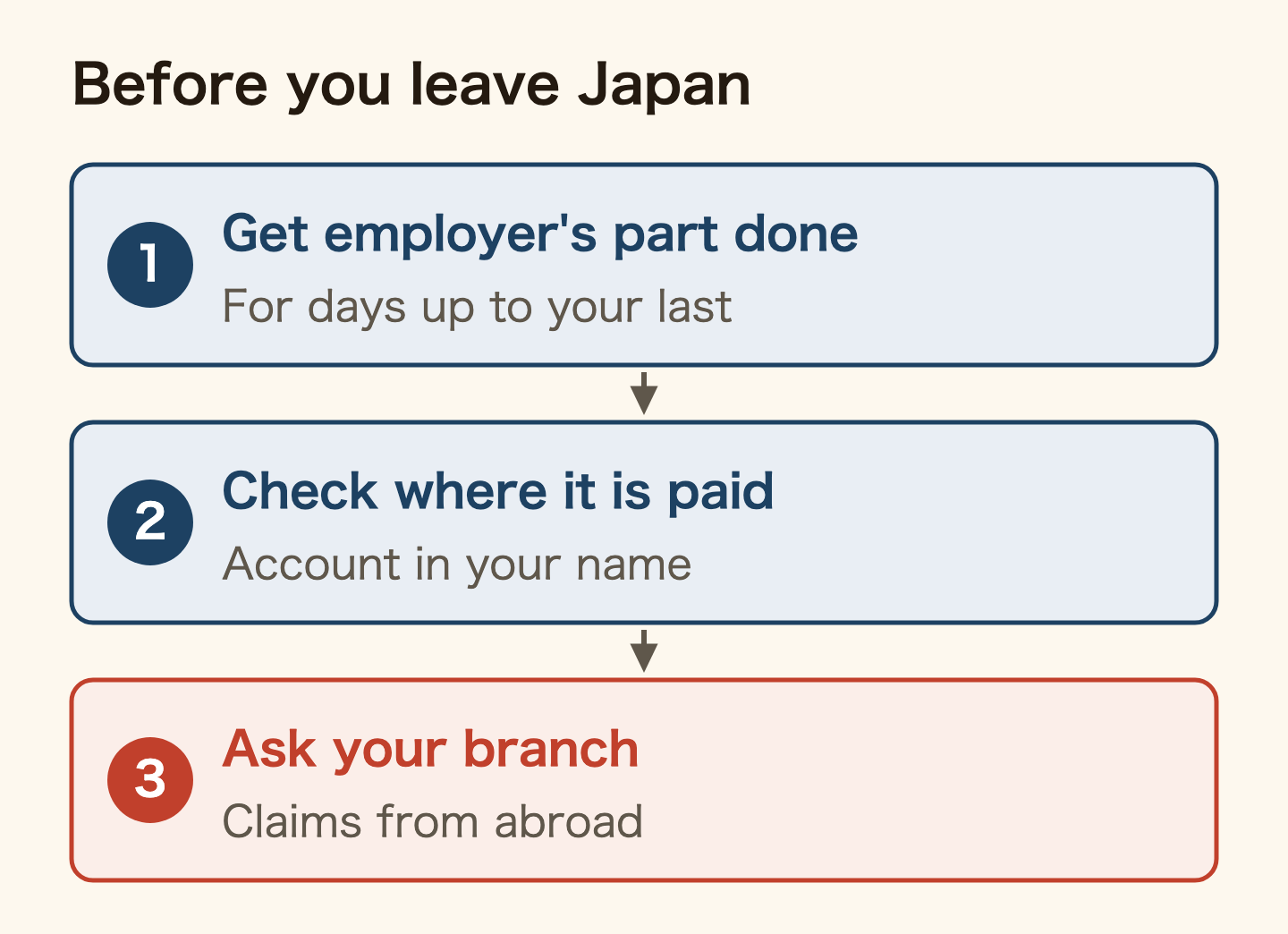
So do three things before you go. Get your employer to certify the days up to your last day. Keep a Japanese account in your own name open until the last payment arrives. And ask your Kyokai Kenpo branch: “Can I still claim and be paid after I leave Japan? How should the doctor’s part be done?” Book your flight after you have the answer. The order for closing your bank account and sorting your pension is in our leaving-Japan checklist.
Can you get it together with paid leave, rosai, unemployment benefit or a disability pension?
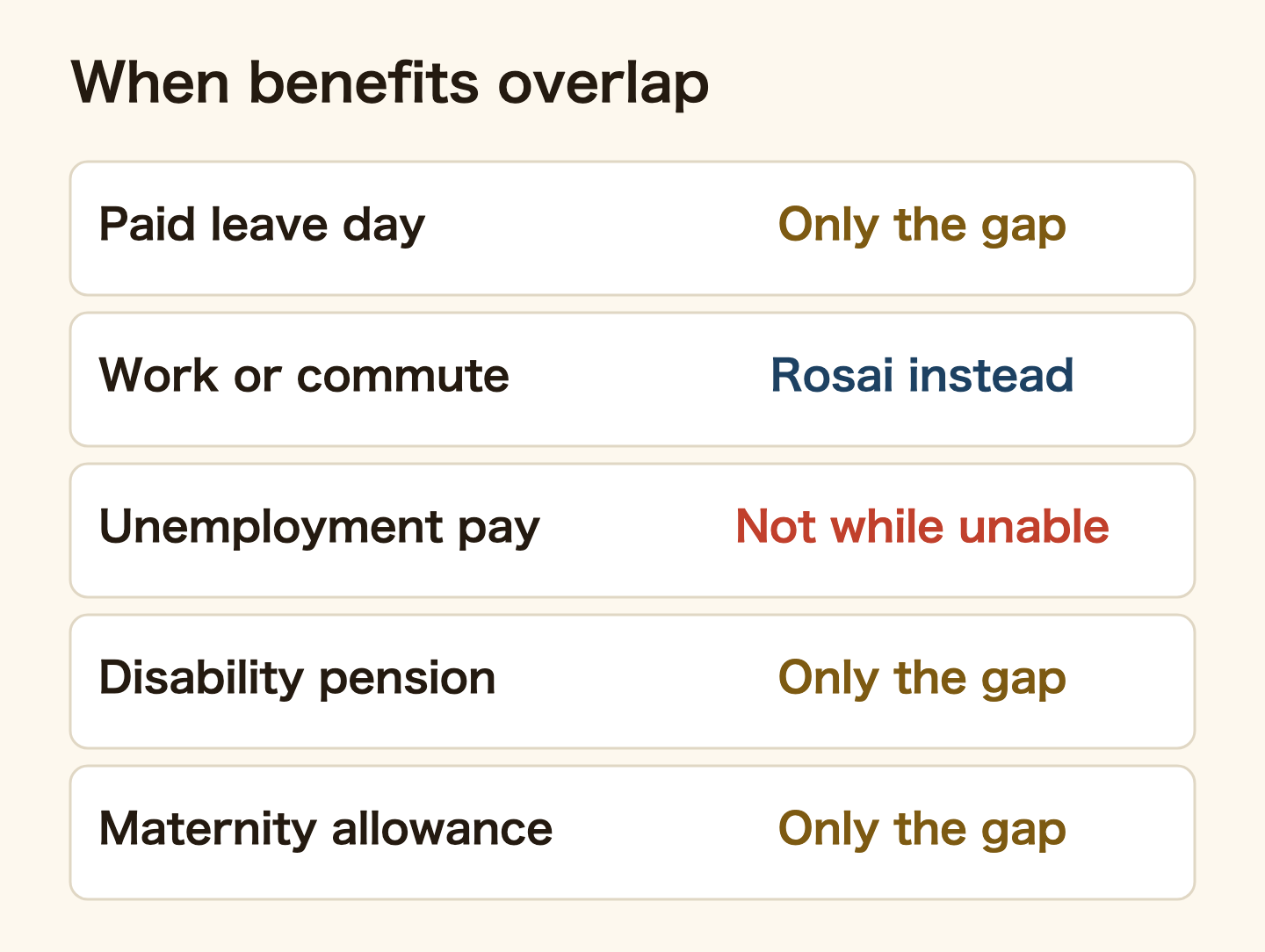
When another payment covers the same day, the allowance either stops or shrinks to the difference. Here is how Kyokai Kenpo and the law handle each case.
Paid leave
A day of paid leave is a paid day, so no allowance is paid for it. If the leave pay is lower than the allowance, you get the difference (Kyokai Kenpo FAQ). Paid leave days do count towards the 3 waiting days. Our paid leave guide helps you count how many days you have.
Rosai (workers’ accident insurance)
Illness or injury from work or the commute belongs to rosai, and the sickness allowance is not paid. You can claim the allowance while a rosai claim is being decided, but if rosai is approved, you pay the allowance back (Kyokai Kenpo Hokkaido branch).
Unemployment benefit (the basic allowance)
The basic allowance is for people who are “able to take a job at any time”. Hello Work states that you cannot receive the basic allowance “when you cannot take a job right away because of illness or injury” (Hello Work, basic allowance, in Japanese). The sickness allowance is for people who cannot work, so while you cannot work, there is no basic allowance.
The period in which you can receive the basic allowance is, as a rule, 1 year from the day after you leave. If illness or injury keeps you from working for 30 days or more in a row, you can ask Hello Work to extend that period by the number of days you could not work, by up to 3 years. The order is: finish the sickness allowance, recover, then claim the basic allowance. Separately, employment insurance has its own “injury and sickness benefit” for people who fall ill after registering at Hello Work; it is not paid for days on which you can receive the health insurance allowance (Employment Insurance Act, Article 37(8)). Conditions and amounts are in our guide to unemployment benefit for foreigners.
Disability pension and maternity allowance
If you can receive a disability employees’ pension for the same illness or injury, the sickness allowance is not paid. If the pension works out lower than the allowance, you get the difference (Health Insurance Act, Article 108(3)). If a disability pension is later granted back-dated over a period when you received the allowance, the allowance already paid is adjusted (Japan Pension Service, disability pension guide FY2026, in Japanese). As a rule, a disability pension can be claimed from 1 year 6 months after your first visit to a doctor for the condition (Japan Pension Service leaflet).
For any period when both the maternity allowance and the sickness allowance apply, only the maternity allowance is paid. If it is the lower of the two, you get the difference (Kyokai Kenpo FAQ).
Which one are you?
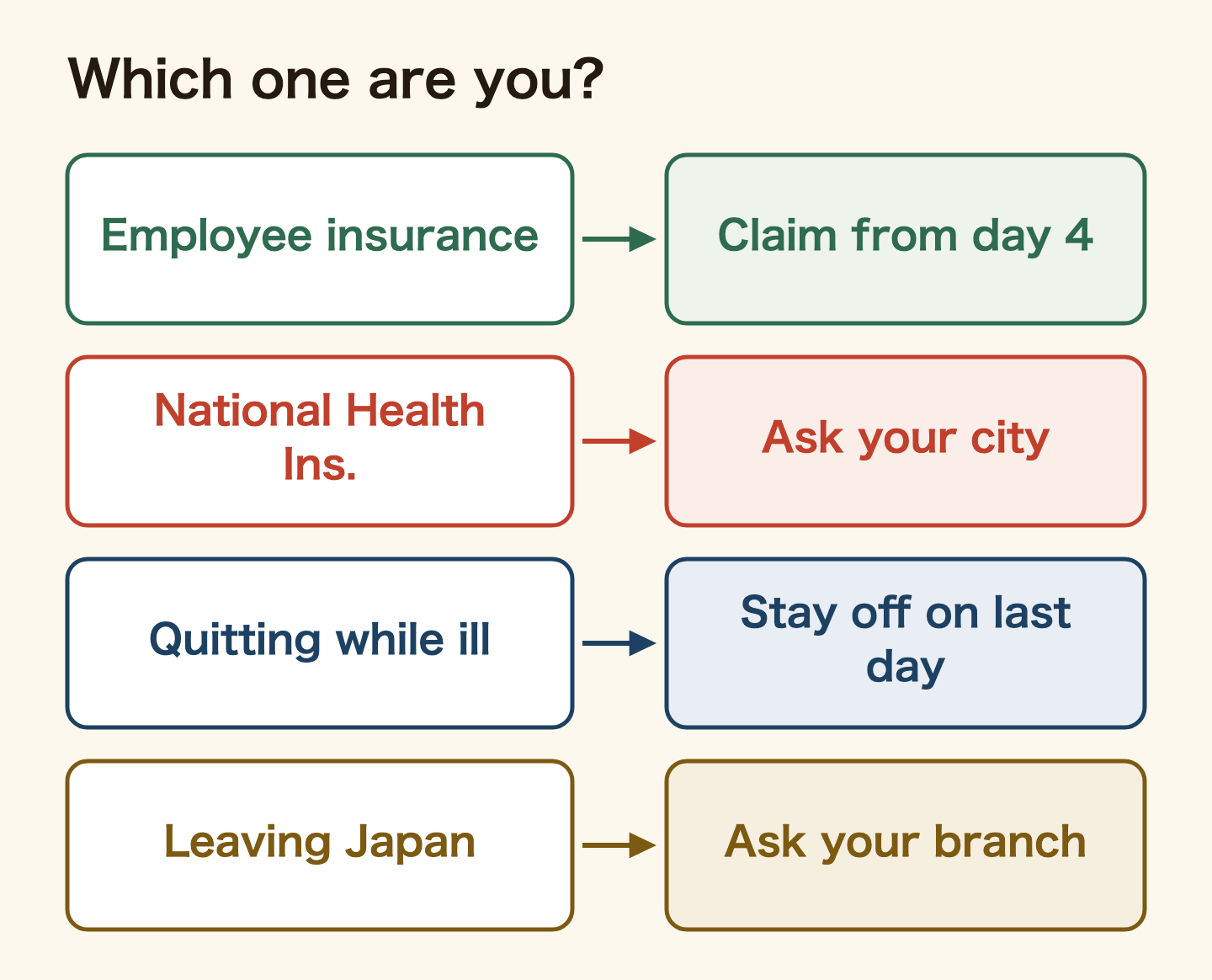
- On employee health insurance and off sick — after 3 days in a row, you qualify from day 4. Today, note the date you first stopped work, ask your employer to fill in their page, and check that your doctor will complete theirs.
- On National Health Insurance (students and the self-employed, for example) — it depends on your city. Today, call your city’s NHI counter and ask whether there is an injury and sickness allowance and what the conditions are.
- Leaving your job while ill — with a year or more of continuous cover, the rest keeps coming after you leave. Today, count your months of cover and agree with your employer that you will not work on your last day.
- Leaving Japan while on the allowance — Kyokai Kenpo says nothing about claiming from abroad. Today, ask your branch whether you can claim and be paid from overseas, and decide when to close your Japanese account only after you have the answer.
Frequently asked questions
Q. Can foreigners get the injury and sickness allowance in Japan?
Yes. There is no nationality condition. If you are the insured person in employee health insurance, an illness or injury outside work keeps you off for at least 4 days including 3 in a row, and you are not paid for those days, you qualify. Family members covered as dependants do not.
Q. When is the injury and sickness allowance paid?
With Kyokai Kenpo, if the claim can be paid, within 10 working days of receipt. Because your employer has to certify each period, Kyokai Kenpo recommends claiming monthly, in line with your payroll cut-off. Errors on the form send it back and cause delay.
Q. Can I get the allowance after leaving my job?
Yes, if you have been insured continuously for at least a year by your last day, and you are receiving the allowance or meet its conditions when you leave. If you go to work on your last day, nothing is paid after you leave.
Q. Is there sick pay on National Health Insurance?
It depends on your city. The National Health Insurance Act says cities “may” provide the allowance under their bylaws. Ask the NHI counter at your city office whether it exists and what the conditions are.
Q. Can I get the sickness allowance and unemployment benefit at the same time?
Not while you cannot work. Hello Work says you cannot receive the basic allowance when you cannot take a job right away because of illness or injury. If you cannot work for 30 days or more in a row, ask Hello Work to extend your benefit period.
Q. Can international students working part-time get it?
As a rule, students are outside company social insurance, and on National Health Insurance it depends on the city. Students who are in employee health insurance — for example those on leave of absence, in night or correspondence courses, or staying with the same employer after graduating — are eligible.
Summary
The injury and sickness allowance is for people in employee health insurance who cannot work because of an illness or injury outside work and are not being paid. After 3 days in a row, from day 4 it pays two-thirds of your 12-month average standard monthly pay divided by 30, for up to 1 year 6 months in total. With less than a year of cover, the lower of your own average and the Kyokai Kenpo average is used. On National Health Insurance, it exists only where your city’s bylaws provide it.
If you leave your job, a year of continuous cover and not working on your last day are what decide whether it continues. While you cannot work there is no basic unemployment allowance, so ask Hello Work to extend the period. If you are planning to leave Japan, Kyokai Kenpo’s guidance says nothing about claiming from abroad — ask your branch before you set the date.
Official sources (in Japanese): Kyokai Kenpo, injury and sickness allowance / Kyokai Kenpo FAQ / claim form page / application form (PDF) / Hokkaido branch slides / overseas medical expenses / Health Insurance Act / National Health Insurance Act / Employment Insurance Act / Hello Work, basic allowance / Japan Pension Service, disability pension guide FY2026 / disability pension leaflet / who counts as a student (all checked 7 October 2026).
Related reading
Found this useful? Share it
Send it to a friend who lives in Japan.
WHO WROTE THIS

mori
Japanese. I read the ministries’ own notices, orders and Q&As in the original, and I start from what my Nepalese and Sri Lankan friends in Japan actually ran into. I do not write about what I have not checked or been told.
What this site can and cannot do →Looking for something else?
You may use the figures in this article, including commercially, if you credit this site with a link. How to use our figures