Checked on 22 November 2026. Sources: JASSO’s FY2023 survey of privately funded international students, the Immigration Services Agency’s FY2025 survey of foreign residents, MEXT’s FY2024 survey of Japanese language education, and the health ministry’s volunteer page. University examples come from official pages at the University of Tokyo, Waseda University and Tokyo University of Foreign Studies.
The short answer
- About 3 in 10 international students have no contact with Japanese students outside class. At Japanese language schools it is 37.7% (JASSO survey).
- For language school students who do meet Japanese students, the top place is a part-time job. Waiting inside school rarely brings more chances.
- There are 5 places to go. Your school’s exchange programs, your part-time job, and outside school: your city’s international association, a local Japanese class, and a volunteer center.
- At a university or vocational school, ask the office about 4 things: exchange events, language exchange, buddy (tutor) programs and clubs. What exists depends on the school.
- In a survey of foreign residents, the top reason for not joining local activities was “I don’t know what exists.” This week, sign up for one thing.
Knowing this, you can stop asking “what is wrong with me?” and spend that time choosing one place to go. Even at a language school, you will find places outside school that you can sign up for.
Everyone in your language school class is an international student. At break, most people speak their own language. Six months in, the only Japanese people you have talked to are your manager at work and the convenience store clerk. You want to ask a Japanese person how to make Japanese friends. But there is no Japanese person to ask. Ask someone at work, and they may say, “You just meet people at school.” There are no Japanese students in your classroom.
- No Japanese friends in Japan? About 3 in 10 international students have no contact outside class
- How to make Japanese friends: where do students actually meet them?
- At a Japanese language school? Try your international association, a local class, volunteering
- At a university or vocational school? Ask the office about 4 things
- Where to start? The biggest barrier is not knowing
- When you talk: casual Japanese, keigo, saying no
- How much does it cost? Some events are free, but check each one
- Lonely without friends? Do not carry it alone
- Which one are you?
- FAQ
- Summary
- Related reading
No Japanese friends in Japan? About 3 in 10 international students have no contact outside class
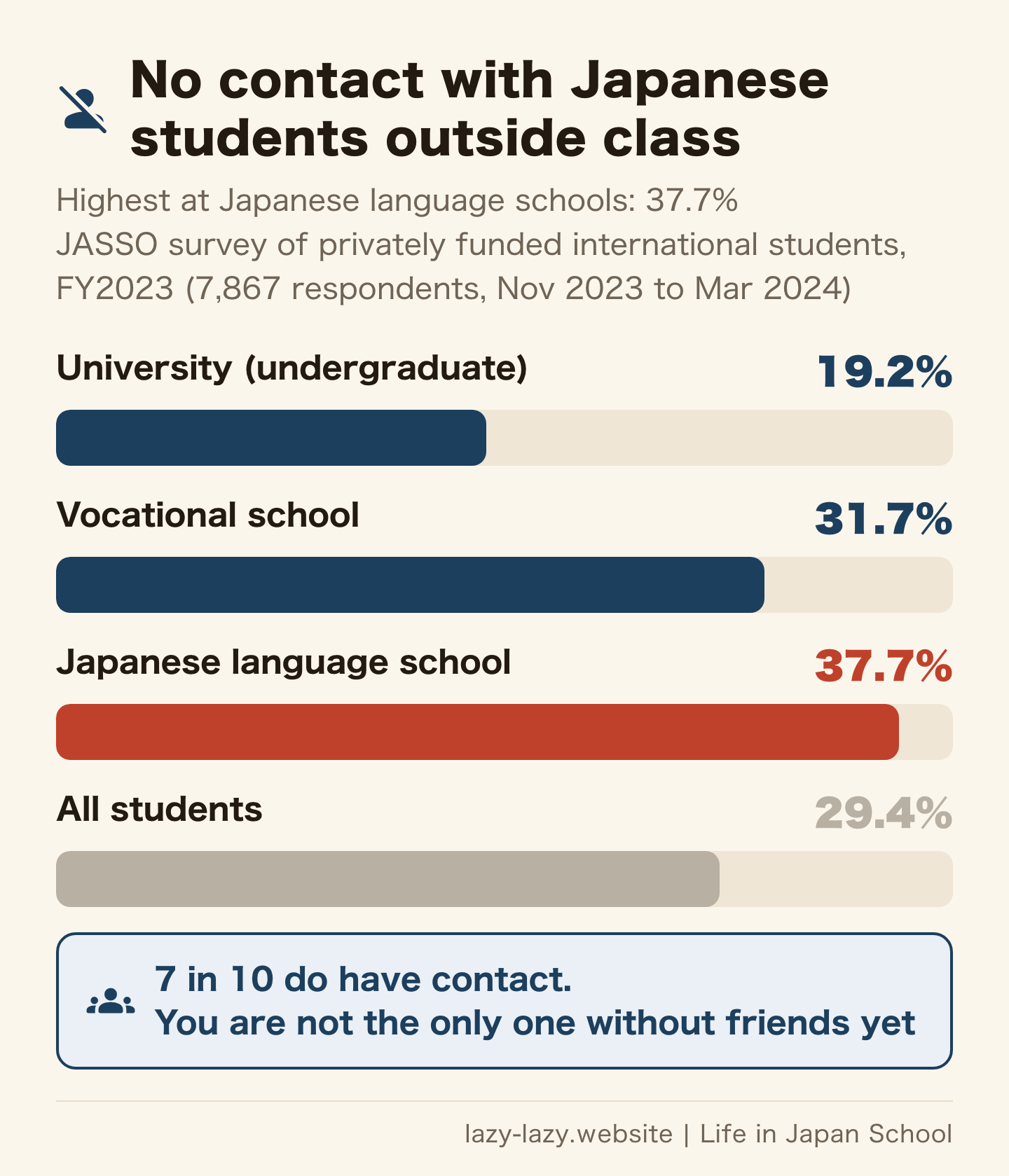
You are not unusual. The Japan Student Services Organization (JASSO) asked 7,867 privately funded international students in its FY2023 student life survey (in Japanese). 2,313 of them (29.4%) had no contact with Japanese students outside class.
It depends on the school. The figure was 19.2% for university undergraduates, 31.7% for vocational schools and 37.7% for Japanese language schools. At language schools, almost 2 in 5 students have no contact with Japanese students outside class.
Many students feel this. In the same survey, students chose up to 3 things they were unhappy with at school. 20.0% chose “chances to meet Japanese students.” Only “nothing” ranked higher. Before coming to Japan, the most common worry was whether they could build good relationships with people around them (49.8%).
How to make Japanese friends: where do students actually meet them?
Go to school, and friends will come. Where you come from, that may be normal. In Japan, a language school classroom is almost all international students. In the JASSO survey, look at language school students who do have contact with Japanese students. Only 30.8% meet them at school or through study. At universities and similar schools it is 65.3%.
So where do they meet? Language school students gave 2,396 answers. A part-time job came first at 40.6%. Next were “spending breaks or days off together” at 15.9% and “school exchange events” at 9.7%.
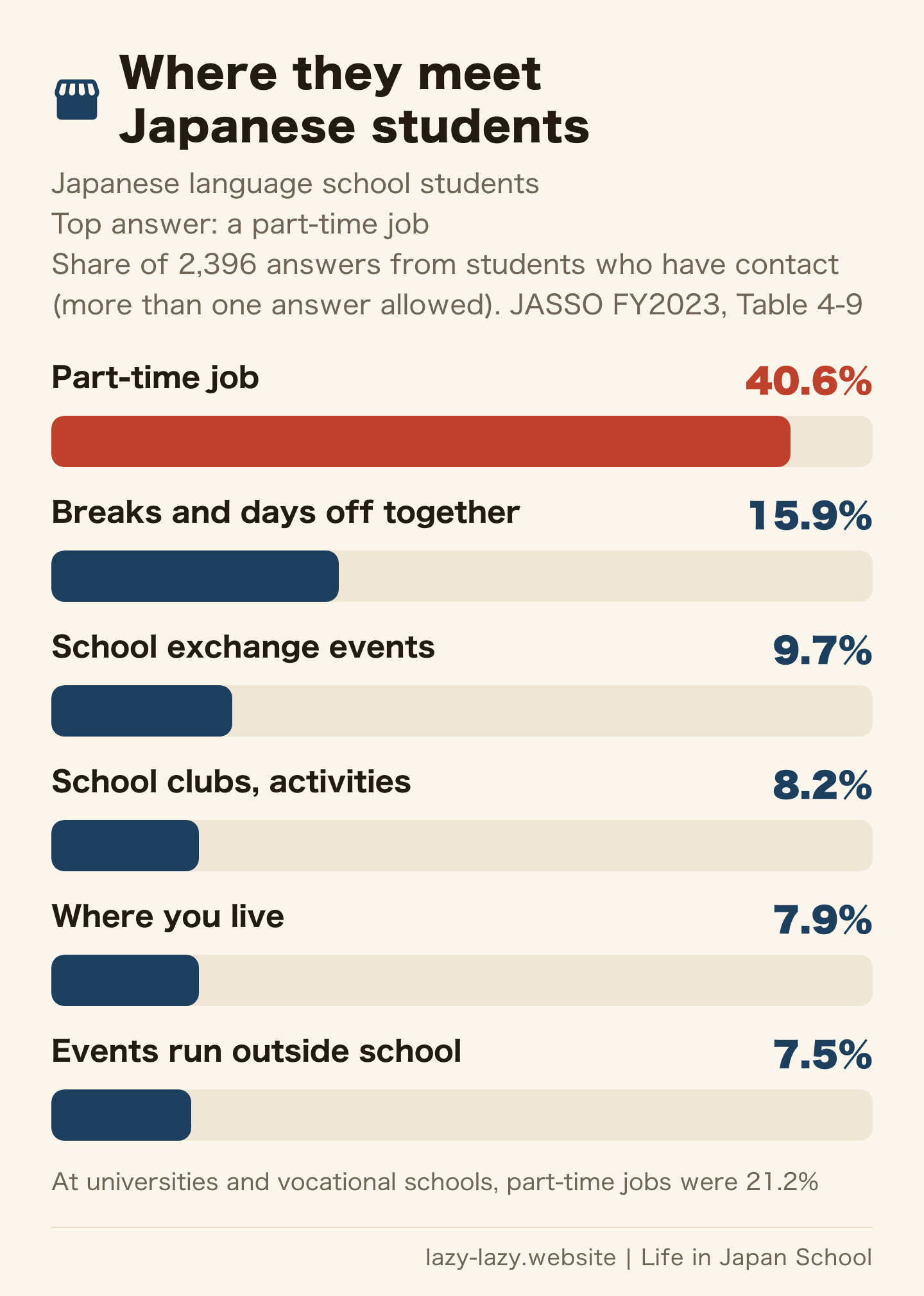
At a part-time job, you see the same people every week. Among students who meet Japanese students, the most common pattern was 2 to 4 times a week (46.4%). Work words are enough to start talking. For greetings and calling in sick, see 35 Japanese phrases for your part-time job.
But part-time work has a limit. A student’s work permission allows up to 28 hours a week (up to 8 hours a day during long school holidays). Do not add shifts past the limit to make friends. To check how the hours are counted, see the 28-hour rule for student part-time jobs.
At a Japanese language school? Try your international association, a local class, volunteering
If your school has few chances, look in your area. First, ask your school office: “Nihonjin to kōryū dekiru ibento wa arimasu ka?” (Are there events where I can meet Japanese people?). Then there are 3 places.
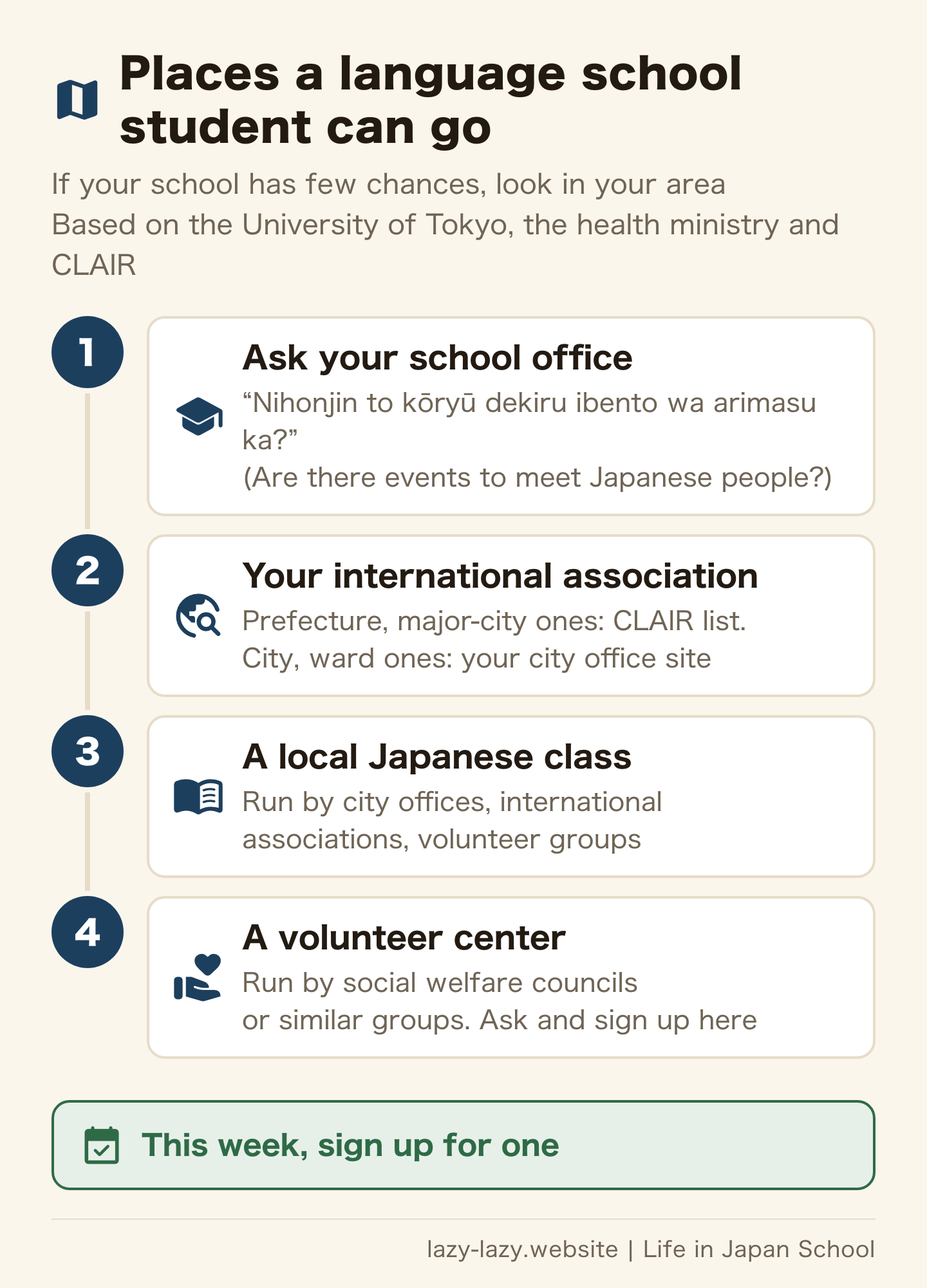
1. Your city’s international association
An international association (kokusai kōryū kyōkai) is a local group that runs exchange and support for foreign residents. The University of Tokyo’s page for international students says city and ward international associations run many kinds of exchange programs (in Japanese). For prefecture and major-city associations, use CLAIR’s list of regional international associations. For your city or ward’s association, check your city office website.
Here is one example. The international exchange center of the Saitama Tourism and International Relations Bureau announced a free “Hajimemashite” (nice to meet you) event for 18 October 2025. Saitama University’s notice called it a place for newly arrived foreign residents to meet local people. Events and dates differ by association, so check the “events” section of your association’s site.
2. A local Japanese class
City offices, international associations and volunteer groups run these classes for foreign residents in the area. In a MEXT survey, 53.1% of all people teaching Japanese in Japan (including at language schools) were volunteers. A place to practise Japanese can also be a place to meet local people. For costs and how to find one, see free Japanese classes in Japan.
3. A volunteer center (social welfare council)
If you want to volunteer, go to your city’s volunteer center. The health ministry says city volunteer centers handle questions and sign-ups. The centers sit inside social welfare councils (shakai fukushi kyōgikai) and similar groups. Search for your city name plus “社会福祉協議会 ボランティア”.
Among foreign residents, the top activities people want to join are hobby clubs (26.4%) and volunteering (20.8%) (Immigration Services Agency, FY2025 survey).
At a university or vocational school? Ask the office about 4 things
Universities and vocational schools may have their own programs. But the names, the content and who can join differ by school. Ask the international student office about these 4 things.
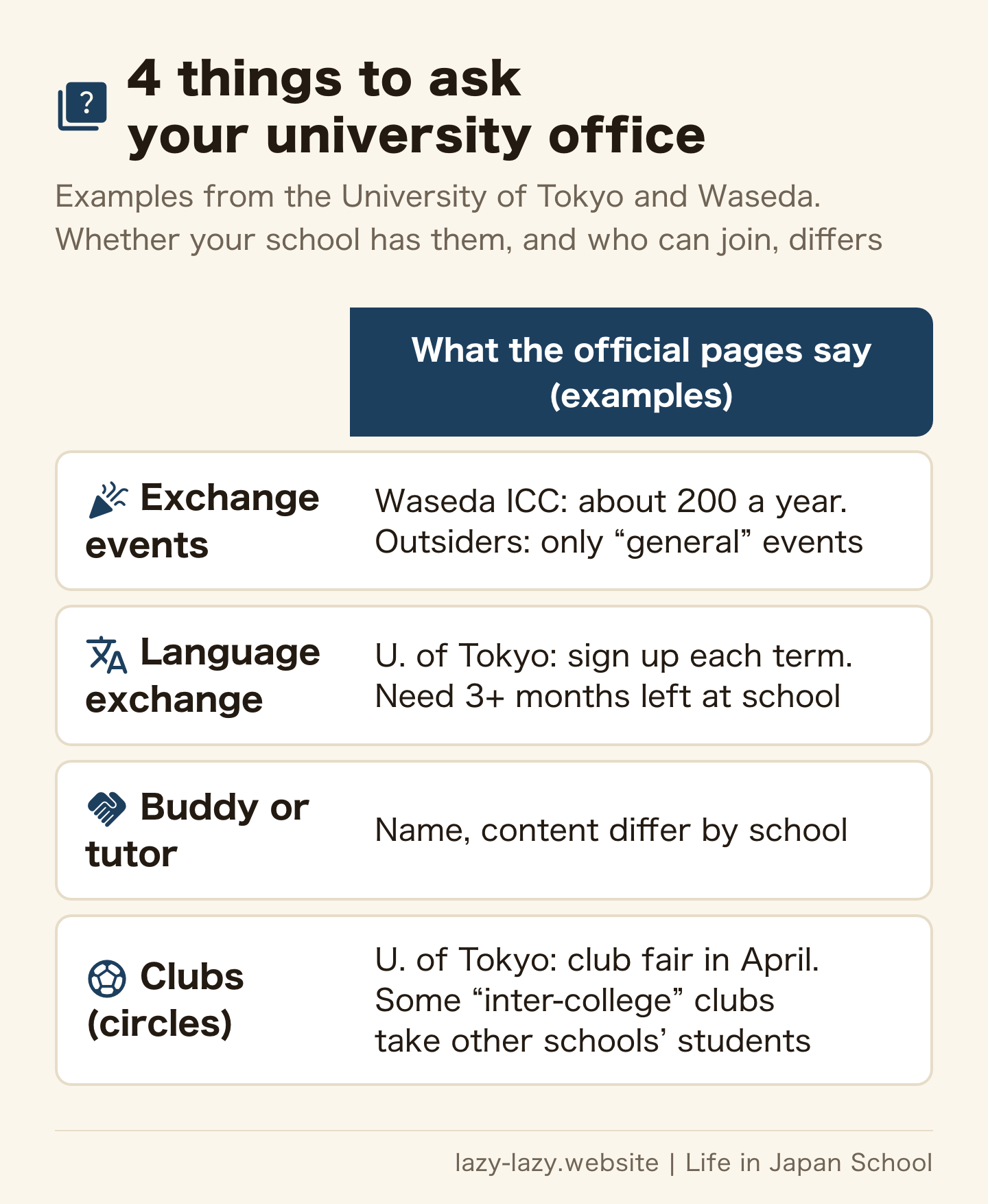
- Exchange events: Waseda University’s ICC (Intercultural Communication Center) runs about 200 events a year, planned mainly by students. People from outside Waseda can join events marked “general” (ippan).
- Language exchange: you teach your language and learn Japanese in return. At the University of Tokyo, you sign up for the language exchange program each term. When you get a partner’s contact, you must reply within 48 hours.
- Buddy or tutor: current students help international students with study and daily life. Tokyo University of Foreign Studies calls its student volunteers “buddies.” Its buddies are for exchange students and similar groups. The name, who it is for and what they help with differ by school.
- Clubs (sākuru): student groups for sports, culture and more. The University of Tokyo’s page says rules, the Japanese you need and costs differ by club. The club fair in April and the month of welcome events after it are the time to choose.
Missed that time after you started? Ask the office, “Ima kara haireru mono wa arimasu ka?” (Is there anything I can join now?). You will learn when the next sign-up is.
Where to start? The biggest barrier is not knowing
Even with places to go, something can stop you. The Immigration Services Agency asked 8,874 foreign residents what makes local activities hard to join. The top answer was “I don’t know what activities exist” at 21.2%. These are not students only, but the pattern is the same.
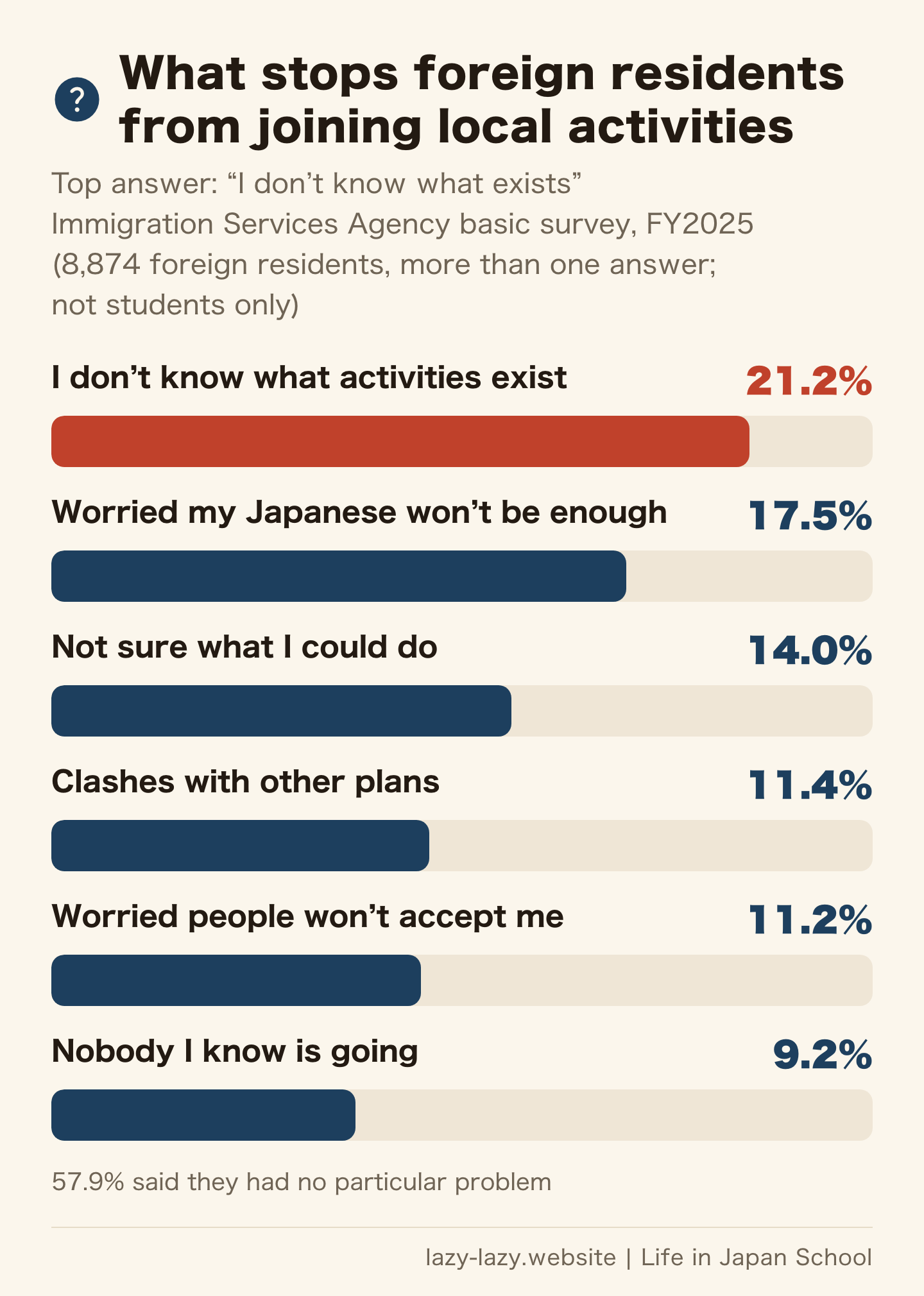
The top 3 all get smaller if you ask before you sign up.
- Don’t know what exists → check with your school office and your city’s international association website. Looking up every place in this article is free.
- Worried about your Japanese → a local Japanese class is a place for people learning Japanese. The University of Tokyo’s language exchange does not list Japanese level as a condition.
- Not sure what you could do → ask the volunteer center, “I’m a foreign resident and my Japanese is basic. What could I do?” Answering questions is part of its job.
Nervous about going alone? Invite one classmate and sign up together. That makes “nobody I know is going” (9.2%) smaller.
When you talk: casual Japanese, keigo, saying no
Once you meet people, the next question is how polite to be. Staying too polite with friends and classmates puts distance between you. With teachers and seniors at work, polite Japanese is the basic rule. For when to switch, see keigo vs casual Japanese.
When you become friends, people invite you to meals or drinks. Some days you cannot go. To say no without hurting the friendship, see how to say no in Japanese. It also has a line for people who do not drink.
How much does it cost? Some events are free, but check each one
Costs differ by event. Saitama’s “Hajimemashite” event was announced as free. Some local Japanese classes are free too. You pay your own train or bus fare to get there. In the foreign resident survey, 4.8% named “the cost of joining, such as transport” as a problem. Check the fee (sankahi) on the sign-up page first.
Lonely without friends? Do not carry it alone
Days without friends can feel heavy. The foreign resident survey asked people who feel lonely when they feel it. 32.0% said “when I have no contact with people.” If you cannot sleep at night or cannot get to school, talk to someone before you look for events. Helplines in other languages and school counselling rooms are listed in mental health help in Japan.
Which one are you?
- At a language school with few chances to meet Japanese people — open your city’s international association website. Sign up for one event or Japanese class this week.
- At a university or vocational school — ask the international student office about the 4 things, then sign up for the one with the nearest deadline.
- You talk to people at work, but it goes no further — say one thing to a coworker at break. Recount your shifts so you stay within 28 hours a week.
- Being without friends keeps you from sleeping or going to school — today, contact your school counselling room or a helpline in your language. Looking for events can wait.
FAQ
Q. Is it common for international students to have no Japanese friends?
Yes. In JASSO’s survey, 29.4% of international students had no contact with Japanese students outside class. At Japanese language schools it was 37.7%.
Q. How do I make Japanese friends as an international student? Where can I meet them?
For language school students who meet Japanese students, the most common place is a part-time job. Outside school, go to your city’s international association, a local Japanese class or a volunteer center at the social welfare council.
Q. Can language school students join exchange events?
Yes. International association events and local Japanese classes are for foreign residents in the area. Some university events are open to outsiders too, such as Waseda ICC events marked “general.”
Q. Can I join if my Japanese is not good?
Local Japanese classes are places for people learning Japanese. The University of Tokyo’s language exchange does not list Japanese level as a condition. Conditions differ by event, so check the sign-up page or ask the organiser.
Q. Where can I find volunteer work in Japan?
At your city’s volunteer center. The health ministry says city volunteer centers handle questions and sign-ups. The centers sit inside social welfare councils and similar groups.
Q. Where can I get help if I feel lonely without friends?
Your school counselling room, or a helpline in your language. If you cannot sleep or cannot get to school for days, talk to someone before you look for events.
Summary
About 3 in 10 international students have no contact with Japanese students outside class. At language schools it is 37.7%. Few chances at school are not your fault. For language school students who meet Japanese students, a part-time job is the most common place.
There are places outside school too: your city’s international association, a local Japanese class and a volunteer center. At a university or vocational school, ask the office about 4 things. The biggest barrier is not knowing, so this week, sign up for one.
Official sources (in Japanese): JASSO, FY2023 survey of privately funded international students (PDF) / Immigration Services Agency, FY2025 basic survey of foreign residents, summary (PDF) / Immigration Services Agency, work permission for student visa holders / Ministry of Health, Labour and Welfare, volunteering / MEXT, FY2024 survey of Japanese language education (PDF) / CLAIR, list of regional international associations / University of Tokyo, student clubs / University of Tokyo, language exchange program / University of Tokyo, community exchange / Waseda University, What is ICC? / Tokyo University of Foreign Studies, buddy recruitment, autumn 2026 / Saitama University, “Hajimemashite” event notice (all checked 22 November 2026). University programs are examples. Check your own school’s programs with your school office.
Related reading
Found this useful? Share it
Send it to a friend who lives in Japan.
WHO WROTE THIS

mori
Japanese. I read the ministries’ own notices, orders and Q&As in the original, and I start from what my Nepalese and Sri Lankan friends in Japan actually ran into. I do not write about what I have not checked or been told.
What this site can and cannot do →Looking for something else?
You may use the figures in this article, including commercially, if you credit this site with a link. How to use our figures