Checked on 20 November 2026 against the statement of purpose forms of Waseda, Keio, Tokyo University of Foreign Studies and Kanda University of International Studies, the Tokyo University of Foreign Studies 2027 guidelines, interview papers published by Sapporo, Shizuoka and Gunma universities, and the notice the education ministry sent to vocational schools through prefectures.
The short answer
- A statement of purpose (shibou riyuusho) says why you chose the school and what you will study there. The four forms we opened ask two or three questions: why, what, and what next.
- The length and the writing rules differ by school. Waseda wants 800 to 1,000 characters, typed. Keio Commerce wants 600 to 800, handwritten. Tokyo University of Foreign Studies wants about 1,200, handwritten, for its EJU-based exam for International Japanese Studies.
- Write three points, one sentence each, then expand them. Why this school. What you will study. What you will do after.
- The interview asks about what you wrote. Tokyo University of Foreign Studies says its questions are based on the statement. Shizuoka lists motivation, study plan, career after graduation and your Japanese studies.
- For vocational schools, the government asks them to check, by interview or other means, how you will pay fees and living costs. The education ministry sent this notice to schools through prefectures.
Knowing this, you can stop staring at the blank form and write your three core sentences today. The same three sentences prepare you for the interview.
This article contains affiliate links.
December at language school. You open the application guide for the school you want, and one of the documents is a “statement of purpose”. The form has a box and a character count, nothing else. You ask a Japanese friend how to write it. They only know the version for Japanese high school students. They never took an exam for international students. What you need to look at first is already printed on your form.
- What is a statement of purpose for a Japanese university?
- How to write a statement of purpose: three sentences first, then expand
- Example: three core sentences, and one of them expanded
- Japanese university interview questions for international students
- Vocational school interview: your aim, your Japanese, and how you will pay
- How much does it cost?
- What if I break the rules?
- Deadline close, or no one to practise with?
- Which one are you?
- FAQ
- Summary
- Related reading
What is a statement of purpose for a Japanese university?
It is a document that answers the school’s own questions. The school prints those questions on the form. When we put four schools’ forms side by side, they ask almost the same thing.
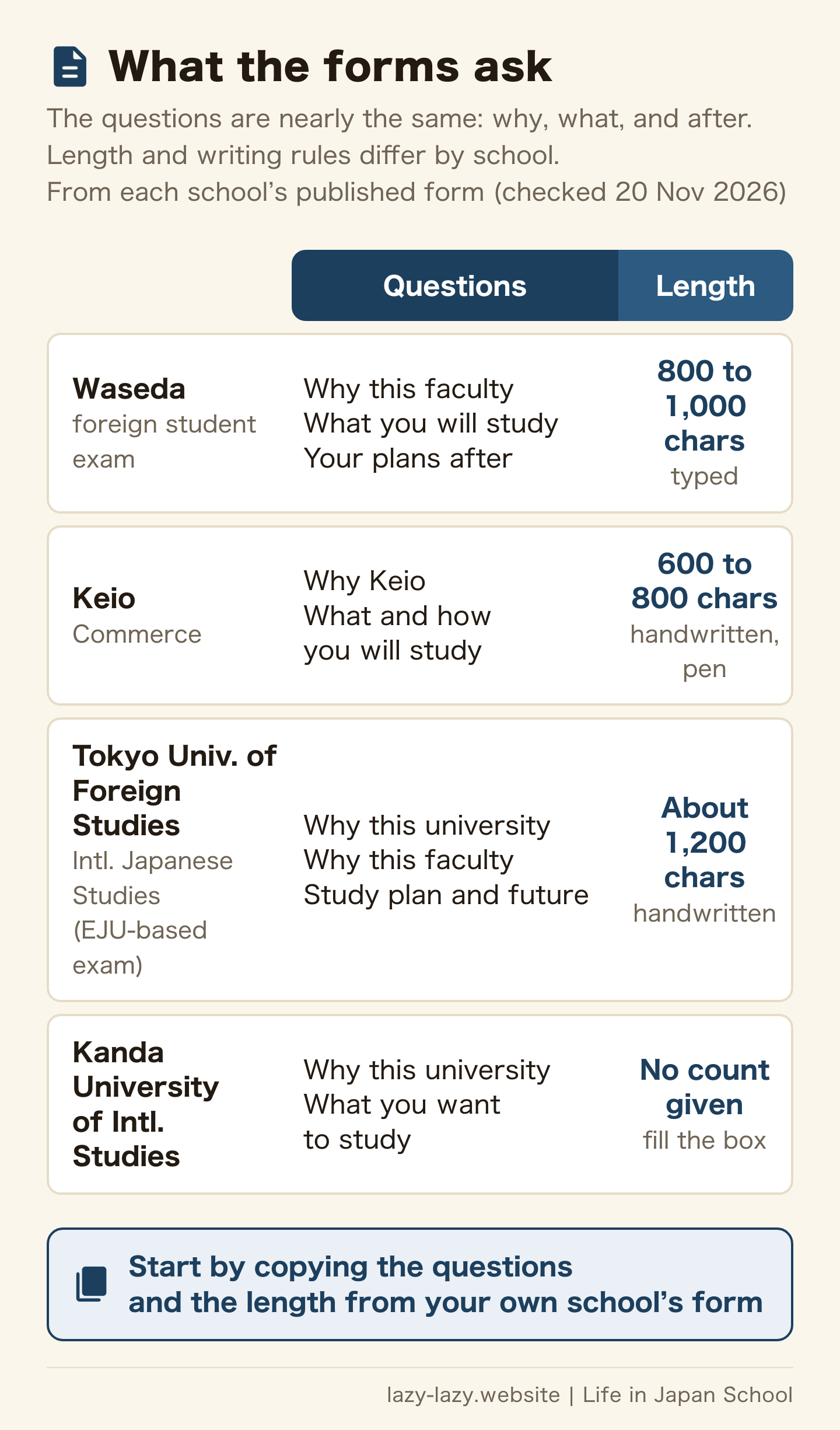
- Waseda University (undergraduate exam for foreign students): why you want this faculty, your study plans after entry, and your goals after graduation. 800 to 1,000 characters, punctuation included.
- Keio University, Faculty of Business and Commerce (2027): why you chose Keio, and what and how you want to study, linked to the faculty. 600 to 800 characters.
- Tokyo University of Foreign Studies, School of International Japanese Studies (2027, EJU-based exam): why this university, why this school compared with the others, and your study plans and goals. About 1,200 characters.
- Kanda University of International Studies (2027): why you chose the university, and what you want to study. No character count. You fill one lined page.
So the questions are two or three: why here, what you will study, and what comes after. What changes is the length, and whether you type or write by hand. Even one university can use different forms for different exams. For its exam for privately financed international students, Tokyo University of Foreign Studies wants a typed Word form. The length is about 1,200 characters for Language and Culture Studies and about 2,000 for International and Area Studies (2027 guidelines). Your first job is to copy the questions, the length and the writing rules from your own school’s form. Some schools use a different form for each faculty. Waseda asks you to write one for each faculty you apply to.
Not sure yet what comes after language school? Read the four roads after Japanese language school first. Each one needs different things.
How to write a statement of purpose: three sentences first, then expand
If you start writing 800 characters from the top, you lose your way halfway. Build the bones first.
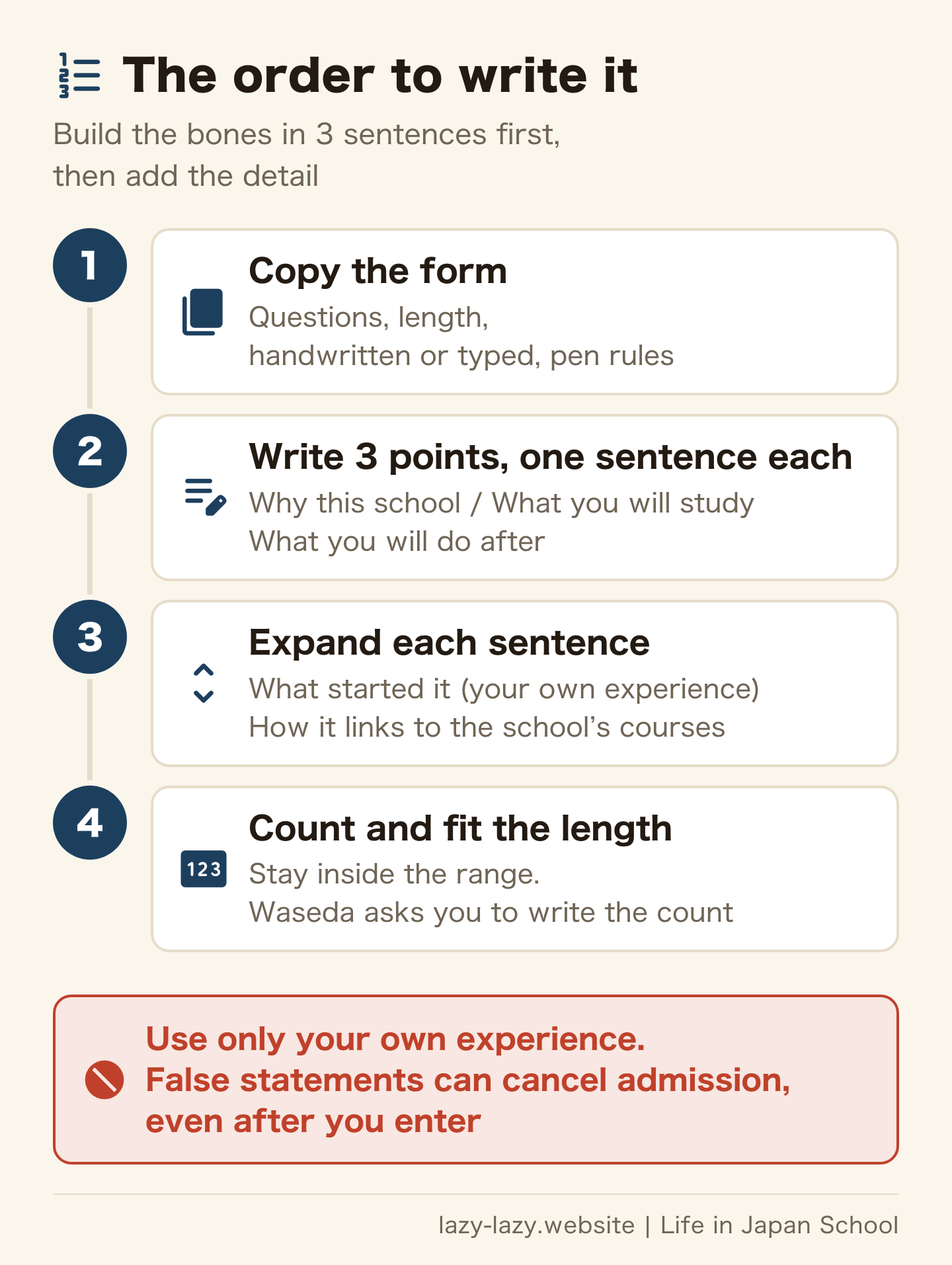
- Copy the form. Write down the questions, the length, typed or handwritten, and any pen rules.
- Write three points, one sentence each. 1) Why this school (or faculty). 2) What you will study. 3) What you will do after. If the form asks only two questions, add point 3 at the end of point 2.
- Expand each sentence. Add what made you think this, using something that really happened to you. Then link it to the school’s courses. Check course names on the school’s website or brochure.
- Count and fit the length. Stay inside the range. Waseda’s form has a box where you write your character count.
To start, divide the range by three. For 800 characters, that is about 270 per point. This is only a way to begin. The school does not set it. If the form has two questions, like Keio Commerce, divide by two.
A “character” here is one Japanese character; Waseda counts punctuation too. If your form must be typed, get used to Japanese input first. How to type Japanese shows free setups for computer and phone.
Example: three core sentences, and one of them expanded
Below is a made-up example to show the method. It is not a real person’s text. Replace the parts in [ ] with your own facts. If you borrow or invent an experience, you cannot answer when the interviewer asks about it.
Template (three core sentences, in Japanese)
①私は[きっかけになった自分の体験]から[学びたいこと]に関心を持ち、[学校名・学部名]を志望します。
(Because of [your experience], I became interested in [subject], so I am applying to [school and faculty].)
②入学後は[授業や学科の名前]で[具体的に学ぶこと]を学びます。
(After entering, I will study [what] in [course name].)
③卒業後は、学んだことを[仕事や目標]に生かしたいと考えています。
(After graduating, I want to use it in [job or goal].)
Made-up example (someone applying to economics)
①私は、アルバイト先の店で売れ残りの量が日によって違うことに気づき、需要の動きに関心を持ちました。そこで〇〇大学経済学部を志望します。
②入学後は、統計の授業でデータの読み方を学び、ゼミで消費の変化を調べます。
③卒業後は、データを使って商品の量を決める仕事に就きたいと考えています。
Point 1 expanded (made-up example)
私は日本語学校に通いながら、コンビニでアルバイトをしています。同じ弁当でも、雨の日は多く残り、晴れた週末はすぐになくなります。店長は、天気と曜日を見て注文の量を決めていました。私はそれを見て、人が物を買う量には理由があり、数字で考えられると知りました。経済学部では、この「需要」を理論とデータの両方から学べます。〇〇大学経済学部には、1年生から統計を学ぶ授業があります。感覚ではなく数字で説明できる力をつけたいと考え、志望しました。
In English, the expanded part says: I work at a convenience store. On rainy days the same lunch boxes are left over; on sunny weekends they sell out. The manager orders by weather and day. That showed me buying has reasons you can measure. The faculty teaches demand through theory and data, with statistics from year one. So I am applying.
The expansion added three things: a scene (rainy-day lunch boxes), what you noticed, and the link to the school’s courses. The last sentence returns to point 1, so the reader never gets lost. Expand points 2 and 3 the same way.
Japanese university interview questions for international students
Some universities publish what their interviews cover. Here is what they say in their own papers for privately financed international students.
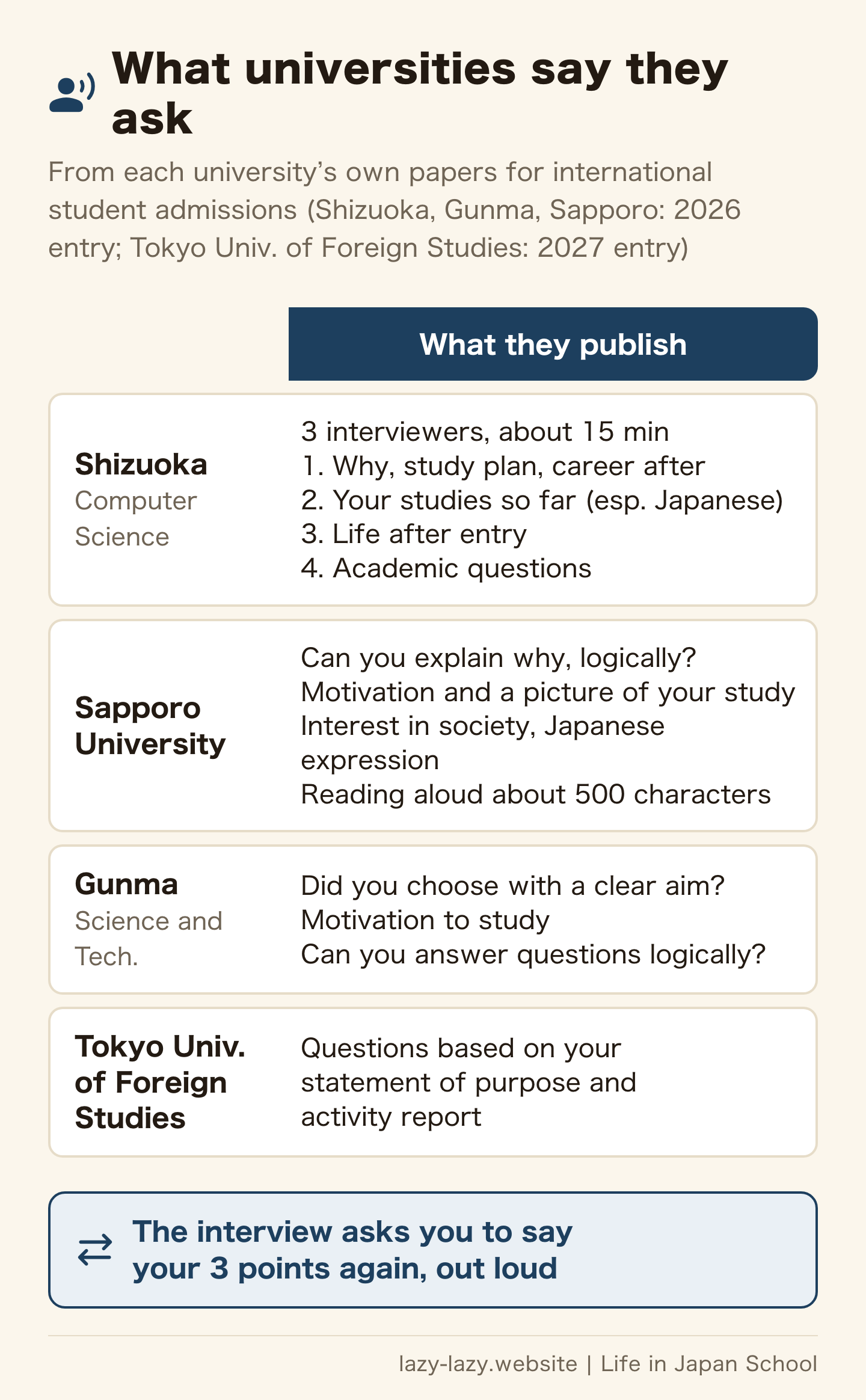
- Shizuoka University, Faculty of Informatics, Department of Computer Science (2026 entry): three interviewers, about 15 minutes. Four main topics: your motivation, study plan and career after graduation. Your studies so far, especially Japanese. Your life after entry. Academic questions.
- Sapporo University (2026 entry): can you explain logically why you chose the course? It also checks your motivation, a picture of what you will study, interest in society, and Japanese good enough for class. There is a reading-aloud task of about 500 characters.
- Gunma University, Faculty of Science and Technology (2026 entry): did you choose with a clear aim? It also looks at motivation, and whether you answer questions logically.
- Tokyo University of Foreign Studies (2027 entry): interview questions are based on your statement of purpose, activity report and other papers.
What the four share is your three points: why here, what you will study, what comes next. Start by saying your three sentences, one by one, without looking at the paper. Ask yourself “Why?” about each of the three sentences, and prepare an answer. Practise telling the expanded part in your own words too.
Shizuoka lists “your studies so far, especially Japanese”. So be ready to say what you studied at language school and how. Sapporo has a reading-aloud task, so reading newspaper or textbook passages out loud also helps. Your school’s own guidelines say what its interview looks like.
Vocational school interview: your aim, your Japanese, and how you will pay
The interviewer asks, “How will you pay your fees and living costs?” A question about your family’s money may surprise you. Where you come from, schools may not ask this at entry. In Japan, the government asks vocational schools to check it.
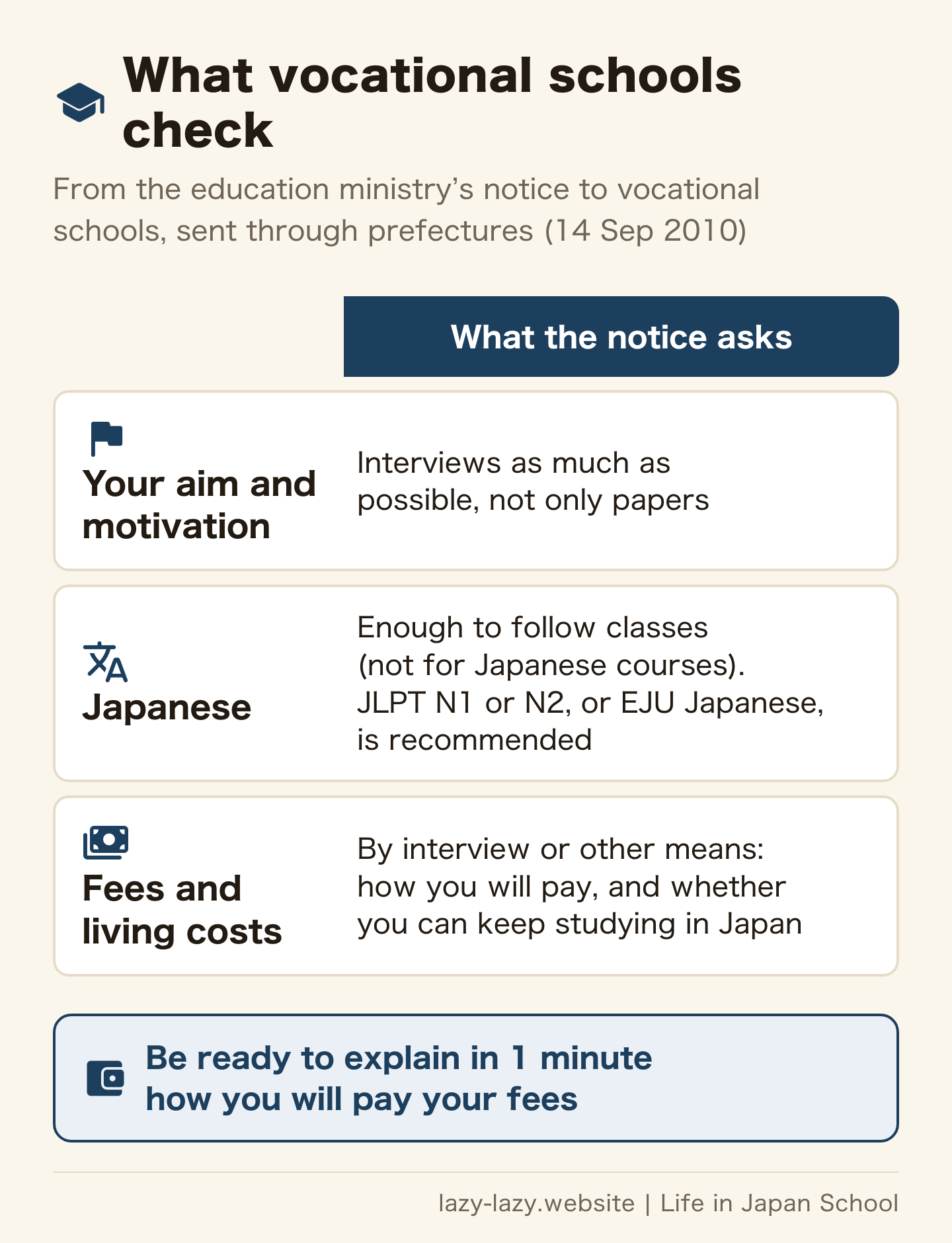
We could not find a vocational school that publishes its interview questions in detail. What we have instead is a notice the education ministry sent to vocational schools through prefectures: notice to vocational schools on managing international students (14 September 2010, in Japanese). It says how schools should select students:
- Use interviews as much as they can, not only documents, to judge aim and motivation
- Check that their Japanese is good enough for class (except Japanese-language courses). Using the JLPT (N1 or N2) or EJU Japanese is recommended
- Through interviews or other means, check how they will pay fees and living costs, and that they can afford to keep studying
So prepare three things. Why this course and what job you want (your three sentences). What you studied in Japanese, and your test results. And who will pay your fees and living costs, and how. For the last one, be able to explain your case in one minute: money from family, savings, scholarships. The Japanese you need to enter (one year at language school, or N2, and so on) is in our guide to vocational school in Japan.
How much does it cost?
The forms are free to download from each school’s website. Writing the statement costs nothing.
What you pay is the exam fee when you apply, and it differs by school. For example, the 2027 exam for privately financed international students at Tokyo University of Foreign Studies has an exam fee of 17,000 yen. You pay 4,000 yen for the first stage when you apply. Only people who pass the first stage pay the 13,000 yen for the second. The payment handling fee is extra, and you pay it (2027 guidelines). A handwritten form also means printing and the right kind of pen.
How you will pay tuition after you pass may come up in the interview too. Scholarships for international students and tuition fee exemption have their own deadlines and conditions.
What if I break the rules?
The form rules are detailed. Keio Commerce says to write in black or blue ballpoint pen. No pencil, and no erasable pens such as FriXion. Waseda says not to change the form’s layout, font or font size.
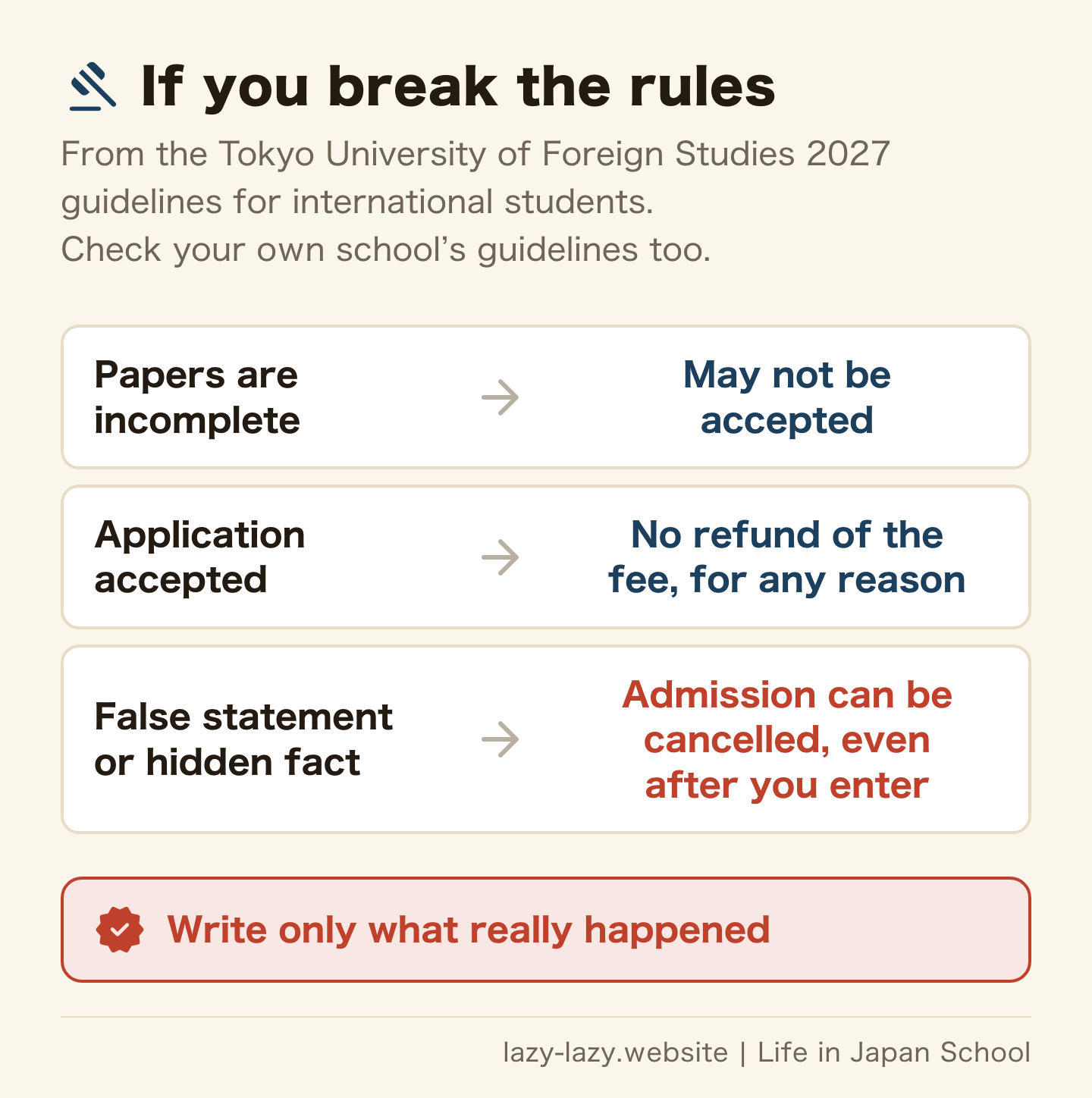
What happens if you break them is in the guidelines. The Tokyo University of Foreign Studies 2027 guidelines say three things:
- If your papers are incomplete or wrong, they may not be accepted
- Once your application is accepted, the fee is not refunded for any reason
- If you write something false or hide a fact, admission can be cancelled, even after you enter
Write only experiences that really happened. Copying someone’s text or inventing an experience moves you toward that “false statement”. Find the same warning in your own school’s guidelines and read it.
Deadline close, or no one to practise with?
Deadlines differ by school and by exam. The Tokyo University of Foreign Studies exam for privately financed international students took applications from 8 to 16 October 2026. Always check the date in your own school’s guidelines.
When time is short, start from the three sentences. With the bones done, you can ask a language school teacher a clear question: “Do these three points come across?” Ask your homeroom or further-study teacher first.
Want to practise the interview in the evening, or get a second opinion? You can also buy one-to-one Japanese lessons one at a time. italki showed 1,216 Japanese teachers available for lessons (checked 20 November 2026). The site works in English. Tell the teacher you want to practise for an admission interview, and show your three sentences. Prices differ by teacher. Ask your school teacher first, and try a trial lesson before you buy more. Find a Japanese teacher on italki (ad)
Which one are you?
- You have written nothing yet — open your school’s guidelines and form. Copy the questions, the length and the rules onto paper. Today, write your three points, one sentence each.
- You have three sentences but not enough characters — add a scene that started it and a link to the school’s courses to each one. Check course names on the school website today.
- You have finished and the interview is near — practise saying the three sentences without paper. Prepare one minute on how you studied Japanese at language school.
- You are applying to a vocational school — do all of the above. Also prepare one minute on who pays your fees and living costs, and how. Today, confirm the amounts with your family.
FAQ
Q. How long is a statement of purpose for a Japanese university?
Your school’s form decides. Waseda wants 800 to 1,000 characters and Keio Commerce 600 to 800. Tokyo University of Foreign Studies wants about 1,200 for its EJU-based exam for International Japanese Studies. Some forms, like Kanda’s, give no count, only a box.
Q. What should I write in a statement of purpose?
Answer the questions on the form. The four forms we opened asked two or three things: why you chose the school, what you will study, and your goals after graduation. Write each as one sentence first, then expand.
Q. Can I copy an example statement?
No. The interview may ask about what you wrote, and you cannot answer for an experience that is not yours. The Tokyo University of Foreign Studies guidelines say admission can be cancelled, even after entry, if your papers contain something false.
Q. What do Japanese universities ask international students in the interview?
It depends on the university. Shizuoka’s Department of Computer Science (Faculty of Informatics) lists motivation, study plan, career after graduation, your Japanese studies, life after entry, and academic questions. Sapporo also has a reading-aloud task of about 500 characters.
Q. What do vocational schools ask in the interview?
The notice the education ministry sent to vocational schools through prefectures asks them to judge your aim and motivation by interview. They also check your Japanese, and how you will pay fees and living costs. Be ready to explain how you will pay.
Q. Should I type or handwrite it?
Follow the form. Waseda wants it typed. Keio Commerce wants it handwritten, and so does the EJU-based exam form for International Japanese Studies at Tokyo University of Foreign Studies. The same university’s exam for privately financed international students wants a typed Word form. Keio says black or blue ballpoint pen, with no pencil and no erasable pen.
Summary
The questions and the length are printed on your school’s form. The four forms we opened ask almost the same thing: why here, what you will study, what comes next. Only the length and the writing rules change. Copy the form, write three sentences, then expand them with your own experience and the school’s courses.
The interview is where you say those three sentences again, out loud. Universities ask about motivation, study plans, careers and your Japanese. Vocational schools also check how you will pay. For both the writing and the talking, what really happened is enough.
Sources (official, in Japanese): Waseda Admissions Center, exams for returnees and foreign students (statement of purpose form) / Keio Faculty of Business and Commerce, 2027 statement of purpose form / Tokyo University of Foreign Studies, 2027 International Japanese Studies statement of purpose / Tokyo University of Foreign Studies, 2027 guidelines for privately financed international students / Kanda University of International Studies, 2027 statement of purpose form / Sapporo University, 2026 international student selection: aims of the questions / Shizuoka University, Faculty of Informatics, Department of Computer Science interview sheet (2026) / Gunma University, 2026 Faculty of Science and Technology interview points / Ministry of Education, notice to vocational schools (via prefectures) on managing international students (all checked 20 November 2026). Before you apply, always check this year’s guidelines and form from your own school.
Related reading
Found this useful? Share it
Send it to a friend who lives in Japan.
WHO WROTE THIS

mori
Japanese. I read the ministries’ own notices, orders and Q&As in the original, and I start from what my Nepalese and Sri Lankan friends in Japan actually ran into. I do not write about what I have not checked or been told.
What this site can and cannot do →Looking for something else?
You may use the figures in this article, including commercially, if you credit this site with a link. How to use our figures