Checked on 26 November 2026 against Japan Meteorological Agency (JMA) normals, the Ministry of the Environment WARMBIZ page, the Secondhand Articles Dealer Act, Jimoty’s official guides, and NITE (a government product safety body).
The short answer
- A January morning in Tokyo is 1.2°C. That is the usual-year value (JMA “normal”). Sapporo is −6.4°C, with a lot of snow.
- Layering means wearing several thin pieces on top of each other. Start with 3: a base layer, a middle layer like fleece, and an outer layer.
- Keep your neck, wrists and ankles warm. A scarf, gloves and thick socks do the job.
- Get clothes free first, then used, then new. Start by asking a teacher with one short message.
- Buying new? Check the total first. Before you buy, look up 3 items on the official site: one base layer, one fleece, socks. Prices change over time.
Knowing this, you can skip buying an expensive coat in a panic. You build your winter outfit from what you have, then pay only for the missing piece.
It is late November. The wind on the station platform is cold in the morning. The clothes you brought from home are T-shirts and one thin long-sleeve top. You ask a Japanese friend what to buy. “Just go to UNIQLO,” they say. But what, and how many? How much should you spend? Your friend moving to Sapporo will need even more. The answer starts with real temperatures and a simple way to layer.
- How cold is Japan in winter? Tokyo mornings are 1.2°C in January
- What to wear in Japan in winter? 3 thin layers, warm “necks”
- Where to get winter clothes cheap? Free first, then used, then new
- How to get winter clothes free? Ask your teacher, check Jimoty
- Buying at secondhand shops? Look for the licence, bring ID
- Buying new: where, how much? Check the total for 3 items
- Cold room? Adjust with clothes, watch for low-temperature burns
- Got sick from the cold? See a doctor; at night, find an urgent clinic
- Which one are you?
- FAQ
- Summary
- Related reading
How cold is Japan in winter? Tokyo mornings are 1.2°C in January
JMA publishes “normals”. A normal is the usual value for a place: the average over the 30 years from 1991 to 2020. In January, Tokyo reaches 9.8°C in the day. The morning low is 1.2°C.
Nagoya is 9.3°C by day, 1.1°C in the morning. Osaka is 9.7°C by day, 3.0°C in the morning. Fukuoka is 10.2°C by day, 3.9°C in the morning.
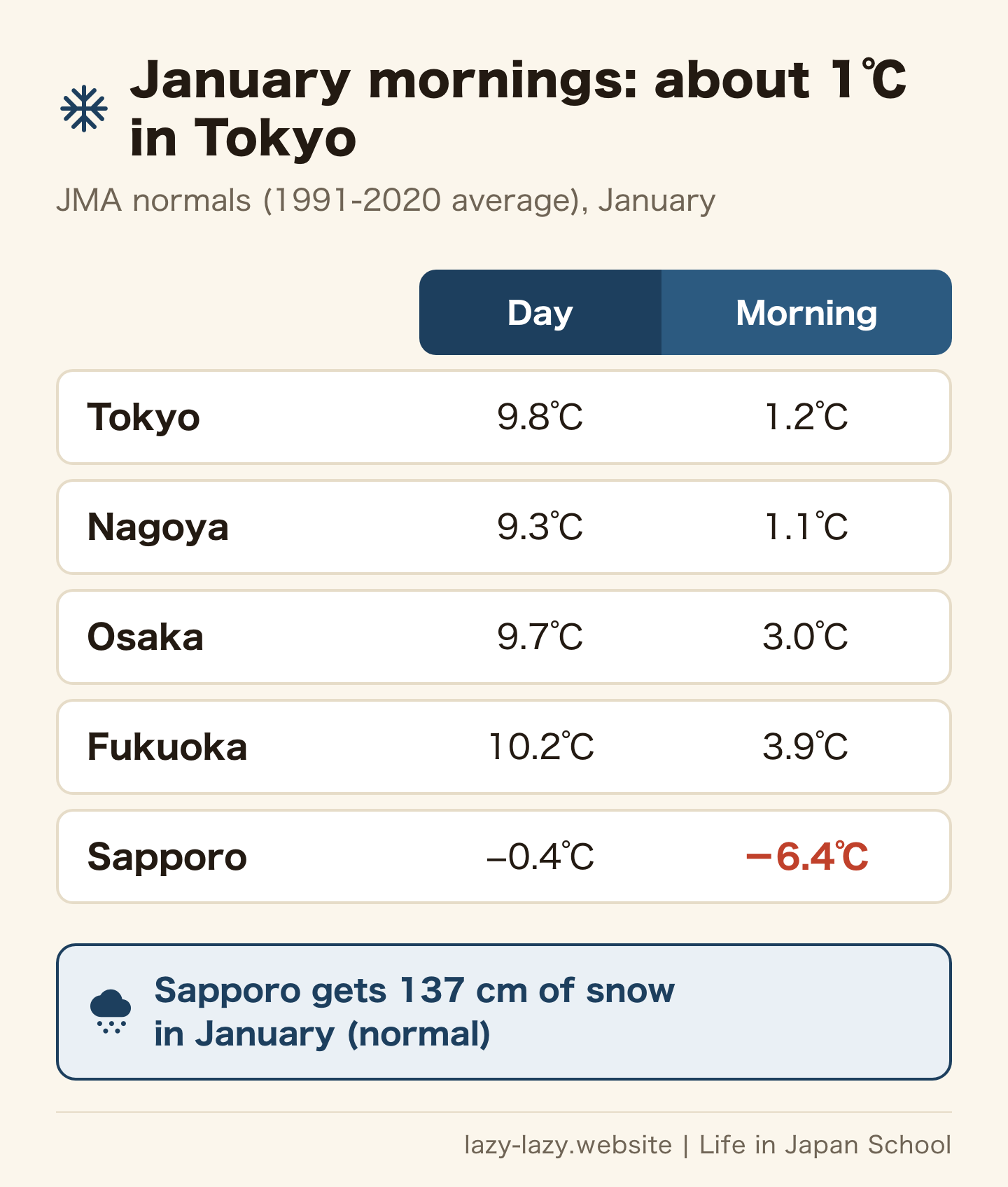
Hokkaido is a different kind of cold. In Sapporo, January is −0.4°C even in the day. Mornings are −6.4°C. About 137 cm of snow falls in January, and the normal snow depth in February reaches 95 cm. If you live there, think about shoes you can walk on snow with.
A normal is an average, so some mornings are colder. Check the JMA weather forecast the night before. It helps you decide how many layers to wear.
What to wear in Japan in winter? 3 thin layers, warm “necks”
Indoors, you wear one T-shirt and turn the heater up when you feel cold. Where you come from, that may be normal. In Japan, the Ministry of the Environment suggests keeping heated rooms at about 20°C and adjusting with clothes (Ministry of the Environment, Ecojin, WARMBIZ). So expect to wear an extra layer inside too.
Start with 3 layers:
- Base layer: a thin long-sleeve shirt worn next to your skin, under your clothes. UNIQLO’s HEATTECH is one example. On the UNIQLO site it is listed under “innerwear”. Tights, leggings for your legs.
- Middle layer: a fleece, a sweater. Indoors, stop here.
- Outer layer: a coat, a padded jacket. Take it off in class if you get warm.
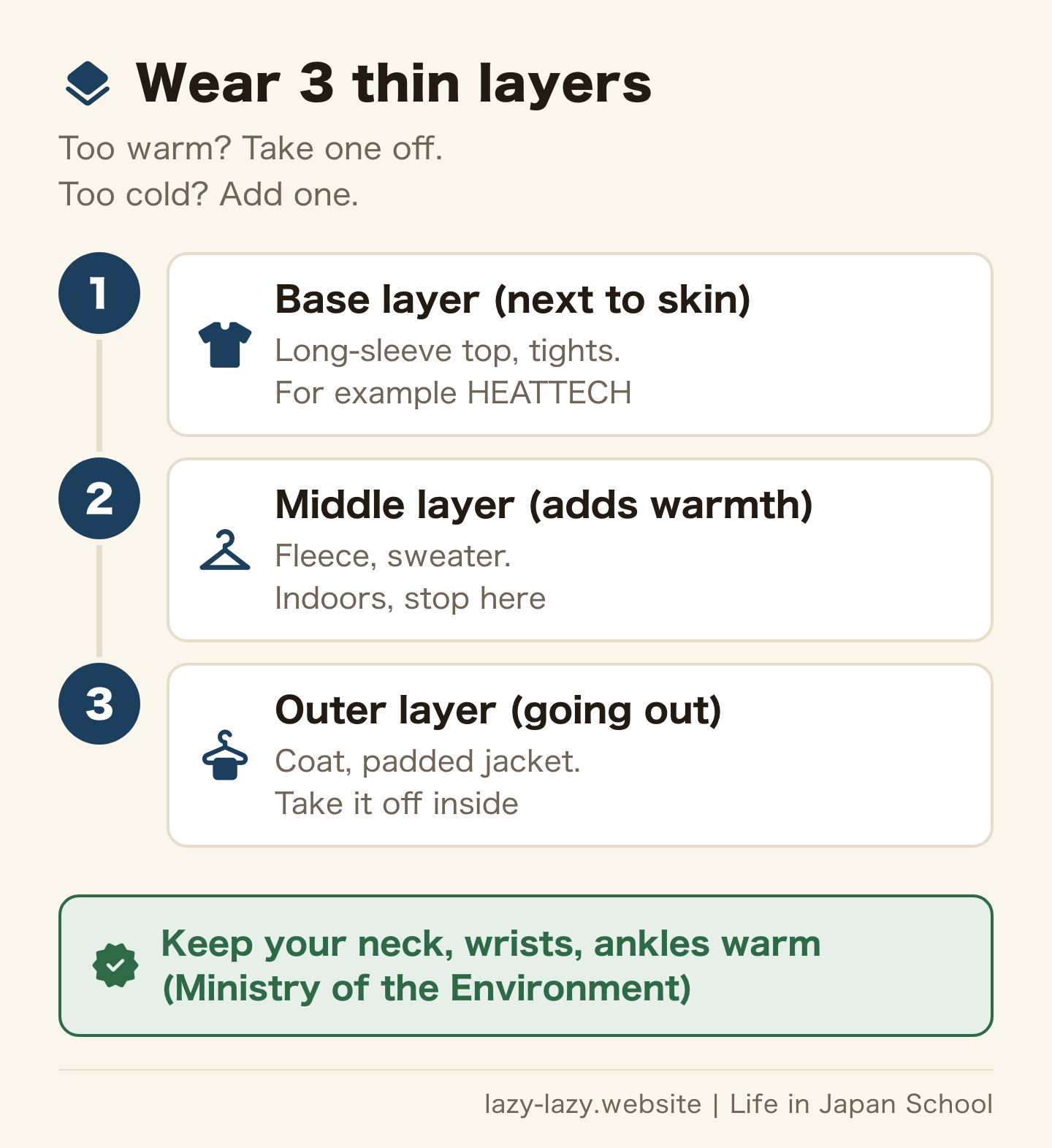
Thin layers beat one thick piece. You can take one off, then put it back on. Some days, the morning is over 8°C colder than the afternoon (see the chart). Layers let you match each part of the day.
The second trick is the “3 necks”. The ministry says your neck, wrists and ankles have large blood vessels. Warming them first heats your whole body well. A scarf covers your neck. Gloves cover your wrists. Thick socks cover your ankles.
Where to get winter clothes cheap? Free first, then used, then new
There are 3 ways to get winter clothes: get them free, buy used, buy new. Look in that order and you spend the least.
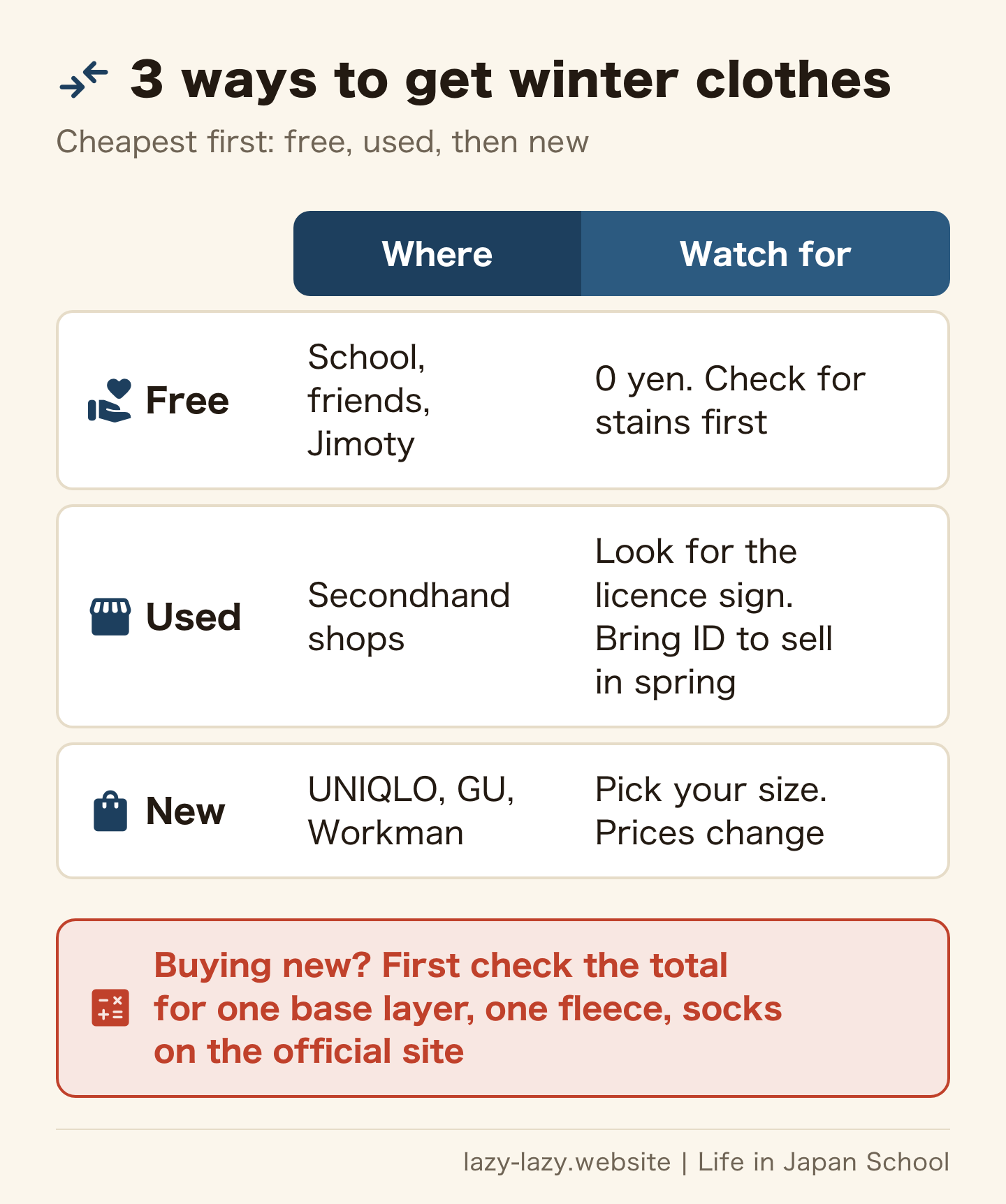
Think about order too. You wear a base layer and socks every day, so buy those new first. A coat often costs more. Try getting one free, then used, before you decide.
How to get winter clothes free? Ask your teacher, check Jimoty
First, ask your teachers, older students and people from your country. Ask people who are going home soon too. One short message is enough:
“If you have winter clothes you no longer use, could I have them?”
Next, try Jimoty. It is a local listings board for each prefecture and city, with a smartphone app. Signing up is free, with no fees. Open “sell / give away” (売ります・あげます), then the clothing section (服/ファッション), and look for 0-yen items. The site is in Japanese.
If you want something, press the inquiry button and chat with the person to set a place to meet. Jimoty asks users to hand things over in busy places like a convenience store, a station, a shopping centre. Keep all messages inside Jimoty’s chat. The other side is a private person, not a shop. Check for stains and holes before you take anything.
Jimoty also works with city governments. For example, Funabashi City signed an agreement on 20 October 2023 to promote reuse through Jimoty. Check your city’s waste page for reuse ideas too.
Buying at secondhand shops? Look for the licence, bring ID
Used clothes can be cheaper than new ones. Shops that buy and sell used goods have a licence from the prefectural public safety commission. They show a licence sign in the shop (Secondhand Articles Dealer Act). When you sell your winter clothes in spring, bring ID such as your residence card.
One example of a licensed secondhand chain is 2nd STREET. It buys and sells used clothes, shoes, bags, furniture, home appliances and more. It has over 900 shops across Japan, plus an official app with an online store. In spring, you can sell winter clothes at a shop. You can also send them in a cardboard box by delivery. Each shop handles different items, so check with your nearest shop before you go.
If you also need furniture, how to furnish your flat cheaply explains secondhand shops and city reuse.
Buying new: where, how much? Check the total for 3 items
For new clothes, it helps to know how the shops differ. The prices below are the regular prices we saw on each official site on 27 November 2026. These are not the same items, so they are not a price comparison. Prices move with limited-time offers and markdowns.
| Shop | What it is like | Example: long-sleeve base layer |
|---|---|---|
| UNIQLO | You can see base layers, fleeces and socks with prices on the official site | HEATTECH Crew Neck T (long sleeve): 1,290 yen |
| MUJI | Sells clothes plus everyday household goods | On 27 November its official online store was stopped, so we could not check. Look in a shop |
| Shimamura | Its official online store shows the before-tax price first, with the tax-included price in brackets | Women’s round-neck long-sleeve innerwear: 890 yen + tax (979 yen with tax; pre-order item) |
| 2nd STREET | A secondhand chain (clothes, shoes, furniture and more), from the “used” part above | Each item is different. Check in a shop or the app |
For example, at UNIQLO a long-sleeve base layer (1,290 yen), a fleece jacket (2,990 yen) and HEATTECH socks (590 yen) come to 4,870 yen in total (official site, 27 November 2026).
Do one thing before you buy. Check the total for 3 items on the official site: one base layer, one fleece, socks. If nobody gives you a coat, add its price.
Workman has over 1,100 shops across Japan. Its official site shows work clothes plus outdoor, sports and everyday wear. If your part-time job is outside, it may be worth a look.
Winter clothes are a once-a-year cost, not a monthly one. Write down costs like this early. Then other months do not get squeezed. How to set a monthly budget in Japan shows how. For your whole budget, see living costs for international students.
If this month is really short, do not buy everything at once. Buy a base layer with socks first. Keep looking for a free coat.
Cold room? Adjust with clothes, watch for low-temperature burns
Do not keep a hot-water bottle, a heat pack on one spot for long. Take the bottle out of your futon when you sleep. Remember just this.
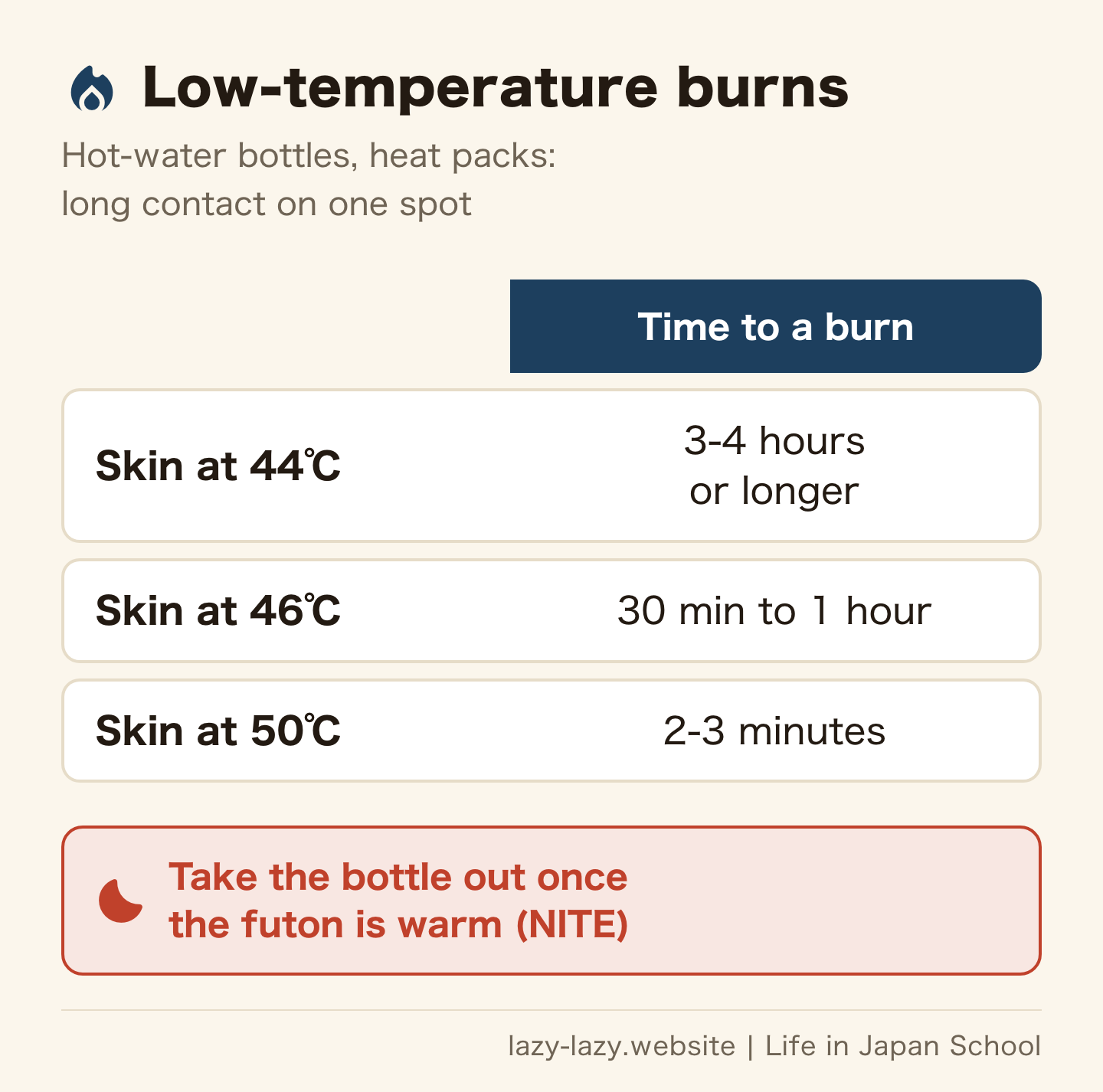
Even heat that feels just warm can burn your skin over time. This is called a low-temperature burn. NITE, a government product safety body, gives a guide in its sheet on low-temperature burns. It takes 3 to 4 hours or longer at 44°C, but only 2 to 3 minutes at 50°C (see the chart below).
The skin may look only a little changed, with weak pain. Even so, the burn can go deep into the skin. If something feels wrong, see a specialist doctor early.
Indoors, use clothes first. Wear your middle layer, put on thick socks and put a blanket on your knees. For heater settings and how the bill is calculated, see winter electricity bills in Japan. If your windows get wet in the morning, mold and condensation in Japanese apartments can help.
Got sick from the cold? See a doctor; at night, find an urgent clinic
If your health is weak, if you have a long-term illness, talk to your doctor about winter. If you get a fever and a cough, do not push yourself to go to school. See a doctor instead. How to see a doctor in Japan explains the steps and which clinic to choose.
If you feel sick at night, on a holiday, urgent care in Japan shows where is open and the extra fee. Thinking about a flu shot? Read flu shots in Japan.
Which one are you?
- You only have T-shirts and a thin long-sleeve top: today, lay out your clothes. Write down what is missing.
- You have almost no money: today, send the sample message above to a teacher.
- You can spend a little: today, buy a base layer with thick socks. Start looking for a coat on Jimoty.
- You live somewhere snowy like Sapporo: today, check tomorrow morning’s temperature in the forecast. Make sure you have shoes for snow.
FAQ
Q. Does it snow in Tokyo?
Sometimes. JMA normals show about 4 cm of snow in Tokyo in January, with another 4 cm in February. That is far less than Sapporo’s 137 cm in January.
Q. Is December cold too?
Yes. December morning normals are 3.8°C in Tokyo, 5.3°C in Osaka, −4.0°C in Sapporo. Starting to gather winter clothes in November helps.
Q. Can I use Jimoty on a smartphone app?
Yes. Jimoty’s official guide says there is a smartphone app, with no sign-up fee. The site is in Japanese.
Q. Who can help if something goes wrong on Jimoty?
Talk to the other person first. Next, use Jimoty’s report button, its customer support. If that fails, call the consumer hotline 188 to reach a local consumer centre.
Q. Does wrapping a hot-water bottle in a towel stop low-temperature burns?
No. NITE says burns can happen even with a thick towel, a cover. Take the bottle out once the futon is warm.
Q. Can I put a shoe heat pack on my back?
No. NITE warns not to use disposable heat packs, shoe heat packs on any part of the body they are not made for.
Summary
Winter in Japan brings mornings near 0°C even in Tokyo, while Sapporo stays below 0°C in the day. Thin layers with a warm neck, wrists and ankles work better than one expensive coat. They let you adjust outside, on the train, at home.
The fastest way to save is to ask people. Send one message to a teacher, check the 0-yen clothes on Jimoty, try a secondhand shop. Then buy new only what is still missing. Start today by laying out the clothes you already have.
Official sources: JMA normals: Tokyo / Nagoya / Osaka / Fukuoka / Sapporo / Ministry of the Environment, Ecojin, WARMBIZ / e-Gov: Secondhand Articles Dealer Act (Art. 3 licence, Art. 12 sign, Art. 15 seller check) / 2nd STREET / Jimoty: safety / Jimoty: app / National Consumer Affairs Center (2 Sep 2025) / Funabashi City: agreement with Jimoty / NITE: low-temperature burns (all checked 26 November 2026).
Related reading
Found this useful? Share it
Send it to a friend who lives in Japan.
WHO WROTE THIS
mori
Japanese. I read the ministries’ own notices, orders and Q&As in the original, and I start from what my Nepalese and Sri Lankan friends in Japan actually ran into. I do not write about what I have not checked or been told.
What this site can and cannot do →Looking for something else?
You may use the figures in this article, including commercially, if you credit this site with a link. How to use our figures