Checked on 24 November 2026 against official pages: Japan’s Copyright Act (e-Gov), the Agency for Cultural Affairs copyright text (2026 edition), the education ministry’s 2023 notice for universities on generative AI, the Immigration Services Agency’s renewal document lists for the Student visa, plus official guides from Ritsumeikan, Kagoshima, Kyoto, Tohoku, Sophia, Nagasaki and Sagami Women’s University. Each university rule is that school’s own example.
The short answer
- You may use other people’s words in a report if you quote them correctly. Put them in quotation marks (「 」) and show the source. Quoting has 4 conditions (summed up by the Agency for Cultural Affairs).
- Copy-paste with no source is plagiarism (hyosetsu), a form of misconduct. Penalties differ by school. Examples: an F for that course (Ritsumeikan), failing every general-ed course that term (Kagoshima), suspension.
- Whether you can use ChatGPT or other AI depends on your university and course. The education ministry said each university should ideally set guidelines. It calls handing in AI output as it is “generally inappropriate”.
- Some courses, like ones at Sagami Women’s University, ask you to report AI used for translation. A translated text still needs its source.
- Your transcript is a document for Student visa renewal. Kyoto University says poor grades, very few credits can lead to a refused renewal. If you are not sure, ask your teacher before you hand it in.
Knowing this, you can check what is allowed before you hand in your report, so you do not break a rule by mistake. You also get ready-to-use questions for your teacher.
Your report is due tomorrow. You found a website on your topic. Its Japanese is much better than yours. Can you change a few words and use it? Can ChatGPT write a draft? What if you write in your own language, then run it through a translator? You ask a Japanese friend. “Depends on the teacher?”
- What is quoting in a Japanese university report? Using others’ words to support your own
- How to cite in a Japanese report: quotation marks, a number, a reference list
- Will they catch copy-paste? The real issue: it is misconduct
- Can you use ChatGPT for university assignments in Japan? It depends on the school, the course
- Is using Google Translate or DeepL plagiarism? Check your course rules
- Can lost credits affect your visa renewal? Your transcript goes to immigration
- Not sure? Ask your teacher, one point at a time, before you hand it in
- Which one are you?
- FAQ
- Summary
- Related reading
What is quoting in a Japanese university report? Using others’ words to support your own
In a university report, you use books, papers and websites to support your own ideas. Using someone else’s words inside your text is called quoting (in’yo).
The law allows it. Under Copyright Act Article 32, you may quote published works. A “work” means something a person created, like a book or an article. The quote must follow fair practice (the accepted way of quoting). It must stay within a fair amount for purposes like research. Article 48 says you must show the source.
The Agency for Cultural Affairs breaks this into 4 conditions (copyright text, 2026 edition, page 75).
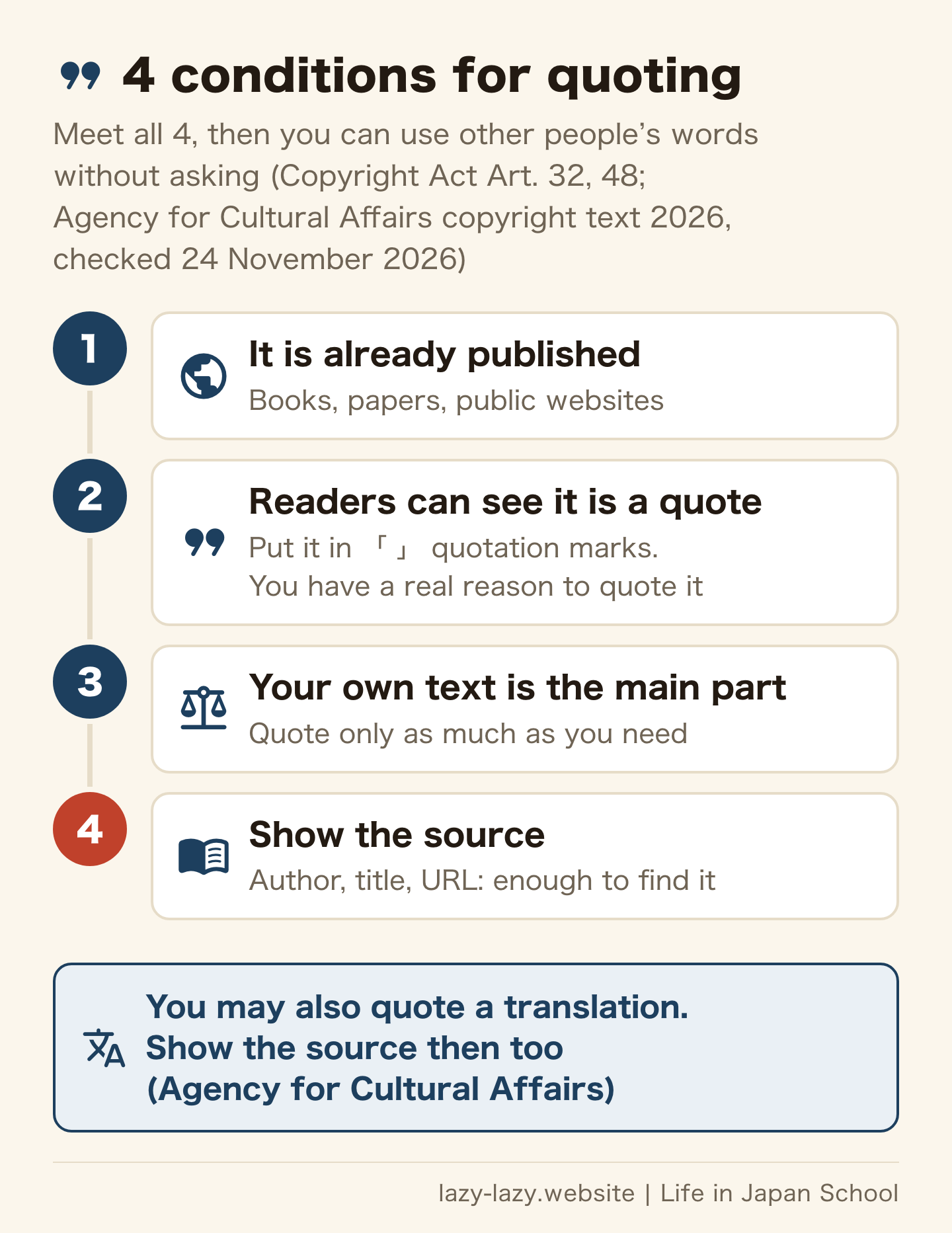
Condition 2 includes a real reason: your text needs that quote. Condition 3 means your own writing is the center. The quote only supports it. The Agency says to quote the smallest amount you need. Your main text should matter more than the quote. Pasting several paragraphs from a website, then adding one line of opinion, does not meet this.
How to cite in a Japanese report: quotation marks, a number, a reference list
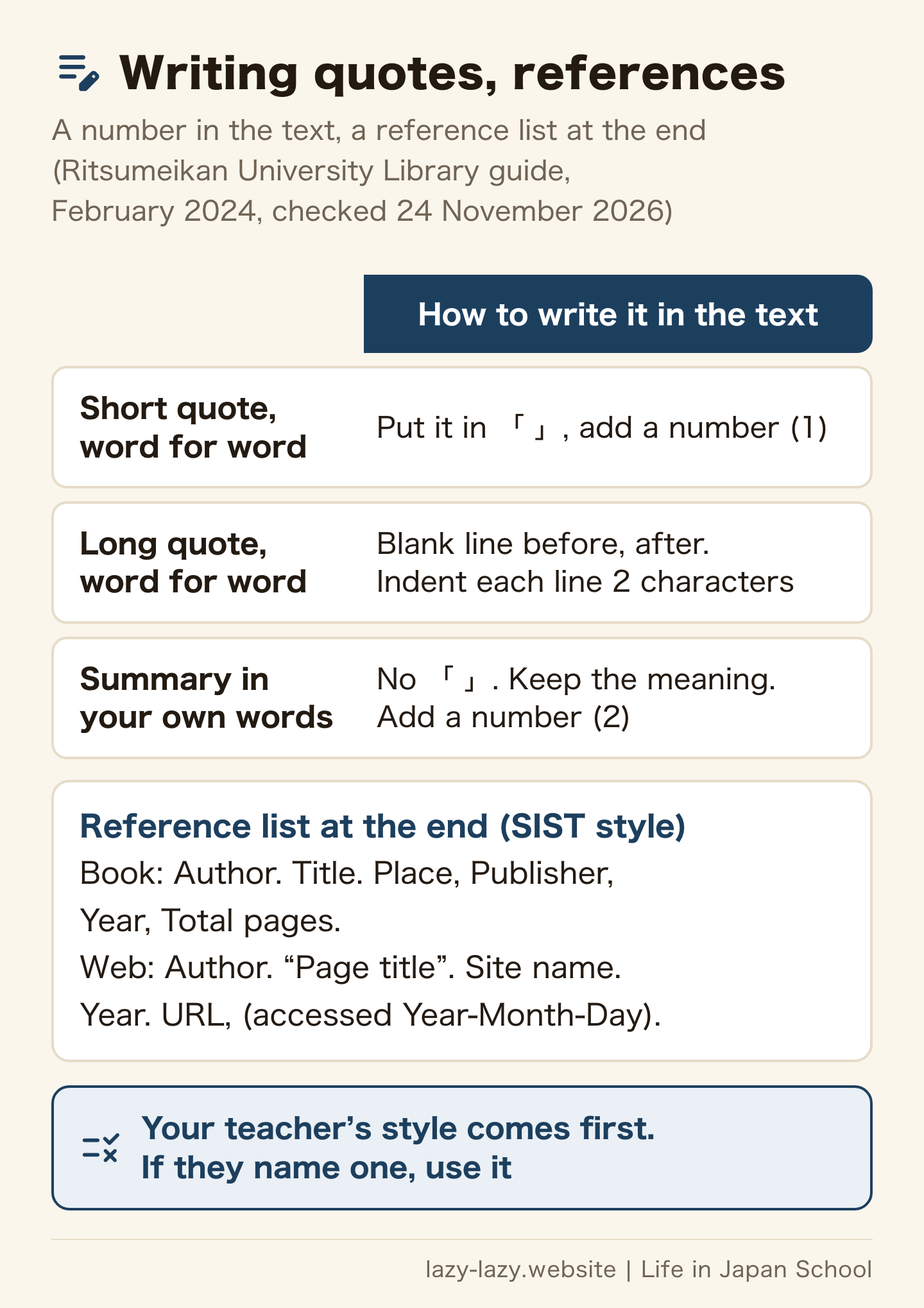
The style depends on your field or your teacher. If nobody names a style, a library guide is a good model. Here we use the Ritsumeikan University Library guide (February 2024). It has 3 basic rules. Keep quotes apart from your own text. Show the source where you quote. List your references at the end.
- Short quote, word for word: put it in 「 」
- Long quote, word for word: leave a blank line before it, after it. Indent each line by 2 characters
- Summary in your own words: no 「 」. Keep the original meaning
Each time, add a number like (1). The number matches your reference list at the end. This is the number style. Another style puts the author’s name, year at the quote. A summary needs a source too. Changing the words does not make the idea yours.
How to write references: books, websites
The same guide shows SIST, a reference style set by the Japan Science and Technology Agency. It is widely used in Japan. A book goes: “Author. Title. Place, Publisher, Year, Total pages.” A website goes: “Author. “Page title”. Site name. Year. URL, (date you accessed it).” Web pages can change later. That is why you write the date you saw it. Here is the Agency for Cultural Affairs text used in this article, written in this style.
文化庁著作権課. “著作権テキスト -令和8年度版-”. 文化庁. 2026. https://www.bunka.go.jp/seisaku/chosakuken/seidokaisetsu/pdf/94436101_01.pdf, (参照 2026-11-24).
In English: Agency for Cultural Affairs, Copyright Division. “Copyright Text, 2026 edition”. Agency for Cultural Affairs. 2026. URL, (accessed 2026-11-24).
Need more books? Your city library can help. Foreign residents can get a library card for free.
Will they catch copy-paste? The real issue: it is misconduct
Some students passed homework at school by joining texts from the internet. Where you come from, that may be normal. In Japan, copying with no source at university is plagiarism. It counts as misconduct.
Plagiarism means writing someone else’s text, or a website’s text, as your own without following quoting rules (Kagoshima University). Copying a friend’s report counts. Ritsumeikan says paying someone to write your report counts too. Kagoshima says it may check reports with software.
Penalties differ by school. What matters is your own school’s rules. Below are examples we checked on official pages.
- Ritsumeikan University: plagiarism can lead to discipline (a penalty from the university, such as suspension or a formal warning), with an F (fail) for that course. During a suspension you cannot attend classes, sometimes not even exams
- Kagoshima University (general education courses): all general-ed courses taken that term are failed (0 points). Suspension is possible
- Kyoto University: each faculty sets its own rules. The grades of every course that year can be cancelled
- Tohoku University, Faculty of Law: report misconduct can bring strict penalties, up to expulsion
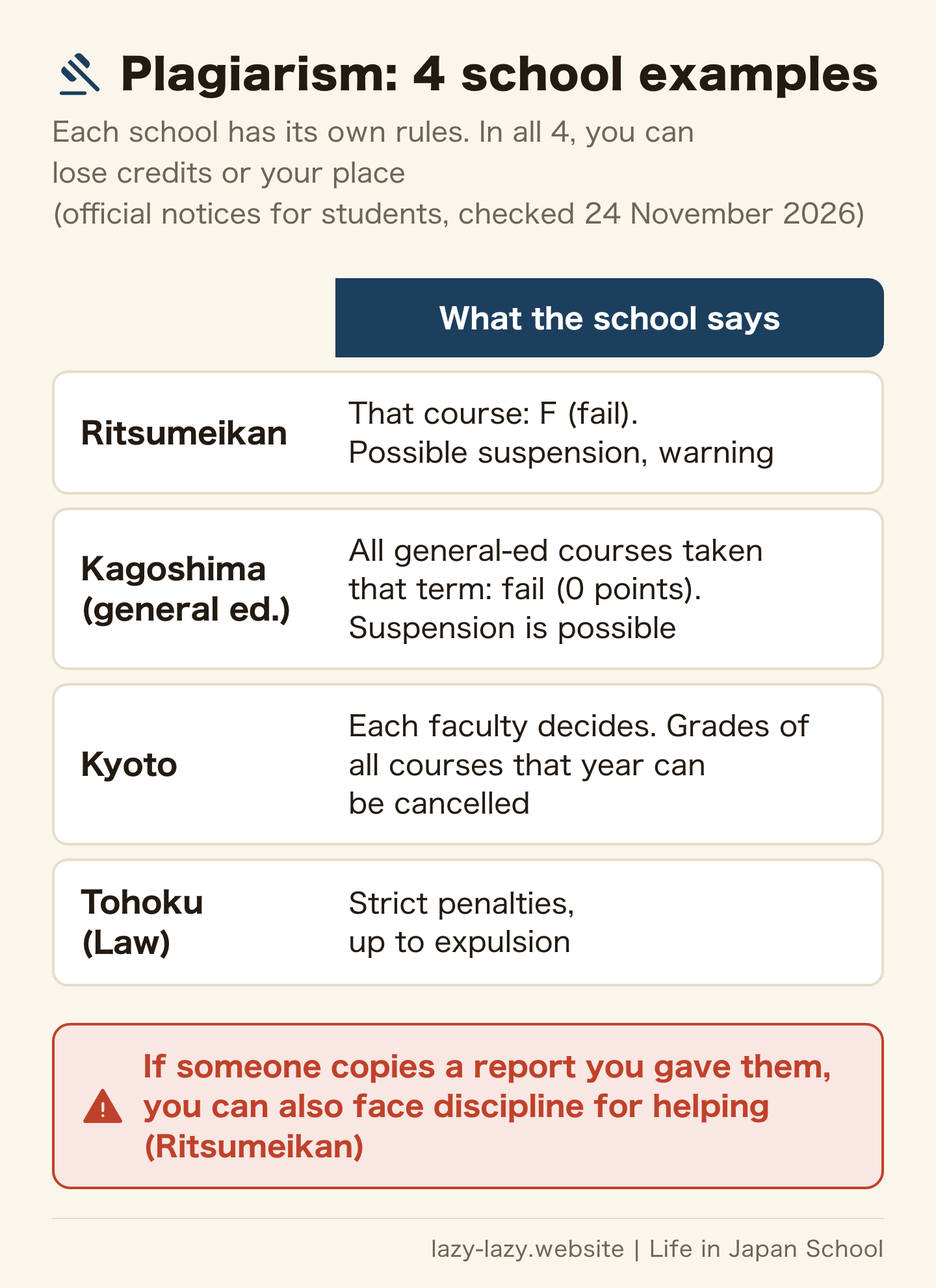
The person who shares a report is not safe either. Ritsumeikan says an older student who gave a report to a younger one can face discipline for “helping” (hojo, helping someone cheat). If both took the same course that term, the giver also gets an F. If a friend asks to see your report, share tips on how to write it instead.
Can you use ChatGPT for university assignments in Japan? It depends on the school, the course
There is no single national answer. The education ministry’s notice (13 July 2023) says each university should ideally set its own guidelines. As examples where AI may help, it lists brainstorming, research, proofreading (fixing mistakes) and translation.
It also warns about 3 things. Handing in AI output as it is, without your own work, is “generally inappropriate”. If AI output contains someone’s text, you may plagiarize without knowing it. AI answers can be wrong, so you must check them.
The notice went to the bodies that run universities, colleges of technology (such as national university corporations, school corporations). It asked them to pass it on to their schools. Vocational schools were not on the list.
At a vocational school or a language school, check your own school’s rules. Look at the guide you got when you entered, the course syllabus, the student handbook if your school has one. If you cannot find it, ask the academic office or your homeroom teacher. The same goes for AI or a translator in language school homework.
University rules also differ in strength. These are examples.
- Nagasaki University (25 April 2023): you may not use AI content in reports or theses. If you do, the teacher can give you zero points
- Sophia University (11 November 2025): text made by AI does not count as your own work. A teacher may still allow AI. Teachers tell students if AI is allowed
- Sagami Women’s University: proper use is fine, but some courses ban or limit it. You may be asked to state the AI you used, where you used it
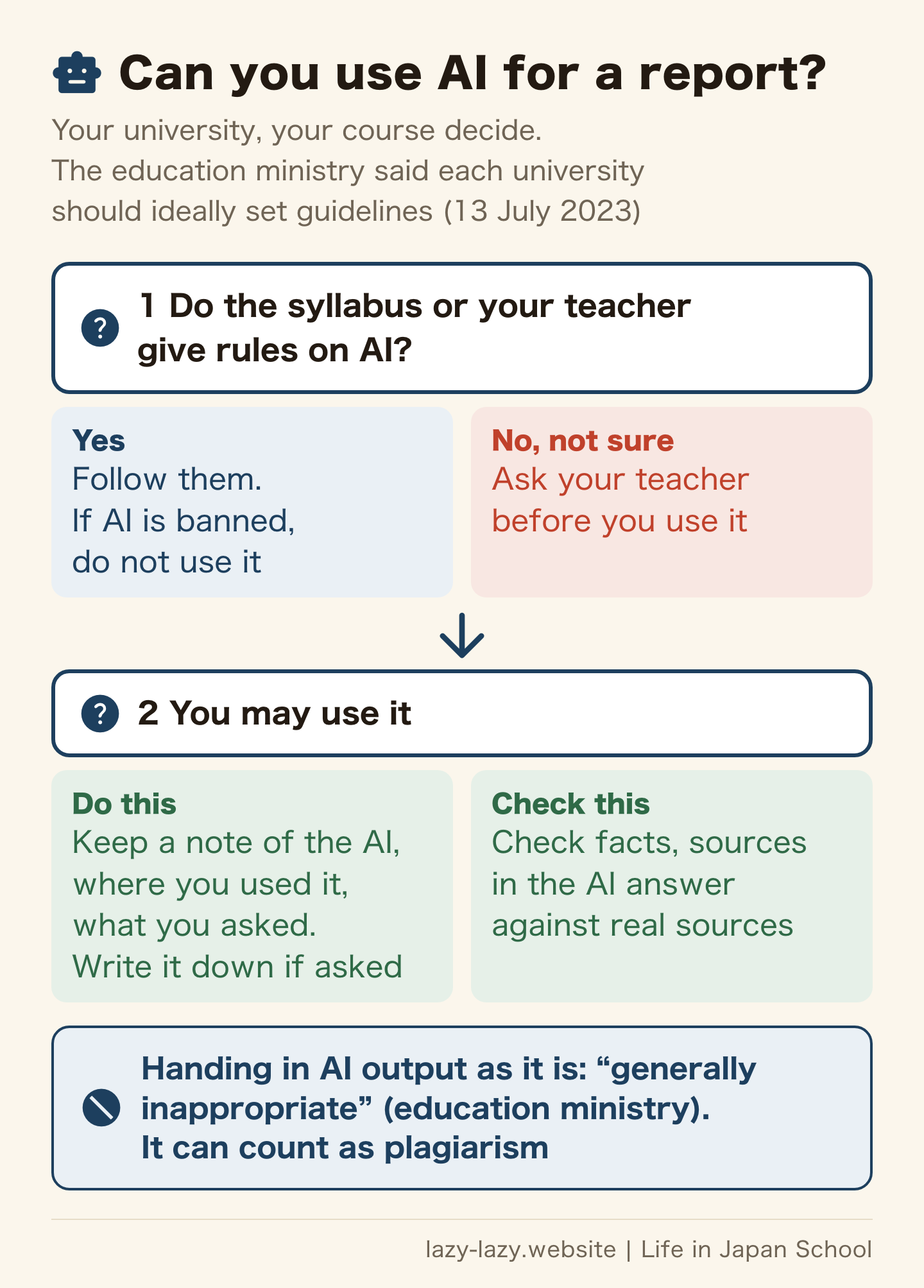
If you may use AI, keep a record. Kagoshima University asks students to save their questions to the AI, plus its answers, so they can show them as a reference. Check that any book or paper the AI names really exists. Tohoku’s Faculty of Law lists quoting sources that do not exist as misconduct.
Is using Google Translate or DeepL plagiarism? Check your course rules
Writing in your own language, then using a translator to hand it in in Japanese: we found no official university page that names this. So ask your teacher before you do it.
There are clues. The education ministry lists translation as a useful AI task. Sagami Women’s University lists types of AI use. Translating a foreign-language source with AI counts as “translating, summarizing foreign-language information”. Fixing your own writing with AI counts as “proofreading, editing your own writing”. At that university, some courses may ask you to report these uses.
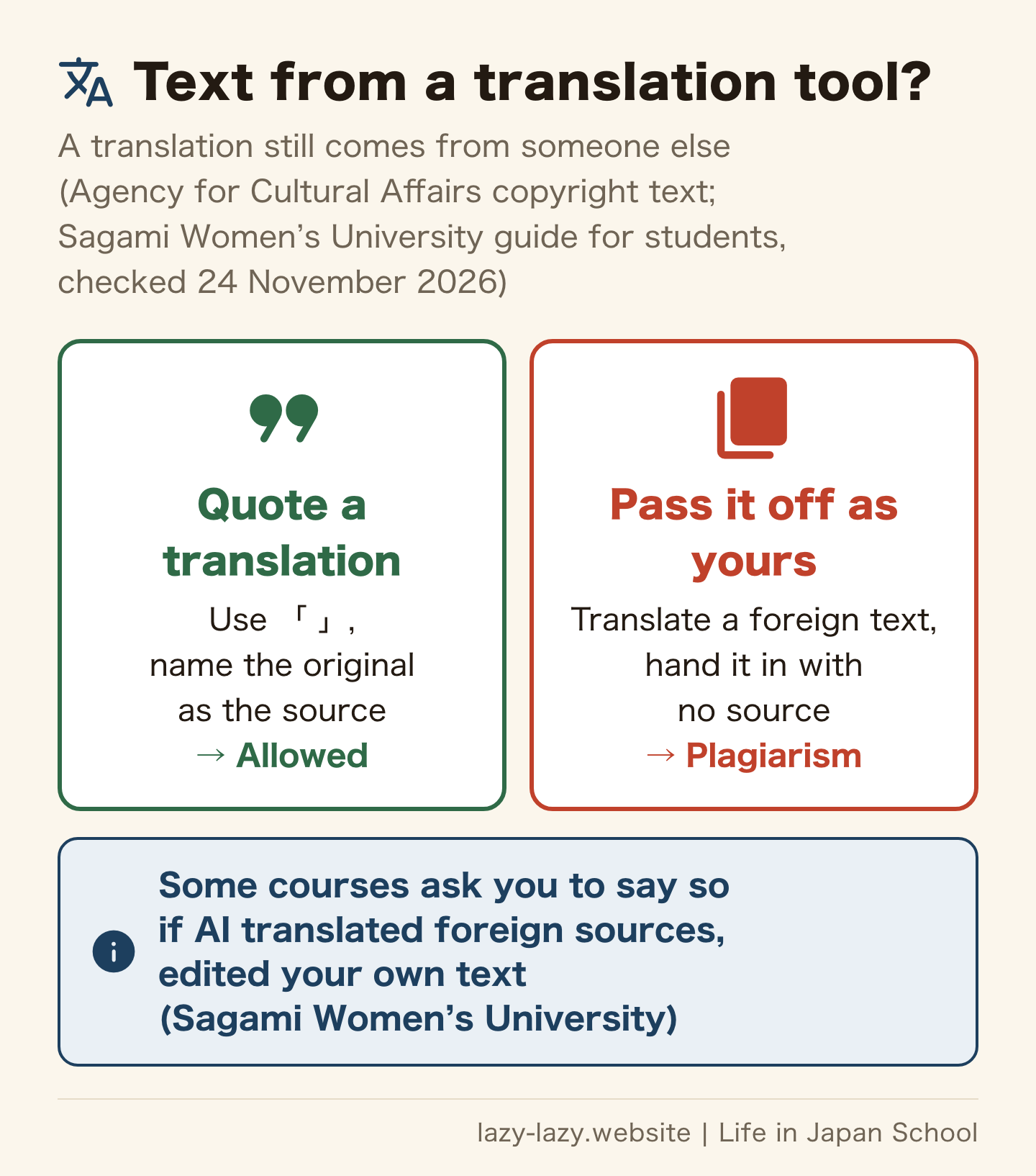
You can translate a source in your language, or in English, and use it. The Agency for Cultural Affairs says a quote may be a translation. You still need 「 」 and the source. If you translate a foreign article and hand it in as your own with no source, that fits the definition of plagiarism. Translating it does not make the words yours.
Can lost credits affect your visa renewal? Your transcript goes to immigration
For international students, this is not only about credits. The Immigration Services Agency renewal document lists include a transcript (seiseki shomeisho). This applies to universities, vocational schools too. An attendance certificate is also needed if the school can issue one.
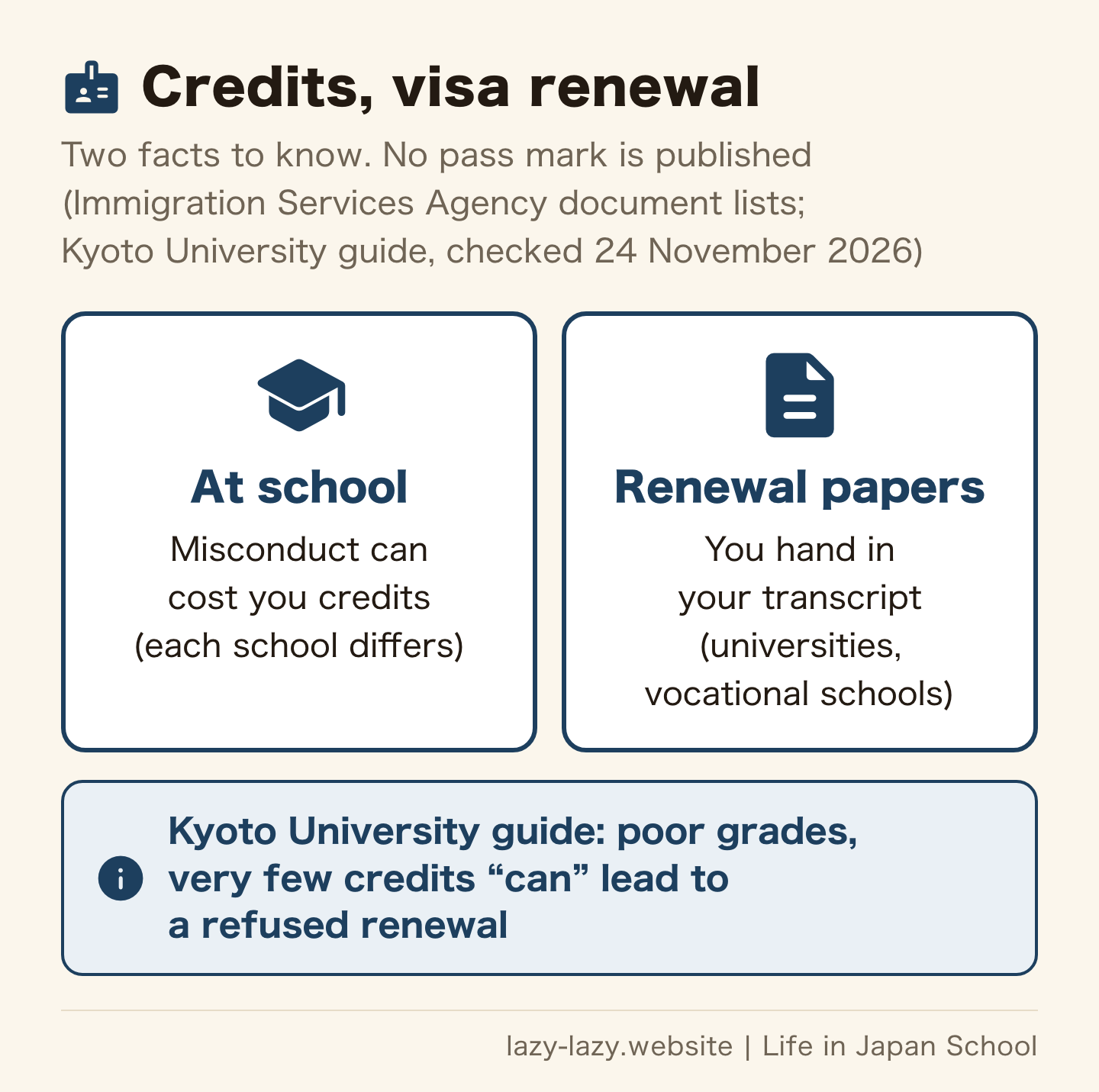
Immigration does not publish a pass mark for grades or credits. Kyoto University tells its students that poor grades, or very few credits, can lead to a refused renewal. For the full renewal list, see our Student visa extension guide. For how attendance is counted, see the attendance rules guide.
Not sure? Ask your teacher, one point at a time, before you hand it in
Many students get stuck here because rules change from course to course. Sophia University asks teachers to tell students if AI is allowed. Kagoshima, Sagami Women’s tell students to ask the course teacher when unsure. Asking is not rude.
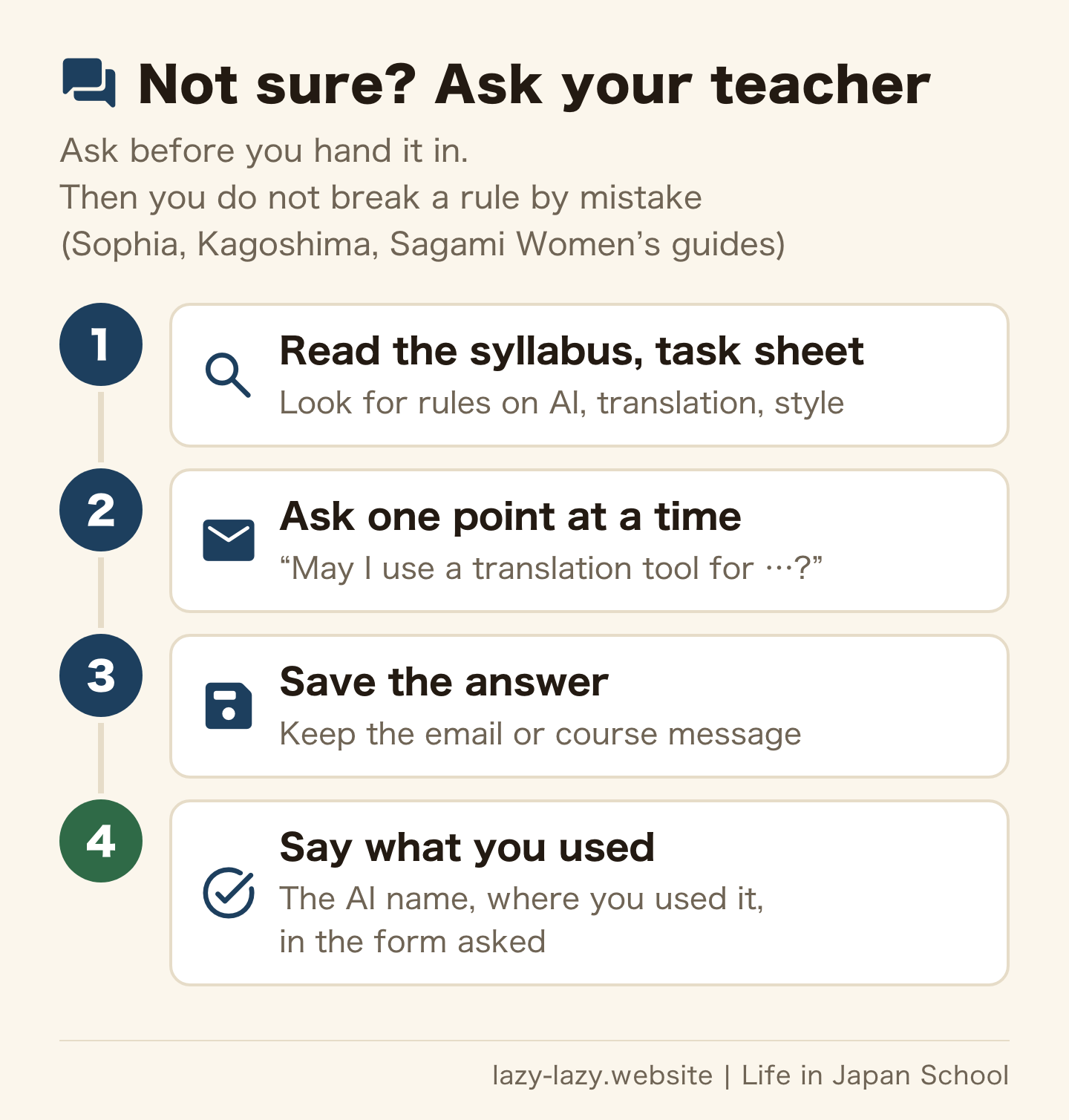
Say clearly what you want to use it for. You can copy these Japanese sentences.
- 「〇〇の授業のレポートについて質問です。資料を探すときに、生成AIを使ってもいいですか。」 (About the report for [course]: may I use AI to find sources?)
- 「使ってよい場合、使ったことはどこに、どう書けばいいですか。」 (If yes, where, how should I state that I used it?)
- 「自分で書いた日本語の文法を直すために、翻訳ツールを使ってもいいですか。」 (May I use a translation tool to fix the grammar of Japanese I wrote myself?)
- 「参考文献の書き方に、決まった形はありますか。」 (Is there a set style for references?)
Keep the reply email. For the subject line, greeting, closing, use the same pattern as our guide to telling your school you are absent. If you will miss the deadline, talk to your teacher before you copy anything.
Which one are you?
- You are writing a report now: today, check the syllabus, task sheet for rules on AI, translation, style. If there are none, send your teacher one short question.
- You want to use words from a website or book: put them in 「 」, add a number, list the source at the end. Write the date you saw it.
- You already used AI or a translator: today, note where you used it, what you typed, what it gave you. Check the course rules. Report it if asked.
- A friend asks to see your report: do not send the file. Send writing tips, or this article.
FAQ
Q. What is quoting in a report?
Using someone else’s words to support your own text. There are 4 conditions: the work is published, you mark the quote with 「 」, your own text is the main part, you show the source.
Q. Why is copy-paste not allowed?
Handing in someone else’s words as your own with no source is plagiarism, a form of misconduct. Penalties differ by school, from failing the course to suspension or expulsion.
Q. Can I use ChatGPT for a university report in Japan?
It depends on your university and course. Some courses ban it; some allow it with conditions. Check the syllabus first. The education ministry calls handing in AI output as it is “generally inappropriate”.
Q. Is using a translator plagiarism?
If you translate someone else’s text, you can quote it with 「 」 and the source. For handing in a translated draft, check your course rules.
Q. Can lost credits affect my visa renewal?
Your transcript is a document for Student visa renewal. Kyoto University says poor grades or very few credits can lead to a refused renewal. No pass mark is published.
Q. How do I write references?
Follow your teacher’s style if there is one. If not, SIST is a common model. See the citing section for the format, an example.
Summary
You can use other people’s words if you put them in 「 」, keep your own text as the main part, and show the source. Copy-paste with no source is plagiarism. How heavy the penalty is depends on the school. Your transcript is a document you hand to immigration at Student visa renewal.
Rules on AI, translation tools differ by university and course. The ministry said each university should ideally set guidelines. It calls handing in AI output as it is generally inappropriate. Today, open the syllabus for the report you are writing. If it says nothing, send your teacher one short question.
Official sources: Copyright Act (e-Gov), Articles 32, 48 / Agency for Cultural Affairs, copyright text 2026 edition (Japanese) / Education ministry notice on generative AI at universities (Japanese) / Immigration Services Agency, Student status (Japanese) / Ritsumeikan University Library, how to cite / Ritsumeikan University, plagiarism notice / Kagoshima University, misconduct notice / Kagoshima University, AI in learning / Kyoto University, penalties for exam misconduct / Kyoto University, visa renewal notes / Tohoku University Faculty of Law, report exam notice / Sophia University, AI guidelines / Nagasaki University, AI notice / Sagami Women’s University, AI guide for students (all checked 24 November 2026). University rules are that school’s own examples. Always check your own school’s handbook, syllabus.
Related reading
Found this useful? Share it
Send it to a friend who lives in Japan.
WHO WROTE THIS

mori
Japanese. I read the ministries’ own notices, orders and Q&As in the original, and I start from what my Nepalese and Sri Lankan friends in Japan actually ran into. I do not write about what I have not checked or been told.
What this site can and cannot do →Looking for something else?
You may use the figures in this article, including commercially, if you credit this site with a link. How to use our figures