Checked on 18 November 2026. We used tax answers from the National Tax Agency (NTA) and NISA material from the Financial Services Agency (FSA). We also used the NISA Q&A of the Japan Securities Dealers Association (JSDA), the glossary and trading rules of Japan Exchange Group (JPX), teaching material from J-FLEC, and the Companies Act on e-Gov. This article does not recommend any stock or securities company.
The short answer
- A high dividend stock pays a large dividend for its share price. A dividend is part of the profit that a company pays to its shareholders.
- Dividend yield goes up when the share price falls. The company decides each dividend, so it can be cut or stopped.
- If you buy on the ex-dividend day, you get no dividend. That day is 1 business day before the record date. The price is said to drop by the dividend.
- Dividends in a taxable account are taxed at 20.315%. In NISA, the same tax is taken unless you get dividends at your securities company.
- When you leave Japan, file a NISA form by the day before you leave. Unless your employer transfers you, NISA closes and your shares move to a taxable account.
Knowing this, you can decide if dividend stocks suit you, without chasing a yield number or paying tax you could avoid.
It is break time at work. A Japanese coworker shows you a phone screen. “I get a nice amount from dividends every year,” he says. The screen shows a yield of 5%. You opened a NISA account last year, and you think about buying the same stock. But when do you get the dividend? Is tax taken? What happens if you go home? Your coworker only says, “NISA is tax-free, I think.”
- What are high dividend stocks in Japan? Big dividends, and a yield that moves
- When do you get the dividend? The record date and the ex-dividend day
- What happens to the price after a dividend? It is said to drop by the dividend
- What are the downsides? Dividends can be cut, or stop
- What is the dividend tax rate in Japan? 20.315% in a taxable account
- Are dividends tax-free in NISA? Only with the right payout method
- What about dividends from foreign shares? Foreign tax may be taken too
- Dividend stocks vs index funds: who picks the companies?
- What happens when you leave Japan? File a NISA form by the day before
- Which one are you?
- Frequently asked questions
- Summary
- Related reading
What are high dividend stocks in Japan? Big dividends, and a yield that moves
A dividend is part of a company profit. It is paid to shareholders by the number of shares they hold (JPX glossary). In this article, a “high dividend stock” means a stock that pays a large dividend for its price.
You compare stocks by dividend yield. Dividend yield is the dividend you expect in one year, as a share of the money you invest (JPX glossary). For one share, it is the yearly dividend divided by the share price.
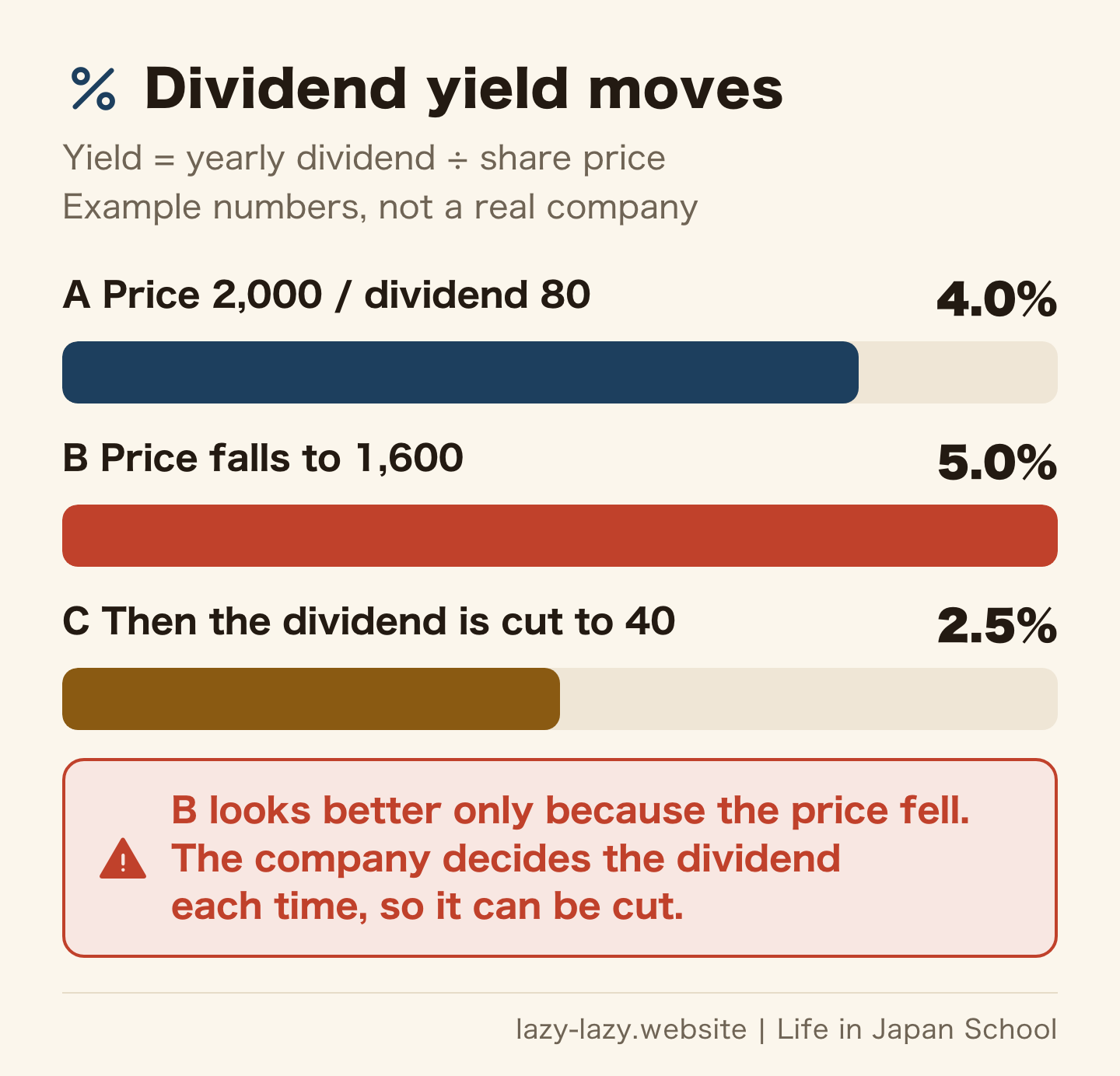
The chart is a worked example. A price of 2,000 yen with a yearly dividend of 80 yen gives a 4.0% yield. If the price falls to 1,600 yen, the same 80 yen gives 5.0%. The yield went up because the price fell. The company did not get better.
If results get worse and the dividend is cut to 40 yen, the yield drops to 2.5%. When you see a high yield, first ask why it is high.
When do you get the dividend? The record date and the ex-dividend day
A dividend goes to the people who hold the shares on a set day. This day is the record date (kenri kakutei bi, or kijun bi). The JSDA NISA Q&A uses March 31 as the record date in its example of a company with a March year-end.
Buying on the record date is too late. The JPX glossary says trades from 1 business day before the record date are “ex-dividend.” If you buy on that ex-dividend day, you get no dividend. So you must buy by 2 business days before the record date. This is because Japanese share trades settle on the 3rd day, counting the trade day (JPX trading rules).
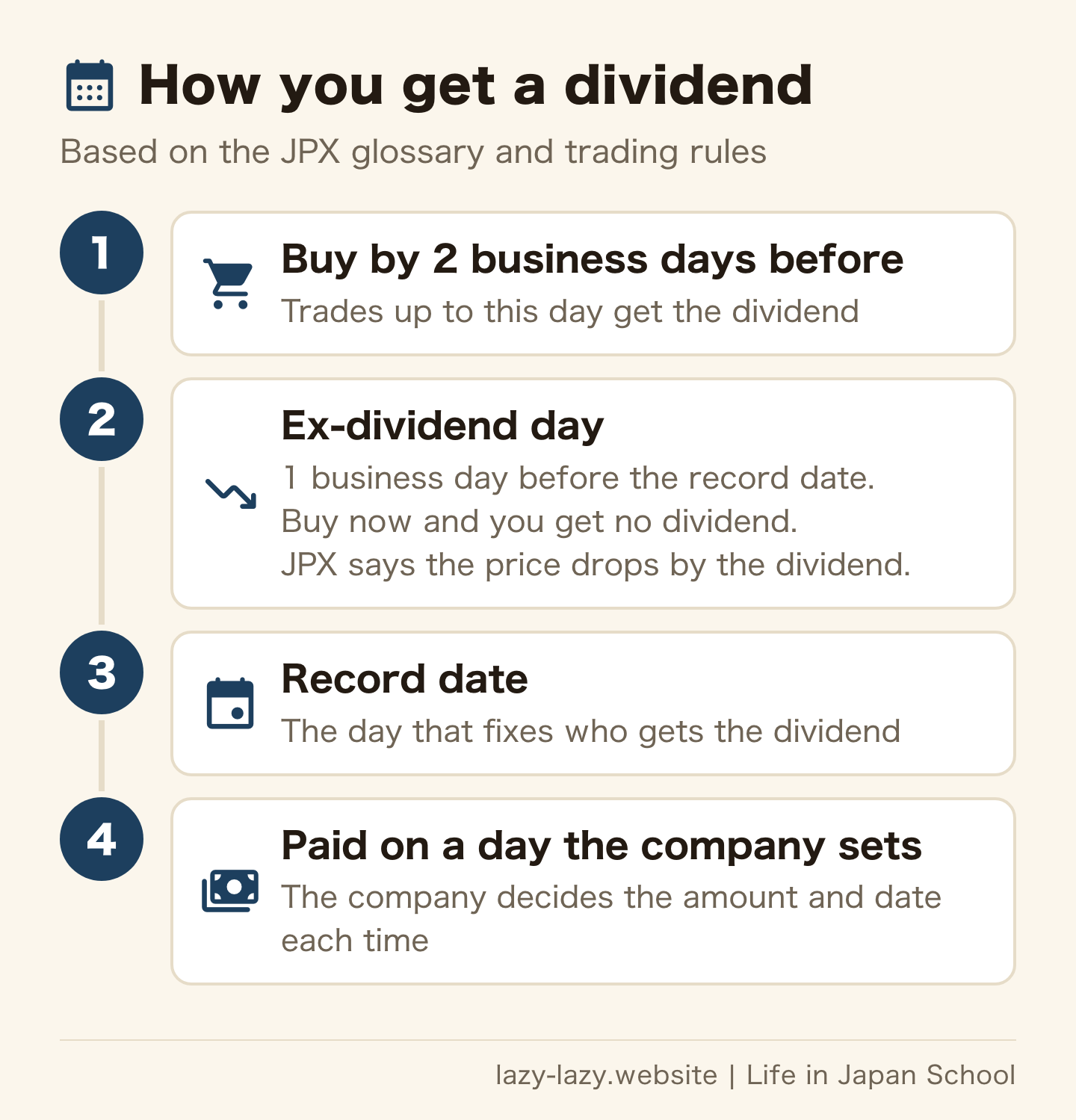
Weekends and holidays are not business days. Each company sets its own record date. Before you buy, check the date in the company announcement.
What happens to the price after a dividend? It is said to drop by the dividend
You may think a dividend is extra money on top. The JPX glossary says the price on the ex-dividend day falls by about the amount of the dividend. People who buy that day get no dividend, so they pay less.
So a dividend is part of the value of your shares, paid out as cash. Buying the day before and selling on the ex-dividend day does not make easy money. Real prices also move every day for other reasons.
What are the downsides? Dividends can be cut, or stop
A dividend is not a promise. Article 453 of the Companies Act says a company “may” pay dividends to shareholders. Under Article 454, as a rule, the shareholders meeting decides the amount and the date each time.
J-FLEC teaching material says dividends can fall or stop when a company does badly. The same material says company results are the root driver of share prices.
So when results get worse, the dividend and the price can both fall. This is the main downside people mention.
- Dividends are decided each time. Last year’s dividend may not come this year.
- Prices can fall. Shares are not guaranteed. The FSA says shares and funds can fall below what you paid.
- Few companies mean more risk. If you hold only a few, one company can change your dividends and value a lot.
You can also buy shares with borrowed money. The JPX FAQ explains margin trading (shinyo torihiki). You borrow money or shares from your broker to trade. This site does not recommend investing with debt or margin trading. Even if dividends are cut, you must still pay back the loan.
What is the dividend tax rate in Japan? 20.315% in a taxable account
Dividends from listed Japanese shares are taxed. The NTA sets the rate at 20.315%. That is 15.315% national income tax (with the reconstruction tax) plus 5% local tax. It is taken before the dividend reaches you. This is withholding tax.
From January 2027, the national part is split up a little differently. The NTA says the total rate does not change.
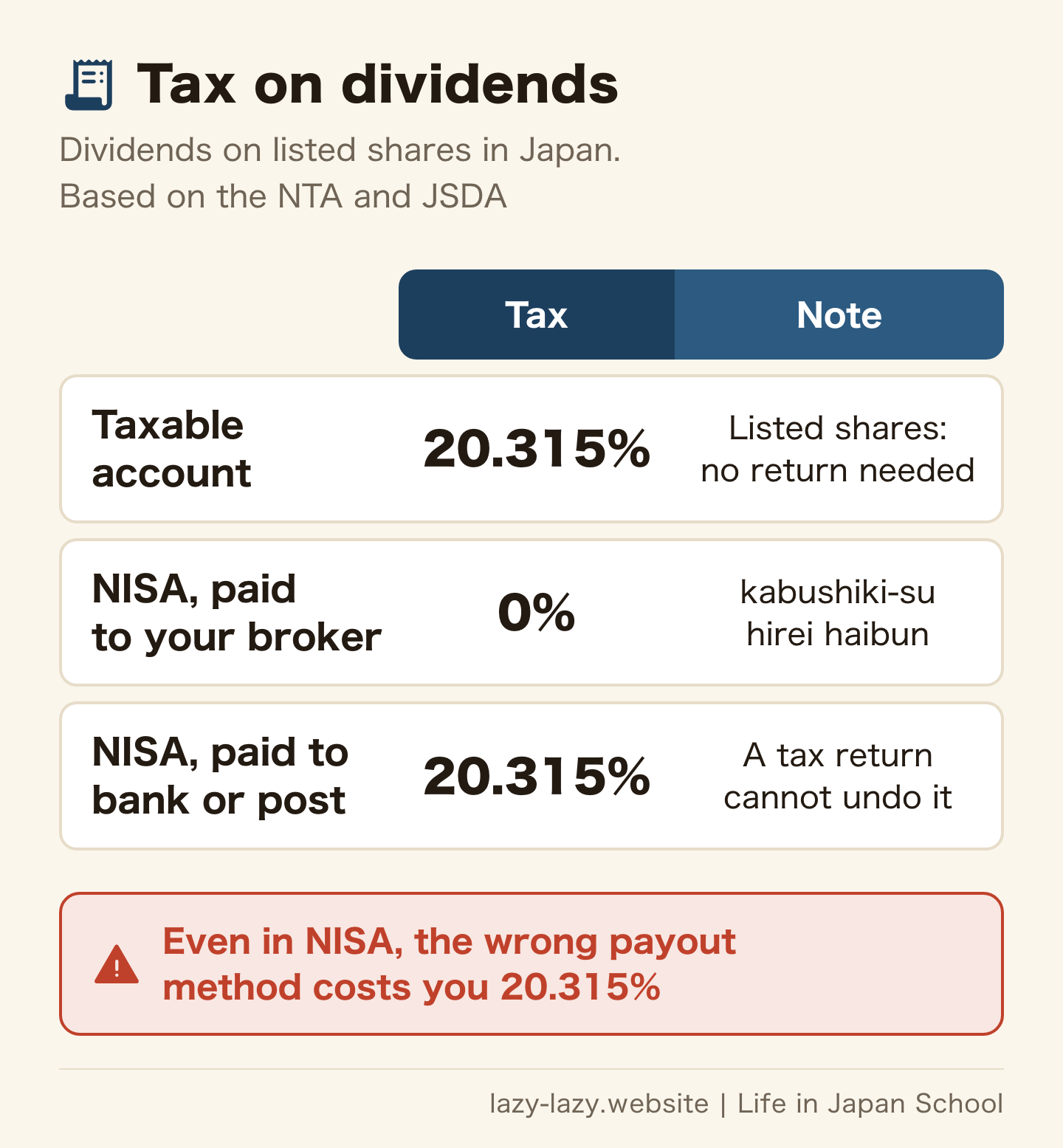
You do not have to file a tax return. The NTA tax answer says dividends from listed shares need no return, whatever the amount. Large holders with 3% or more of a company are the exception. You can still file and choose another method. To see how this fits with your salary tax, read who must file a tax return in Japan.
Are dividends tax-free in NISA? Only with the right payout method
The NISA growth allowance can hold listed shares. The FSA slides set it at 2.4 million yen a year. Dividends on NISA shares can be tax-free, if you meet one condition.
A dividend is a dividend, at any bank or broker. Where you come from, that may be normal. In Japan, in NISA, the place you get the dividend decides the tax.
The JSDA NISA Q&A lists three ways to get dividends.
- At Japan Post Bank or a post office (haito-kin ryoshusho hoshiki)
- To a bank account you choose (toroku haito-kin juryo koza hoshiki, or kobetsu meigara shitei hoshiki)
- To your securities company account (kabushiki-su hirei haibun hoshiki)
Only method 3 makes NISA dividends tax-free. In plain words, it means “get dividends at your broker.” With method 1 or 2, 20.315% is taken, even on NISA shares. A tax return cannot make that tax-free later (same Q&A). Gains from selling NISA shares stay tax-free with any method.
You apply through your securities company. The JSDA says a company with a March year-end needs the form in by the record date, March 31. Check your payout setting on your broker site before the dividend comes.
One more point. If you choose method 3, it also applies to shares in your taxable account. It applies to shares at other brokers too. You cannot use a different method at each broker.
What about dividends from foreign shares? Foreign tax may be taken too
A dividend from a foreign company may be taxed in that country. A resident of Japan can sometimes take that foreign tax off Japanese income tax in a tax return. This is the foreign tax credit (NTA No.1240).
Foreign shares in NISA are different. The same NTA page says foreign tax on NISA dividends does not count for the credit. NISA removes the Japanese tax, but the foreign tax is not returned. Foreign shares also move with exchange rates.
Shares you hold at a bank or broker in your home country can be taxed differently. It depends on how long you have lived in Japan. Read non-permanent resident tax in Japan.
Dividend stocks vs index funds: who picks the companies?
With dividend stocks, you pick each company yourself. Japanese shares trade in units of 100 shares (JPX). At a price of 2,000 yen, one company costs 200,000 yen, plus fees.
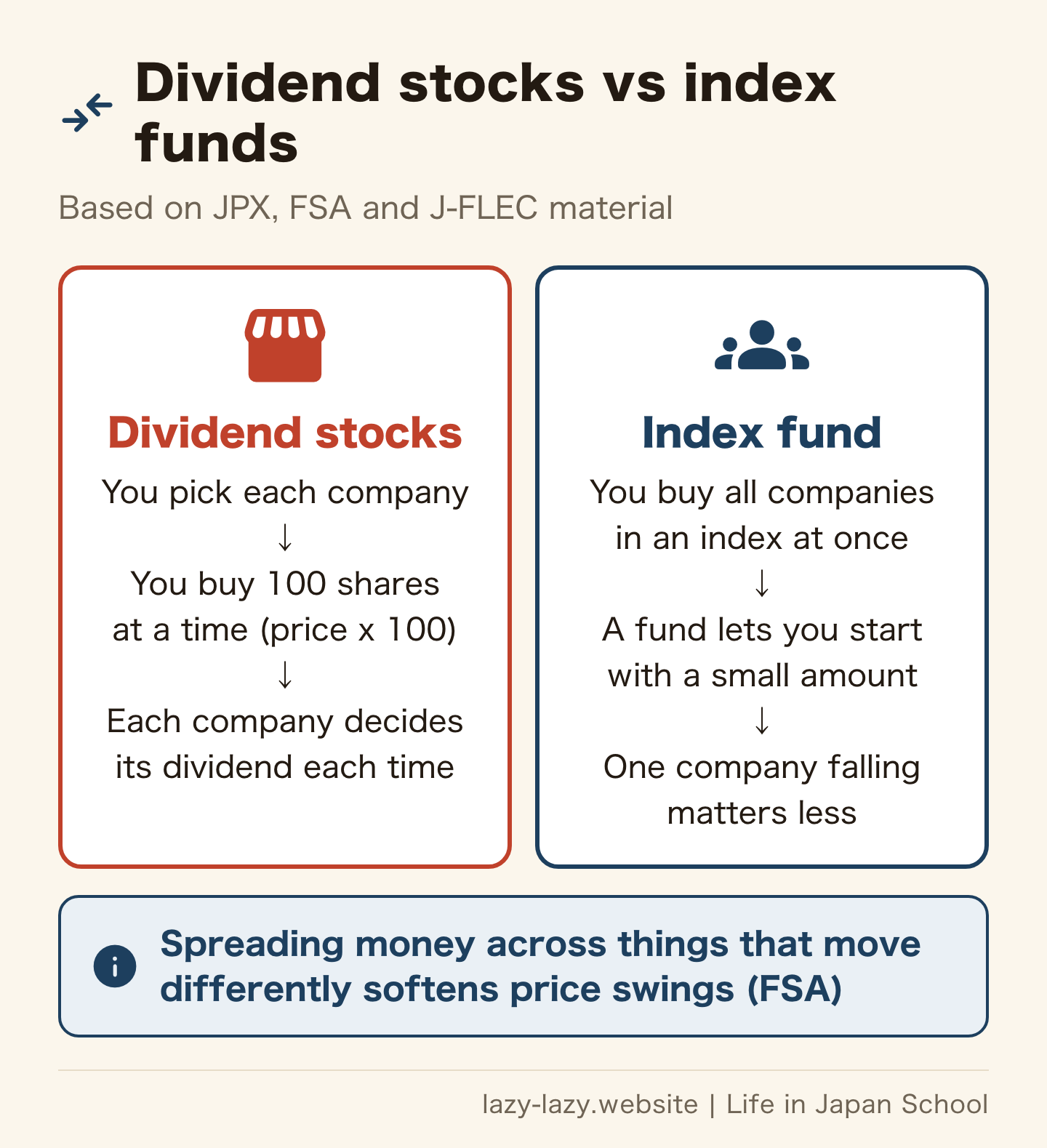
An index fund invests in all the companies in an index at once. The FSA says spreading money across assets that move differently softens price swings to some extent. To spread the same way with dividend stocks, you need money for 100 shares of each company.
Neither choice is the right one for everyone. The difference is who picks the companies: you, or the index rules. To learn how index funds work, read what an index fund is. To compare the fund formats, read investment trust vs ETF in Japan. For the order to start investing at all, read should foreigners invest in Japan.
What happens when you leave Japan? File a NISA form by the day before
NISA is for people who live in Japan. The JSDA NISA Q&A says you file a form with your broker by the day before you leave.
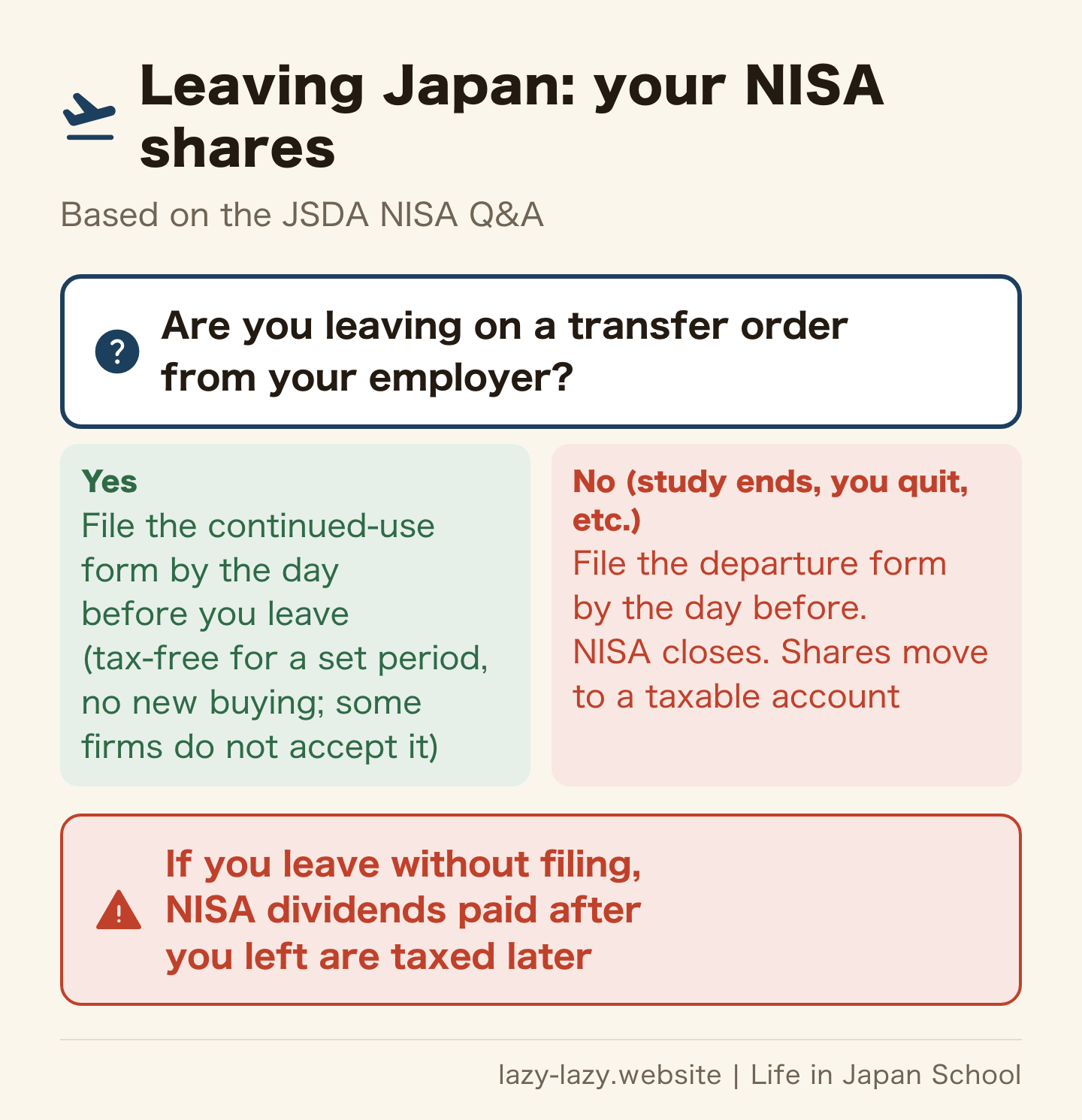
- Your employer transfers you abroad: file the continued-use form (keizoku tekiyo todokedesho). You can keep NISA tax-free for a set period. You cannot buy anything new while abroad. Some brokers do not accept this form. You must file a return form (kikoku todokedesho) by December 31 of the year 5 years after you filed. If you do not, NISA closes and your shares move to an ippan account.
- Any other reason (your studies end, you quit, you go home by choice): file the departure form (shukkoku todokedesho). NISA closes. Your shares move to a taxable account (tokutei or ippan). Dividends after that are taxed.
Not filing does not help. The same Q&A says the broker may learn later that you left. Then NISA dividends paid after you left are taxed back to that date. You can open NISA again if you come back. But shares already moved to a taxable account cannot go back into the new NISA.
Whether you can keep a normal brokerage account after you leave depends on the firm. For the form deadlines and account rules, read NISA for foreigners in Japan. To plan the day you sell, see the section on leaving in what to do in a market crash.
Which one are you?
- You hold Japanese shares in NISA. Today, check on your broker site that your payout method is kabushiki-su hirei haibun hoshiki.
- You want a stock because its yield is high. Today, check if its price fell this year, and if its dividend was cut.
- You hold nothing yet. Today, decide with the money you can use: 100 shares of one company, or a fund that follows an index.
- You may go home within a few years. Today, write a note to ask your broker which form to file, and the account your NISA shares would move to.
Frequently asked questions
Q. What is a high dividend stock, in simple words?
It is a stock that pays a large dividend for its price. A dividend is part of the profit a company pays to shareholders. You compare stocks by dividend yield: the yearly dividend divided by the price.
Q. Is a higher dividend yield always better?
No. When the price falls, the yield rises even if the dividend stays the same. The company decides each dividend, so it can be cut or stopped.
Q. If I buy on the record date, do I get the dividend?
No. The JPX glossary says trades from 1 business day before the record date are ex-dividend. You must buy by 2 business days before the record date.
Q. Are dividends tax-free in NISA?
Yes, if your payout method is kabushiki-su hirei haibun hoshiki. That means you get dividends at your securities company. If you get them at a bank or post office, 20.315% is taken, even in NISA. A tax return cannot undo it.
Q. Do I need a tax return for dividend tax?
No, not for listed Japanese shares after 20.315% is withheld. Large holders are the exception. You can still file and choose another method.
Q. What happens to my NISA shares and dividends when I leave Japan?
Unless your employer transfers you, file the departure form by the day before you leave. NISA closes. Your shares move to a taxable account, and later dividends are taxed. If you leave without filing, NISA dividends paid after you left are taxed back.
Summary
A high dividend stock pays a large dividend for its price. Dividend yield rises when the price falls. The company decides each dividend, so it can be cut or stopped. You must buy by 2 business days before the record date. The price is said to drop by the dividend on the ex-dividend day.
Dividends in a taxable account are taxed at 20.315%. In NISA, the same tax is taken unless you get dividends at your broker. When you leave Japan, file a NISA form by the day before you go. Your task for today: check the payout method on your own account.
Sources (official): NTA No.1330, dividend income (Japanese) / NTA No.1331, separate taxation of listed share dividends (Japanese) / NTA No.1240, foreign tax credit for residents (Japanese) / FSA, NISA briefing slides (Japanese) / FSA, basics of asset building (Japanese) / JSDA, NISA Q&A (Japanese) / JPX glossary, dividend (Japanese) / JPX glossary, dividend yield (Japanese) / JPX glossary, ex-dividend (Japanese) / JPX, types of trades (Japanese) / JPX, trading unit (Japanese) / JPX FAQ, margin trading (Japanese) / e-Gov, Companies Act, Articles 453 and 454 (Japanese) / J-FLEC, asset management teaching material (Japanese) (all checked on 18 November 2026)
Related reading
Found this useful? Share it
Send it to a friend who lives in Japan.
WHO WROTE THIS

mori
Japanese. I read the ministries’ own notices, orders and Q&As in the original, and I start from what my Nepalese and Sri Lankan friends in Japan actually ran into. I do not write about what I have not checked or been told.
What this site can and cannot do →Looking for something else?
You may use the figures in this article, including commercially, if you credit this site with a link. How to use our figures