Checked on 26 November 2026 against guidance from the Consumer Affairs Agency, the National Consumer Affairs Center, the Fukuoka City consumer center, plus official notices from Takashimaya, Hankyu Umeda, AEON Mall, KALDI, Maruzen Junkudo.
The short answer
- Year-end sales, New Year sales and lucky bags bring lots of lower prices. Decide before you go: do you really want it, do you need it, how much will you spend?
- A lucky bag (fukubukuro) is a bag of several items sold together at one price. Some bags show what is inside. Some keep it a surprise.
- Whether you can return something depends on the shop’s rules. Online shopping in Japan has no cooling-off.
- The first sale day differs by shop and by year. Check the shop’s own website.
Once you know this, you can buy what you need, not just what is cheap. You are less likely to find unused things in your room in January.
It is late December. Station posters and phone alerts are full of lucky bags and New Year sales. A coworker at your part-time job says, “I queue on New Year’s Day.” Should you go? What should you buy? You ask a Japanese friend. “I go every year. It’s fun,” they say. Nobody tells you if you can choose what is inside, or if you can take it back.
- Before buying at Japan’s New Year sales: 3 questions
- When do New Year sales start in Japan? It depends on the shop
- What is a lucky bag (fukubukuro)? Can you see what is inside?
- Can you return a lucky bag or sale item? The shop decides
- Buying lucky bags online? Read the return rule first
- Is a “was 10,000 yen, now 5,000 yen” label true? Decide by today’s price
- How much to spend on lucky bags? Use what is left after monthly bills
- Problem after buying? Contact the shop first, then call 188
- Which one are you?
- FAQ
- Summary
- Related reading
Before buying at Japan’s New Year sales: 3 questions
From late December into early January, shops and websites fill with lower prices and lucky bags. Low prices are nice. But something you never use is still money gone.
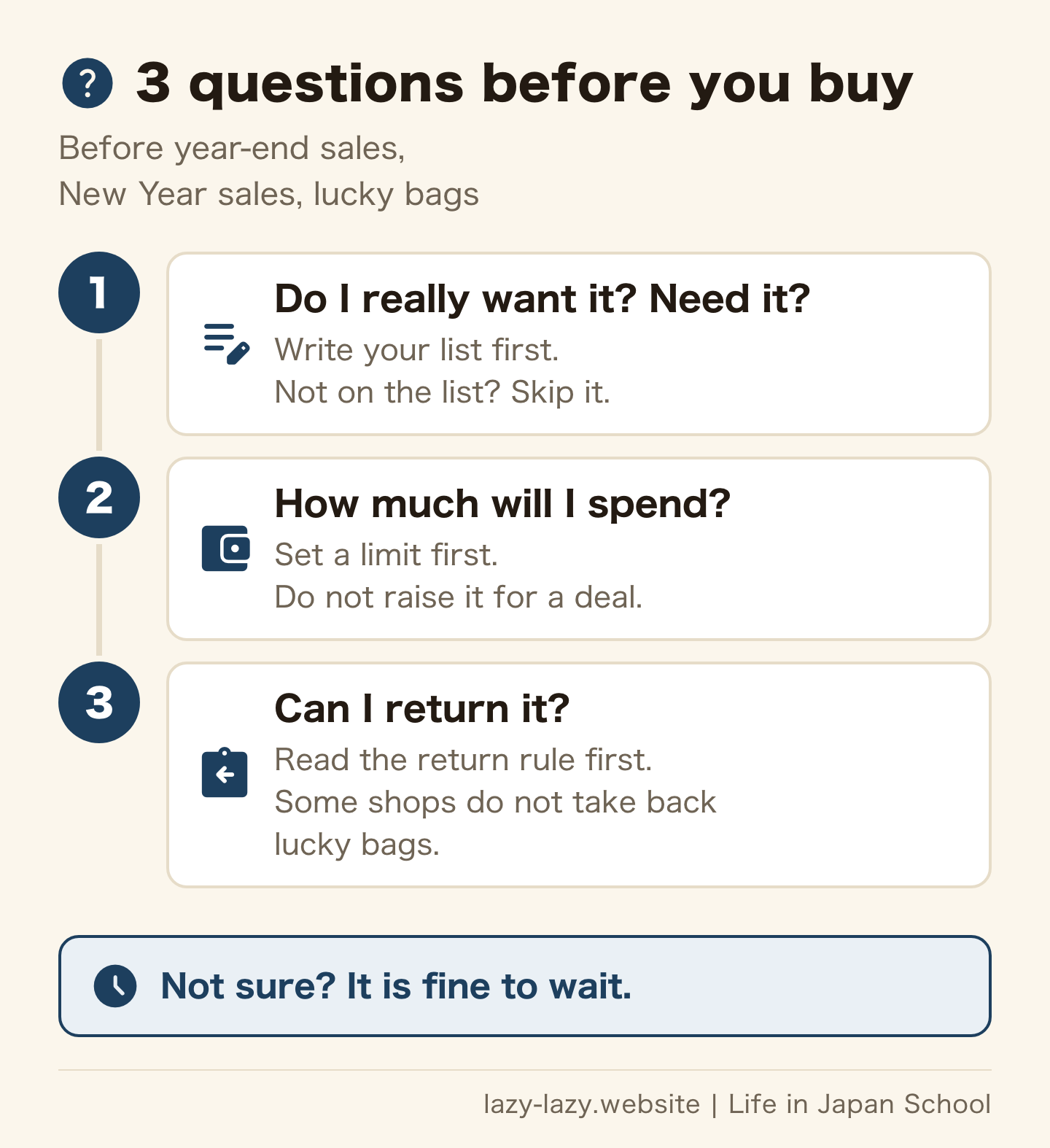
- Do I really want it? Do I need it? Before you go, write what you will buy in a note, on paper, on your phone. If it is not on the list, let it go that day.
- How much will I spend? Set your limit at home. Do not raise it in the shop because “this price is good.”
- Can I return it if it does not fit? Read the return rule before you pay.
Not sure about something? Ask if you will still want it after the sale ends. Waiting costs you nothing.
It takes time, too. New Year sales and lucky bag counters get crowded. You spend time in queues, also searching busy shops. You could spend that time studying, working a shift, or resting.
When do New Year sales start in Japan? It depends on the shop
The New Year sale (hatsuuri) is a shop’s first sale of the year, on its first opening day. There is no national date. It differs by shop, and the same shop can change it from year to year. In 2027, some department stores stay closed on January 1 and 2.
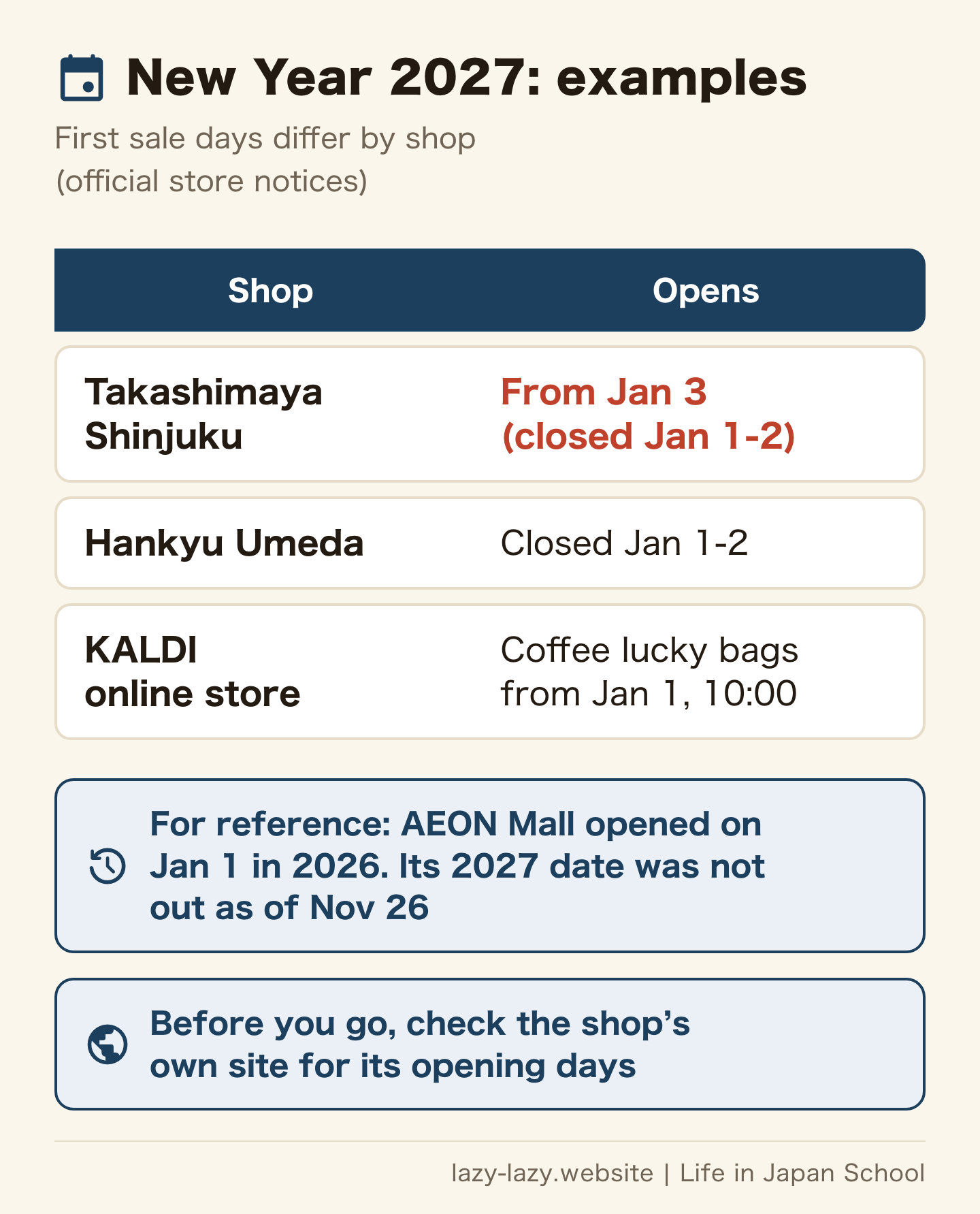
The chart is based on official notices from Takashimaya Shinjuku, Hankyu Umeda, KALDI, AEON Mall (all in Japanese). Check the website of the shop you plan to visit for its New Year days and hours.
City offices and bank counters also close over New Year. The dates are in our guide to New Year closures in Japan. If you still have a transfer or paperwork to do, it is safer to finish it first.
What is a lucky bag (fukubukuro)? Can you see what is inside?
A lucky bag is a bag or box of several items sold together at one price. How much you know about the contents depends on the bag.
Takashimaya’s online store (Japanese) sorts its 2027 lucky bags into many categories. One category shows the contents in advance. Another keeps them a surprise until the bag arrives.
If you cannot see inside, think about whether you would use everything. You may not be able to return the things you do not want.
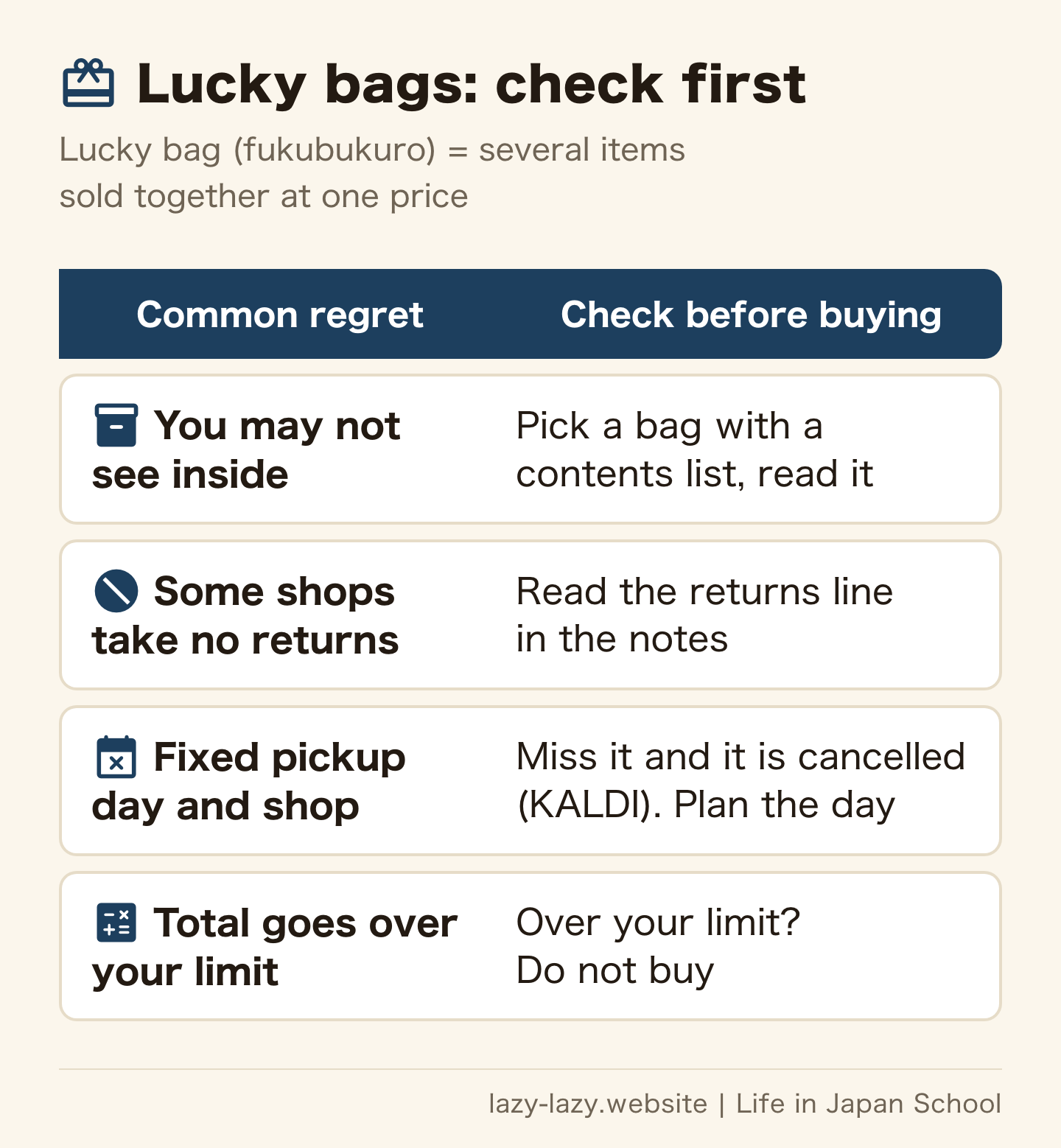
Some shops take bookings or run lotteries for lucky bags before New Year. A booked bag may have a fixed pickup day at a fixed shop. In the KALDI app lottery, a missed pickup period counts as a cancellation.
Check how you can pay, too. Takashimaya’s online lucky bags (Japanese) cannot be paid for at a convenience store. No credit card? Compare your options in how to pay in Japan without a credit card.
Can you return a lucky bag or sale item? The shop decides
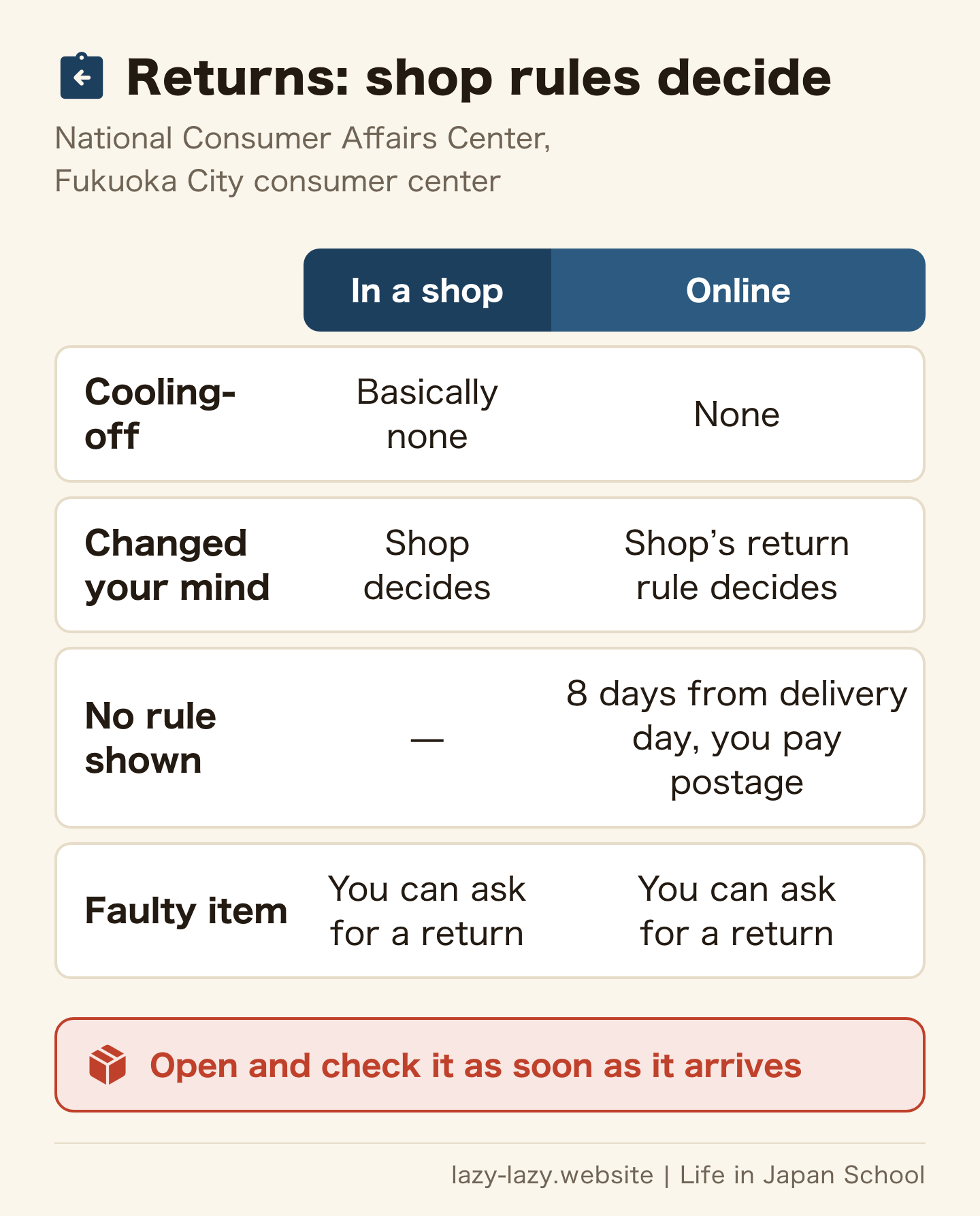
If something does not fit, you take it back. Back home, that may have been easy. In Japan, the shop basically decides whether it takes returns.
The Fukuoka City consumer center (Japanese) says the same: returns are basically up to the shop. If the item is faulty, you can ask for a return.
Some shops say clearly that lucky bags cannot be returned. Maruzen Junkudo’s online store (Japanese) is one example. It said its 2026 lucky bags could not be returned or exchanged for the buyer’s own reasons.
Buying lucky bags online? Read the return rule first
When you buy online, look for the shop’s return rule. It tells you if you can return, by when, and who pays postage. In Japanese law it is called henpin tokuyaku.
Online shopping in Japan has no cooling-off. Cooling-off lets you cancel a contract within a set number of days, with no reason needed. The National Consumer Affairs Center (Japanese) says mail order does not have it.
If the shop shows no return rule, you can return the item within 8 days. Count from the day you receive it, including that day. You pay the postage (Consumer Affairs Agency, Japanese).
One shopper bought shoes online. They were too tight. The terms said “no returns,” so the shop refused. The case is in the Center’s case report No. 471 (Japanese). Read the return rule before you order. Open the box as soon as it arrives. For contracts you can cancel, see our cooling-off guide.
Is a “was 10,000 yen, now 5,000 yen” label true? Decide by today’s price
Do not decide by the old price. Decide by whether today’s price fits your limit. It also helps to check what the same item costs now at another shop, also online.
Labels that show an old price next to a new one have rules. Using the price of a different product as the “old price” may be misleading. So may an “old price” that was not charged for a fair period recently, unless the label says when, for how long (Consumer Affairs Agency, Japanese).
How much to spend on lucky bags? Use what is left after monthly bills
Set your limit at home, not in the shop. First, take your monthly costs out of your take-home pay: rent, food, money you send home. Then set your sale limit from what is left.
If money is tight this month, not buying is the cheapest choice. That is what this site recommends.
A cost that comes once a year does not show in a monthly budget. Put it aside as an irregular cost. Our guide to a monthly budget in Japan shows how. New Year food is a year-end cost too; our osechi guide explains it. To lower what you spend every month, see cutting fixed costs.
Problem after buying? Contact the shop first, then call 188
The item arrived broken. Or a different item arrived. First, contact the shop. If it is faulty, you can ask for a return.
Your lucky bag cannot be returned, but it has things you will not use? You can give them to family or friends.
If talking to the shop does not solve it, call the consumer hotline 188 (Japanese). It guides you to a nearby consumer center. Worried about a phone call in Japanese? First see free helplines in English and more.
Which one are you?
- You already know what you want. Today, check the shop’s website for its New Year days, also its return rule.
- You are curious about lucky bags. Today, read the contents list, plus the pickup and payment rules.
- You do not need anything, but want to look. Today, take your monthly bills out of your pay, then write a limit from what is left.
- You plan to buy online. Today, bookmark the return page of the shop you want to use.
FAQ
Q. Is there cooling-off for things I buy in a shop?
Basically, no. Shop purchases are basically not covered by cooling-off. Whether the shop takes returns depends on its own rules. The Fukuoka City consumer center explains this.
Q. Can I return an item sold as flawed?
Maybe not. Items sold as flawed (wakeari, B-grade) count as bought with that flaw, says the Fukuoka City consumer center. This is not the same as a faulty item.
Q. Where can I find an online shop’s return rule?
Shops must show it in their ads, on their pages. When you buy online, it must also appear on the final check screen before you order. This rule is in the Consumer Affairs Agency’s guide to the law.
Q. How can I spot a bad shopping site?
The National Consumer Affairs Center lists warning signs. Brand goods are cheaper than usual. Only a few ways to pay are offered. The bank account for payment is in a person’s name. If a site matches, do not buy there.
Q. When can I book lucky bags?
It differs by shop. Some shops take bookings or run lotteries before New Year. At some shops, such as Takashimaya’s online store, start dates and deadlines differ by item. Check the shop’s own website.
Q. Is “10 times the points” a good deal?
Only for things you planned to buy anyway. Shopping more just for points means spending more. See are point cards worth it.
Summary
Year-end sales, New Year sales and lucky bags bring lots of lower prices. Returns depend on the shop, and online shopping has no cooling-off.
Decide what you want, your limit, whether you can return it. Then even a crowded shop is easier to handle.
Official sources (Japanese): Consumer Affairs Agency, double price labels (Act against Unjustifiable Premiums and Misleading Representations) / Consumer Affairs Agency, mail-order rules (Act on Specified Commercial Transactions, Art. 11, Art. 15-3) / Consumer Affairs Agency, hotline 188 / National Consumer Affairs Center, cooling-off / same, case report No. 471 / same, bad shopping sites / Fukuoka City consumer center. Shop examples: AEON Mall / Takashimaya Shinjuku / Takashimaya online store / Hankyu Umeda / KALDI / Maruzen Junkudo online store. All checked on 26 November 2026. Opening days and lucky bag terms can change, so check each shop’s site before you buy.
Related reading
Found this useful? Share it
Send it to a friend who lives in Japan.
WHO WROTE THIS

mori
Japanese. I read the ministries’ own notices, orders and Q&As in the original, and I start from what my Nepalese and Sri Lankan friends in Japan actually ran into. I do not write about what I have not checked or been told.
What this site can and cannot do →Looking for something else?
You may use the figures in this article, including commercially, if you credit this site with a link. How to use our figures