Checked on 19 November 2026 against the health ministry’s norovirus Q&A, its manual for large kitchens and its infection guide for care work, the Children and Families Agency’s childcare infection guideline, the Fire and Disaster Management Agency’s ambulance guide, Kyokai Kenpo’s sickness allowance page and Japanese law on e-Gov. For medical decisions, ask a doctor.
The short answer
- Symptoms usually last 1 to 2 days. But the virus can stay in your stool for about a week, sometimes about a month.
- No medicine kills norovirus. Treatment is fluids and food. Call 119 if someone is confused, vomits blood or has sudden, severe stomach pain.
- No law in Japan sets how many days you take off work. Rest while you have symptoms. Your workplace’s rules decide when you go back.
- Food, care or childcare job? Phone work before you go back. Large kitchens: staff diagnosed with norovirus should ideally not touch food until a stool test is clear.
- Clean with chlorine bleach. Alcohol sanitiser is not enough.
Knowing this, you can decide on the bad morning itself: clinic or ambulance, how many days off, and when you can go back. You will also know how to clean up without infecting your family, and what happens to your pay.
You were sick all night, and now it is morning. You have a shift at the convenience store this evening. You message a Japanese friend: “I think it’s norovirus. How many days should I take off?” The answer: “Just go back when you feel better?” Japanese people do not have a fixed number of days either. But if your job involves food, “when you feel better” may not be enough.
- What are the symptoms of norovirus in Japan?
- Should I see a doctor or call an ambulance?
- Norovirus treatment in Japan: is there medicine?
- How long is norovirus contagious after symptoms stop?
- How many days off work with norovirus in Japan?
- Working with food, in care or in childcare
- Asked for a negative test or certificate?
- How many days off school?
- How do I stop my family catching it?
- Will I be paid for the days off?
- Which one are you?
- Frequently asked questions
- Summary
- Related guides
What are the symptoms of norovirus in Japan?
Norovirus is a virus that causes nausea, vomiting and diarrhoea. It is one of the main causes of winter stomach flu in Japan, called kansensei ichoen (infectious gastroenteritis) (health ministry infection guide for care work). It happens all year, but most of all in winter.
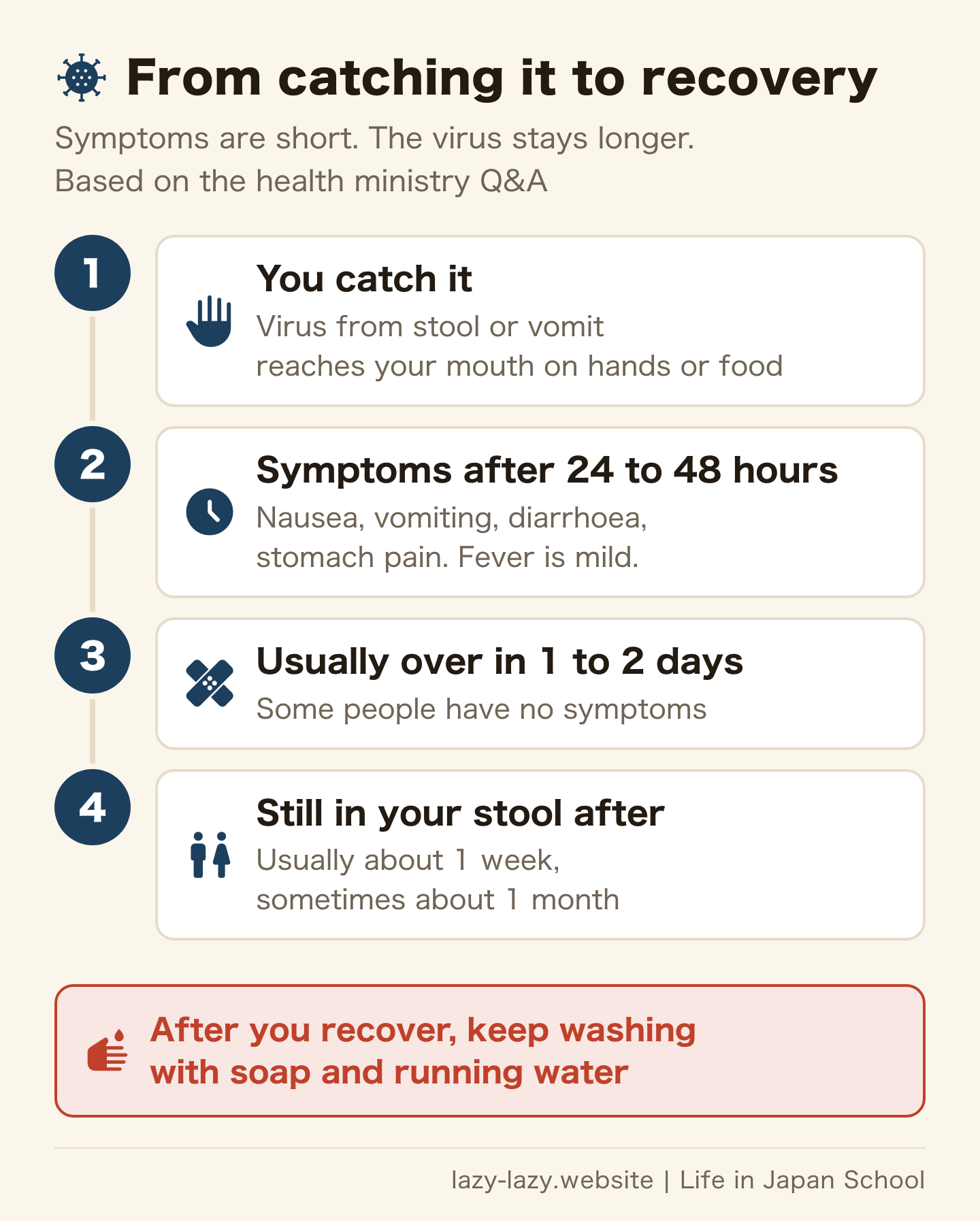
The health ministry’s norovirus Q&A says symptoms start 24 to 48 hours after you catch it. The main ones are nausea, vomiting, diarrhoea and stomach pain. Any fever is mild. It usually lasts 1 to 2 days and leaves no lasting harm. Some people have no symptoms, or only something like a mild cold.
It spreads almost always through the mouth. Stool and vomit carry a lot of virus. It reaches your mouth on hands or food. It can also pass from person to person in droplets.
Healthy adults usually get a mild case. Children and older people can get very ill. The ministry notes that some have died after vomit blocked their airway.
Should I see a doctor or call an ambulance?
The fire agency’s ambulance guide lists signs in adults that mean you should call 119 without waiting. These include:
- Not responding, or confused. Limp and drained
- Vomiting blood. Blood in the stool, or black stool
- Sudden, severe stomach pain, or severe pain that does not stop
- Strong nausea with a cold sweat
What to say on 119, in what order, is in our guide on how to call an ambulance in Japan.
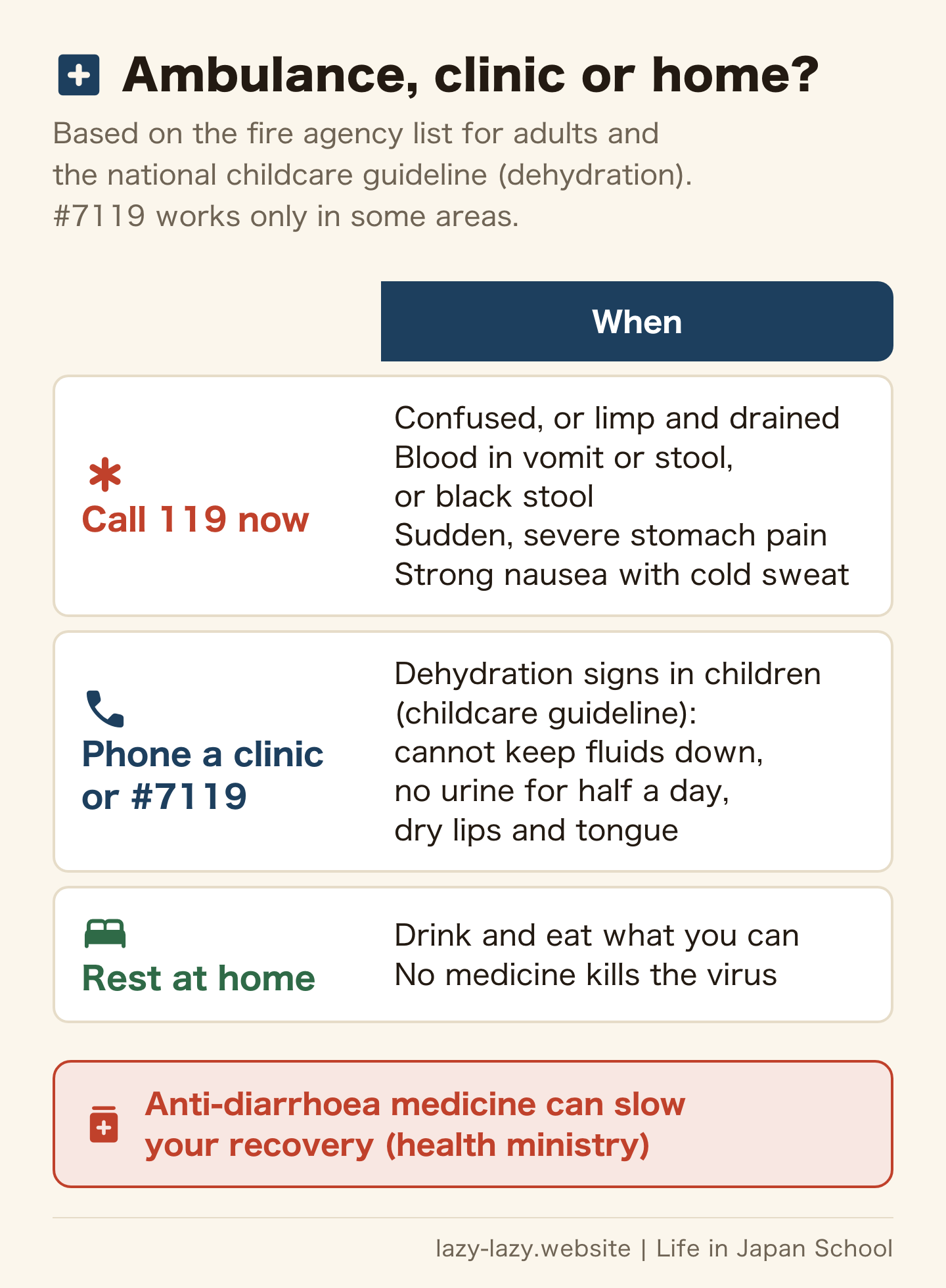
Short of an emergency, watch for dehydration. The national childcare infection guideline lists signs in children. They include not keeping fluids down, dry lips and tongue, no urine for half a day, and little, dark urine. The health ministry says bad dehydration may need treatment at a hospital, such as a drip. It also says to talk to your regular doctor or the public health centre if you think you have it.
If you are not sure, some areas have a #7119 advice line. To find a clinic open at night or on a holiday, see our guide to urgent care in Japan. In the daytime, phone a local internal medicine clinic (naika) before you go.
Norovirus treatment in Japan: is there medicine?
No antiviral medicine works against norovirus. A clinic treats the symptoms. The ministry’s Q&A says to take in enough fluids and food, so you do not get dehydrated or worn out.
It is better not to take anti-diarrhoea medicine on your own. The ministry says it can slow your recovery, so it is best not to use it. Ask a doctor or pharmacist before you take anything you have at home.
A clinic visit will not always confirm it is norovirus. Health insurance covers the stool antigen test only for some people, such as children under 3 and adults 65 and over. Doctors often judge from your symptoms and what is going around. How to see a doctor and how to describe your symptoms are in our guide to seeing a doctor in Japan.
How long is norovirus contagious after symptoms stop?
When the symptoms go, the virus may not. The health ministry says it can stay in your stool for usually about a week after diarrhoea stops, and sometimes about a month. The childcare guideline says “3 weeks or more” in some cases.
So what you do after recovery matters. Wash your hands with soap and running water after the toilet and before cooking. Alcohol sanitiser does not replace hand washing. For a while, it is safer if someone else cooks for the family.
How many days off work with norovirus in Japan?
Infectious gastroenteritis, including norovirus, is a Category V disease under the Infectious Diseases Control Act (Enforcement Regulations, Art. 1). A prefectural governor can restrict work only for Categories I to III and pandemic-type flu. Category V is not included (Act, Art. 18). No law sets a number of days off work for adults.
Still, stay home while you are vomiting or have diarrhoea. Your stool and vomit carry a lot of virus then (health ministry Q&A). Some employers have their own rule, such as a set number of days for stomach flu. Check the day you go back with your manager.
Contact work before your shift starts, and contact the person the shop named. You could say:
- Moshimoshi, (name) desu. Yoru kara hakike to geri ga arimasu. Sorede, kyou wa yasumitai n desu ga… — “Hello, it’s (name). I have had nausea and diarrhoea since last night, so I would like to take today off…”
- Byouin ni ittara, mata renraku shimasu. — “I will call again after I see a doctor.”
If you handle food, also say what you work on. You can practise the order and polite forms with our Japanese phrases for calling in sick.
Your manager may say, “We are short-staffed, you can’t take the day off.” For food jobs, the ministry tells managers they should not let anyone with symptoms handle food directly. For any job, you can get free advice from a labour consultation service for foreign workers.
Working with food, in care or in childcare
The diarrhoea stopped yesterday and you have no fever, so you go back into the kitchen as usual. Where you come from, that may be normal. In Japan, the virus can stay in your stool after you feel better. So food workers may be asked to stay away from handling food directly for a while.
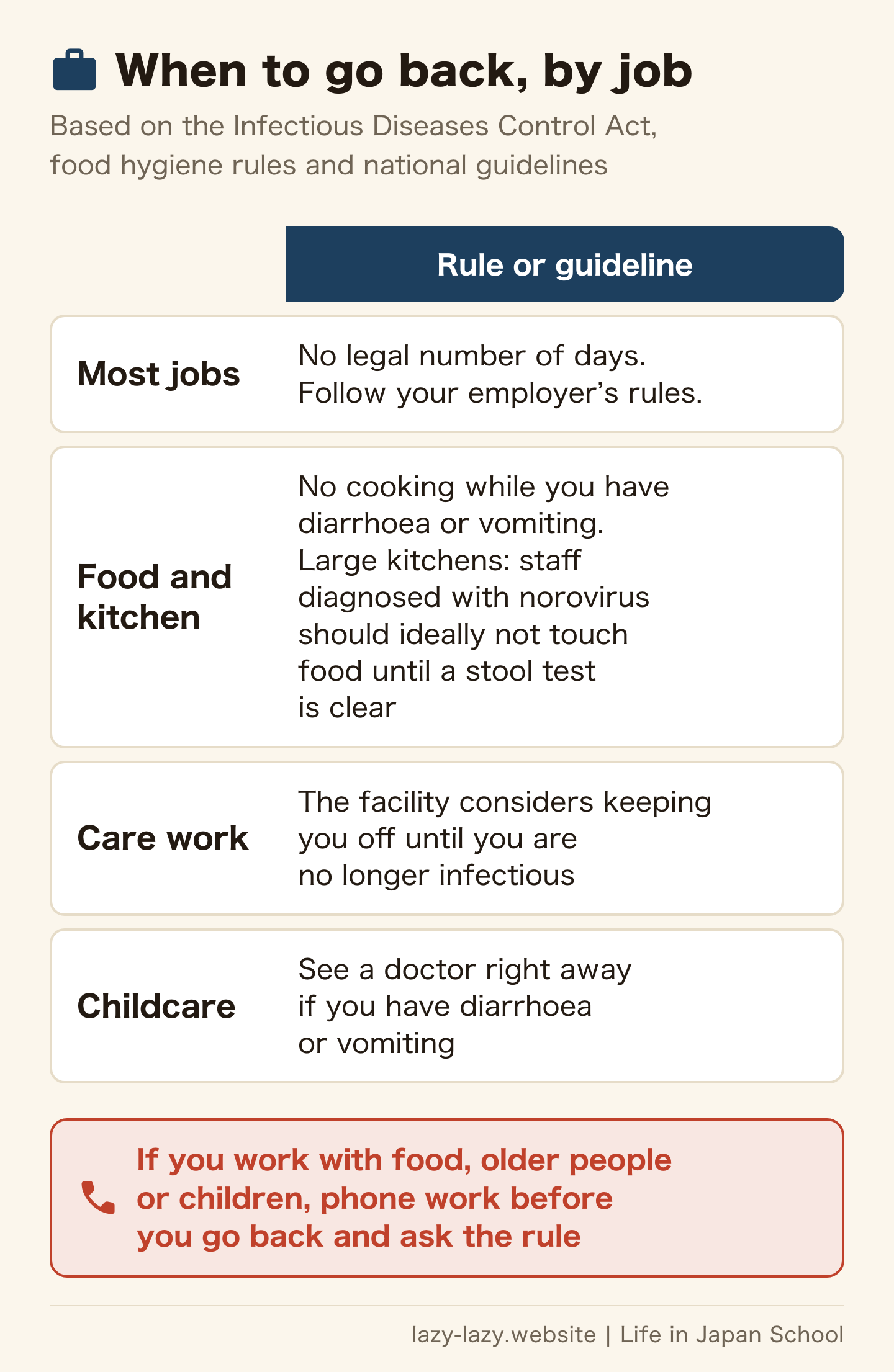
Each type of workplace has its own rule:
- Restaurants and food jobs: the Food Sanitation Act Enforcement Regulations, Appended Table 17, say the business must judge whether a worker with diarrhoea, stomach pain, fever, nausea or vomiting needs a doctor and must stop handling food. The ministry’s Q&A says workers should not handle food directly for a while, even after they get better
- Large kitchens (the same menu for 300 or more meals at once, or 750 or more a day): the ministry’s manual for large-scale cooking facilities says not to cook with diarrhoea, vomiting or fever. Staff diagnosed with norovirus should ideally not touch food directly until a stool test shows no virus
- Care work: the infection guide for care work says the facility should consider keeping a worker with symptoms off until they are no longer infectious. If your family is sick, tell your manager early
- Childcare: the childcare guideline says staff with diarrhoea or vomiting should see a doctor right away and take care not to infect others
Why it matters: in 2025, norovirus caused 462 of Japan’s 1,172 food poisoning cases, and 18,566 of the 24,727 people who fell ill, says the ministry’s Q&A. It adds that cases spread by food workers have been rising. Even at a convenience store or restaurant job, ask before you go back: “Which tasks should I start with?”
Asked for a negative test or certificate?
Your workplace may ask for proof that you have recovered. But clinic tests have limits. The health ministry says the antigen test used at clinics can miss an infection, and cannot show that you are not infected. The more reliable gene tests are not usually done at clinics. Public health and research bodies run them.
If a food workplace asks for a stool test, ask them how and at which place to take it. In other jobs, ask your doctor whether you can go back to work, and share that answer with your workplace. For schools, the Japanese Society of School Health says schools do not need to ask every pupil for a norovirus test or a recovery certificate.
How many days off school?
Unlike flu, norovirus has no fixed number of days off school in Japanese law. The School Health and Safety Act Enforcement Regulations have a Category III slot called “other infectious diseases”. The Japanese Society of School Health guide explains it. It is only for a serious outbreak not normally seen at school, when needed. The principal decides after hearing the school doctor. It does not mean a pupil must always be kept home.
The same guide says pupils with infectious gastroenteritis, such as norovirus, can go back once diarrhoea and vomiting have eased and they feel well overall. The virus can stay in stool for weeks after recovery, so keep washing your hands after the toilet.
Rules differ by school, so phone your school to check when to stay off and when to return. For international students, attendance matters for your visa. Note the day you saw a doctor and the clinic’s name, so you can explain later. How attendance is counted is in our guide to student visa attendance rules.
How do I stop my family catching it?
Alcohol does not kill norovirus well enough. The health ministry says to use sodium hypochlorite. Household chlorine bleach works instead. Look for bottles that say 塩素系 (enso-kei, chlorine type).
The Children and Families Agency’s guideline gives these mixes for a product of about 6% strength.
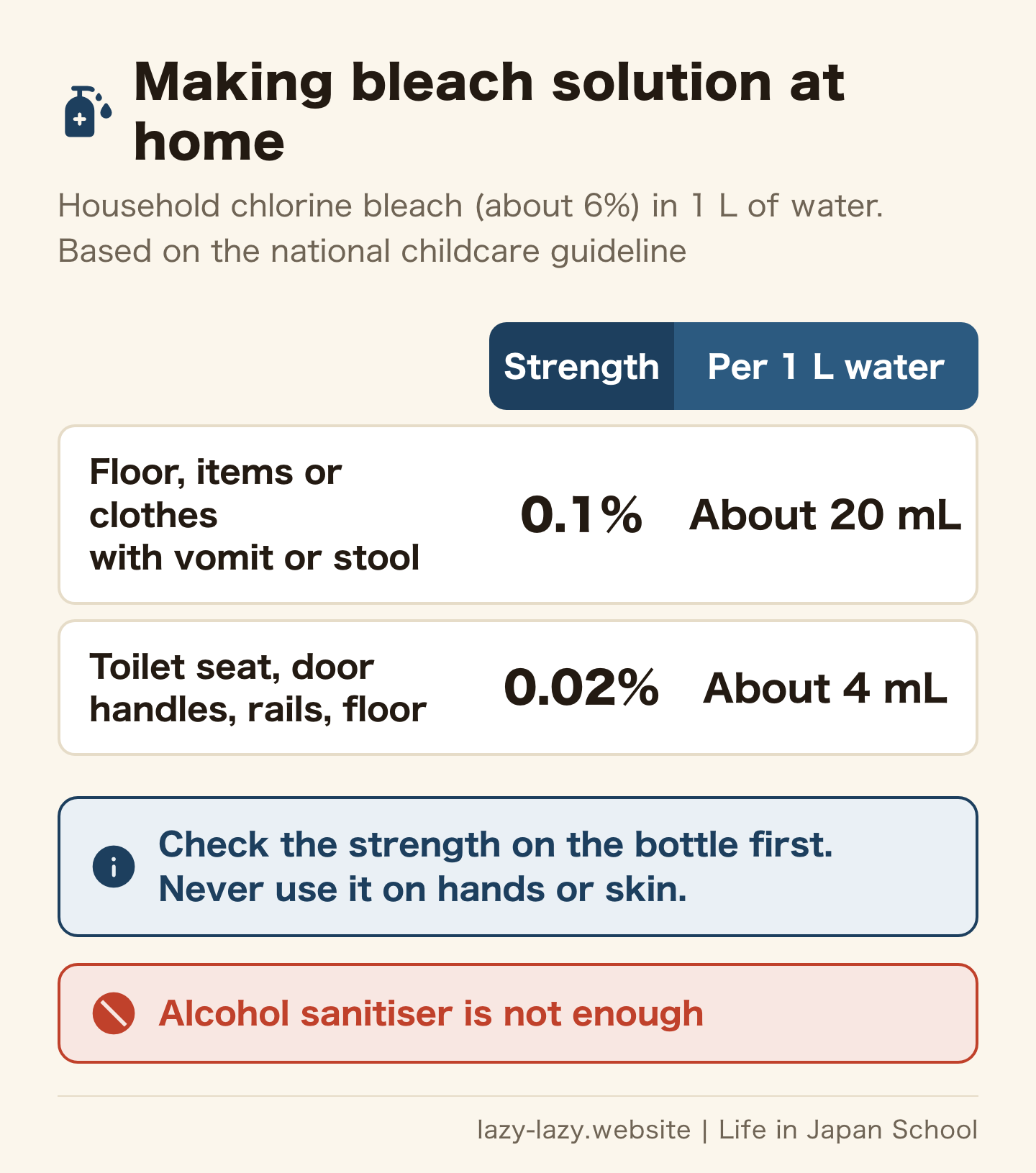
Products differ, so check the strength on the bottle first. To clean up vomit, the ministry’s Q&A gives this order:
- Put on disposable gloves, a mask and an apron
- Gently wipe up the vomit or stool with paper towels
- Put the waste in a plastic bag and close it tightly
- Wipe the area with chlorine solution, then wipe with water
- Open the windows to air the room. Last, wash your hands with soap and running water
Dried vomit can release virus into the air, and it can reach your mouth. Clean it up before it dries. Wash dirty clothes and sheets in water at 85°C for at least 1 minute, or use chlorine solution. For things you cannot wash, like a futon, dry them well and use a steam iron or futon dryer. Chlorine bleach can fade colours and rust metal, so read the label.
Will I be paid for the days off?
Employer health insurance has a sickness allowance that replaces pay for sick days. But at Kyokai Kenpo, it starts only from day 4, after 3 days off in a row (the waiting period). If you take 2 days off and work on day 3, the waiting period does not count.
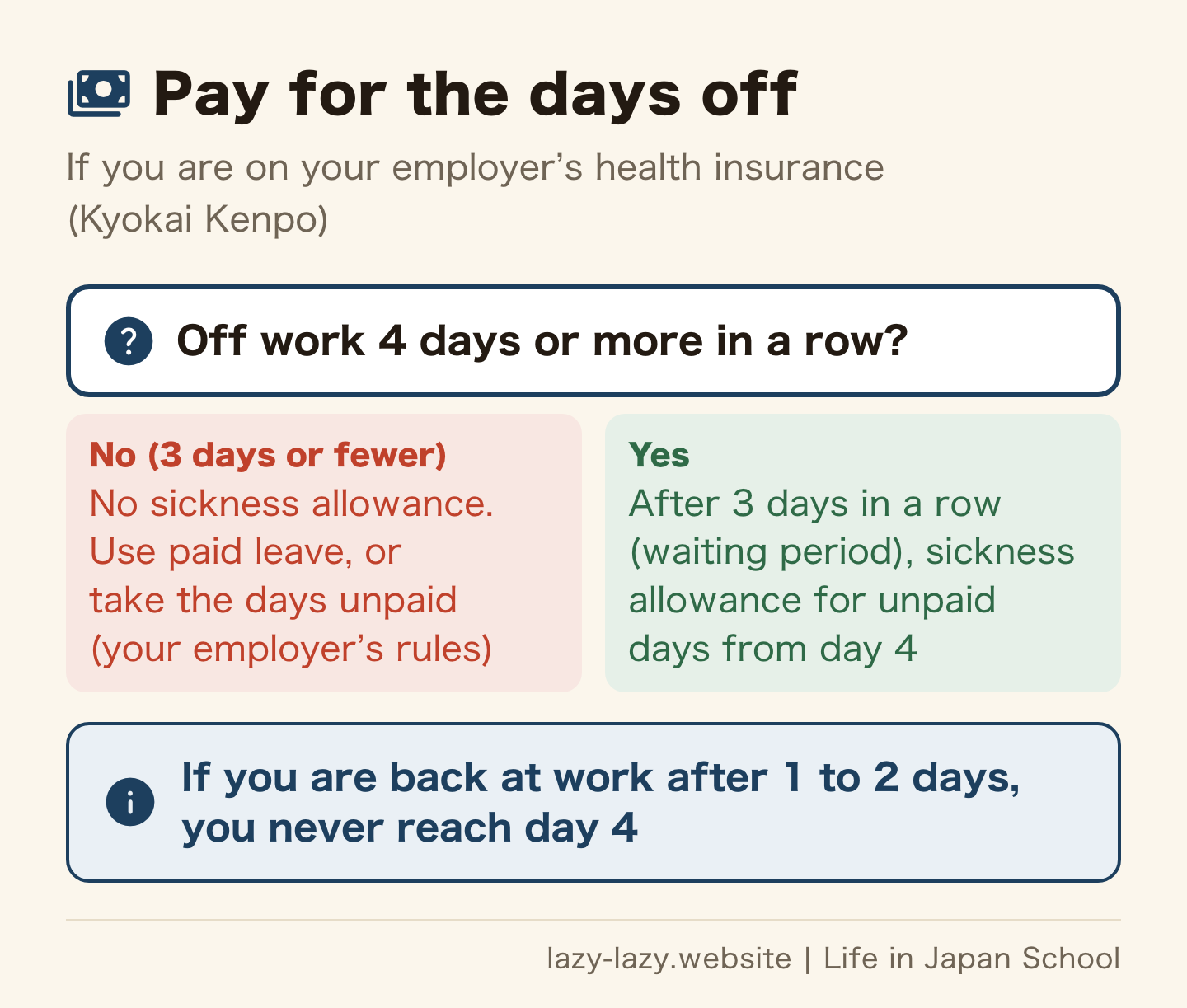
Norovirus symptoms usually last 1 to 2 days. If you go back to work after that, you never reach day 4. For a short absence, you either use paid leave or take the days without it. Whether you are paid for days without paid leave depends on your employer’s work rules.
Part-timers can have paid leave too. Check whether you can use it, and how many days you have, in our guide to paid leave in Japan. If illness keeps you unable to work for 4 days or more (judged from your doctor’s opinion), check the conditions and how to apply in our sickness allowance guide.
Which one are you?
- You are very sick right now: call 119 for confusion, vomiting blood or sudden, severe stomach pain. Otherwise, drink and rest. If you are worried, talk to your regular doctor or the public health centre.
- You handle food at a restaurant, convenience store or kitchen: phone work before your shift and say what you work on. Before you go back, ask which tasks to start with.
- You work in care or childcare: do not go in while you have symptoms, and see a doctor. Ask your manager the rule for going back, and for when your family is sick.
- Someone at home has vomited: wipe it up with gloves and a mask, then make chlorine solution. Check the strength on the bottle first.
Frequently asked questions
Q. How many days off work do I need with norovirus in Japan?
No law sets a number of days. Stay home while you have nausea, vomiting or diarrhoea, and follow your employer’s rules for going back. In food, care or childcare jobs, check with work before you return.
Q. How long is norovirus contagious?
Symptoms usually go in 1 to 2 days. But the health ministry says the virus can stay in your stool for usually about a week, sometimes about a month. Keep washing your hands with soap and running water after the toilet.
Q. Is there norovirus medicine in Japan?
No antiviral medicine works against norovirus. Treatment is mainly fluids and food, with a drip at a hospital for bad dehydration. The health ministry says it is best not to use anti-diarrhoea medicine, because it can slow recovery.
Q. When should I call an ambulance?
The fire agency says adults should call 119 without waiting if someone is not responding or confused, limp and drained, vomiting blood, or has sudden, severe stomach pain or strong nausea with a cold sweat. Some areas also have #7119 for advice.
Q. Can a clinic give me a negative certificate for work?
The health ministry says the antigen test at clinics cannot show that you are not infected. If a food workplace asks for a stool test, ask them where to take it.
Q. Does alcohol kill norovirus?
Not well enough. Use household chlorine bleach mixed with water. For a product of about 6%, use about 20 mL per litre for spots with vomit. Use about 4 mL per litre for door handles and toilets.
Summary
Norovirus symptoms usually last 1 to 2 days. No medicine kills it, and treatment is fluids and food. Call 119 for confusion, vomiting blood or sudden, severe stomach pain. No law sets your days off work. Rest while you have symptoms, and follow your employer’s rules for going back.
The virus can stay in your stool for a week to a month after you feel better. So if you work with food, older people or children, ask your workplace’s rule before you return. Clean at home with chlorine bleach. For a short absence, think in terms of paid leave or days off without it.
Official sources: Ministry of Health, Labour and Welfare, norovirus Q&A / manual for large-scale cooking facilities / infection guide for care work (3rd ed.) / Children and Families Agency, childcare infection guideline / Fire and Disaster Management Agency, ambulance guide / Japanese Society of School Health, guide to infectious diseases at school / Kyokai Kenpo, sickness allowance / e-Gov law (Infectious Diseases Control Act, its Enforcement Regulations, Food Sanitation Act Enforcement Regulations, School Health and Safety Act Enforcement Regulations). All checked on 19 November 2026. Ask a doctor about your health, and your workplace about going back.
Related guides
Found this useful? Share it
Send it to a friend who lives in Japan.
WHO WROTE THIS

mori
Japanese. I read the ministries’ own notices, orders and Q&As in the original, and I start from what my Nepalese and Sri Lankan friends in Japan actually ran into. I do not write about what I have not checked or been told.
What this site can and cannot do →Looking for something else?
You may use the figures in this article, including commercially, if you credit this site with a link. How to use our figures