Checked on 16 November 2026 against the Financial Services Agency (FSA) NISA website and briefing slides, the FSA list of products eligible for the NISA tsumitate allowance (as of 23 October 2026), teaching material from J-FLEC (the Japan Financial Literacy and Education Corporation) and guides from the Investment Management Association of Japan. This guide does not recommend any product or securities company.
The short answer
- An index fund is an investment trust, sometimes an ETF, that aims to move in line with an index such as the Nikkei 225 or the S&P 500. It aims for about the market average and does not try to beat it by much.
- Active funds aim to beat the index, but they can also fall below it. The FSA describes index funds as relatively low cost and active funds as relatively high cost.
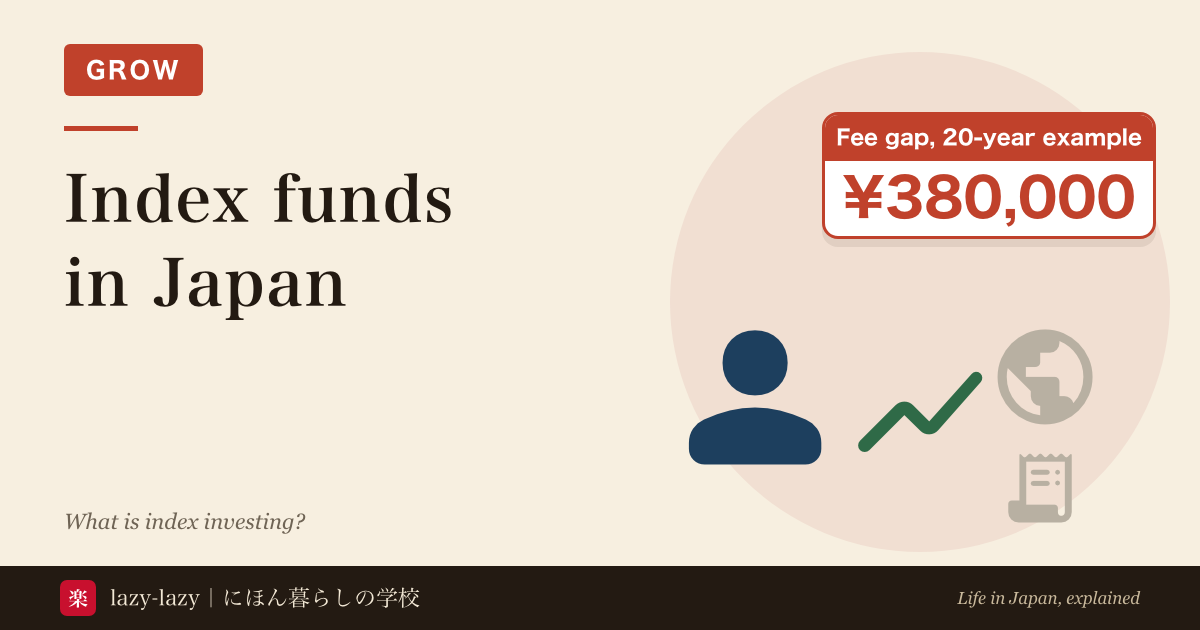
- The annual fee (shintaku hōshū) is taken every day for as long as you hold the fund. In an example of ¥10,000 a month for 20 years, a 0.3% fee leaves about ¥380,000 more than a 1.5% fee.
- Index funds have no principal guarantee, and there will be periods when prices fall. Do not put in money you need soon, or money you borrowed.
- Global, US and Japan index funds differ in how many countries they cover and in currency risk. Which suits you depends on you. Check NISA and leaving Japan separately.
Knowing this, you can open the papers for any fund you are offered and see what it tracks and how much it takes each year. A falling market becomes less of a shock.
A coworker is looking at an investment app on their phone at lunch. “I just buy the index every month,” they say. At the bank counter, you were offered a different investment trust. Both are called investment trusts. What is the difference? How different are the fees? What happens if prices fall? Your coworker only says, “Everyone buys it.”
- What is an index fund? A fund that aims to track an index
- Index fund vs active fund: goal, holdings and cost
- How much do index funds cost in Japan? The annual fee comes out of your holding every day
- How do fees add up over the long term? An example: ¥10,000 a month for 20 years
- Why diversify and keep going? Long term, regular and spread out
- Can index funds fall? There is no principal guarantee
- Global, US or Japan index funds: what is the difference? Number of countries and currency
- What should foreigners watch for with index funds in Japan? NISA, leaving and currency
- How to invest in index funds in Japan: the order before you start
- Which one are you?
- FAQ
- Summary
- Related reading
What is an index fund? A fund that aims to track an index
Start with the index. The FSA’s NISA briefing slides define it as a single number that combines the prices of the whole market, or of companies picked by a fixed rule, using a fixed formula. The Nikkei 225 and TOPIX are Japan’s best-known indexes.
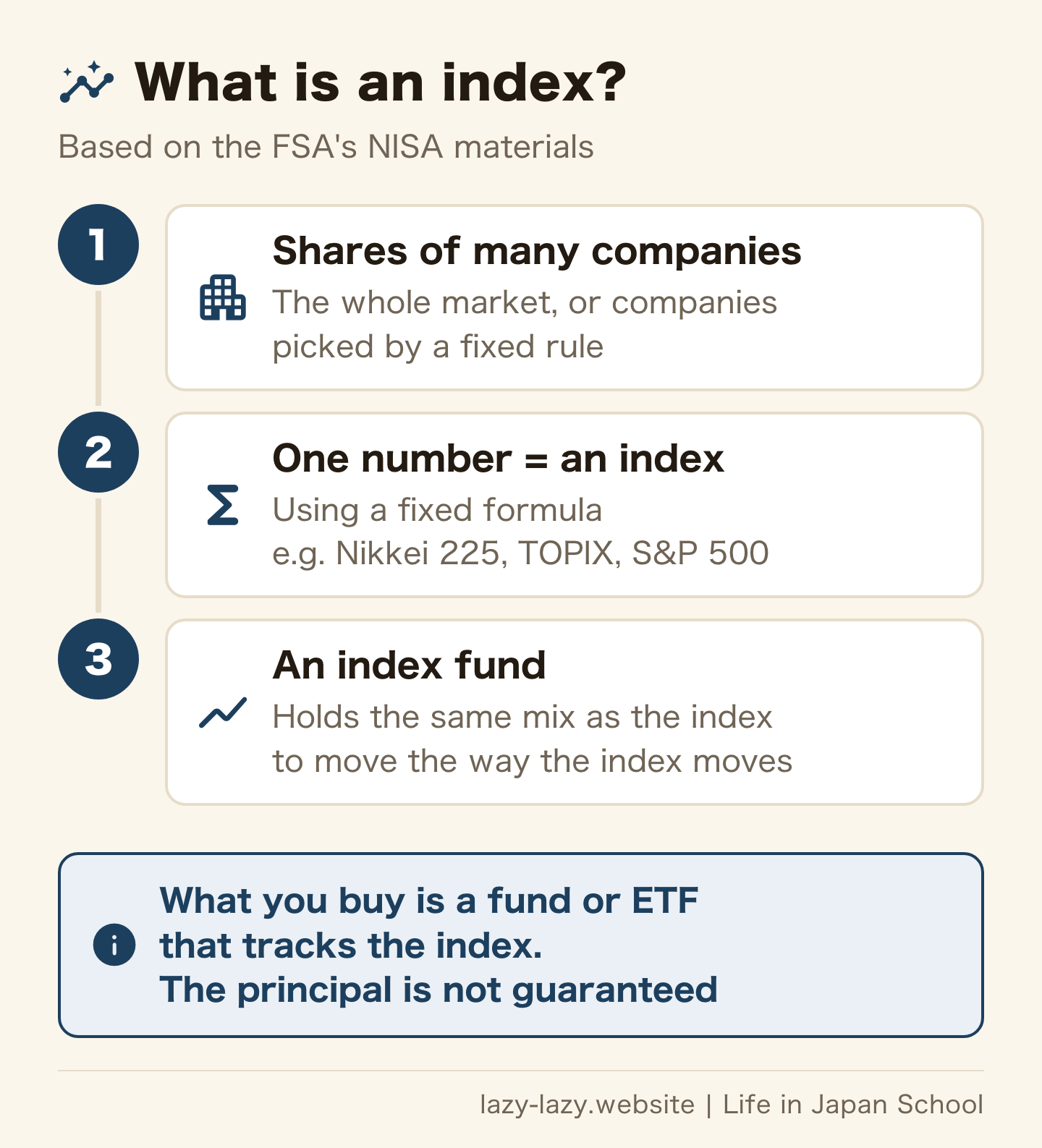
An index itself is not a product. In index investing, what you buy is an investment trust or ETF that aims to track an index. The Investment Management Association of Japan classifies these as the index type. An index fund is an investment trust of this type.
In one sentence, an investment trust and an ETF differ in where you trade and how the price is set. An ETF trades on a stock exchange at the market price of the moment. An ordinary investment trust trades at a net asset value set once a day.
Index fund vs active fund: goal, holdings and cost
Investment trusts are run in two broad ways. Index funds aim to move with an index. Active funds aim to beat it.
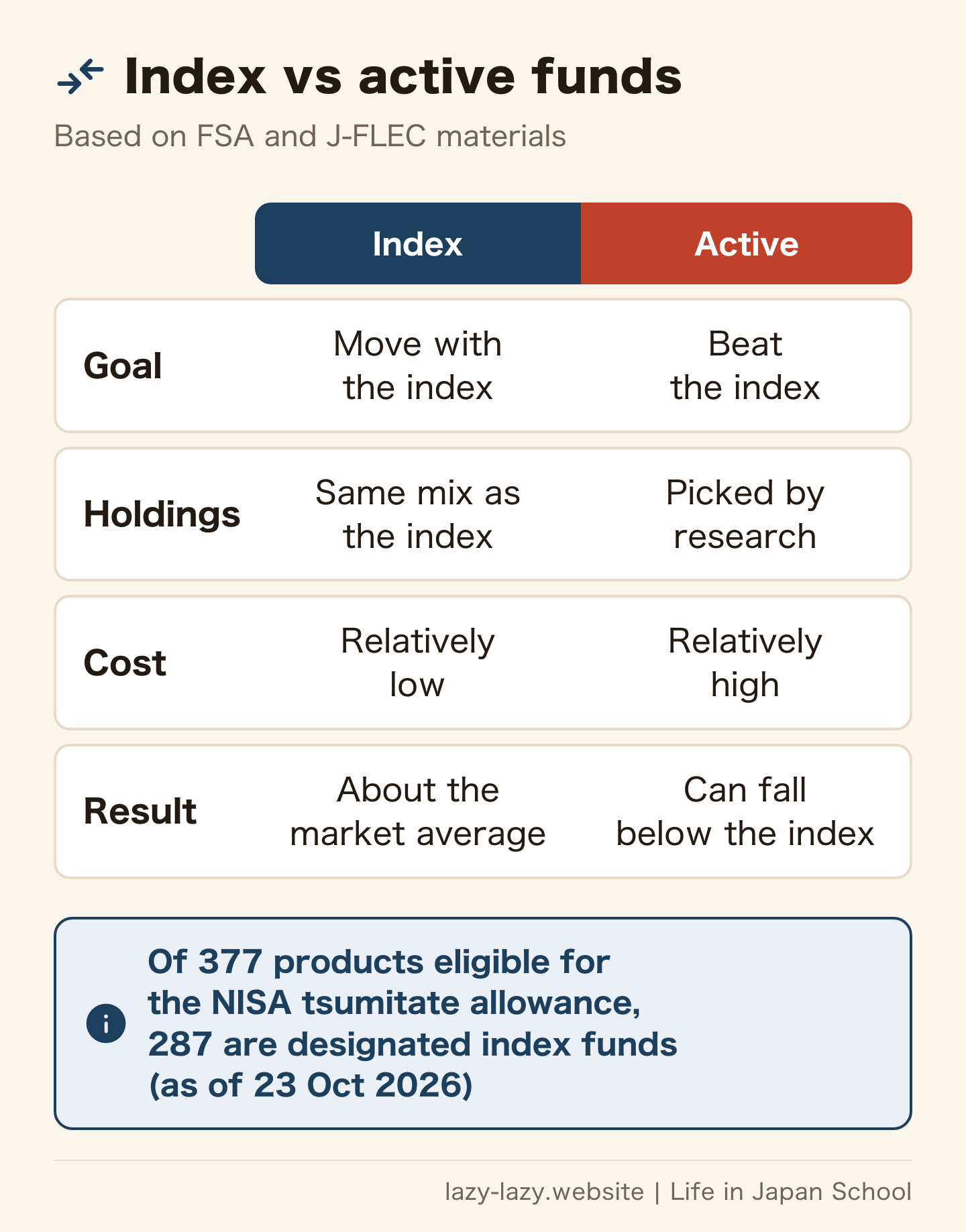
In an active fund, the managers research companies and choose shares. That work costs more. J-FLEC’s teaching material says active funds do not always beat their benchmark, and that results depend on the skill of the people running them. It says index funds can be expected to perform about as well as the market average, while beating the average by a wide margin is difficult.
As of 23 October 2026, 377 products can be bought with the NISA tsumitate allowance. In the FSA’s list, 287 of them are funds that track an index designated by the FSA. Active and other funds number 79, and ETFs 11. Neither is simply right: the difference is what the fund aims for, and how much you pay for it.
How much do index funds cost in Japan? The annual fee comes out of your holding every day
Investment trust costs come at three points. These are the ranges in J-FLEC’s material:
- When you buy: a purchase fee of about 0 to 3.5% of the amount, depending on the seller. A fund with no purchase fee is called no-load.
- While you hold: the annual fee (trust fee, or management fee), about 0.2 to 3.0% a year, depending on the product.
- When you sell: an exit charge (shintaku zaisan ryūhogaku) of about 0.2 to 0.3% of the amount, which some funds do not have.
You buy the fund the bank counter recommends, just as it is offered. Where you come from, that may be normal. In Japan, fees differ by product and by seller, even between funds that track similar indexes. The Investment Management Association of Japan notes that the costs are set out in the prospectus.
The NISA tsumitate allowance has cost limits. Under the FSA’s rules, the purchase fee must be zero. For index funds, the annual fee must be 0.5% or less for funds investing in Japanese assets, and 0.75% or less for funds investing overseas (both before tax). As of 23 October 2026, the average among eligible index funds was 0.27% for Japan and 0.34% for global and overseas.
Profits are also taxed. According to J-FLEC, distributions and gains when you sell are taxed at 20.315%. Profits on what you buy inside the NISA allowance are not taxed.
How do fees add up over the long term? An example: ¥10,000 a month for 20 years
The annual fee never shows up on a statement as a line saying it was taken. According to the Investment Management Association of Japan, it is taken every day from the fund’s assets, in proportion to what you hold. It is easy to miss, and it keeps working for as long as you hold.
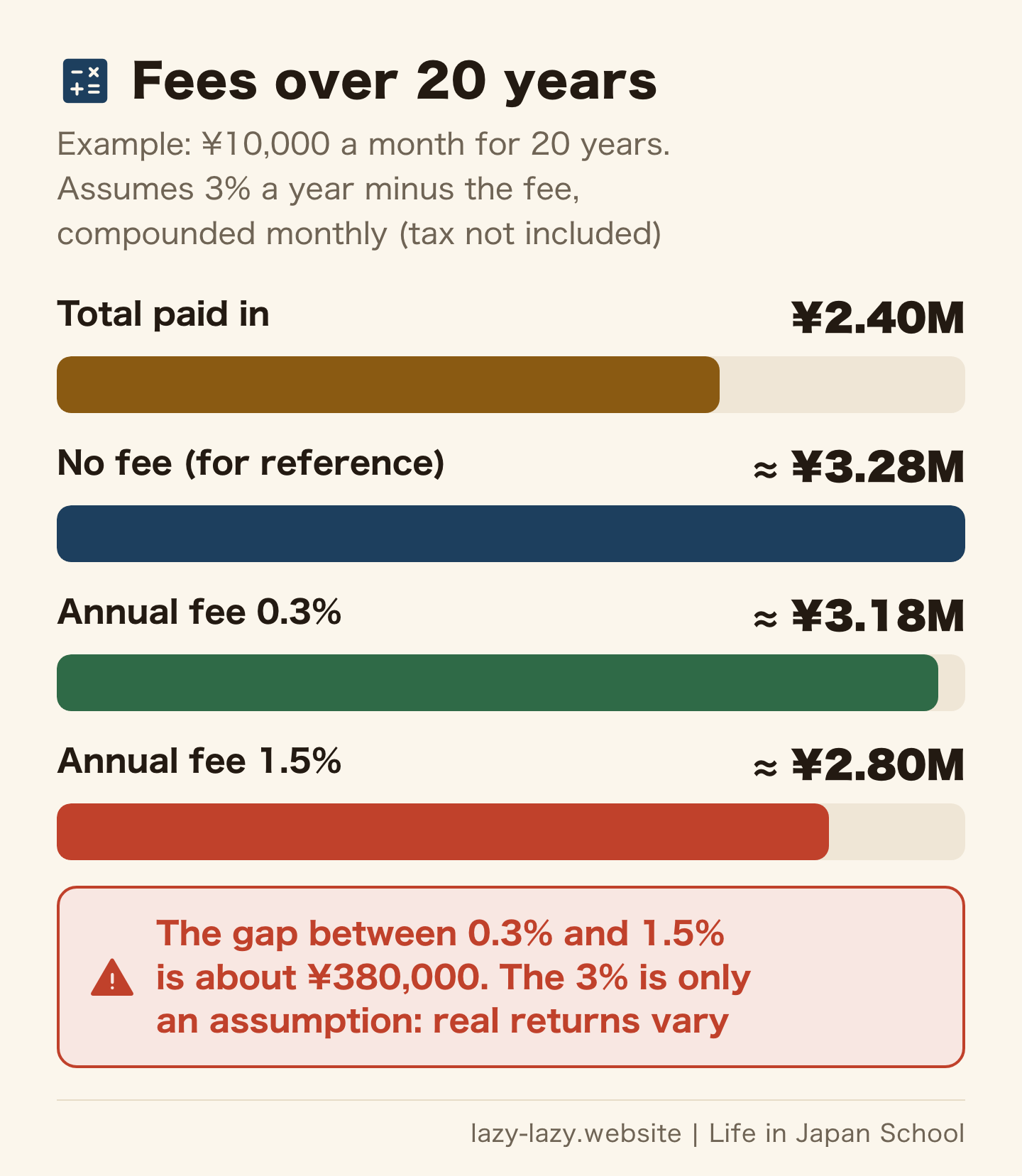
The example assumes ¥10,000 a month for 20 years (¥2.4 million paid in), growing at 3% a year. The 3% matches the flat rate the FSA uses in its NISA examples. It is an assumption, not a forecast. The fee is subtracted from it, and the result is compounded monthly.
- With a 0.3% annual fee, you have about ¥3.18 million after 20 years. The growth is about ¥780,000.
- With a 1.5% annual fee, you have about ¥2.80 million. The growth is about ¥400,000.
The gap is about ¥380,000 in total. In this example, a difference of 1.2 points a year, kept up for 20 years, removes about half of the growth. Real returns change every year, and some years go down. Fees are taken every year whatever the market does. Annual fees are written as a yearly rate. Check whether the prospectus figure includes tax.
Why diversify and keep going? Long term, regular and spread out
An index fund invests in all the companies in its index at once. If one company falls sharply, the effect on the whole is small. The FSA explains that spreading money across assets that move differently can soften price swings to some extent.
Keeping going also matters. According to the FSA, the longer you invest, the bigger the effect of compounding, where growth itself grows. Buying a fixed amount regularly means you avoid buying only when prices are high, or missing the times they are low. The Investment Management Association of Japan writes that markets can swing widely over short periods, while the risk of swings tends to shrink over long periods.
No method makes the risk zero, though. The association also writes that there is no such convenient product as low risk with high return.
Can index funds fall? There is no principal guarantee
An index fund follows the market, so when the whole market falls, it falls too. The Investment Management Association of Japan states that investment trusts have no principal guarantee. Gains and losses belong entirely to the investor. This is where a fund differs from a bank deposit.
Funds that track overseas share indexes also move with the exchange rate. Generally, a stronger yen lowers the price in yen, and a weaker yen raises it. Market falls and currency moves can come together, and there will be periods of large drops.
If you sell in a falling period, the amount you get is fixed at that day’s price. That is why you decide in advance how much to put in. The FSA’s slides suggest starting with an amount you could live without. Do not put in money you will need soon, or money you borrowed. This site does not recommend investing borrowed money. How to set aside money for daily life first is in how big your emergency fund in Japan should be.
If you suddenly need the money, you can sell part way through. The FSA notes that NISA investments can be sold part way through, including only the part you need. If someone promises “guaranteed gains” or “no risk to your principal,” that is not index investing. Firms that sell financial products must be registered with the government, and you can check them on the FSA’s list of registered firms. The tricks are covered in scams that target foreigners in Japan.
Global, US or Japan index funds: what is the difference? Number of countries and currency
Two index funds can hold very different things, depending on the index. Using examples of indexes the FSA designates for the NISA tsumitate allowance:
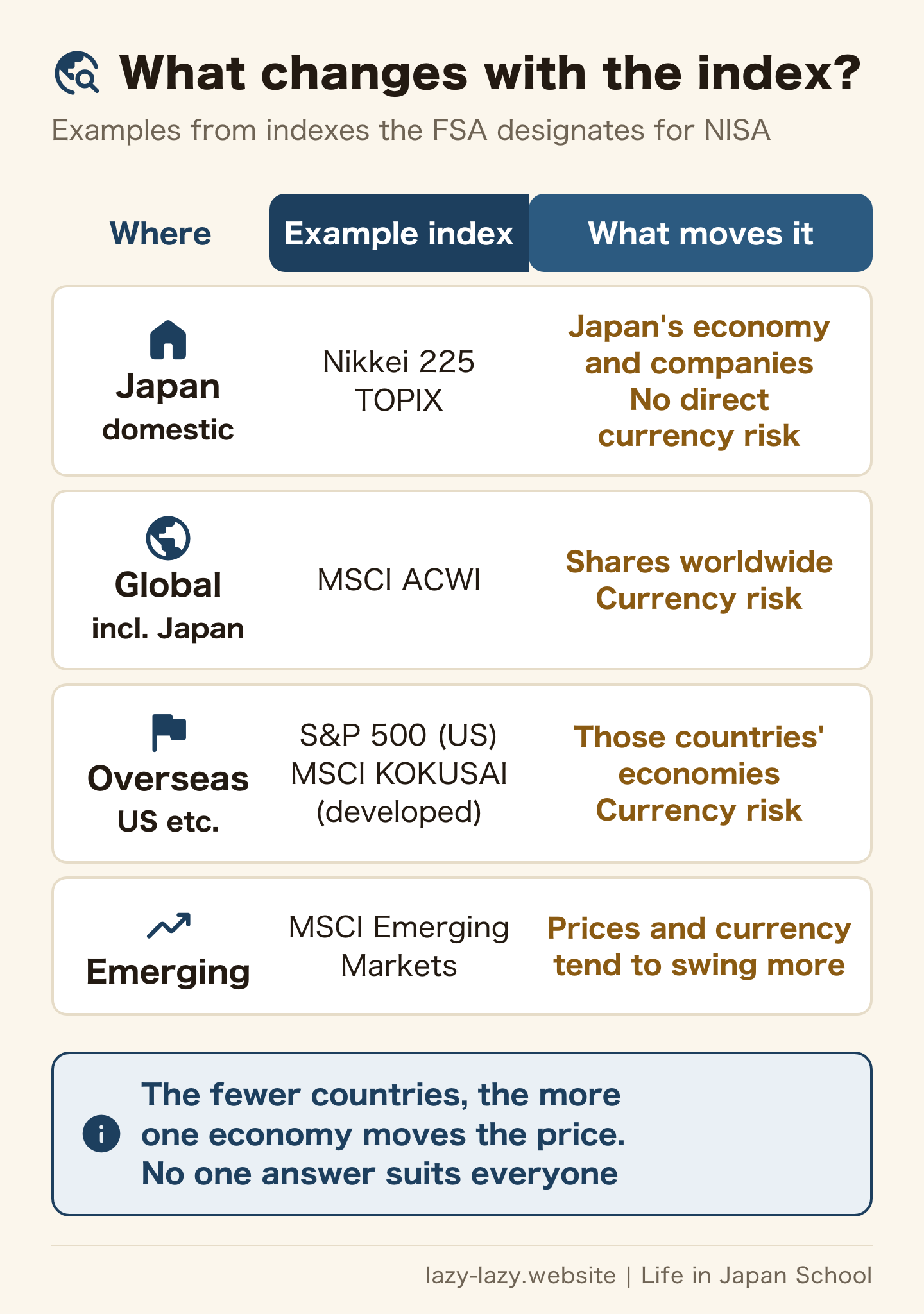
- Japan (domestic): the Nikkei 225, TOPIX, the JPX-Nikkei Index and others. Moved by Japan’s economy and company results. Priced in yen, so there is no direct currency risk.
- Global including Japan: MSCI ACWI and others. Spread across shares worldwide, including Japan. Affected by exchange rates.
- US and developed markets (overseas): the S&P 500 (US), MSCI KOKUSAI (developed markets) and others. Moved by those countries’ economies and by exchange rates.
- Emerging markets (overseas): MSCI Emerging Markets and others. The FSA’s slides say both prices and exchange rates tend to swing more than in developed markets.
The difference in thinking is how widely you spread. The fewer countries an index covers, the more one country’s economy moves it. The more countries it covers, the less any one country matters. Which suits you depends on how many years you can keep going, and on which country you will spend your money in later. This guide does not say which to choose.
What should foreigners watch for with index funds in Japan? NISA, leaving and currency
How index funds work does not change with nationality. The differences are in the rules and in the exit.
- NISA: according to the FSA, anyone living in Japan who is 18 or over on 1 January of the year can open an account. Keeping NISA tax-free after leaving Japan is limited to people who leave because of a transfer order from their employer (Act on Special Measures Concerning Taxation, Article 37-14); finishing your studies or leaving for your own reasons does not count, so read the exit first in NISA for foreigners in Japan. How to open an account is there too.
- Leaving Japan: if you know when you will leave, you largely know when you will sell. If prices are down on that day, you may not be able to wait. If you are still deciding whether investing is for you, should foreigners invest in Japan? sets out the order for people who will leave.
- Currency: overseas share indexes move with the exchange rate when seen in yen. If you will go home, you also face the rate when you finally convert your yen. How the currency you will live on changes what to watch is in weak yen and inflation in Japan.
How to invest in index funds in Japan: the order before you start
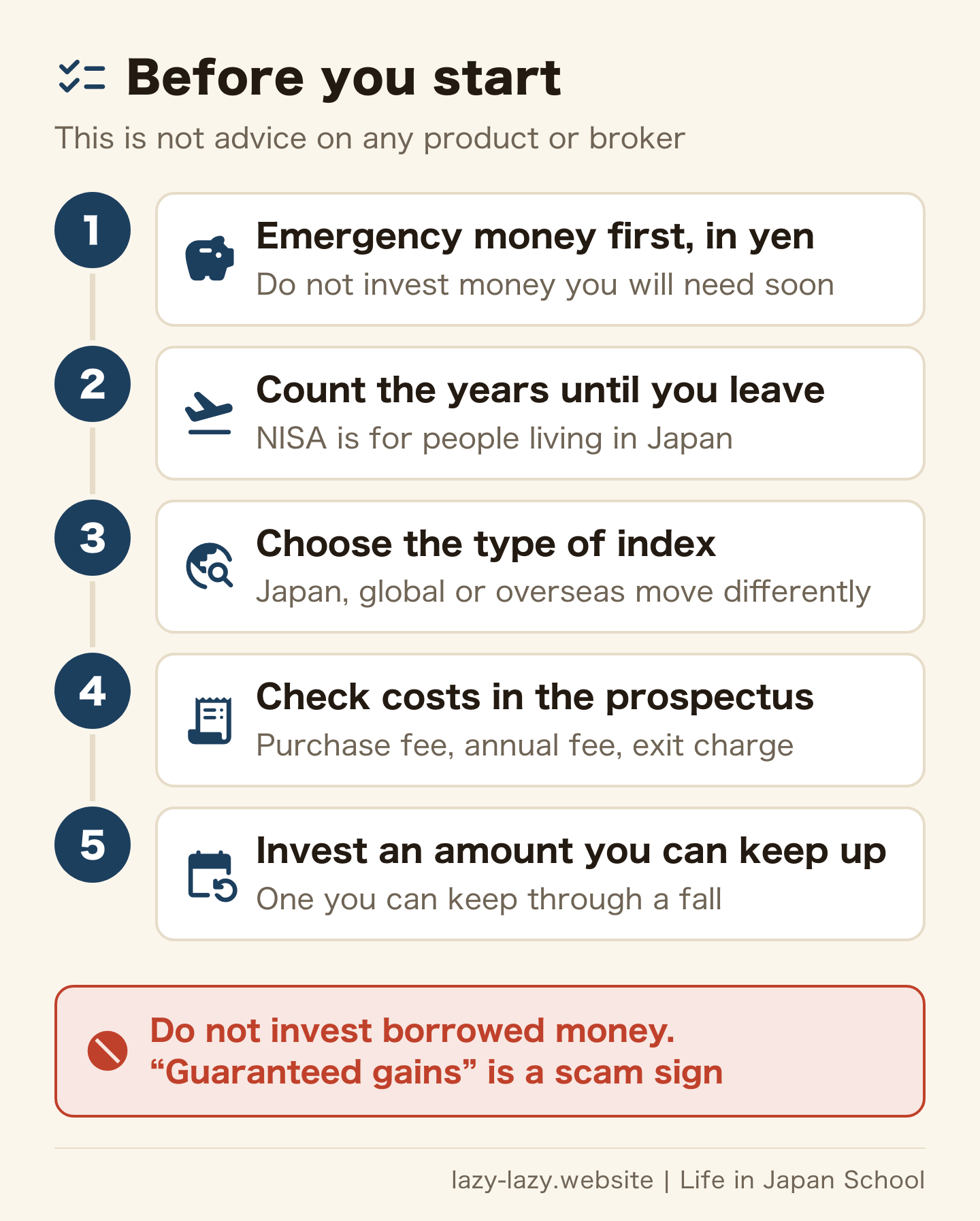
- Set aside money for daily life first: keep money you need soon, and your emergency money, in a yen deposit.
- Count the years until you leave Japan: if you plan to go home, work backwards from the day you will sell.
- Choose the type of index: whether it tracks Japan, global or overseas shares changes both the price swings and the currency effect.
- Check the costs in the prospectus: the purchase fee, the annual fee (a yearly rate) and the exit charge.
- Invest an amount you can keep up: one you could keep going with through a fall.
Which one are you?
- You do not have an emergency fund yet: today, write down your monthly spending and decide how much to keep in yen before investing.
- You already hold a fund a bank or an acquaintance recommended: today, open its prospectus and copy down the index it tracks and its annual fee rate.
- You plan to leave Japan within a few years: today, write down the year you expect to leave and read the NISA exit rules first.
- You plan to stay in Japan for a long time and want to decide how to start: today, write down which approach (Japan, global or overseas) fits you, and compare the annual fees of three funds that track that kind of index.
FAQ
Q. What is an index fund, in simple terms?
It is an investment trust or ETF that aims to move in line with an index such as the Nikkei 225 or the S&P 500. It invests in all the companies in the index at once, so it aims for about the market average. The principal is not guaranteed.
Q. How does an index fund differ from an active fund?
An index fund aims to track an index, while an active fund aims to beat it. Because active managers research and choose shares, costs are relatively high, and results can fall below the index.
Q. When is the annual fee taken, and what is a normal level?
It is taken every day from the fund’s assets, in proportion to what you hold. J-FLEC’s material gives a range of about 0.2 to 3.0% a year. For the NISA tsumitate allowance, index funds must charge 0.5% or less a year for Japanese assets and 0.75% or less for overseas assets (before tax).
Q. What are the downsides of index investing?
When the whole market falls, the fund falls too, and the principal is not guaranteed. It does not aim to beat the market average by much. Funds that track overseas indexes also move with the exchange rate.
Q. Should I keep holding when prices fall?
This guide does not advise whether to sell or hold. If you sell in a falling period, the amount is fixed at that day’s price. So the first step is to put in only an amount you could live without if it fell. If you need money, you can sell just part of it along the way.
Q. Which is better, a global or a US index fund?
That depends on the person. A global fund is spread across shares worldwide, including Japan. A US fund is concentrated in one country. The fewer countries, the more that country’s economy moves the price. Both are affected by exchange rates.
Summary
An index fund is an investment trust or ETF that aims to track an index. Active funds aim to beat the index, but they can fall below it, and they cost relatively more. The annual fee is taken every day, and in the example of ¥10,000 a month for 20 years, a 0.3% fee leaves about ¥380,000 more than a 1.5% fee.
Index funds have no principal guarantee, and there will be falling periods. Global, US and Japan index funds differ in how many countries they cover and in currency risk. Today, open the prospectus of a fund you hold or are considering, and check which index it tracks and its annual fee rate.
Official sources: FSA, NISA briefing slides (Japanese) / FSA, products eligible for the tsumitate allowance / FSA, overview of eligible products (as of 23 October 2026) / FSA, basics of building assets / FSA, about NISA / FSA, list of licensed and registered firms / J-FLEC, investment trusts / Investment Management Association of Japan, fund classification / same, fund costs / same, fund risks / same, what matters in investing / Act on Special Measures Concerning Taxation (e-Gov) (all in Japanese, checked 16 November 2026)
Related reading
Found this useful? Share it
Send it to a friend who lives in Japan.
WHO WROTE THIS

mori
Japanese. I read the ministries’ own notices, orders and Q&As in the original, and I start from what my Nepalese and Sri Lankan friends in Japan actually ran into. I do not write about what I have not checked or been told.
What this site can and cannot do →Looking for something else?
You may use the figures in this article, including commercially, if you credit this site with a link. How to use our figures