Checked on 17 November 2026. We used NISA material from the Financial Services Agency (FSA) and the NISA Q&A of the Japan Securities Dealers Association (JSDA). We also used teaching material from J-FLEC (the Japan Financial Literacy and Education Corporation). Other sources: ETF guides from Japan Exchange Group (JPX), guides from the Investment Management Association of Japan (IMAJ), and prospectuses from Mitsubishi UFJ Asset Management. This guide does not recommend any product or securities company.
The short answer
- An ETF is an investment trust that is listed on a stock exchange. Inside, it works like any investment trust. The difference: the place you buy it, and how the price is set.
- You can buy investment trusts at a bank. You can buy ETFs only at a securities company. A NISA account at a bank cannot hold ETFs.
- An investment trust has one price a day, and you order without knowing it. An ETF trades like a share. Its price moves, and you can set the price you want.
- With an ETF, you pay a broker fee each time you buy or sell. The yearly fee tends to be lower for ETFs.
- To get ETF payouts tax-free in NISA, choose to receive them at your securities company. If you receive them at a bank or post office, 20.315% tax is taken.
Knowing this, you can choose the right place for your account before you open it. You will know what you can hold in NISA. You will also know what to check when two products have similar names.
It is lunch break at work. A coworker says, “I bought an ETF.” You started an investment trust at your bank last month. At the bank counter, you ask, “Can I buy ETFs here?” The answer is, “We do not handle them.” People say the two are similar inside. So why are they sold in different places? Your Japanese coworker only says, “ETFs are cheaper, I think.”
- Investment trust vs ETF: what is the difference? The place you buy, and how the price is set
- Which place sells them? Investment trusts at banks too, ETFs only at securities firms
- How is the price set? One price a day, or a price that keeps moving
- How much are the fees? With an ETF, a broker fee each time you trade
- Two funds with similar names: what is different? The same index can come with a different fee
- How much do you need to start? Small amounts for investment trusts, price times trading unit for ETFs
- How are payouts different? Take the cash, or put it back in
- How does NISA treat them? Only 11 ETFs in the tsumitate allowance, and a payout trap
- What if you need cash fast? How long until the money arrives
- What should foreigners watch for? Yen trading, overseas ETFs, your account
- Investment trust vs ETF on one page: the numbers and your choices
- Which one are you?
- FAQ
- Summary
- Related reading
Investment trust vs ETF: what is the difference? The place you buy, and how the price is set
In Japan, a mutual fund is called an investment trust (toshi shintaku). Many people put money in. Professionals invest it in shares and bonds as one pool. J-FLEC teaching material says you can start with a small amount, because many people share the pool.
An ETF (exchange-traded fund) is an investment trust listed on a stock exchange. The IMAJ describes an ETF as an investment trust that is listed and aims to track an index. So an ETF is also a kind of investment trust.
The difference is the place you trade, and the price you pay. Here is a simple version of the FSA comparison.
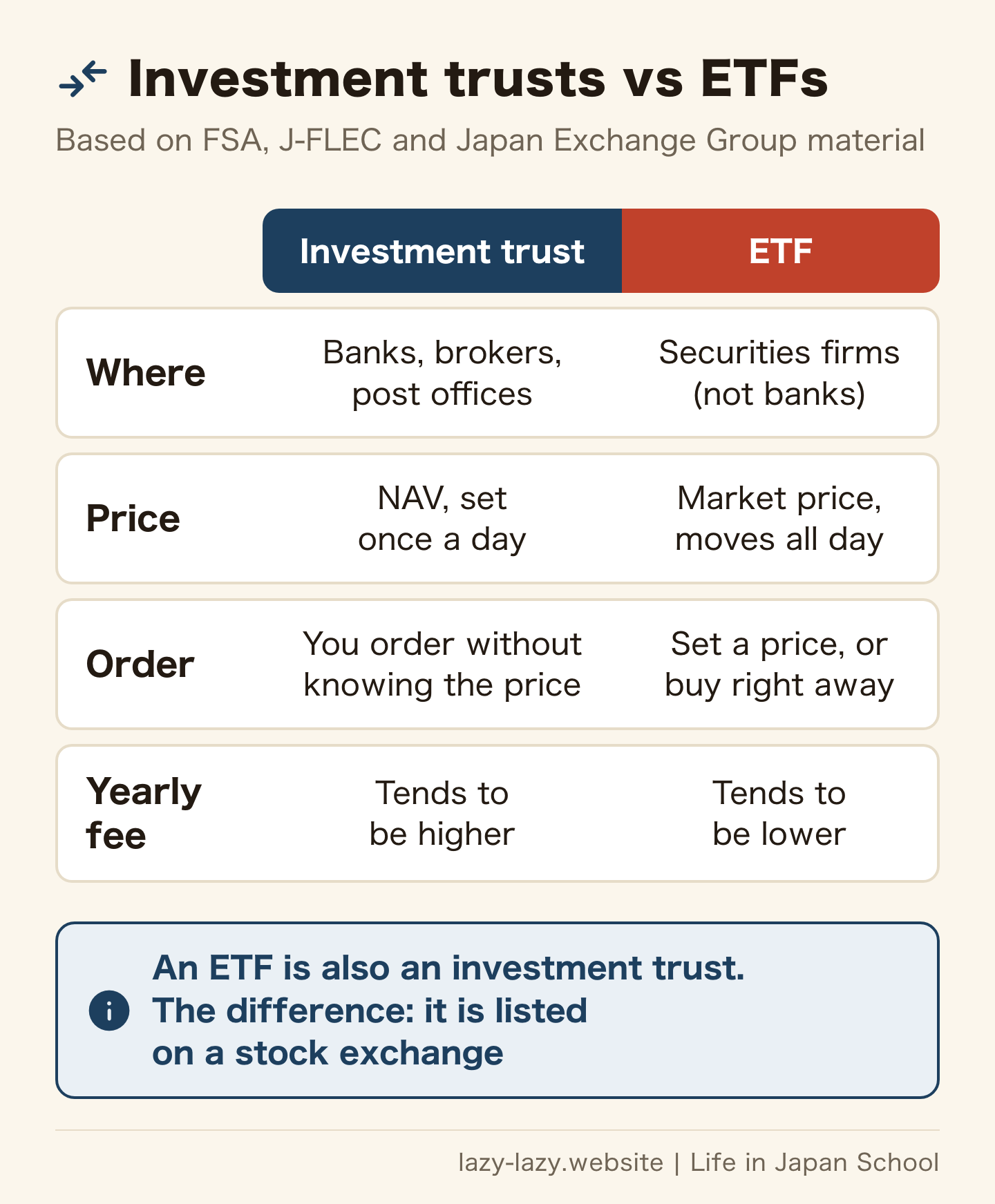
What it invests in can be the same for both. Many track an index, such as the Nikkei 225. An index is one number that shows how a whole market moves. To learn how index investing works, read what an index fund is, and how fees add up. This guide only covers one choice. Do you buy that content as an investment trust, or as an ETF?
Which place sells them? Investment trusts at banks too, ETFs only at securities firms
A company that sells investment trusts is called a seller (hanbai gaisha). The IMAJ lists securities firms, banks, insurance companies, credit unions and post offices. Not every seller handles the same products.
ETFs trade on the exchange, like shares. J-FLEC says you buy ETFs at a securities company. You cannot buy them at a bank. On the other hand, JPX says you can buy listed ETFs at any securities company in Japan, as a rule.
The same applies to NISA. The JSDA NISA Q&A says a NISA account at a securities firm can hold shares, ETFs and investment trusts. A NISA account at a bank or post office can hold investment trusts only. The FSA allows one NISA account per person. You can change the firm for it once a year (FSA slides, p8). Still, if you want ETFs, decide this before you open the account.
How is the price set? One price a day, or a price that keeps moving
You watch the price in an app and tap “buy” right away. Where you come from, that may be normal for funds too. In Japan, you order an ordinary investment trust without knowing the price.
The price of an investment trust is called the net asset value, or NAV (kijun kagaku). It is set only once a day. The IMAJ says the NAV comes out after orders for the day close. So you order without knowing the price for that day. This is called the blind method.
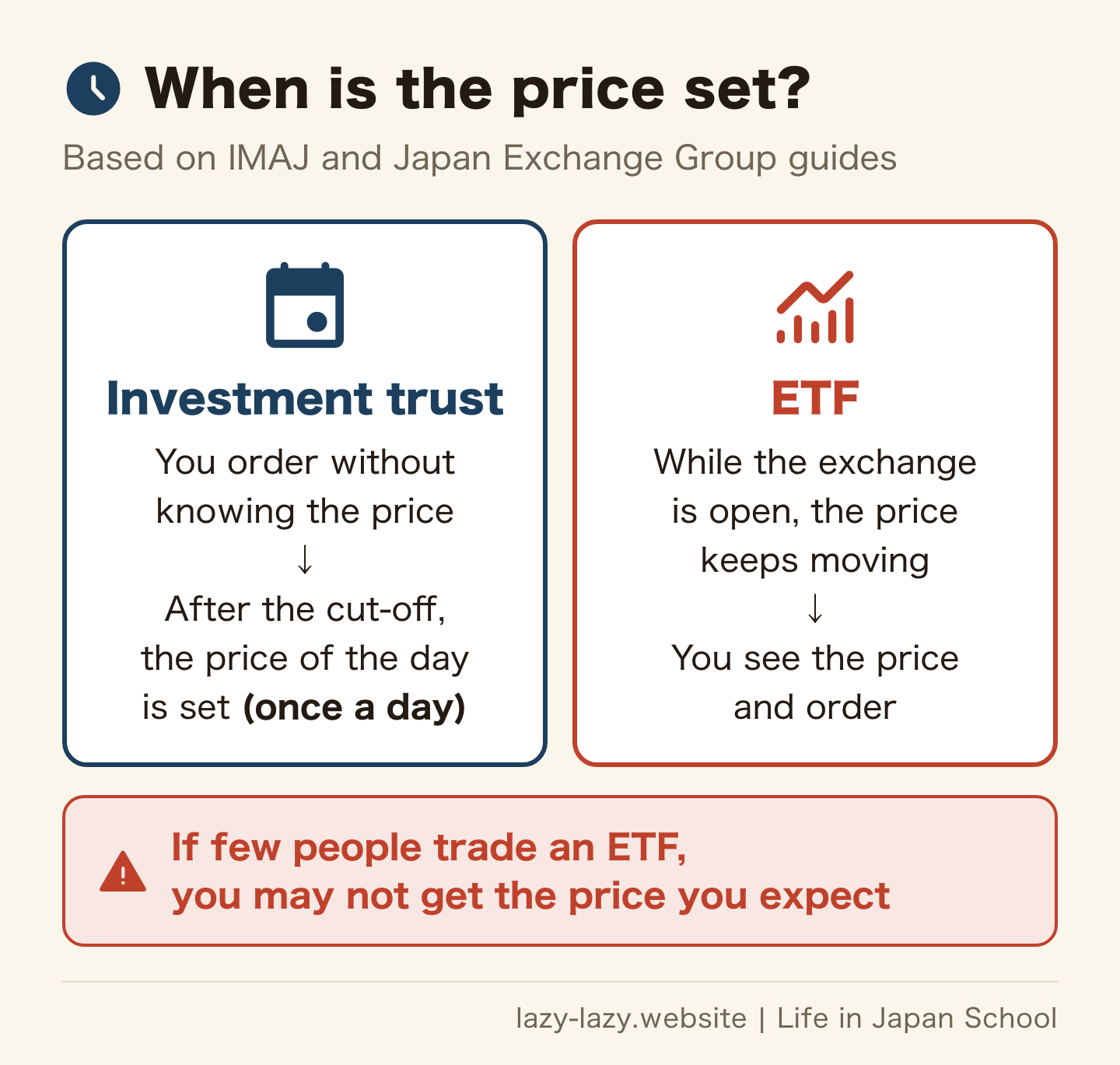
An ETF has a market price. It moves all the time while the exchange is open. The JPX trading rules say you can order ETFs the same way as shares. A limit order (sashine) sets your price: buy only at this price or lower. A market order (nariyuki) buys or sells right away, at the price of the moment.
ETFs have a weak point too. The JPX risk page says the market price moves with how many people want to buy or sell. So it may not move the same way as the value inside the ETF. If few people trade an ETF, you may not get the price you expect. Remember that a limit order lets you set the price for an ETF.
How much are the fees? With an ETF, a broker fee each time you trade
You pay fees at different times for each. This summary is based on J-FLEC material.
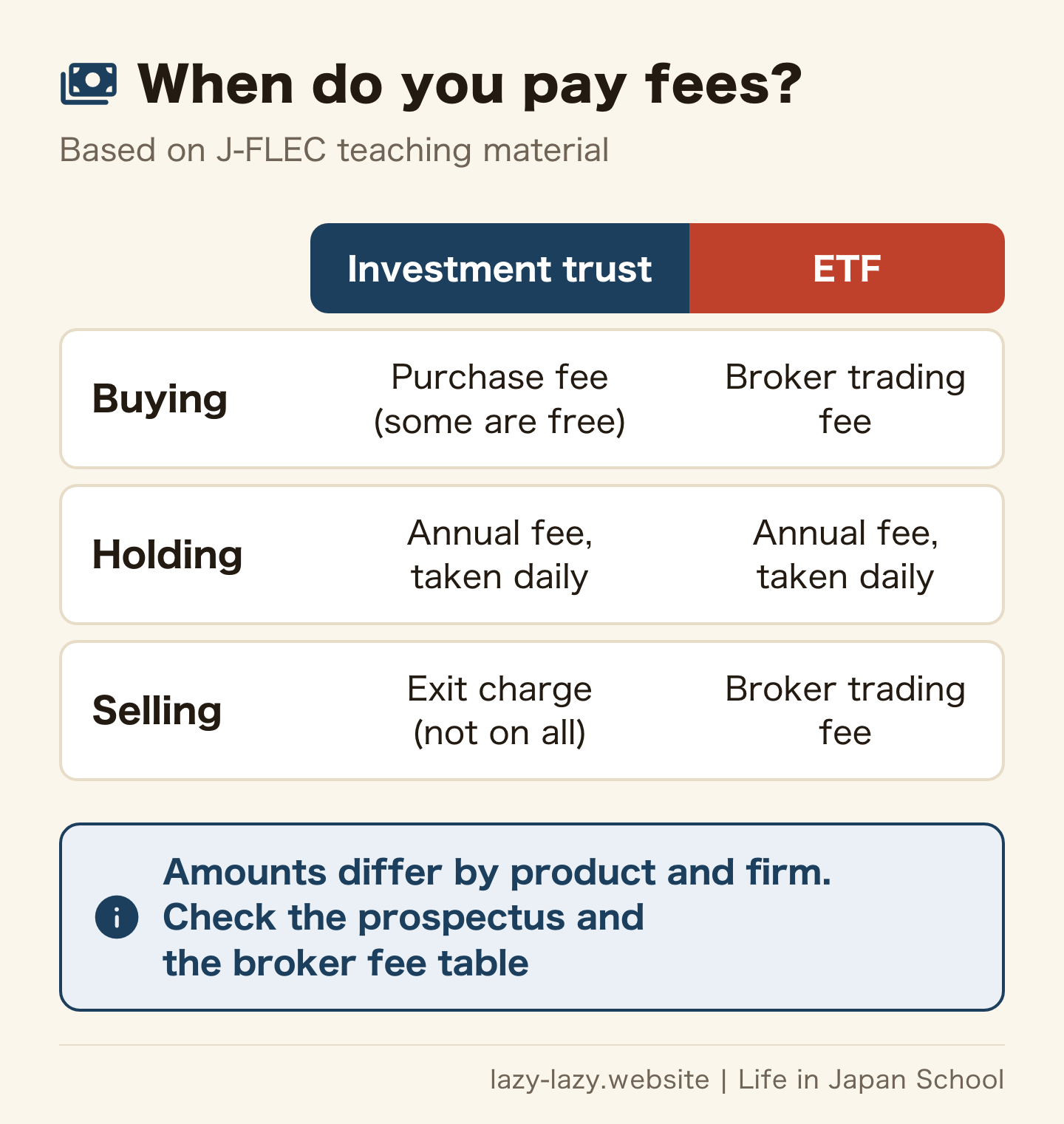
- Investment trust: you may pay a purchase fee when you buy. You may pay an exit charge when you sell. Some products have neither.
- ETF: you pay the trading fee of your securities firm, when you buy and when you sell. Each firm sets its own rate.
- Both: you pay an annual fee (shintaku hoshu) while you hold it. It is a small fee taken every day, for as long as you hold.
The annual fee tends to be lower for ETFs, says the FSA. J-FLEC explains one reason. With an ETF, no part of the annual fee goes to a seller. JPX puts the running cost of ETFs at about 0.1 to 1%.
Still, an ETF is not always cheaper. If you buy small amounts many times, you pay a trading fee each time. To see how a gap in the annual fee grows, read the 20-year example in our index fund guide.
Two funds with similar names: what is different? The same index can come with a different fee
In Japan, people search for the difference in two fund names: eMAXIS and eMAXIS Slim. Both are investment trust names from Mitsubishi UFJ Asset Management. The names look alike. The fees may not be the same.
As an example, we compared two funds that track the same index. We used the prospectus from the fund company. A prospectus is the official paper that explains a fund. Both aim to track TOPIX (with dividends), an index of Japanese shares. Neither has a purchase fee. The annual fee was different.
- eMAXIS TOPIX Index: an annual fee of up to 0.44%, tax included (prospectus dated 24 October 2026).
- eMAXIS Slim Kokunai Kabushiki (TOPIX), meaning Japan shares: an annual fee of up to 0.143%, tax included (prospectus dated 25 July 2026).
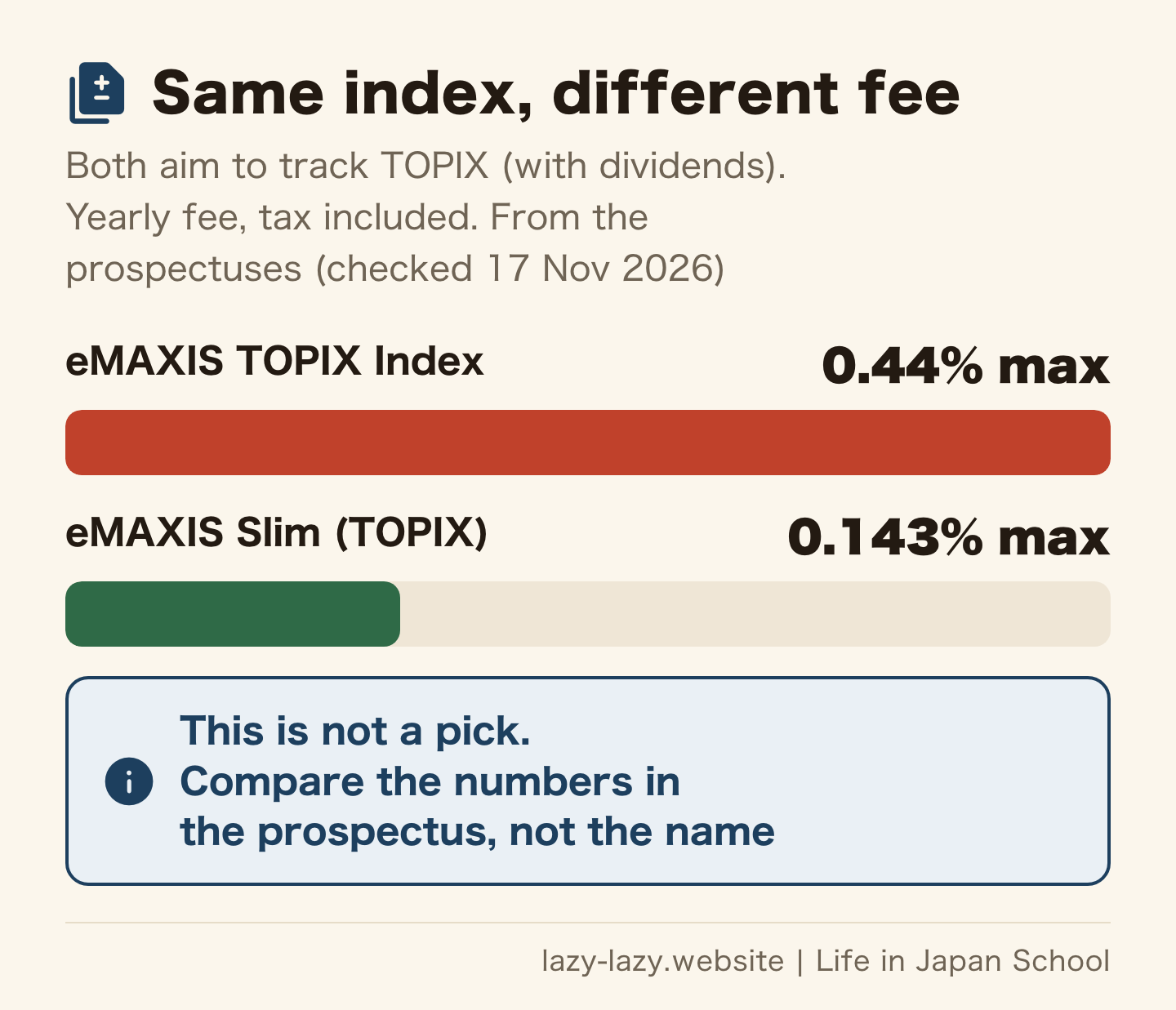
This guide does not recommend either fund. The point is what to check. Do not assume two funds cost the same because the names or the index look alike.
- In the prospectus, find the section on fund costs. Check the purchase fee, the annual fee and the exit charge.
- Check if the annual fee includes tax or not.
- Check that both track the same index (the benchmark).
You can open the prospectus from the product page on the official site of the fund company. Note one thing for ETFs. J-FLEC says you do not get a prospectus when you buy an ETF that already trades on the exchange. Check its costs on the site of the fund company yourself.
How much do you need to start? Small amounts for investment trusts, price times trading unit for ETFs
You buy an investment trust by amount of money. J-FLEC says you can start with a small amount, because many people share the pool. The minimum depends on the seller and the product. Check it with the seller where you open your account.
You buy an ETF by number of units, like a share. The smallest number you can buy is the trading unit. Each ETF sets its own. In a JPX example, the price is 1,000 yen and the trading unit is 10. So the minimum is 1,000 yen × 10 = 10,000 yen. JPX says you can buy an ETF for a few thousand to a few tens of thousands of yen.
The ETF price moves, so its minimum changes every day. You can buy an investment trust by setting an amount. You usually buy an ETF by number of units. (ETFs in the tsumitate allowance are bought through a saving plan.)
How are payouts different? Take the cash, or put it back in
A payout (bunpaikin) is money a fund pays to its holders from what it earned. The IMAJ says the NAV drops by the amount paid out. Some funds pay every month. Some pay once a year. Some pay nothing.
With an investment trust, you can sometimes choose how to receive payouts. The IMAJ Q&A describes two courses. One pays you cash. The other uses the payout to buy more of the same fund automatically. Some sellers offer only one of them.
ETF payouts work like dividends on shares. JPX says the ETF pays people who hold it on a set record date. Each ETF has its own date. Some pay nothing.
Bank counters sometimes offer funds that pay out every month. To see why a payout is not always profit, read our guide to products sold at bank counters.
How does NISA treat them? Only 11 ETFs in the tsumitate allowance, and a payout trap
The NISA tsumitate allowance can only hold products that meet FSA rules. The FSA list had 379 products on 16 November 2026. Only 11 were ETFs. The rest were investment trusts. The JSDA Q&A says you can buy them in this allowance only through a regular saving plan (tsumitate).
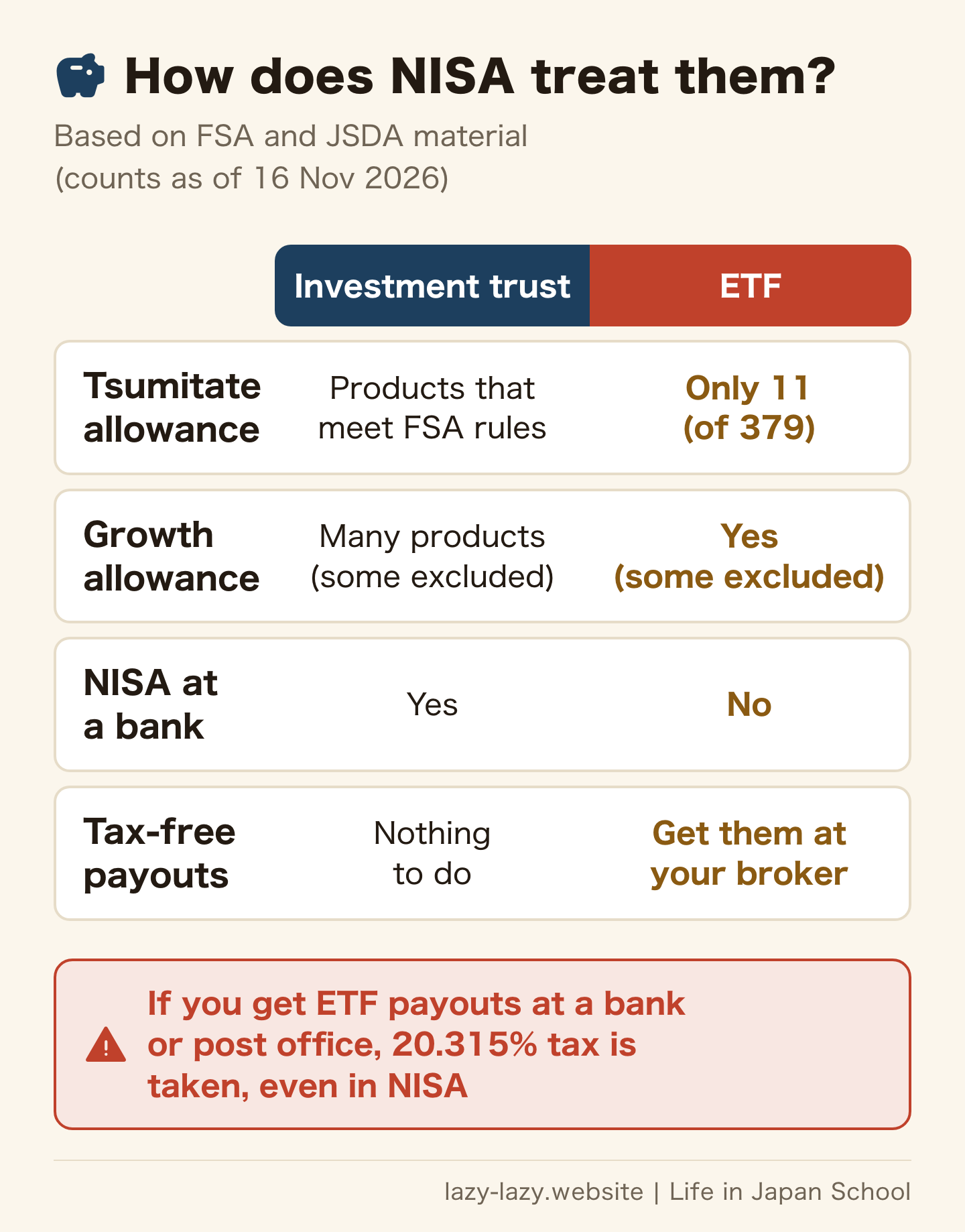
The growth allowance can hold both ETFs and investment trusts, with some exceptions. The FSA excludes funds that pay out every month, among others.
The biggest trap is ETF payouts. The JSDA Q&A says you must choose one method to keep them tax-free in NISA. With this method, payouts go into your securities account (kabushiki-su hirei haibun hoshiki). Do you receive them at a bank account or post office? Then 20.315% tax is taken, even in NISA. Payouts from investment trusts are tax-free in NISA without this step.
If you reinvest investment trust payouts, that also uses your NISA allowance. In an IMAJ Q&A example, you buy 2.3 million yen in the growth allowance. Then you reinvest a payout of 50,000 yen. You have now used 2.35 million yen of the allowance.
Want to know how to open the account? Or what happens to NISA when you leave Japan? Read NISA for foreigners in Japan.
What if you need cash fast? How long until the money arrives
After you sell, the money takes a few days to reach your securities account or other account. Know this before an urgent bill comes.
- Investment trust: the IMAJ says you can ask to sell at any time, as a rule. You get paid from the 4th business day, counting the day you ask. A few daily-settled products are faster. Some products cannot be sold for a set period.
- ETF: JPX says the money and the ETF change hands on the 3rd day, counting the trade day. You sell while the exchange is open.
For an ETF, the market price when your sale goes through sets the amount. For an investment trust, it is a NAV you do not know yet when you ask to sell. To see which day of NAV is used, check the redemption price (kankin kagaku) in the prospectus. You may have to sell on a day when prices are low. Keep money you need soon in a bank account, not in investments. This site does not recommend investing borrowed money. An ETF can also be delisted if it meets exchange rules for removal (JPX).
What should foreigners watch for? Yen trading, overseas ETFs, your account
Investment trusts and ETFs work the same for every nationality. Watch these three points.
- Currency: JPX says all ETFs on its exchange trade in yen. An ETF that holds foreign shares is still bought in yen. Its price also moves with exchange rates.
- Overseas ETFs: some ETFs are listed on foreign exchanges. The JSDA Q&A says that if you buy one in a foreign currency, NISA counts it in yen. It uses the exchange rate on the trade date.
- Your account: your salary bank account cannot buy ETFs. You need an account at a securities company. If you plan to leave Japan, ask the firm what happens to the account after you leave.
If you plan to go home, count the years until you leave before you invest. That order is in why foreigners in Japan should think about investing.
Investment trust vs ETF on one page: the numbers and your choices
Everything below was checked in official material on 17 November 2026.
| Question | Investment trust | ETF |
|---|---|---|
| Place to buy | Securities firms, banks, post offices and others (IMAJ) | Securities firms only, not banks (J-FLEC) |
| Price | NAV, once a day. You order without knowing it | Market price that moves. Limit or market orders (JPX) |
| Fee to buy or sell | Purchase fee and exit charge (some products have neither) | Broker trading fee, when you buy and when you sell |
| Fee while holding | Annual fee. Tends to be higher | Annual fee. Tends to be lower (FSA) |
| Minimum | You can start small (check the minimum with your seller) | Price × trading unit. You can buy one for a few thousand to a few tens of thousands of yen (JPX) |
| Payouts | Cash course or reinvest course (some sellers offer one) | Paid to holders on the record date. Sometimes zero |
| NISA tsumitate allowance | Funds that meet FSA rules | 11 out of 379 products (as of 16 November 2026) |
| Tax-free payouts in NISA | Nothing to do | Choose to receive payouts in your securities account (JSDA) |
| From sale to cash | From the 4th business day (a few daily-settled products are faster) | 3rd day from the trade day |
Reading from the top, you decide two things. First, the place for your account. Second, do you want an investment trust, bought by amount? Or an ETF, usually bought by units? If the index inside is the same, look at the annual fee next.
Which one are you?
- You are about to open an account: today, decide if you want ETFs too. If so, plan to open your NISA account at a securities company.
- You already hold an investment trust from a bank: today, open its prospectus. Copy down the annual fee from the cost section.
- You hold ETFs in NISA: today, check on the site of your securities firm that payouts go into your securities account.
- Two funds with similar names, and you cannot decide: today, open both prospectuses. Write the index, the annual fee (with or without tax) and the purchase fee side by side.
FAQ
Q. Investment trust vs ETF: what is the difference, in simple terms?
An ETF is an investment trust listed on a stock exchange. You can buy an ordinary investment trust at a bank too, and its price is set once a day. You buy an ETF at a securities company, and its price moves all day.
Q. Can I buy ETFs at a bank in Japan?
No. You buy ETFs at a securities company. A NISA account at a bank or post office can hold investment trusts, but not ETFs.
Q. When do I pay fees on an ETF?
You pay a broker trading fee when you buy and when you sell. While you hold it, an annual fee is taken every day. The amounts differ by firm and product.
Q. How much money do I need to buy an ETF?
The minimum is the price times the trading unit. In a JPX example, the price is 1,000 yen and the unit is 10, so you need 10,000 yen. JPX says you can buy an ETF for a few thousand to a few tens of thousands of yen.
Q. Why was tax taken from my ETF payout in NISA?
If payouts go to a bank account or post office, 20.315% tax is taken, even in NISA. To keep them tax-free, choose to get payouts in your securities account.
Q. eMAXIS vs eMAXIS Slim: what is the difference?
Both are investment trust names from Mitsubishi UFJ Asset Management. We compared two funds that track TOPIX, using their prospectuses. The annual fees were up to 0.44% and up to 0.143%, both tax included (checked on 17 November 2026). This is not a pick. Compare the numbers in the prospectus.
Summary
An ETF is an investment trust listed on a stock exchange. You can buy an ordinary investment trust at a bank, and its price is set once a day. You can buy an ETF only at a securities company, and its price moves all day. An ETF has a broker fee each time you trade, and its yearly fee tends to be lower.
Only 11 ETFs can go in the NISA tsumitate allowance. ETF payouts are taxed unless you receive them in your securities account. Two funds with similar names can have different fees. Your step for today: open the prospectus of a fund you are looking at, and check the numbers in the cost section.
Sources (official): FSA, NISA briefing slides (Japanese) / FSA, products for the tsumitate allowance (Japanese) / JSDA, NISA Q&A (Japanese) / J-FLEC, investment trusts (Japanese) / JPX, ETFs vs other investment trusts (Japanese) / JPX, ETF features (Japanese) / JPX, ETF trading rules (Japanese) / JPX, ETF risks (Japanese) / IMAJ, NAV and payouts (Japanese) / IMAJ, how to buy (Japanese) / IMAJ, how to sell (Japanese) / IMAJ, how ETFs work (Japanese) / IMAJ, Q&A on payouts (Japanese) / Mitsubishi UFJ Asset Management, eMAXIS TOPIX Index (Japanese) / eMAXIS Slim Kokunai Kabushiki (TOPIX) (Japanese) (all checked on 17 November 2026)
Related reading
Found this useful? Share it
Send it to a friend who lives in Japan.
WHO WROTE THIS

mori
Japanese. I read the ministries’ own notices, orders and Q&As in the original, and I start from what my Nepalese and Sri Lankan friends in Japan actually ran into. I do not write about what I have not checked or been told.
What this site can and cannot do →Looking for something else?
You may use the figures in this article, including commercially, if you credit this site with a link. How to use our figures