Checked on 16 November 2026 against official pages from the Financial Services Agency (FSA), the National Consumer Affairs Center of Japan (NCAC), the Japan Securities Dealers Association (JSDA), the Japan Institute of Life Insurance, the Life Insurance Association of Japan, the Japanese Bankers Association and FINMAC, and the text of the Insurance Business Act, the Financial Instruments and Exchange Act and the Act on the Provision of Financial Services (e-Gov). This guide does not recommend, or warn against, any particular bank or product.
The short answer
- Foreign-currency insurance, structured bonds, monthly-distribution funds and wrap accounts sold at bank and post office counters are not deposits, and none of them guarantees your principal. Being sold at a bank counter is not a sign of safety.
- Foreign-currency insurance is life insurance paid for, and paid out, in a currency such as US dollars. It carries exchange fees, a commission paid to the selling agent, and surrender charges if you quit early, so in yen it can lose money.
- Before signing, ask the 9 questions the FSA suggests. For example: “With the amount I put in, what is the cost in yen?” and “What do I lose if I want out?” If you do not understand the Japanese explanation, do not sign that day.
- Insurance can usually be cancelled under cooling-off within 8 days. Investment funds, structured bonds and wrap accounts have no cooling-off.
- If you are unsure, you can call the FSA Counseling Office even before you sign (0570-016812). Fund or bond problems go to FINMAC, insurance to the Life Insurance Association, banking to the Japanese Bankers Association, and 188 if you do not know which.
Knowing this, you can ask at the counter, on the spot, whether it is a deposit, what it costs and what happens if you quit. You avoid signing something you do not understand and losing money when you leave Japan.
You are at the bank where your salary is paid, sorting out a time deposit. The person at the counter slides a brochure across. “Money just sitting in the bank will not grow. How about a dollar-based insurance plan?” You follow about half of the Japanese. Words like ganpon (principal), kaiyaku henreikin (surrender value) and shijō kakaku chōsei (market value adjustment) go past. A Japanese friend says, “If the bank recommends it, it is probably fine.” But your friend has never bought one either.
- What do Japanese bank counters recommend? Four products that are not deposits
- What should you know about foreign-currency insurance? Exchange rates, three fees and early cancellation
- What is a structured bond? Losses under set conditions, and hard to sell early
- Are monthly-distribution funds paying you a profit? Not necessarily
- What is a wrap account? You pay more to have it managed
- How much are the fees? Ask in yen, not percent
- What should you ask at the counter? The FSA’s 9 questions
- Can you cancel after signing? Insurance 8 days; funds, structured bonds and wraps no
- Past 8 days, or already losing money? Get advice before you cancel
- Planning to leave Japan? Long contracts and the currency mismatch
- Which one are you?
- FAQ
- Bottom line
- Related reading
What do Japanese bank counters recommend? Four products that are not deposits
Bank counters in Japan sell insurance and investment products as well as deposits. In the FSA’s survey for April to September 2025, the product with the second-largest sales at both major and regional banks was single-premium insurance (FSA monitoring results, 29 July 2026, Japanese). The FSA calls these “risk-bearing financial products” and reviews how foreign-currency single-premium insurance, structured deposits, structured bonds and foreign-currency bonds are sold (FSA interim monitoring report, April 2024, Japanese).
Four come up again and again at the counter.
- Foreign-currency insurance: life insurance paid and paid out in a foreign currency, often as savings-type whole life or private pension plans
- Structured bonds: bonds with special conditions built in through derivatives such as options
- Monthly-distribution investment funds: funds that settle accounts monthly and aim to pay out every month
- Wrap accounts: a contract handing the allocation and management of your money to the firm (a discretionary investment contract)
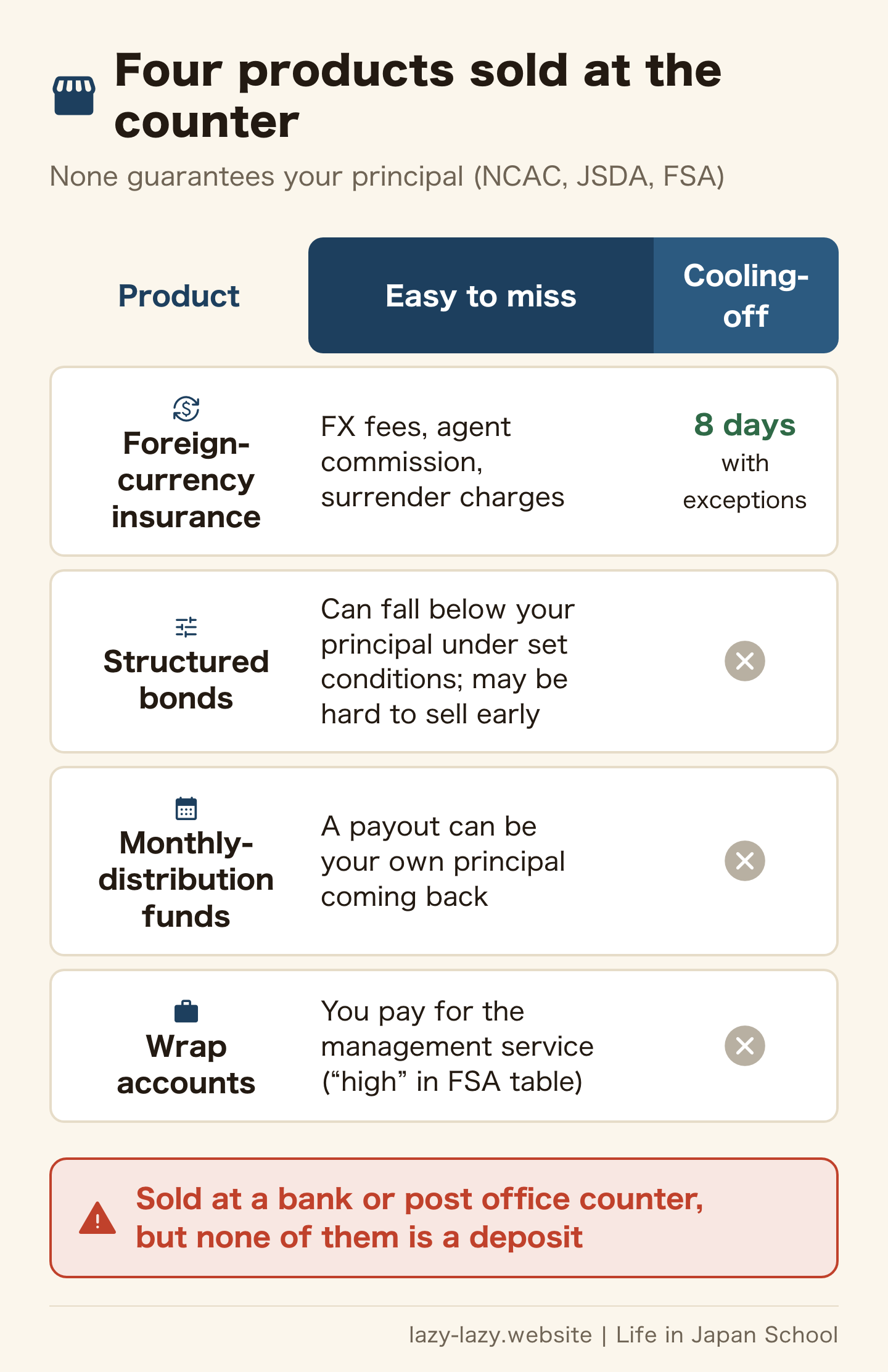
The NCAC has received complaints from people who thought they had made a time deposit and found they had bought a foreign-currency private pension policy (NCAC, 20 February 2020, Japanese). The first thing to check is whether you are being offered a deposit, an insurance policy or an investment product. Even with “deposit” in the name, the FSA counts structured deposits as risk-bearing products (same report).
What should you know about foreign-currency insurance? Exchange rates, three fees and early cancellation
Holding dollars feels like the safe choice. Where you come from, that may be normal. In Japan, if you earn and spend yen, foreign-currency insurance does not guarantee your principal in yen. The yen amount goes up or down with the exchange rate, from the day you pay to the day you receive (NCAC).
The NCAC also points to costs that are easy to miss.
- An exchange fee when your yen is changed into foreign currency, and again when it is changed back
- When a bank sells the policy as an agent, the insurer pays the bank a commission, and that cost is passed on to policyholders indirectly
- If you cancel early, a surrender charge based on the years held may be deducted
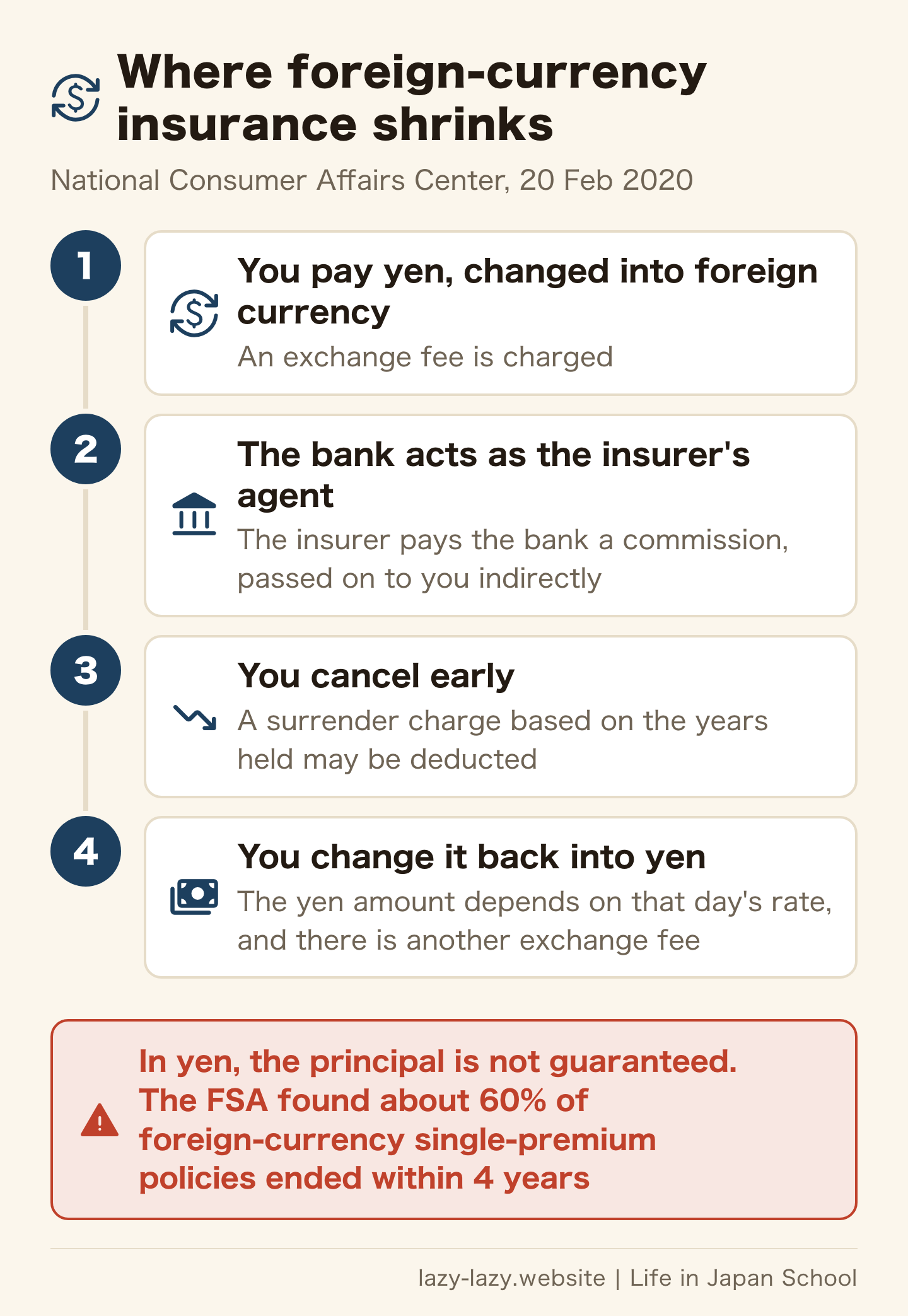
These are products meant to be held for a long time, yet many people quit early. When the FSA examined sellers, about 60% of foreign-currency single-premium policies, mainly “target-type” policies that are often cancelled once they reach a set value, had been cancelled or otherwise ended within four years of purchase. Most of the gain came from the weak yen, and cancellation costs (market value adjustment and surrender charges) ate into it (FSA interim monitoring report, April 2024, Japanese).
Complaints have grown too. The NCAC logged 144 consultations about foreign-currency life insurance in fiscal 2014 and 538 in fiscal 2018. About half involved people aged 70 or over, but people under 40 consulted every year as well. Whether you need death cover at all is worked out in our life insurance guide, which counts the three public benefits first. If you do not need the cover, there is little reason to save through insurance.
What is a structured bond? Losses under set conditions, and hard to sell early
A structured bond is a bond given a special “structure” through derivatives such as swaps or options (JSDA, features and risks of financial products, Japanese). Most are issued overseas and sold in Japan as foreign bonds.
The JSDA lists these points.
- Movements in a reference index, such as a share price or exchange rate, can cut the interest or make the redemption amount fall below your principal
- You may be repaid in shares instead of cash (for example, exchangeable bonds known as EB bonds)
- Selling before maturity means selling at market price, and if there is no buyer you may not be able to sell
Do not decide on “more interest than a time deposit” alone. In its July 2026 report, the FSA named reselling a new structured bond after one is redeemed early as one of the problems that keep coming back. If you cannot explain in your own words which share price has to fall how far before you lose money, do not buy it.
Are monthly-distribution funds paying you a profit? Not necessarily
Money arriving every month looks like interest. But a fund’s distribution, unlike deposit interest, is paid out of the fund’s own assets, and the fund’s price (its net asset value) falls by the amount paid (JSDA, monthly-distribution funds, Japanese).
Part of a distribution can be your own principal coming back, called a return of capital. In the JSDA’s example, the same 100-yen distribution produces very different results depending on the fund price.
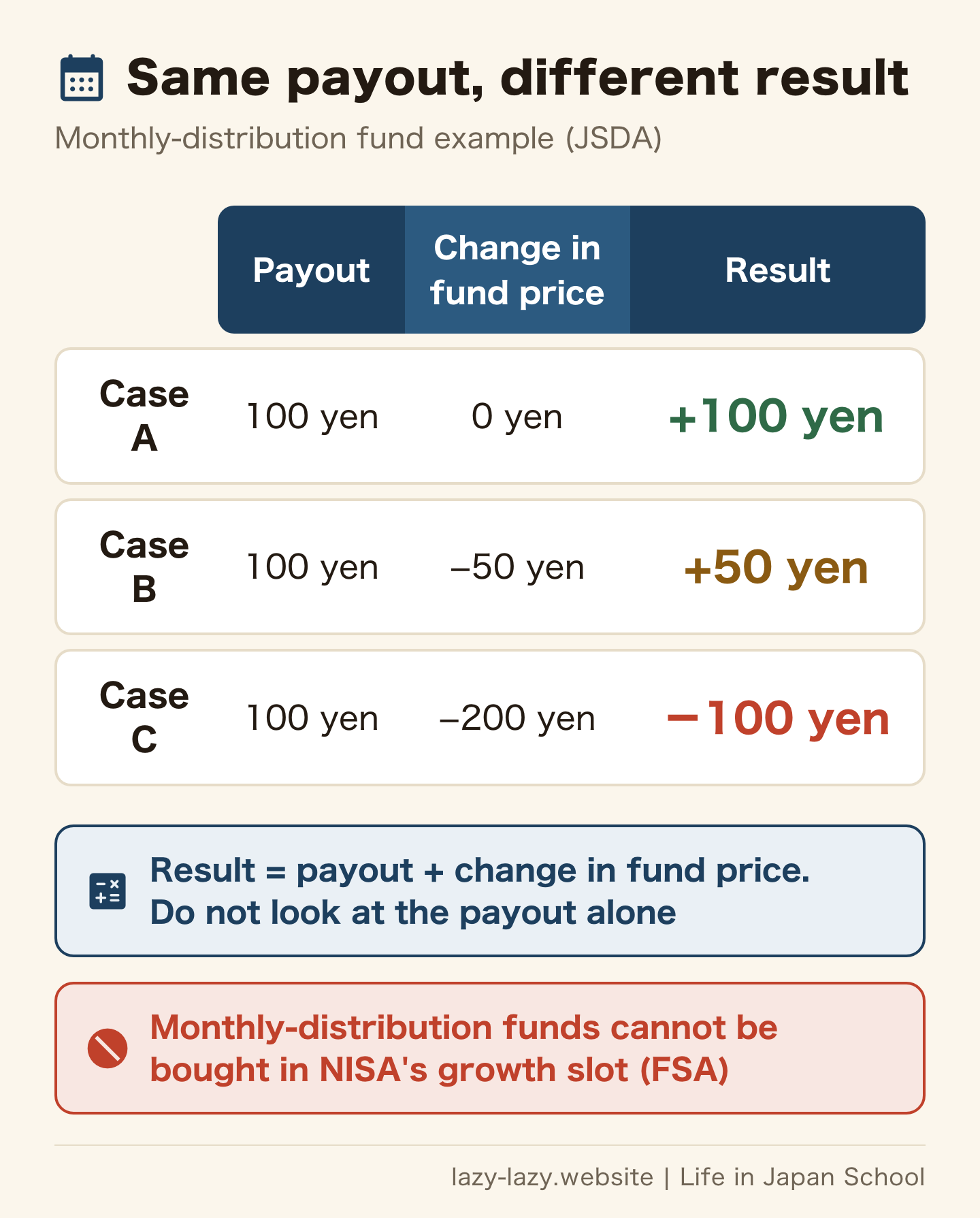
What counts is the payout plus the change in the fund price. Monthly-distribution funds are also excluded from NISA’s growth investment slot (FSA NISA site, Japanese). If you said you wanted to invest through NISA and were offered a monthly-distribution fund, the conversation has already gone off track. What foreigners should know about NISA, including what happens when you leave, is in our NISA guide.
What is a wrap account? You pay more to have it managed
A wrap account (fund wrap) is not a single product. It is a discretionary investment contract in which the firm designs and adjusts your asset mix. Comparing products that do a similar job, the FSA rates the cost of a balanced index fund as “low”, a wrap-type investment fund as “medium” and a fund wrap as “high” (FSA monitoring results, 2025 business year, Japanese).
The higher cost pays for designing and reviewing your allocation and for ongoing advice. The FSA says that if the service is no different from the regular reports sent after any product sale, it is questionable whether the value matches the cost. If one is offered to you, ask exactly what you get for the fee.
How much are the fees? Ask in yen, not percent
Sales commissions on investment funds vary by seller. In the FSA’s figures for April to September 2025, the average sales commission rate was 2.0% at major securities firms, 1.5% at regional banks and 0.9% at major banks, and “far lower” at online brokers (FSA data on retail sales of risk-bearing products, Japanese).
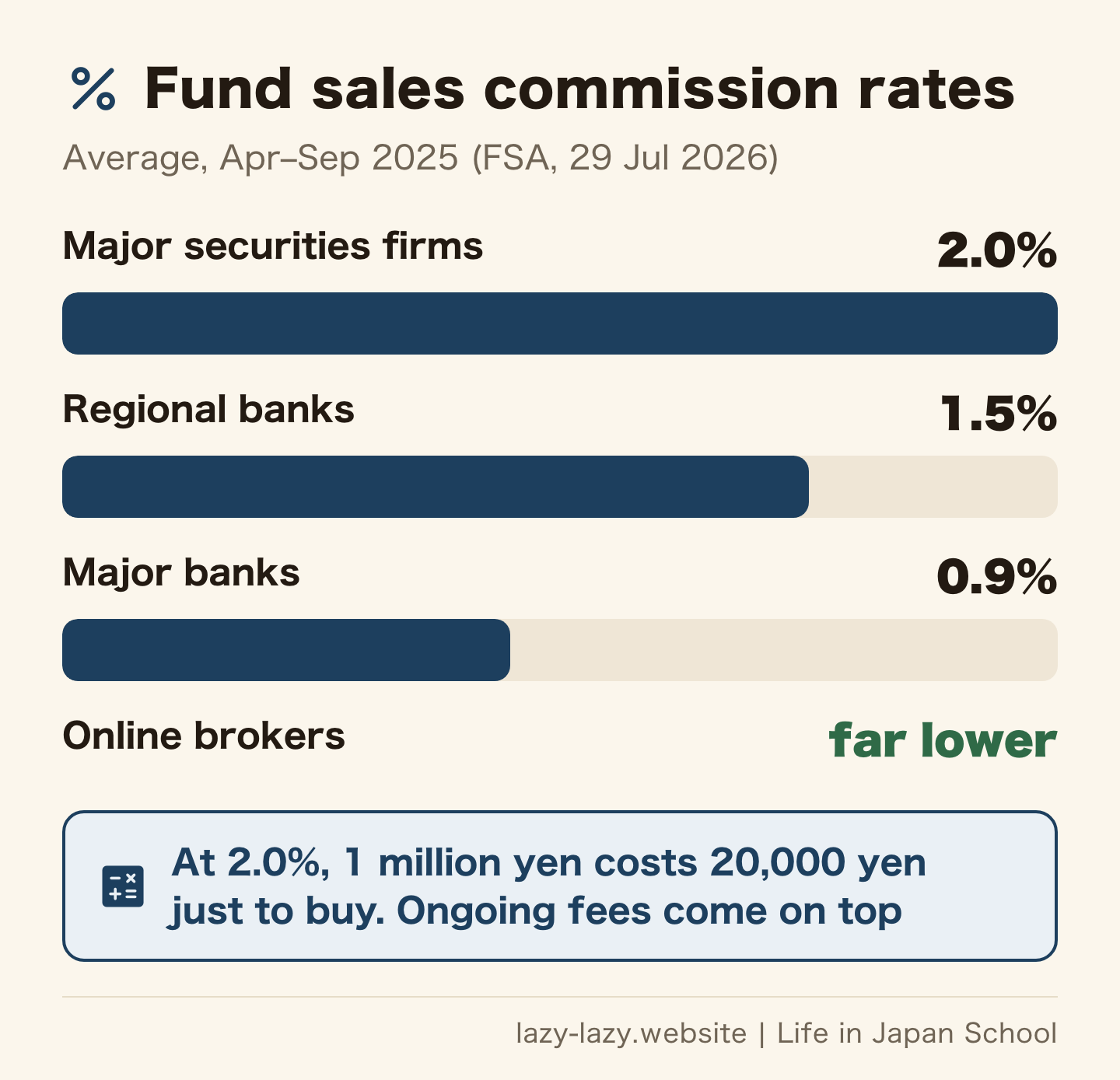
Buying 1 million yen of a fund at 2.0% costs 20,000 yen just to get in. Ongoing fees, such as the trust fee, are charged on top while you hold it. So ask about costs in yen for your amount, not as a percentage.
It helps to know the seller’s side too. The FSA reported a seller that, in staff reviews for regular-premium insurance, counted foreign-currency policies several times higher than yen policies (the firm later removed the gap). Since 1 December 2025, securities firms, banks and similar firms that sell investment products such as funds must tell customers about possible conflicts of interest, under an amended cabinet office ordinance of the Financial Instruments and Exchange Act (FSA, 11 March 2025, Japanese). Asking how much the firm earns from a product is a fair question.
What should you ask at the counter? The FSA’s 9 questions
The FSA has published a model “key information sheet” for selling investment-type products. It includes 9 sample questions for customers to ask the seller (FSA key information sheet, Japanese). In short, they are these.
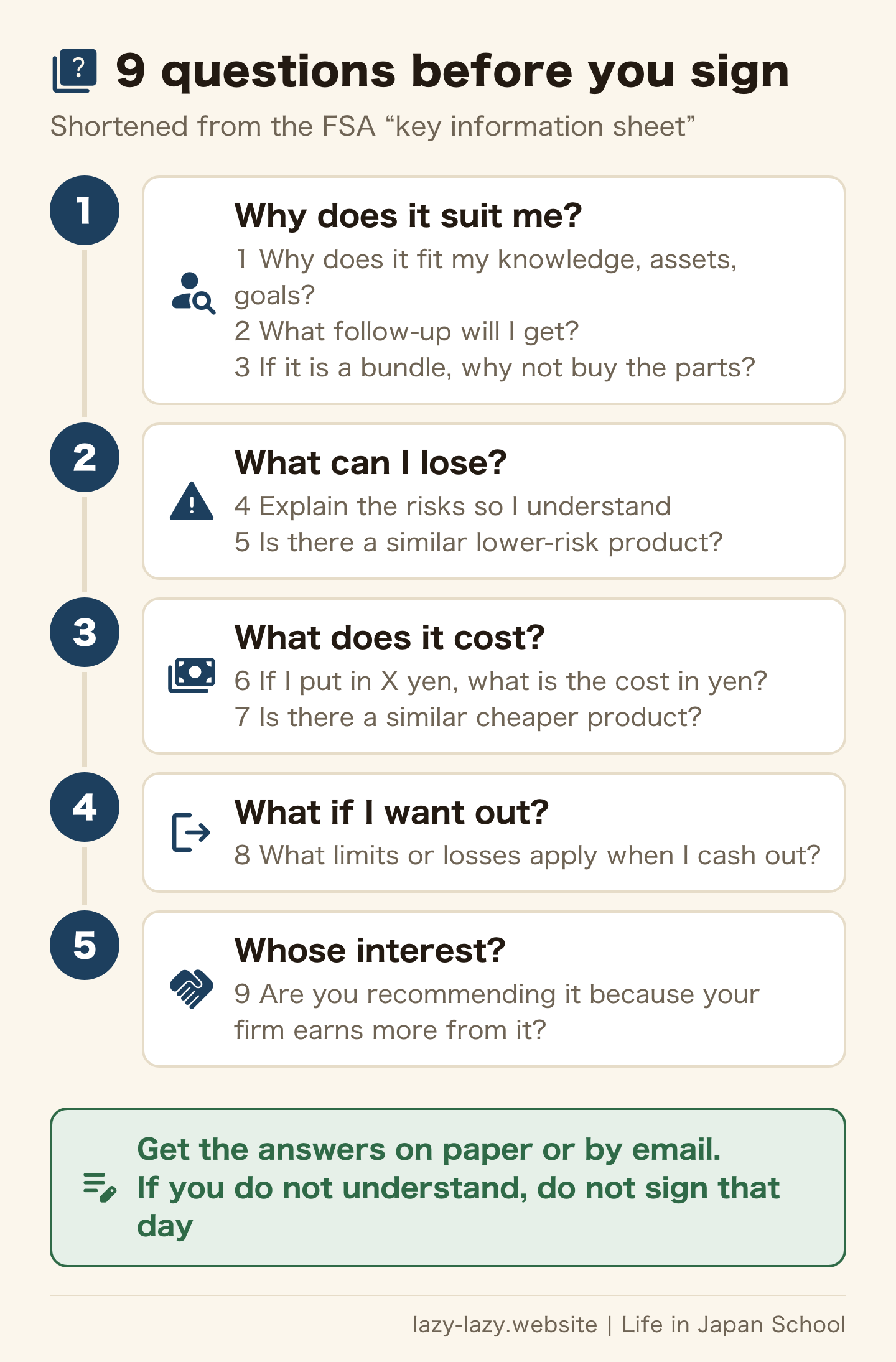
The law sets rules for the explanation. Sellers must explain key points such as the risk of losing principal, and the explanation must be given in the way and to the degree needed for you to understand it, in light of your knowledge, experience, assets and purpose. Telling you something uncertain as if it were certain, such as “it will definitely go up”, is banned (Act on the Provision of Financial Services, Articles 4 and 5, Japanese). But if you tell the seller you do not need the explanation, this duty no longer applies (Article 4(7)), so do not waive it.
Not understanding Japanese is not your fault. You may keep asking until you understand, and you do not have to sign if you do not. The NCAC also advises people not to sign a contract they do not understand (NCAC, 21 December 2017, Japanese). To say no, one line is enough: Kyō wa kimemasen. Shiryō o mochikaerimasu (I will not decide today. I will take the papers home).
Can you cancel after signing? Insurance 8 days; funds, structured bonds and wraps no
Insurance contracts have cooling-off. Under Article 309 of the Insurance Business Act, you can withdraw or cancel your application in writing or electronically (by email, for example) within 8 days, counted from the later of the day you received the document explaining cooling-off and the day you applied. A written notice takes effect when you send it. The insurer cannot charge a penalty and must promptly return the money it received, except that after a contract has taken effect it may keep a set amount of premium for the period up to cancellation (Insurance Business Act, Article 309, paragraphs 5 and 6, Japanese).
There are exceptions, though.
- Contracts with cover of one year or less
- You told the seller the date in advance, made clear the visit was to apply, and went to their office yourself to apply
- A medical examination by the insurer’s appointed doctor has been completed
- You applied by paying the premium yourself into the insurer’s account (unless the seller arranged the transfer), and others
The exceptions are listed in Article 309(1) of the Insurance Business Act (cover of one year or less, for example) and Article 45 of its Enforcement Order (a booked visit, a doctor’s exam, paying by transfer and others), both in Japanese. Check the cooling-off section of the documents you were given to see whether one applies to you.
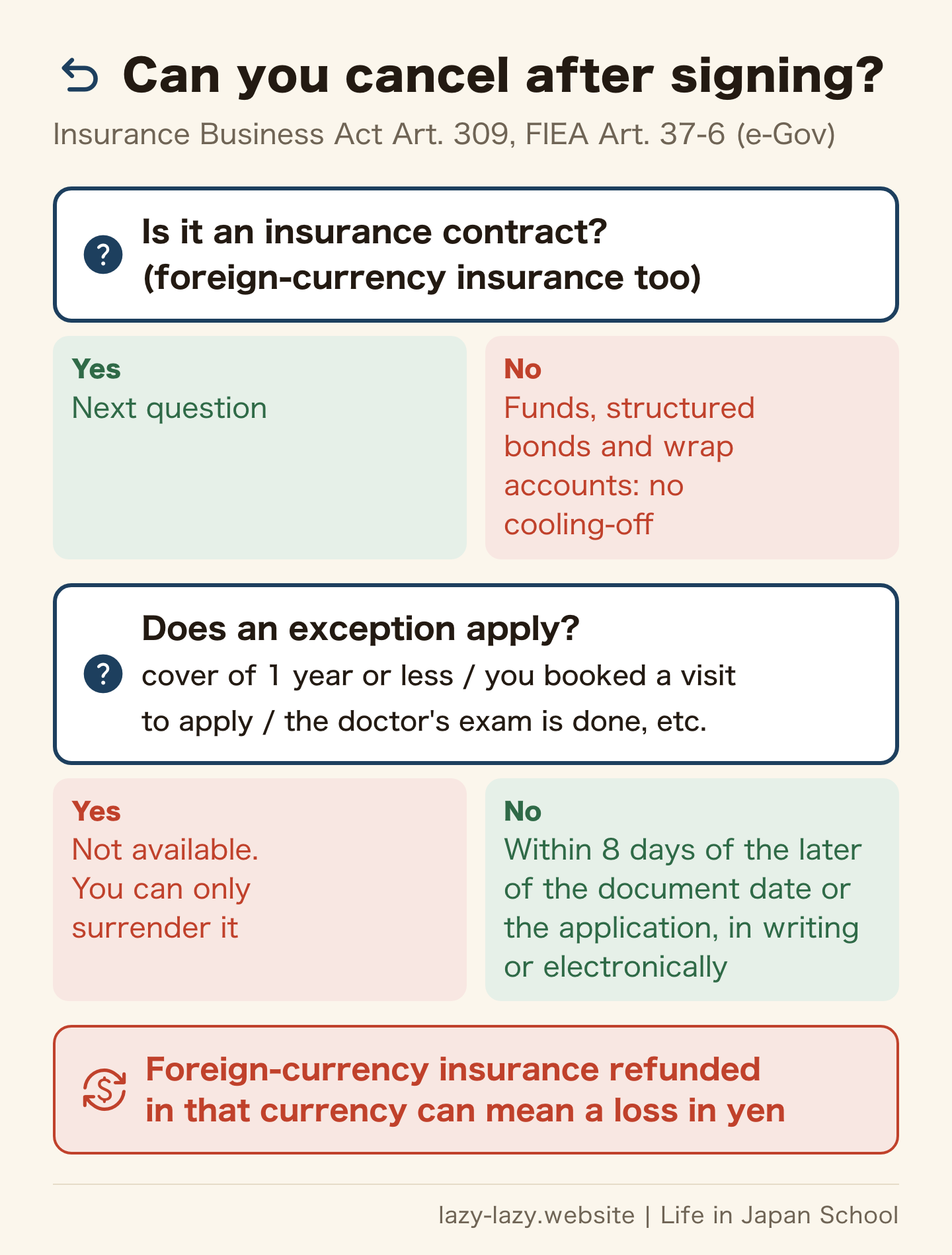
Foreign-currency insurance has one more trap. Without a rider to pay premiums in yen, a cooling-off refund comes back in the foreign currency you paid. When you change it back to yen, the exchange rate and exchange fee can leave you with a loss (NCAC, 2020).
Investment funds, structured bonds and wrap accounts have no cooling-off. Under the Financial Instruments and Exchange Act, written cancellation applies only to investment advisory contracts, within 10 days (FIEA Enforcement Order, Article 16-3, Japanese). The FSA’s model key information sheet also says that cooling-off does not apply. For investment products, the moment before you sign is your last chance to decide. Cooling-off for other contracts, such as door-to-door and phone sales, is covered in our cooling-off guide.
Past 8 days, or already losing money? Get advice before you cancel
After 8 days, insurance can only be ended by surrendering it. The surrender value is usually less than the total premiums paid, and soon after signing there may be none at all, or very little (Japan Institute of Life Insurance, surrender, Japanese). A surrendered policy cannot be restored.
So get advice before you rush to cancel. If key points were not explained, or you were told the principal was guaranteed, say so. The law makes a seller liable for the resulting damage if it failed to explain key points or presented uncertain things as certain (Act on the Provision of Financial Services, Article 6).
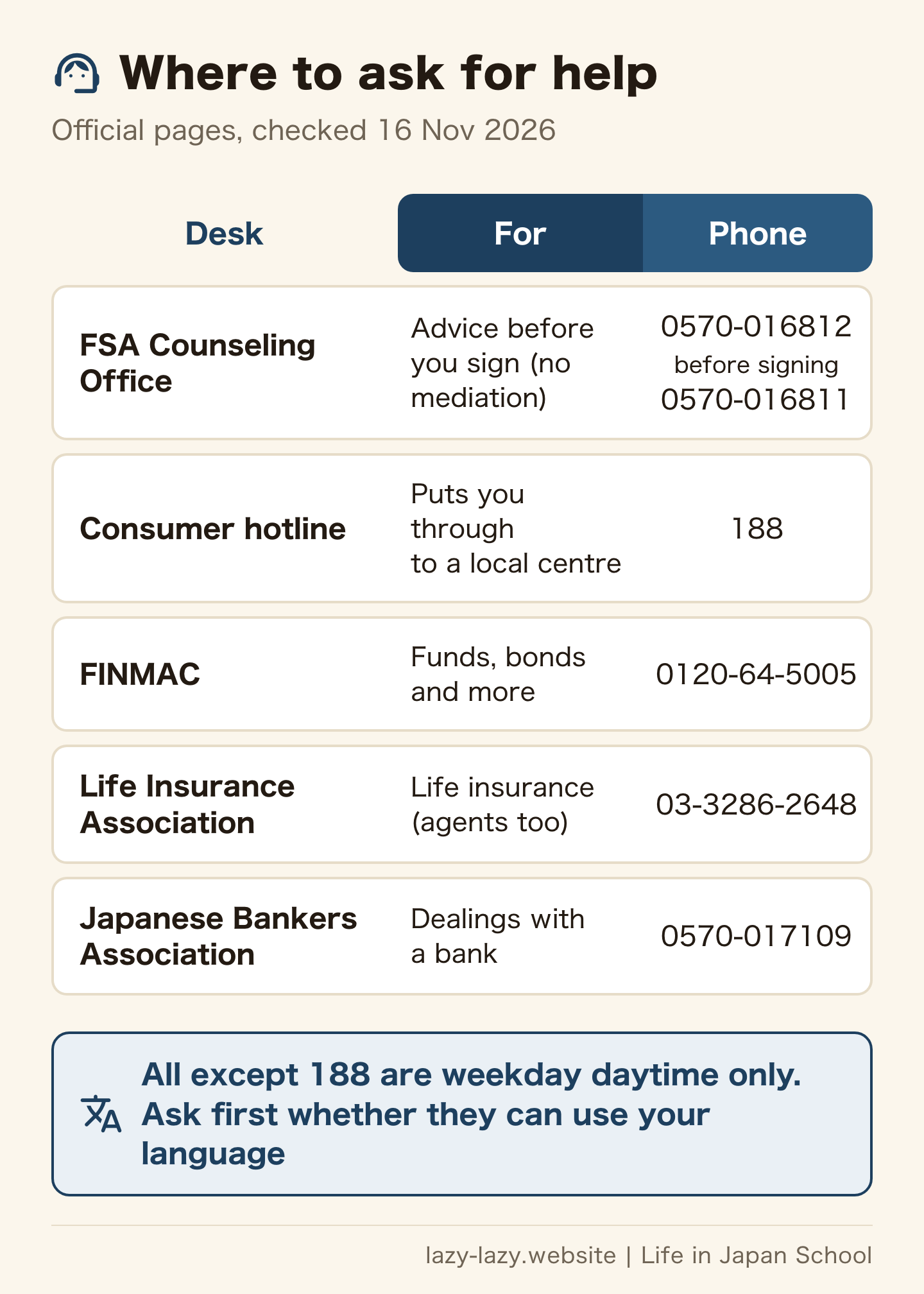
- FSA Counseling Office for Financial Services Users: 0570-016812 for advice before signing, 0570-016811 for other matters (weekdays 10:00 to 17:00). It refers you to other bodies and helps sort out the issues, but does not mediate (FSA, Japanese)
- FINMAC (Financial Instruments Mediation Assistance Center): problems with funds, bonds, shares and similar. 0120-64-5005 (weekdays 9:00 to 17:00). Deposits and insurance are outside its scope (FINMAC, Japanese)
- Life Insurance Association of Japan, Life Insurance Consultation Center: life insurance, including problems with agents and sales staff. 03-3286-2648 (weekdays 9:00 to 17:00) (Life Insurance Association, Japanese)
- Japanese Bankers Association Customer Relations Center: questions and complaints about dealings with a bank. 0570-017109 or 03-5252-3772 (weekdays 9:00 to 17:00). Phone consultations through an English, Chinese or Korean interpreter are available (Japanese Bankers Association, Japanese)
- Consumer hotline 188: if you do not know where to go, it directs you to a local consumer affairs centre
Whether you can talk in your language depends on the desk. When you get through, first ask Tsūyaku wa arimasu ka? (Is there an interpreter?). Helplines for every kind of problem are in our list of free helplines. If someone you met on social media pushed you to invest, or you sent money to an unregistered firm, it may be fraud: follow the steps in our scams guide and contact the police.
Planning to leave Japan? Long contracts and the currency mismatch
Some foreign-currency insurance runs 10 years or more to maturity (NCAC). A contract longer than your stay in Japan is likely to be cancelled early when you leave, and that is when surrender charges and exchange-rate differences cost you.
There is a currency mismatch too. Many policies are in a currency such as US dollars, which may be neither yen nor your home currency. If you count in the currency you will finally spend, the money passes through two exchange rates.
You may be able to keep a policy after leaving Japan. But life insurers generally do not send benefits and similar payments abroad (Japan Institute of Life Insurance, Japanese). Before signing, decide for yourself how many years until you leave Japan, and avoid contracts longer than that. For the order of tasks before you go, use our leaving-Japan checklist.
Which one are you?
- You were offered something at the counter and have not signed: today, do not sign; take home the brochure and key information sheet, and get written answers to two of the 9 questions, “what is the cost in yen” and “what do I lose if I want out”.
- You signed an insurance contract within the last 8 days: today, check the cooling-off section of your documents and, if it applies, send the insurer a written or emailed cancellation; for foreign-currency insurance, ask whether the refund will be in yen or the foreign currency.
- You bought a fund, structured bond or wrap account: today, put your trade reports and contract papers in one place, reread the fees and the terms for quitting early, and send the seller written questions on anything unclear.
- The explanation was wrong, or you were told the principal was guaranteed: before cancelling, write down the date, who explained it and what was said; today, call FINMAC (investments) or the Life Insurance Consultation Center (insurance), or the FSA Counseling Office if unsure.
FAQ
Q. Is the foreign-currency insurance a Japanese bank recommends a deposit?
No. It is a type of life insurance, and the bank sells it as the insurer’s agent. In yen, the principal is not guaranteed, and exchange fees and surrender charges may apply.
Q. Can foreign-currency insurance be cancelled under cooling-off in Japan?
In most cases, yes, in writing or electronically within 8 days of the later of the day you received the document and the day you applied. It does not apply to cover of one year or less, after a completed doctor’s exam and in some other cases. Without a yen-payment rider, the refund comes in the foreign currency and can mean a loss in yen.
Q. Can investment funds or structured bonds be cancelled under cooling-off?
No. Under the Financial Instruments and Exchange Act, written cancellation applies only to investment advisory contracts, so funds, structured bonds and wrap accounts are not covered. Check the costs and the terms for quitting early before you sign.
Q. Is the payout from a monthly-distribution fund a profit?
Not necessarily. It is paid from the fund’s assets, and the fund price falls by the same amount. Part of it can be your own principal coming back, so judge by the payout plus the change in the fund price.
Q. What if I signed without understanding the Japanese explanation?
For insurance, check the 8-day cooling-off first. If it has passed, get advice before cancelling from the FSA Counseling Office, FINMAC for investments or the Life Insurance Consultation Center for insurance. By law, the explanation must be given in a way and to a degree that lets you understand it.
Q. Can I talk to someone neutral before signing?
The FSA Counseling Office has a number for advice before signing (0570-016812, weekdays 10:00 to 17:00). Staff explain general points to watch in financial contracts and the general features of financial products (they do not judge whether a specific product you were offered is good or bad). Having the answers to the 9 questions in front of you makes it easier to sort out what to check.
Bottom line
Foreign-currency insurance, structured bonds, monthly-distribution funds and wrap accounts sold at bank and post office counters are not deposits, and none guarantees your principal. Exchange fees, the agent’s commission, surrender charges, how distributions work and the cost of having your money managed are all hard to see in a short explanation at the counter.
So before signing, use the FSA’s 9 questions to ask what it costs in yen and what happens if you quit, and get the answers on paper. If you do not understand, do not sign that day. Insurance can be cancelled within 8 days under cooling-off; funds, structured bonds and wrap accounts cannot. If you plan to leave Japan, avoid contracts longer than your stay.
Sources (official, Japanese): FSA, customer-oriented business conduct / FSA, key information sheet / FSA monitoring results and data (2025 business year) / FSA interim monitoring report (April 2024) / FSA, conflict-of-interest disclosure rule / FSA NISA site / FSA Counseling Office / NCAC (20 February 2020) / NCAC (21 December 2017) / JSDA, features and risks of financial products / JSDA, monthly-distribution funds / Japan Institute of Life Insurance, surrender / Insurance Business Act / its Enforcement Order / FIEA Enforcement Order / Act on the Provision of Financial Services / FINMAC / Life Insurance Association of Japan / Japanese Bankers Association (all checked 16 November 2026). This guide explains how these products work in general; it does not recommend for or against any product.
Related reading
Found this useful? Share it
Send it to a friend who lives in Japan.
WHO WROTE THIS

mori
Japanese. I read the ministries’ own notices, orders and Q&As in the original, and I start from what my Nepalese and Sri Lankan friends in Japan actually ran into. I do not write about what I have not checked or been told.
What this site can and cannot do →Looking for something else?
You may use the figures in this article, including commercially, if you credit this site with a link. How to use our figures