Checked on 23 September 2026 against the Ministry of Education (MEXT) Japanese education survey for FY2024 and its Tsunahiro learning site, the Japan Foundation’s IRODORI and Minato, NHK WORLD-JAPAN’s Easy Japanese, the Act on the Promotion of Japanese Language Education, and the official pages of Toshima City, Abiko City and the Yokohama Association for International Communications and Exchanges.
The short answer
- Yes, free Japanese classes exist in Japan: local classes run by city offices, international associations and volunteer groups for the foreign residents who live there. Toshima City in Tokyo lists five free classes for adults, plus classes at 100 yen a session or 500 yen a month.
- To find one, search your city or ward’s official website for 日本語教室 (nihongo kyoshitsu). If nothing comes up, check the class list of your prefecture’s or city’s international association.
- Before you go, message the class to ask who can join, whether you need to book, and which days it meets. Some are only for people who live or work in that city.
- 38.2% of municipalities in Japan have no confirmed Japanese class. If yours is one, the Japan Foundation’s IRODORI and NHK’s Easy Japanese are free, and MEXT’s Tsunahiro site opens with no sign-up.
- Fee-paying language schools are a different system: “accredited Japanese language institutions”, taught by “Registered Japanese Language Teachers”, a national qualification.
Knowing this, you can start Japanese this week, at a class near you or with an official course, without paying school fees. You will also know whether you are A1 or A2, so you know which course to open first.
At the city office counter, the words will not come out. That evening you message a Japanese coworker: “Is there anywhere cheap to learn Japanese?” The reply: “A language school? Those are expensive, I think.” Japanese people never studied Japanese as a foreign language, and some have no idea that a free class meets at the community centre down the road.
- Are there free Japanese classes for foreigners in Japan?
- How do I find a Japanese class near me?
- How much do community Japanese classes cost?
- No class near me: free official courses online
- What level am I? The A1–C2 scale
- How is this different from a language school or a registered teacher?
- The class is full, or not right for me
- Which one are you?
- FAQ
- Summary
- Related reading
Are there free Japanese classes for foreigners in Japan?
Yes. A community Japanese class (chiiki nihongo kyoshitsu) is a class run by a city office, an international association or a volunteer group for the foreign residents of that area. The law names them too. The Act on the Promotion of Japanese Language Education describes a Japanese class as a programme that teaches Japanese mainly to foreign residents (Article 16).
Under the same Act, the national government supports starting and running these classes. Local governments are responsible for policies that fit their own area (Article 5). That is a different footing from a language school, which runs on tuition.
MEXT’s survey (as of 1 November 2024) counted 525 local governments and boards of education, 320 international associations and 695 voluntary groups and other organisations teaching Japanese. Of the 50,309 people teaching Japanese nationwide, 26,721 (53.1%) were volunteers — in the survey’s terms, people who are not paid for teaching.
What happens in class varies. At Gakushuin University’s class in Toshima, student helpers and learners “chat about everyday topics”. The Waku Waku class in the same ward is a short intensive course for complete beginners: greetings, shopping, writing your name in katakana.
How do I find a Japanese class near me?
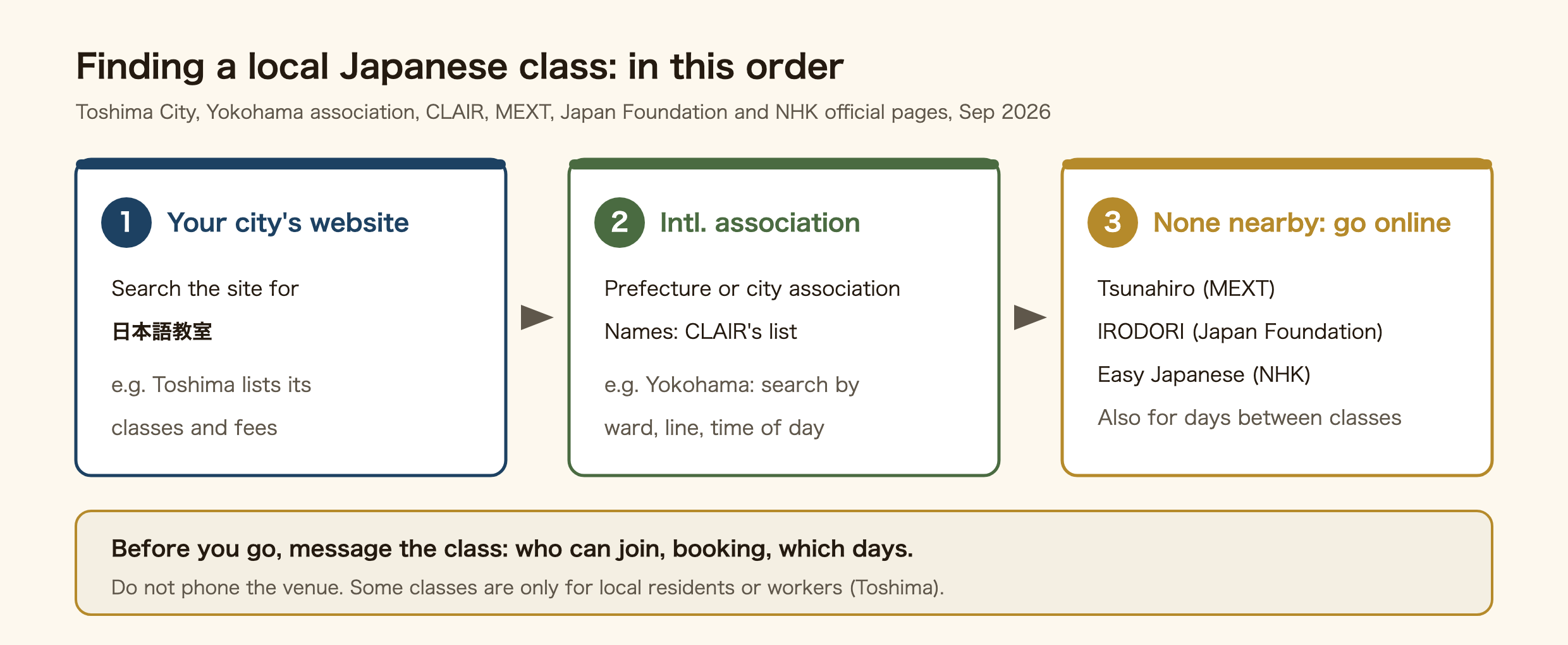
Go through these in order and stop when you find one.
- Your city or ward’s official website. Use the site search and type 日本語教室. Toshima City lists its classes for adults and children on one page, with the day, venue, fee and contact for each. Abiko City in Chiba explains on its city page the class it runs with the local international association.
- Your prefecture’s or city’s international association. If the city page has nothing, the association may have a list. The Yokohama association’s “Database of Japanese Language and Study Support Classes” lets you search by ward, train line, map, time of day and whether childcare is available. The Hyogo association also publishes a list of classes for adults. If you do not know your association’s name, the Council of Local Authorities for International Relations (CLAIR) lists the regional international associations for every part of Japan.
- The Japanese education office at your city or prefecture. If nothing turns up online, ask by phone or email. MEXT publishes a list, in Japanese and English, of the offices in charge of Japanese education in each prefecture, designated city, core city and more (as of 1 April 2026).
Some classes run online. Rikkyo’s class in Toshima takes people in person and online, and in the Yokohama database you type オンライン (online) in the keyword box.
Three things to ask before you go
Do not just turn up at the venue. Toshima’s page says plainly: do not phone the venue. Send your question to the contact listed for the class, usually an email address or a social media page.
- Who can join: some classes are only for people who live or work in that city, such as Rikkyo’s class in Toshima.
- Booking: some classes need a booking or application, and one asks first-timers to email before coming.
- Which days: some pages say “check the dates with the group” and “the venue may change”.
A short message is fine: “I want to study Japanese. I live in [city]. Can I come on [day]?” Three sentences is enough.
How much do community Japanese classes cost?
Each class sets its own fee, and there is no national price. These are the examples on official city pages.
| Class (city) | Cost |
|---|---|
| Five classes for adults, including Toshima Nihongo Kyoshitsu and Rikkyo (Toshima) | Free |
| Mejiro Nihongo Circle (Toshima) | 100 yen a session |
| Nihongo Circle Konnichiwa! (Toshima) | 500 yen a month |
| Gakushuin University class (Toshima) | 500 yen, first time only (materials) |
| Waku Waku Toshima class (Toshima) | No fee; materials 4,500 yen, first time only |
| Japanese class for foreign residents (Abiko) | Free (200–500 yen for copies) |
Look past the word “free”. A class with no fee can still charge for materials or photocopies. The Waku Waku class is a short intensive course of 15 weekday sessions (10 in some terms), with no fee and a one-off 4,500 yen for materials.
If you are weighing this against a language school, put the school’s first-year total next to it — how to compare Japanese language schools shows what goes into that number. Once a week around a job points to a community class. Every day, full time, points to a school.
No class near me: free official courses online
Of Japan’s 1,892 municipalities, 722 had no confirmed Japanese class: 38.2%, home to 170,455 foreign residents (MEXT, as of 1 November 2024). That count leaves out universities, language schools and online teaching.
For people in those areas, MEXT built a site you can use alone. The Japan Foundation and NHK also offer free courses.
Tsunahiro — “Tsunagaru Hirogaru Nihongo de no Kurashi” (MEXT)
A learning site launched in June 2020 for people with no Japanese class nearby. It is aimed at people who have just started living in Japan and are learning Japanese for the first time. You learn from videos of everyday scenes: shopping, the doctor, moving house, raising children.
It works in 20 languages including Japanese — among them Bengali, Nepali, Sinhala, Vietnamese and Myanmar. Subtitles can be in Japanese, romaji or your own language. When we opened it on 23 September, there was no login or sign-up screen; the videos just played. The site used to be run by the Agency for Cultural Affairs, but Japanese education moved to MEXT in April 2024. The old address on some flyers (tsunagarujp.bunka.go.jp) did not open on 23 September; the current one is tsunagarujp.mext.go.jp.
IRODORI: Japanese for Life in Japan (Japan Foundation)
A coursebook for people living and working in Japan. You can download it free from the website, print the PDF or read it on your phone, and the audio is included. As of March 2026 there are versions in 20 languages. The official FAQ says you can study it on your own if you follow the book.
For conversation practice there is the IRODORI Japanese Online Course, which calls itself a free online course on its front page; you log in to use it. The Japan Foundation’s Minato e-learning platform has free registration, with both free and paid courses.
Easy Japanese (NHK WORLD-JAPAN)
A beginner course of 48 lessons: greetings, shopping, travel. Audio and text come together, and every text PDF can be downloaded for personal use.
All three also work for people who do go to a class, as practice on the days in between.
What level am I? The A1–C2 scale
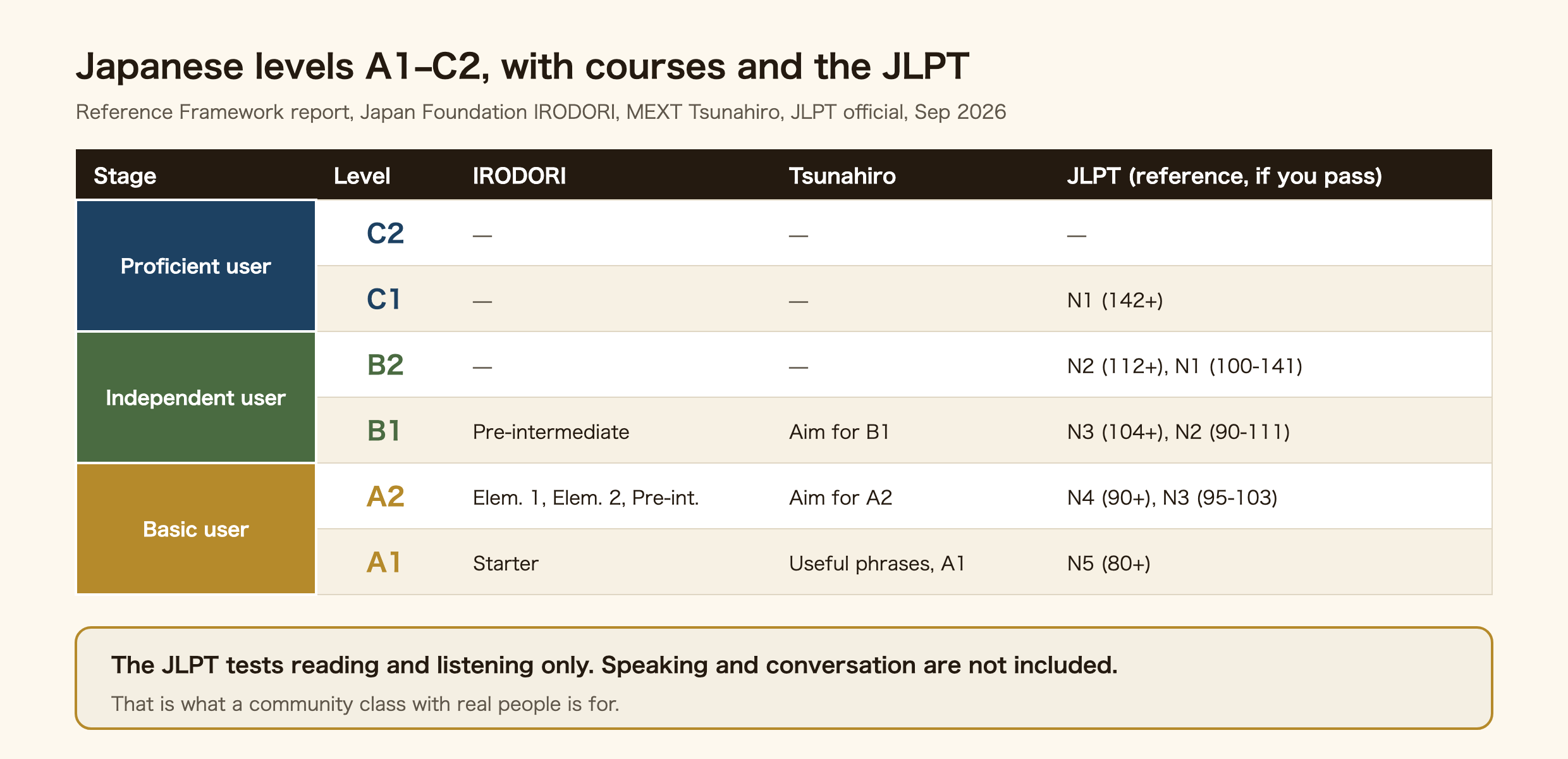
Class and course descriptions use labels like “A1” and “A2”. They come from the Reference Framework for Japanese Language Education, a 2021 report by the Council for Cultural Affairs. It follows the European CEFR and splits Japanese ability into six levels.
| Stage | Level | Rough description (summarised from the framework’s global scale) |
|---|---|---|
| Basic user | A1 | Understands and uses familiar everyday expressions and basic phrases |
| A2 | Can exchange simple information on familiar things: shopping, the neighbourhood, work | |
| Independent user | B1 | Understands the main points on familiar topics at work, school and leisure |
| B2 | Understands the main ideas of complex text, including technical discussion in their field | |
| Proficient user | C1 | Understands long, demanding texts; speaks fluently and naturally |
| C2 | Understands virtually everything heard or read with ease |
IRODORI’s Starter book is A1, Elementary 1 and 2 are A2, and Pre-intermediate is A2 and B1. Tsunahiro starts with useful phrases, then groups its scenes by A1, A2 and B1. It also has a “find your level” check: answer the questions and it tells you where to start.
Since the December 2025 test, JLPT results also show one of these levels, for reference and only for people who pass. Pass N4 with 90 or more and it shows A2; N3 with 104 or more shows B1. But the JLPT tests reading and listening. Speaking and conversation are not part of it, and that is exactly what a class with real people gives you. Dates and pass marks are in JLPT registration, fee and pass marks.
How is this different from a language school or a registered teacher?
On 1 April 2024 a new law took effect under which the Minister of Education accredits Japanese language institutions that meet set standards: “accredited Japanese language institutions” (nintei nihongo kyoiku kikan). Besides courses for international students, accreditation covers courses for work and courses for daily life. MEXT’s accreditation portal points people who want to learn Japanese to live in Japan with their family to these institutions too.
Teachers at accredited institutions hold a national qualification, “Registered Japanese Language Teacher” (toroku nihongo kyoin): pass the teacher exam, complete practical training, then register. 20,075 people had registered as of 21 August 2026.
Community classes sit outside this. The law says an institution “may” apply for accreditation; it is not required. Neither is better. Pick by what you need.
- Fixed daily hours and a clear finish line → an accredited institution, with fees
- Someone to talk to once a week, around work or children → a community class
- No class nearby, or the times do not fit → start alone with IRODORI, Tsunahiro or NHK
The class is full, or not right for me
Classes fill up. Toshima’s Gun Gun class (first term) had “stopped taking applications because it exceeded capacity”. The Waku Waku class runs four terms a year and Gun Gun two, so ask when the next term opens.
If the level is wrong, try another class. In Toshima, Gakushuin’s class is for intermediate learners who can already hold a conversation, while Waku Waku is for complete beginners. The same city list may have something that fits better.
If the days do not work, bridge the gap with an online class or with IRODORI, Tsunahiro or NHK. Toshima’s list alone has classes on weekday afternoons, weekday evenings and Saturdays, so check the day column first.
If you find nothing online, ask your city office. Toshima’s class page lists its lifelong learning section as the contact. The section in charge differs by city; if unsure, call the main number and say 「日本語教室について聞きたいです」 (I’d like to ask about Japanese classes).
Which one are you?
- Complete beginner — open Tsunahiro today and take the “find your level” check. Search your city’s site for 日本語教室 and send one message to a beginners’ class.
- You can talk a little but have no one to talk to — look for a conversation class on your city or association list. Send the “who, booking, which days” message today.
- No class nearby, or the times do not fit — download the IRODORI book for your level (Starter if you are A1) and play the Lesson 1 audio today.
- You want daily study and a clear finish line — search MEXT’s list of accredited institutions for schools with daily-life or work courses. Ask one for its first-year total today.
FAQ
Q. Are there free Japanese classes for foreigners in Japan?
Yes. City offices, international associations and volunteer groups run Japanese classes for local foreign residents. Toshima City lists five free classes for adults, and Abiko City’s class is free apart from 200–500 yen for copies.
Q. How do I find a Japanese class near me?
Search your city or ward’s official website for 日本語教室. If nothing comes up, check the class list of your prefecture’s or city’s international association. Some, like Yokohama’s, have a database you can search by ward or train line.
Q. How much do community Japanese classes cost?
It depends on the class. In Toshima there are free classes, one at 100 yen a session, one at 500 yen a month, one with a 500 yen first-time charge, and one with no fee but 4,500 yen for materials. Ask about materials and copies as well as the fee.
Q. What can I do if there is no Japanese class near me?
Start with official online courses. The Japan Foundation’s IRODORI is a free download, NHK WORLD-JAPAN’s Easy Japanese has 48 lessons, and MEXT’s Tsunahiro teaches everyday scenes on video in 20 languages. 38.2% of municipalities in Japan have no confirmed Japanese class.
Q. What do A1 and A2 mean in Japanese?
They are levels in Japan’s Reference Framework for Japanese Language Education, which splits ability into six levels from A1 to C2. A1 and A2 are basic users, B1 and B2 independent users, C1 and C2 proficient users. IRODORI’s Starter book is A1 and its Elementary books are A2.
Q. What is the difference between a community class and a Japanese language school?
Language schools accredited by the Minister of Education are “accredited Japanese language institutions”, and their teachers hold the national “Registered Japanese Language Teacher” qualification. Community classes are run by city offices, international associations and volunteers, and do not need that accreditation.
Summary
Community Japanese classes are run by city offices, international associations and volunteers for the foreign residents who live nearby. Each class sets its own fee, and Toshima has classes that are free, 100 yen a session or 500 yen a month. Search your city’s website first, then your international association’s list.
If there is no class near you, IRODORI, Tsunahiro and NHK’s Easy Japanese let you start alone. Knowing your level on the A1–C2 scale makes it easier to choose both a course and a class. Before you go, ask the class who can join, whether to book and which days it meets.
Official sources: MEXT, Japanese Education Survey FY2024 / Act on the Promotion of Japanese Language Education / MEXT, Tsunahiro / MEXT, Japanese Language Education Division contact list / MEXT, accreditation portal / Japan Foundation, IRODORI / NHK WORLD-JAPAN, Easy Japanese / JLPT, CEFR reference levels / Toshima City, Japanese classes / Abiko City, Japanese class for foreign residents / Yokohama YOKE class database / CLAIR, regional international associations. Checked on 23 September 2026. Class days and fees change, so confirm with the class before you go.
Related reading
Found this useful? Share it
Send it to a friend who lives in Japan.
WHO WROTE THIS

mori
Japanese. I read the ministries’ own notices, orders and Q&As in the original, and I start from what my Nepalese and Sri Lankan friends in Japan actually ran into. I do not write about what I have not checked or been told.
What this site can and cannot do →Looking for something else?