Checked on 18 September 2026 against the Ministry of Health, Labour and Welfare’s brochure on industrial accident compensation insurance for foreign workers (Japanese edition, Parts 1 and 2, read in full). The same brochure is published in English, Vietnamese, Nepali and ten other languages; the link is at the end.
In short
- Rosai insurance pays the treatment costs and lost pay for injuries and illness caused by work or the commute, and it covers foreign workers regardless of nationality. A student hurt during a part-time job is covered. The employer pays the premium; nothing comes out of your wages.
- Health insurance cannot be used for a work injury. Treatment at a rosai-designated hospital is free; if you paid elsewhere, the full amount comes back.
- From the fourth day off work, you get 80% of your pay per day (60% benefit plus a 20% special payment). On 200,000 yen a month, about 5,200 yen a day.
- The claim is filed by you, not the company. “This is not a work accident” or “we are not enrolled” does not stop you. You can claim after resigning, and after the company has closed.
- You can claim after going home. Two years for treatment costs, five for lasting disability. The office to go to is the Labour Standards Inspection Office.
Knowing this, you can say “not my health card” on the day you are hurt. Treatment costs nothing, lost pay comes back, and the employer’s words stop being the last word.
You caught your finger in a machine at the factory. You fell off the bicycle on a delivery. The manager says “use your health insurance”, the owner says “we are not in the rosai scheme”. Neither of those is a sentence you have to obey. Ask a Japanese colleague and you hear “Isn’t rosai something the company applies for?” It is not. The injured person files the claim, and no permission from the employer is needed. This article lays out, in order, only what the Ministry’s own brochure for foreign workers says.
- What is rosai? State insurance for work and commuting injuries, the same for foreigners
- How much of the treatment cost comes back? Free at designated hospitals, full refund elsewhere
- Do I get paid while off work? From day four, 80% a day
- The employer says “not a work accident” or “we are not enrolled”. Now what? You can still claim
- What if I go home? You can claim from abroad
- The decision: what to do today
- FAQ
- Summary
What is rosai? State insurance for work and commuting injuries, the same for foreigners
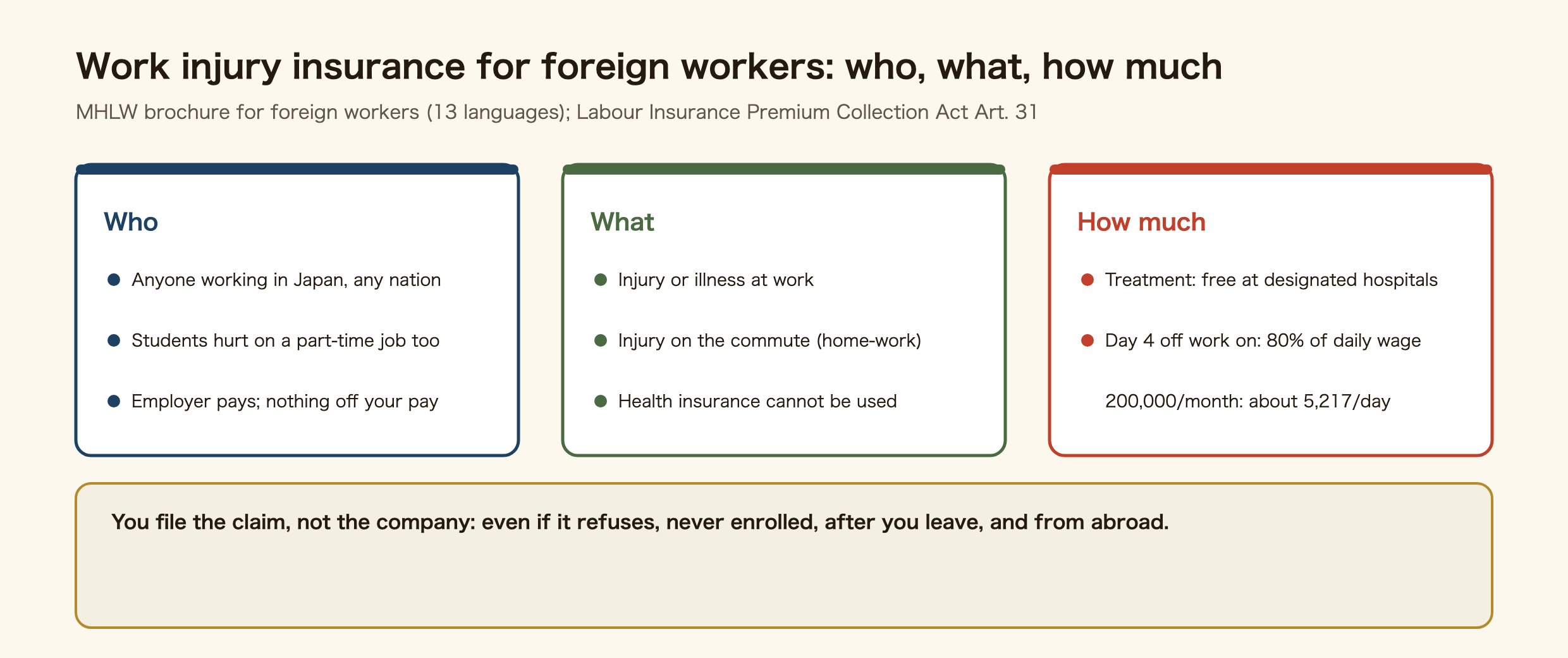
Rosai insurance (workers’ accident compensation insurance) pays the treatment costs and other necessary benefits when a worker is injured, falls ill or dies because of work or the commute (MHLW brochure). “It applies regardless of nationality to foreign nationals working as workers in Japan: not only holders of a status that permits work, but also, for example, a student injured in an accident during part-time work” – that is on page one of the brochure, in that order.
Three basics to keep.
- Nothing is deducted from your wages. The employer pays. If your payslip has no “rosai premium” line, that is normal (unlike employment and health insurance).
- Health insurance cannot be used for a work or commuting injury. The brochure states it flatly: “health insurance cannot be used for an industrial accident”. At the hospital desk, say it was an injury at work.
- Two kinds are covered: work accidents and commuting accidents. A commute means travel between home and the workplace by a reasonable route and means. A collision with an unidentified cyclist counts. A different route can count if conditions are met.
How much of the treatment cost comes back? Free at designated hospitals, full refund elsewhere
Hospital first. The brochure’s answer has three parts.
- Treated at a rosai hospital or a “rosai-designated medical institution”: treatment is free. You pay nothing at the desk. This is the “medical benefit in kind”; you file the claim form (Form 5, or 16-3 for a commuting accident) through the hospital to the Labour Standards Inspection Office. There is no time limit on this.
- Had to use a non-designated hospital: pay first, then claim, and the full amount comes back. Keep every receipt. File Form 7 (16-5 for commuting) directly with the Inspection Office. Time limit: two years from the day after you paid.
- Travel to treatment: reimbursed at cost if conditions such as a one-way distance of 2 km or more are met.
Ask the hospital “Is this a rosai-designated institution?” Most large hospitals are. If you used health insurance by mistake, do not leave it: talk to the hospital and the Inspection Office.
Do I get paid while off work? From day four, 80% a day
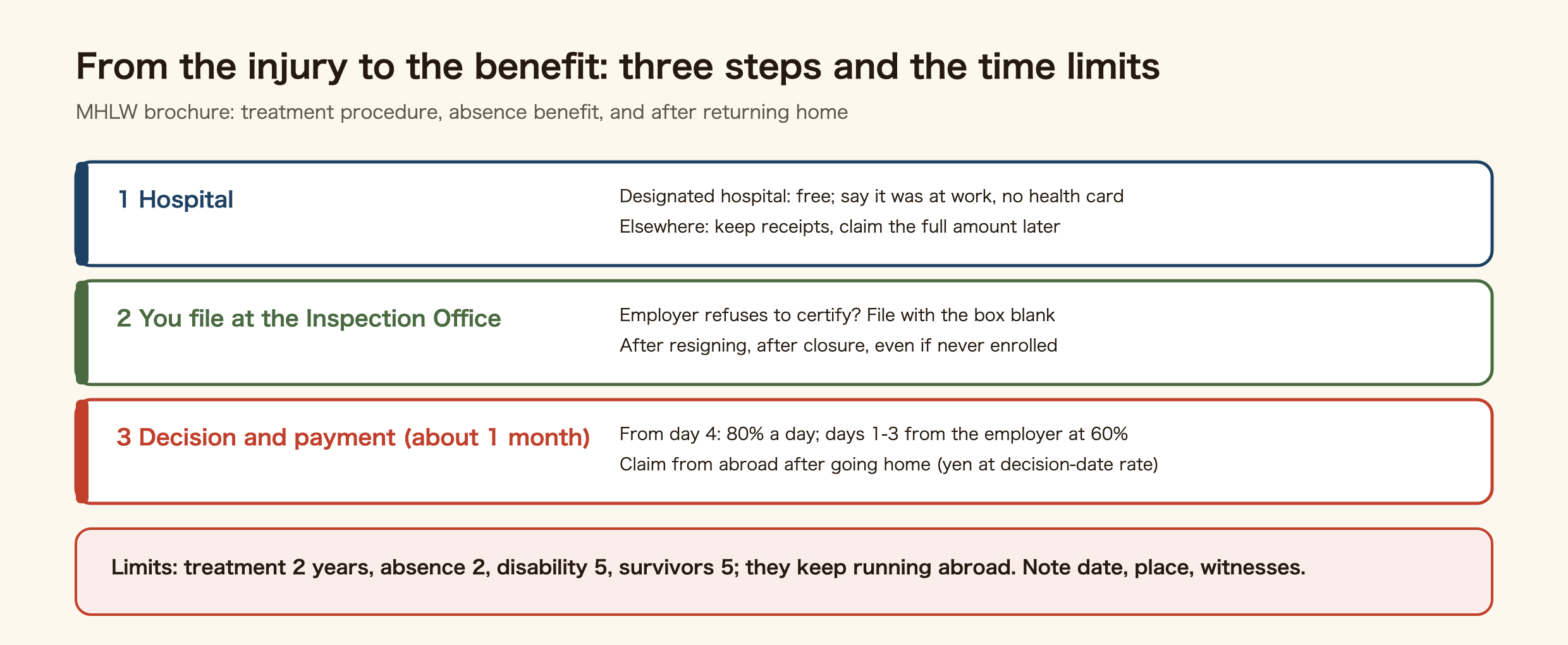
When you are off work for treatment and receive no pay, the absence benefit starts on the fourth day off, at 80% of the “basic daily wage” per day (60% benefit plus a 20% special payment). The basic daily wage is your wages for the three months before the accident divided by the calendar days in them.
The brochure’s own example: 200,000 yen a month, accident in October: 200,000 x 3 / 92 days = about 6,522 yen basic daily wage, and 80% of that is about 5,217 yen a day. Two part-time jobs? Both wages are added together (200,000 plus 100,000 gives about 7,912 yen a day).
Days one to three (the waiting period) are not paid by rosai. For a work accident, the employer must pay those three days at 60% of average wage under the Labour Standards Act. For a commuting accident the employer has no such duty, and 200 yen is deducted from the first payment. Time limit for the absence benefit: two years from the day after each unpaid day.
If a lasting disability remains after the injury stabilises, there is a disability benefit; in the event of death, survivors’ benefit and funeral expenses. Both carry a five-year limit.
The employer says “not a work accident” or “we are not enrolled”. Now what? You can still claim
This is the part that matters most to foreign readers. From the brochure’s Q&A, as written.
- “As a rule, the injured person files the rosai procedures themselves.” The claim is yours. It is not something to wait for the company to do.
- “Even where the employer’s certification cannot be obtained, such as when the company refuses to certify, a rosai claim can be made.” The form has a box for the employer; you can file with it blank. Consult the nearest Labour Bureau or Inspection Office.
- “Even if the company has not completed enrolment in rosai insurance, benefits can as a rule be received for injury or illness caused by work or the commute.” “We are not enrolled” is not a reason you go without.
- “You can claim even after resigning, or after the company has ceased to exist.” Fired, or the company went under: you can still claim.
- Compensation from the company’s private insurance does not block rosai (amounts the employer has already paid for treatment or lost pay may be deducted or reduce the benefit).
About one month from receipt of the claim to the decision. The Inspection Office may ask you or the company for documents or interviews. Write down the date, time, place, what happened and the names of witnesses on the day of the accident. When the employer will not cooperate, that note and the doctor’s certificate are your evidence.
What if I go home? You can claim from abroad
The brochure’s final chapter is “Points to note after returning to your home country”. Claims can be filed from outside Japan, and the amount is paid in yen converted at the selling exchange rate on the decision date. Treatment received abroad is reimbursed if its content is judged reasonable.
Some support exists only inside Japan: aftercare, prosthetics and other appliances, post-surgical treatment, and school support for children. If a lasting disability is likely, ask the Inspection Office before you leave which benefits continue abroad and which do not. The limits – two years for treatment and absence, five for disability and survivors – keep running after you leave. See the leaving-Japan checklist as well.
The decision: what to do today
Injured now: go to a rosai-designated hospital and say it happened at work (or on the commute). Do not hand over your health insurance card. Keep receipts and notes. Do not let the employer’s words stop you.
Employer refusing: take the form to the Labour Standards Inspection Office with the employer’s box left blank. Say the company refused to certify. The brochure says you can still claim.
Already home, or about to leave: claim before the limit runs out. Two years for treatment and absence, five for disability. It can be filed from abroad.
FAQ
Q. Are foreign workers covered by rosai insurance in Japan?
Yes, regardless of nationality. A student injured during a part-time job is covered, and the employer pays the premium.
Q. Can I use health insurance for an injury at work?
No. Health insurance cannot be used for an industrial accident. Treatment at a rosai-designated hospital is free; elsewhere, pay first and the full amount comes back.
Q. How much do I get while off work?
From the fourth day off, 80% of the basic daily wage (your average wage over the previous three months) per day. About 5,217 yen a day on 200,000 a month. For a work accident the employer pays days one to three at 60%.
Q. My employer says it is not enrolled, or that this is not a work accident.
You can still claim. You file it yourself; you do not need the employer’s certification, and benefits are payable as a rule even if the company never enrolled. Go to the Labour Standards Inspection Office.
Q. Can I claim after leaving the job, or after leaving Japan?
Yes. After resignation, after the company has closed, and from abroad. Limits: two years for treatment and absence, five for disability and survivors.
Q. Is an accident on the way to work covered?
Yes. An injury while travelling between home and the workplace by a reasonable route is a commuting accident, including a collision with an unidentified cyclist.
Summary
Rosai covers foreign workers regardless of nationality, students on part-time jobs included, and the employer pays. Never use health insurance for a work or commuting injury. Free treatment at designated hospitals; 80% a day from the fourth day off.
You file the claim. You can file when the employer refuses, when it never enrolled, after you have left, and after you have gone home. Two years for treatment, five for disability. Write it down on the day, and go to the Labour Standards Inspection Office.
Sources (official): MHLW, brochure about industrial accident compensation insurance for foreign workers (Japanese, English, Chinese, Korean, Vietnamese, Nepali and 7 more languages) / Japanese edition, Part 1 (PDF) / Japanese edition, Part 2 (PDF) / Act on Collection of Labour Insurance Premiums, Art. 31 (e-Gov) (all checked 18 September 2026)
Found this useful? Share it
Send it to a friend who lives in Japan.
WHO WROTE THIS

mori
Japanese. I read the ministries’ own notices, orders and Q&As in the original, and I start from what my Nepalese and Sri Lankan friends in Japan actually ran into. I do not write about what I have not checked or been told.
What this site can and cannot do →Looking for something else?