Figures, prices and terms were checked against the Immigration Services Agency pages on the Certificate of Eligibility and the Ministry of Foreign Affairs visa pages on 10 August 2026. They change — check the current terms yourself before you sign up or file anything.
Last updated: August 2026 (covers the rule change for the October 2026 intake)
In short
- The Certificate of Eligibility (COE) is Japan’s pre-approval, issued before your visa. Without it, a student visa application does not start.
- You cannot file it yourself from abroad. Your school in Japan applies as your proxy. Your job is to hand them correct documents on time.
- The review takes 1 to 3 months. The COE stays valid for 3 months. The application is free.
- The most common reason applications fail: the money is there, but its origin cannot be explained. A balance alone is not enough.
- From the October 2026 intake, language-school applicants must prove Japanese ability. The only exemption is for nationals of the countries and regions on the Agency’s list who have graduated from a foreign university.
Knowing this, you prepare the “where the money came from” papers, not just the balance – and remove the most common reason for refusal before you file.
The Certificate of Eligibility – in Japanese, zairyu shikaku nintei shomeisho (在留資格認定証明書), usually shortened to COE – is a document from Japan’s Immigration Services Agency stating, before you travel, that you meet the conditions for living in Japan. Almost every long-term stay, including study, starts with it.
What is a COE, and how is it different from a visa?
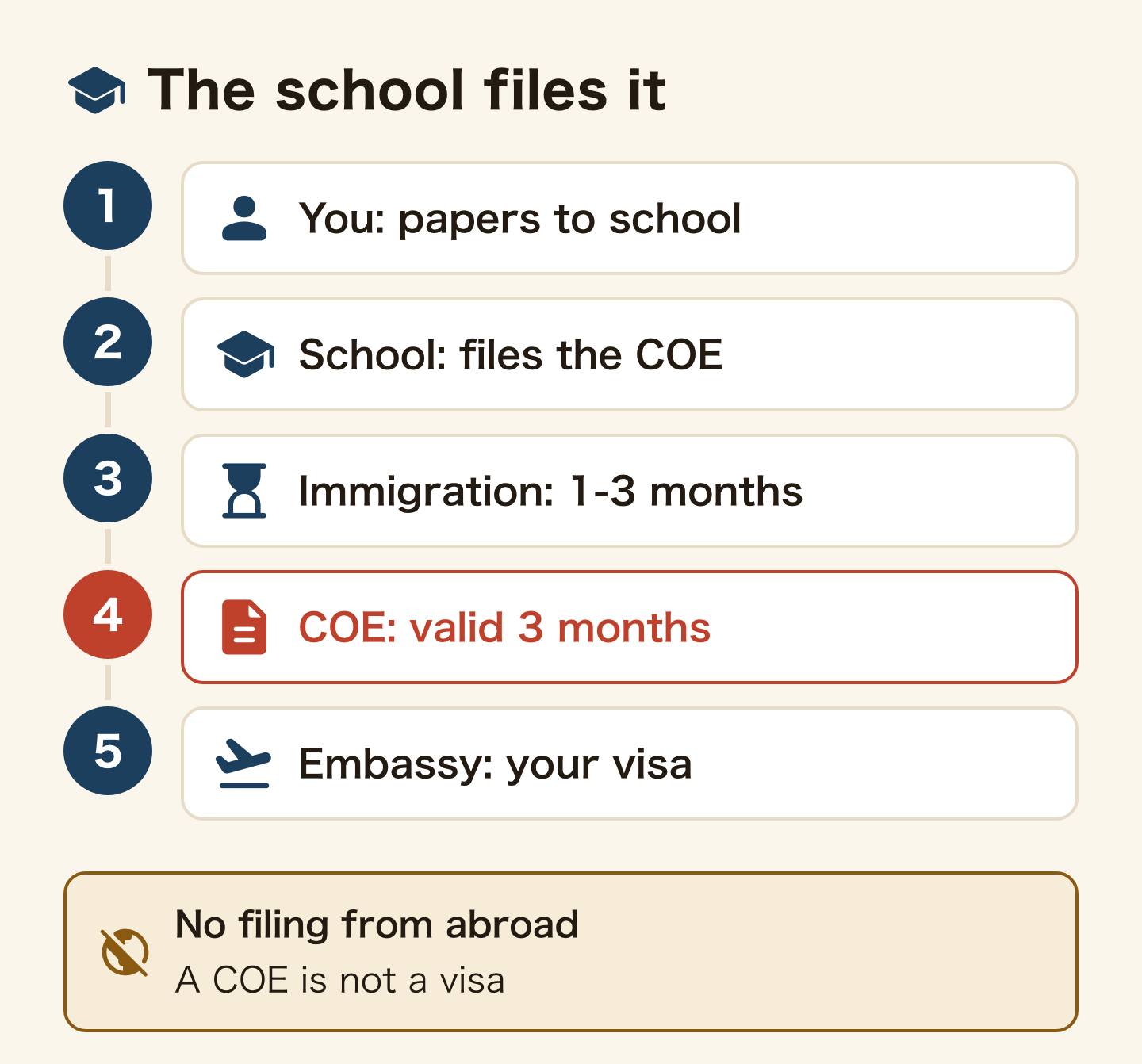
A COE is not a visa. It is immigration’s pre-screening pass that makes the visa itself fast. Long-term stays work in two steps: first the COE is issued in Japan, then you take it to the Japanese embassy in your country and apply for the visa.
Two points matter here:
- Only someone in Japan can file it. For students, that is your school, acting as your proxy (Immigration Services Agency, official guide).
- The COE application is free. Visa fees at the embassy vary by country, but immigration charges nothing for the COE itself.
Since March 2023 there is an electronic COE: a PDF sent by email, accepted for visa applications as it is (Immigration Services Agency: the electronic COE). No waiting for an envelope to cross the world. Ask your school which format they will receive.
What is the timeline for an October intake?
The review alone takes 1 to 3 months, so the process realistically starts about half a year before your term. The deadline that matters is not immigration’s – it is your school’s, usually set in spring to early summer.
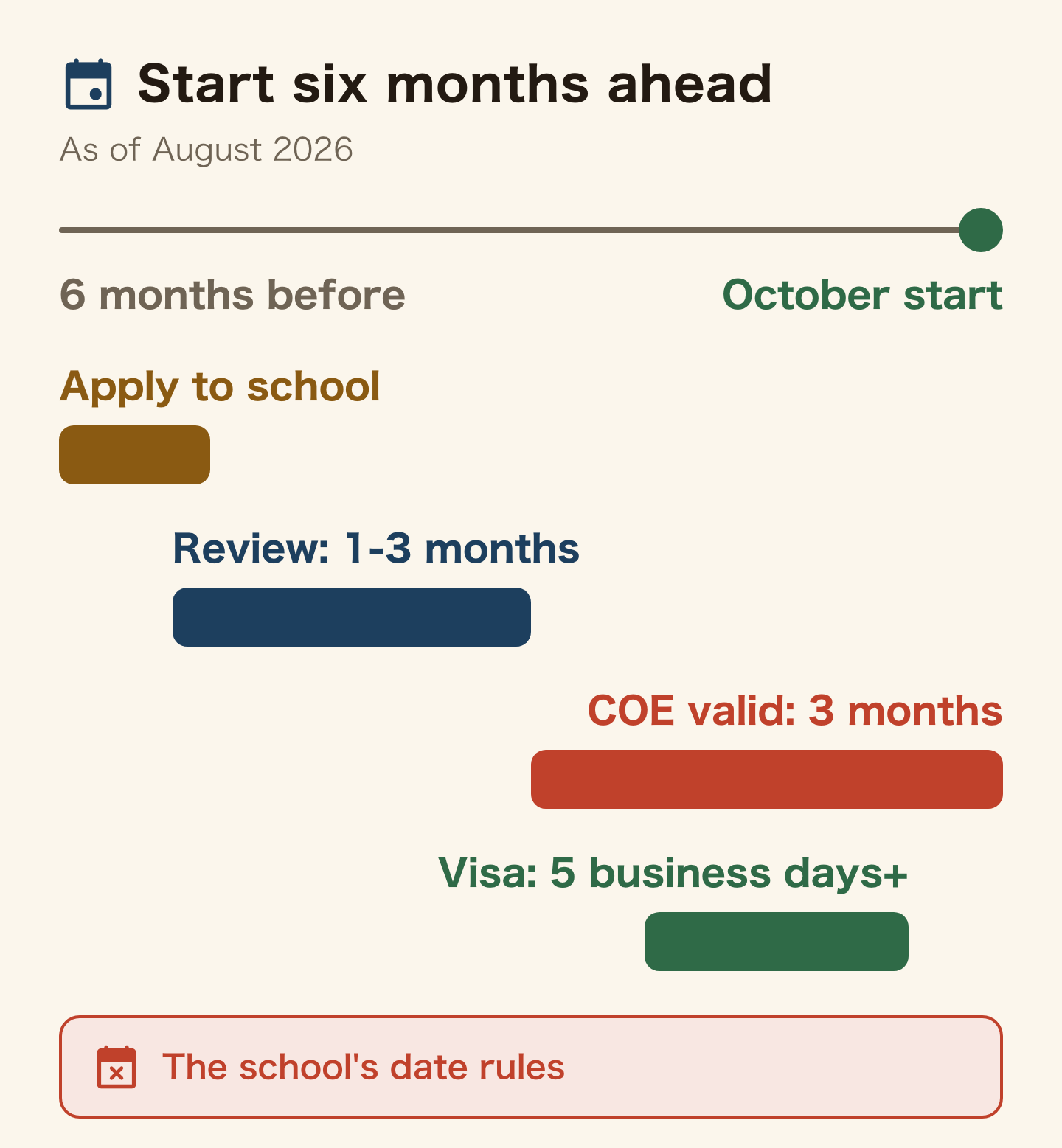
| Step | Who does it | Time (as of August 2026) |
|---|---|---|
| Apply to the school, submit documents | You | School deadline, months before the term |
| COE application | Your school (proxy) | Review 1 to 3 months, free |
| Receiving the COE | School, then you | Same day by email if electronic |
| Visa application | You, at your embassy | 5 business days if smooth; over a month if referred to Tokyo (Ministry of Foreign Affairs: visa processing time) |
| Entering Japan | You | Within 3 months of the COE issue date |
Note the trap: the COE is valid for 3 months. Visa and entry must both happen inside that window. And a late COE can miss your term start – so hand in your documents as soon as they are ready, not at the deadline.
Why do COE applications get refused?
Shortly before the application, your family moves a large sum into the account. Where you are from, a balance that is high enough may be the end of the story. In Japan, the way that money arrived can be the reason the COE is refused.
Most refusals are not about having too little money. They are about money that cannot be explained. Immigration looks past the bank balance to how the money got there. A large deposit right before the application looks like borrowed money staged for the certificate – and that alone can sink an application.
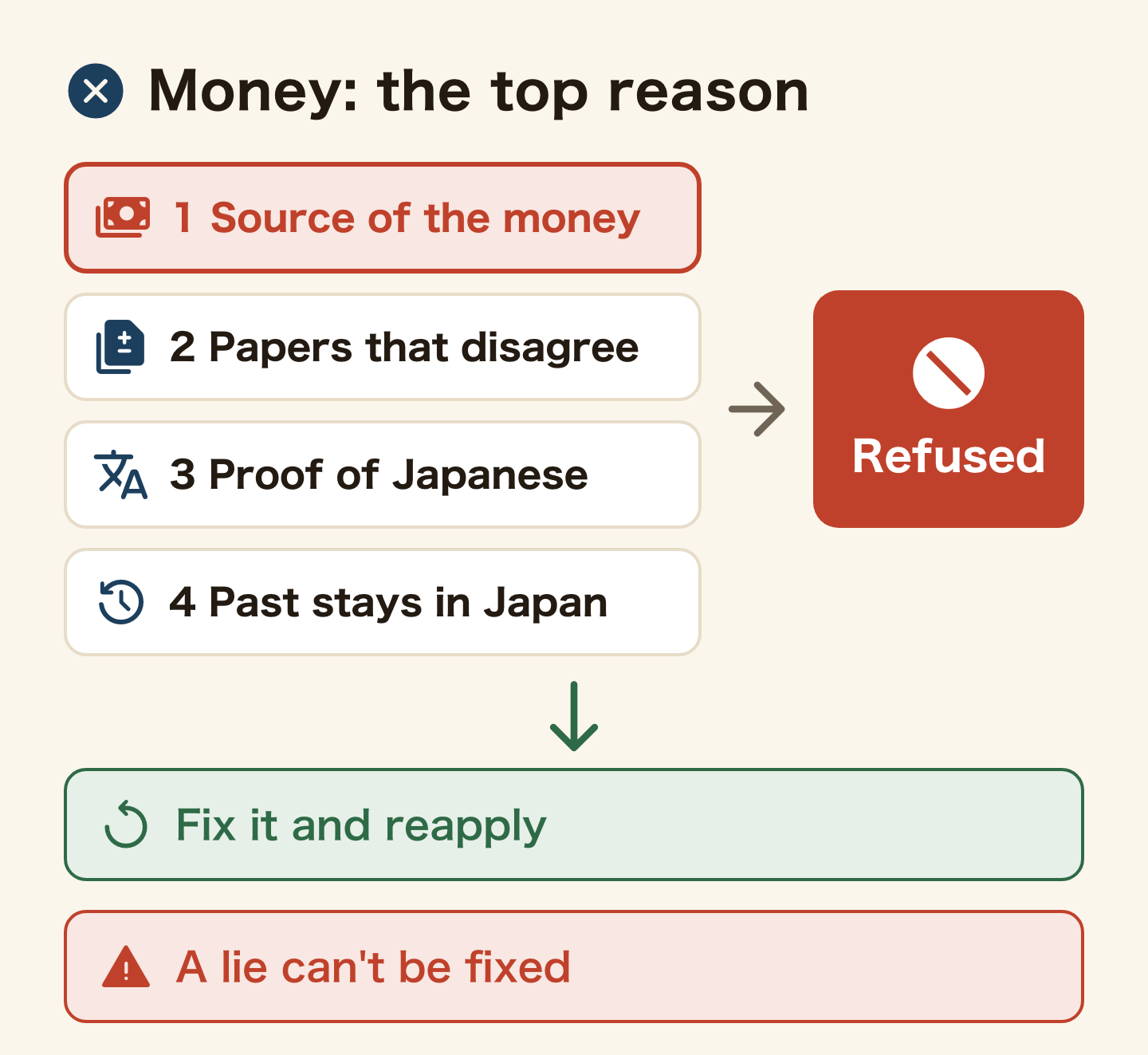
- Where the money came from. Your sponsor’s income and the balance have to make sense together. We cover this in detail in our guide to language school costs.
- Documents that disagree. Education history, work history and family relations must match across every paper. A false statement is fatal – and it stays on record for future applications.
- Proof of Japanese ability. New for language-school applicants from the October 2026 intake. The exemption is narrow: it covers only nationals of the countries and regions on the Agency’s list who have graduated from a foreign university (Immigration Services Agency: revised rules for language-school entrants).
- Past stays in Japan. An overstay or poor attendance from a previous stay makes the review much harsher.
Is a refusal the end?
No. You can fix the reason and reapply for the next intake. Ask your school what was weak – in many cases it is the money explanation, and a cleaned-up application passes the second time. The one exception is false documents. That record follows every application you make afterwards. A weakness can be repaired; a lie cannot.
Once your COE and visa are done and you land in Japan, the first two weeks have their own paperwork. Start with residence registration and national health insurance, then a bank account.
This article explains the system in general terms and is not advice on an individual application. Check the current requirements on the official pages: Immigration Services Agency (COE application) / Immigration Services Agency (electronic COE) / Immigration Services Agency (revised rules for language-school entrants, October 2026 intake) / Ministry of Foreign Affairs (visa processing time) (checked 26 September 2026)
Once it is issued, pre-departure preparation starts; check which medicines you cannot bring into Japan before you pack.
Frequently asked questions
Q. How much does a COE cost?
Nothing. The COE application is free. Visa fees at the embassy vary by country and visa type, so check with the Japanese embassy in your country.
Q. Can I apply for the COE myself from abroad?
No. Apart from the applicant in Japan, only a proxy in Japan – such as staff of the accepting school – can file it. Your role is to give the school correct documents before their deadline.
Q. Can I enter Japan with just the COE?
No. You take the COE to the Japanese embassy or consulate in your country and apply for the visa. If there are no issues it takes around 5 business days; if the application is referred to Tokyo for closer review, it can take more than a month.
Q. Does the COE expire?
Yes. It is valid for 3 months from the issue date. Both the visa application and your entry into Japan must happen within that window. If it expires, the application starts over.
Q. What is an electronic COE?
Since March 2023, the COE can arrive as a PDF by email. It is accepted for visa applications as it is, with no need to mail the paper original internationally.
Summary
- The COE is immigration’s pre-screening before the visa, filed by your school in Japan
- Review 1 to 3 months, application free, valid for 3 months once issued
- The most common failure: money whose origin cannot be explained
- Proof of Japanese ability is required from the October 2026 intake (exempt only if you are a national of a listed country or region and hold a foreign university degree)
- A refusal can be fixed and refiled. Only a lie cannot.
Related guides
Found this useful? Share it
Send it to a friend who lives in Japan.
One thing you can settle while you wait: buy the laptop here, not at home.
Buying a Laptop in Japan →WHO WROTE THIS

mori
Japanese. I read the ministries’ own notices, orders and Q&As in the original, and I start from what my Nepalese and Sri Lankan friends in Japan actually ran into. I do not write about what I have not checked or been told.
What this site can and cannot do →Looking for something else?
You may use the figures in this article, including commercially, if you credit this site with a link. How to use our figures