This article contains affiliate links.
Last updated: July 2026
In short
- New Year is the one time of year Japan genuinely shuts down. City offices close December 29 to January 3, and bank counters close December 31 to January 3.
- Anything you need from a city office – certificates, insurance, address changes – must be done before December 29 or it waits until January 4.
- Convenience stores, their ATMs, and emergency services (110 and 119) stay open the whole time. You will not be stranded.
- Osechi is the food that exists because of this shutdown – dishes preserved with sugar, salt, and vinegar so nobody has to cook for three days.
- Every dish carries a wish for the year, and knowing them turns a meal into the most direct cultural experience you can have here.
Your first New Year in Japan comes with a surprise that nobody warns you about: the country stops. Not “quieter than usual” – the city office is locked, the bank counter is dark, your clinic is closed, and a lot of restaurants put up a sign until January 4.
This guide covers what actually closes, what to handle before it happens, and the food Japanese people invented to get through it.
What actually closes, and for how long
Government offices close from December 29 to January 3 under the Act on Holidays of Administrative Organs, and bank counters close from December 31 to January 3 under the Banking Act. Convenience stores, convenience store ATMs, and emergency services keep running the entire time.
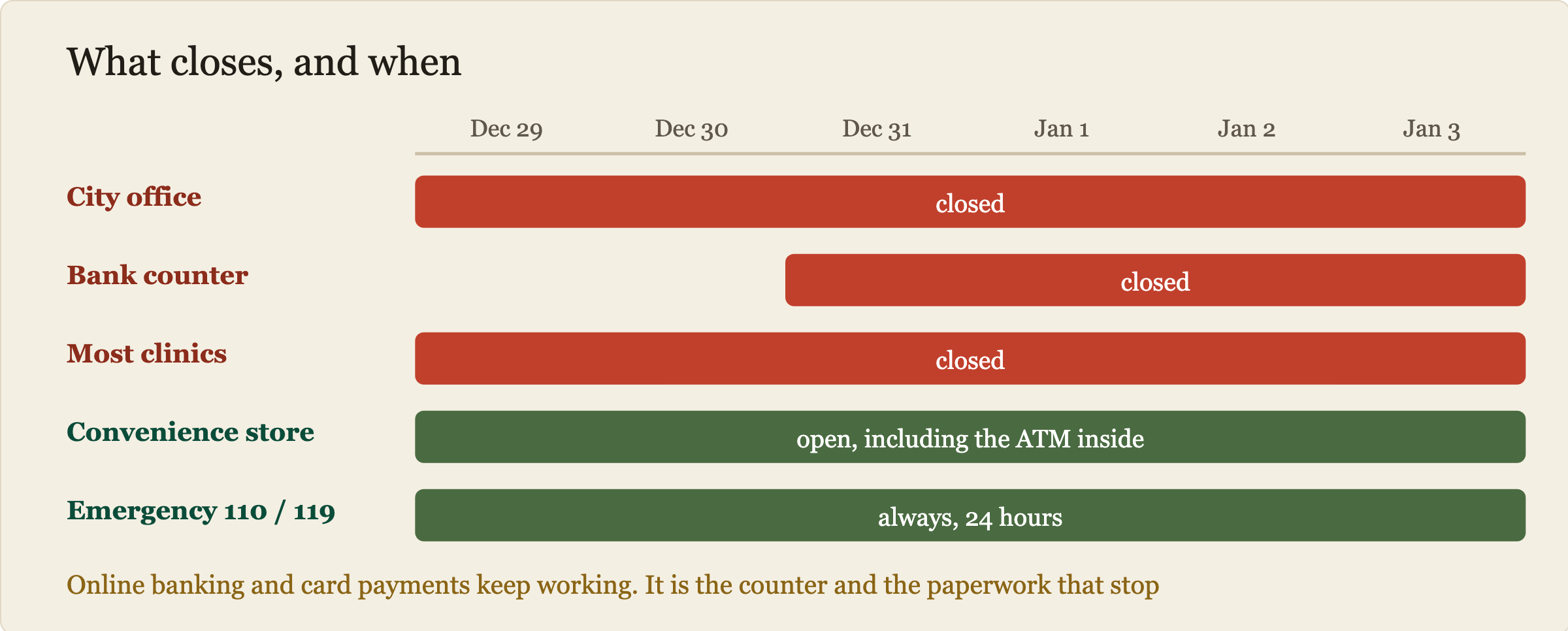
The practical consequences for a resident, in order of how much trouble they cause:
- City office paperwork stops for six days. Moving-in and moving-out notices, certificates of residence, national health insurance changes – all of it waits until January 4. If you have a deadline in early January, handle it in December
- Clinics close, so a minor illness becomes awkward. Emergency rooms operate throughout, and 119 always answers, but a normal cold on January 2 means waiting or paying emergency rates. See our guide to seeing a doctor for how the system works
- Bank counters close, but ATMs do not. Convenience store ATMs (Seven Bank, E-net, Lawson Bank) run through the whole period and accept most foreign cards. What you cannot do is anything needing a teller, like a large international transfer
- Rent and bills still come out on schedule. Make sure the balance is there before the counter closes
The one thing to do before December 29
Take ten minutes in mid-December to check three things: whether you need anything from the city office, whether your account has enough for early-January payments, and whether you have any medicine you are going to run out of. That is the entire preparation, and skipping it is the only way New Year in Japan actually causes a problem.
| Check | Why it matters | Deadline |
|---|---|---|
| City office errands | Certificates and insurance changes stop entirely | December 28 |
| Cash and account balance | Counters shut, and rent still leaves your account | December 30 |
| Prescription refills | Your usual clinic will be closed for up to six days | December 28 |
| Money home | Bank transfers by teller pause; online services still run | December 30 |
If sending money home is on that list, doing it online rather than at a counter avoids the problem entirely – see the cheapest way to send money home.
Why osechi exists: food built for a closed country
Osechi ryori is the set of dishes eaten during the first days of January, and it is designed around exactly the shutdown described above. Everything is preserved with sugar, salt, or vinegar so it keeps for several days without cooking – because historically the shops were closed and the kitchen was meant to rest.
The food is packed into jubako, square tiered boxes that stack. The stacking itself is the point: layers of boxes represent layers of happiness piling up in the year ahead. Contents vary by region and by family, so every household has its own version.
Every dish is a wish
What makes osechi worth understanding rather than just eating is that each item is a pun or a symbol standing for something you want in the coming year. Once you know them, the box reads like a list of new year resolutions.
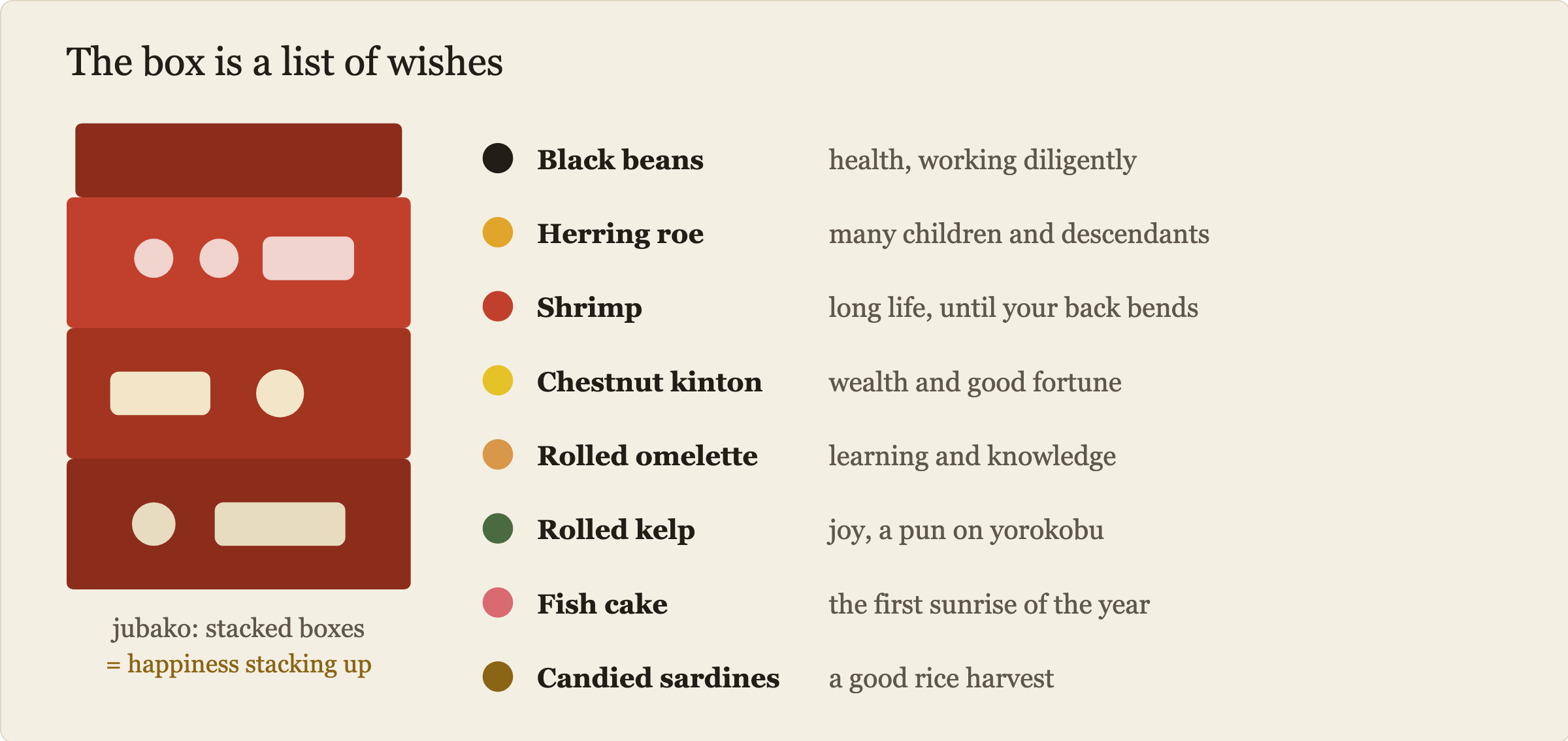
The kelp one is a good example of how the logic works. The Japanese word for kelp is kobu, which sits inside yorokobu, the verb for being glad. Eating it is a small pun for a joyful year. Several of the dishes work this way, which is why osechi is often the single most efficient Japanese lesson on the calendar.
Three ways to actually try it
You do not need a family or a kitchen to experience osechi. The three routes are making a couple of dishes yourself, ordering a full box online, or buying single items at a supermarket or department store food hall.
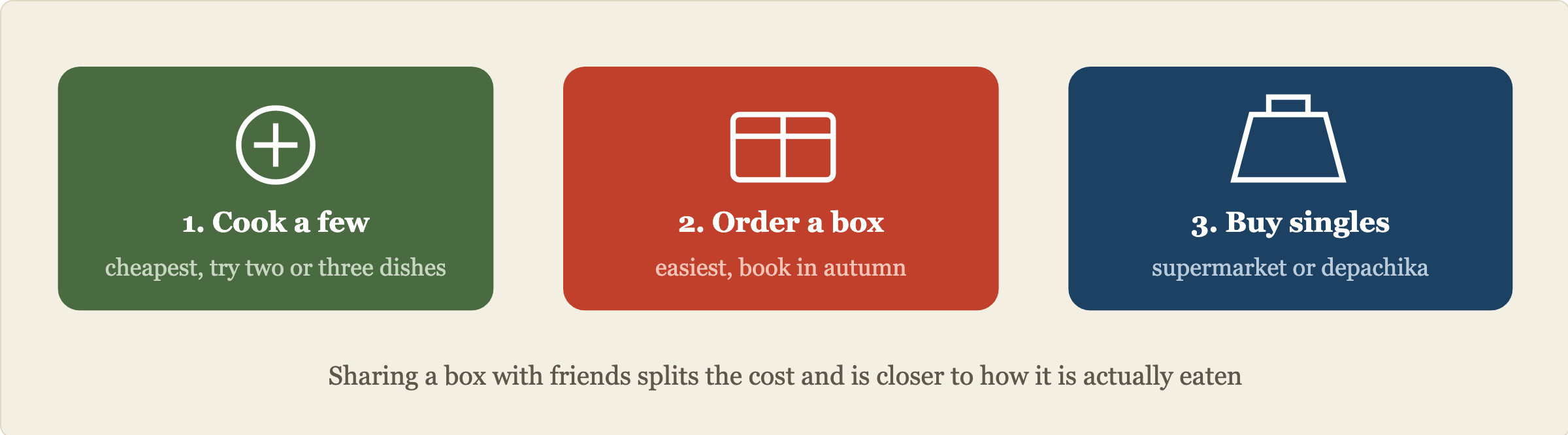
The easiest route by far is ordering online: a restaurant-made box arrives at your door, already arranged in its jubako, with nothing to prepare. Popular boxes sell out, and early-booking discounts run from autumn into early winter, so it is one of the few things worth arranging months ahead. Splitting one with friends brings the per-person cost down and matches how osechi is meant to be eaten – shared.
Booking opens in autumn and early-bird pricing closes well before December
Reference (official): Ministry of Agriculture, Forestry and Fisheries, Japanese food culture
Frequently asked questions
Q. When do people eat osechi?
During the first three days of January, usually starting on the morning of January 1. Because it keeps without cooking, the same box gets eaten across several meals rather than in one sitting.
Q. Do I have to eat all of it?
No. There is no rule, and nobody finishes everything. Trying a few items and learning what they mean is a completely normal way to take part.
Q. Is it worth it if I live alone?
Yes, and smaller one-to-two person boxes are widely sold for exactly this reason. Splitting a larger box with friends is also common and cheaper per person.
Q. Are there halal or vegetarian options?
Some sellers offer vegetarian-friendly or seafood-free boxes, but halal certification is not standard. Check the ingredient list on the product page before ordering, since fish stock is used widely even in vegetable dishes.
Q. What is actually open on January 1?
Convenience stores and their ATMs, most large train lines, emergency services, and many shrines and their surrounding food stalls. Shrine visits on the first days of January are themselves a major New Year custom and cost nothing to join.
Summary
- City offices close December 29 to January 3; bank counters close December 31 to January 3
- Finish city office errands by December 28 and check your balance before the counters shut
- Convenience stores, their ATMs, and emergency services run the whole time
- Osechi is preserved food built for that shutdown, packed in stacked boxes meaning stacked happiness
- Every dish is a wish. Order online, buy singles, or cook two dishes – any of them counts as taking part
Related guides
Found this useful? Share it
Send it to a friend who lives in Japan.
WHO WROTE THIS

mori
Japanese. I read the ministries’ own notices, orders and Q&As in the original, and I start from what my Nepalese and Sri Lankan friends in Japan actually ran into. I do not write about what I have not checked or been told.
What this site can and cannot do →Looking for something else?