This article contains affiliate links.
Last updated: July 2026
In short
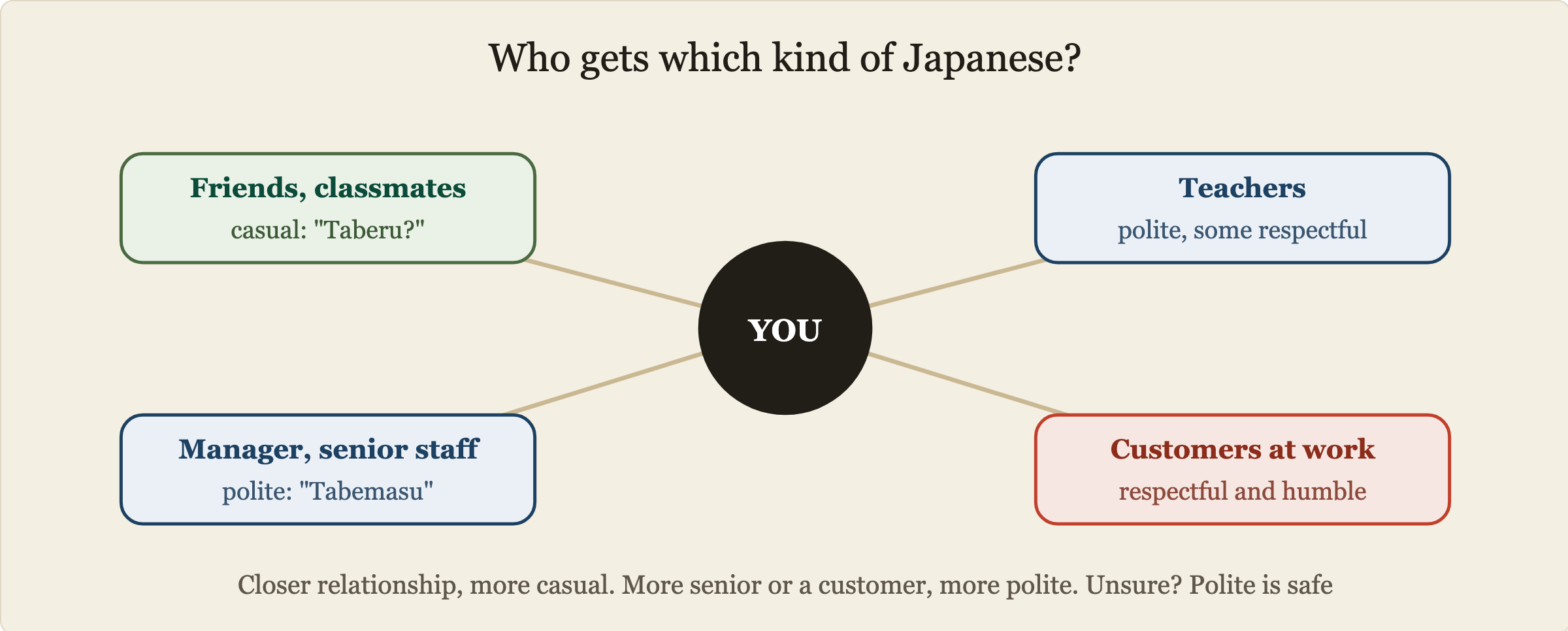
- You change how you speak based on your relationship to the listener. Friends get casual speech (tameguchi); teachers, managers, and customers get polite speech (keigo).
- Keigo has three types: teineigo (desu/masu), sonkeigo (raises the other person), and kenjougo (lowers yourself).
- The trick is direction: sonkeigo lifts the other person UP, kenjougo pushes yourself DOWN.
- You can work a part-time job in Japan using only desu/masu. You do not need to master all three before your first shift.
- The mistake most guides skip: being too formal with friends and coworkers keeps people at a distance. Knowing when to drop keigo matters as much as knowing how to use it.
Keigo (敬語) is the set of Japanese forms that express respect for the listener through the shape of the words themselves. It splits into three types: sonkeigo, kenjougo, and teineigo.
Most guides to keigo teach it as grammar. This one is written for people who actually live and work here, so it answers the two questions grammar guides tend not to: what do I say on my shift tomorrow, and when am I being too polite?
- The core rule: who you are talking to decides how you speak
- The three types, explained by direction
- The conversion table you can keep open
- What you actually say on a part-time shift
- The mistake nobody warns you about: being too polite
- Common mistakes and how to fix them
- Frequently asked questions
- Summary
- Related guides
The core rule: who you are talking to decides how you speak
In Japanese, the same sentence can be natural or rude depending only on who hears it. “Taberu?” (want to eat?) is perfectly normal to a friend and disrespectful to a teacher. So the first thing to learn is not verb forms – it is the map of who gets which register.
The three types, explained by direction
All three types exist to raise the other person relative to you. Teineigo does it neutrally, sonkeigo does it by lifting their actions up, and kenjougo does it by lowering your own actions down. Thinking in directions is what makes the difference finally click.
- Teineigo (polite): add desu and masu. The simplest and safest
- Sonkeigo (respectful): raises the other person’s actions, upward
- Kenjougo (humble): lowers your own actions, downward
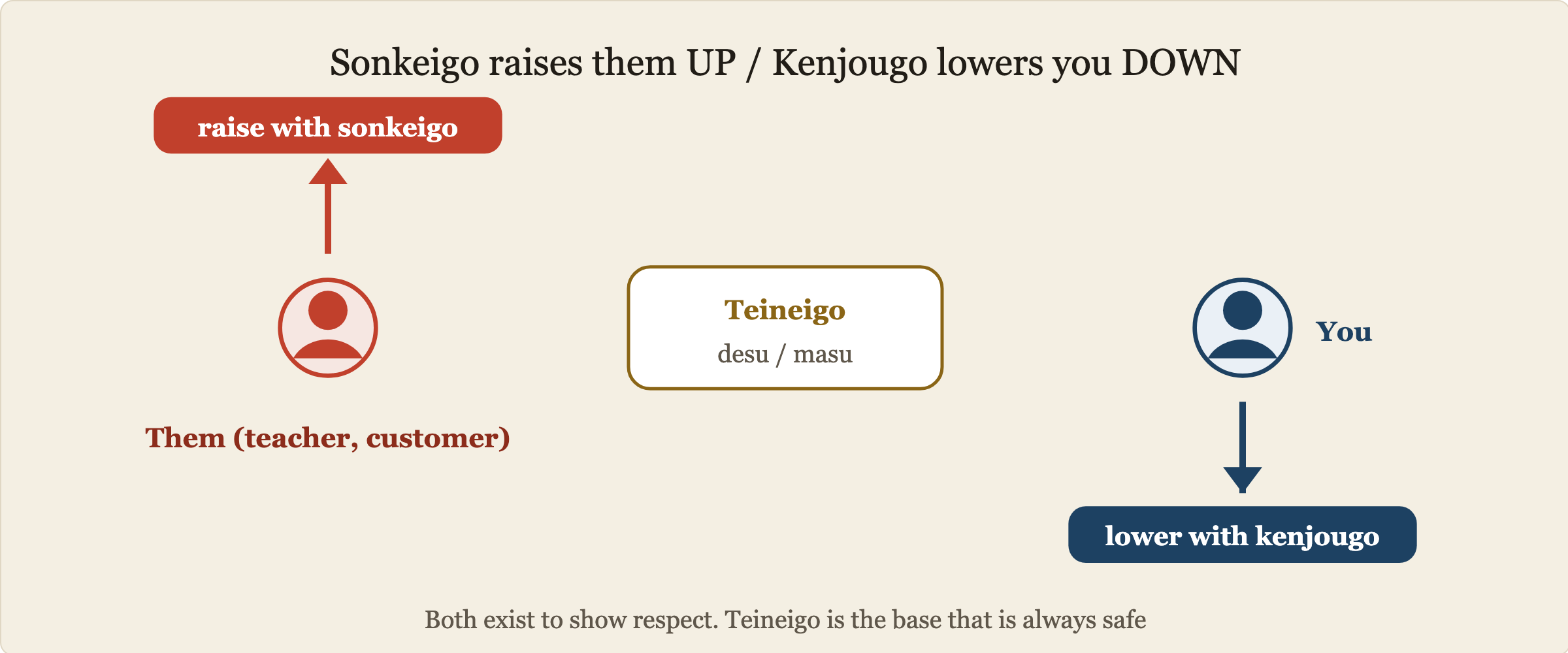
Take the verb “to go.” If the teacher goes, it becomes irassharu (sonkeigo, raising them). If you go, it becomes mairu or ukagau (kenjougo, lowering yourself). Same action, different word, decided entirely by whose action it is.
The conversion table you can keep open
These are the verbs that come up constantly. Start with the teineigo column only – you can add the other two over months, not days.
| Plain | Teineigo (safe) | Sonkeigo (them, up) | Kenjougo (you, down) |
|---|---|---|---|
| iku (go) | ikimasu | irassharu | mairu / ukagau |
| kuru (come) | kimasu | irassharu / okoshi ni naru | mairu |
| iru (be present) | imasu | irassharu | oru |
| miru (see) | mimasu | goran ni naru | haiken suru |
| iu (say) | iimasu | ossharu | mousu / moushiageru |
| taberu (eat) | tabemasu | meshiagaru | itadaku |
| suru (do) | shimasu | nasaru | itasu |
What you actually say on a part-time shift
You do not need all three registers to start working. Almost every shift at a convenience store or restaurant runs on a small set of fixed phrases, and nobody expects you to conjugate anything on the spot. Learn these and you are functional from day one.
| Situation | What to say | Meaning |
|---|---|---|
| Customer walks in | Irasshaimase | Welcome |
| Asking them to wait | Shoushou omachi kudasai | One moment please |
| You kept them waiting | Omatase itashimashita | Sorry for the wait |
| Handing something over | Douzo | Here you are |
| Any apology at work | Moushiwake gozaimasen | I am very sorry |
| Thanking a customer | Arigatou gozaimashita | Thank you (completed) |
| Reporting a task done | Kochira, owarimashita | This one is finished |
| Leaving before others | Osaki ni shitsurei shimasu | Excuse me for leaving first |
Notice that most of these are memorized units, not grammar you build. That is the honest shortcut: customer-facing Japanese is more like learning eight phrases than learning a system. If you are still choosing where to work, see our part-time job guide – front-of-house roles pay more than the hourly rate suggests, because every shift doubles as a free speaking lesson.
The mistake nobody warns you about: being too polite
Most guides tell you that when in doubt, be more polite. That is good advice with strangers and bad advice with people you see every day. Keigo used with a friend creates distance, and holding it too long can quietly stop a friendship from forming.
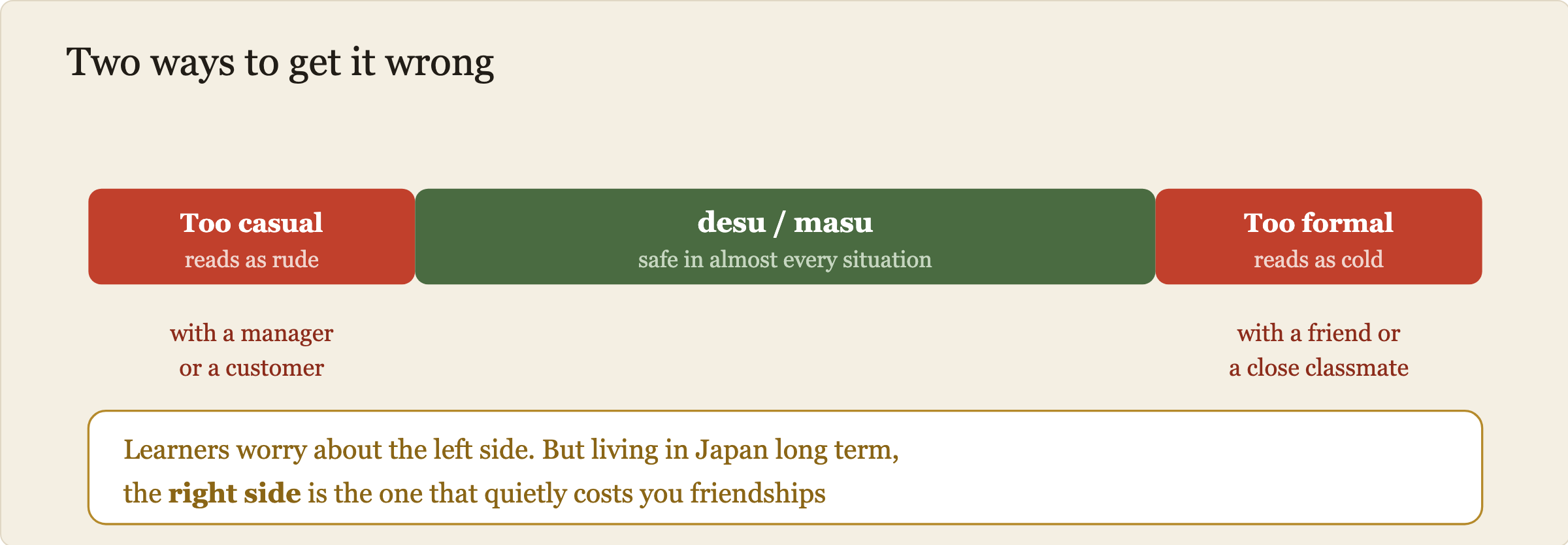
So how do you know when to switch? There are reliable signals:
- They say “tameguchi de ii yo” – a direct invitation to drop keigo. Take it
- They start using casual forms with you first – the senior person opens the door, and it is fine to follow
- You are the same age or year, outside of work – classmates almost always move to casual quickly
- When it is genuinely unclear, stay on desu/masu with a warm tone. Politeness with warmth never reads as cold
The reverse never applies at work: with a shift manager or a customer, stay polite regardless of how friendly things get. Casual speech to a customer is the one mistake that gets you a talking-to.
Common mistakes and how to fix them
| Wrong | Right | Why |
|---|---|---|
| Otabe ni narimasu ka? (to a friend) | Taberu? | Sonkeigo to a friend creates distance |
| Goran ni nararemasu ka? | Goran ni narimasu ka? | goran ni naru plus rareru is doubled keigo |
| Kore, shite kudasai | Kore, onegai shimasu | shite kudasai lands close to an order |
| Kore, yattokimashita | Kochira, yatte okimashita | kore is casual; kochira is the polite form |
Doubled keigo (nijuu keigo) is worth a special note, because it is the mistake that comes from trying hard. Piling a respectful verb on top of another respectful ending does not make you more polite – it makes you sound like you are overreaching. One layer is correct.
Reference (official): Agency for Cultural Affairs, Guidelines on Keigo
Somewhere to actually say the phrases out loud
The eight phrases in this article take a day to memorise. The problem is having nobody to say them to. Saying them for the first time in a job interview is the most expensive practice there is.
- Over 2,000 Japanese teachers. Tell them you only want to practise keigo and they will
- Pay per lesson, not monthly. Two lessons before an interview is a perfectly normal way to use it
- From around 800 yen a lesson, often less than one class at a language school
- Honest note: teachers vary. Use a trial lesson to check they are easy to talk to first
Find a Japanese teacher on italki (site opens in Japanese; use the language switcher)
Frequently asked questions
Q. What should I learn first?
Teineigo, the desu and masu forms. It is the easiest and it is almost never rude with anyone. Build that base first, then add sonkeigo and kenjougo gradually.
Q. I keep mixing up sonkeigo and kenjougo.
Ask yourself whose action it is. Their action takes sonkeigo (irassharu, meshiagaru). Your action takes kenjougo (mairu, itadaku). Picture the direction diagram above: them up, you down.
Q. Do I need keigo for a part-time job interview?
Yes, but desu and masu plus a few fixed phrases is genuinely enough to interview well. Nobody expects perfect keigo from a foreign applicant. Visibly trying to be polite counts for more than getting every form right.
Q. Is it strange to keep using keigo with a friend?
It does create distance over time. Once someone tells you tameguchi is fine, or starts speaking casually to you, follow their lead and shift gradually.
Q. Can I get by at work with only desu and masu?
Yes. Combined with the set phrases in the table above, desu and masu will carry you through a convenience store or restaurant shift. Sonkeigo and kenjougo make you sound more polished, but they are not a requirement to start.
Summary
- Speech level is chosen by your relationship to the listener, not by the sentence
- Three types: teineigo, sonkeigo, kenjougo
- The direction trick: sonkeigo raises them, kenjougo lowers you
- desu and masu plus about eight set phrases is enough to work a shift
- Watch the other failure mode too: too much formality with friends keeps people at a distance
Related guides
Found this useful? Share it
Send it to a friend who lives in Japan.
Once your speech is in order, reading is next. Six years of primary-school drills reach roughly JLPT N2.
Learn Kanji With Japanese School Drills →READ THIS NEXT
Start a Blog in Japan →Japanese practice arrives in weeks, a portfolio in months, income maybe never.WHO WROTE THIS

mori
Japanese. I read the ministries’ own notices, orders and Q&As in the original, and I start from what my Nepalese and Sri Lankan friends in Japan actually ran into. I do not write about what I have not checked or been told.
What this site can and cannot do →Looking for something else?