Checked on 30 September 2026 against the Ministry of Health, Labour and Welfare’s FY2026 dental fee schedule and notices, its pages on mixed insured and uninsured care and its dental questionnaire, the rules for insured medical care (e-Gov), the Japan Dental Association, the National Tax Agency, the Immigration Services Agency’s living and working guidebook, and official pages of Tokyo and Nishinomiya City.
The short answer
- Japanese health insurance covers the dentist. If you are on National Health Insurance or a company plan, it works for you exactly as it does for Japanese people. Under 70, you pay 30% of the fee at the desk.
- The first-visit fee is 2,750 yen, so you pay about 830 yen. A repeat visit is 600 yen, so 180 yen. X-rays and treatment are added on top (national fee schedule from June 2026).
- “Jihi” (self-pay) means treatment outside insurance, where you pay the whole bill. Implants are self-pay as a rule, and whitening is not covered. Ask what it involves and what it costs before any self-pay or extra-charge work starts.
- Find a dentist on the health ministry’s “Navii” search by choosing “dental clinic” and your language. Then phone to book, and say it is your first visit and where it hurts.
- You can describe your symptoms with the ministry’s dental questionnaire in 13 languages. Each version sits next to the Japanese, and you just tick what applies.
Knowing this, you can pick up the phone on the day a tooth starts hurting already knowing what to bring, whom to call and what to say. And fear of an uninsured bill stops being a reason to sit through the pain.
A back tooth twinges every time you drink something cold. You have no idea what a Japanese dentist costs, whether insurance applies, or how to book. A Japanese friend shrugs: “It’s on insurance. Thirty percent.” Thirty percent of what, though? And what do you do if the dentist suggests something that is not covered? Your friend has paid dental bills for years and never once read the breakdown.
- How much does the dentist cost in Japan?
- Does Japanese health insurance cover dental? Insured, insured plus extra, or self-pay
- How do foreigners find a dentist in Japan?
- Do I need an appointment at a Japanese dentist?
- How do I explain my symptoms to a Japanese dentist?
- Forgot your insurance card, or stopped going? Full price, and the one-month rule
- What if I cannot pay, or the dentist suggests self-pay treatment?
- Toothache on a Sunday or at night?
- Which one are you?
- FAQ
- Summary
- Related reading
How much does the dentist cost in Japan?
Dental fees are set nationally in a points table, the same everywhere in Japan. One point is 10 yen, and a new table took effect on 1 June 2026 (Ministry of Health, FY2026 fee revision, Japanese).
The first-visit fee is 272 points. Since June 2026 a 3-point “price add-on” for outpatient dental care comes on top, making 275 points, or 2,750 yen (MHLW dental fee schedule, Japanese PDF). At 30%, you pay about 830 yen.
From the second visit, the repeat-visit fee is 59 points plus a 1-point add-on: 60 points, or 600 yen. At 30%, that is 180 yen.
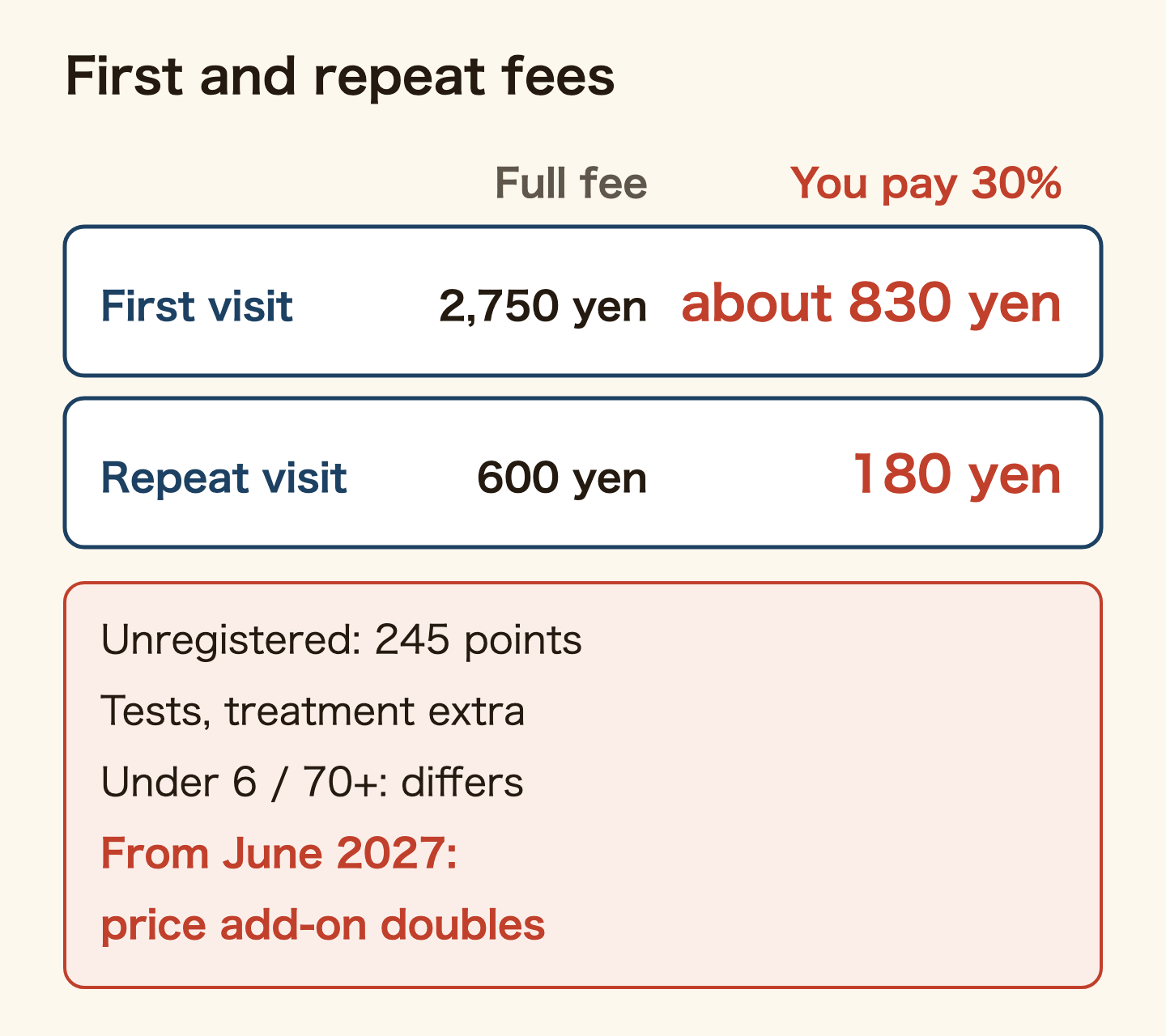
That is only the basic consultation fee. Every X-ray, filling or scaling adds its own points. Treatment points depend on the number and position of the teeth and on what the clinic has registered, so there is no single price per tooth. If you want to know, ask before treatment: “Kyō wa daitai ikura desu ka?” (Roughly how much today?)
Three things change the amount:
- A clinic that has not registered infection-control measures charges 245 points for a first visit and 45 for a repeat visit. Dental departments of larger regional hospitals charge 296 and 76
- Nights and holidays cost more. For patients aged 6 and over, a first visit on a holiday adds 250 points (750 yen more at 30%), late at night (10pm to 6am) 480 points, and outside the clinic’s own hours 85 points
- Children under 6 get a 40-point add-on at the first visit, and pay 20% instead of 30%
The share you pay is 30% under 70, 20% for children who have not started primary school, and 20% from 70 to 74 (30% for those with working-age level income) (MHLW, copayment rates, Japanese PDF). For children, your city’s child medical subsidy may bring the cost down further.
The fee schedule also says the price add-on doubles from June 2027. Even at 6 points, your 30% of a first visit stays at about 830 yen.
Does Japanese health insurance cover dental? Insured, insured plus extra, or self-pay
Japan’s system puts necessary and appropriate treatment on insurance as a basic rule (MHLW, mixed insured and uninsured care, Japanese). Treating cavities and gum disease, extractions and dentures are all in the insured fee table. The materials a dentist may use under insurance are also fixed by the state.
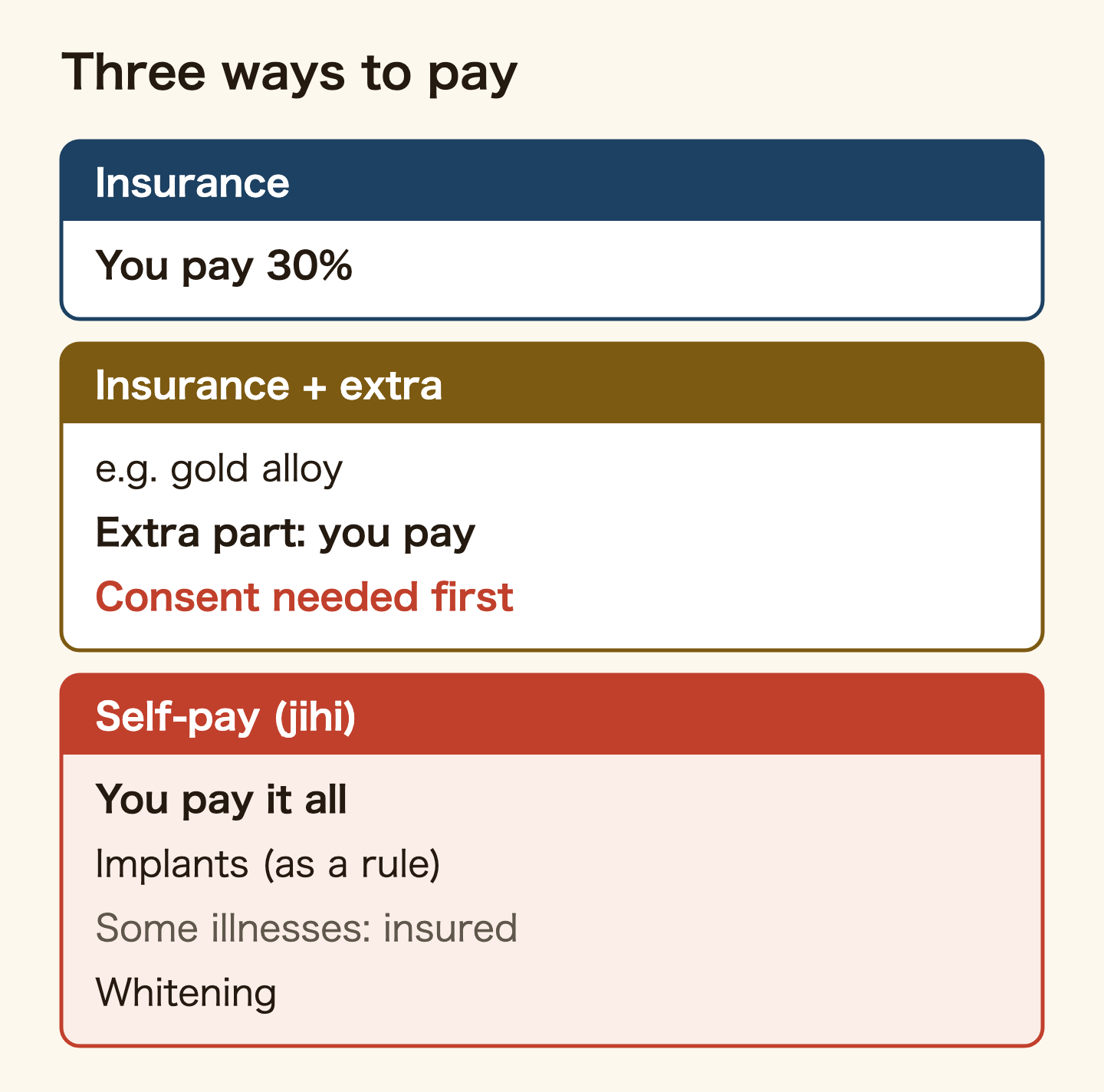
Payment falls into three kinds:
- Insured care — you pay 30% (or 20% or 10% depending on age)
- Insured care plus an extra charge (“selected care”, sentei ryōyō) — the basic treatment is insured, and you pay a special charge only for the part you choose. The national categories for dentistry include gold alloy and metal-base full dentures. Some clinics also charge extra for appointment-based care or out-of-hours care
- Self-pay (jihi) — no insurance, you pay the whole bill
The second kind comes with a rule. The clinic must explain what the extra is and what it costs, and get your consent, before it starts. It must also post these details in the clinic and, as a rule, on its website (Rules for insured medical care, Article 5-4, Japanese).
The most common self-pay treatments are implants and whitening. The Japan Dental Association says implant treatment is self-pay as a rule. Insurance covers it only in limited cases, such as bone grafts after part of the jaw was removed for cancer, or certain congenital conditions, and only at designated institutions such as hospitals with inpatient beds. Whitening is not covered by insurance either, and the price depends on the product and method.
White crowns are not automatically self-pay. The insured fee table includes a white crown made by computer (a CAD/CAM crown). It can only be used at clinics that have registered for it, and only on teeth that meet the conditions. Ask your dentist whether your tooth qualifies.
How do foreigners find a dentist in Japan?
The most reliable tool is the health ministry’s Medical Information Net, “Navii”. It searches hospitals, clinics and dental clinics across Japan, and the screen can be switched to English, Chinese (simplified or traditional) or Korean.
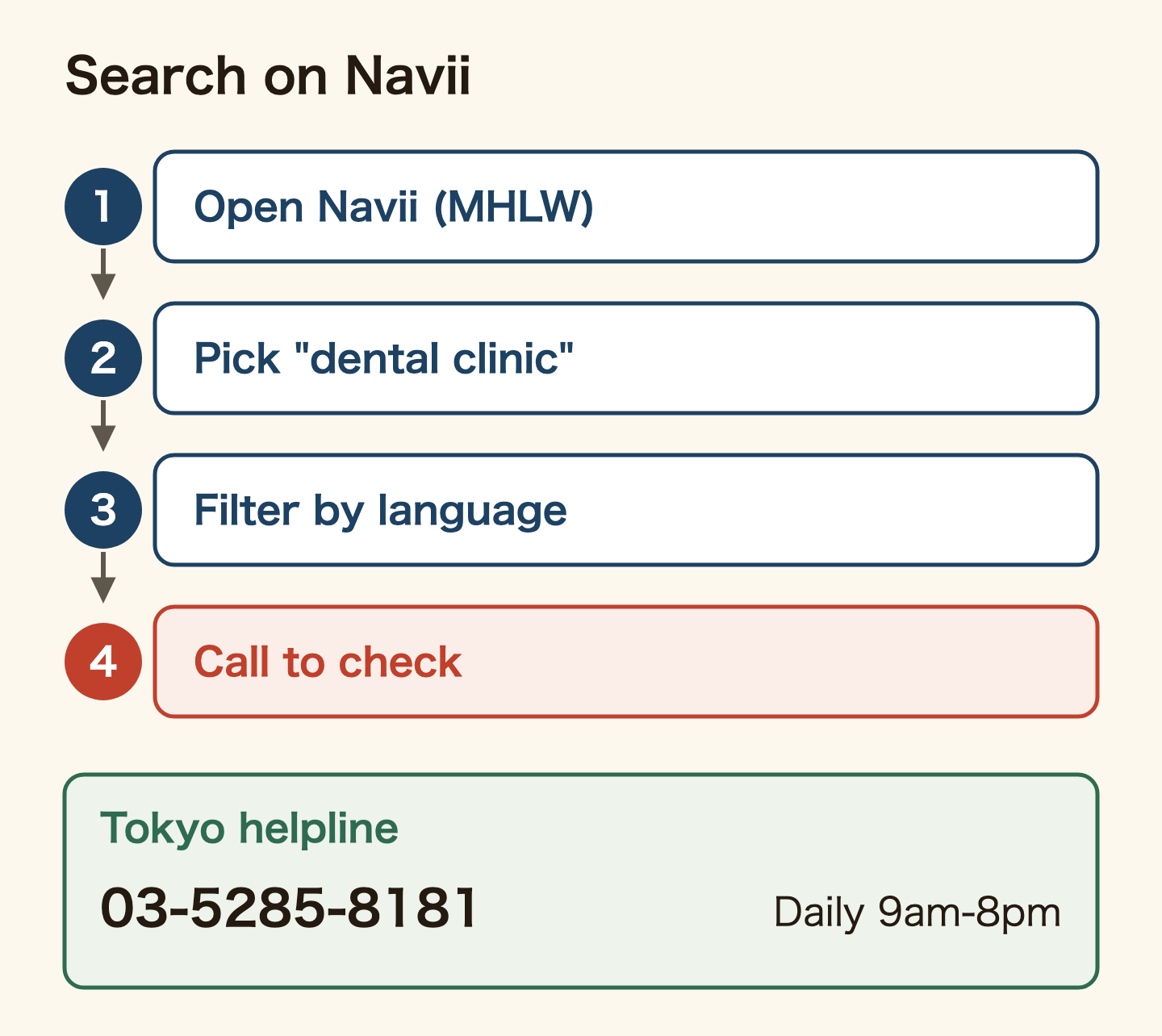
- Open Navii and choose “dental clinic” as the type of institution
- Under the detailed search, pick the foreign language you speak (how to use Navii, Japanese)
- Narrow it to near your home or work, then phone a few and check your language really works
You can also search by phone. Tokyo runs a medical information service for foreign patients (03-5285-8181) that points you to clinics in your language, in English, Chinese, Korean, Thai and Spanish, every day from 9am to 8pm. Elsewhere, your city office and local international association can help (Immigration Services Agency, Guidebook on Living and Working, Japanese).
If you also need an interpreter, how to get a medical interpreter and who pays for one covers the lists of clinics that take foreign patients.
Do I need an appointment at a Japanese dentist?
It hurts, so you just walk in and wait to be seen. Where you come from, that may be normal. In Japan, some clinics need an appointment, and at others you are seen sooner if you have one (Tokyo, how to see a doctor, Japanese). Phone before you go.
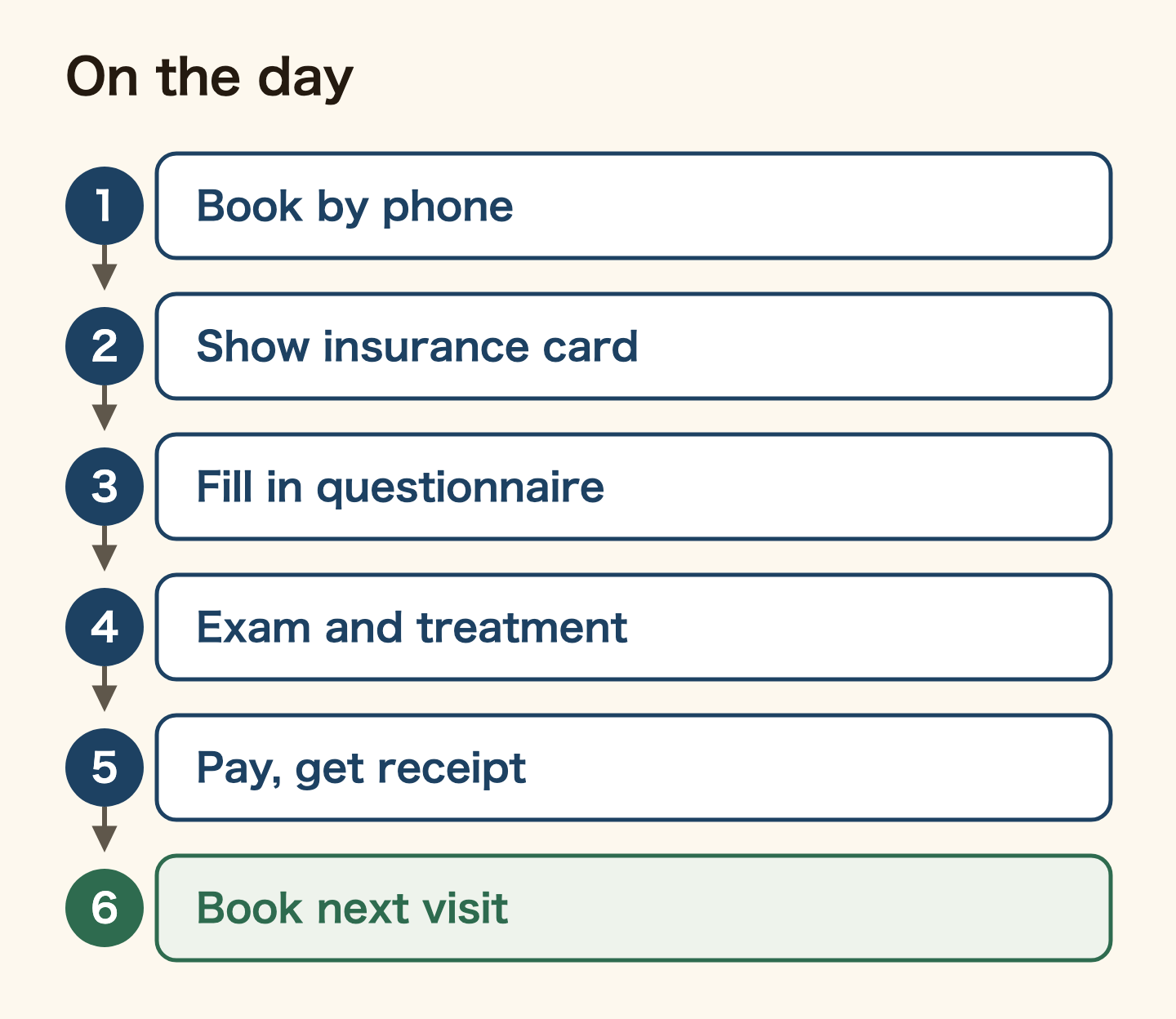
On the phone, say three things:
- “Hajimete desu. Yoyaku o onegai shimasu.” (It’s my first visit. I’d like an appointment.)
- Where it hurts, since when, and how (for example “Migi no okuba ga, mikka mae kara itai desu”: my right back tooth has hurt for three days)
- That your Japanese is limited (“Nihongo ga sukoshi dake desu”)
Bring your My Number health card (or eligibility certificate), your residence card or passport, money, and your medicines or medicine notebook. Tokyo notes that small clinics often take cash only.
At the desk you get a receipt. Clinics must give a receipt that splits the bill by type of charge, free of charge, and designated clinics must also give a free itemised statement showing the points (Rules for insured medical care, Article 5-2). If treatment continues, book the next visit before you leave.
How do I explain my symptoms to a Japanese dentist?
You do not need to read the form at reception. The health ministry publishes a dental questionnaire in 13 languages: English, Chinese, Korean, Portuguese, Spanish, Ukrainian, Hindi, Indonesian, Nepali, Tagalog, Thai, Vietnamese and Arabic. Each one has the Japanese alongside, so you just tick boxes. Print it, fill it in at home and take it with you.
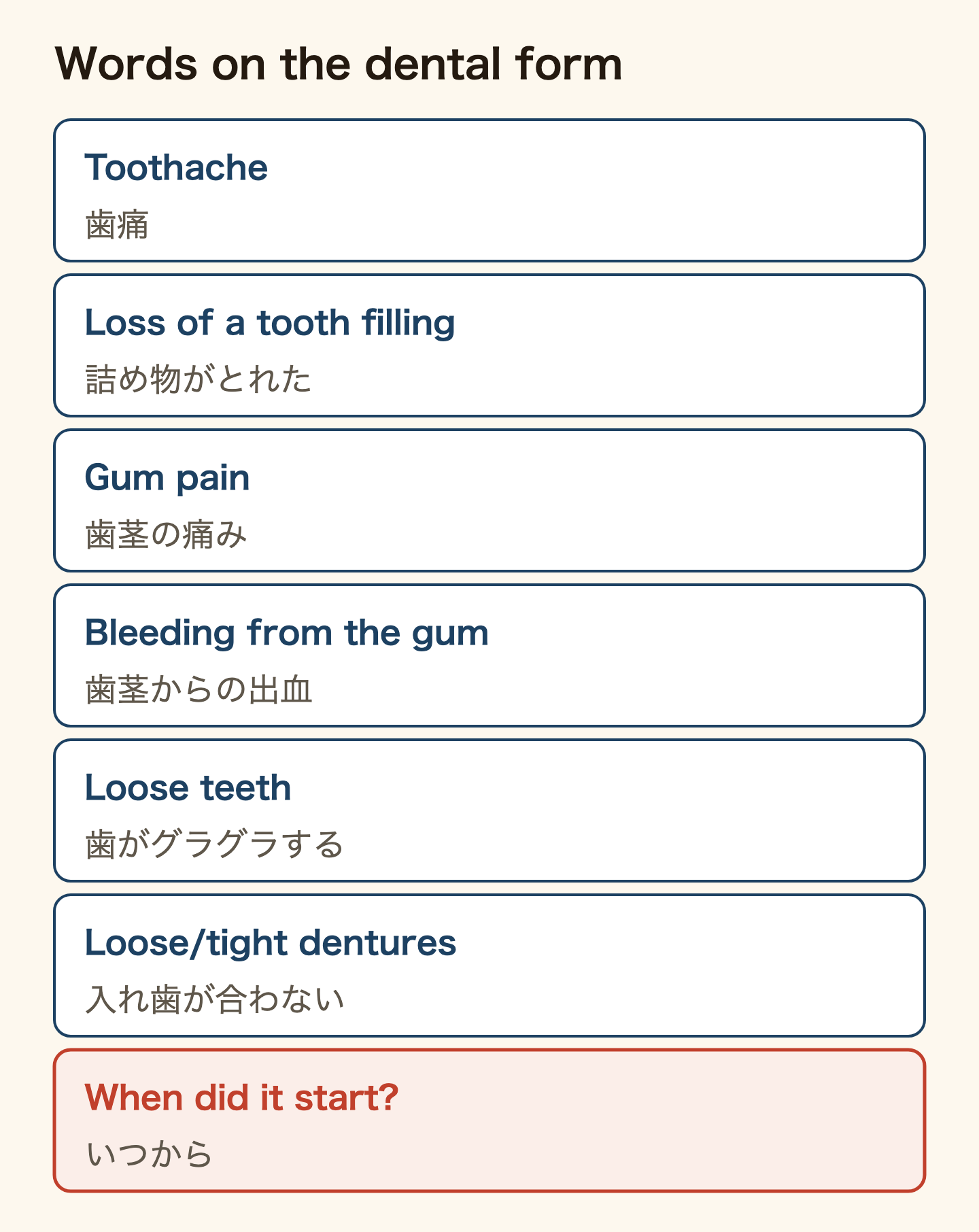
The symptom list includes toothache, a lost filling, gum pain, bleeding gums, loose teeth, dentures that do not fit, mouth ulcers, jaw pain, bite problems and wanting whiter teeth. It also asks when it started, and whether anaesthesia worked poorly or bleeding was hard to stop in past treatment.
There are boxes for medicines and allergies too. The form asks you to include vitamins and supplements. Show your actual medicines or your medicine notebook.
Forgot your insurance card, or stopped going? Full price, and the one-month rule
If you do not show your My Number health card or equivalent, you pay the full fee that day (Guidebook on Living and Working). If you have just started a job, your card is not yet registered and you have no eligibility certificate either, pay in full and claim later from your insurer. If the claim is approved, everything except your normal share comes back. How the cards work is in the My Number health card guide.
The counting catches people who drift away. If you stop treatment on your own and come back to the same dentist a month or more later, it counts as a first visit again, even for the same tooth and the same problem (MHLW notes on the dental fee schedule, Japanese PDF). You pay the first-visit fee again.
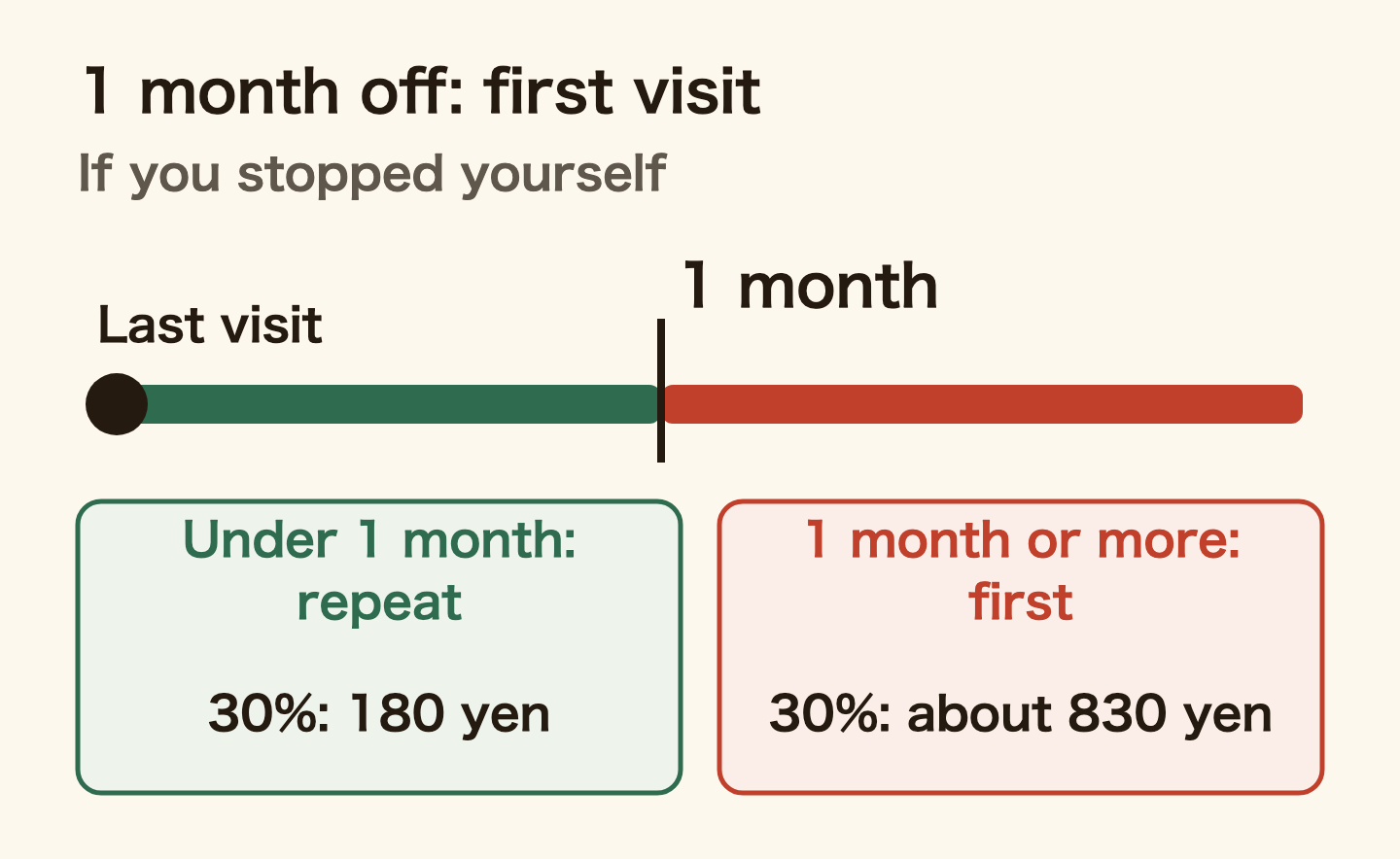
If you already know you will be away, for example on a trip home, tell the dentist and agree how far to take the treatment before you go.
What if I cannot pay, or the dentist suggests self-pay treatment?
“There is also a treatment outside insurance.” Do not decide on the spot; ask what it involves, what it costs, how long it takes and what the risks are. Japan’s National Consumer Affairs Center advises exactly this before implant treatment. Asking “What can be done on insurance?” is not rude.
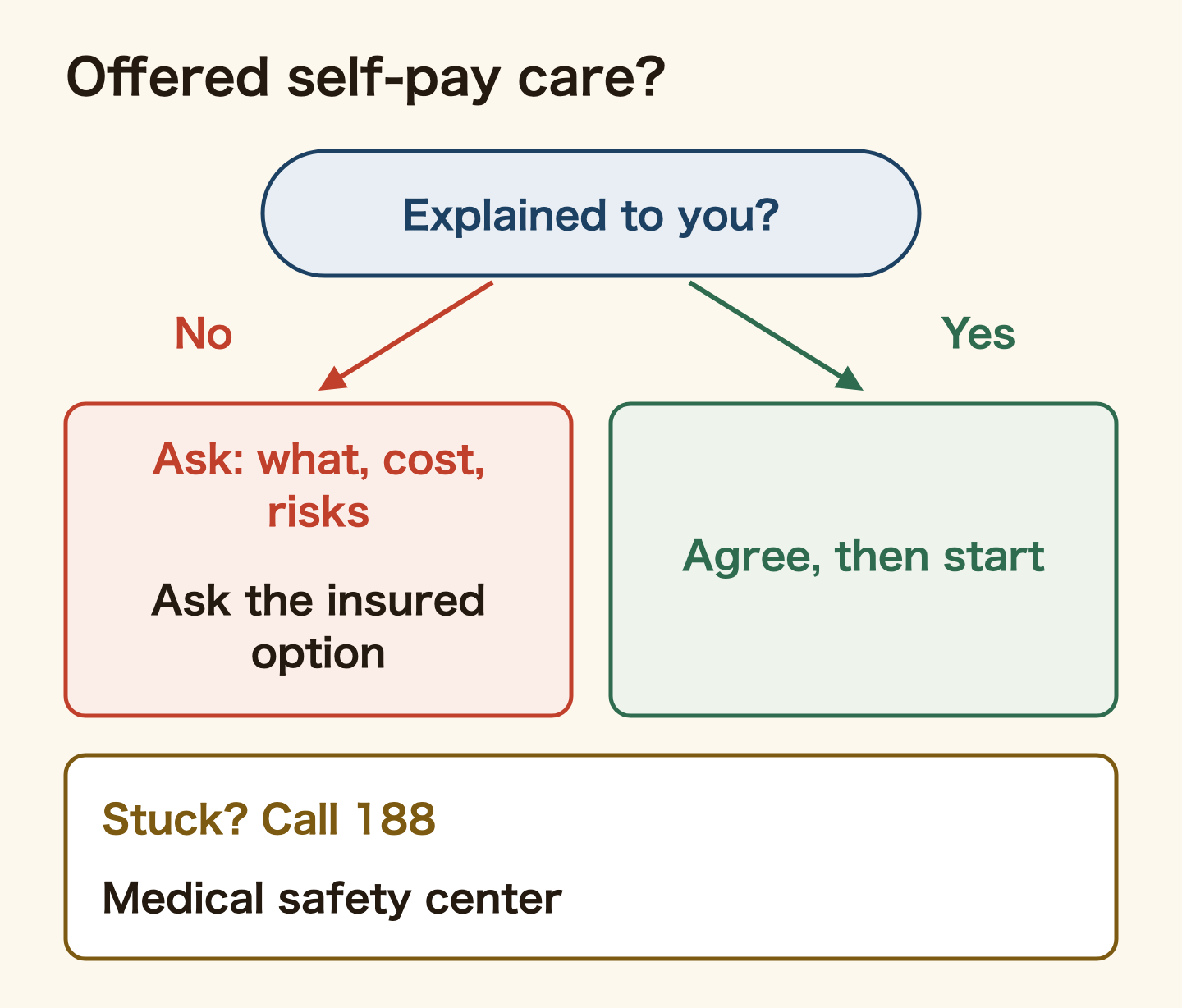
If something goes wrong, there are two places to turn. The consumer hotline 188 connects you to your local consumer centre (advice is free, the call is not). Medical complaints and questions go to a medical safety support center; there are about 400 of them, run by prefectures and larger cities.
Some things help when money is tight:
- Medical expense deduction — when a year’s medical costs go over 100,000 yen (or 5% of total income if that is under 2 million yen), you get tax back. The National Tax Agency counts gold and porcelain work, but not orthodontics for appearance, and not the interest and fees on a dental loan
- Free or low-cost medical care — a service for people on low incomes, set out in the Social Welfare Act (Article 2). Only some institutions offer it, so ask your city office
- Child medical subsidy — your city pays part of your child’s medical costs. The amount and age limit depend on the city
How to claim the deduction is in the medical expense deduction guide.
Toothache on a Sunday or at night?
On Sundays and public holidays, look for your city’s holiday dental service. Nishinomiya City, for example, has a dental welfare centre (0798-41-2031) open on Sundays and holidays, with reception from 9:30am to noon. Bring your My Number card or insurance card.
Places and hours differ by city. Search your city’s page for “kyūjitsu shika” (holiday dental) or use Navii’s search for clinics open at night and on holidays. For patients aged 6 and over, a holiday first visit costs 750 yen more at 30%. If it looks life-threatening, call 119 for an ambulance.
Which one are you?
- Your tooth hurts and you have your My Number health card or eligibility certificate — find a dental clinic nearby on Navii and phone to book today. Bring about 830 yen for the first-visit fee plus money for treatment.
- You are nervous about phoning in Japanese — print the ministry’s dental questionnaire in your language and tick your symptoms. In Tokyo, call 03-5285-8181 to find a clinic in your language.
- You are thinking about implants or whitening — these are self-pay, so at the first consultation ask for the treatment, cost, time and risks in writing. Do not decide that day.
- You stopped going halfway through treatment — call before a month passes and rebook. If you are going abroad, tell them that too.
FAQ
Q. Can foreigners use health insurance at the dentist in Japan?
Yes. If you are on National Health Insurance or a company plan, it works exactly as it does for Japanese people. Under 70, you pay 30% at the desk.
Q. How much is a first visit to the dentist in Japan?
Under the fee schedule from June 2026, the first-visit fee plus the price add-on is 2,750 yen, so about 830 yen at 30%. X-rays and treatment are added on top. Clinics that have not registered infection-control measures charge a little less, 245 points.
Q. What does Japanese health insurance not cover at the dentist?
Implants are self-pay as a rule, and whitening is not covered. Implants are insured only for certain conditions, such as after jaw surgery for cancer. Gold alloy and metal-base dentures are “selected care”: insured treatment plus an extra charge.
Q. Do I need an appointment for the dentist in Japan?
Some clinics see patients without one, but others need an appointment or see you sooner with one. Phone before you go, say it is your first visit, and book.
Q. What if I forget my insurance card?
You pay the full fee that day. If your My Number health card is not registered yet and you have no eligibility certificate, you can claim from your insurer later; if approved, everything except your normal share comes back.
Q. Can I say no to self-pay treatment?
The choice is yours. For selected care with an extra charge, the clinic must explain the treatment and cost and get your consent first. Ask what it involves, the cost, the risks and the insured option before deciding.
Summary
Foreign residents with Japanese health insurance pay 30% at the dentist, like everyone else. The first-visit fee is 2,750 yen, about 830 yen at 30%, and a repeat visit is 180 yen at 30%, with tests and treatment added. Implants are self-pay as a rule and whitening is not covered, so hear the explanation before agreeing to any extra-charge or self-pay work.
Search Navii for “dental clinic” and your language, then phone to book. The ministry’s dental questionnaire lets you describe symptoms in your language. Do not drop treatment halfway; rebook before a month passes. On holidays, use your city’s holiday dental clinic.
Official sources: MHLW dental fee schedule (Notice No. 69 of 2026, in force 1 June) / MHLW notes on the dental fee schedule / MHLW copayment rates / MHLW mixed insured and uninsured care / MHLW multilingual materials (dental questionnaire) / Rules for insured medical care / Japan Dental Association, implants / NTA No.1128 / ISA Guidebook on Living and Working, 8th ed. / Tokyo, how to see a doctor / Nishinomiya City, holiday and night care (all checked 30 September 2026, in Japanese). Confirm the cost of any treatment with the clinic before it starts.
Related reading
Found this useful? Share it
Send it to a friend who lives in Japan.
WHO WROTE THIS

mori
Japanese. I read the ministries’ own notices, orders and Q&As in the original, and I start from what my Nepalese and Sri Lankan friends in Japan actually ran into. I do not write about what I have not checked or been told.
What this site can and cannot do →Looking for something else?