Checked on 26 September 2026 against the Immunization Act and its Enforcement Order on e-Gov, the Ministry of Health, Labour and Welfare’s routine vaccination guidelines (revised 1 September 2026) and vaccination Q&A, and official guidance from Yokohama, Osaka, Saitama and Kawaguchi. This explains the system; it is not medical advice.
The short answer
- Routine vaccinations (teiki sesshu) are the ones set by the Immunization Act and given by the city, town or ward where you live. Nationality is not a condition. Foreign children are included.
- Each routine vaccine is publicly funded only within a set age window. Yokohama and Osaka make them free. After the window closes, the same vaccine becomes a voluntary shot you pay for.
- The forms (yoshinhyo, the pre-vaccination questionnaire and voucher) come from the city where you are registered as a resident. After arriving or moving, do not wait for them: go to your city’s health centre and ask.
- Vaccines your child had abroad can count, if the doctor agrees and you consent. Keep the original record from home.
- You get the shot at a local clinic that works with the city, you book it yourself, and a parent normally has to come along.
Knowing this, you can find out in your first week after arriving or moving which shots your child still needs and when each publicly funded window closes, and book before it does. You can also ask a doctor to count the shots your child already had at home instead of repeating them.
Three months after you arrive, you take your two-year-old to a clinic. At reception they ask which vaccinations your child has had. The card from home is in your own language. At home there are several envelopes from the city office, and you are not sure what any of them are. A Japanese parent at the playground says, “You just take the voucher from the handbook to the clinic.” Your family never had that voucher in the first place.
- Are vaccinations free for foreign children in Japan?
- Routine vs voluntary vaccinations: what is the difference?
- Until what age are routine vaccinations publicly funded?
- Where do the vaccination forms come from?
- Just arrived or moved: what do I do?
- What about vaccinations my child had in my home country?
- Where do we get vaccinated, and how do I book?
- How much does it cost?
- What if the age window has passed?
- No record, or not sure what was given?
- Which one are you?
- FAQ
- Summary
- Related reading
Are vaccinations free for foreign children in Japan?
Child vaccinations in Japan come in two kinds: routine (teiki sesshu) and voluntary (nin’i sesshu).
Routine vaccinations are carried out by the city under the Immunization Act. The Act says the mayor must vaccinate “persons residing within the municipality” (Immunization Act, Article 5). There is no nationality condition. A foreign child living in Japan is covered on the same terms as a Japanese child.
The city pays for them under the law (Article 49). The Ministry of Health, Labour and Welfare’s vaccination Q&A says that for these childhood vaccinations (the “Category A” diseases), “if you receive them in the municipality where you live, they are publicly funded”. Yokohama’s children’s vaccination guide says the vaccination is free within the target period, and Osaka says Category A shots are free at its contracted clinics.
The routine childhood vaccinations cover (Immunization Act Article 2, Enforcement Order Article 1):
- Diphtheria, whooping cough, polio, tetanus and Hib (now given together as the five-in-one vaccine)
- Measles and rubella (the MR vaccine)
- Tuberculosis (BCG), hepatitis B, rotavirus, childhood pneumococcal disease, chickenpox and Japanese encephalitis
- HPV, for girls of roughly the last year of primary school to the first year of high school
The RSV vaccine for pregnant women (once, between 28 weeks 0 days and 36 weeks 6 days) is also routine. If you are pregnant, the guide to the boshi techo handbook and prenatal checkups covers the steps from registering the pregnancy to the birth.
Routine vs voluntary vaccinations: what is the difference?
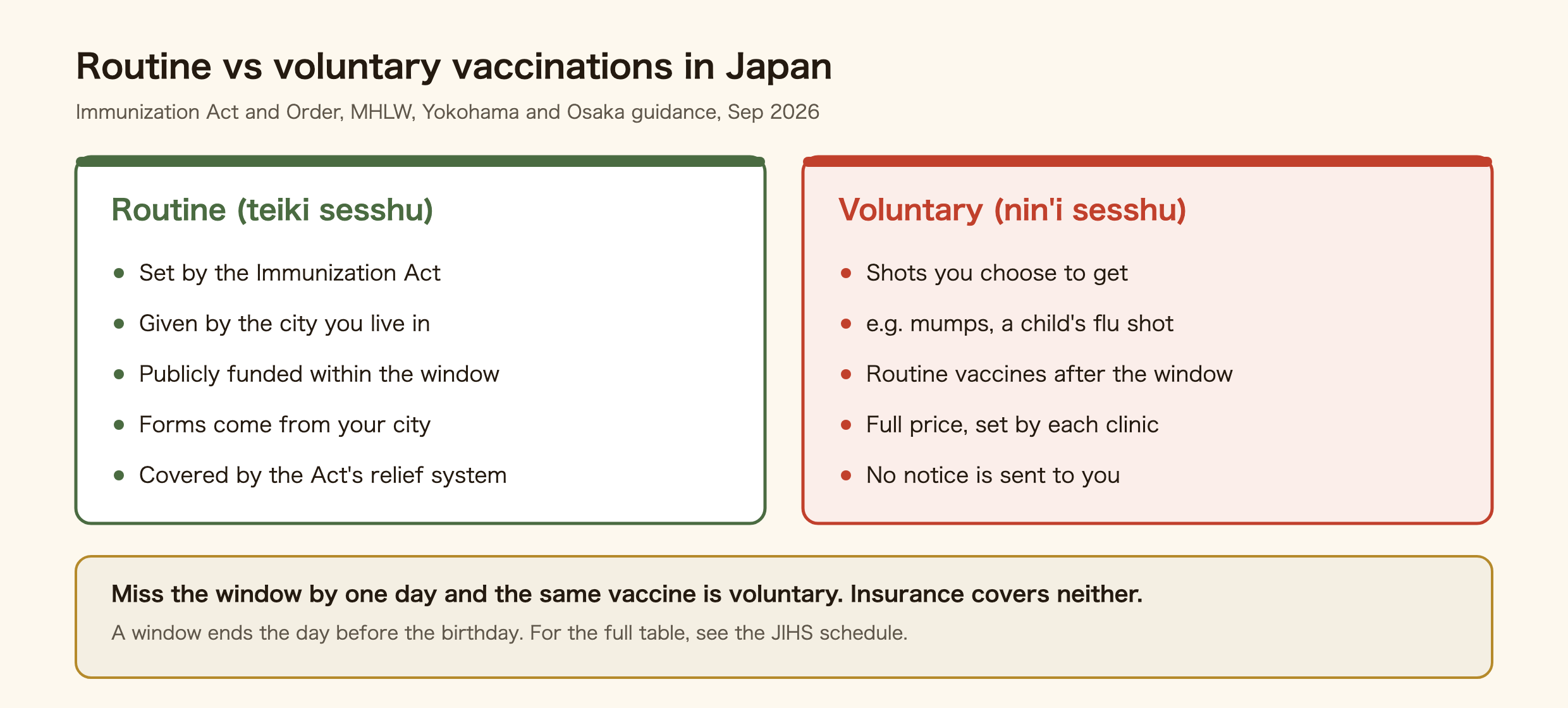
A voluntary vaccination is any shot outside the routine programme that you choose to get. The ministry’s examples:
- Seasonal flu and mumps vaccines
- Vaccines recommended for travel, depending on the destination
- A routine vaccine given after the child has passed the target age
| Routine | Voluntary | |
|---|---|---|
| Set by | The Immunization Act and Enforcement Order | You, with your doctor |
| Cost | Publicly funded within the window (free in Yokohama and Osaka) | In principle the full price, set by each clinic |
| Notice | Sent by the city where you are registered | None. You find it yourself |
| Relief for health damage | The Immunization Act’s relief system | Outside the Immunization Act’s relief system |
| Health insurance | Not used for either (a vaccination is not a treatment) | |
A child’s flu shot is voluntary. What it costs and which cities help pay is in the flu shot guide.
For Category A routine vaccinations, the law says the child and parents “shall endeavour” to receive them (Article 9). It is a duty to try, not an order. The Immunization Act has no penalty for not getting vaccinated.
Until what age are routine vaccinations publicly funded?
Your child has a fever that drags on, and you put off a planned shot for a few months. You can always get it later, when things settle. Where you come from, that may be normal. In Japan, each routine vaccine is publicly funded only within an age window set by law, and after it closes the same vaccine becomes a voluntary shot you pay for.
Some of the windows (Enforcement Order Article 3):
- BCG and hepatitis B: until the first birthday
- Diphtheria, whooping cough, polio and tetanus (the five-in-one and similar): from 2 months to 90 months (7 years 6 months)
- MR (measles and rubella): first dose from age 1 until age 2; second dose in the one year before starting primary school
- Chickenpox: from age 1 until age 3
- HPV (girls): from 1 April of the school year in which she turns 12 to 31 March of the school year in which she turns 16
Rotavirus is the shortest: from about 6 weeks to 32 weeks after birth. Yokohama warns that once the rotavirus window has passed, the vaccine cannot be given at all, routine or voluntary. For the full table of doses and timing, use the official vaccination schedule from the Japan Institute for Health Security (JIHS).
Japan counts the end of a window in a particular way. Under the ministry’s interpretation, a child becomes a year older on the day before their birthday. So “until age 1” means up to and including the day before the first birthday. Months work the same way: “3 months old” arrives on the day before the same date three months later. For a child born on 1 April, the last day for BCG is 31 March the following year.
The second MR dose has only that one year before primary school. It falls in the same year as enrolling your child in a Japanese primary school, so put both in your calendar together.
Where do the vaccination forms come from?
The city runs routine vaccinations, so the city sends the notices. Article 6 of the Enforcement Order requires it to tell each child’s parents in advance which vaccines, when and where. The ministry’s guidelines say this should, in principle, be an individual notice, in practice a letter to your home.
How it arrives differs by city:
- Yokohama: sends the forms (vouchers) before the child turns 0, 1 and 3, before the final kindergarten year, before 9 and 11, and to girls before the first year of junior high
- Osaka: gives a “vaccination booklet” with the forms attached when it issues the Maternal and Child Health Handbook
A child born in Japan picks up the forms along the way, through the birth registration and the steps after having a baby. A child born abroad never goes through that.
The guidelines note that more foreign children are now eligible and ask cities to try to give notices in English, Chinese, Korean, Vietnamese, Nepali and other languages. Yokohama publishes an English guide and English and Chinese sample forms. The samples are for reading. You still fill in the official Japanese form. Some cities have also started a digital questionnaire you fill in on Mynaportal.
Just arrived or moved: what do I do?
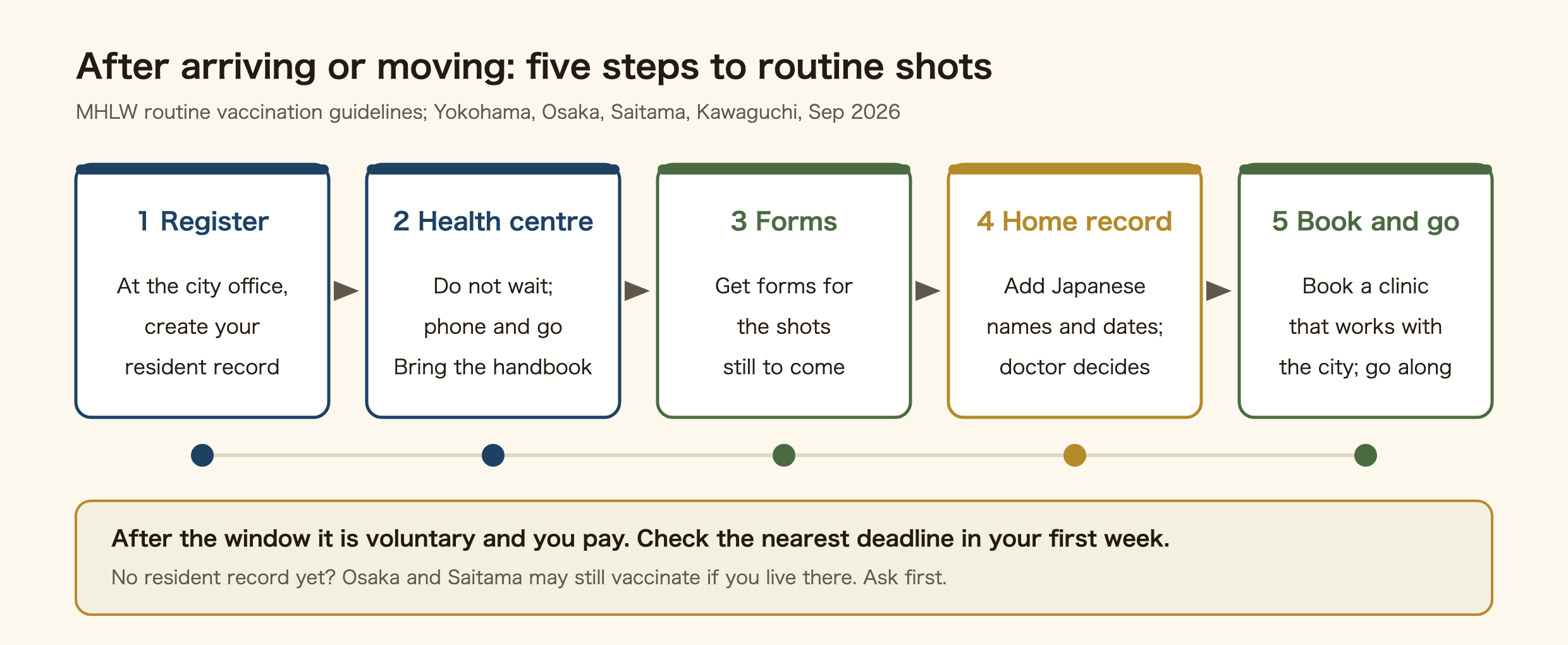
Routine vaccinations are run by the city you live in, so when you move you switch to your new city’s forms. Yokohama says that if you have moved in from another city and still have shots to go, the ward office will issue the forms once you complete the procedure. Osaka tells families moving in to phone the ward health and welfare centre and bring the Maternal and Child Health Handbook.
The key is to go yourself. In a city that sends forms at fixed ages, a child who moves in after that point will not get them in the post unless you ask. Osaka gives a “vaccination number” to children aged 7 years 6 months or younger when they move in, and sends it by letter in the second half of the following month. Do not wait for the letter. Phone first and collect the forms.
Start with registering your address at the city office, because routine vaccinations belong to the city you live in. At the same counters you can also ask about your child’s medical card and daycare applications.
Not registered yet? Do not give up. Osaka and Saitama say that a child who actually lives in the city may still get routine vaccinations without a resident record, so contact the health centre first. On the other hand, in Osaka a shot given while you have no home here, such as on a short visit back, is not under the Immunization Act: it is voluntary and you pay the full price.
What about vaccinations my child had in my home country?
The ministry’s guidelines are clear. Vaccinations received abroad can, based on the doctor’s judgement and the parent’s consent, be treated as the same number of routine doses already given. A vaccine your child had three times at home does not necessarily have to start again from dose one.
For that, the record from home has to be readable. What cities ask:
- Saitama: bring the record from abroad, work out which vaccines were given, and add the Japanese names to it. Use the Okayama Prefecture Vaccination Centre’s glossary of foreign vaccine terms to translate
- Kawaguchi: copy each vaccination date into the “vaccination record” pages of the Japanese handbook, and write the country’s name where the doctor would sign
- Kawaguchi: on the day of the shot, bring both the handbook with the copied dates and the original record from abroad
If your child has no Japanese handbook, ask the health centre when you move in where the record should be kept. Some cities, such as Misato, help at the counter with translating a foreign record and matching it to the Japanese schedule.
Which Japanese vaccine a foreign one matches, and how many doses count, is the doctor’s decision in the end. Do not skip a shot because you have decided yourself that it is done.
Where do we get vaccinated, and how do I book?
The notice gives a date, and you take your child to the public health clinic that day. Where you come from, that may be normal. In Japan, routine vaccinations are in principle given one child at a time at a local clinic that works with the city (the guidelines call this individual vaccination). Some cities also hold group sessions. Choosing the clinic and booking it is your job as the parent.
Each city lists the clinics on its website. Saitama warns that a clinic on the list may still turn you away for its own reasons, such as “existing patients only” or a minimum age, so check with the clinic and book in advance. Yokohama says you can go to a clinic in any of its wards, not only your own.
What to bring, using Yokohama’s list:
- The Maternal and Child Health Handbook (or another record of past vaccinations)
- Something showing name, date of birth and address (the child’s medical card, a My Number Card)
- The form
- A letter of authorisation, if a parent cannot come
A parent normally has to be present (guidelines). In Yokohama, a grandparent or someone else bringing the child needs a letter of authorisation. Each shot is written into the handbook.
If the Japanese form worries you, look for your city’s sample in your language, or ask the health centre.
How much does it cost?
| Situation | Cost |
|---|---|
| Routine vaccine, within the window, at a clinic working with your city | Publicly funded (free in Yokohama and Osaka) |
| Routine vaccine at a clinic outside your city | Yokohama: needs a request letter, and you usually pay (refunds for cases such as staying with family to give birth). Osaka: free at contracted clinics even outside the city |
| A shot after the window, or a vaccine not in the routine programme | Voluntary. In principle the full price, set by each clinic |
| Health insurance, children’s medical subsidy | Not usable for vaccinations |
| Vaccination certificate in English (Yokohama) | 300 yen each, about two weeks |
By law a city may charge the actual cost of a routine vaccination (Immunization Act Article 52). It may not charge a family that cannot pay for financial reasons. The guidelines say cities judge this by residence tax status, public assistance and similar. What you pay in your city is in the notice that comes with the forms.
What if the age window has passed?
After the window closes, the vaccine becomes voluntary and you pay in full, in principle (Yokohama). It is not only about money. The Immunization Act’s relief system for health damage covers vaccinations given under the Act, and Osaka describes a shot outside the Act as voluntary.
The exception is serious illness. Article 3(2) of the Enforcement Order says a child who could not be vaccinated within the window because of a long-term illness or similar “special circumstances” can get it as a routine vaccination for two years from the day those circumstances end. Some vaccines have an upper age limit. In Yokohama’s examples, BCG must be given before age 4 and childhood pneumococcal before age 6. You have to apply, and the city decides whether the illness qualifies, so talk to the health centre once your child is well enough.
If you simply forgot, there is no national exception. But some cities, such as Yokohama, make certain vaccines free on application, including hepatitis B, BCG, chickenpox and MR. Yokohama treats these as voluntary shots covered by the city’s own relief scheme. Ask your health centre whether your city has something similar.
No record, or not sure what was given?
In Japan the Maternal and Child Health Handbook is the vaccination record. Yokohama asks families to keep it for life, and a handbook lost after the child starts junior high cannot be reissued.
If it is lost, look in this order:
- Ask the clinic that gave the shots (Yokohama says clinics usually keep records for five years)
- Ask the city (Osaka can check shots given from April 2013, or April 2017 for BCG, at the ward health and welfare centre; bring ID)
- Look on Mynaportal (in Yokohama, some routine shots given in the city since January 2016; this is not a certificate)
If you still cannot tell, decide with the doctor. If you need a certificate in English for a move abroad or study, apply to the city where you live.
Which one are you?
- Just arrived in Japan with your child — after filing your moving-in notice, phone the health centre that same day. Take out the vaccination record from home and write the Japanese vaccine names and dates next to each entry.
- Moved within Japan — take the handbook to your new city’s health centre and collect forms for the shots still to come.
- Have the forms but have not booked — find the form with the nearest deadline, choose a clinic from the city’s list, and phone it today.
- The window has passed — if illness was the reason, phone the health centre and ask how to apply for the exception. If you forgot, ask whether your city has its own free scheme.
FAQ
Q. Are vaccinations free for foreign children in Japan?
Routine vaccinations are publicly funded within their age windows, whatever the child’s nationality. The Immunization Act covers people living in the city. Yokohama and Osaka make routine shots within the window free.
Q. What is the difference between routine and voluntary vaccinations in Japan?
Routine vaccinations are set by the Immunization Act and given by the city, publicly funded within the window. Voluntary vaccinations are shots you choose, and in principle you pay the full price. Mumps, a child’s flu shot and any shot after the window are voluntary.
Q. What happens if my child misses the routine vaccination window?
The shot becomes voluntary and, in principle, you pay the full price. If a long-term illness or similar prevented it, there is an exception: two years from the day those circumstances end, as a routine vaccination.
Q. We just moved. What do I do about the vaccination forms?
Get forms for the remaining shots from your new city’s health centre. Bring the Maternal and Child Health Handbook. Routine vaccinations are run by the city you live in, so after a move you use your new city’s forms.
Q. Do vaccinations from my home country count in Japan?
With the doctor’s judgement and your consent, they can be treated as routine doses already given. Bring the record from home, check the vaccine names and dates in Japanese, and ask the clinic.
Q. Is there a penalty for not vaccinating my child in Japan?
The Immunization Act has no penalty for not being vaccinated. For routine childhood vaccinations, the law asks the child and parents to endeavour to receive them.
Summary
Children’s vaccination in Japan centres on the routine vaccinations set by the Immunization Act. The city you live in gives them, and nationality does not matter. Each one is publicly funded within its age window, and once the window closes the same vaccine becomes a voluntary shot you pay for.
After arriving or moving, go to the health centre for the forms instead of waiting for them. Keep the vaccination record from home and let the doctor count those doses. Then book a local clinic yourself.
Official sources: e-Gov, Immunization Act (Japanese) / e-Gov, Immunization Act Enforcement Order (Japanese) / MHLW routine vaccination guidelines, revised 1 September 2026 (Japanese) / MHLW vaccination Q&A (Japanese) / MHLW notice on interpreting target ages (Japanese) / MHLW vaccination relief system (Japanese) / Yokohama City, children’s vaccinations / Osaka City, vaccination FAQ / Saitama City, children who moved from abroad / Kawaguchi City, copying records from abroad into the handbook. Checked on 26 September 2026. Windows, charges and procedures differ by city, so confirm with your own city’s guidance.
Related reading
Found this useful? Share it
Send it to a friend who lives in Japan.
WHO WROTE THIS

mori
Japanese. I read the ministries’ own notices, orders and Q&As in the original, and I start from what my Nepalese and Sri Lankan friends in Japan actually ran into. I do not write about what I have not checked or been told.
What this site can and cannot do →Looking for something else?