Checked on 10 October 2026 against the Labour Standards Act, the Childcare and Family Care Leave Act and the Employees’ Pension Insurance Act (e-Gov), Kyokai Kenpo’s maternity allowance page, the MHLW leaflet on childcare leave benefits (revised 1 August 2026) and the Immigration Services Agency page on deemed re-entry. The benefit caps are the figures valid until 31 July 2027.
In short
- Maternity and childcare leave are legal rights to stay employed while off work around a birth and until the child turns one, and foreigners have exactly the same rights. Six weeks before and eight after (Labour Standards Act); childcare leave to age one (up to two if no nursery place).
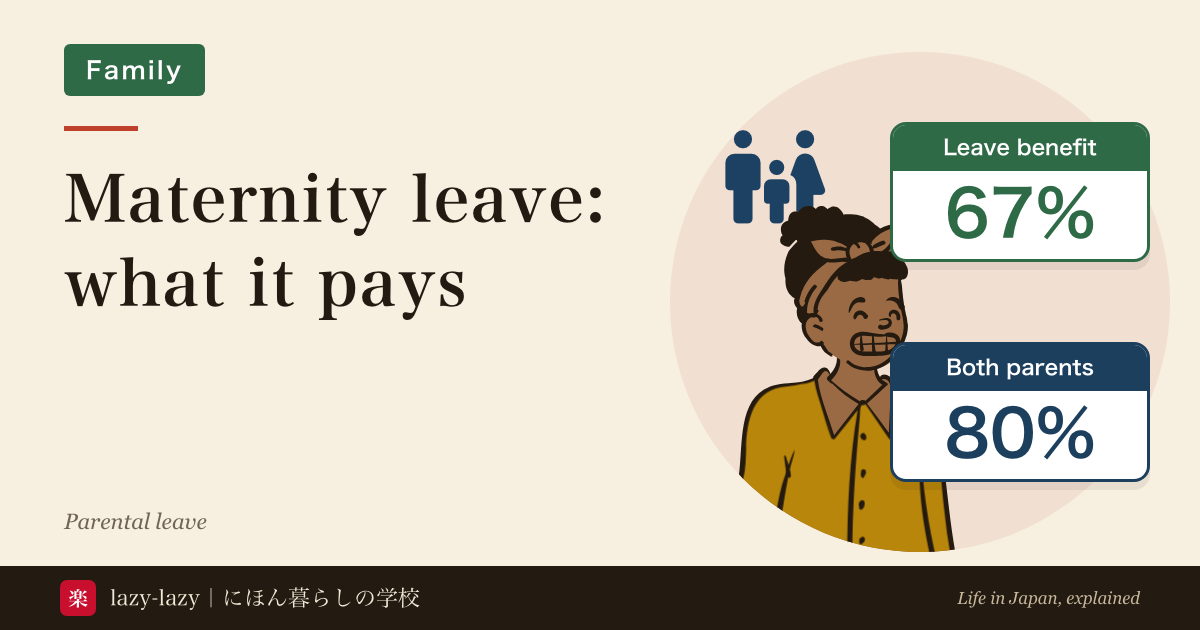
- While off, you are paid benefits, not salary. Maternity: the maternity allowance (two-thirds of pay, employer health-insurance members only). Childcare leave: the childcare leave benefit (67% for 180 days, then 50%).
- Since April 2025, if both parents take 14 days or more, the first 28 days pay 80% – roughly full take-home. Benefits are tax-free and social insurance premiums are waived.
- Conditions: 12 months in employment insurance, and for fixed-term contracts, no clear end before the child is 18 months. Student part-time jobs are outside.
- Resign and go home, and the benefit stops that day. Going home while still employed is different from quitting.
Once you know this, on the day you learn you are pregnant you can say, in numbers, how many months you can be off and what will land in your account. And when you talk to your employer, you are the one who knows what the rules say.
You are pregnant. Telling the company feels frightening. Maybe they will say “foreigners cannot take childcare leave”. If they do, the law is on your side, not theirs. Japanese colleagues say “everyone takes it” but cannot tell you what it pays. Here is how long you can be off, what money arrives while you are, the conditions, and the one problem only foreigners have – going home – using nothing but the law and the Ministry’s own figures.
- What are maternity and childcare leave? Legal rights, the same for foreigners
- Quick reference: when, how long, and what pays
- What arrives while you are off? Two-thirds during maternity leave, 67% then 50% on childcare leave
- Can fathers take it? Yes – up to 28 days of post-birth leave
- The conditions: 12 months in employment insurance, and a contract that runs to 18 months
- What if you go home? Staying employed and quitting are two different things
- If they refuse, or tell you to quit? The law stops them
- The decision: once you know you are pregnant, in this order
- FAQ
- Summary
What are maternity and childcare leave? Legal rights, the same for foreigners
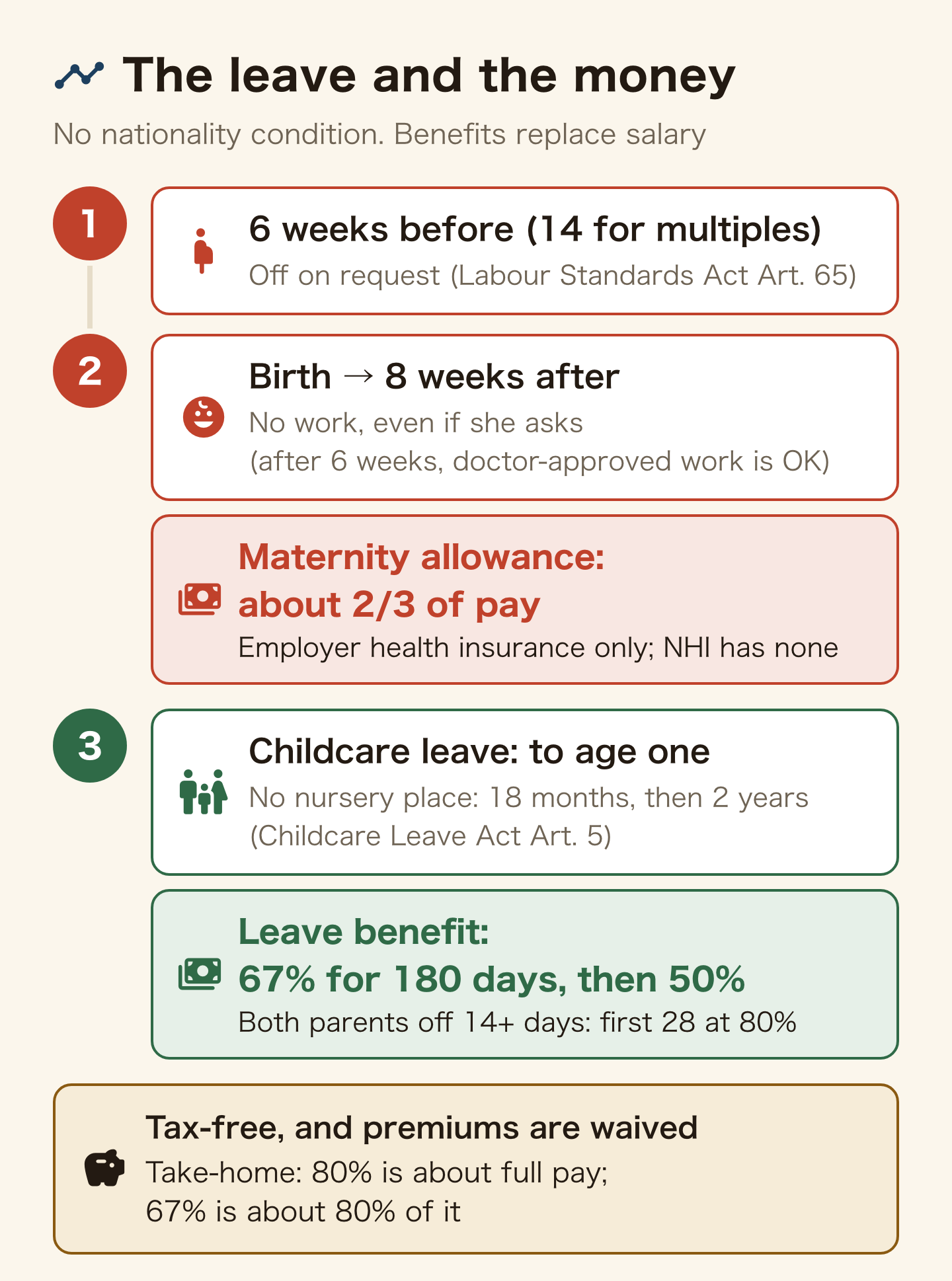
Maternity leave (sankyu) is the right, under the Labour Standards Act, for the person giving birth to be off work for six weeks before the birth (14 for multiples) and eight weeks after (Art. 65). Before the birth the employer must release her on request; for eight weeks after, the employer may not have her work even if she asks (after six weeks, work a doctor approves is allowed at her request).
Childcare leave (ikukyu) is leave a worker raising a child under one can take by applying to the employer (Childcare and Family Care Leave Act, Art. 5). Mothers and fathers alike. If there is no nursery place, it can be extended to 18 months and then to two years.
Neither article has a nationality condition. “Because you are foreign” or “we have never done it here” is not a lawful reason to refuse.
Quick reference: when, how long, and what pays
| Leave | Period | Who | Money | Basis |
|---|---|---|---|---|
| Before the birth | From 6 weeks before the due date (14 for multiples) | The person giving birth, on request | Maternity allowance (about two-thirds of pay) | Labour Standards Act Art. 65 |
| After the birth | 8 weeks from the day after the birth (after 6 weeks, doctor-approved work is allowed on her request) | The person who gave birth (may not be made to work even if she asks) | Maternity allowance (same) | Labour Standards Act Art. 65 |
| Post-birth paternal leave | Up to 28 days in total within 8 weeks of the birth, in up to two blocks | Mainly fathers | 67% (80% with the top-up) | Childcare Leave Act Art. 9-2 |
| Childcare leave | Until the child is 1 (up to two blocks); 18 months, then 2 years if there is no nursery place | Mothers and fathers | 67% for 180 days, then 50% | Childcare Leave Act Art. 5 |
| Premiums while on leave | For the leave period | When the employer files | Health insurance and pension premiums waived | Employees’ Pension Insurance Act Arts. 81-2, 81-2-2 |
| Dismissal and unfavourable treatment | No dismissal during maternity leave and the 30 days after; no dismissal or other unfavourable treatment for applying for or taking childcare leave | Everyone | – | Labour Standards Act Art. 19; Childcare Leave Act Art. 10 |
If both parents use the “Papa-Mama plus” arrangement, the period covered by the benefit runs until the child is 1 year 2 months old (MHLW leaflet).
What arrives while you are off? Two-thirds during maternity leave, 67% then 50% on childcare leave
You expect your usual salary to keep landing in your account while you are on maternity leave. Where you come from, that may be taken for granted. Japan works differently: what arrives instead of salary is a benefit, and it is smaller than your normal pay.
The employer owes no salary while you are on leave. Two benefits take its place.
- Maternity allowance (during maternity leave) – for the person giving birth who is a member of employer health insurance (Kyokai Kenpo or a company plan). For days off without pay from 42 days before the birth (98 for multiples) to 56 days after: per day, the average standard monthly remuneration of the last 12 months / 30 x two-thirds. On 250,000 yen a month, about 5,600 yen a day, roughly 540,000 yen over the full 98 days. National Health Insurance has no such benefit.
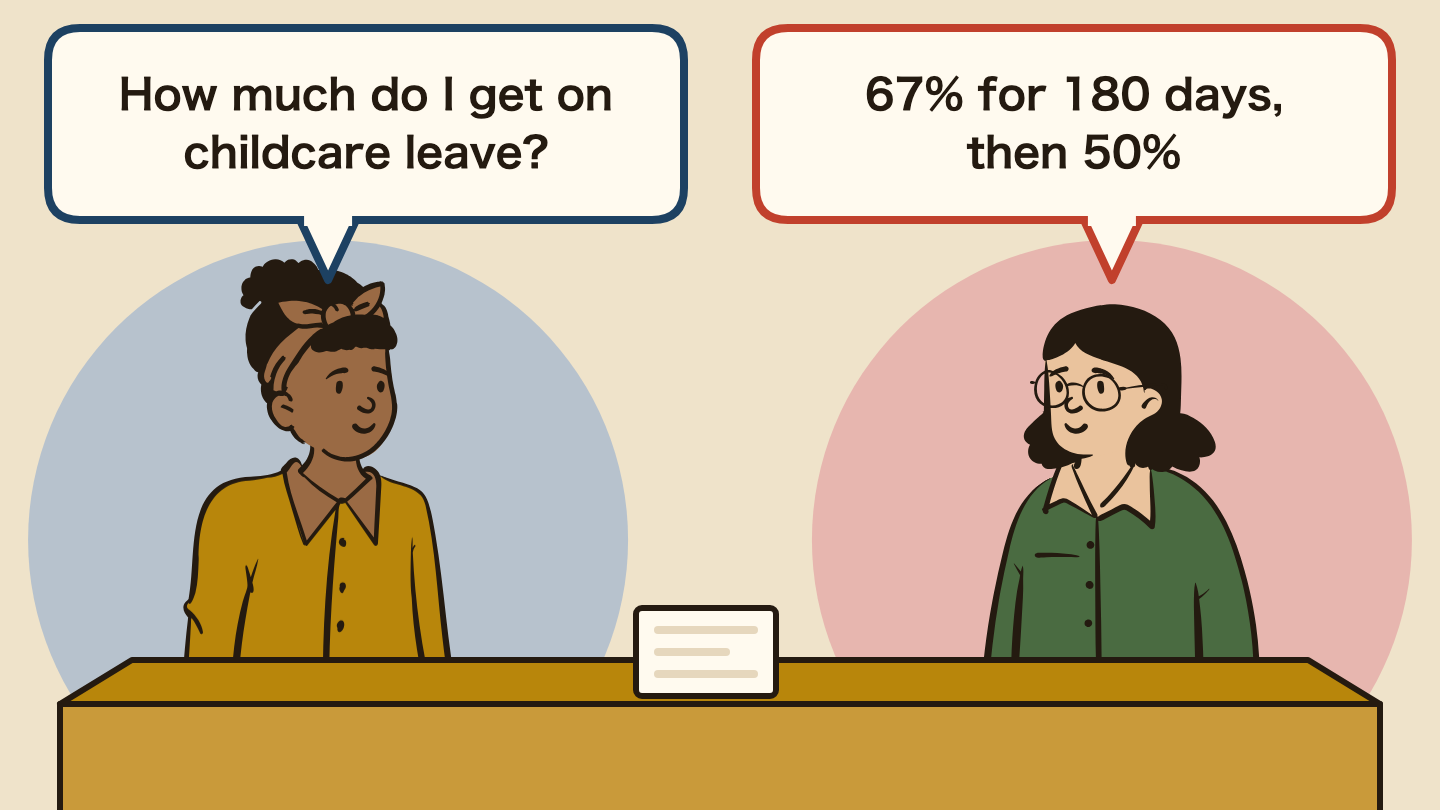
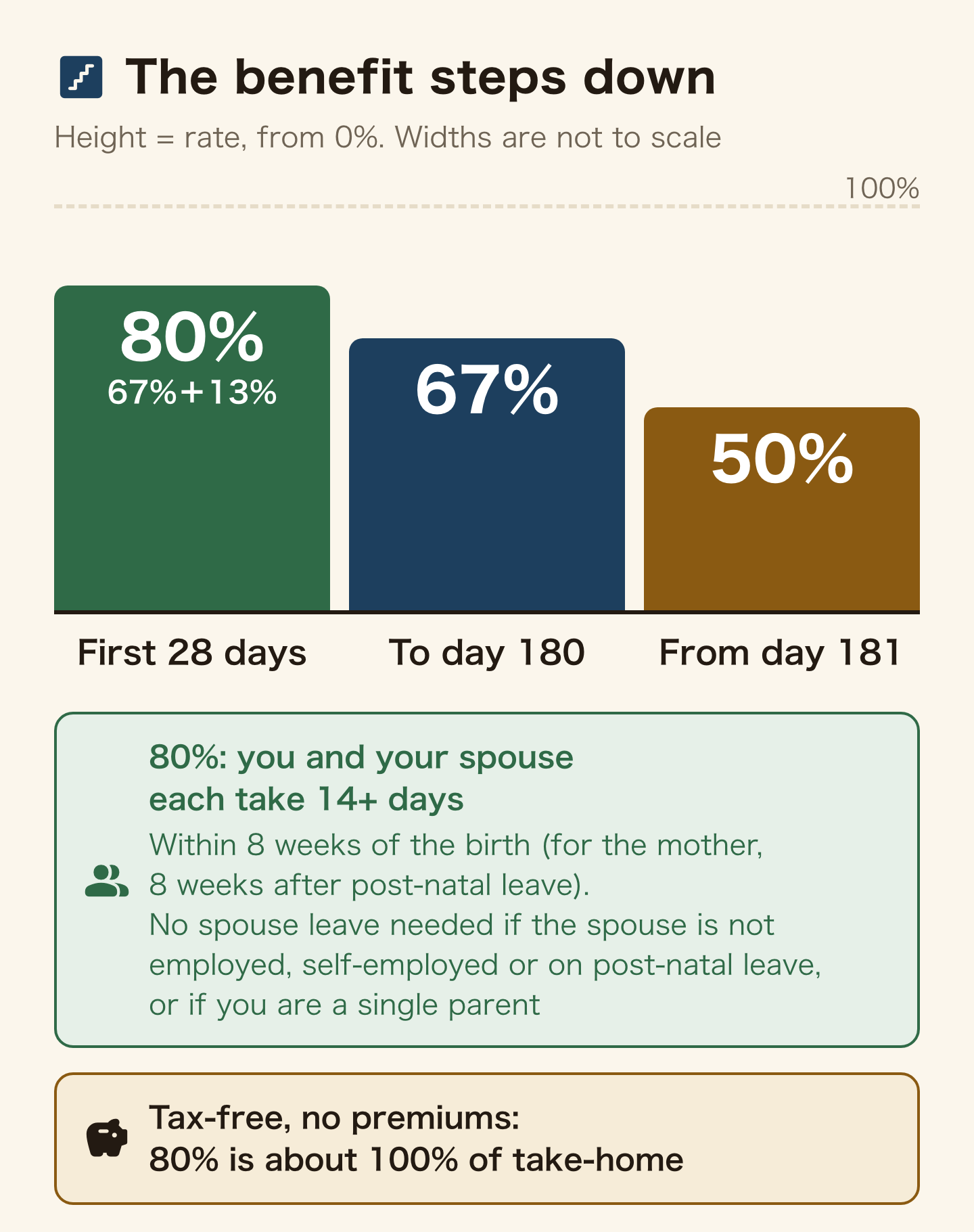
- Childcare leave benefit (during childcare leave) – for people insured under employment insurance. Daily wage at the start of leave x days x 67% for up to 180 days, then 50% (MHLW leaflet, August 2026 edition). The daily wage is capped (16,540 yen, until 31 July 2027), so a 30-day payment tops out at 332,454 yen (67%) or 248,100 yen (50%).
Then the top-up added in April 2025. If, within eight weeks of the birth (for the mother, eight weeks after her post-natal leave), you take 14 or more days of childcare leave and your spouse also takes 14 or more, the first 28 days carry a 13% “post-birth leave support benefit”, for 80% in total. The spouse’s leave is not required if the spouse is not employed, self-employed, on post-natal leave, or you are a single parent.
Examples by monthly pay
These assume a steady monthly salary with no bonus or overtime swings. Amounts are before tax and premiums. The childcare leave benefit is per 30 days (the 80% rate per 28 days); the maternity allowance is the total for the full 98 days (42 before and 56 after the birth).
| Monthly pay | Maternity allowance (98 days total) | Leave 67% (30 days) | Leave 50% (30 days) | 80% (first 28 days) |
|---|---|---|---|---|
| 200,000 yen | about 436,000 yen | 134,000 yen | 100,000 yen | about 149,300 yen |
| 250,000 yen | about 544,000 yen | 167,500 yen | 125,000 yen | about 186,700 yen |
| 300,000 yen | about 653,000 yen | 201,000 yen | 150,000 yen | 224,000 yen |
| 400,000 yen | about 871,000 yen | 268,000 yen | 200,000 yen | about 298,700 yen |
| 500,000 yen or more | monthly pay / 30 x two-thirds x 98 days | capped at 332,454 yen | capped at 248,100 yen | capped at 370,496 yen |
According to the MHLW leaflet, the “daily wage at the start of leave” behind the childcare leave benefit is your total wages for the last six months (excluding irregular pay and pay made at intervals over three months) divided by 180. On a steady salary that is monthly pay / 30, and the 16,540 yen cap corresponds to roughly 496,000 yen a month. The maternity allowance does not use the daily wage; it uses the average standard monthly remuneration (your pay placed into a grade) over the last 12 months, so it can differ from the table by a few thousand yen. The table is the official formula applied to round monthly pay; what you actually receive is set by your insurer and your application.
If the employer pays wages during childcare leave, the benefit is reduced, and once the wages reach 80% or more of daily wage x days, no benefit is paid. You may work 10 days or fewer in each one-month payment period (or 80 hours or fewer if you work more than 10 days) (MHLW leaflet).
The benefits are tax-free, and health-insurance and pension premiums are waived while you are on leave (Employees’ Pension Insurance Act, Arts. 81-2 and 81-2-2; the employer files). That is why the Ministry describes 80% as “roughly 100% of take-home”. Even 67% comes to about 80% of your usual take-home, since nothing is deducted.
Can fathers take it? Yes – up to 28 days of post-birth leave
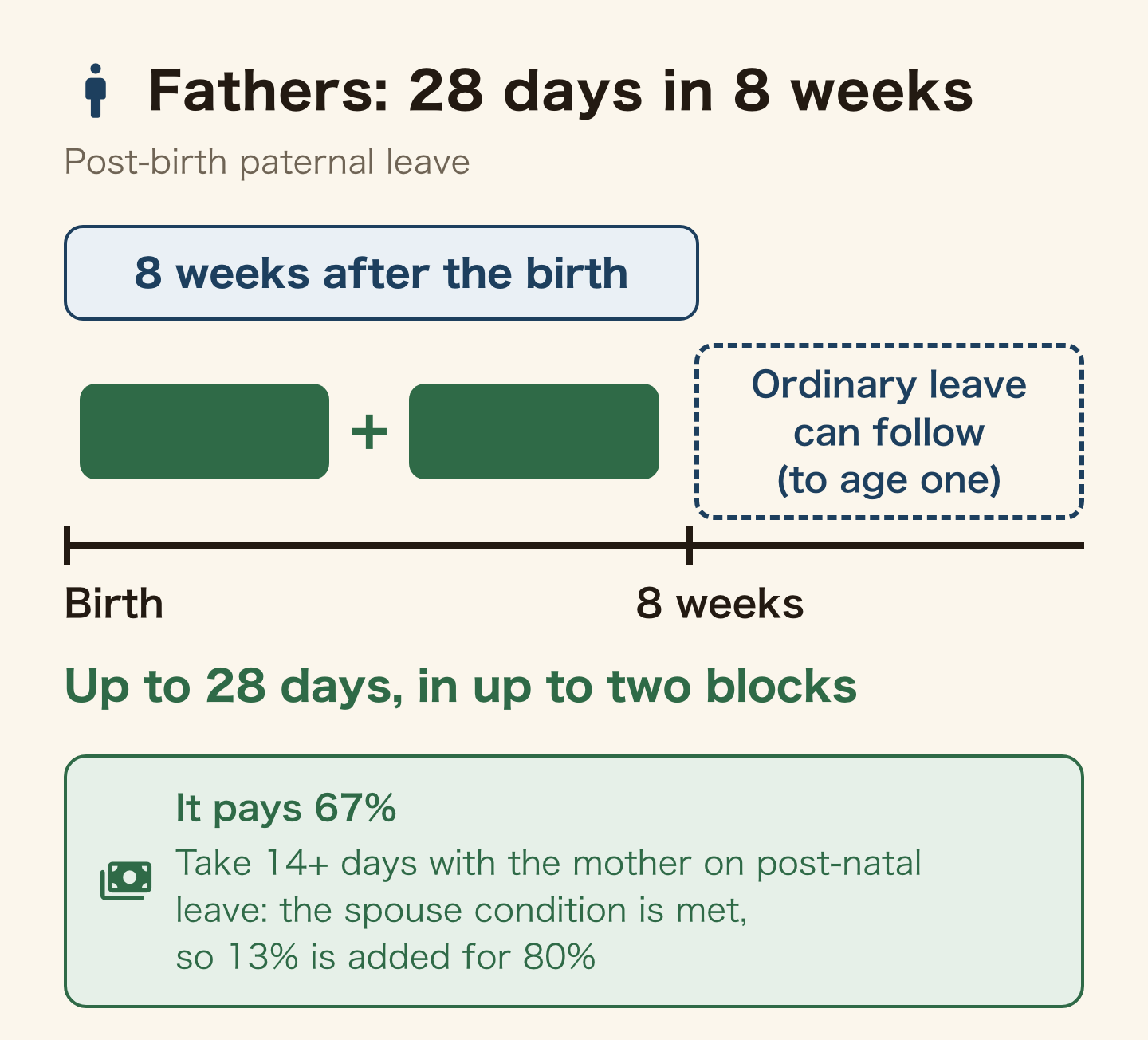
A father can take up to 28 days of “post-birth paternal leave” within eight weeks of the birth, in up to two blocks. It pays 67% as the post-birth childcare leave benefit, and since the mother is on post-natal leave the spouse condition is met, so the 13% supplement applies: 80%. Ordinary childcare leave to age one can follow.
This applies equally to families where the working parent is a foreigner. Read it with the baby’s residence status and the 500,000 yen grant, and the monthly child allowance (apply within 15 days).
The conditions: 12 months in employment insurance, and a contract that runs to 18 months
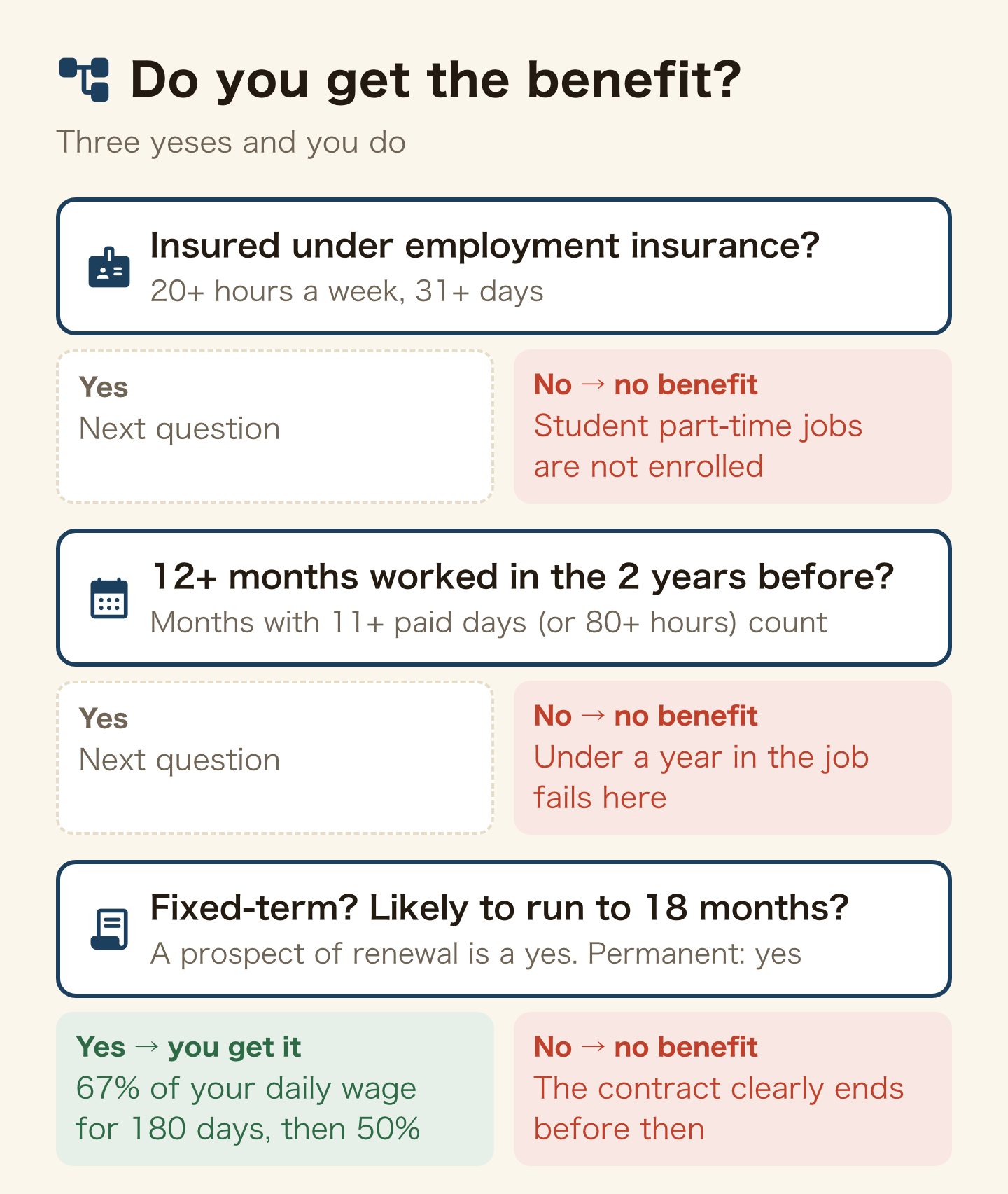
- Insured under employment insurance – 20 or more hours a week, 31 or more days. A student’s part-time job is not enrolled, so no childcare leave benefit (maternity leave itself is Labour Standards Act and still applies).
- Twelve or more months with 11 or more paid days (or 80 or more hours) in the two years before the leave starts – under a year in the job in Japan, and this is where it fails.
- On a fixed-term contract (contract or agency staff), it must not be clear that the contract ends before the child turns 18 months (Art. 5 proviso). A realistic prospect of renewal is enough. “Fixed-term, so no” is wrong.
Childcare leave itself has one more gate, separate from the benefit. If the employer and the workers’ representative have a written labour-management agreement excluding employees with less than one year of service, the employer may refuse the request (Childcare and Family Care Leave Act, Art. 6). Ask HR or check the work rules whether such an agreement exists. Maternity leave (Labour Standards Act) and the maternity allowance have no such exception. Apply at least one month before the date you want to start; if you apply later, the employer may push the start date to a date within one month of your application.
For the maternity allowance the only condition is membership of employer health insurance (the plan you are in together with the Employees’ Pension).
What if you go home? Staying employed and quitting are two different things
This is the problem only foreigners have. Many want to go home during the leave so their parents can help.
- Go home temporarily while still employed – the leave continues, and as long as the conditions hold (still insured, few working days), so does the benefit. Back within a year, you leave on the deemed re-entry permit. If your period of stay ends sooner than a year after you leave, you must be back by that date. Carry a valid passport and your residence card, and tell the officer at departure that you are leaving on the deemed re-entry permit. People with a period of stay of three months or less, and short-stay visitors, are not covered.
- Resign and go home – on the day you leave the company you stop being insured, and the childcare leave benefit ends there. The maternity allowance continues after resignation only if you had been in employer health insurance continuously for a year or more up to the day before you left, and you resign while on leave; if you work on your last day, you lose it (Kyokai Kenpo). For the childcare leave benefit, “I’ll quit first, then go home” loses money.
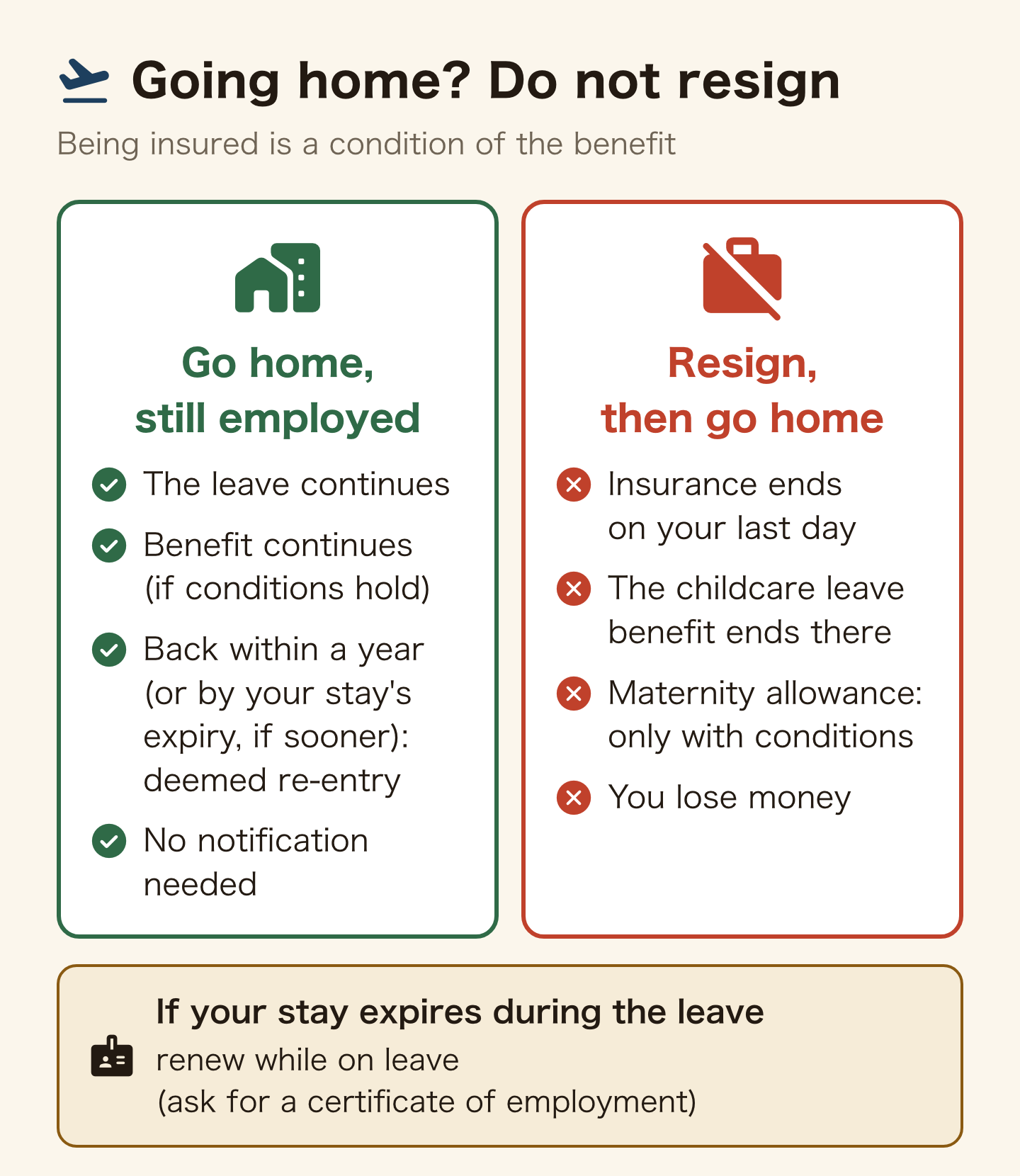
Quick reference: how you go home
| What to check | Go home temporarily, still employed | Resign and go home |
|---|---|---|
| Childcare leave benefit | The leave continues. The benefit continues as long as you are still insured and meet the conditions, such as limits on working days | Paid up to your last day at the company, then it ends |
| Maternity allowance | Continues during maternity leave | Continues only if you were in employer health insurance for one year or more up to the day before you left, and you resign while on leave. If you work on your last day, you lose it |
| Leaving Japan | Back within a year of departure (or by the expiry of your stay, if sooner): deemed re-entry permit. Not available with a period of stay of three months or less, or for short-stay visitors | Not applicable if you are not coming back |
| Status paperwork | No notification of leaving the company. If your stay expires during the leave, you can file the renewal while on leave (ask the employer for a certificate of employment) | You file the notification for leaving your employer |
On the status side, because you remain employed while on leave, the notification you file when you quit is not needed. If your period of stay expires during the leave, the renewal can be filed while on leave (ask the employer for a certificate of employment).
If they refuse, or tell you to quit? The law stops them
- During maternity leave and the 30 days after it, the employer generally may not dismiss you (Labour Standards Act, Art. 19).
- Dismissing you or treating you unfavourably because you applied for or took childcare leave is prohibited (Childcare and Family Care Leave Act, Art. 10).
- The lawful exception is the one above: under one year of service plus a labour-management agreement. “Because you are foreign” or “we have no precedent” does not qualify.
The decision: once you know you are pregnant, in this order
- Check your payslip for both employer health insurance and employment insurance. Both deducted means both the maternity allowance and the childcare leave benefit apply to you.
- Tell the employer. The request for maternity leave and the application for childcare leave are yours to make; apply for childcare leave at least a month before it starts, and if you have under a year of service, ask whether a labour-management agreement excludes you. If you hear “no precedent”, show Art. 65 of the Labour Standards Act and Art. 5 of the Childcare Leave Act.
- Talk to your partner about 14 days. If you both take leave, the first 28 days pay 80%.
- If you go home, go without resigning. The benefit stops the day you quit.
FAQ
Q. Can foreigners take maternity and childcare leave in Japan?
Yes. The Labour Standards Act (6 weeks before, 8 after) and the Childcare Leave Act (to age one) have no nationality condition.
Q. How much is childcare leave paid?
The childcare leave benefit pays 67% of your daily wage for 180 days, then 50%. If both parents take 14 days or more, the first 28 days pay 80%. Tax-free, premiums waived.
Q. What do I get during maternity leave?
Members of employer health insurance get the maternity allowance, about two-thirds of pay (42 days before to 56 after the birth). National Health Insurance has none.
Q. Can I take childcare leave on a fixed-term contract?
Yes, unless it is clear your contract ends before the child is 18 months. A prospect of renewal is enough.
Q. What happens to the benefit if I go home during leave?
Still employed and visiting home: it continues. Resign and go home: it ends the day you resign.
Q. Can I take childcare leave with less than a year at the company?
Yes, unless the company has a written labour-management agreement excluding employees with under one year of service; then it may refuse. The benefit has its own condition of 12 months in employment insurance.
Q. Can I be dismissed for taking childcare leave?
No. Dismissal or other unfavourable treatment for applying for or taking childcare leave is prohibited (Art. 10), and dismissal during maternity leave and the 30 days after is generally barred (Labour Standards Act, Art. 19).
Q. Can fathers take leave?
Yes. Up to 28 days of post-birth paternal leave within eight weeks of the birth (67% + 13% = 80%), then ordinary childcare leave to age one.
Summary
Maternity and childcare leave are the same rights for foreigners: 6 weeks before, 8 after, and leave to age one (up to two). The money is the maternity allowance (two-thirds, employer plans only) and the childcare leave benefit (67% then 50%; 80% for the first 28 days if both parents take leave), tax-free with premiums waived.
Conditions: 12 months in employment insurance, and for fixed-term contracts a run to 18 months. Going home? Do not resign first – the benefit stops the day you quit. Check the payslip, tell the employer: that is step one. The same week, register the pregnancy at the city office for your boshi techo and checkup vouchers.
Sources (official): Labour Standards Act, Art. 65 (e-Gov) / Childcare and Family Care Leave Act, Art. 5 (e-Gov) / Japan Health Insurance Association, maternity allowance / MHLW, childcare leave benefits: content and application procedure (revised 1 August 2026) / Employees’ Pension Insurance Act, Arts. 81-2 and 81-2-2 (e-Gov) / Immigration Services Agency, deemed re-entry permit (all checked 9 October 2026)
Found this useful? Share it
Send it to a friend who lives in Japan.
WHO WROTE THIS

mori
Japanese. I read the ministries’ own notices, orders and Q&As in the original, and I start from what my Nepalese and Sri Lankan friends in Japan actually ran into. I do not write about what I have not checked or been told.
What this site can and cannot do →Looking for something else?
You may use the figures in this article, including commercially, if you credit this site with a link. How to use our figures