Addresses, phone numbers, opening hours and interpreter languages were checked against the Ministry of Health, Labour and Welfare and each centre’s own pages on 10 September 2026. They change. Call or check the site before you go.
In short
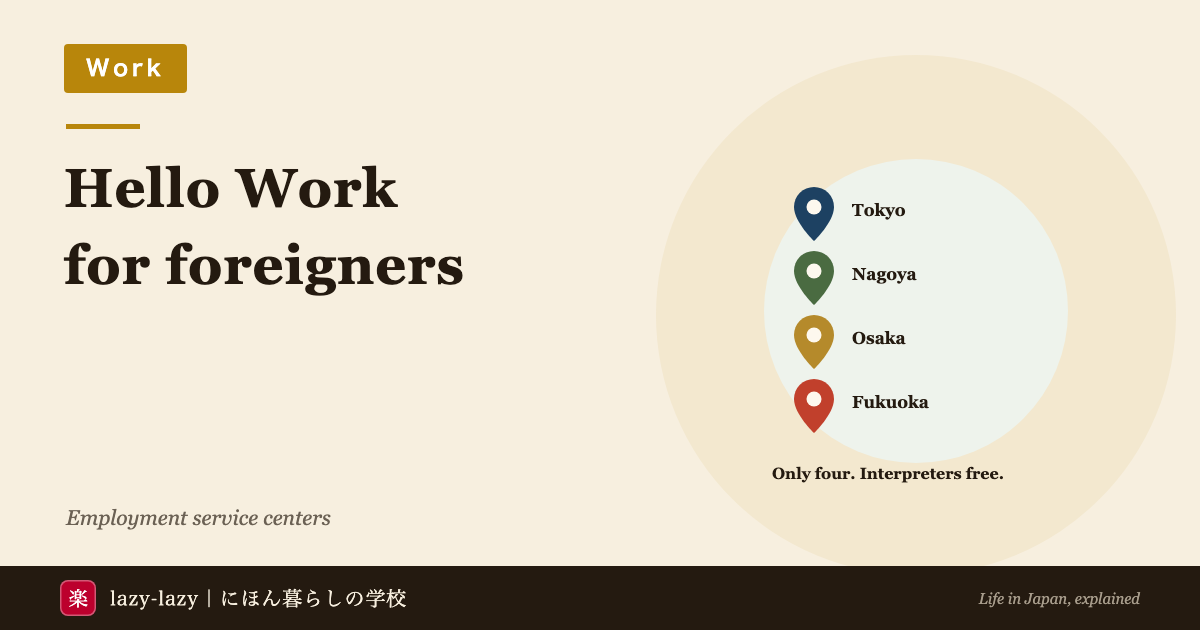
- There are only four Employment Service Centers for Foreigners in Japan – Tokyo, Nagoya, Osaka and Fukuoka.
- Interpreters are free. Nagoya has 10 languages, including Nepali, Burmese and Thai. Osaka has 6. The list differs by centre.
- Tokyo is for full-time employment. Its own English page says part-time work is not covered.
- Bring your residence card and your Hello Work registration slip. Bring your passport too if your status is Designated Activities.
- Not near one? That is fine. Ordinary Hello Work offices with interpreters exist across Japan.
Most people start a job search on a jobs website. Far fewer know that Japan runs a free public employment office built for foreign residents, with interpreters on site. Your Japanese friends will not mention it. The rule does not apply to them, so they have never had to learn it.
- What is an Employment Service Center for Foreigners?
- Where are they?
- Are the interpreters really free?
- Who is allowed to use them?
- What should you bring?
- What if you do not live near one of the four?
- Is this better than a private recruitment site?
- When should you stop coming here?
- Frequently asked questions
- Summary
What is an Employment Service Center for Foreigners?
It is a Hello Work office specialising in foreign job seekers. Hello Work is Japan’s public employment service, run by the Ministry of Health, Labour and Welfare. The centres give job counselling, introduce you to employers, and help with your Japanese resume. All of it is free.
Two things make them different from an ordinary Hello Work: they serve foreign residents only, and they keep interpreters on site. The staff also understand status of residence, which is not true everywhere.
Where are they?
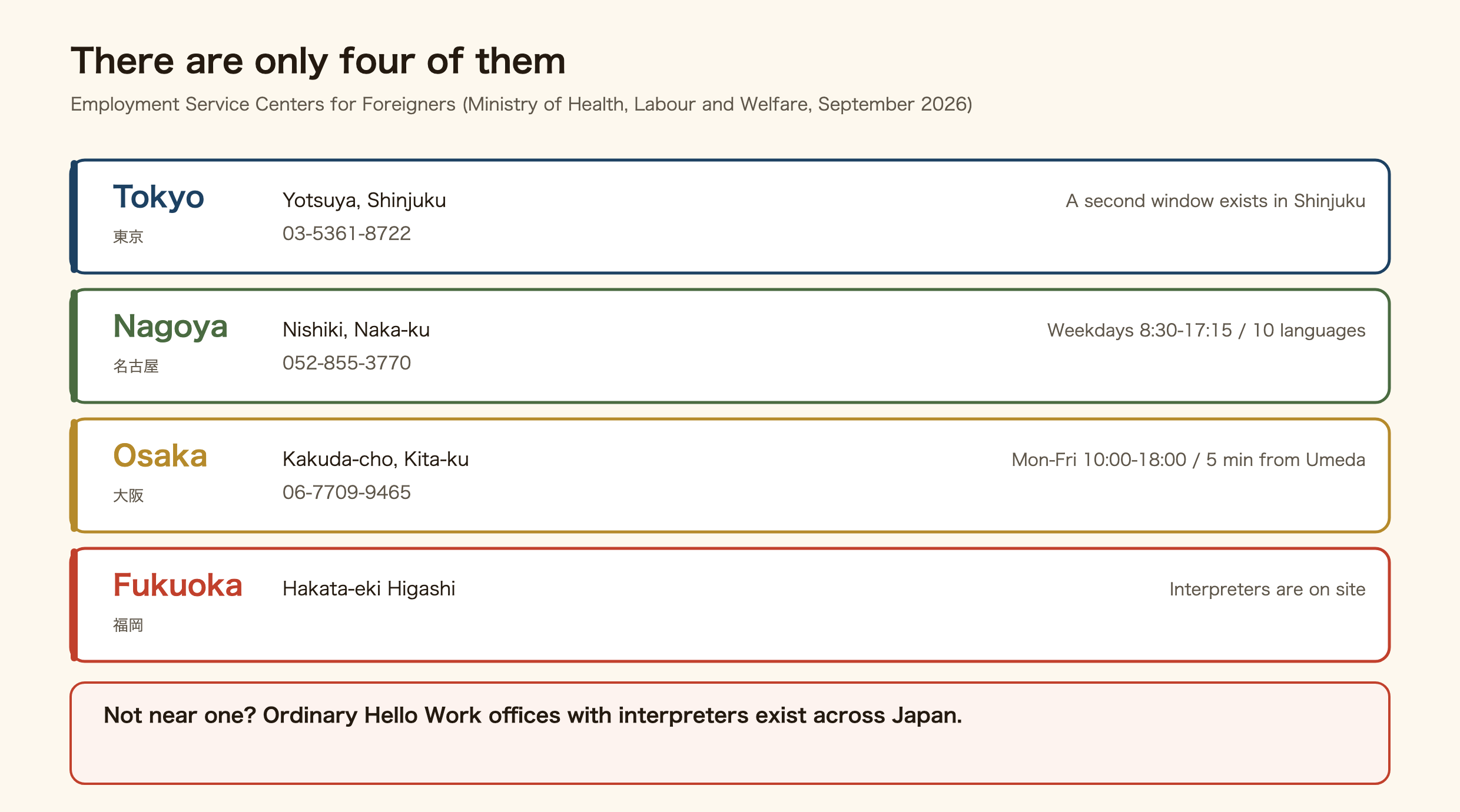
Tokyo, Nagoya, Osaka and Fukuoka. That is the whole list. No other prefecture has one, so the first thing to check is whether one is within reach of where you live.
- Tokyo: 13F Yotsuya Tower, CO-MO-RE Yotsuya, 1-6-1 Yotsuya, Shinjuku-ku (inside the Foreign Residents Support Center, FRESC) / 03-5361-8722 / 1 minute from Yotsuya Station
- Nagoya: 8F Yamaichi Building, 2-14-25 Nishiki, Naka-ku / 052-855-3770 / 2 minutes from Fushimi subway station
- Osaka: 16F Hankyu Grand Building, 8-47 Kakuda-cho, Kita-ku / 06-7709-9465 / 5 minutes from Osaka or Umeda Station
- Fukuoka: 2-11-1 Hakata-eki Higashi, Hakata-ku, Fukuoka Joint Government Building
Osaka opens Monday to Friday, 10:00 to 18:00. Nagoya opens weekdays 8:30 to 17:15. Both close on weekends, public holidays and over the new year. We could not find published opening hours for Tokyo or Fukuoka, so call them.
Are the interpreters really free?
Yes. But the languages, the days and the hours are different at each centre. Turn up on the wrong day and there is nobody to interpret for you.
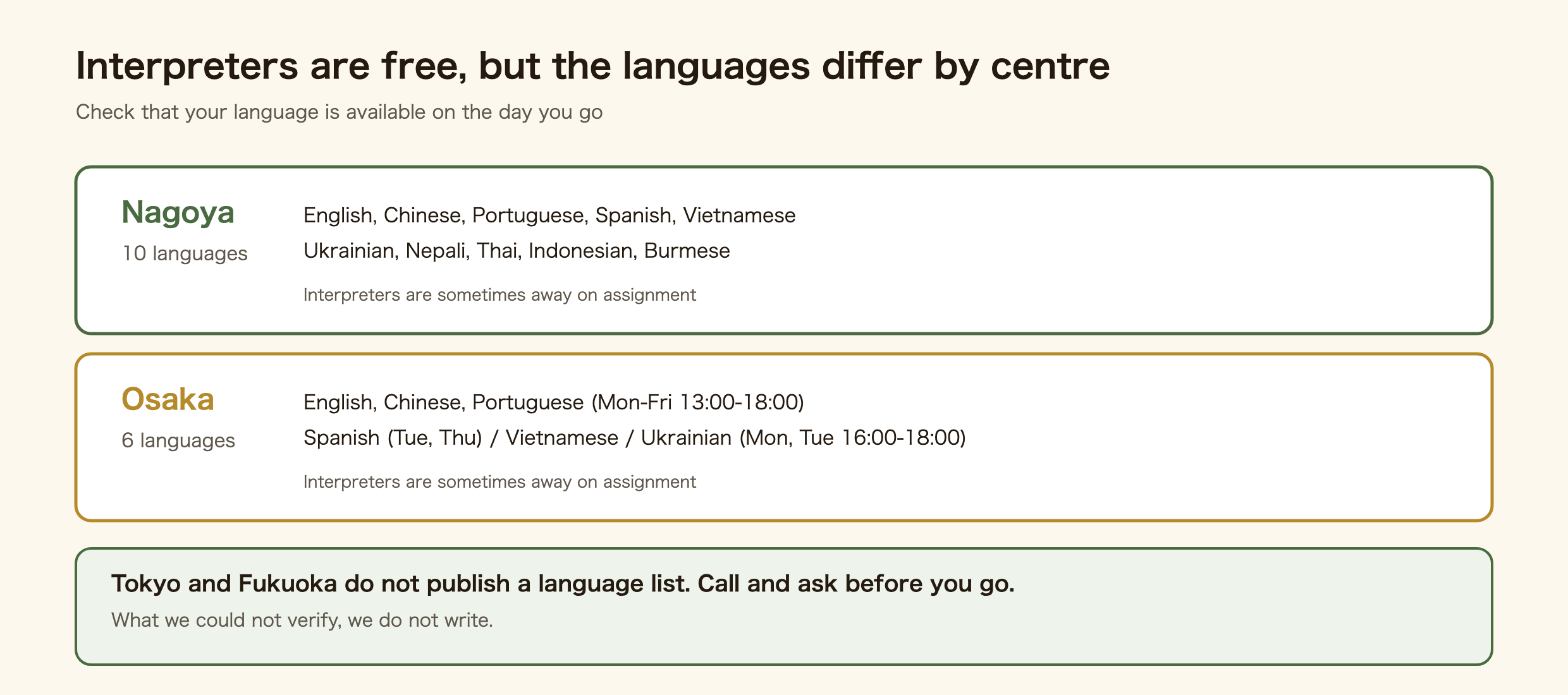
Nagoya lists ten languages – English, Chinese, Portuguese, Spanish, Vietnamese, Ukrainian, Nepali, Thai, Indonesian and Burmese. Very few public windows in Japan go as far as Nepali and Burmese.
Osaka lists six, with fixed days. English, Chinese and Portuguese run Monday to Friday 13:00-18:00; Spanish on Tuesday and Thursday; Ukrainian on Monday and Tuesday 16:00-18:00. Note one thing carefully: the Osaka website can be displayed in Nepali, but Nepali is not on its interpreter list. Being able to read the site is not the same as being understood at the counter.
Both centres add that interpreters are sometimes away on assignment. If you are travelling any distance, phone the day before.
Who is allowed to use them?
This is the part people get wrong. The Tokyo centre’s own English page states who it serves:
- Student – but for full-time employment. It says explicitly: not part-time.
- Engineer / Specialist in Humanities / International Services
- Instructor
- Skilled Labor
In other words it is built for holders of specialist and technical status, and for students about to start a career. If you are a student looking for part-time work, the Tokyo centre is not the right door.
There is also a second window in Shinjuku: the Shinjuku Foreigners’ Employment Assistance and Guidance Center (03-3204-8609). We could not find an official explanation of how the two differ. Describe what you need on the phone and let them tell you which one to visit.
What should you bring?
Nagoya publishes a list. The other centres are likely to want the same, but Nagoya is the one that spells it out.
- Your residence card
- Your passport – if your status of residence is Designated Activities
- Your Hello Work registration slip – the paper you receive when you register as a job seeker. If this is your first visit, you can register on the spot.
You can also search and apply through Hello Work Internet Service. That site is in Japanese only.
What if you do not live near one of the four?
Many ordinary Hello Work offices also have interpreters. The ministry publishes a list of Hello Work offices with foreign-language assistance, and there are far more of those than there are centres.
The Osaka centre also runs a LINE account for students (ID: all0249s), and some centres offer online counselling. One phone call is often enough to find out which door is yours.
Is this better than a private recruitment site?
It is not either-or. In the ministry’s own survey, the most common way foreign residents found their job was through friends and acquaintances, at 37.8%, with job advertisements at 19.1%. The public employment service is only part of the picture.
The reason to start here anyway is simple: it costs nothing, an interpreter comes with it, and the staff understand status of residence. Use the free window fully before you pay anyone.
When should you stop coming here?
If two or three visits produce only jobs that do not match your status of residence, this is not your channel. A centre can only introduce the vacancies it holds, and hiring is concentrated in particular regions. Use your school’s careers office and private services alongside it.
Where the centres are genuinely strong is anything that touches your visa. If you are planning the change from a student to a work status, there are not many places where you can discuss the job and the status in the same conversation.
Frequently asked questions
Q. Does it cost anything?
No. Counselling, job introductions and interpreting are all free. These are public offices run by the Ministry of Health, Labour and Welfare.
Q. Do I need an appointment?
We could not find a statement that booking is required. However, the centres say interpreters are sometimes away, so if you need your language, call ahead.
Q. Can I go if I do not speak Japanese?
Yes – that is what the interpreters are for. Nagoya lists 10 languages and Osaka 6, on fixed days. Tokyo and Fukuoka do not publish a list, so call and ask.
Q. Can a student use it to find part-time work?
Not at the Tokyo centre. Its English page says the service is for students seeking full-time employment, not part-time. For part-time work use an ordinary Hello Work or a jobs site, and keep to the 28-hour weekly limit.
Q. Are there really only four?
Four carry that name – Tokyo, Nagoya, Osaka and Fukuoka. But ordinary Hello Work offices with interpreters exist across the country, and the ministry publishes the list.
Q. Can they help with my visa application?
They will discuss employment questions that involve your status of residence. Only a registered lawyer or administrative scrivener may file an application on your behalf, and the centres do not do that.
Summary
An Employment Service Center for Foreigners is a Hello Work office for foreign job seekers, with interpreters on site. There are four – Tokyo, Nagoya, Osaka, Fukuoka – and everything they do is free.
Check three things before you go. Whether your status of residence is covered (Tokyo is for full-time employment, not part-time); whether your language is available on that day (Nagoya 10, Osaka 6, Tokyo and Fukuoka unpublished); and what to bring (residence card, Hello Work slip, plus passport for Designated Activities).
If none of the four is near you, ordinary Hello Work offices with interpreters exist across Japan. Use the free window before you consider a paid one.
Sources (official): MHLW, employment support for foreign nationals / Tokyo Employment Service Center for Foreigners / Nagoya / Osaka / Fukuoka (all checked 10 September 2026)
Found this useful? Share it
Send it to a friend who lives in Japan.
WHO WROTE THIS

mori
Japanese. I read the ministries’ own notices, orders and Q&As in the original, and I start from what my Nepalese and Sri Lankan friends in Japan actually ran into. I do not write about what I have not checked or been told.
What this site can and cannot do →Looking for something else?