Figures, prices and terms were checked against the Immigration Services Agency report on international students employed in 2024, the MHLW and the Ministry of Education on 1 September 2026. They change — check the current terms yourself before you sign up or file anything.
Last updated: 1 September 2026
Summary
- Getting hired here means changing your residence status from student to a working one. Last year 39,766 people did it.
- 3,909 of them were Nepalese and 8,484 were Vietnamese. The door is not closed by nationality.
- It still looks empty because Tokyo takes 42.4% of the jobs.
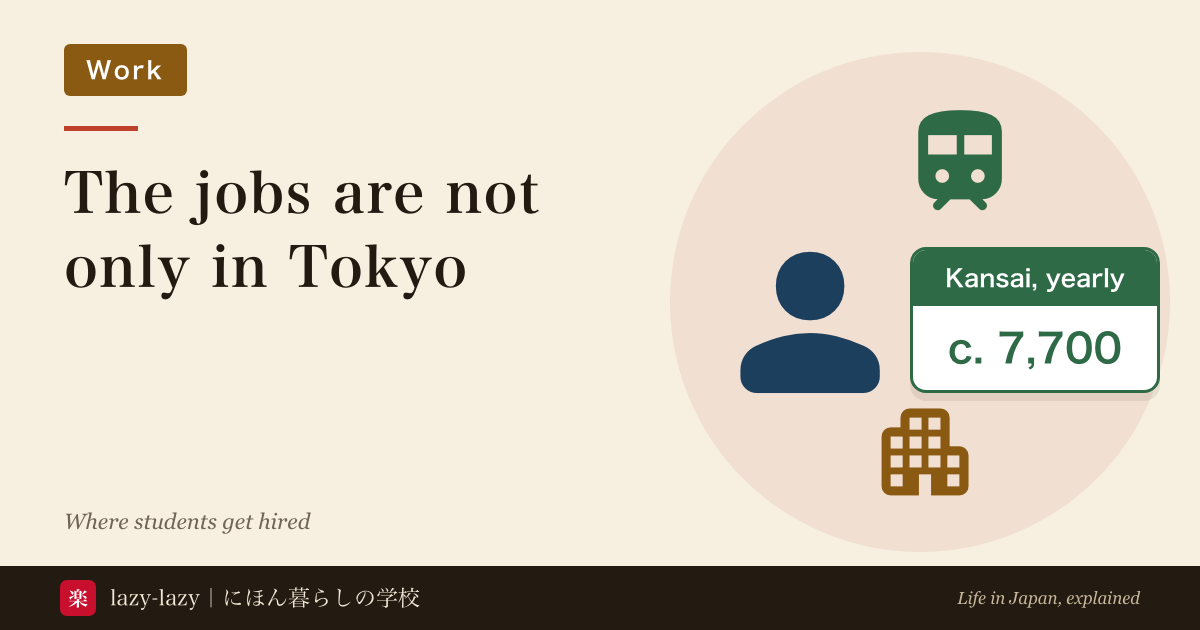
- Kansai has them too. About 7,700 a year in the Kinki region, about 5,900 in Osaka and Hyogo alone.
- 55.8% of hires go to companies with under 100 staff. Almost none of the names you know.
- Four job types cover 35.4%: translation and interpreting, IT, administration, and overseas trade.
- The pay, honestly: 25.7% start under 200,000 yen a month.
- The nearest government office sits directly above Hankyu Umeda station. No bullet train needed.
Knowing this, you stop looking for the jobs that are not there and start looking where 55.8% of them actually are – companies under 100 people.
You open a job site, set your filters, and nothing comes back. The school noticeboard has nothing for you. None of your seniors have offers either. So you conclude there are no jobs for international students.
That feeling is half right. Here are the numbers first.
- 39,766 students changed status last year
- It looks empty because the jobs pile up in Tokyo
- Kansai has about 7,700 a year
- The companies hiring are ones you have never heard of
- Four job types cover a third of everything
- The pay, without decoration
- A quarter of hires came from vocational schools
- The nearest office is above Hankyu Umeda station
- What to do this week
- FAQ
- Summary
39,766 students changed status last year
To start working here you change your residence status from “Student” to a working one. The Immigration Services Agency publishes those applications and results every year.
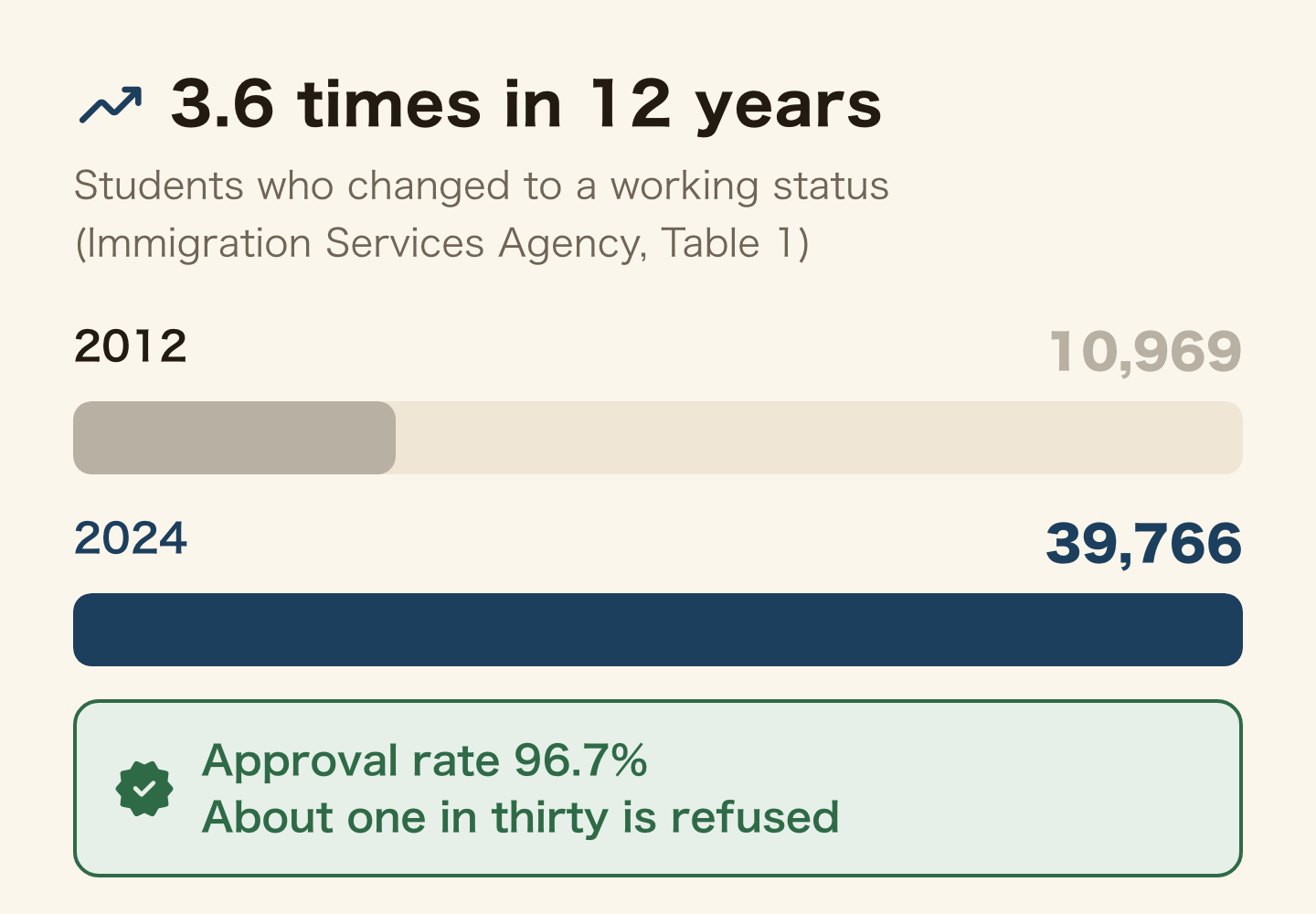
In 2024 it processed 41,142 applications and approved 39,766. That is an approval rate of 96.7%.
By nationality: China 14,511, Vietnam 8,484, Nepal 3,909, South Korea 1,688, Indonesia 1,331. Those five make up 75.2% of the total.
In 2012 the figure was 10,969 (Immigration Services Agency, Table 1). Twelve years later it is 3.6 times larger, and 96.7% of applications succeed. Roughly one in thirty is refused. The system is not the thing that is closed.
It looks empty because the jobs pile up in Tokyo
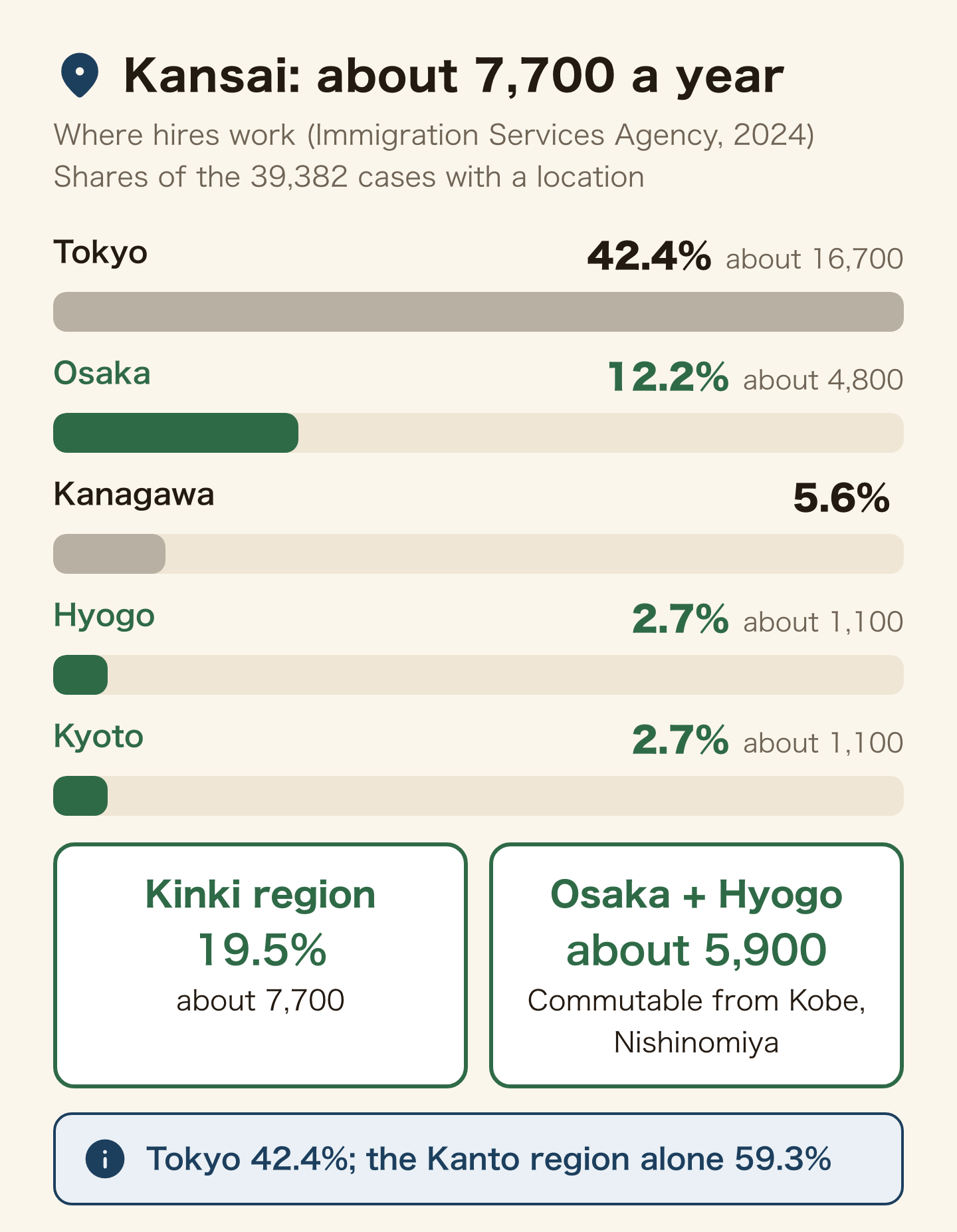
Tokyo 42.4%, Osaka 12.2%, Kanagawa 5.6%. The Kanto region alone is 59.3%. When a job site keeps showing you Tokyo, that is because that is where the jobs are.
Most people stop there and decide their own city has nothing. There is one more number to look at first.
Kansai has about 7,700 a year
| Where | Share | People a year |
|---|---|---|
| Tokyo | 42.4% | about 16,700 |
| Osaka | 12.2% | about 4,800 |
| Hyogo | 2.7% | about 1,100 |
| Kyoto | 2.7% | about 1,100 |
| Kinki region | 19.5% | about 7,700 |
The shares are of the 39,382 cases whose workplace location was recorded on the application, not of all 39,766 approvals. The numbers are those shares applied to 39,382, so they are estimates.
Osaka and Hyogo together come to about 5,900. Kobe, Nishinomiya and Amagasaki are 15 to 30 minutes from central Osaka by train. That is 5,900 jobs a year inside commuting distance.
Job hunting in Tokyo from elsewhere means fares and a hotel. Out of the 199,000 yen a month it costs to live, saving that is not easy. Searching where you already live costs nothing.
Tokyo does have more. But “you cannot get hired unless you move to Tokyo” is not what this data says.
The companies hiring are ones you have never heard of
This is the part people get wrong most often.
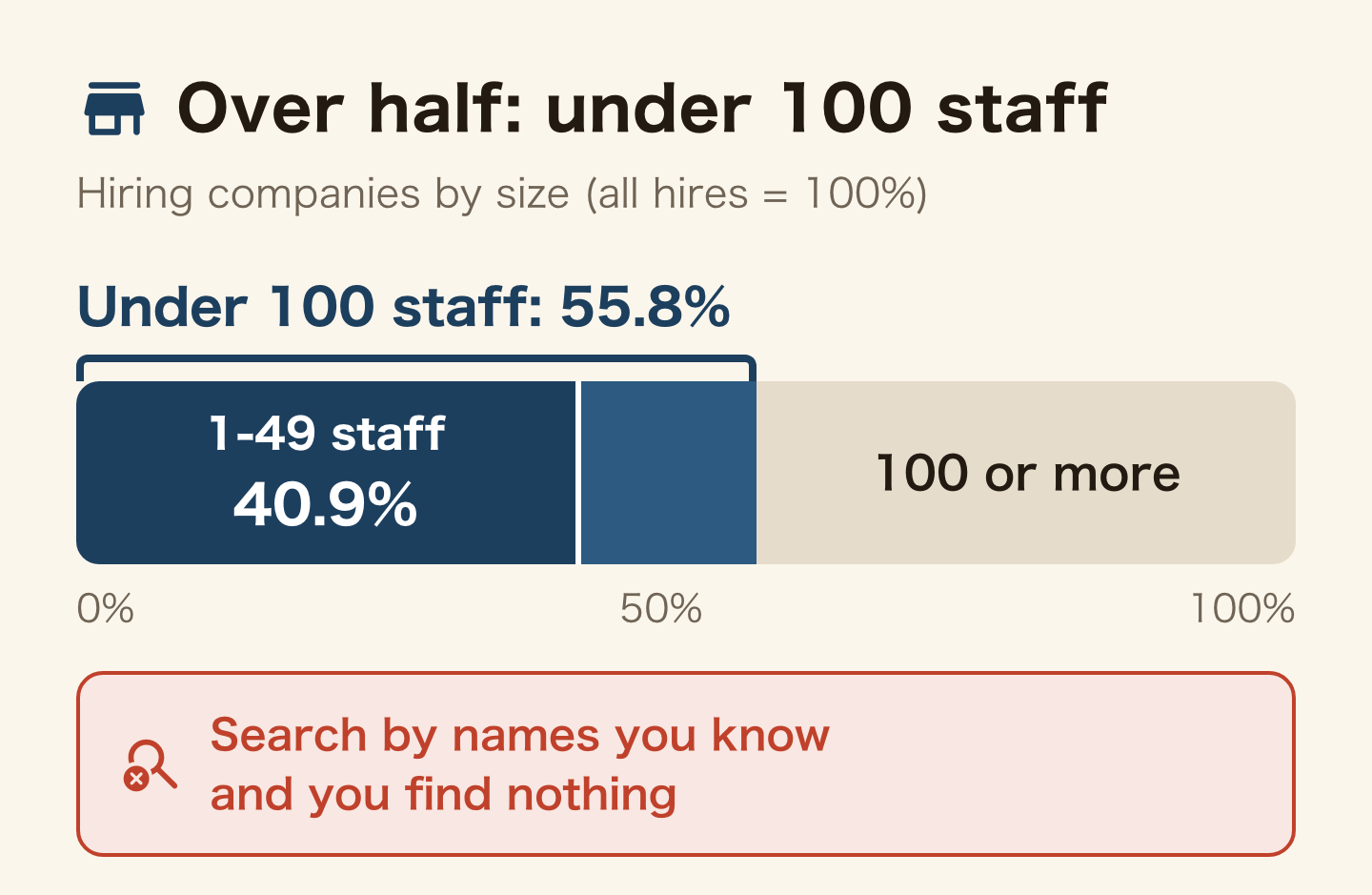
- 40.9% were hired by companies with 1 to 49 employees
- Widen that to under 100 employees and it is 55.8%
- 27.3% went to companies capitalised at 5 million yen or less
More than half have fewer than a hundred staff. Not the companies on television, and not the ones people know back home. Searching by company names you recognise will find you nothing.
By sector, 86.4% is non-manufacturing. Retail leads at 10.2%, then information and communications at 9.3%.
Four job types cover a third of everything
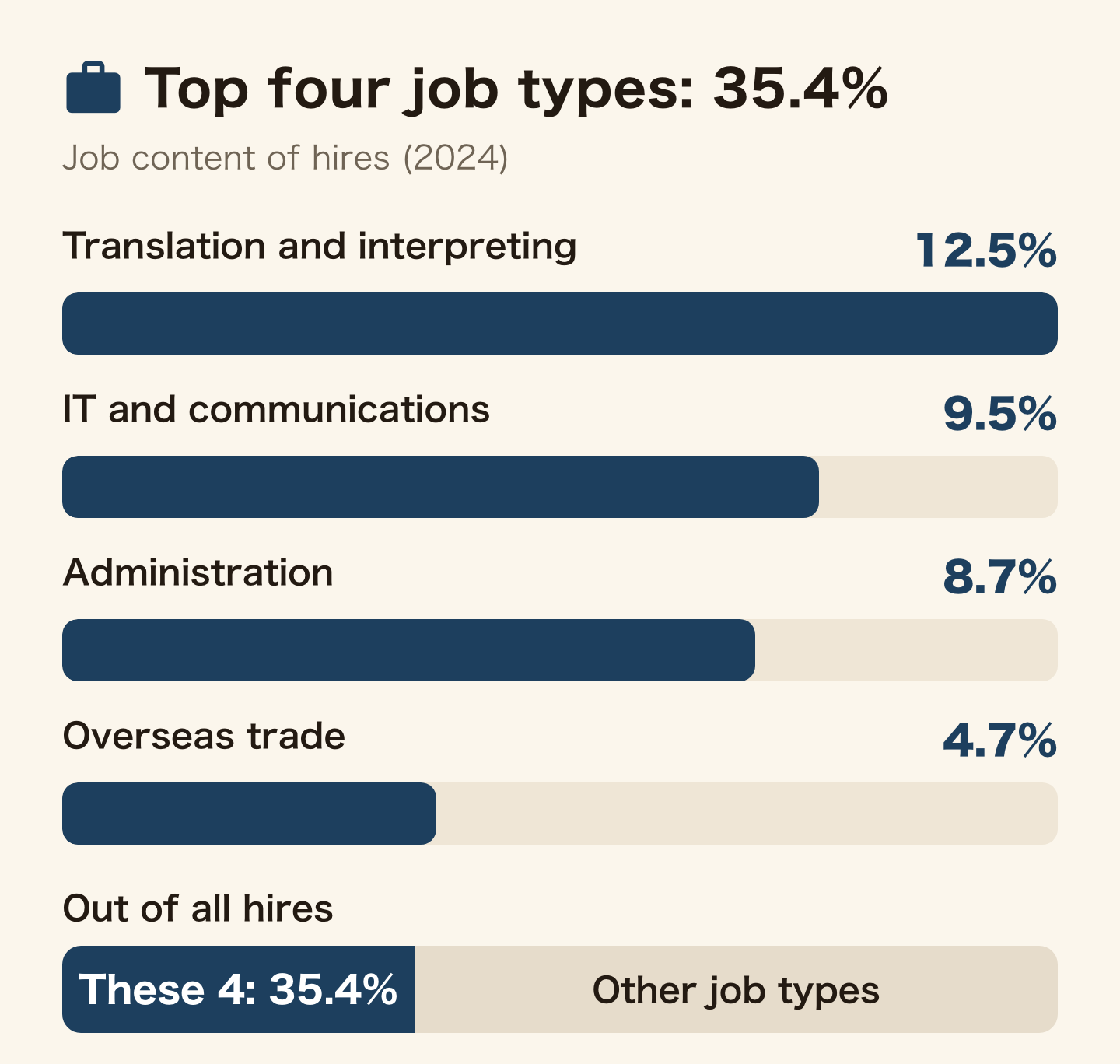
Translation and interpreting 12.5%, information processing and communications technology 9.5%, administration excluding executives 8.7%, overseas trade 4.7%. Those four are 35.4% of the total.
Which means how close you can get to those four decides how much you find. If your Japanese is usable, translation, interpreting and overseas trade open up. Pushing your kanji and reading widens the list directly.
The pay, without decoration
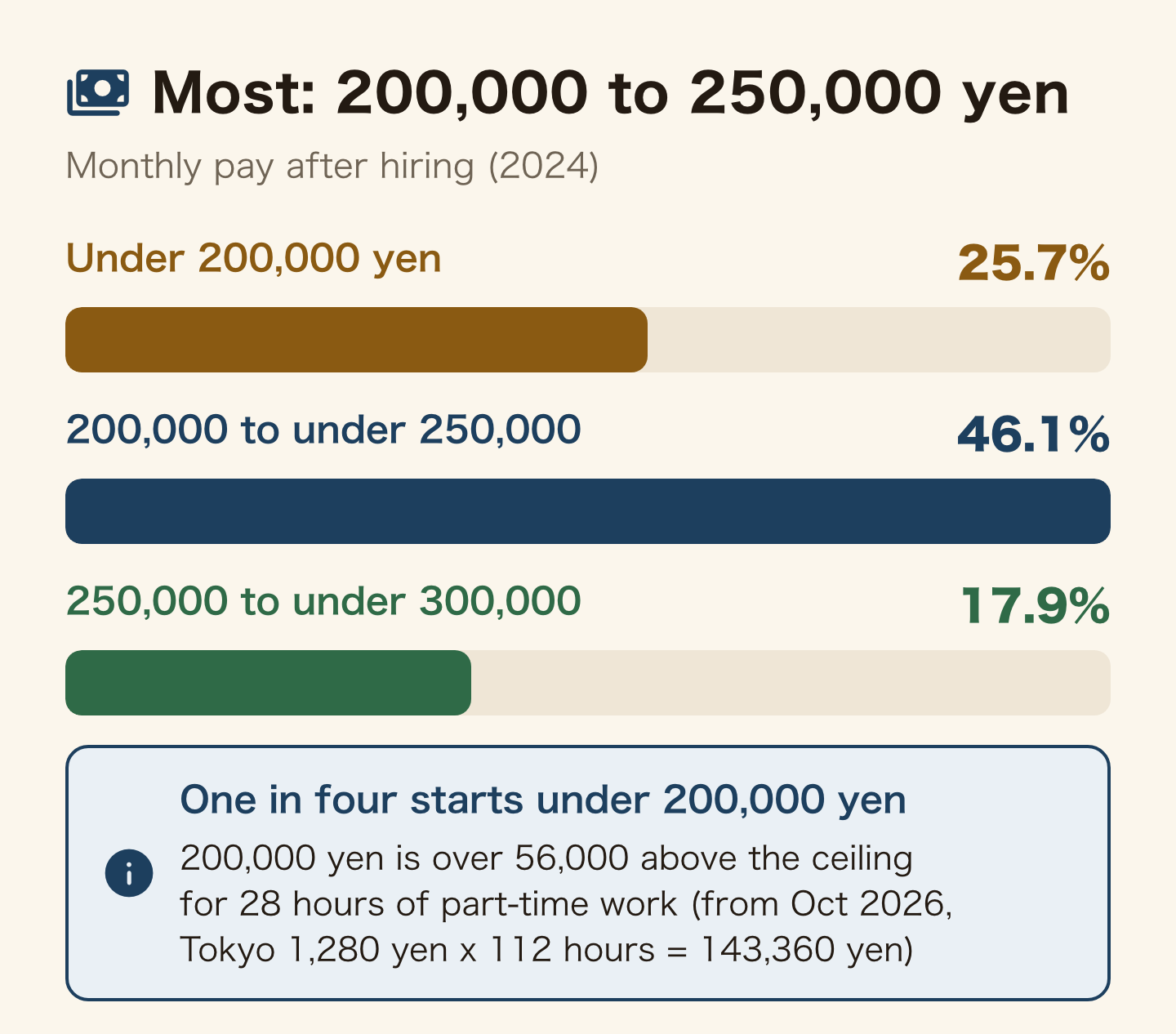
Monthly pay lands at 200,000 to 250,000 yen for 46.1%, under 200,000 for 25.7%, and 250,000 to 300,000 for 17.9%.
One in four starts under 200,000 yen a month. That is not comfortable. But the ceiling on 28 hours of part-time work is 143,360 yen a month from October 2026 (Tokyo’s 1,280 yen minimum wage x 28 hours x 4 weeks). Even 200,000 is more than 56,000 yen a month above it.
And once you are hired, employer social insurance starts coming out of your pay, so the drop from gross to net is steeper than it was as a student. Do not compare the headline figures alone.
A quarter of hires came from vocational schools
By final education:
- University 44.7%
- Vocational school (senshu gakko) 24.5%
- Graduate school 24.0%: masters 19.7%, doctorate 4.4%
- Junior college 2.7%, other 4.1%
One in four came through a vocational school. The Immigration Services Agency report puts graduate schools at 24.0% and universities plus graduate schools at 68.7% (masters and doctorate add up to 24.1% only because of rounding). Vocational schools are behind that, but the route is real.
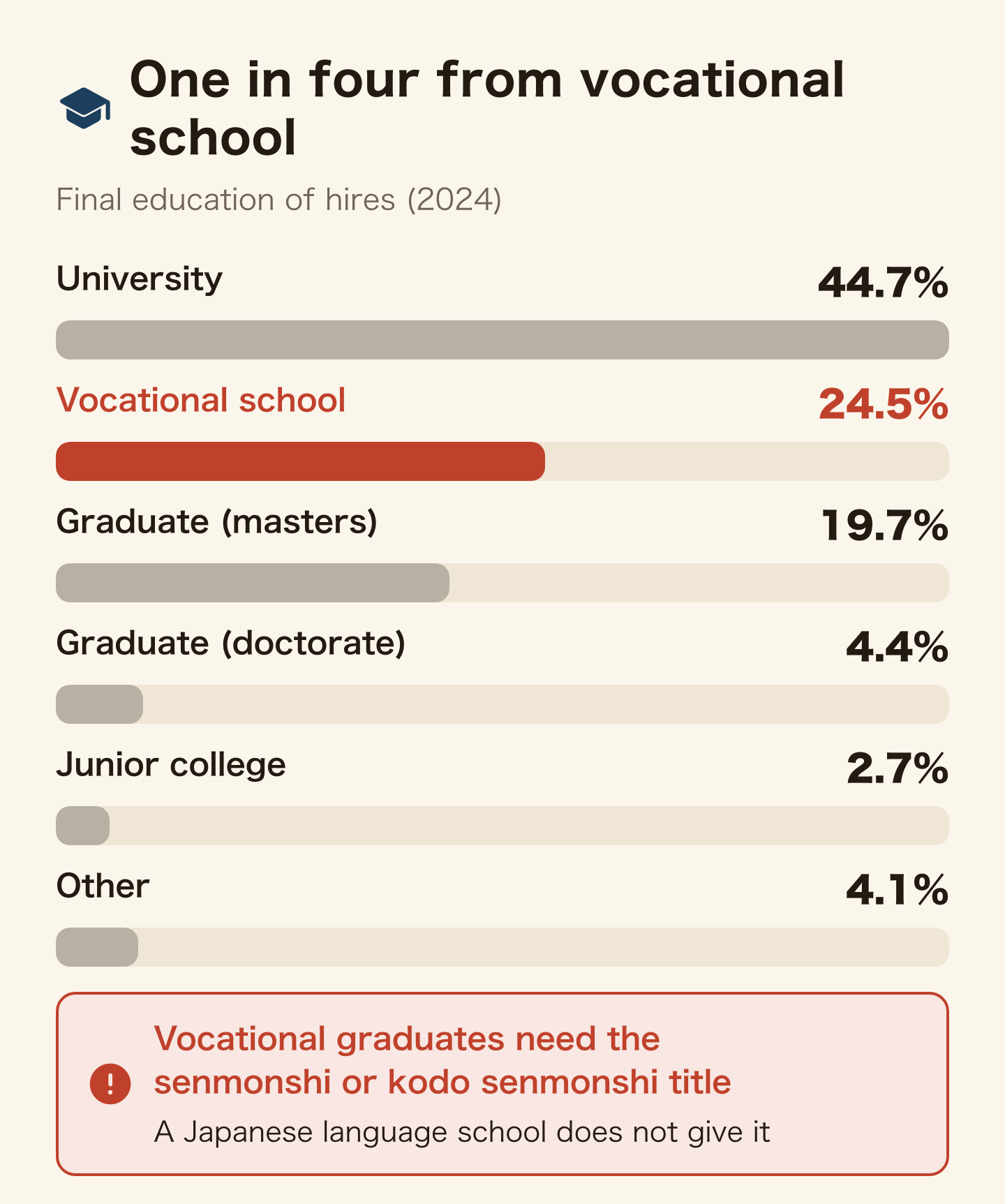
There is a condition. For the engineer or specialist in humanities visa, a vocational school graduate needs the title of “senmonshi” or “kodo senmonshi”. The Ministry of Education grants it only for courses it has approved, which must run two years or more and total at least 1,700 class hours.
A Japanese language school is not a vocational school, so no senmonshi comes with it. Finishing language school alone does not qualify you for this visa. Know that before you choose your next step.
The nearest office is above Hankyu Umeda station
The Ministry of Health, Labour and Welfare runs Employment Service Centers for Foreigners in four cities: Tokyo, Nagoya, Osaka and Fukuoka. They give information to international students, run job-hunting guidance, offer internship programmes, and hold recruitment interview events. If an internship is paid, check which permit it needs and the weekly hour limit first.
Osaka Employment Service Center for Foreigners
16F Hankyu Grand Building, 8-47 Kakuda-cho, Kita-ku, Osaka 530-0017
It is the building on top of Hankyu Umeda station, reachable without changing trains from the Kobe, Takarazuka and Kyoto lines. From Nishinomiya-Kitaguchi it is about 15 minutes and 280 yen one way (Hankyu fare table, Japanese; the trip is 15.6 km). No bullet train and no hotel.
You can use it while you are still enrolled. First year of language school or first year of vocational school, the guidance sessions are open to you.
What to do this week
The next move depends on where you are studying now.
If you are at a Japanese language school
- Call the Osaka centre and ask when the next guidance session is. Go before you decide on a school
- If you are considering a vocational school, ask that school whether the course carries senmonshi. Some do not
- Keep your attendance up. It is looked at when you apply for the work visa
If you are at a vocational school
- Same office. Interview events are for people still enrolled. After graduation is late. If you run out of time, the job-hunting visa gives you up to a year (ask for the school letter before you graduate)
- Stop searching by company name. Search by job type. Those four cover 35.4% of all hires
- Filter to Osaka and Hyogo. Spend less time looking at Tokyo listings and feeling behind
Either way it is the same address. A 280 yen train ride, this week.
The first sheet in any application is the rirekisho; the Ministry’s template is free.
FAQ
Q. Are there really jobs for international students in Japan?
Yes. In 2024 the Immigration Services Agency approved 39,766 changes from student status to a working status. By nationality that included 3,909 Nepalese, 8,484 Vietnamese and 14,511 Chinese. The figure is 3.6 times what it was in 2012 and the approval rate is 96.7%.
Q. Do I have to move to Tokyo?
No. Tokyo accounts for 42.4% of hires, but the Kinki region holds 19.5%, about 7,700 a year. Osaka at 12.2% and Hyogo at 2.7% come to roughly 5,900, all within commuting distance of Kobe and Nishinomiya.
Q. Why does nothing come up on job sites?
Because 55.8% of hires are at companies with fewer than 100 employees and 40.9% at companies with 1 to 49. Searching by names you recognise finds nothing. Search by job type instead: translation and interpreting 12.5%, IT 9.5%, administration 8.7%, overseas trade 4.7%.
Q. Can I get hired from a vocational school?
Yes. Vocational school graduates are 24.5% of all hires. But the engineer or specialist in humanities visa requires the senmonshi or kodo senmonshi title, which only comes from courses approved by the Ministry of Education. Ask the school before you enrol.
Q. Can I get a job straight after Japanese language school?
Not on the engineer or specialist in humanities visa. A language school is not a vocational school, so no senmonshi is awarded and the education requirement is not met. You either go on to a vocational school or university, or take a route that does not ask for a degree, such as specified skilled worker.
Q. How much will I earn?
46.1% are paid 200,000 to 250,000 yen a month, 25.7% under 200,000, and 17.9% between 250,000 and 300,000. One in four starts under 200,000. A salary of 200,000 is more than 56,000 yen a month above the 143,360 yen ceiling on 28 hours of part-time work in Tokyo.
Summary
- The jobs exist: 39,766 approvals in 2024, including 3,909 Nepalese, at a 96.7% approval rate
- It looks empty because Tokyo holds 42.4%. The Kinki region still has about 7,700 a year
- Osaka plus Hyogo is about 5,900, inside commuting range of Kobe and Nishinomiya. No travel budget needed
- 55.8% of hires are at companies under 100 staff. Names you know will not appear
- Four job types cover 35.4%: translation and interpreting, IT, administration, overseas trade
- 25.7% start under 200,000 yen a month. A salary of 200,000 is still above the part-time ceiling (143,360 yen in Tokyo) by more than 56,000
- Vocational school graduates are 24.5%, but the visa needs the senmonshi title
- Language school alone does not meet the education requirement
- The Osaka Employment Service Center sits above Hankyu Umeda and is open to you while enrolled
Sources: Immigration Services Agency, employment of international students by Japanese companies, 2024 (published November 2025) / same, engineer / specialist in humanities / international services / Ministry of Health, Labour and Welfare, employment policy for foreign workers / Osaka Employment Service Center for Foreigners / Ministry of Education, on the senmonshi and kodo senmonshi titles
Found this useful? Share it
Send it to a friend who lives in Japan.
WHO WROTE THIS

mori
Japanese. I read the ministries’ own notices, orders and Q&As in the original, and I start from what my Nepalese and Sri Lankan friends in Japan actually ran into. I do not write about what I have not checked or been told.
What this site can and cannot do →Looking for something else?
You may use the figures in this article, including commercially, if you credit this site with a link. How to use our figures