This article contains affiliate links.
Last updated: 2 October 2026
In short
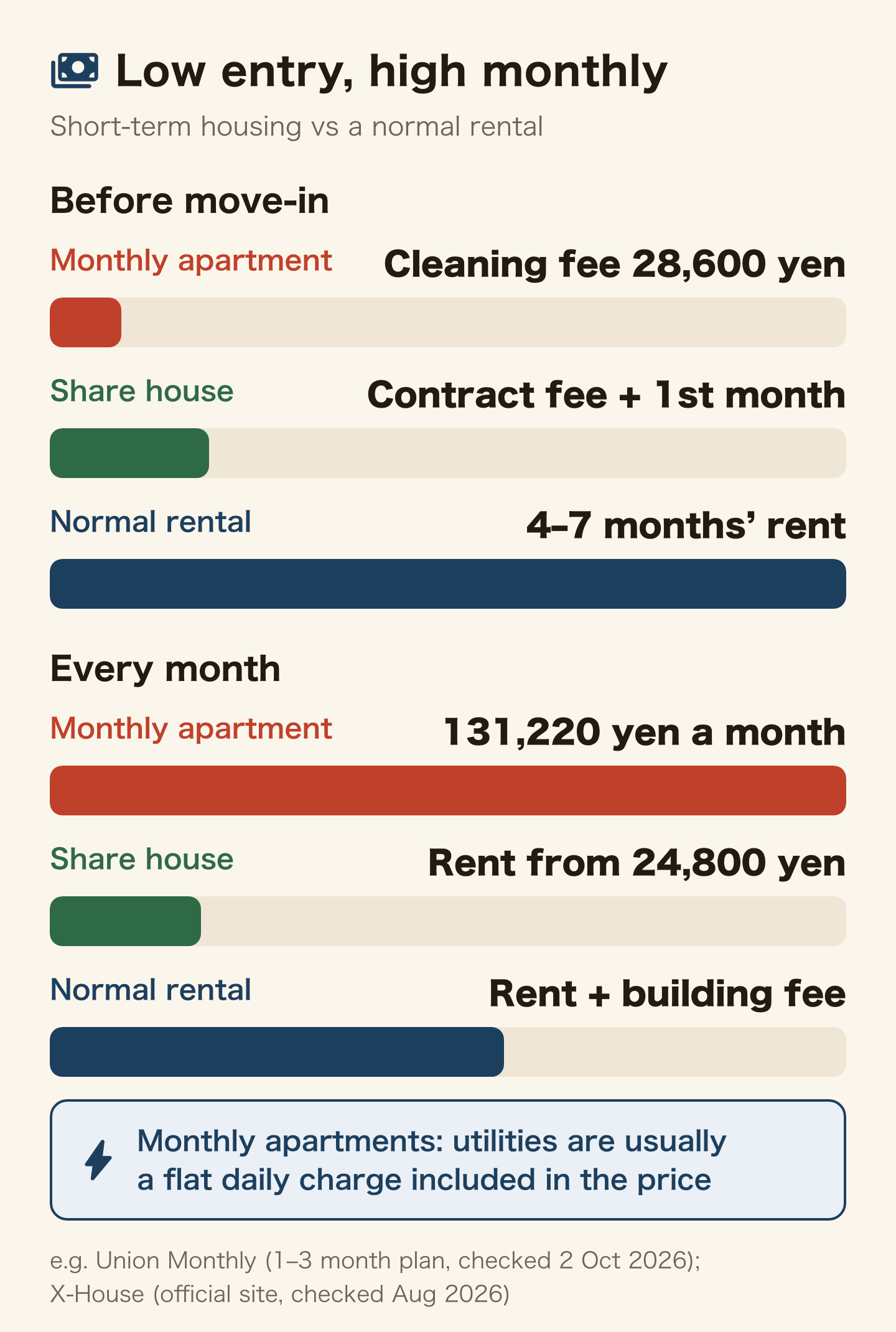
- Short-term housing is cheap to enter and expensive per month. A normal rental is the exact opposite. That single trade-off decides everything.
- A monthly apartment costs more per month than a normal rental – one Tokyo-area operator lists 131,220 yen a month for a 1 to 3 month stay (Union Monthly official price page, checked 2 October 2026) – but you pay only a one-off cleaning fee (28,600 yen on that plan) before moving in.
- No deposit, no key money, no agency fee, and utilities are usually a flat daily charge included in the total.
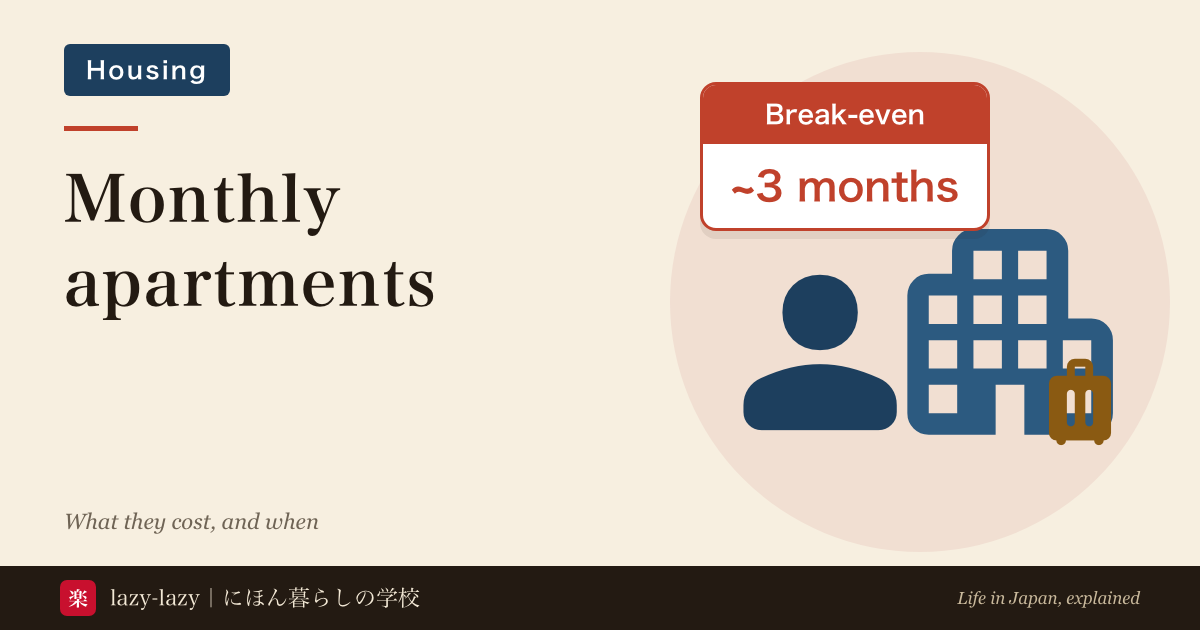
- The break-even is roughly three months. Under that, monthly wins. Over a year, a normal rental wins. In between, a share house.
- If your residence period is under one or two years, some agencies will refuse you a two-year contract anyway. Then this is not a preference – it is your only route.
What changes: you know the three-month break-even, so you pick monthly, share house or a normal lease by how long you will actually stay.
You have somewhere to be in Japan next month, and you do not have the 4 to 7 months of rent a normal rental asks upfront. Or your stay is one year and no agency will sign a two-year lease with you. This is the guide for that situation. Contracts and the full cost breakdown for a normal rental are in how renting works in Japan.
What is a monthly apartment?
A monthly apartment – in Japanese mansuri mansion (マンスリーマンション) – is a flat you rent by the month rather than on a two-year lease. It comes furnished, with appliances and internet already working. There is a weekly version too. You agree the length at the start and usually pay for the whole period upfront.
The reason it exists is that Japan’s normal rental market is nearly impossible to enter for a short stay. Two-year contracts, four to seven months of rent upfront, and a guarantor. A monthly apartment removes all three – and charges you for it in the monthly rate.
What it actually costs
Here is the fact the operators’ own sites put last: per month, a monthly apartment costs more than a normal rental. One example: Union Monthly’s official price page (Tokyo, Kanagawa, Saitama, Chiba and Ibaraki; checked 2 October 2026) lists plan examples of 131,220 yen a month for 1 to 3 months and 118,890 yen for 7 months or more, including the common-area fee, while its own comparison puts the rent of a normal rental at 75,000 yen. Prices vary by operator, area and season, so compare quotes from several operators.
What you save is at the entrance. The bill is built like this:
| What you pay | How much | When |
|---|---|---|
| Rent, charged per day | the bulk of the total | usually the whole period upfront |
| Utilities, flat rate | a fixed daily amount set by the operator (check the quote) | included in the total |
| Cleaning fee | set per contract (24,200 to 36,300 yen in Union Monthly’s plan examples) | once, before you move in |
| Insurance | small, fixed | once |
| Deposit, key money, agency fee | none | – |
The flat-rate utilities are worth understanding. You are not billed on what you use, so a cold January with the heating on does not produce a frightening bill. It also means a careful person subsidises a wasteful one. For a short stay, the certainty is usually worth more.
Always ask what is included before you sign. Internet and building fees are bundled in some contracts and not others, and the headline day rate hides that difference.
How long are you staying? That decides everything
There is no best option here, only a break-even point. The monthly apartment’s high rate is buying you the 4 to 7 months of rent you did not pay at the start. The longer you stay, the worse that trade gets.
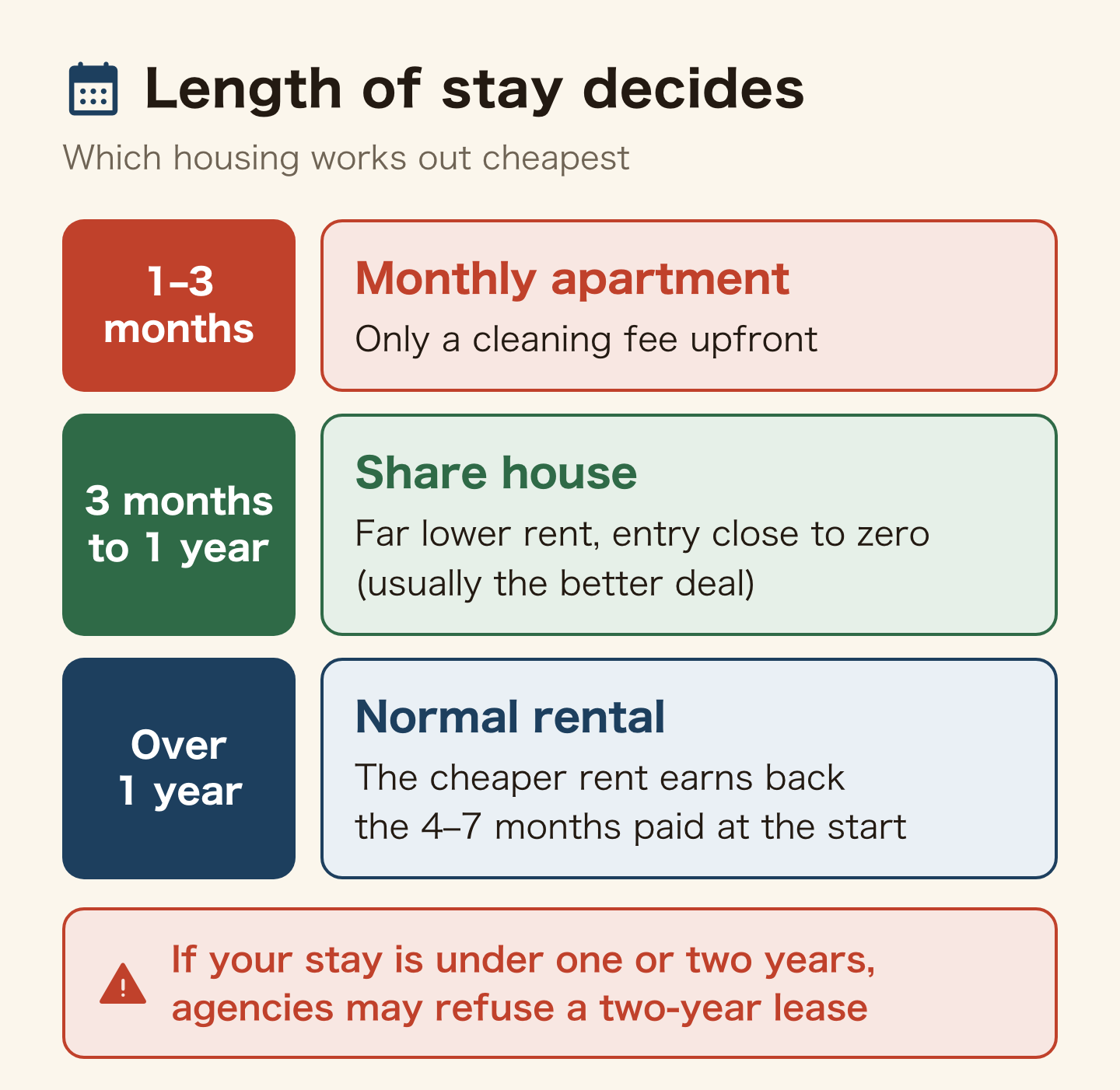
One to three months – a monthly apartment is genuinely the cheapest thing available. You skip the 4 to 7 months of rent a lease asks upfront and pay a premium for only a few months.
Three months to a year – a share house is usually the better deal. Monthly rates start far lower, and the entry costs are still close to zero. You give up some privacy for it.
Over a year – a normal rental starts winning, because you are there long enough for the cheaper monthly rate to repay what you handed over at the start.
The situation nobody mentions: you may not be allowed a normal rental
You arrive on a working holiday and ask an agency for a room for just one year. Where you are from, the lease may simply match how long you plan to stay. In Japan, a normal rental assumes a two-year contract, and if your stay does not fit that length, you can be stopped at the door (Ministry of Land, Infrastructure, Transport and Tourism, Apartment Search Guidebook (English)).
If you are in Japan on a stay of under one or two years – a short language course, a working holiday – agencies may simply refuse to sign a two-year lease with you. It is not about your money or your Japanese. The contract outlives your permission to be here, and that is enough for them to say no.
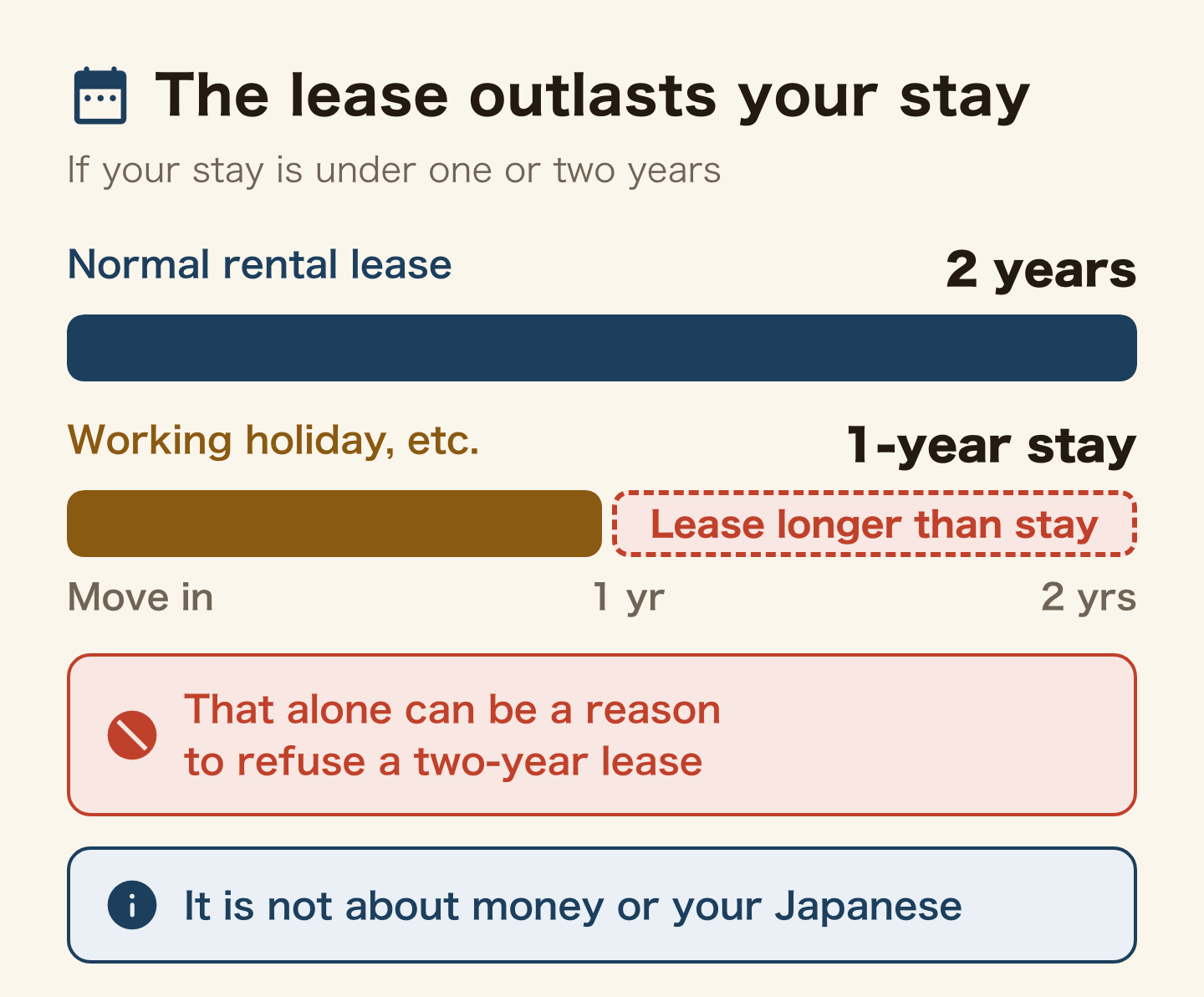
If that is your situation, the comparison above stops being a choice. Short-term housing is your route, and the question becomes which one, not whether.
What you need to sign
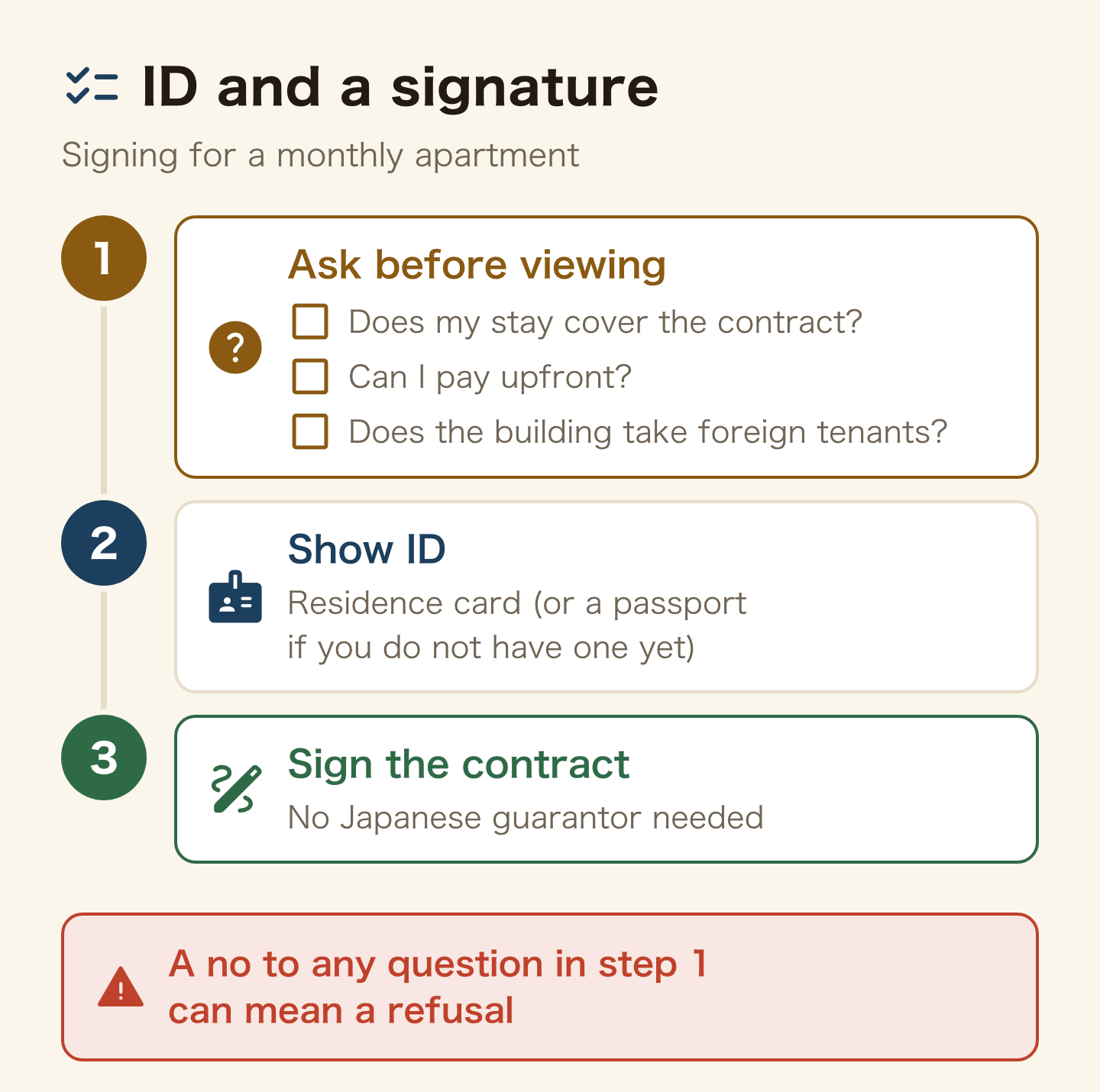
Compared with a normal rental this part is short. You show ID and sign. A residence card is the standard document; a passport is used for people who do not have one yet. No Japanese guarantor is required, which removes the single biggest obstacle in the normal market.
Being refused is still possible. The usual reasons are a stay shorter than the contract, no way to pay upfront, or a building that simply does not take foreign tenants. Ask before you view, not after.
From one month, in your own language: X-House
X-House (Cross House) runs share houses and furnished flats in Tokyo from one month, so it covers the same need as a monthly apartment at a share-house monthly rate. Support is available in Nepali, Sinhala and other languages.
- Share house rooms from 24,800 yen a month (official site, checked August 2026) – well under a monthly apartment
- No deposit, no key money, no agency fee, no guarantor
- Furnished, so you can move in the day you land
- Honest note: the “30,000 yen to move in” in the ads is not the total. Your first month of rent comes on top
Share houses do not suit everyone, and we say who should think twice in our share house guide. If you need your own bathroom and silence, a monthly apartment is worth its higher rate.
Market rates were checked on 21 August 2026 and change by area and season. Confirm the current total with the operator before you book. Official sources: Ministry of Land, Infrastructure, Transport and Tourism, Apartment Search Guidebook (English) / Ministry of Land, Infrastructure, Transport and Tourism, guideline on restoration costs (checked 26 September 2026)
Frequently asked questions
Can a foreigner rent a monthly apartment?
Yes. You show identification and sign a contract, the same as anyone else. A residence card is standard, and a passport is accepted where you do not have one yet. No Japanese guarantor is required.
Is a monthly apartment cheaper than a normal rental?
Only for a short stay. The monthly rate is higher than a lease (example: 131,220 yen a month for 1 to 3 months on Union Monthly’s price page) – but you avoid the 4 to 7 months of rent a lease asks upfront. Under about three months you are ahead; over a year you are behind.
Do I pay for electricity separately?
Usually not. Utilities are charged as a flat daily amount set by the operator and included in the total, so there is no separate bill and no surprise in winter. Check the daily rate on the quote.
What is the cleaning fee?
A one-off charge set in the contract and paid before you move in (Union Monthly’s plan examples list 24,200 to 36,300 yen, checked 2 October 2026). It replaces the deposit-and-restoration system of a normal rental.
I am only in Japan for one year. What are my options?
Agencies may refuse a two-year lease when your residence period is shorter than the contract. A monthly apartment or a share house is then the practical route, and a share house is usually much cheaper for a stay of that length.
Summary
- Cheap to enter, expensive per month. A normal rental is the opposite
- Monthly apartments cost more per month than a lease (example: 131,220 yen for 1 to 3 months at Union Monthly), with only a cleaning fee upfront
- No deposit, key money, agency fee or guarantor. Utilities at a flat daily rate
- Break-even is about three months. Longer than that, look at a share house; over a year, a lease
- A short residence period can remove the choice – agencies may refuse a two-year contract
Related guides
Found this useful? Share it
Send it to a friend who lives in Japan.
Past three months, a share house costs less per month.
Share House in Japan →READ THIS NEXT
Moving House in Japan →A single person pays about 142,000 yen to move in March and 66,000 to 74,000 from May.WHO WROTE THIS

mori
Japanese. I read the ministries’ own notices, orders and Q&As in the original, and I start from what my Nepalese and Sri Lankan friends in Japan actually ran into. I do not write about what I have not checked or been told.
What this site can and cannot do →Looking for something else?
You may use the figures in this article, including commercially, if you credit this site with a link. How to use our figures