Checked on 7 November 2026 against the Civil Code, the Code of Civil Procedure, the Immigration Act and other laws (e-Gov), and pages from the courts, Houterasu, the National Tax Agency, the National Police Agency, the Financial Services Agency, the Ministry of Justice, the Ministry of Finance, the Japan National Notaries Association and Japan Post. Fees and laws change, so check the official page before you act. For your own case, ask a specialist service such as Houterasu.
The short answer
- You have no duty to lend. To say no, keep it short: “I can’t lend you money.” Do not invent a reason.
- If you lend, stay within what you could lose completely without your life falling apart. This site’s guide is savings, minus your emergency fund, minus bills due within 3 months. Never borrow in order to lend.
- A shakuyosho (IOU) is a paper the borrower writes for the lender, showing the amount and the repayment date. The loan is valid without one, but it is strong evidence if the money does not come back.
- If you are not repaid, demand it in writing first. Then look at small claims (up to 600,000 yen), a payment demand or civil mediation. Your claim can expire 5 years after the due date.
- Lending your bank account or residence card is not a loan. It can be a crime. If someone you have never met asks, call #9110 before you send anything.
Knowing this, you can decide whether you may say no, how much you could lend, and what you would do if it never came back, all before you reply.
It is five days before payday when a message comes from an older friend from your home country. “Can you lend me 30,000 yen? I’ll pay you back next month.” This is the person who helped you find your first room. If you refuse, maybe they will stop talking to you.
You ask a Japanese friend, and the conversation ends with “Better not to lend.” They cannot feel the weight of a request between people from the same country. They may not know what happens when the borrower goes home, or why you must never lend your residence card.
- A friend asking to borrow money? Three checks before lending money to a friend
- How to say no to lending money: what to say in Japanese and English
- How can you help without lending?
- How much is safe to lend? What you could lose without your life falling apart
- Lending money to a friend: how to write a contract (IOU) in Japan
- Friend won’t pay back money? Written demand first, then legal action
- What is the time limit on a loan in Japan? 5 years and 10 years
- Lending money to a friend: tax implications if you say “keep it”
- Asked to lend your bank account or residence card? That is not a loan, and it can be a crime
- Asked to be a guarantor? There is no such thing as “just your name”
- Asked to send money abroad for someone? Keep it out of your account
- Is the request a scam? Signs of a romance scam
- Which one are you?
- Frequently asked questions
- Summary
- Read next
A friend asking to borrow money? Three checks before lending money to a friend
You do not have to answer on the spot. Say “I’ll reply tomorrow” and take a day. Use it to go through these three checks, in order.
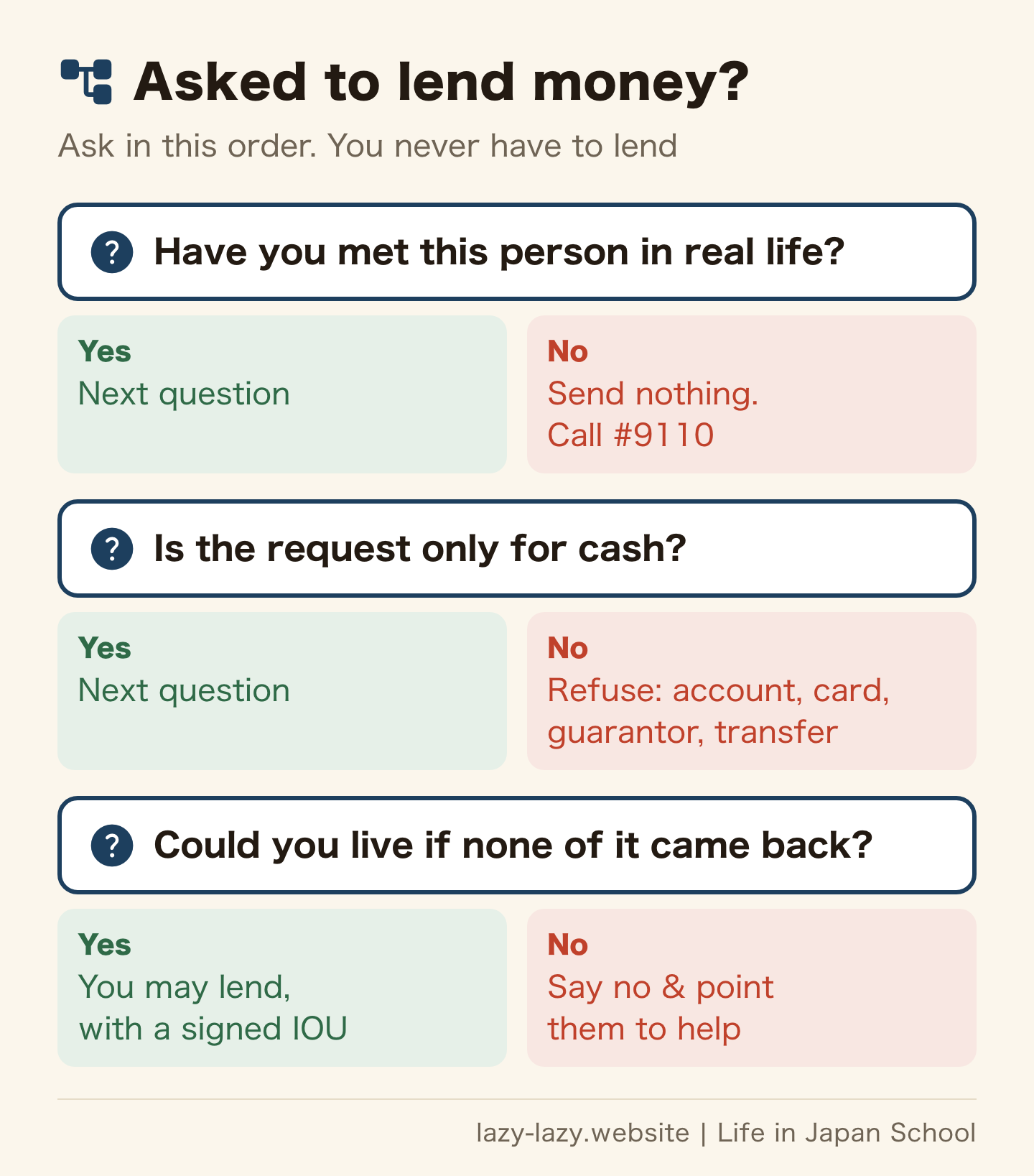
A “no” at the first check means this may be a scam, not a loan. A “no” at the second means a possible crime or a heavy legal burden. A “no” at the third means refusing is the right answer, however much you want to help. If your own life falls apart, you are the next person who needs help.
How to say no to lending money: what to say in Japanese and English
Three things help. Keep it short. Do not add a false reason. Make it your own rule, not a judgment of the other person.
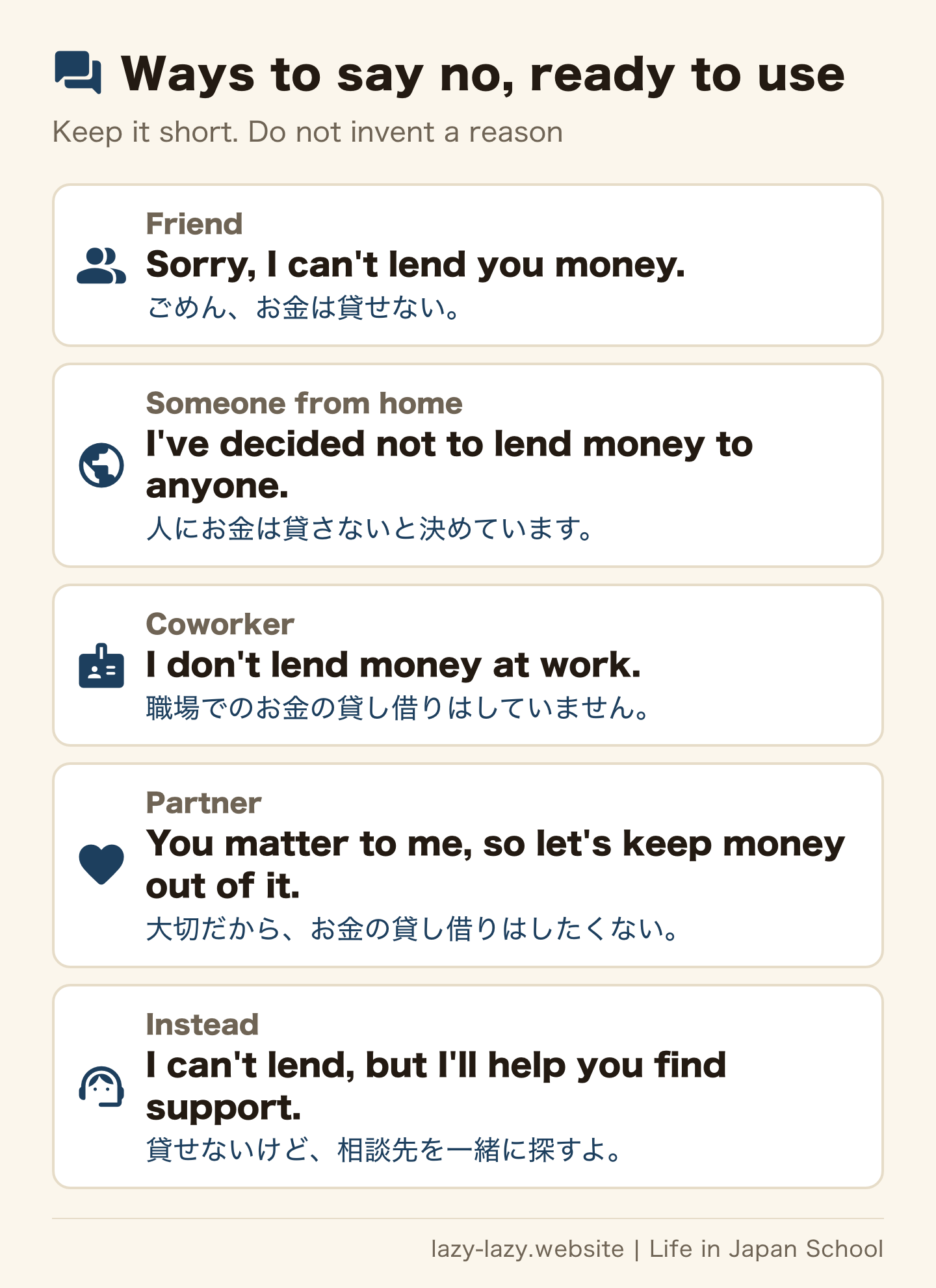
“I have no money right now” invites “So when will you?” “I’ve decided not to lend to anyone” still works next month. It also does not suggest you distrust them.
The same lines work with a boyfriend, girlfriend or partner. If you do hand money over, say out loud whether it is a loan or a gift. Without a paper, it is harder to prove later that you lent it.
If someone keeps asking, repeat yourself: “As I said before, my answer is the same.” (前にも言ったとおり、答えは同じです。) If you are pressed on the spot, say “I can’t answer now. I’ll reply tomorrow.” (今は答えられません。明日返事します。) and walk away.
It can be hard to refuse a boss or someone senior. You do not have to carry that alone: the list of free helplines includes the ones for work problems.
How can you help without lending?
Saying no is not the same as abandoning someone. You can often shrink the problem without handing over money.
- If they have a bill they cannot pay, they can ask to split or delay it before the deadline. What to do instead of borrowing explains how, and sending them that page already helps.
- If life has become hard, each area has a self-reliance support centre that also helps rebuild a household budget. You could help them write the first email or make the first call.
- If they are drowning in repayments, Houterasu has a multilingual line (0570-078377, weekdays 9:00 to 17:00).
How much is safe to lend? What you could lose without your life falling apart
The law sets no figure. This article uses one idea: only what you could lose completely and still pay next month’s rent and tuition.
The sum is savings, minus your emergency fund, minus bills due within 3 months. This is this site’s guide. An emergency fund is money that lets you live without borrowing if your income stops. You work it out as monthly spending × months + one-off costs.
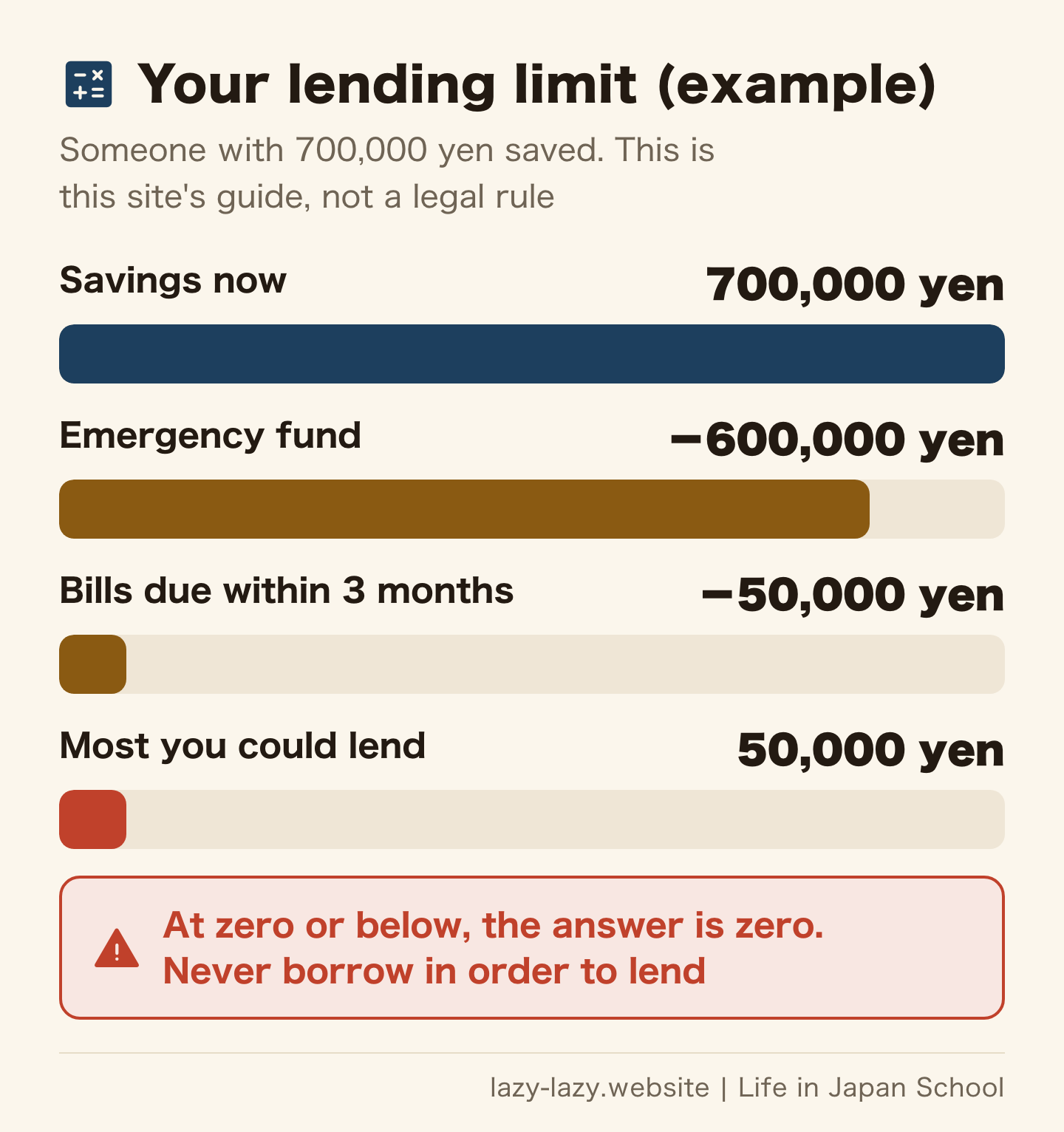
Here is an example. You live alone and spend 150,000 yen a month. Three months comes to 450,000 yen. Add 150,000 yen for one-off costs such as a flight home, and your emergency fund is 600,000 yen. With 700,000 yen saved and 50,000 yen of tuition or other bills due within 3 months, 50,000 yen is left. A request for 30,000 yen is possible. For 100,000 yen, offer up to 50,000 yen or refuse.
The result is a ceiling, not a target. If it comes to zero or less, the answer is no.
Never use a cash advance or revolving credit to lend to someone. If they do not repay, your own repayments and interest carry on. The numbers on revolving credit show how heavy those fees are.
If the borrower is due to leave Japan, set the repayment date before they go. Do not lend a second time until the first loan is repaid. This site suggests both rules.
Lending money to a friend: how to write a contract (IOU) in Japan
“We’re from the same country. We don’t need paperwork.” Where you come from, that may be normal. In Japan, a spoken loan is valid, but if you go to court, the lender has to prove it.
A loan with no shakuyosho (IOU) is not void. But if the other person says “you gave it to me” or “I never borrowed it”, you have lost strong evidence. If you decide to lend, put it on paper, even for a small amount.
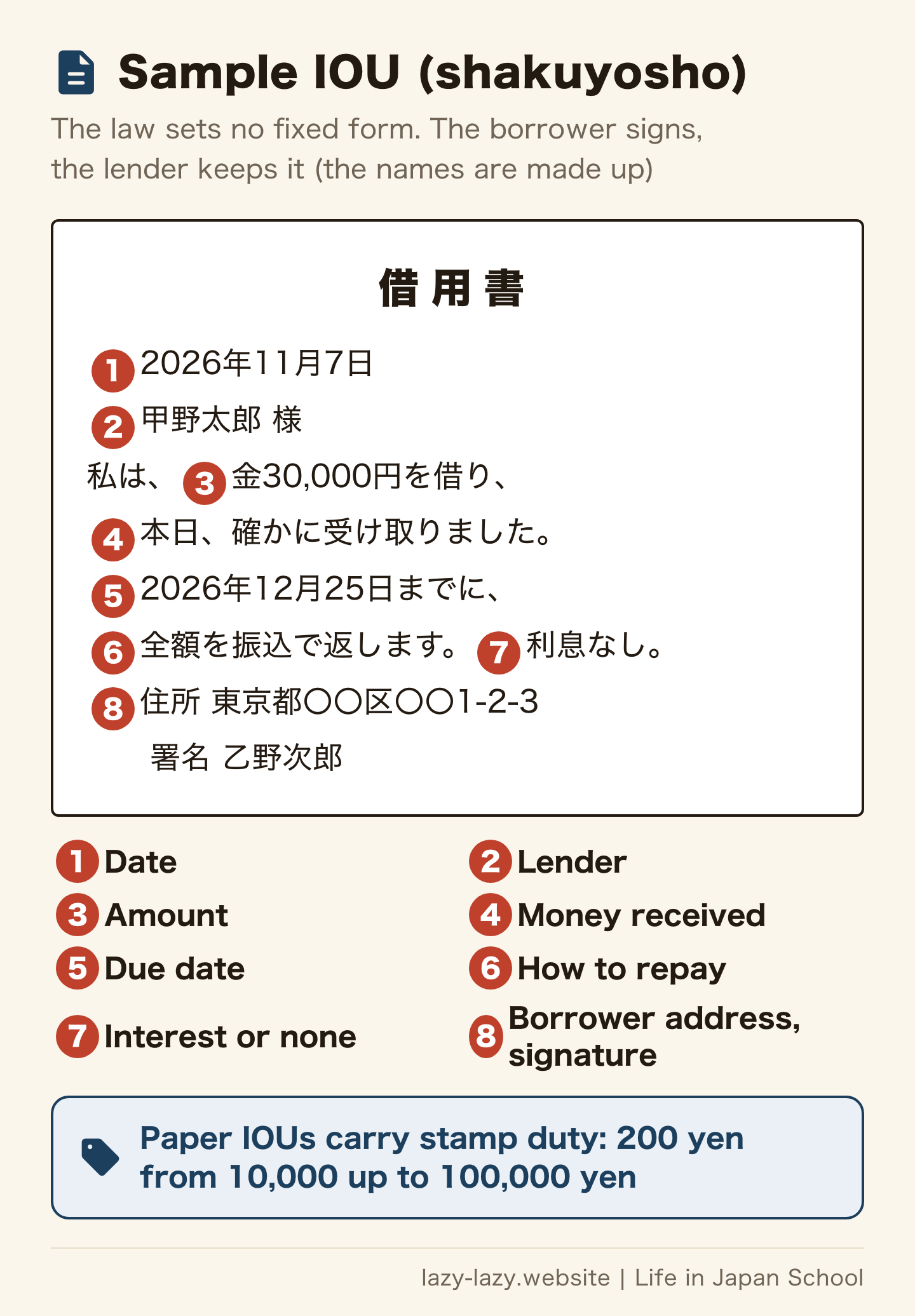
The law sets no fixed form. This site put these eight items together from the Houterasu Q&A and the courts’ sample claim form for a loan. The idea is to write down at the start what you would need to put on that form later.
- The borrower writes and signs it, and the lender keeps the original. If Japanese is hard for them, add their own language so they know what they are signing.
- Hand over the money by bank transfer, which leaves a record. If you use cash, keep the sentence saying the money was received.
- Write the repayment date as an actual date. Without one, under Civil Code article 591, you start by demanding repayment within a reasonable period.
- Get the address where they live now, because court papers go there. A contact address for after they leave Japan is useful too. Do not hold on to their residence card.
A paper IOU carries stamp duty. A loan note is a Class 1 document for the National Tax Agency. Under 10,000 yen there is no duty. From 10,000 yen up to 100,000 yen it is a 200 yen revenue stamp, up to 500,000 yen it is 400 yen, and up to 1,000,000 yen it is 1,000 yen. For the 30,000 yen in the sample, that means 200 yen.
Without an agreement on interest, you cannot claim any (Civil Code article 589). This site’s view is simple: do not charge a friend interest. Do not make money by lending repeatedly either. The Financial Services Agency says that lending with the intent to repeat it is money lending, even for an individual. Unregistered money lending carries up to 10 years in prison or a fine of up to 30 million yen, or both.
For a large amount, you can make a notarised deed at a notary office. If it says the borrower accepts compulsory execution on default, you can go to enforcement without a lawsuit. The basic fee is 3,000 yen up to 500,000 yen, and 5,000 yen up to 1,000,000 yen. Extra charges, such as for the number of pages, can apply.
Friend won’t pay back money? Written demand first, then legal action
When the due date passes, go in this order. Houterasu describes the same path.
- Send a message stating the amount and the date, and save the screenshots.
- If there is no answer, send a demand by certified-content mail (naiyo shomei). The post office certifies when you sent it and what it said. One page in a standard envelope comes to 1,070 yen in total. Only certain post offices accept it, so ask first.
- If you are still not repaid, look at the court routes.
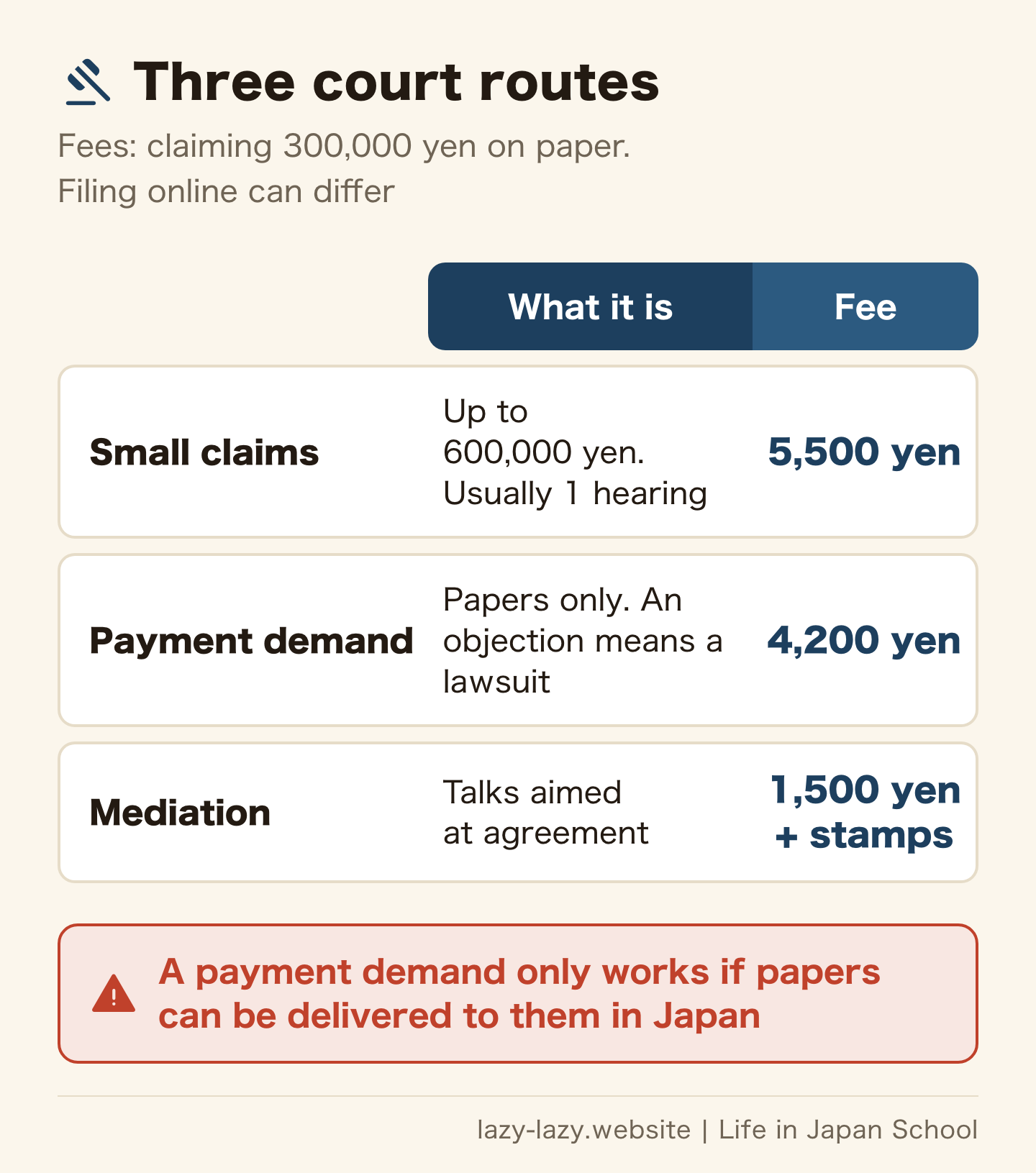
Small claims (shogaku sosho) is a lawsuit for up to 600,000 yen. It usually ends in one hearing, so bring your IOU and transfer records by the first date. You can use it up to 10 times a year at the same court. If the other side asks, it moves to an ordinary lawsuit. Even if you win, the court may order instalments over up to 3 years.
A payment demand (shiharai tokusoku) goes ahead on papers alone, with no court visit. You file at the summary court for the borrower’s address. If they object within 2 weeks of receiving it, it becomes a lawsuit. If they do not, you apply for a declaration of provisional execution within 30 days. Miss that, and the demand loses its effect.
Civil mediation (minji chotei) is not about winning. You talk it through with mediators. It suits people who do not want to end the relationship.
The courts’ fee table lists every amount. To claim 300,000 yen on paper, small claims costs 5,500 yen, a payment demand 4,200 yen and mediation 1,500 yen. Online, small claims costs 4,400 yen and a payment demand 4,000 yen. The fees for lawsuits and payment demands now include postage. Mediation stamps are separate, and each court gives the amount. If a payment demand turns into a lawsuit, you pay the difference.
Winning does not make the money arrive by itself. If they still do not pay, you apply separately for compulsory execution, such as seizing wages or savings.
If the borrower leaves Japan or you lose their address, your options narrow. A payment demand only works if papers can be served in Japan without service by publication (Code of Civil Procedure article 382). Service by publication means the court treats papers as delivered, by a notice, when it cannot find the person. Small claims also moves to an ordinary lawsuit if this becomes necessary. If you hear they are leaving, act before they go.
Not sure which route fits? Ask Houterasu. The interpreter line is 0570-078377 (weekdays 9:00 to 17:00). Free legal consultations are for people with an address in Japan and lawful residence, whose income and assets are under the limits. For one person, the limit is 182,000 yen of monthly take-home income (annual take-home pay including bonuses, divided by 12), or 200,200 yen in places such as Tokyo’s 23 wards and Osaka City. If you pay rent, up to 41,000 yen can be added to the limit for one person (up to 53,000 yen in Tokyo’s 23 wards, Japanese PDF). Having fees advanced also requires that your case is not without prospect of winning, among other conditions.
You have every right to ask for your money. Still, do not use threats such as “I’ll tell immigration” or “I’ll tell your company”. That only gives you a different problem.
What is the time limit on a loan in Japan? 5 years and 10 years
The right to demand repayment can expire. Civil Code article 166 gives 5 years from when you knew you could exercise it, or 10 years from when you could, whichever comes first. The 10 years matters only if you did not know you could exercise it. If you set a due date, you know that date. So the working rule is 5 years after the due date.
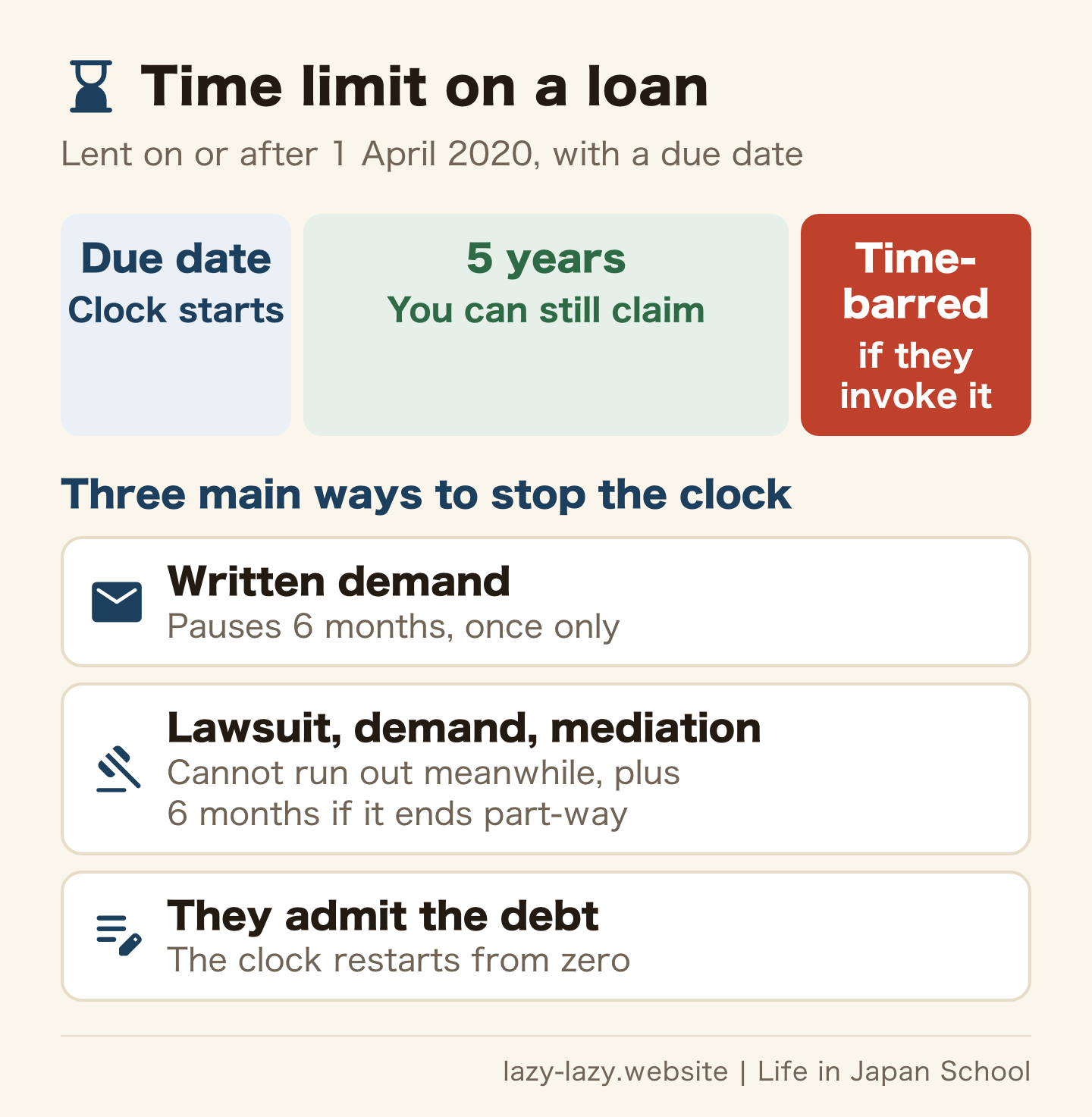
After 5 years the debt does not vanish by itself. It ends only when the borrower invokes the time limit (article 145).
There are three main ways to stop the clock. A written demand holds it off for 6 months, and a second demand adds nothing (article 150). A lawsuit, a payment demand or mediation means it cannot run out during the process. If the process ends part-way, it cannot run out for 6 months from then (article 147(1)). If the borrower admits the debt, the count restarts (article 152). A note saying “I owe X yen and will pay in month Y” gives you something to show later.
Money lent up to 31 March 2020 falls under the older rules (supplementary provisions of the 2017 amendment, article 10(4)). A loan with no due date also needs a judgment on when the count starts. For either one, check with Houterasu.
Lending money to a friend: tax implications if you say “keep it”
Gift tax falls on the person who receives the gift. If the total received in a year is 1,100,000 yen or less, there is no tax and no return to file. A genuine loan does not bring the lender into gift tax at all.
The moment to watch is when you say “You don’t need to pay me back.” The National Tax Agency says that someone released from a debt is treated as having received that amount as a gift. The tax would fall on the borrower. The part they cannot repay because they have lost the means to pay is not treated as a gift.
Promises like “pay me whenever” or “pay me when you make it” are risky too. The tax agency’s page says such loans are treated as a gift of the whole amount. It adds that with an interest-free loan, the interest saved can count as a gift. That page is about parents, children and similar close relations. If a large sum is involved, ask the tax office whether the same applies between friends. Gift tax on money from family shows how the 1,100,000 yen line is counted.
Asked to lend your bank account or residence card? That is not a loan, and it can be a crime
“I only need your residence card for one day, for an interview.” Where you come from, lending your ID may be a small favour. In Japan, handing over your own residence card so someone can use it carries up to 1 year in prison or a fine of up to 200,000 yen (Immigration Act article 73-6). It is also a ground for deportation (article 24, item 3-5).
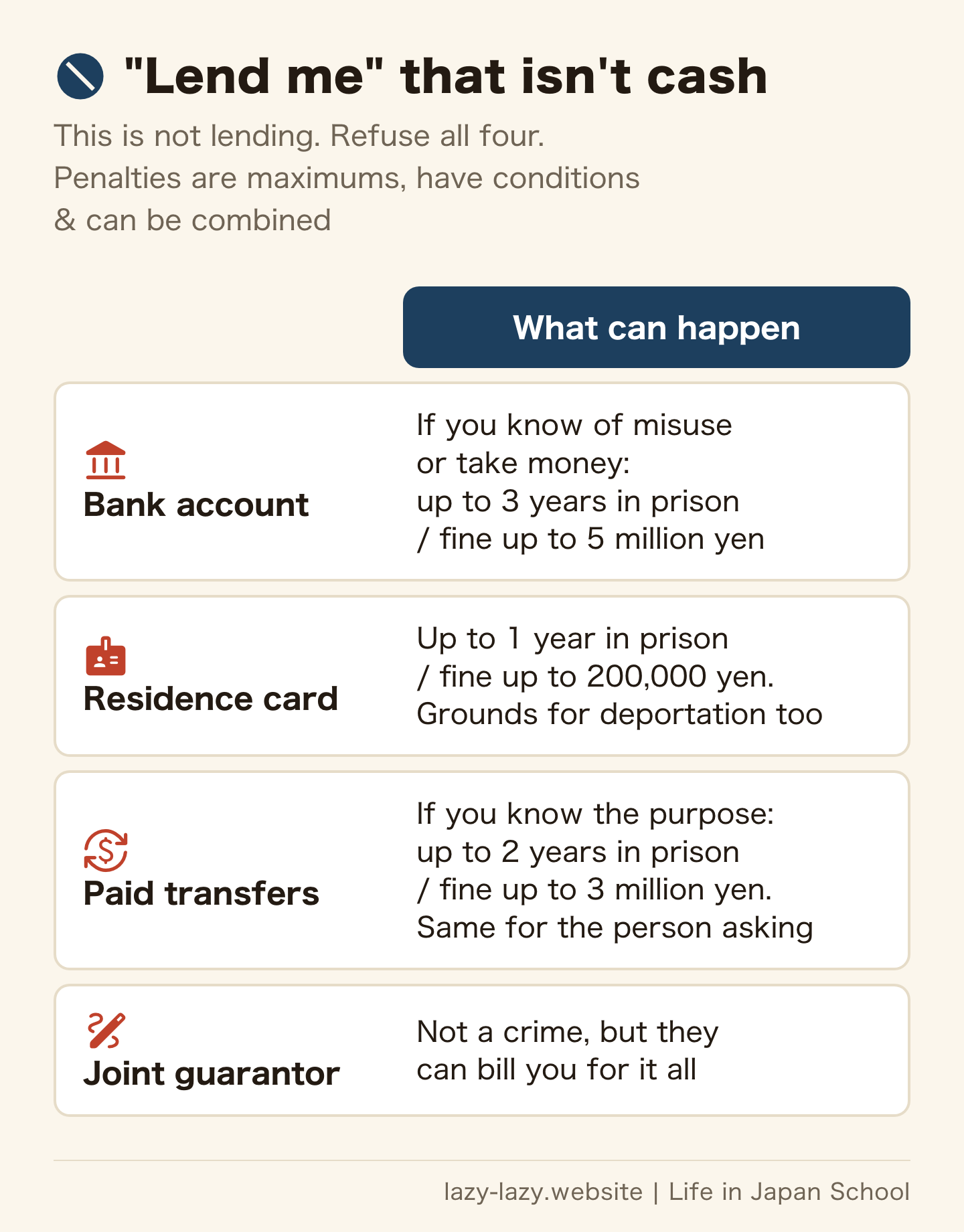
The same goes for bank accounts. The National Police Agency warns that transferring an account is a crime, paid or unpaid. Handing over an account knowing it will be misused, or handing it over for money without a legitimate reason, can bring up to 3 years in prison or a fine of up to 5 million yen, or both (Act on Prevention of Transfer of Criminal Proceeds, article 26(2)). “Just for a while” and “I’m leaving Japan anyway” change nothing. The tricks, and who to call if you have already handed one over, are in the “lend your bank account” section of the scams guide. The detailed conditions and penalties, and the rules on phones and SIM cards, are in 7 laws foreign residents can break.
Asked to be a guarantor? There is no such thing as “just your name”
“You’ll never be bothered.” “I only need your name.” A Ministry of Justice leaflet warns that people who sign after hearing just these words can end up in serious trouble.
A guarantor promises to pay if the borrower does not. A joint guarantor (rentai hoshonin) can be billed and have assets seized whether or not the borrower has money (Civil Code article 454). That can include wages and savings.
When you lend, the most you can lose is what you lent. With a guarantee, the amount depends on someone else’s debt. It does not fit inside your lending limit, so the default answer is no. A guarantee has no effect unless it is made in writing, including an electronic record (article 446). If someone needs a guarantor for a flat, show them three ways to rent without one.
Asked to send money abroad for someone? Keep it out of your account
“I want to send money to my family but my account doesn’t work. I’ll pay it into yours, and you send it.” Refuse this too. They can send it themselves through a bank or a registered provider.
Anyone other than a bank is barred from running a money transfer business under the Banking Act and related laws. Funds transfer providers must register with the Financial Services Agency. A National Public Safety Commission report calls paid overseas transfers by unqualified people underground banking, which breaks the Banking Act and related laws. It lists arrests of people who took requests on social media. Unlicensed banking carries up to 3 years in prison or a fine of up to 3 million yen, or both.
Since 10 July 2026 there is also a new crime covering paid transfers. If, with no legitimate reason, you send money at someone’s request, knowing their purpose and on a promise of a reward, you face up to 2 years in prison or a fine of up to 3 million yen, or both. Repeating it raises that to 3 years or 5 million yen, or both. The person asking faces the same penalties (Act on Prevention of Transfer of Criminal Proceeds, article 32). The police material also gives the example “Send this and I’ll cancel your debt.” Cancelling a debt counts as a reward too.
An unpaid transfer falls outside this new penalty, the National Police Agency says. Even so, if money you cannot explain passes through your account, the name on it is yours. To choose your own way of sending, see the money transfer comparison, and send the same page to the person asking.
Is the request a scam? Signs of a romance scam
If someone speaks to you like a partner but you have never met, stop before you send anything. The National Police Agency says to be careful whenever a person you have not met in real life brings up money. It adds that even on a video call, an impostor may be pretending to be someone else.
The police list these lines:
- “It’s for our future together”
- “Let’s grow your money by investing”
- “Send me the fare so I can come and see you”
- “I’m sending you a parcel, so please pay the fee”
If even one fits, the police ask you to talk to them before you pay. The same page warns about being moved to LINE soon after matching on a dating app. Call #9110. If you have already sent money, the scams guide has the steps. This is not your fault, and the sooner you call, the better the chance of stopping it.
Which one are you?
- A friend or someone from home asked, and you do not want to lend — today, pick one line from the table and send it as it is.
- You are willing to lend — today, take your emergency fund from your savings and find your limit. If you lend, have the borrower write an IOU like the sample.
- A friend owes you money — today, save your transfer records and messages, and count the years since the due date. If there is no reply, send a certified-content letter.
- You were asked for your account, residence card, a guarantee or a transfer — today, say no. If you have already handed something over, call #9110 or go to a police station.
- You have never met the person asking — today, send nothing. Keep screenshots of the messages and call #9110.
Frequently asked questions
Q. Can I refuse when a friend asks to borrow money?
Yes. You have no duty to lend. Say “Sorry, I can’t lend you money” and do not add a false reason. You can offer to help find support instead.
Q. How much is it safe to lend a friend?
The law sets no figure. This site’s guide is savings, minus your emergency fund, minus bills due within 3 months. Stay within what you could lose completely. If the result is zero or less, do not lend.
Q. Can I get money back without an IOU?
The loan is valid without one, and you can ask for repayment. In court, though, the lender has to prove it. Save transfer records and messages, and if you can, get a note now saying “I owe X yen”.
Q. What is the time limit on a personal loan in Japan?
For loans from 1 April 2020, it is 5 years from when you knew you could claim, or 10 years from when you could, whichever comes first. The 10 years matters only if you did not know you could claim. With a due date, the working rule is 5 years after that date. It does not end unless the borrower invokes it, and a lawsuit or their admission of the debt can stop it.
Q. Do I need a lawyer to get my money back?
Not always. Small claims covers up to 600,000 yen, and a payment demand runs on papers alone. If you are unsure, call Houterasu (0570-078377, weekdays 9:00 to 17:00). If you meet the income limits and other conditions, you can use a free legal consultation.
Q. What happens if the borrower goes back to their country?
The debt does not disappear, but your options narrow. A payment demand only works if papers can be delivered to them in Japan. Set the due date before they leave, and act before they go if you hear they are leaving.
Summary
When someone says “lend me money”, you have no duty to agree. If you refuse, keep it short and make it your own rule. If you lend, stay within what you could lose completely, and get an IOU. If you are not repaid, demand it in writing, then move to small claims, a payment demand or mediation. The claim can expire 5 years after the due date.
Your bank account, your residence card and paid transfers are not loans. They can be crimes. A joint guarantee does not fit inside any lending limit. When someone you have never met talks about money, call #9110 before you send anything. Protecting your own life and your status in Japan is what lets you help someone next time.
Official sources: e-Gov: Civil Code / Code of Civil Procedure / Immigration Control and Refugee Recognition Act / Money Lending Business Act / Banking Act / Act on Prevention of Transfer of Criminal Proceeds / Courts: small claims / payment demand / civil mediation / fee table / Houterasu FAQ / National Tax Agency No.4424 / No.4420 / No.7140 / National Police Agency: transfer crime / romance scams / Financial Services Agency / Ministry of Justice: guarantees / Ministry of Finance FAQ / Japan National Notaries Association / Japan Post. Checked 7 November 2026.
Read next
Found this useful? Share it
Send it to a friend who lives in Japan.
WHO WROTE THIS

mori
Japanese. I read the ministries’ own notices, orders and Q&As in the original, and I start from what my Nepalese and Sri Lankan friends in Japan actually ran into. I do not write about what I have not checked or been told.
What this site can and cannot do →Looking for something else?
You may use the figures in this article, including commercially, if you credit this site with a link. How to use our figures