This article was checked on 26 October 2026 against the Interest Rate Restriction Act, the Investment Act, the Money Lending Business Act and the Act on Self-Reliance Support for Needy Persons (e-Gov), the Financial Services Agency’s guides to the money lending rules and its warnings about illegal lenders, Rakuten Card’s official revolving and cash advance pages, CIC’s credit information pages, and the Tokyo Council of Social Welfare’s guide to the emergency small loan. Rates and conditions change, so check the official pages on the day you apply.
The short answer
- When you are short of money, move the payment date before you borrow. Rent, tax, health insurance, pension and tuition can sometimes be split or delayed if you ask before the due date.
- Revolving payment (ribo) means paying a roughly fixed amount of principal each month plus a fee on the remaining balance. Borrowing 100,000 yen and repaying 3,000 yen of principal a month (the fee is added on top) on Rakuten Card’s revolving rate (17.64% a year) takes 34 payments and 25,224 yen in fees by our calculation.
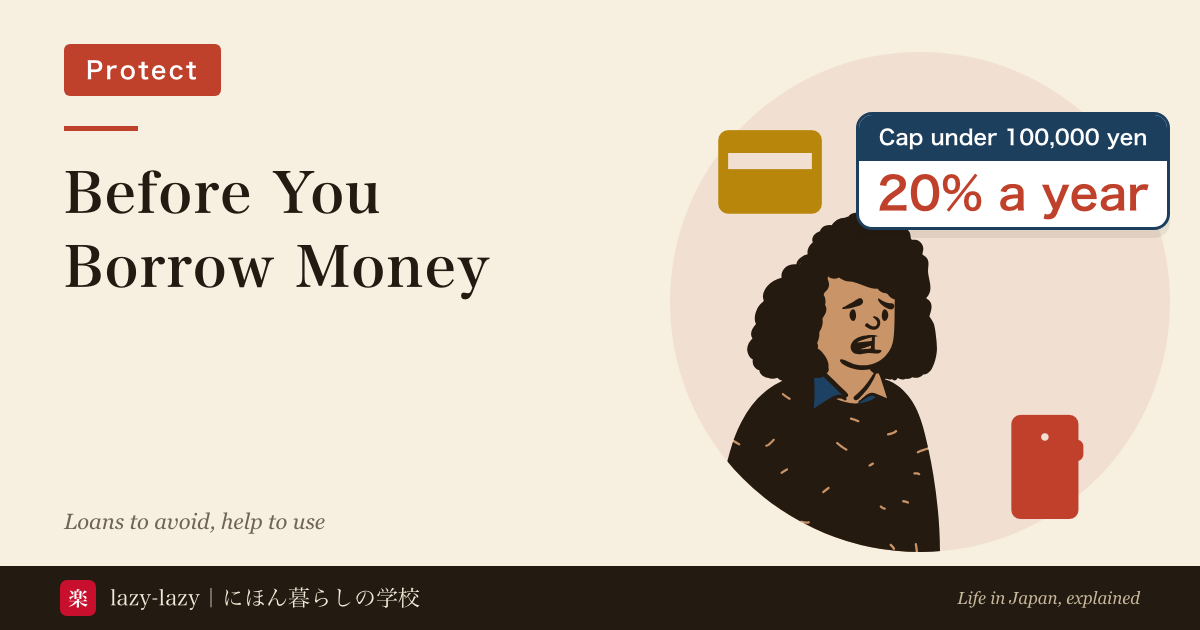
- The legal cap on loan interest is 15-20% a year. Lending as a business above 20% a year is a crime. Do not borrow through SNS “personal loans” or from unregistered lenders.
- The public option is the emergency small loan from the social welfare council (up to 100,000 yen, no interest, no guarantor). In Tokyo, foreign residents qualify only with statuses such as permanent resident, long-term resident or spouse of a Japanese national; student and work statuses are not included.
- If a payment is 61 days or 3 months or more late, CIC records it as a default (ido), and the record stays for 5 years after the contract ends. If you are struggling, talk to a self-reliance support centre, the police on #9110 or the 188 hotline before you borrow.
Knowing this, you can act in the right order before fees make the debt bigger: move the payment date, lean on public help, and turn illegal lenders away.
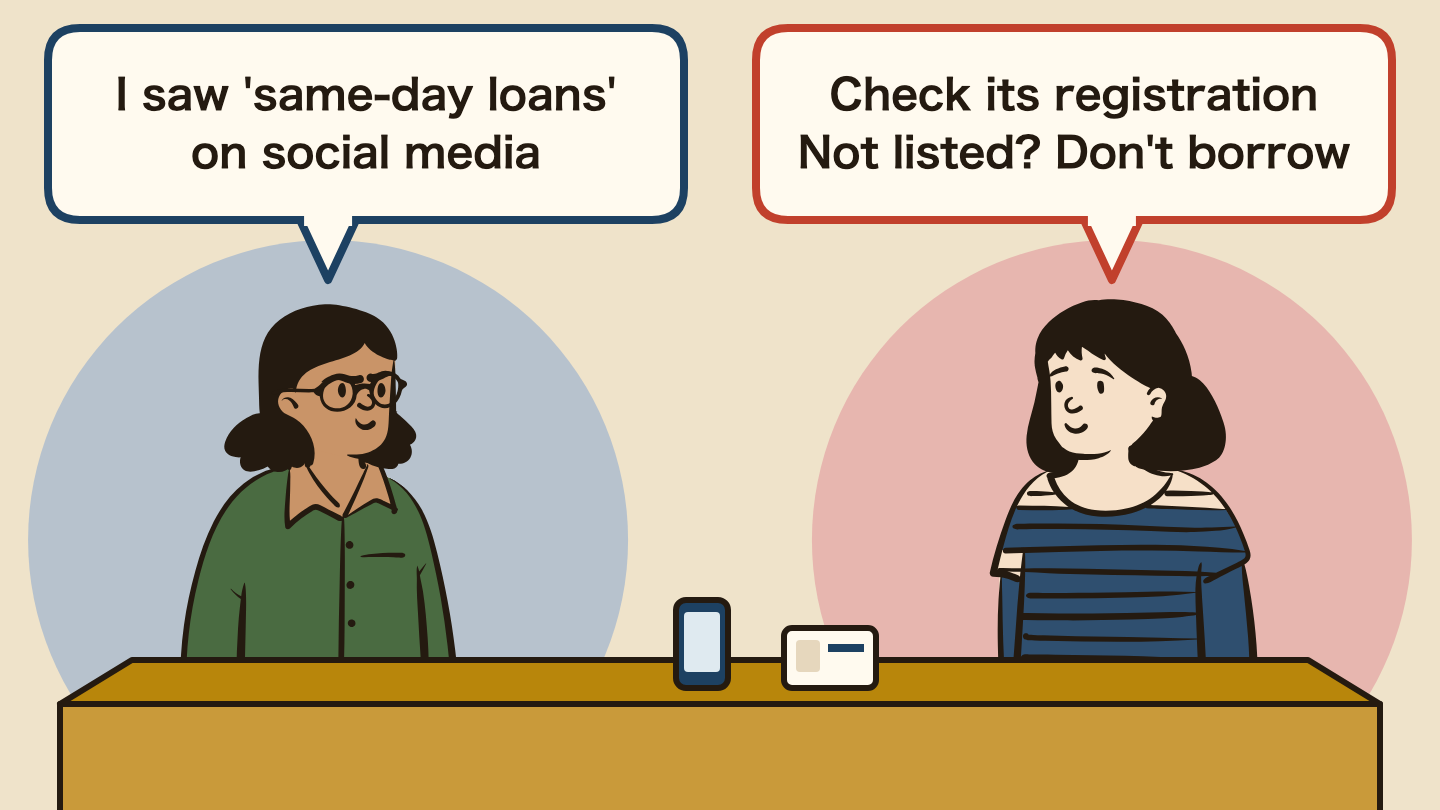
January of your second year as a student. Your autumn tuition is due next week, and your bank balance will not cover it. On social media a post scrolls past: “Residence card only, same-day loans.” You ask a Japanese friend, who says, “Just put it on revolving, then it’s a little each month.” Both look like a way through this month. But one may be an illegal lender, and the other is a way of paying where the fee runs for months. Before either, you may be able to move the deadline itself.
- Short of money in Japan? What to do before you borrow, in four steps
- Can you split a bill you cannot pay? Rent, tax, health insurance, pension, tuition
- What public loans can foreigners use? Self-reliance support centres and the emergency small loan
- What interest do revolving, cash advances and card loans charge? The legal cap is 15-20% a year
- How much does it cost to repay 100,000 yen on revolving? Worked out with Rakuten Card’s formula
- What is the one-third-of-income rule? And what “bank card loans are not covered” means
- What happens if you pay late? A CIC “default” stays for 5 years
- Why are SNS “personal loans” and loan sharks dangerous? Eight warning signs
- Already borrowed and cannot repay? Who to call: #9110, 188 and the Japan Financial Services Association
- Which one are you?
- FAQ
- Summary
- Related reading
Short of money in Japan? What to do before you borrow, in four steps
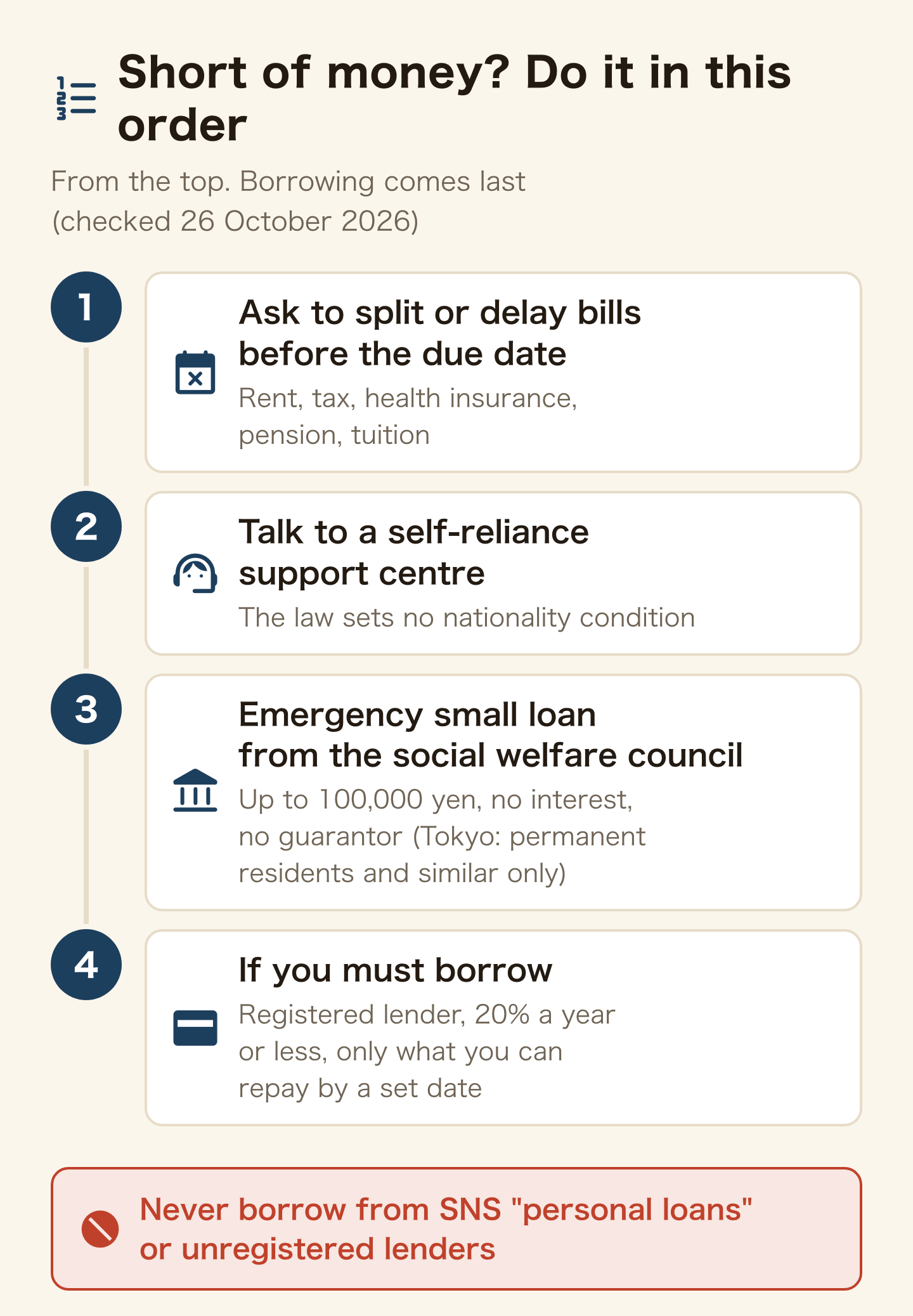
When money runs short, the first move is not to borrow. Go down this list from the top, and stop as soon as one step solves it.
- Move the payment date: if the problem is next week’s bill, ask to split or delay it before the due date.
- Go to a public support desk: a self-reliance support centre listens to problems with work, rent and household money. Article 3 of the Act on Self-Reliance Support for Needy Persons defines a “needy person” with no nationality condition (e-Gov: Act on Self-Reliance Support for Needy Persons).
- Ask about a public loan: the emergency small loan from the social welfare council. There are residence status conditions, though.
- If you still have to borrow: use a lender registered with the national or prefectural government, at 20% a year or less, and only an amount you can repay by a date you set.
If your plan is to work more shifts to pay it back, count in the 28-hour weekly limit for students. How the limit is counted is in part-time jobs in Japan for foreigners (the 28-hour rule).
Can you split a bill you cannot pay? Rent, tax, health insurance, pension, tuition
Letting a due date pass in silence is what closes the most doors. If you get in touch before the date, some bills can be split, delayed or reduced.
- Residence tax, health insurance, pension: how to ask for instalments or a delay, and how the late charges differ, is in unpaid residence tax in Japan. For health insurance check the premium reductions first, and for pension the exemption and deferral.
- Tuition: some schools offer deferred payment or monthly instalments. At some the deadline is the same as for the fee waiver, so check the dates in tuition fee exemption in Japan before you go to the student office. Ask the same office whether the school has its own emergency loan.
- Rent: tell your landlord or the management company first when you will be able to pay. If you keep being unable to pay rent, ask a self-reliance support centre about housing support.
The Tokyo Council of Social Welfare itself says that if there is another way, such as paying in instalments, you should use that before a loan (Tokyo Council of Social Welfare: emergency small loan guide). If you can split the bill, you may not need the debt at all.
What public loans can foreigners use? Self-reliance support centres and the emergency small loan
There is a self-reliance support centre for every area. They also offer household budget support, helping you rebuild your finances, and can arrange a loan when one is needed (Ministry of Health, Labour and Welfare: self-reliance support system). Find yours in the national list of self-reliance support centres. How to use the centre, and the housing security benefit that helps with rent, are covered in welfare in Japan for foreigners (help before welfare).
The emergency small loan (kinkyu koguchi shikin) is public money lent by the social welfare council (shakyo). The Tokyo council sets these terms (Tokyo Council of Social Welfare: emergency small loan guide, April 2026).
| Item | Tokyo emergency small loan |
|---|---|
| Amount | Up to 100,000 yen (in units of 1,000 yen) |
| Interest | None (3% a year late interest after the repayment deadline) |
| Repayment starts | After a 2-month grace period |
| Repayment period | Within 12 months |
| Guarantor | Not needed |
| Time to receive the money | At least 5 business days from applying |
In the Tokyo council’s example for 100,000 yen, you repay 8,330 yen eleven times and 8,370 yen the last time. 8,330 × 11 + 8,370 = 100,000 yen, with no interest.
There is a residence status condition. For foreign nationals, the Tokyo council requires a mid- to long-term resident with the status of permanent resident, spouse or child of a permanent resident, spouse or child of a Japanese national, long-term resident or spouse of a long-term resident, or a special permanent resident. You must also have lived at your current address for 6 months or more and be expected to live in Japan permanently. In Tokyo, people on student or work statuses are not included in this condition. For other prefectures, tell your local social welfare council your residence status and ask.
There are other rules too. The money cannot be used to repay debts. Households with large debts, or with someone behind on repayments, are not eligible. As a rule, you first need to consult a self-reliance support centre.
What interest do revolving, cash advances and card loans charge? The legal cap is 15-20% a year
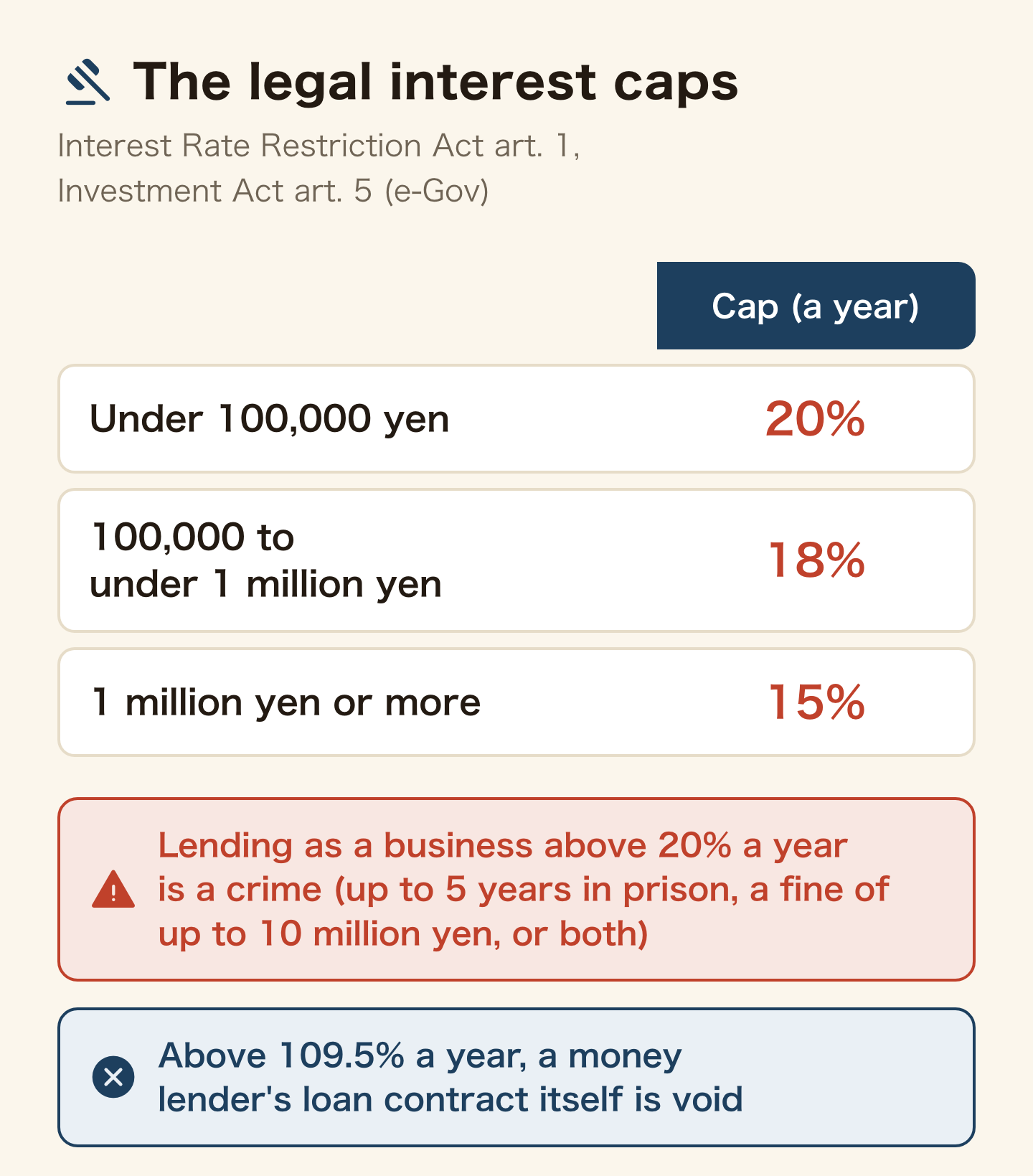
The law caps the interest on a loan. Article 1 of the Interest Rate Restriction Act sets the cap by the amount borrowed (the principal) and makes anything above it void (e-Gov: Interest Rate Restriction Act).
- Under 100,000 yen: 20% a year
- 100,000 yen to under 1 million yen: 18% a year
- 1 million yen or more: 15% a year
Under Article 5(2) of the Investment Act, contracting for interest above 20% a year as a business is punishable by up to 5 years in prison, a fine of up to 10 million yen, or both (e-Gov: Investment Act). Article 42 of the Money Lending Business Act makes the loan contract itself void when interest above 109.5% a year is contracted as a business (e-Gov: Money Lending Business Act).
Actual rates differ by company and contract. Here we use one company’s official page as the example. A cash advance on a Rakuten Card (borrowing cash on the card) costs 18.0% a year, charged by the day (Rakuten Card: cash advance). Borrow 100,000 yen for 30 days and the interest is 100,000 × 18.0% ÷ 365 × 30 = 1,479 yen. At an ATM, amounts over 10,000 yen carry a separate 220 yen fee. Late payment charges are 20.0% a year.
Card loans and consumer finance companies also set their own rates. Before you apply, look at the “effective annual rate” and the number of payments in the contract, and work out the total interest until it is paid off.
How much does it cost to repay 100,000 yen on revolving? Worked out with Rakuten Card’s formula
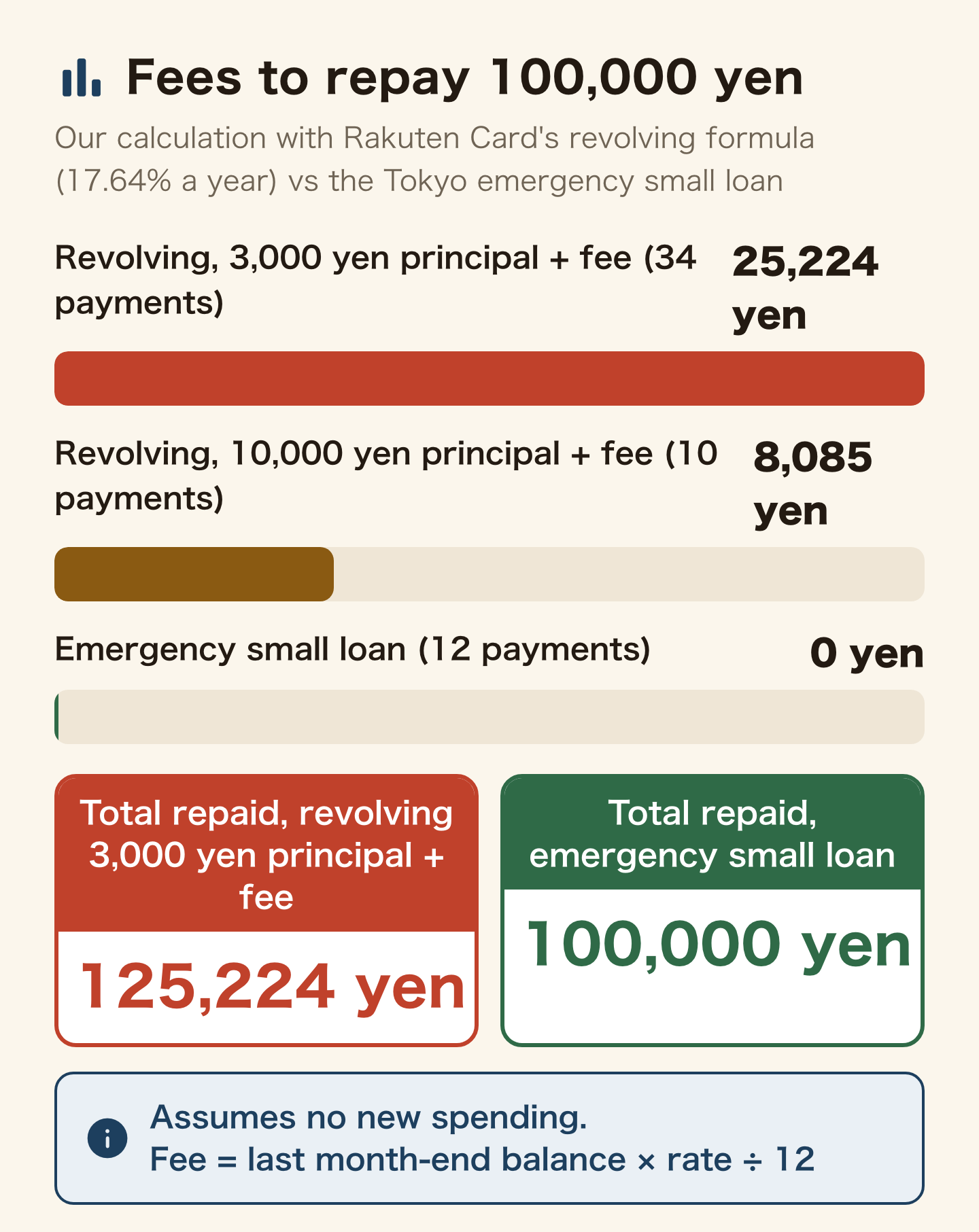
Revolving on Rakuten Card costs 17.64% a year on cards such as the Rakuten Card and Rakuten PINK Card. The monthly fee is “the balance at the end of the previous month × the effective annual rate ÷ 12 months”, and new members start on the 3,000 yen a month course (Rakuten Card: revolving payment).
We used that formula to work out 100,000 yen on the 3,000 yen course, repaying 3,000 yen of principal a month (the fee is added on top). The first month’s fee is 100,000 × 17.64% ÷ 12 = 1,470 yen, so the first month’s payment is 3,000 + 1,470 = 4,470 yen. The fee shrinks as the balance falls, but it takes 34 payments to finish, and the fees add up to 25,224 yen. Repaying 10,000 yen of principal a month (the fee is added on top), it takes 10 payments and 8,085 yen in fees. Both assume no new spending and round each month’s fee down to the yen. Check the real figures with Rakuten Card’s repayment simulator.
| How you repay 100,000 yen | Payments | Fees or interest | Total repaid |
|---|---|---|---|
| Revolving, 3,000 yen principal + fee | 34 | 25,224 yen | 125,224 yen |
| Revolving, 10,000 yen principal + fee | 10 | 8,085 yen | 108,085 yen |
| Emergency small loan (Tokyo) | 12 | 0 yen | 100,000 yen |
With revolving, the smaller the monthly payment, the longer the fee keeps running. The rules to keep once you have a card are in credit cards for foreigners in Japan (why not to use revolving). If you already have a revolving balance, stopping new spending and raising the monthly payment cuts the fees.
What is the one-third-of-income rule? And what “bank card loans are not covered” means
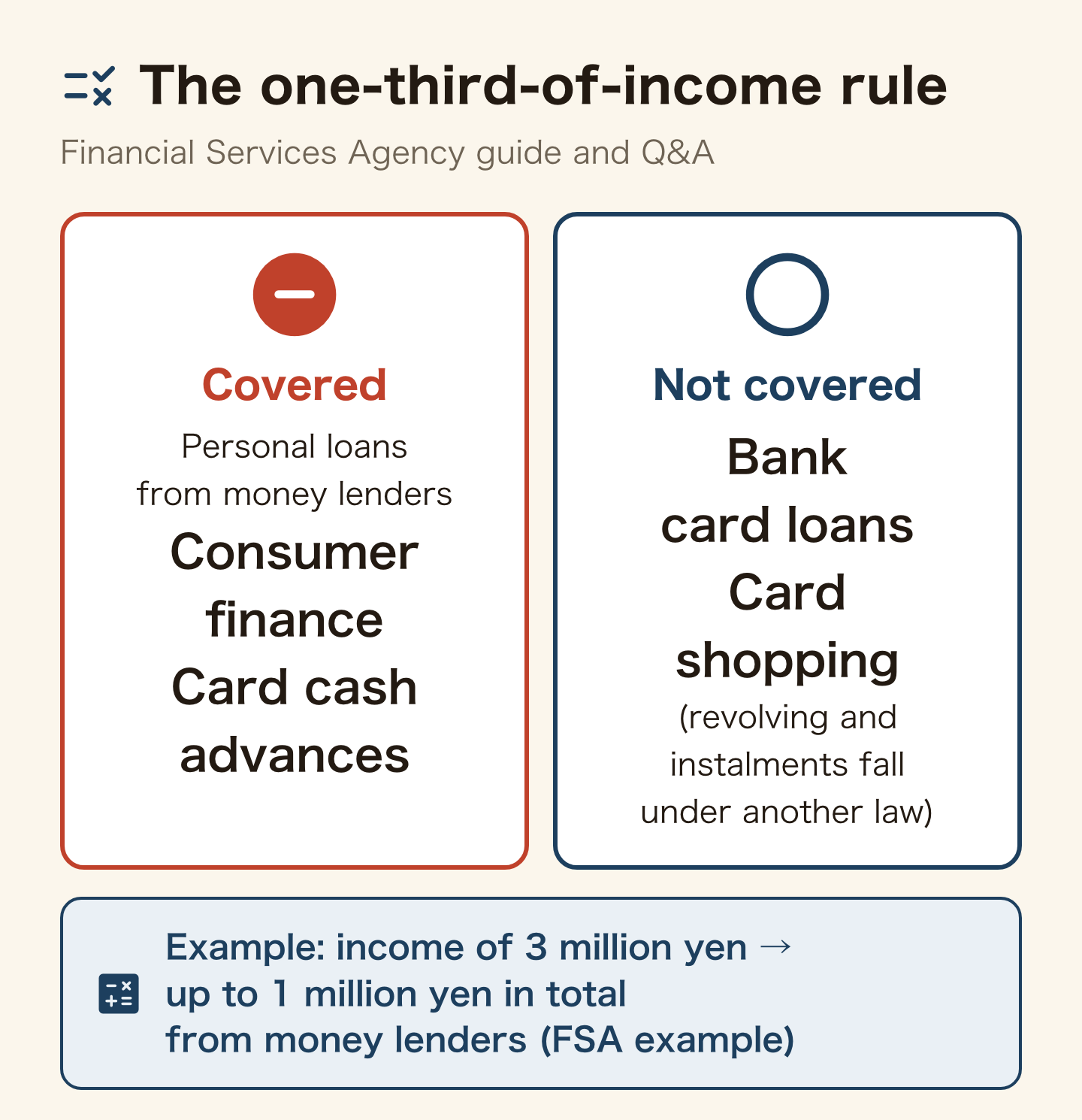
The total lending limit (soryo kisei) means that once your borrowing from money lenders exceeds one third of your annual income, you cannot borrow more (Financial Services Agency: basics of the Money Lending Business Act). In the agency’s Q&A example, someone earning 3 million yen a year can borrow up to 1 million yen in total from money lenders (Financial Services Agency: money lending Q&A).
According to the agency’s Q&A, the rule covers money lenders such as consumer finance companies and credit card companies (Financial Services Agency: money lending Q&A).
- Covered: loans from consumer finance companies, and credit card cash advances
- Not covered: bank card loans and other borrowing from lenders that are not money lenders
- Not covered: shopping on a card. Revolving and instalment payments are transactions under the Installment Sales Act
If you are already over one third of your income, you are not made to repay the excess straight away. Nor is the borrower punished. But “not covered by the rule” does not mean safe to borrow. Bank card loans and revolving both add interest or fees to what you pay back.
What happens if you pay late? A CIC “default” stays for 5 years
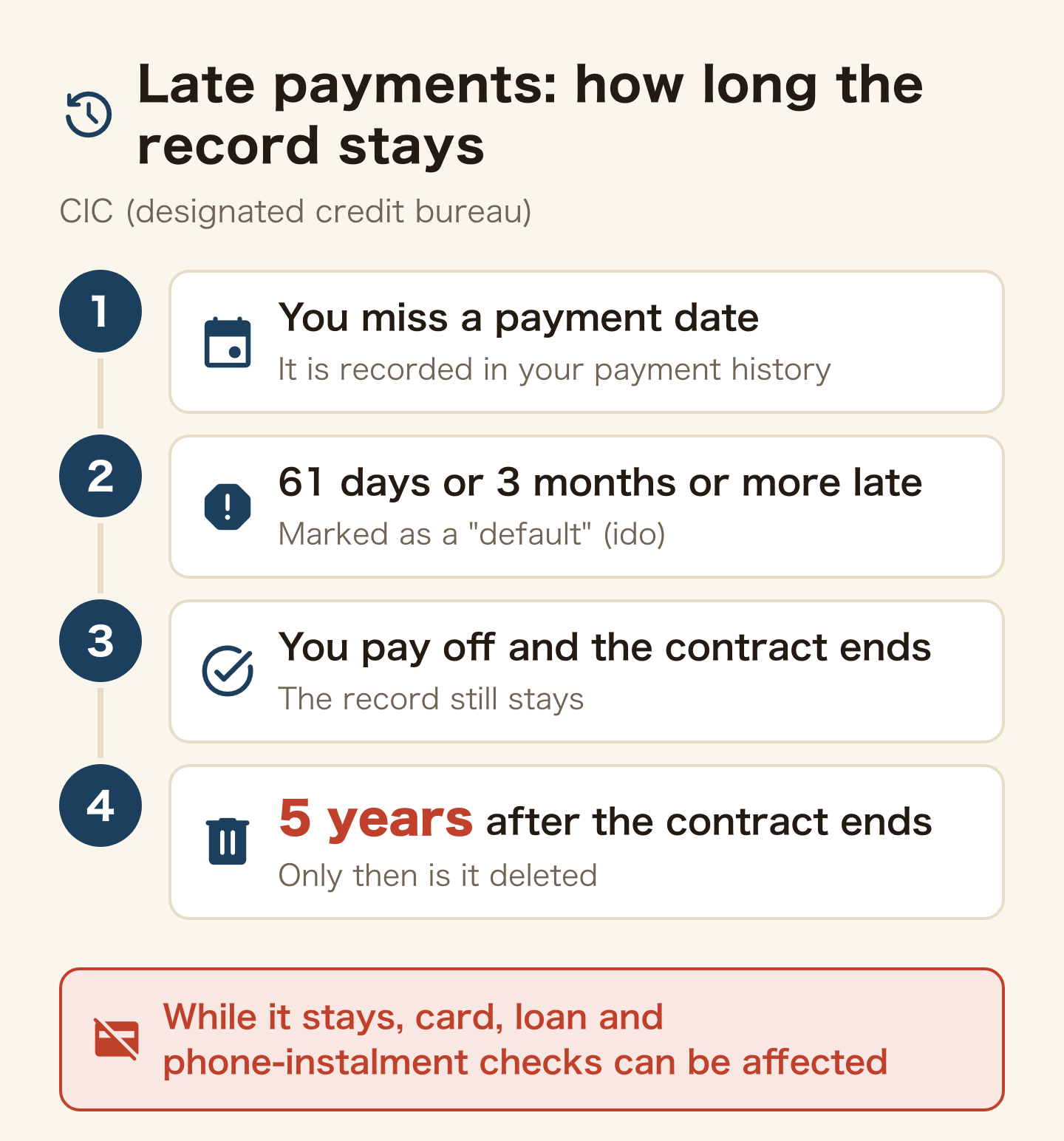
Your card and loan payments are recorded by CIC, a credit bureau. CIC calls a payment 61 days or 3 months or more late a “default” (ido) (CIC: glossary of report items). Credit information, including payment history, is kept during the contract and for 5 years after it ends (CIC: how long credit information is kept).
When you apply for a card or a phone on instalments, the company checks this record. Calling the card company before the payment date, as soon as you know you cannot pay, leaves you more options than going quietly late. If you want to stop yourself borrowing, the agency points to a self-exclusion scheme. Register with the Japan Financial Services Association or the Japanese Bankers Association’s credit information centre, and new loans are blocked (Financial Services Agency: multiple debt and the Money Lending Business Act).
Why are SNS “personal loans” and loan sharks dangerous? Eight warning signs
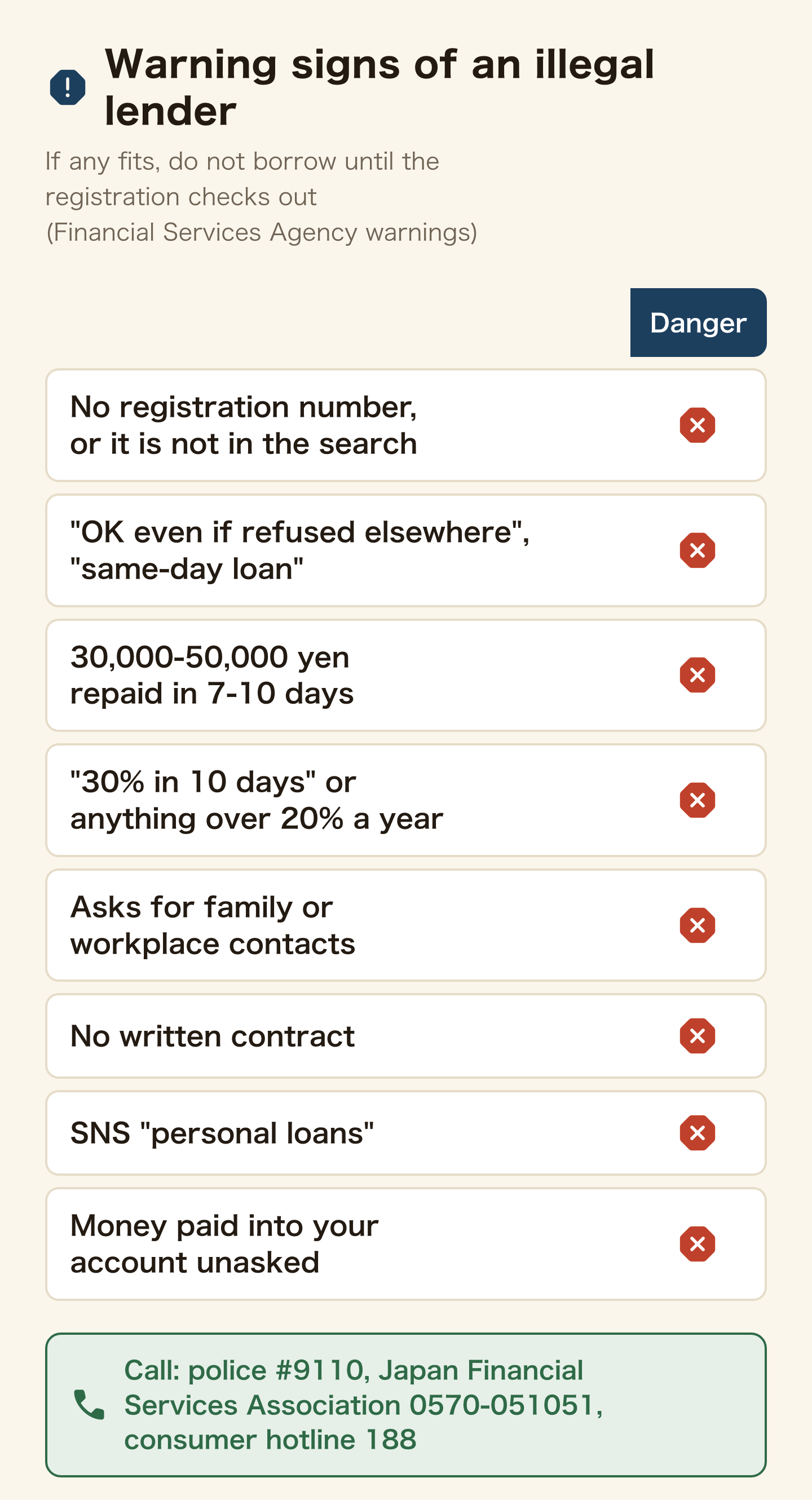
When things are tight, you borrow from a friend of a friend, or from someone you found online. Where you come from, that may be normal. In Japan, anyone who lends money repeatedly, even as an individual, is running a money lending business and must be registered with the national or prefectural government (Financial Services Agency: beware of SNS “personal loans”). The agency warns that loan sharks pose as individuals, lend at illegal rates and misuse your personal information.
We picked eight warning signs from the agency’s warnings (Financial Services Agency: beware of illegal lenders).
- They will not give a registration number, or it does not show up in the agency’s registered money lender search
- They advertise “OK even if refused elsewhere” or “same-day loans”
- Small loans of 30,000 to 50,000 yen, repaid over a short 7 to 10 days
- Interest above 20% a year, such as “30% in 10 days” or “borrow 30,000 yen, pay 10,000 yen interest after 7 days”
- They ask for the contacts of your family, relatives or workplace
- They give you no written contract
- “Personal loans” on social media or message boards
- Money paid into your account without your asking, followed by a demand for high interest (oshigashi)
According to the agency, illegal lenders respond to even a short delay with threatening collection calls to your workplace or family. If any sign fits, do not give your address, phone number or bank details until you have checked the registration. The dangers of being asked to lend your bank account or “just pick up a package” are in scams in Japan that target foreigners.
Already borrowed and cannot repay? Who to call: #9110, 188 and the Japan Financial Services Association
If you have borrowed from an illegal lender, do not negotiate alone. Keep the contract and every message, and get advice. The agency says that if you face illegal interest or abusive collection, you should keep evidence such as the contract and recordings.
- Police consultation line: #9110 (threatening collection, illegal lenders)
- Japan Financial Services Association, money lending consultation and dispute resolution centre: 0570-051051 (9:00-17:00, closed weekends, holidays and New Year)
- Financial Services Agency, counselling office for financial services users: 0570-016811 (weekdays 10:00-17:00)
- Consumer hotline: 188 (connects you to your nearest consumer centre; Consumer Affairs Agency: consumer hotline)
If debts from registered lenders have piled up beyond what you can repay, you can talk to the multiple-debt desks at the regional finance bureaus, or to the household budget support at a self-reliance support centre. Before you borrow again to repay, call one of them.
Which one are you?
- You cannot pay next week’s bill (tuition, tax, health insurance, rent): move the payment date before you borrow. Today, call the office that sent the bill and ask whether you can split or delay it.
- You are a few weeks short on living costs: go to a self-reliance support centre. Today, find your city’s centre in the list and call it. If your status is permanent resident, long-term resident or similar, ask about the emergency small loan at the same time.
- You have a revolving balance: stop new revolving spending. Today, check your balance and monthly payment on the card company’s page, and see whether you can raise the payment.
- Someone on SNS or an unknown company offers to “lend right away”: do not borrow. Today, look up their registration number in the agency’s search, and cut contact if it is not there.
- You already borrowed from an illegal lender and are being chased: call #9110. Today, save the contract, messages and transfer records, and delete nothing.
Once you have moved the due date or reached a public desk, this decision is done. What is left is to set out your monthly spending and income and, with the person at the desk, find a way not to repeat the same month.
FAQ
Q. Can foreigners or international students borrow money in Japan?
Whether you can borrow depends on the screening and conditions of each lender or scheme. The public emergency small loan, in Tokyo, is limited to statuses such as permanent resident, long-term resident and spouse of a Japanese national; student and work statuses are not included.
Q. What is the legal cap on loan interest in Japan?
Under the Interest Rate Restriction Act, 20% a year if you borrow under 100,000 yen, 18% from 100,000 yen to under 1 million yen, and 15% from 1 million yen. Lending as a business above 20% a year is a crime under the Investment Act.
Q. How is the revolving fee calculated?
On Rakuten Card, it is the balance at the end of the previous month × the effective annual rate (such as 17.64%) ÷ 12 months. Borrowing 100,000 yen and repaying 3,000 yen of principal a month (the fee is added on top) takes 34 payments and 25,224 yen in fees by our calculation.
Q. Does the one-third-of-income rule apply to bank card loans?
No. According to the Financial Services Agency, the rule covers borrowing from money lenders such as consumer finance and credit card companies, and bank card loans are not covered.
Q. How long does a late payment stay on my CIC record?
A payment 61 days or 3 months or more late is recorded as a default (ido). Credit information, including payment history, is kept during the contract and for 5 years after it ends.
Q. Is it OK to use an SNS personal loan?
Do not use one. The Financial Services Agency warns that lending repeatedly, even as an individual, is a money lending business that needs registration, and that loan sharks posing as individuals charge illegal rates and misuse personal information. Call the police on #9110 or the 188 hotline.
Summary
When money runs short, move the bill’s due date and talk to a self-reliance support centre before you borrow. The social welfare council’s emergency small loan is up to 100,000 yen with no interest and no guarantor, but in Tokyo foreign residents qualify only with statuses such as permanent resident, long-term resident or spouse of a Japanese national.
The legal cap on loan interest is 15-20% a year, and lending as a business above 20% is a crime. Borrowing 100,000 yen and repaying 3,000 yen of principal a month (the fee is added on top) on Rakuten Card’s revolving rate costs 25,224 yen in fees by our calculation. A payment 61 days or more late is recorded as a default at CIC and stays for 5 years after the contract ends. Do not borrow through SNS personal loans or from unregistered lenders, and if you are in trouble, call #9110, 188 or the Japan Financial Services Association.
Sources (official): Interest Rate Restriction Act, Investment Act, Money Lending Business Act, Act on Self-Reliance Support for Needy Persons (e-Gov) / Financial Services Agency basics of the Money Lending Business Act, money lending Q&A, multiple debt and the Money Lending Business Act, beware of illegal lenders, beware of SNS “personal loans”, registered money lender search / Consumer Affairs Agency: consumer hotline / Ministry of Health, Labour and Welfare: self-reliance support system / Tokyo Council of Social Welfare livelihood welfare fund loans, emergency small loan guide / Rakuten Card revolving payment, cash advance / CIC how long credit information is kept, glossary (all checked 26 October 2026). Rates and conditions change, so check the official pages on the day you apply.
Related reading
Found this useful? Share it
Send it to a friend who lives in Japan.
WHO WROTE THIS

mori
Japanese. I read the ministries’ own notices, orders and Q&As in the original, and I start from what my Nepalese and Sri Lankan friends in Japan actually ran into. I do not write about what I have not checked or been told.
What this site can and cannot do →Looking for something else?
You may use the figures in this article, including commercially, if you credit this site with a link. How to use our figures