Last updated: August 2026
Summary
- You can open a Japanese brokerage account regardless of nationality, as long as you live in Japan. You need a residence card and a My Number.
- But you will be refused if your residence card is close to expiring. Apply after your renewal, not before it.
- NISA only works while you live in Japan. Once you leave and become a non-resident, the account is normally closed.
- This is where foreigners differ from Japanese investors. The rule that lets you keep holding tax-free after leaving applies only to people transferred abroad by their employer. Finishing your studies or going home by choice does not qualify.
- So work backwards from when you expect to leave. The answer is different for someone here for three more years and someone aiming for permanent residence.
NISA is a Japanese tax-free investment account. Normally about 20% of your investment profit is taken as tax. Inside the NISA allowance, it is zero.
Foreigners can use it. But what happens when you leave Japan is not the same as it is for a Japanese person. That is what this article is mostly about. Even if you only want to know how to start, read the exit first.
Yes, you can open a brokerage account
The requirement is that you live in Japan. Nationality is not the issue.
“Living in Japan” here means being a resident in the tax sense: you have an address in Japan, or you have been living here continuously for a year or more. Your type of residence status does not matter.
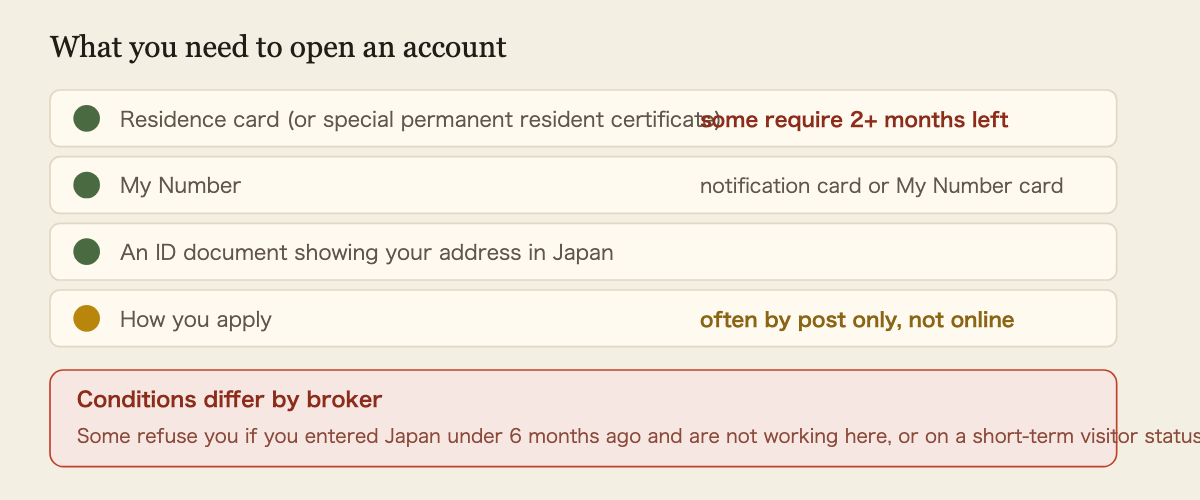
The thing that trips people up is the expiry date on the residence card. SBI Securities, for example, requires a residence card with at least two months left before it expires. Apply just before a renewal and your application stops. Renew first, then apply.
One more thing: for foreign nationals, many brokers only accept paper applications by post. If you were expecting to finish it on your phone in ten minutes, plan for one to two weeks instead.
If you do not have a bank account yet, start there — see Opening a bank account in Japan.
NISA only exists while you live in Japan
Now the important part.
NISA is for residents of Japan only. Anyone 18 or over can use it, whatever their nationality. The question is what happens after you leave.
Once you leave Japan and become a non-resident, your brokerage account is normally closed or frozen, and the NISA account is abolished.
There is a rescue rule, designed for Japanese employees posted overseas. It is called a keizoku tekiyō todokedesho (continued-application notification). File it before you leave and you can keep holding tax-free until December 31 of the year containing the fifth anniversary of the filing.
That rescue rule does not cover most foreigners
This is the part almost no English-language guide mentions.
The rule applies where you leave Japan and become a non-resident “due to a transfer order from the person who pays your salary, or another unavoidable reason equivalent to it.” In plain terms: your employer sends you abroad.
Finishing your studies and going home. Quitting your job and going home. Going home for your family. None of these qualify. They are treated as leaving by choice.
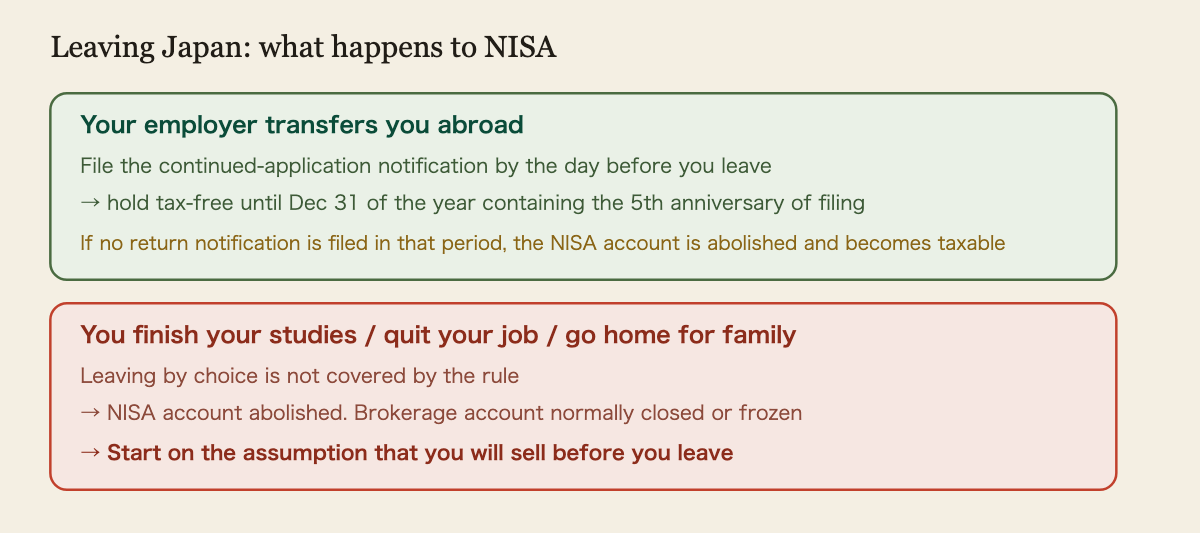
That difference changes the whole design of your investing. Where a Japanese investor can simply leave it alone and wait, most foreigners are investing on the assumption that they will have to sell. You do not get to choose the timing.
So work backwards from your departure
Whether NISA is right for you depends on how long you will be in Japan.
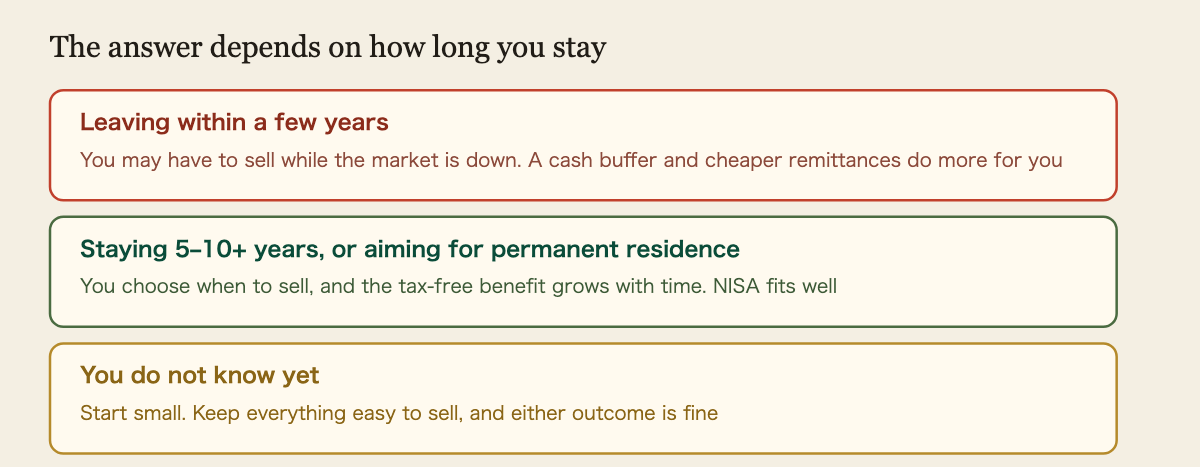
If you are leaving in a few years, the most reliable way to keep more of your money is not investing. It is cutting the fees on the money you send home. You do that transfer again and again, so the difference compounds.
If you are aiming to stay, NISA suits you well, because you decide when to sell. Read it together with the permanent residency requirements.
If you do not want extra paperwork
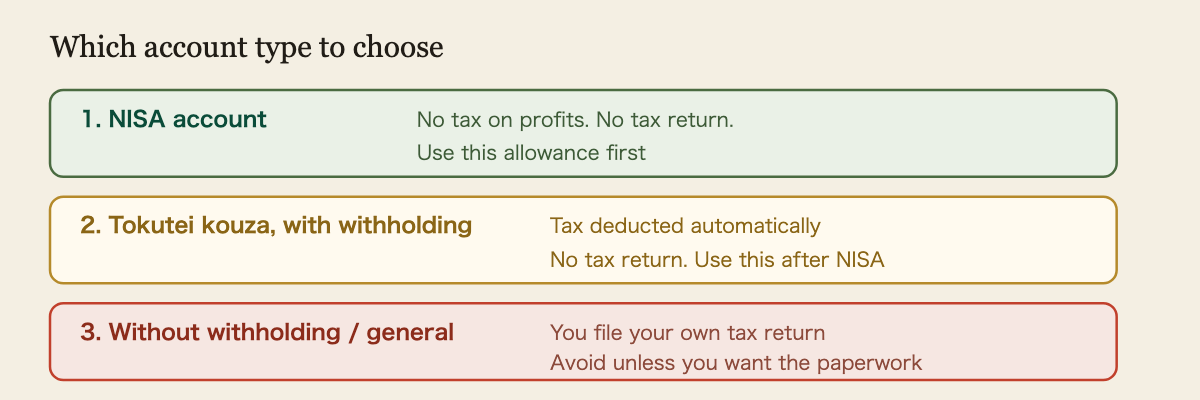
When you open the account, choose a “tokutei kōza” with withholding (特定口座・源泉徴収あり).
With this, tax is deducted automatically when you make a profit, and you never have to file a tax return for it. If you would rather not fight with Japanese tax forms, this is the option.
Anything bought inside the NISA allowance is not taxed at all. Use up the NISA allowance first, then use the tokutei kōza — that is the normal order.
You will also hear about iDeCo; it is locked until 60, which weighs heavily on anyone who may leave Japan, so read that first.
FAQ
Q. Can a student open a brokerage account?
A. Yes, if you are a resident of Japan. You need a residence card and a My Number. But a residence card close to expiry will get you refused, and some brokers will not accept you until you have been in Japan for a certain period. Conditions differ by company — check before you apply.
Q. What happens to my NISA when I go home?
A. Becoming a non-resident abolishes the NISA account. The continued-application notification that lets you keep holding tax-free is for people transferred abroad by an employer, and does not cover finishing your studies or going home by choice. Assume you will sell before you leave.
Q. Can I keep the account open after I leave?
A. Non-residents normally have their brokerage account closed or frozen. Handling varies by company, so contact your broker as soon as you know you are leaving. Leaving quietly and hoping is the worst option.
Q. Japanese broker or one back home?
A. If you are investing yen you earned in Japan while you live here, a Japanese account is simpler. But if you are leaving in a few years, not starting in Japan is a perfectly reasonable choice. Rather than being forced to sell on your way out, send the money home and invest it there.
Q. Do I have to file a tax return?
A. Not if you only use NISA and a tokutei kōza with withholding. Any other choice means filing yourself. The basics of salary and tax are in Part-time work and taxes in Japan.
Official source: Financial Services Agency: the official NISA site
In short
You can open a Japanese brokerage account as a foreigner living here. You need a residence card and a My Number, and a card close to expiry will get you refused — so renew first, then apply.
NISA only works while you live in Japan. The rule that lets you keep holding tax-free after you leave is only for people whose employer transfers them abroad. It does not cover finishing your studies or going home by choice.
So the answer depends on your timeline. Leaving in a few years? Cutting your remittance fees is the surer win. Staying long term? NISA is a strong tool.
Decide the exit before you start. That is the whole of it.
Related guides
Found this useful? Share it
Send it to a friend who lives in Japan.
WHO WROTE THIS

mori
Japanese. I read the ministries’ own notices, orders and Q&As in the original, and I start from what my Nepalese and Sri Lankan friends in Japan actually ran into. I do not write about what I have not checked or been told.
What this site can and cannot do →Looking for something else?