This article contains affiliate links.
Last updated: July 2026
Figures, prices and terms were checked against ConoHa WING’s official pricing page on 6 August 2026. They change — check the current terms yourself before you sign up or file anything.
In short
- A blog is worth starting even if it never earns a yen. The returns that matter first are Japanese practice and a portfolio someone can actually look at.
- Writing forces output. Most students in Japan get plenty of listening and reading and almost no writing, which is exactly the gap a blog fills.
- When you change from a student visa to a work visa, immigration looks at how your studies connect to the job. A body of work makes that connection visible instead of assumed.
- Publishing is free for anyone. Earning is not. Monetising is treated as work and depends on your visa, so read the rules before you switch on ads.
- The safest sequence: build the audience now, monetise later when your visa allows it.
Most articles about blogging start with how much money you can make. This one does not, because for a foreign student in Japan the money is the slowest and least certain of the three things a blog gives you – and the other two start paying immediately.
- The three returns, in the order they actually arrive
- Why writing beats more studying
- The part almost nobody mentions: it helps your visa change
- Before you monetise: publishing is free, earning is not
- Free blog or WordPress?
- Starting a WordPress blog in four steps
- Getting through the first ten posts
- Frequently asked questions
- Summary
- Related guides
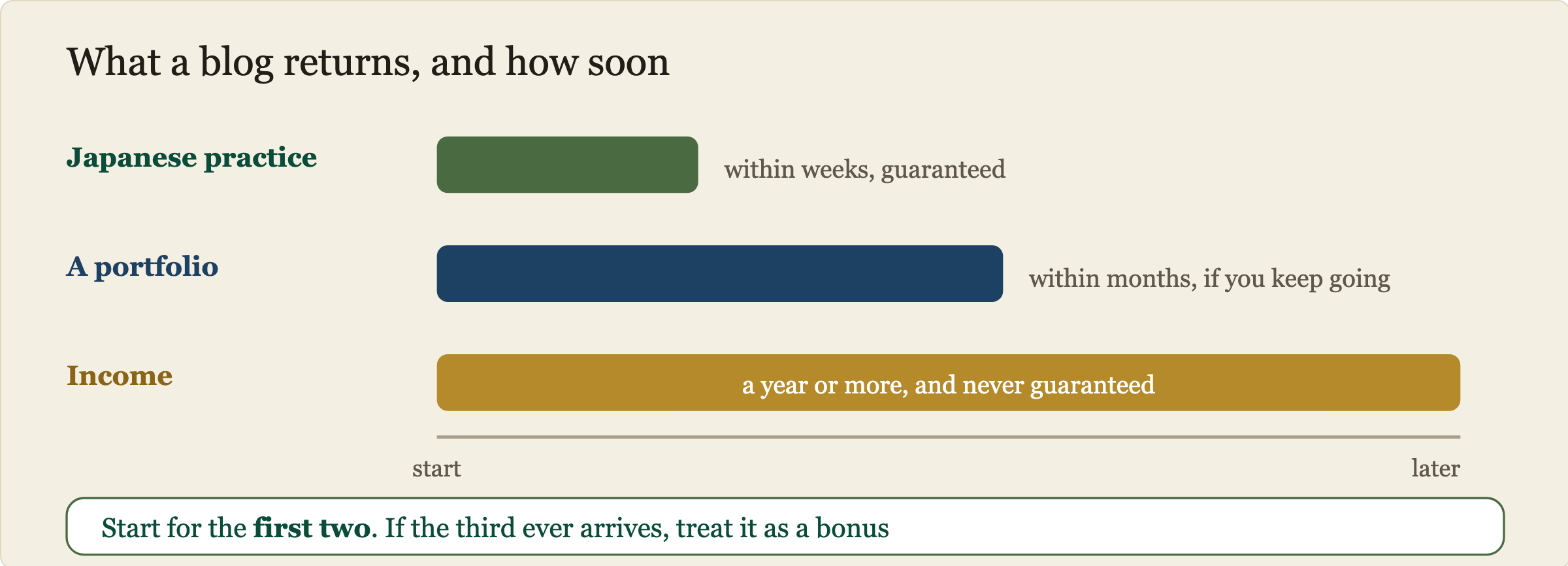
The three returns, in the order they actually arrive
A blog returns Japanese practice within weeks, a portfolio within months, and income only after a year or more, if at all. Judging it by the third return alone is why most people quit before reaching any of them.
Why writing beats more studying
Living in Japan gives you listening and reading for free. It gives you almost no writing, and writing is where vocabulary actually becomes yours. Reading a word teaches you to recognise it. Having to choose it, place it in a sentence, and defend that sentence to a reader is what makes it available when you speak.
A blog is simply the cheapest structure that forces this to happen on a schedule. Three practical ways to use it:
- Write in Japanese about something you already understand – your home country’s food, a process from your field, your commute. Familiar content means the difficulty is all language, which is the point
- Write the same post twice, once in your language and once in Japanese. You will discover what you cannot yet say, which is a better study list than any textbook chapter
- Publish before it is perfect. A post nobody corrects still teaches you more than a notebook nobody reads. Comments and corrections are a free tutor
If you work a customer-facing part-time job, this pairs unusually well: the job gives you speaking practice and the blog gives you writing practice. See keigo vs casual Japanese for the register side of it.
The part almost nobody mentions: it helps your visa change
When you apply to change from a student visa to a work visa, immigration examines whether what you studied connects to the job you are taking. 96.7% of applications are approved, so refusals are about 1 in 30 – and among those, a weak major-to-job connection is one of the recurring reasons.
A blog does not change the law here, but it changes what you can show. If you studied information technology and have two years of posts working through technical problems, that connection stops being a claim on a form and becomes something a person can open and read. The same is true for a design portfolio, translation samples, or writing about your field in Japanese.
It also helps earlier, during job hunting itself. A candidate who can send a link is a different candidate from one who cannot. For what the visa change actually involves, see student visa to work visa: why some applications fail.
Before you monetise: publishing is free, earning is not
Anyone may write and publish, on any visa. The moment you earn continuously from it, that is treated as work or business activity, and your residence status decides whether it is allowed. Getting this wrong can mean illegal work and a failed visa renewal, so it is worth being deliberate rather than switching on ads and hoping.
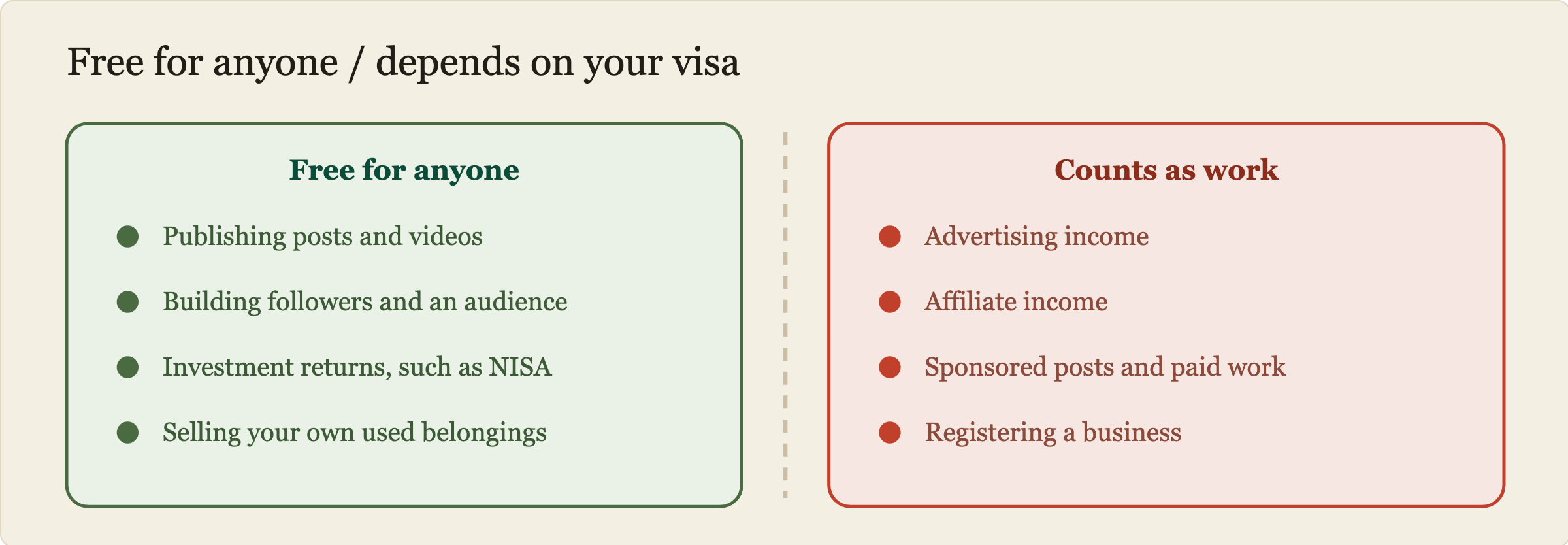
The rules differ by residence status, and we cover them properly in making money in Japan: what your visa really allows – read that before you monetise anything. The short version is that students are bound by the 28-hour rule and should avoid registering a business, work visa holders generally need permission for income outside their job category, and permanent residents have no restriction.
Which points to the safest sequence: build now, monetise later. An audience is an asset that keeps its value while you wait. Growing it during your student years and switching on income once you hold a status without work restrictions is the version of this with no legal risk at all.
Free blog or WordPress?
A free blogging platform is faster to start and fine for pure language practice. WordPress on your own domain costs a little monthly but is the only option that behaves like a portfolio you own.
| Free platform | WordPress on your own domain | |
|---|---|---|
| Cost | Free | 991 yen a month on a 12-month term, or 649 on 36 months (official, August 2026) |
| Ownership | The platform can close or change rules | Yours, and portable |
| As a portfolio | Looks like a hobby account | Looks like your own site |
| Monetising later | Often restricted | No platform restriction |
| Best for | Testing whether you will keep it up | Anything you want to show an employer |
An honest recommendation: if you are not sure you will still be posting in two months, start free. If the portfolio and visa-change reasons above are why you are here, start on your own domain, because moving later means losing the accumulated address history that makes a site findable.
Starting a WordPress blog in four steps
Modern Japanese hosting bundles the domain, the server, and the WordPress install into one signup, so the technical part is genuinely about thirty minutes.
If you intend to keep going, a laptop makes this dramatically faster. You can write on a phone, but restructuring a post, adding images and building tables all come down to screen space, and screen space turns directly into hours. Buying a laptop in Japan covers the Japanese keyboard layout problem and when second-hand or tax-free is worth it. You do not need one first. Write ten posts, then decide.
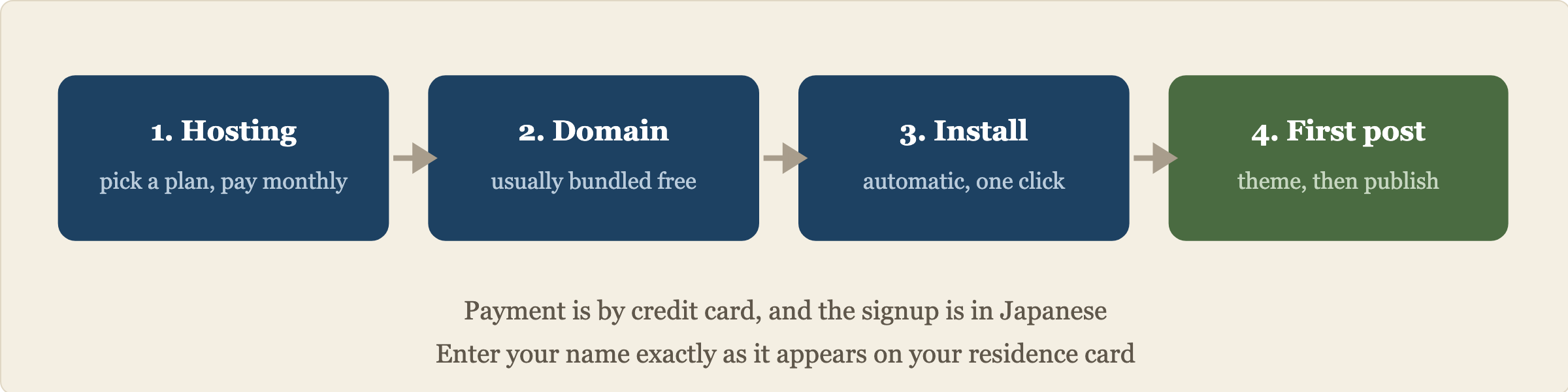
ConoHa WING is a Japanese host that packages all four steps together, including a free domain on the longer plans and a one-click WordPress setup. The control panel and support are in Japanese, which is worth knowing before you sign up – though for a site you are partly building to practise Japanese, that is arguably part of the exercise.
Payment requires a credit card – see our card guide if you do not have one yet
If you do not have a card yet, that is the actual first step: credit cards foreigners can get in Japan.
Getting through the first ten posts
Almost everyone who quits does so before post ten, and almost nobody who reaches post thirty quits. The first ten are not about quality or traffic – they exist to prove to yourself that you can produce on a schedule.
- Write what you had to learn the hard way. Every procedure that confused you in your first year is a post somebody else is searching for right now
- One post a week beats five in a burst. Rhythm is the skill being built, not volume
- Keep them short at first. A useful 800-word post finished beats a 3,000-word post abandoned
- Do not check the numbers for three months. Early traffic is always near zero, and reading that as failure is the single most common reason people stop
If you want people to find you outside the blog, how to use X, Instagram and LinkedIn as a foreigner in Japan is the companion guide.
Frequently asked questions
Q. Can I do this from just a phone?
You can write and publish posts from a phone, and many people draft on one. Initial setup and any design work are much easier on a computer, so borrowing one for the first hour is worth it.
Q. Is there English support for Japanese hosting?
Generally no. Control panels and support for Japanese hosts are in Japanese. Machine translation handles the signup fine, and you can also use a host in your own country if you prefer – the site works the same either way.
Q. What happens if I stop paying?
The site goes offline and, after a grace period, the data is deleted. Export your posts before cancelling if there is any chance you will want them, since a portfolio is only useful while it is reachable.
Q. Can people back home read it?
Yes. A site hosted in Japan is reachable worldwide, and there is nothing to configure for that.
Q. How long until it earns anything?
Realistically a year or more, and many blogs never earn meaningfully. That is exactly why the language practice and portfolio reasons matter – they are the returns you can count on. Check the visa rules before you monetise at all.
Summary
- Start for Japanese output practice and a portfolio, not for income
- Writing is the skill living in Japan does not give you for free
- A visible body of work supports your job hunt and your student-to-work visa change
- Publishing is free for anyone; earning depends on your visa – check the rules first
- The zero-risk sequence is build the audience now, monetise once your status allows it
Related guides
Found this useful? Share it
Send it to a friend who lives in Japan.
READ THIS NEXT
After Japanese Language School →A language school has no job pipeline, and that is not because you are behind.WHO WROTE THIS

mori
Japanese. I read the ministries’ own notices, orders and Q&As in the original, and I start from what my Nepalese and Sri Lankan friends in Japan actually ran into. I do not write about what I have not checked or been told.
What this site can and cannot do →Looking for something else?