Checked on 30 September 2026 against the official payment pages of ahamo, Rakuten Mobile, povo, UQ WiMAX, SoftBank Air and Amazon.co.jp, the debit card guidance of Japan Post Bank and MUFG Bank, the official ETC Personal Card site, the Consumer Affairs Agency and the Telecommunications Carriers Association.
The short answer
- You can get a phone plan and home internet in Japan without a credit card. ahamo, Rakuten Mobile, UQ WiMAX and SoftBank Air all accept direct debit from a bank account. povo accepts Paidy, which you can then pay by direct debit or at a konbini.
- Direct debit (koza furikae) is the method you can rely on. The company takes the monthly bill from your Japanese bank account automatically. Open the account first.
- Debit cards are refused by some phone companies and utilities. Japan Post Bank says so itself, and povo does not take debit cards at all.
- Amazon Japan works with konbini payment. Pay by 23:59 three days after the payment number is issued, or the order is cancelled. Express delivery and Subscribe & Save cannot use it.
- You can get an ETC card without a credit card: the ETC Personal Card, for 1,257 yen a year plus a deposit.
Knowing this, you will not get stuck when a sign-up form asks for a card number, and you can choose how to pay for your phone, internet and online shopping today. Life does not have to wait until a card company approves you.
Two weeks after arriving, you have your residence registration and a bank account. Next come a phone plan and Wi-Fi. You fill in the online form, and on the last page it asks for a credit card number. You do not have one yet. A Japanese friend says, “Just use your card.” They have had a card since university and have never signed a contract without one, so they do not know where the process stops and where it goes through.
- How can you pay in Japan without a credit card? Six ways
- Can you get a phone plan without a credit card? ahamo and Rakuten take direct debit, povo takes Paidy
- Can you get Wi-Fi without a credit card? Monthly fee by direct debit, the router by cash on delivery
- How do you set up direct debit? You need a Japanese bank account
- Where do debit cards not work in Japan? Phone bills, utilities and internet
- Can you shop online without a credit card? Amazon Japan takes konbini payment, not cash on delivery
- What is cash on delivery (daibiki)? You pay at the door, and a fee may be added
- Can you get an ETC card without a credit card? Yes, the ETC Personal Card
- How much does paying without a card cost? The fees
- What if you cannot pay? From a failed debit to termination, and five years
- Which one are you?
- FAQ
- Summary
- Related reading
How can you pay in Japan without a credit card? Six ways
There are six ways to pay in Japan without a credit card. What separates them is when the money moves, and who moves it.
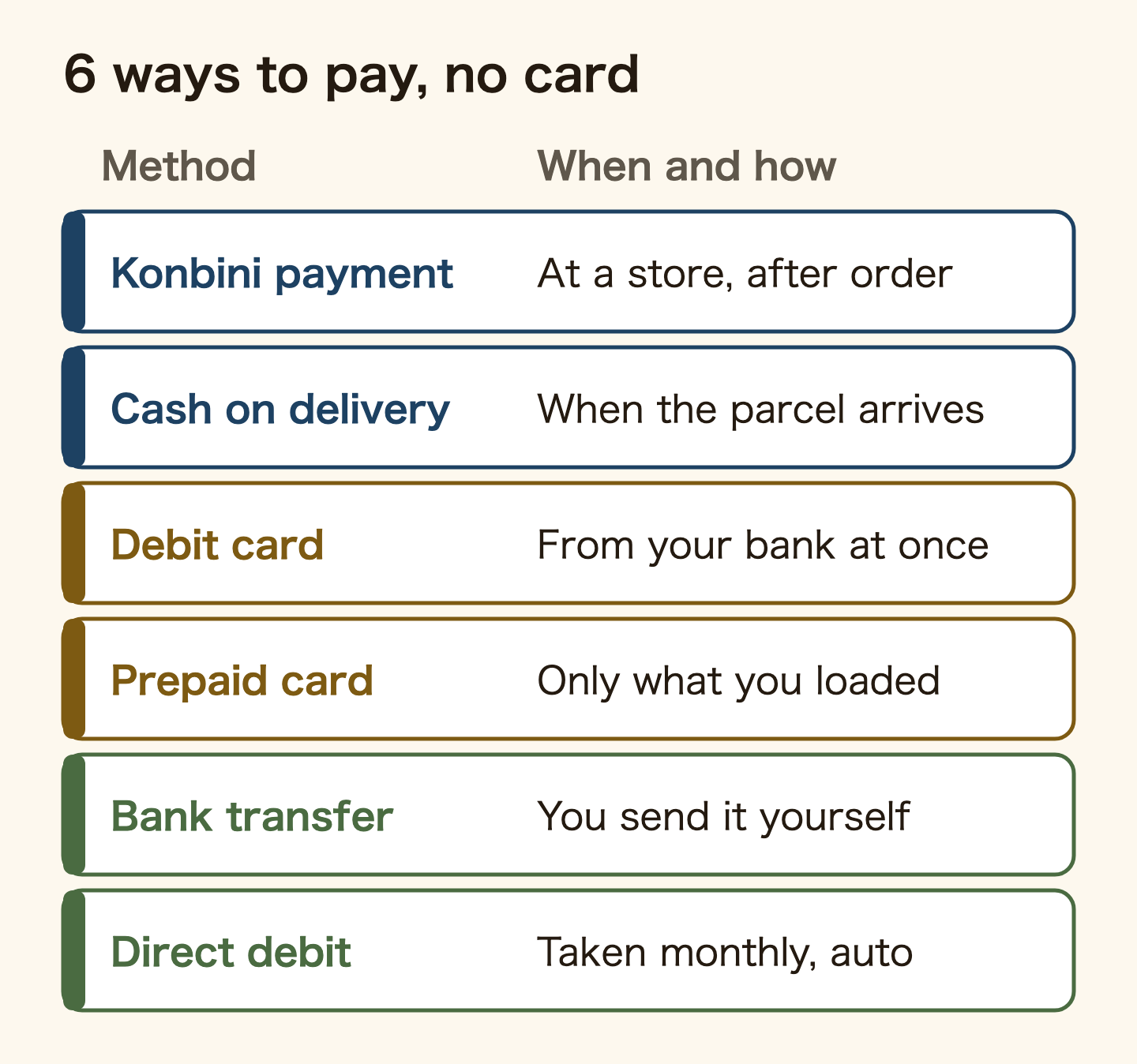
- Konbini payment: after ordering, you get a payment number and pay in cash at a convenience store. Common for online shopping.
- Cash on delivery (daibiki): you pay the delivery driver when the parcel arrives.
- Debit card: looks like a credit card, but the money leaves your bank account the moment you use it.
- Prepaid card: you load money first and spend only that.
- Bank transfer (furikomi): you send the money to the other party’s account yourself.
- Direct debit (koza furikae): the company takes the monthly bill from your account automatically. This is the usual card-free option for phone and internet bills.
Monthly contracts (phone, internet) and one-off purchases (online shopping) accept different methods. For monthly contracts, the weak points are debit and prepaid cards. For online shopping, the weak point is the konbini payment deadline.
Can you get a phone plan without a credit card? ahamo and Rakuten take direct debit, povo takes Paidy
Yes. The official pages of three major low-cost plans each offer a way in for people without a card.
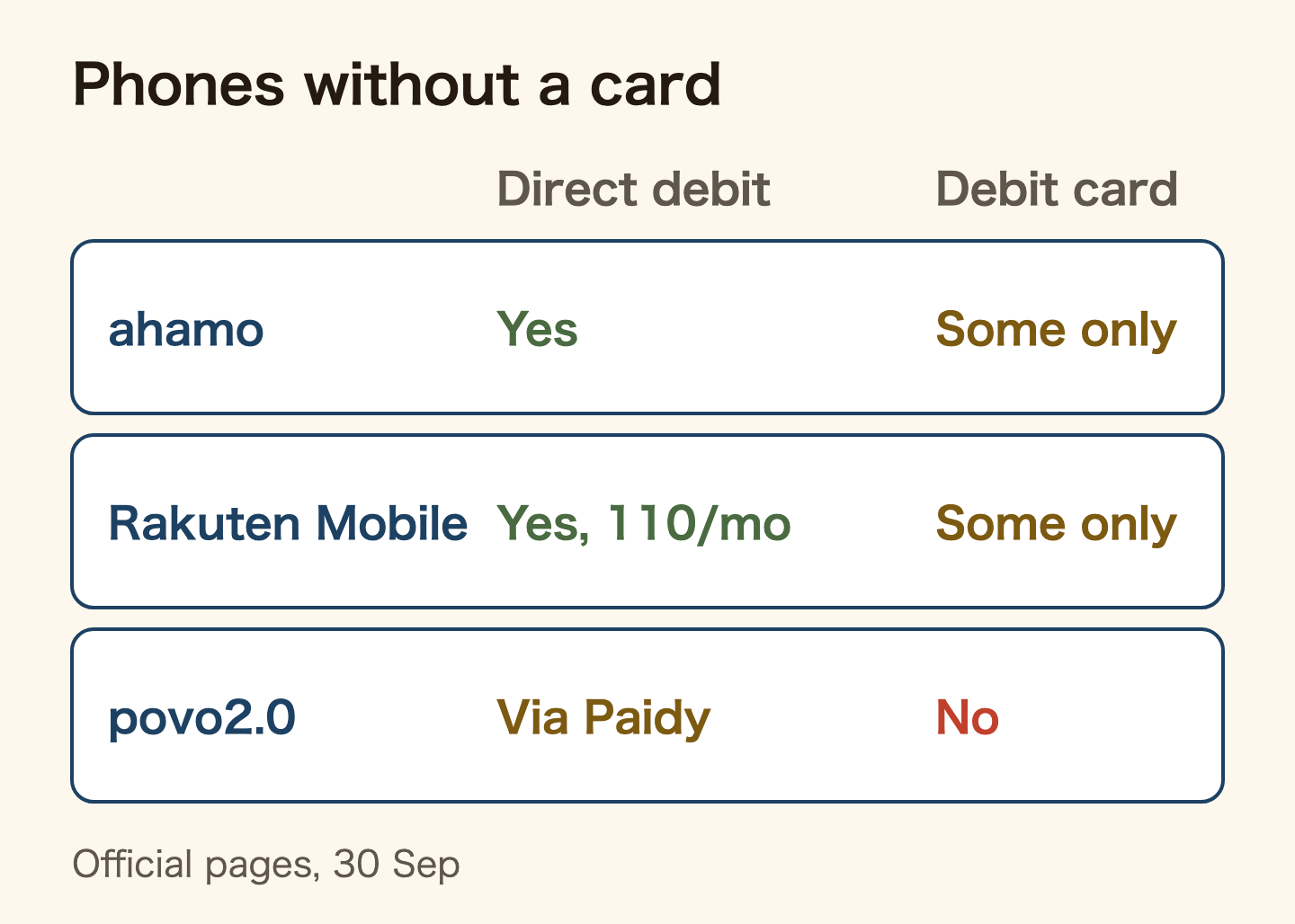
- ahamo: you pay by direct debit or credit card. ahamo’s own FAQ says that if you do not have a credit card, you should use direct debit. Japan Post Bank accounts are accepted. Only some debit cards work.
- Rakuten Mobile: monthly bills can go on direct debit, a debit card (some only) or a credit card. Direct debit costs 110 yen each time the bill is taken. The phone itself cannot be paid by direct debit, only by card or cash on delivery.
- povo2.0: the choices are a credit card or Paidy (pay later). Debit cards are not accepted. With Paidy, you then pay by direct debit, bank transfer or at a konbini.
ahamo also warns that credit cards issued outside Japan may not be accepted. Even if you have a card from home, a Japanese bank account is the safer route. To compare prices and coverage, see which SIM you can get without a credit card.
Can you get Wi-Fi without a credit card? Monthly fee by direct debit, the router by cash on delivery
Yes. The catch is that the monthly fee and the router (the device) are paid in different ways.
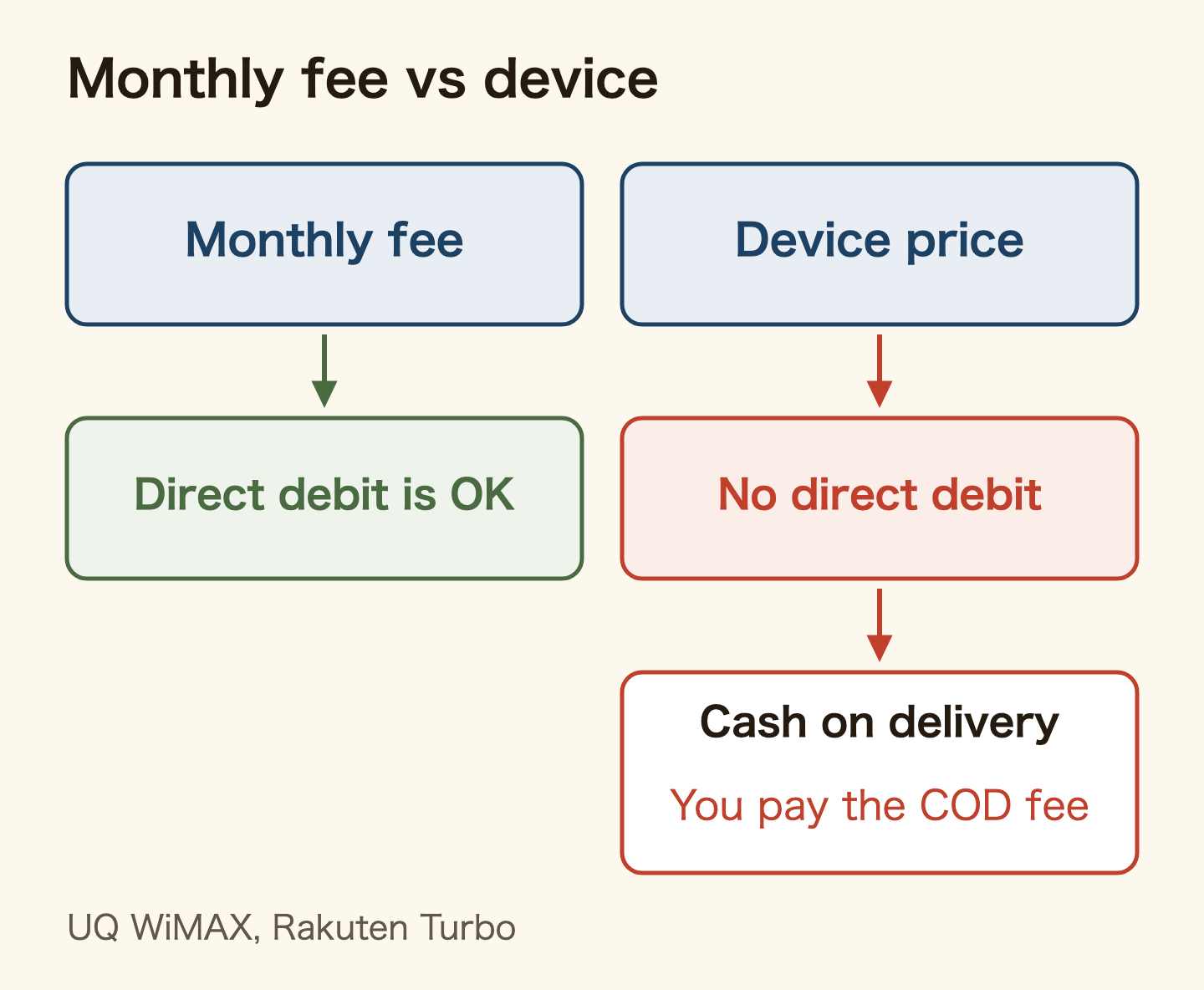
- UQ WiMAX: the monthly fee is paid by credit card or direct debit, and direct debit is taken at the end of each month. The router is paid by credit card or cash on delivery, and the cash-on-delivery fee is paid by the customer.
- Rakuten Turbo: the monthly fee can go on direct debit (a fee applies). The device cannot be paid by direct debit, only by card or cash on delivery.
- SoftBank Air: you choose credit card or direct debit.
So without a card, remember: monthly fee by direct debit, device paid in cash at the door. On delivery day, keep enough cash at home for the device and the fee. To choose a router that needs no installation work, see home internet in Japan.
How do you set up direct debit? You need a Japanese bank account
Direct debit needs a Japanese bank account. If you do not have one yet, that is your first step. Which banks accept people with a short period of stay is in how to open a bank account in Japan.
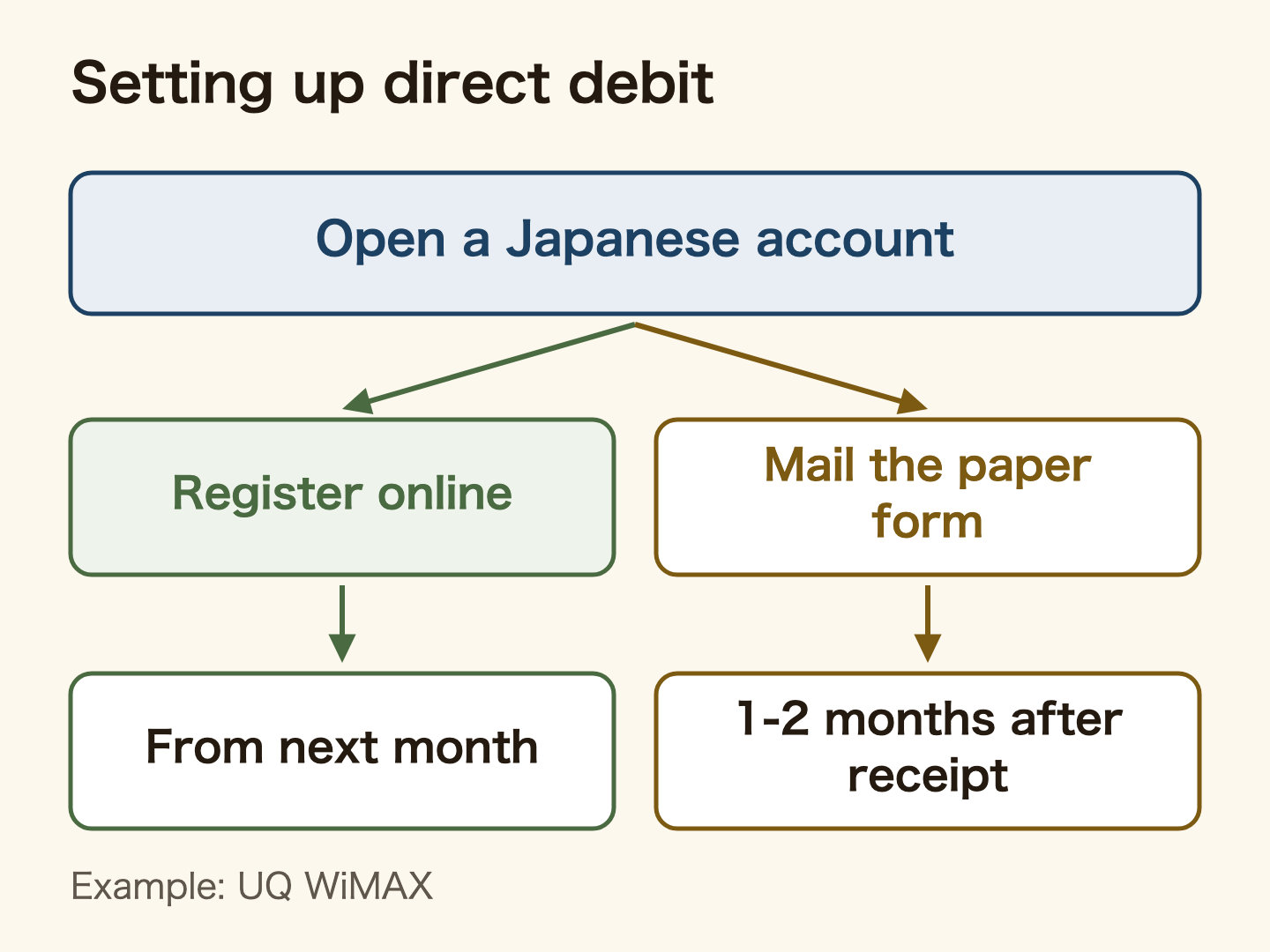
There are two routes.
- Register online: pick your bank on the company’s page and enter the identity items your bank asks for. With UQ WiMAX, there is no form to fill in, stamp or mail, and direct debit starts from the next month’s bill at the earliest.
- Mail the paper form (koza furikae iraisho): write your account details on the form the company sends you and post it back. UQ WiMAX says direct debit then starts from the bill one to two months after it receives the form, at the earliest.
The paper route is slow. If your bank supports online registration, use it. For Japan Post Bank, Rakuten Mobile asks you to use its “Web” method. ahamo requires the account to be in the same name as the contract holder.
Where do debit cards not work in Japan? Phone bills, utilities and internet
You have a debit card with a Visa logo. Where you come from, that may be normal for paying your phone and electricity bills. In Japan, monthly bills can refuse a debit card.
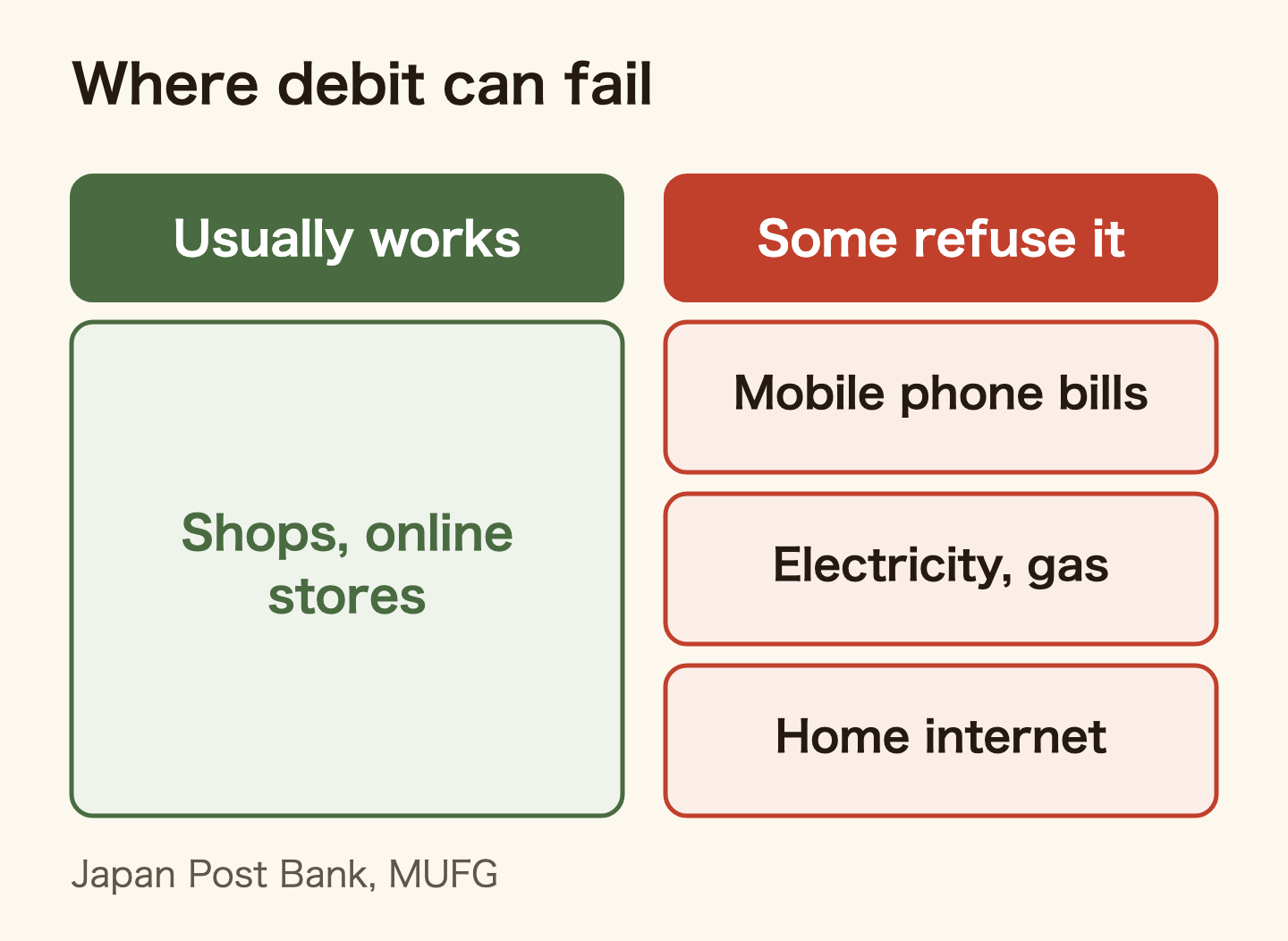
Japan Post Bank’s FAQ says its debit card cannot be used at some merchants, naming expressway tolls, in-flight sales, petrol stations, utilities such as electricity and gas, and mobile phone bills. MUFG Bank’s list for its Visa debit card (as of 30 June 2025) includes UQ WiMAX, Y!mobile and several internet providers.
Some companies, such as Rakuten Mobile and Rakuten Turbo, do accept debit cards. Even Rakuten warns that a card that registers fine may still fail when the bill is charged. Put monthly contracts on direct debit and keep the debit card for shopping. That split keeps things running.
The debit card itself is easy to get. Japan Post Bank’s debit card has no joining fee and no annual fee. Individuals with a Japan Post Bank ordinary account can apply (junior high school students cannot, and other bank conditions apply).
Prepaid cards are weaker still for monthly bills. The Vpreca member terms say they may not work at merchants that charge repeatedly, such as membership or connection fees. For monthly payments you need a type that supports recurring charges, such as “Vpreca+”.
Can you shop online without a credit card? Amazon Japan takes konbini payment, not cash on delivery
Yes. Amazon.co.jp accepts konbini payment and debit cards. Cash on delivery does not appear in Amazon’s list of payment methods.
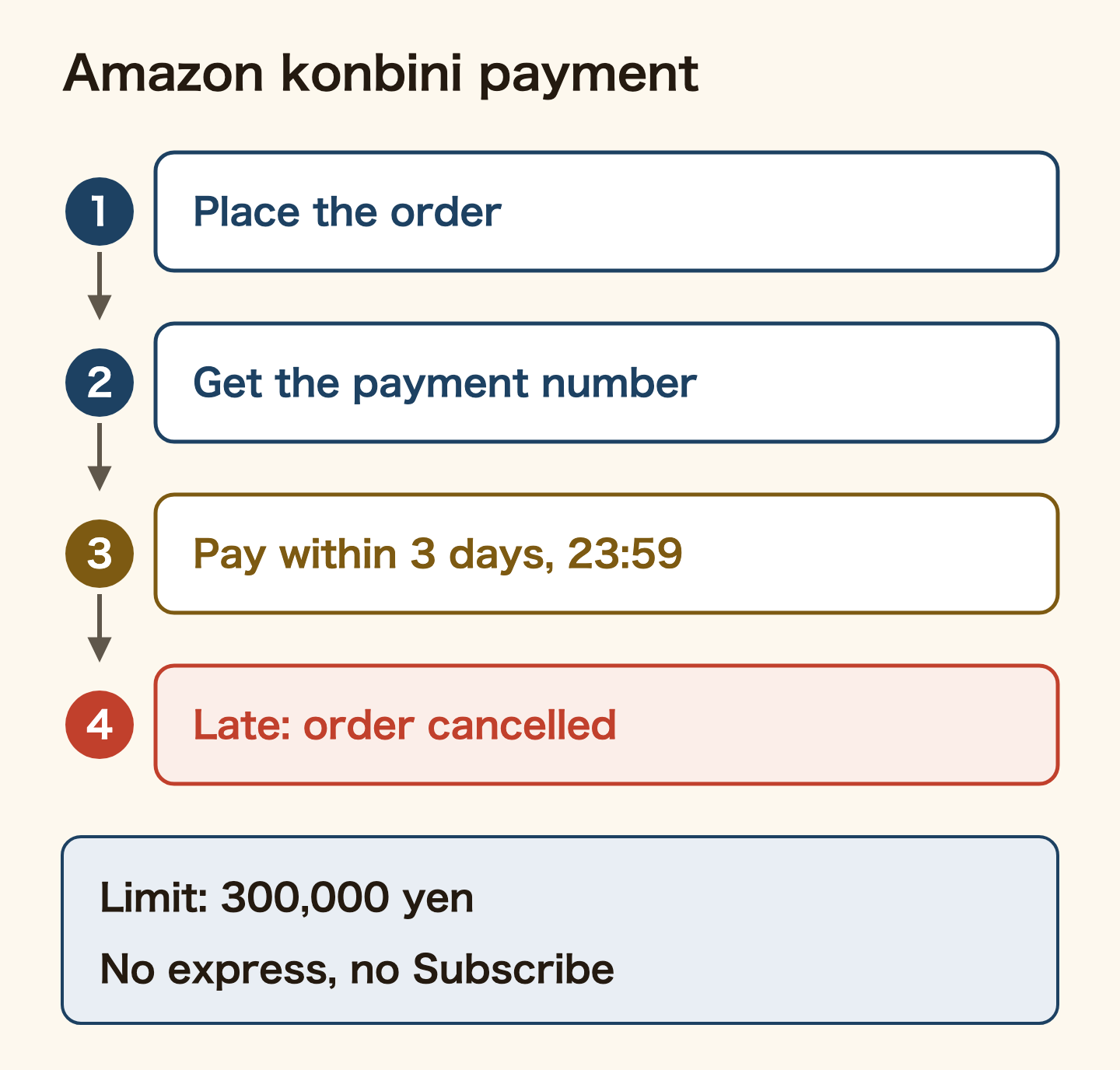
With konbini payment, you take the payment number from Amazon’s email and pay in cash at a convenience store. At Amazon, you can pay at 7-Eleven, Lawson, Ministop, FamilyMart, Daily Yamazaki and Seicomart.
Count the deadline carefully. The deadline is 23:59 three days after the payment number is issued. A number issued on Monday must be paid by 23:59 on Thursday. After that the number expires and the order is cancelled automatically. Amazon says accounts that repeatedly let orders expire this way may be closed.
Some orders cannot use konbini payment:
- express delivery or a chosen delivery date and time
- Subscribe & Save and Amazon Fresh
- digital content such as Kindle books
- orders of 300,001 yen or more (the konbini limit is 300,000 yen)
For those, use a debit or prepaid card. With a debit card, Amazon takes the money from your account when it starts preparing the shipment. If you cancel after that, the money may leave your account first and come back later.
Other shops also have to tell you how you can pay. Under the Act on Specified Commercial Transactions (article 11), online sellers must state when and how you pay. Look for the page called “特定商取引法に基づく表記” (legal notice) at the bottom of the site.
What is cash on delivery (daibiki)? You pay at the door, and a fee may be added
Cash on delivery means you pay the driver when you receive the parcel. With Japan Post, the driver collects the money and sends it to the shop’s account. With Yamato, you can pay cash, a credit card (single payment only) or e-money.
Cash on delivery has a fee. Rakuten Mobile and UQ WiMAX both say the customer pays it. The amount differs by shop, so check the total on the order screen before you choose it.
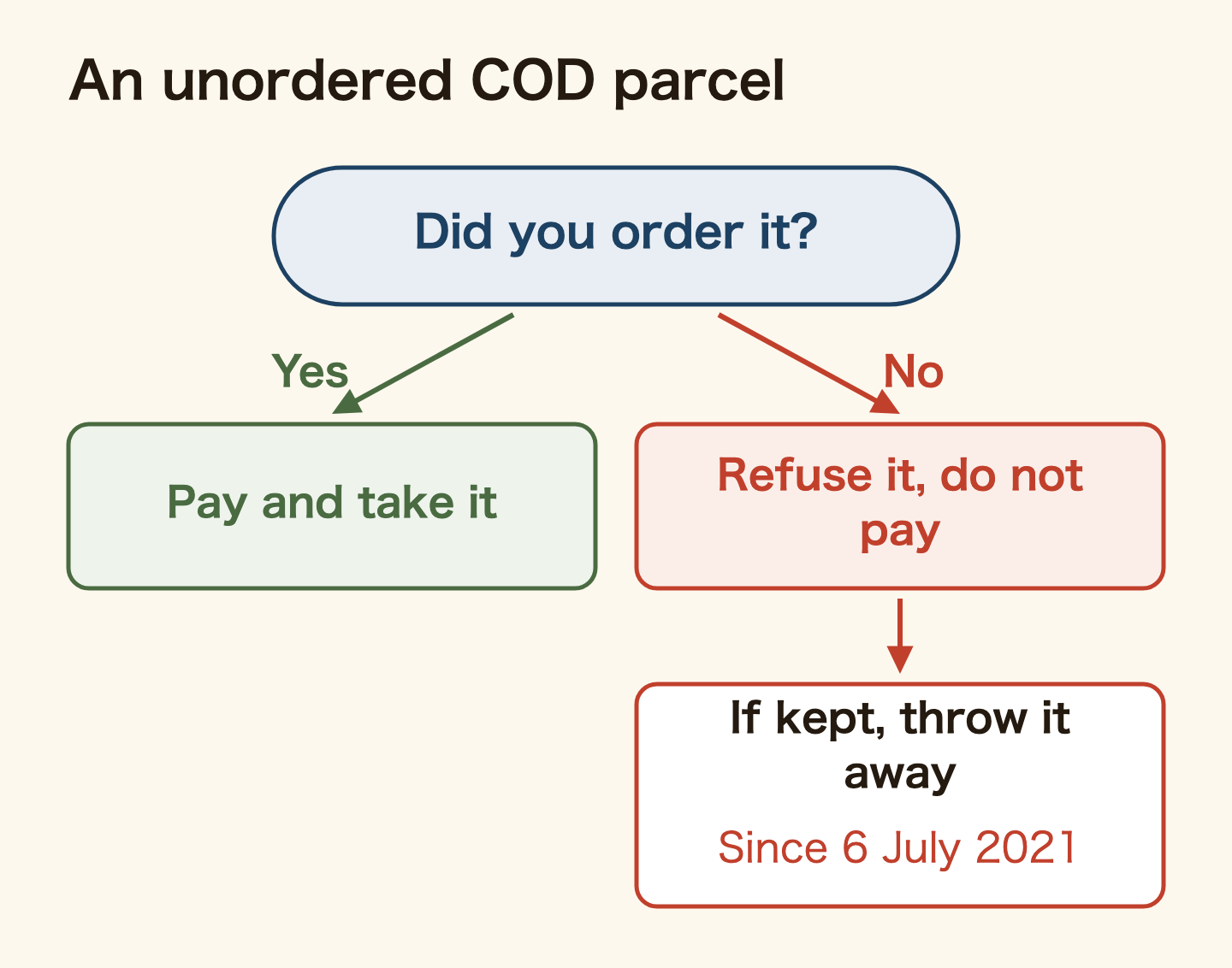
The risk with cash on delivery is a parcel you never ordered. The Consumer Affairs Agency tells people not to accept goods they do not recognise. If you did not order or sign anything, there is no sales contract and you do not have to pay. Since 6 July 2021, goods sent to you one-sidedly can be disposed of immediately. If you are unsure at the door, say “頼んでいません” (I did not order this) and do not take it. For the calls and messages that go after your money, see scams in Japan.
Can you get an ETC card without a credit card? Yes, the ETC Personal Card
Type “no credit card” in Japanese and the first suggestion is ETC. A normal ETC card comes with a credit card. Without one, there is the ETC Personal Card, issued against a deposit.
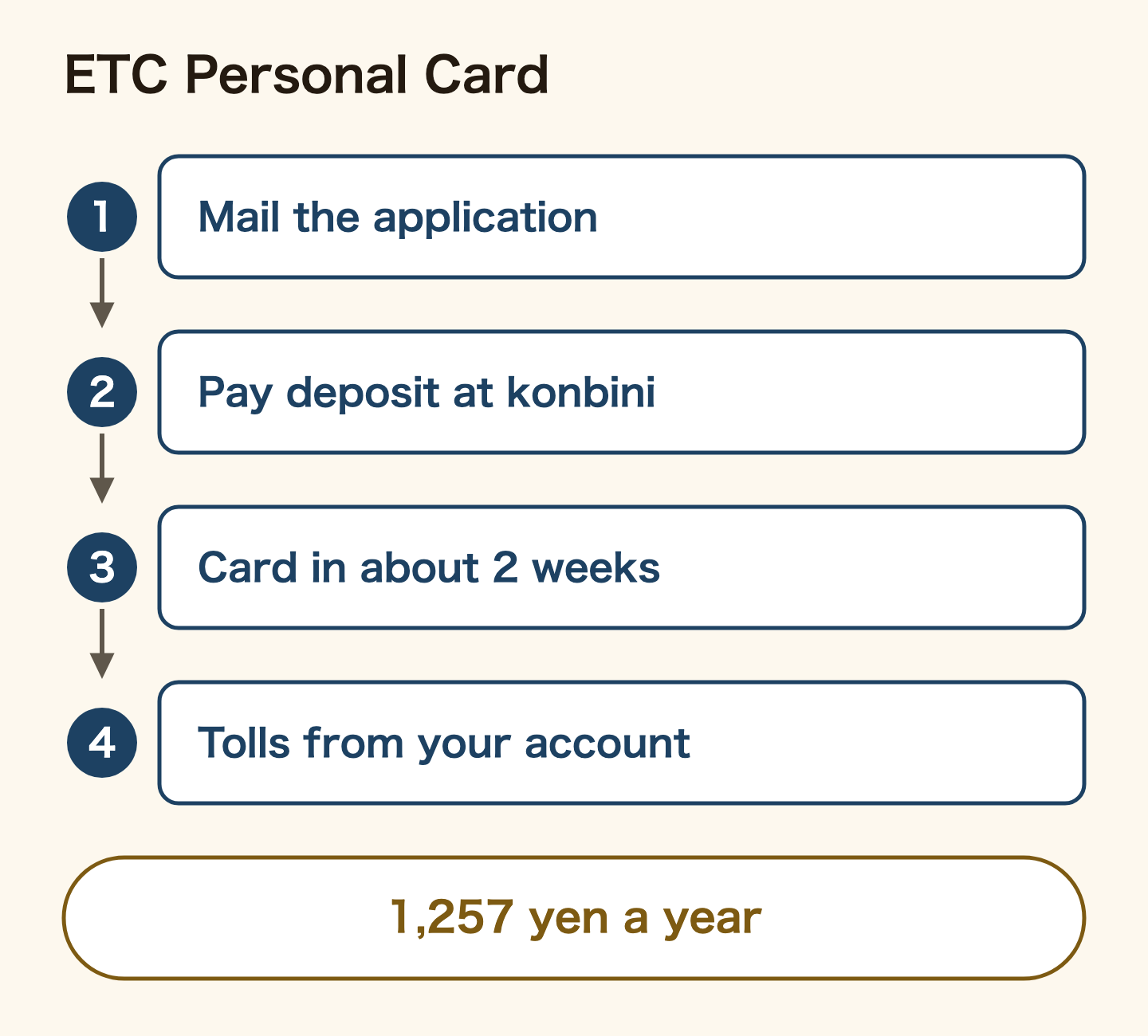
- Make the application form on the website and print it (you can also ask for a paper form by post).
- Mail it with a copy of your ID. Foreign residents attach a copy of the residence card showing the same address as the application.
- Pay the deposit at a convenience store using the payment slip they post to you.
- The card arrives by registered post about two weeks after the deposit is paid.
The annual fee is 1,257 yen including tax. The deposit is not prepaid toll money. Tolls are debited from your account on the 27th of each month, and you can only use up to the deposit amount. The office handles enquiries in Japanese only. Your car also needs an ETC on-board unit.
How much does paying without a card cost? The fees
Card-free payment sometimes adds small fees. These are the ones we confirmed.
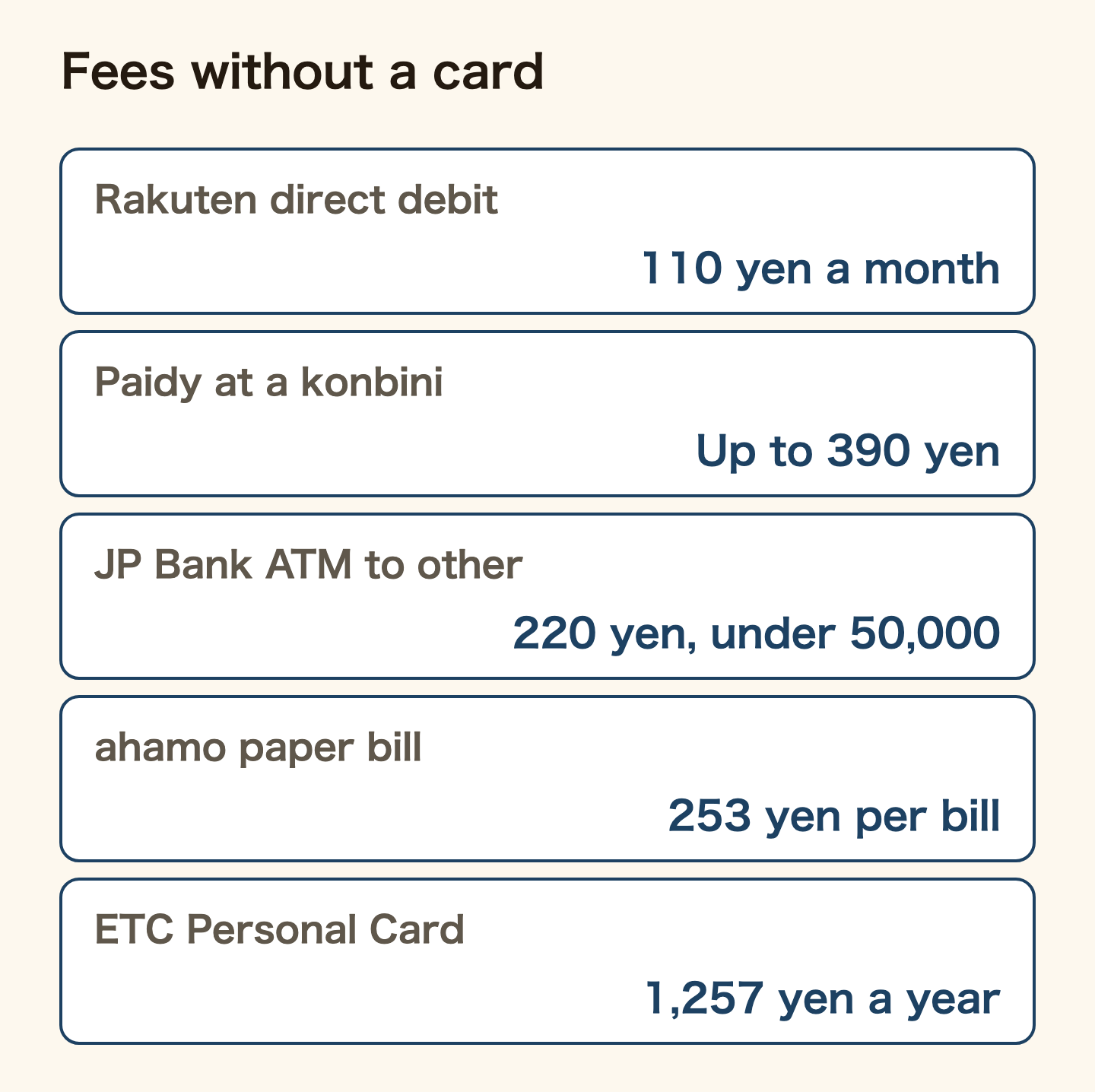
| What | How much |
|---|---|
| Rakuten Mobile direct debit | 110 yen each time the bill is taken |
| povo’s Paidy paid at a konbini | Up to 390 yen (free by direct debit; bank transfer depends on the bank) |
| Transfer from Japan Post Bank to another bank | ATM: 220 yen under 50,000 yen, 440 yen from 50,000 yen / counter: 660 or 880 yen / Yucho Direct: 165 yen |
| Transfer between Japan Post Bank accounts | ATM 100 yen / Yucho Direct and passbook app: free up to 5 times a month |
| ahamo paper bill when direct debit fails | 253 yen per bill |
| Cash on delivery | Differs by shop (check the order screen) |
| ETC Personal Card | 1,257 yen a year plus a deposit |
Japan Post Bank transfers cannot be made in cash. They go from your account. 110 yen a month is 1,320 yen a year, so compare it with companies that charge nothing for direct debit.
What if you cannot pay? From a failed debit to termination, and five years
Your balance was too low and the bill could not be taken. The worst move now is to do nothing.
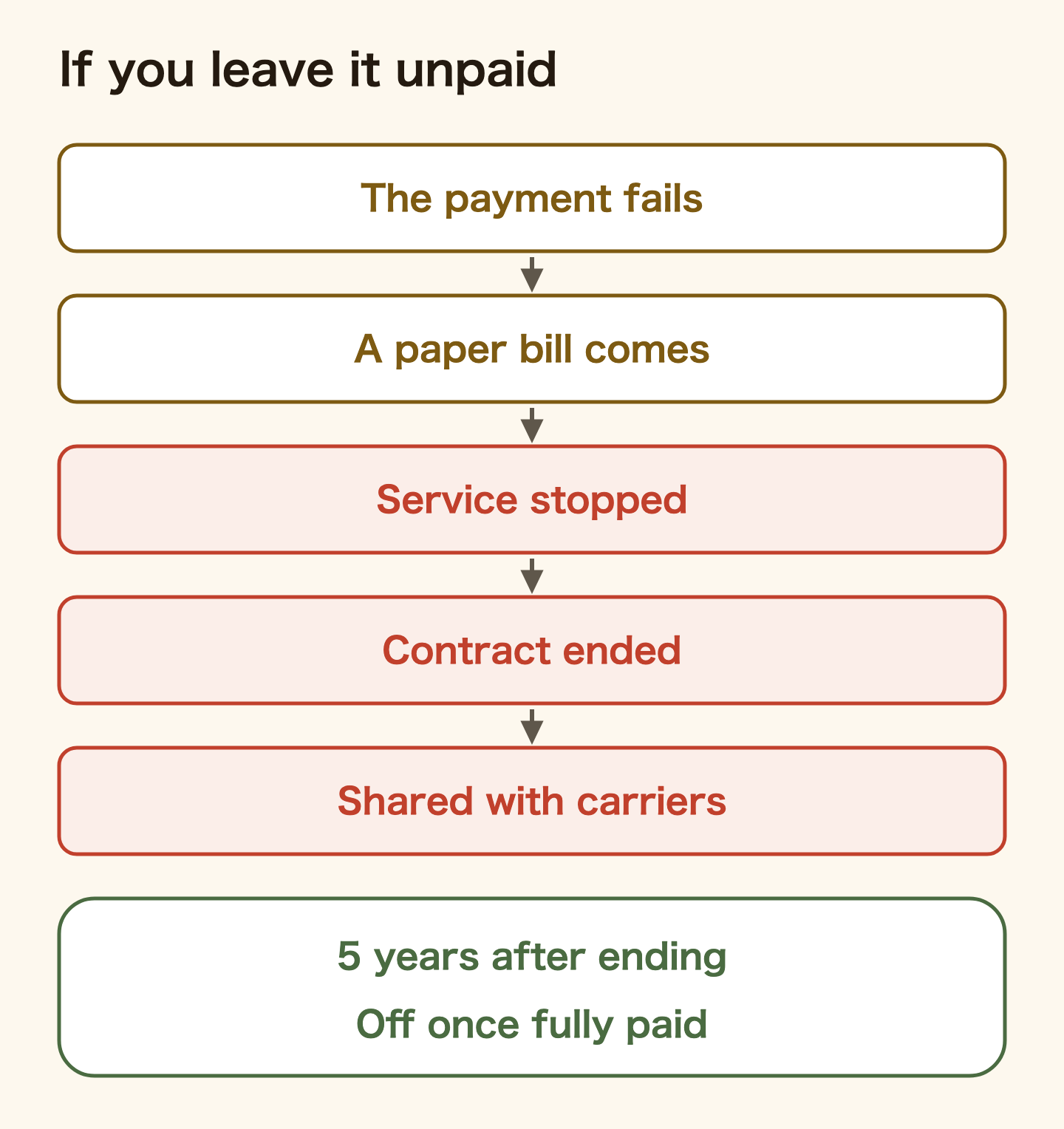
- When the debit fails, the company contacts you or sends a paper bill. ahamo charges 253 yen for each paper bill.
- If you still do not pay, the service is stopped and then the contract is ended. Rakuten Mobile publishes how to pay unpaid charges and the steps up to suspension and termination.
- If money is still owed after the contract ends, mobile carriers exchange that information. According to the Telecommunications Carriers Association, it is shared for up to five years after termination and used when you apply for a new contract.
Once the debt is fully paid, you are no longer included. As soon as you know you cannot pay, contact the company before the paper bill arrives. That is the surest way to protect your next contract. If a payment dispute gets complicated, the consumer hotline 188 connects you to your local consumer centre.
If you are leaving Japan, be careful too. Rakuten Mobile warns that Japanese cards and bank accounts may stop working once your period of stay ends. Decide the order of cancelling your plan and closing your account, so the last bill does not fail.
Which one are you?
- No Japanese bank account yet: start opening one today. Apply for your phone and internet on direct debit once the account is ready.
- A bank account but no credit card: take ahamo or Rakuten Mobile for your phone and UQ WiMAX or SoftBank Air for home internet, on direct debit. Choose cash on delivery for the device and have the cash ready on delivery day.
- Paying monthly bills by debit card: check today that this month’s payment went through. If it was refused, switch to direct debit the same day.
- Only shopping and driving are the problem: use konbini payment on Amazon and pay within three days of getting the number. For ETC, make the Personal Card application form today.
When you are ready for a credit card, read credit cards for foreigners in Japan for the checks to do before you apply.
FAQ
Q. Can I get a phone plan in Japan without a credit card?
Yes. ahamo and Rakuten Mobile let you pay monthly bills by direct debit. povo2.0 does not accept debit cards, but through Paidy you can pay by direct debit, bank transfer or at a konbini.
Q. Can I sign up for ahamo without a credit card?
Yes. ahamo takes direct debit or credit card, and its own FAQ tells people without a credit card to use direct debit. Japan Post Bank accounts are accepted.
Q. Can I get home Wi-Fi without a credit card?
Yes. UQ WiMAX and SoftBank Air accept direct debit for the monthly fee. With UQ WiMAX and Rakuten Turbo, the router cannot be paid by direct debit, so you pay cash on delivery.
Q. Can I pay my phone bill with a debit card in Japan?
It depends on the company and the card. Rakuten Mobile accepts some debit cards and povo2.0 accepts none. Japan Post Bank says its debit card is refused by some merchants, including mobile phone bills and utilities. Direct debit is the reliable option for monthly bills.
Q. Can I shop on Amazon Japan without a credit card?
Yes. You can use konbini payment, ATM payment or a debit card, among others. Konbini payment is due by 23:59 three days after the payment number is issued, and late orders are cancelled automatically. Cash on delivery is not in Amazon’s list of payment methods.
Q. Can I get an ETC card without a credit card?
Yes. The ETC Personal Card is issued against a deposit. The annual fee is 1,257 yen, the card arrives about two weeks after the deposit is paid, and tolls are debited from your bank account each month.
Summary
You can run most of daily life in Japan without a credit card. Phone and internet bills on direct debit, devices by cash on delivery, online shopping by konbini payment or debit card, and the ETC Personal Card for tolls. There is a route for each.
Where people get stuck is paying monthly bills by debit card and missing the konbini deadline. So the first step is simple: open a Japanese bank account and put your monthly contracts on direct debit.
Official sources: ahamo, available cards and bank accounts / ahamo FAQ / Rakuten Mobile, payment methods / Rakuten Mobile, direct debit / Rakuten Turbo, payment methods / povo FAQ / povo, Paidy / UQ WiMAX, payment / SoftBank Air, sign-up flow / Japan Post Bank FAQ / Japan Post Bank, transfer fees / MUFG Bank, Visa debit excluded merchants / Vpreca member terms / Amazon.co.jp help / Japan Post, cash on delivery / Consumer Affairs Agency, unsolicited goods / Act on Specified Commercial Transactions (e-Gov) / ETC Personal Card / Telecommunications Carriers Association, non-payment information (all checked on 30 September 2026). Fees and conditions change, so check each company’s page before you apply.
Related reading
Found this useful? Share it
Send it to a friend who lives in Japan.
WHO WROTE THIS

mori
Japanese. I read the ministries’ own notices, orders and Q&As in the original, and I start from what my Nepalese and Sri Lankan friends in Japan actually ran into. I do not write about what I have not checked or been told.
What this site can and cannot do →Looking for something else?